Space flight, simulators, astronomy, books, flying, music, science, education: whatever the obsession of the moment might happen to be.
Saturday, October 02, 2010
Darrell Scott & A Fine Frenzy
Here are a couple of recent musical discoveries. I've known Darrell Scott from one of his earlier albums ("Real Time," with Tim O'Brien) and from a couple of songs of his recorded by the Dixie Chicks (especially "Long Time Gone" from the Real Time album). But I recently bought his 2010 album "A Crooked Road," which is a real gem. I especially love the title track, so much so that I'm learning it to add to my repertoire of cover songs. The lyrics are great. The live radio performance shown in the video above is a bit different from the album version which has a guitar part in the style of McCartney's "Blackbird," but the live version is easier to play (he's tuned down a half-step in case you want to try it).
The other discovery is a singer-songwriter who calls herself A Fine Frenzy (actually Alison Sudol). She writes gorgeous melodies, and her lyrics and voice are nice too. "One Cell in the Sea" (2007) and "Bomb in a Birdcage" (2009) are both very good albums. She's something like 22 years old.
Monday, September 20, 2010
Carnival of Space #170
I've been a Very Bad Blogger recently. Aside from work and a doggie health crisis, I'm still pretty infatuated with HDTV/Blu-Ray and all the cool stuff streaming through our Netflix "Instant Queue." Things like the 2008 PBS documentary Carrier (10 episodes about the USS Nimitz), In Search of Beethoven, Imagine: John Lennon, and It Might Get Loud (musical conversations with guitarists Jimmy Page, The Edge, and Jack White). Not much space stuff unless you count The Iron Giant (an animated favorite that looks great in HD). I also have the 2009 Sam Rockwell movie Moon in my queue. I saw it once on an airplane and although I didn't love it, I'd like to see it on a bigger screen.
So no wonder there's no time for blogging! But space blogging by other people marches on, as you will quickly see from this week's Carnival of Space #170, hosted by National Geographic's Breaking Orbit blog.
Tuesday, September 07, 2010
JPL Solar System Ambassadors: Sign-up Time
The JPL Solar System Ambassador program is for volunteers (non-NASA employees) who wish to be involved in educational and community outreach related to space exploration. Provided materials (mostly web-based) and telephone briefings tend to be mostly related to JPL programs, but ambassadors are free to define their own presentation subjects and styles. I've been in this program since 2007, and I have really enjoyed doing presentations at schools, libraries, museums, and scouting events. I personally tend to use a lot of simulation software (especially Orbiter and Stellarium) in my presentations, which is purely my choice based on my interests and skills. Other ambassadors may focus more on PowerPoint, video, hands-on activities, and sky observations.
If you live in the United States and are interested in becoming a JPL Solar System Ambassador, September is the only time you can apply, so act now! You certainly don't have to be an engineer, scientist, or teacher, though many ambassadors do have such backgrounds (many are also amateur astronomers). The main thing is that you have an active interest in space exploration and that you enjoy sharing your interests with other people, often but not always children.
Thursday, September 02, 2010
NASA Historical Photo Collection
NASA has a huge collection of photos related to space exploration and history - perhaps too many to conveniently explore considering the many NASA web sites, although there are some "greatest hits" sites such as Great Images in NASA (GRIN). But these days photo galleries are also social media, since people like to share and comment on photos. So NASA has been putting photos out on Flickr (e.g., JWST, JPL, and GSFC). Here's a cool new one, "NASA On the Commons." It's only 180 photos right now, a really random-seeming collection of historical photos, from Freedom 7 to space center construction photos to a "Moon fest" at NASA Ames in 2009. There are also some pre-NASA photos of people for whom NASA centers have been named, including one of my local heroes, Dr. Robert Goddard (GSFC). The one shown here shows Goddard in 1925 with his first liquid-fueled rocket.
Tuesday, August 31, 2010
My Other Car is a Saab?
I'll have to run this by my wife, but it seems like a great deal. We've got a Prius and a Volvo - how about a 1964 Saab in great condition? A mach 2 Saab J35 "Draken" jet interceptor, that is. I saw this in a video news item on Yahoo. It's a sweet ride and an amazing bargain at $175,000 (you can't even get a new Cessna 172 for that) but it is something of a gas guzzler for a Swedish vehicle (about $5000 of jet fuel for 10 minutes of supersonic flight). I'm sure it's much more economical if you stay off the afterburner.
There are also some intermediate hurdles if I'm going to take advantage of this deal. First I'll have to get current on my private pilot certificate (single engine propeller aircraft only) and medical. Then I'd have to get an instrument rating and probably a commercial pilot certificate too. Then I'd have to get some jet training and probably get type certified in a two-seat jet of similar performance (maybe someone in the world has a two seat Draken you can get checked out in - the one for sale in Stockton, CA is a single seater). By the time I do all that, John Travolta will have bought it and flown it home.
Sunday, August 29, 2010
Packing for Mars
When I was ten years old (in 1963), I had a plan for my life. After high school, I would go to the US Air Force Academy, followed by flight training (jets, of course). Later I would go to test pilot school with the ultimate goal of becoming an astronaut. I was too young for Apollo (and for Vietnam as an officer and pilot), but if it had worked out, I would have been an Air Force pilot in the late 70's and astronaut-ready by the mid-80's. The plan fell apart when I was 12 and started to develop severe myopia. The Air Force Academy and flight training wouldn't allow corrective lenses (of course even if I had 20/10 "Yeagervision" there are any number of other things that could have killed my plan, but hey, it was a fun plan while it lasted).
At that time, the idea of space flight represented nothing but sheer excitement, but now that I've read the new book Packing for Mars (by Mary Roach, subtitled "The Curious Science of Life in the Void"), I understand better than ever that the astronaut's life is much more complicated and less enjoyable than you might imagine. Maybe this wasn't the life for me. Of course I knew this at some level from a lot of previous reading about space flight, but with the exception of some astronaut memoirs (especially Mike Mullane's down-and-dirty Riding Rockets), they don't go into much detail on the discomforts and inconveniences of space flight. Mary Roach does, and she does so with a writing style that is informative, colorful, personal, and often downright hilarious. I was laughing out loud at least once in every chapter. Her writing style often reminds me of Bill Bryson. She explains things clearly, but emphasizes quirky details and people. While the situations are often funny, she obviously respects the people and the work they do, so it never comes across as snarky - she's often laughing with the astronauts, cosmonauts, and other space workers.
Of course she covers the required "going to the bathroom in space," but she also covers the psychology of isolation and confinement, general problems of zero-G (including bone loss and vomiting), crash testing (with cadavers!), animal testing, Earth-based mission simulations, hygiene, and the ever-intriguing questions of sex in space. On the latter topic, she isn't able to come up with any hard evidence (sorry) that it has happened, but you can't say her research wasn't thorough. Considering that someone might have "done it" in a zero-G parabolic test flight, she tracks down and watches an obscure porn movie that was rumored to have had one scene shot on such a flight. She uses a fluid dynamics argument (sort of) to conclude that while the scene may have been shot in an airplane, it was not shot in zero-G. Read the book for more. You will also learn some interesting things about dolphin behavior and anatomy, since these marine mammals have to deal with some of the same issues as zero-G astronaut couples might encounter.
The author interviewed astronauts, cosmonauts, and all sorts of researchers, and her field trips included a flight on the "vomit comet" (she didn't vomit, thanks to "good drugs" they give you) and a trip to Devon Island in the Canadian Arctic, where NASA conducts simulated lunar and Mars missions in a remote, desolate, cratered environment that's about as close as you can get to Moon or Mars terrain on Earth. NASA and the US astronauts seemed to be the most "uptight," and the Russian cosmonauts the most frank in describing uncomfortable stuff. One exception was Jim Lovell, who was was unusually open, especially when she asked him about Gemini 7, in which he had spent two bathing-free weeks in the tiny Gemini cabin with Frank Borman, who apparently could be a rather cranky and difficult guy. Lovell proved he was brave enough for Apollo 13 by spending some 23 days in space with Borman (Gemini 7 and Apollo 8 - Borman was sick most of the time on Apollo 8, though it wasn't admitted at the time - so perhaps a bit of crankiness could be forgiven).
I read the Kindle version of the book, and I found it was valuable (and funny) to read most of the footnotes, which required a "click" for each one. Some of the funniest comments are in the footnotes. A very good book, even if you're not especially interested in space.
At that time, the idea of space flight represented nothing but sheer excitement, but now that I've read the new book Packing for Mars (by Mary Roach, subtitled "The Curious Science of Life in the Void"), I understand better than ever that the astronaut's life is much more complicated and less enjoyable than you might imagine. Maybe this wasn't the life for me. Of course I knew this at some level from a lot of previous reading about space flight, but with the exception of some astronaut memoirs (especially Mike Mullane's down-and-dirty Riding Rockets), they don't go into much detail on the discomforts and inconveniences of space flight. Mary Roach does, and she does so with a writing style that is informative, colorful, personal, and often downright hilarious. I was laughing out loud at least once in every chapter. Her writing style often reminds me of Bill Bryson. She explains things clearly, but emphasizes quirky details and people. While the situations are often funny, she obviously respects the people and the work they do, so it never comes across as snarky - she's often laughing with the astronauts, cosmonauts, and other space workers.
Of course she covers the required "going to the bathroom in space," but she also covers the psychology of isolation and confinement, general problems of zero-G (including bone loss and vomiting), crash testing (with cadavers!), animal testing, Earth-based mission simulations, hygiene, and the ever-intriguing questions of sex in space. On the latter topic, she isn't able to come up with any hard evidence (sorry) that it has happened, but you can't say her research wasn't thorough. Considering that someone might have "done it" in a zero-G parabolic test flight, she tracks down and watches an obscure porn movie that was rumored to have had one scene shot on such a flight. She uses a fluid dynamics argument (sort of) to conclude that while the scene may have been shot in an airplane, it was not shot in zero-G. Read the book for more. You will also learn some interesting things about dolphin behavior and anatomy, since these marine mammals have to deal with some of the same issues as zero-G astronaut couples might encounter.
The author interviewed astronauts, cosmonauts, and all sorts of researchers, and her field trips included a flight on the "vomit comet" (she didn't vomit, thanks to "good drugs" they give you) and a trip to Devon Island in the Canadian Arctic, where NASA conducts simulated lunar and Mars missions in a remote, desolate, cratered environment that's about as close as you can get to Moon or Mars terrain on Earth. NASA and the US astronauts seemed to be the most "uptight," and the Russian cosmonauts the most frank in describing uncomfortable stuff. One exception was Jim Lovell, who was was unusually open, especially when she asked him about Gemini 7, in which he had spent two bathing-free weeks in the tiny Gemini cabin with Frank Borman, who apparently could be a rather cranky and difficult guy. Lovell proved he was brave enough for Apollo 13 by spending some 23 days in space with Borman (Gemini 7 and Apollo 8 - Borman was sick most of the time on Apollo 8, though it wasn't admitted at the time - so perhaps a bit of crankiness could be forgiven).
I read the Kindle version of the book, and I found it was valuable (and funny) to read most of the footnotes, which required a "click" for each one. Some of the funniest comments are in the footnotes. A very good book, even if you're not especially interested in space.
More HD Space Exploration
I'm still infatuated with HDTV, Blu-Ray, and streaming high quality movies over the internet. I'm not planning to buy a lot of Blu-Ray discs since there is so much content available on cable and online (not to mention a lot of DVD's I own that now look substantially better). But I did want to have a few "demo discs" including a couple of space-related ones.
One that I bought was "For All Mankind," a 1989 theatrical-release documentary that collects many of the best segments of NASA film from the Apollo era into a single "meta-moon-mission." As director Al Reinert explains in the making-of feature, all the Apollo missions pretty much followed the same script, so why not use the best film from each mission? He even went as far as to use some Gemini footage (mainly Ed White's EVA) because it was just gorgeous, in part because the Gemini missions' earth orbits were much higher than the Apollo, shuttle, or ISS orbits, so you could get a much better sense of the roundness of our planet. He also used some of NASA's "engineering film" including the famous shot of Saturn V stage separation shot from the separating boosters. Since these were film cameras, the film had to be recovered, which was quite a trick. Each camera would eject its film canister housed in a small re-entry vehicle equipped with parachutes and a radio homing beacon. On-station USAF C-130's with special aerial recovery equipment would home on these beacons and snatch the parachutes from the air (a technique that had been developed to recover Corona "spy satellite" film in the early 60's). The narration consists mainly of comments by the Apollo astronauts, recorded by Reinert in audio-only interviews. The Blu-Ray transfer is awesome - it was probably 16 mm film in most cases, but the quality is quite impressive, especially in the scenes of lunar rendezvous with the LM silhouetted against the lunar surface.
I also watched the new Blu-Ray copy of 2001: A Space Odyssey, much of it with the audio commentary by actors Keir Dullea and Gary Lockwood. The film-like quality of the 1080p display is gorgeous and highlights Kubrick's great attention to detail in every aspect of this film. The spacecraft models are amazing. Dullea did some of his own stunts in this film, and he talks about one scene that was just wild, entering the emergency hatch when HAL famously refuses to open the pod-bay doors (here's a three-minute clip of the scene). In his haste to try to save "Frank," "Dave" had forgotten his helmet and gloves, making an EVA into the emergency airlock just a bit dicey.
The pod's door and outer airlock door were on the ceiling of a two-story set, with Dullea falling toward the camera positioned on the inner airlock door (on the floor) when he was supposedly ejected from the pod by pressurized air (this was why a stunt double wasn't used - his face was rushing towards the camera). He was suspended by a heavy rope, the other end of which was handled by a circus trapeze performer who weighed more than Dullea (a critical point). There were knots in the rope to signal the stopping points, and when the first knot reached him, the circus guy stopped the rope (preventing Dullea's face from impacting the camera) and then jumped off a platform with the rope attached to his foot, using his weight to suddenly yank Dullea back toward the outer airlock door (and ceiling of the set!) where he could use the emergency airlock close handle. It was done in one take, and it really looks like this takes place in zero-G. Dullea must have had total faith in Kubrick and that circus performer! An amazing scene in an amazing movie.
One that I bought was "For All Mankind," a 1989 theatrical-release documentary that collects many of the best segments of NASA film from the Apollo era into a single "meta-moon-mission." As director Al Reinert explains in the making-of feature, all the Apollo missions pretty much followed the same script, so why not use the best film from each mission? He even went as far as to use some Gemini footage (mainly Ed White's EVA) because it was just gorgeous, in part because the Gemini missions' earth orbits were much higher than the Apollo, shuttle, or ISS orbits, so you could get a much better sense of the roundness of our planet. He also used some of NASA's "engineering film" including the famous shot of Saturn V stage separation shot from the separating boosters. Since these were film cameras, the film had to be recovered, which was quite a trick. Each camera would eject its film canister housed in a small re-entry vehicle equipped with parachutes and a radio homing beacon. On-station USAF C-130's with special aerial recovery equipment would home on these beacons and snatch the parachutes from the air (a technique that had been developed to recover Corona "spy satellite" film in the early 60's). The narration consists mainly of comments by the Apollo astronauts, recorded by Reinert in audio-only interviews. The Blu-Ray transfer is awesome - it was probably 16 mm film in most cases, but the quality is quite impressive, especially in the scenes of lunar rendezvous with the LM silhouetted against the lunar surface.
I also watched the new Blu-Ray copy of 2001: A Space Odyssey, much of it with the audio commentary by actors Keir Dullea and Gary Lockwood. The film-like quality of the 1080p display is gorgeous and highlights Kubrick's great attention to detail in every aspect of this film. The spacecraft models are amazing. Dullea did some of his own stunts in this film, and he talks about one scene that was just wild, entering the emergency hatch when HAL famously refuses to open the pod-bay doors (here's a three-minute clip of the scene). In his haste to try to save "Frank," "Dave" had forgotten his helmet and gloves, making an EVA into the emergency airlock just a bit dicey.
The pod's door and outer airlock door were on the ceiling of a two-story set, with Dullea falling toward the camera positioned on the inner airlock door (on the floor) when he was supposedly ejected from the pod by pressurized air (this was why a stunt double wasn't used - his face was rushing towards the camera). He was suspended by a heavy rope, the other end of which was handled by a circus trapeze performer who weighed more than Dullea (a critical point). There were knots in the rope to signal the stopping points, and when the first knot reached him, the circus guy stopped the rope (preventing Dullea's face from impacting the camera) and then jumped off a platform with the rope attached to his foot, using his weight to suddenly yank Dullea back toward the outer airlock door (and ceiling of the set!) where he could use the emergency airlock close handle. It was done in one take, and it really looks like this takes place in zero-G. Dullea must have had total faith in Kubrick and that circus performer! An amazing scene in an amazing movie.
Saturday, August 28, 2010
U2 and NASA, Space 2009
This very cool video showed up today in an email update from Space-Multimedia. I'm something of a U2 fan (I saw them live once, back in 1994), but I didn't realize that they had cooperated with NASA for some events during their 2009 tour, including live video feeds with ISS astronauts and with "space tourist" Guy Laliberté (founder of Cirque du Soleil and "the first clown in space," as Bono calls him).
Sunday, August 22, 2010
Apollo 13 Revisited
My first HDTV and Blu-Ray player provided the (de?)motivation for a lazy, movie-watching weekend. I had to try out all the different parts of my new toys, including a WiFi connection that allows access to various internet-based services, some free (Pandora internet radio, YouTube), some not free (Netflix, Amazon Video On Demand). I ordered a Blu-Ray copy of 2001: A Space Odyssey from Amazon (mostly because it was only $8.99), but it won't arrive until next week. In the meantime, Amazon provides a free VOD rental of the film, but unfortunately not the HD version. I watched a little to see how the WiFi connection would work (quite well), but decided to wait for the Blu-Ray disc to watch the whole thing later this week. I've bought 2001 on VHS and DVD and now Blu-Ray. It's a space classic and a home video test case, I guess. With Blu-Ray and a 42 inch 1080p screen, it may start to approach the original movie experience of 1968 (which I barely remember, though I know I made my mother take me to see it).
The one BD that I bought and received so far is a BBC nature show, Nature's Most Amazing Events, and the action, scenery, cinematography, and visual quality did not disappoint. The new Blu-Ray player also does a nice job "upconverting" DVD's so I watched a couple of old favorites, Memphis Belle and Apollo 13. I have the 2-disc anniversary edition of Apollo 13, but for some reason I had never watched the making-of special or listened to Jim and Marilyn Lovell's commentary, both great. I really love that movie, both for the many authentic details of the Apollo era and for the emotional intensity. 13 was to be the fifth manned lunar voyage and the third landing, and the public and the media in 1970 had already come to think of it as routine (e.g., the networks didn't interrupt prime time to televise the crew's live color TV "en route to the moon" broadcast - that was so 1969!). But of course the oxygen tank explosion soon made it anything but routine, and the drama of three astronauts' lives hanging by a thread in the "LM lifeboat" captured the world's attention for almost a week. Riveting stuff even though you know the ending.
The making-of special shows what a great combination Tom Hanks and Ron Howard were for this film. Hanks was a space fanatic and astronaut wannabe. Howard wasn't so much, but he is a fanatic for detail and authenticity (technical and emotional) in all of his films. The fact that they were able to get NASA's cooperation to film parts of the film in sets installed in the KC-135 "vomit comet" was an amazing coup and added tremendously to the you-are-there feeling. All that filming had to be done in 30 second segments as the zero-G training jet flew parabolas over and over. All of the "whole body" shots were done this way, but in many scenes where only the actors' heads or torsos were visible, they had to mime the zero-G effects by swaying their bodies to simulate it. It all looks real to me!
I'm sure I will quickly recalibrate my technology "normal meter" so in a couple of weeks, HDTV will just be routine, and I'll go back to not watching much TV. This happens with all technology (except the iPod Touch - I use it extensively every day, and it still amazes me). But I'm glad it's giving me a reason to revisit some space favorites like Apollo 13 and 2001.
The one BD that I bought and received so far is a BBC nature show, Nature's Most Amazing Events, and the action, scenery, cinematography, and visual quality did not disappoint. The new Blu-Ray player also does a nice job "upconverting" DVD's so I watched a couple of old favorites, Memphis Belle and Apollo 13. I have the 2-disc anniversary edition of Apollo 13, but for some reason I had never watched the making-of special or listened to Jim and Marilyn Lovell's commentary, both great. I really love that movie, both for the many authentic details of the Apollo era and for the emotional intensity. 13 was to be the fifth manned lunar voyage and the third landing, and the public and the media in 1970 had already come to think of it as routine (e.g., the networks didn't interrupt prime time to televise the crew's live color TV "en route to the moon" broadcast - that was so 1969!). But of course the oxygen tank explosion soon made it anything but routine, and the drama of three astronauts' lives hanging by a thread in the "LM lifeboat" captured the world's attention for almost a week. Riveting stuff even though you know the ending.
The making-of special shows what a great combination Tom Hanks and Ron Howard were for this film. Hanks was a space fanatic and astronaut wannabe. Howard wasn't so much, but he is a fanatic for detail and authenticity (technical and emotional) in all of his films. The fact that they were able to get NASA's cooperation to film parts of the film in sets installed in the KC-135 "vomit comet" was an amazing coup and added tremendously to the you-are-there feeling. All that filming had to be done in 30 second segments as the zero-G training jet flew parabolas over and over. All of the "whole body" shots were done this way, but in many scenes where only the actors' heads or torsos were visible, they had to mime the zero-G effects by swaying their bodies to simulate it. It all looks real to me!
I'm sure I will quickly recalibrate my technology "normal meter" so in a couple of weeks, HDTV will just be routine, and I'll go back to not watching much TV. This happens with all technology (except the iPod Touch - I use it extensively every day, and it still amazes me). But I'm glad it's giving me a reason to revisit some space favorites like Apollo 13 and 2001.
Tuesday, August 10, 2010
Space Models!
The moon landings were not faked, but if they were, this guy could have been one of the model builders. OK, maybe not (he says he was only 10 in 1968, and he's French), but he has built some pretty nice space models. I don't know exactly how I found his site, but it's got some pretty amazing stuff. I was an avid model builder in my youth (from maybe age 8 to 15), focused mainly on military aircraft, though I did build a few space models too (long since gone - I remember an especially nice Saturn V and a very large Gemini, possibly the original version of this Revell 1/24 scale model). I was pretty good for a kid modeler, though I didn't have the patience to do really fine painting or to custom-build special details. I pretty much built and painted according to the instructions.
I haven't looked at all the models on M. Meens' web site, but my favorite has to be his recently completed 1/24 scale model of the Lunar Module ascent stage shown above and at left. This thing is a work of art - just beautiful. He has quite a few photos showing the fine detail, but my favorite is the cutaway view shown above. I have seen many illustrations and 3D representations of the LM over the years, including the real full-size one (exterior view only, below right) at the National Air & Space Museum in Washington.
I've also seen life size cutaway mock-ups of the LM flight deck (at KSC and other places) and I've spent hours in the the 3D virtual cockpit of the AMSO LM in Orbiter (flying simulated moon landings, of course). But this two-section view of this 1/24 scale model gives the best impression I've ever felt of the nature and size of the tiny LM cockpit. Very cool.
The web site also includes some models and drawings of the Soviet N1-L3 moon rocket (which failed in all tests). The models (N1 vs. Saturn V) are great and at one time were on display at Cite de l'Espace in Toulouse, which I recently visited (I didn't see them). In addition, there is a beautifully drawn (by Serge Gracieux of Cite de l'Espace) set of "story board" images depicting what the Soviet N1-L3 moon landing mission would have been like if it had succeeded in 1969. The mission had some similarities to Apollo, but only cosmonaut would have landed the "LK" on the moon (shown above), while one other would have remained in lunar orbit until the ascent section of the lander rendezvoused for return to Earth. There were no docking ports planned, so the landing cosmonaut would have to transfer to and from the LK by EVA.
UPDATE: This video is from a Japanese modeler who did a superb customized job building a 1965 Revell 1/24 scale Gemini Spacecraft (the one I had back in the 60's). The video starts with some space scenes with the Apollo 8 transmission of Genesis (December 1968), and a series of stills showing the model building procedure starts around 0:34. The gold foil on the back end of equipment module (from a candy bar wrapper!) is an especially nice touch. Finished model shown below. Very impressive.
I haven't looked at all the models on M. Meens' web site, but my favorite has to be his recently completed 1/24 scale model of the Lunar Module ascent stage shown above and at left. This thing is a work of art - just beautiful. He has quite a few photos showing the fine detail, but my favorite is the cutaway view shown above. I have seen many illustrations and 3D representations of the LM over the years, including the real full-size one (exterior view only, below right) at the National Air & Space Museum in Washington.
I've also seen life size cutaway mock-ups of the LM flight deck (at KSC and other places) and I've spent hours in the the 3D virtual cockpit of the AMSO LM in Orbiter (flying simulated moon landings, of course). But this two-section view of this 1/24 scale model gives the best impression I've ever felt of the nature and size of the tiny LM cockpit. Very cool.
The web site also includes some models and drawings of the Soviet N1-L3 moon rocket (which failed in all tests). The models (N1 vs. Saturn V) are great and at one time were on display at Cite de l'Espace in Toulouse, which I recently visited (I didn't see them). In addition, there is a beautifully drawn (by Serge Gracieux of Cite de l'Espace) set of "story board" images depicting what the Soviet N1-L3 moon landing mission would have been like if it had succeeded in 1969. The mission had some similarities to Apollo, but only cosmonaut would have landed the "LK" on the moon (shown above), while one other would have remained in lunar orbit until the ascent section of the lander rendezvoused for return to Earth. There were no docking ports planned, so the landing cosmonaut would have to transfer to and from the LK by EVA.
UPDATE: This video is from a Japanese modeler who did a superb customized job building a 1965 Revell 1/24 scale Gemini Spacecraft (the one I had back in the 60's). The video starts with some space scenes with the Apollo 8 transmission of Genesis (December 1968), and a series of stills showing the model building procedure starts around 0:34. The gold foil on the back end of equipment module (from a candy bar wrapper!) is an especially nice touch. Finished model shown below. Very impressive.
Monday, August 02, 2010
Why Moon Landings Were Not Faked
I found this brief video clip through a Universe Today post from last week, but I just love it, so I have to post it here too. It's one of the few "space related" things that I find myself sharing widely with "civilians" (i.e., friends and relatives who care nothing about space, also called "normal people"). And it's just so funny, I've watched it five or six times myself.
Admittedly this video is more about humor than space, but it does address something that has always puzzled me about moon landing conspiracy "theorists." Between 1962 and 1972, NASA's budget totaled about $260 billion (in 2007 dollars). Much of that was spent on the Apollo program, ostensibly to send astronauts into Earth orbit (11 times, since all the moon missions first orbited the Earth) and later to the moon (nine times with six successful landings - the others were the two planned orbital missions and Apollo 13 which flew once around the moon and back to Earth). According to Moon hoax fans, if this money was spent at all, it was spent on faking the moon landings through an elaborate conspiracy involving thousands of government and contractor employees. These people supposedly built a lot of real-looking but non-functional hardware (plenty of civilians saw the hardware) and applied amazingly advanced special effects technology to produce thousands of photographs as well as many hours of film footage, video, and audio recordings (including radio transmissions that seemed to come from the moon - though of course NASA also controlled the tracking antennas, so who knows?). They also produced a lot of scientific data and a few hundred kilograms of "moon rocks" (which could have come from Hawaii or someplace, right?).
That's all well and good, the joke's on us and all, but what about the Saturn V rockets? Thousands of people witnessed the launch of thirteen gigantic rockets in Florida from 1967 to 1973. Flames came out, loud noises, something went into the sky. Where did they go (some did go only into Earth orbit for tests and to launch the Skylab space station in 1973)? Well maybe the conspiracy people will allow that NASA can put things into Earth orbit. Are they still up there? Did they burn up and reenter the Earth's atmosphere? Wouldn't someone have noticed this? Or did they go to the moon, but without astronauts? Was NASA good enough to do that, but not to land and return the astronauts?
It's all so ridiculous, of course, and if you are in the conspiracy frame of mind, you can always come up with additional things that could have been faked to conceal the other fakes. But why thirteen Saturn V's? And why six "faked" landings (plus Apollo 13 which was aborted)? Why not just launch two or three Saturn V's (to prove you're testing them, of course) and then one successful faked landing? Then declare "mission accomplished, JFK honored, Soviets beaten" and spend the rest of the money on planes and bombs for Vietnam?
Recently the Lunar Reconnaissance Orbiter has sent back pictures of the Apollo landing sites. But who controls LRO? NASA of course. No doubt the conspiracy continues to this day. And there is no way to convince the conspiracy faithful, of course. But we can have a good laugh about it once in a while, as with the video that triggered this whole rant!
Wednesday, July 28, 2010
When Ideas Have Sex
Following up on my July 5 post reviewing Matt Ridley's book Rational Optimism, here's a 17 minute TED talk in which Mr. Ridley presents the gist of his ideas on the importance of "exchange" (of goods, services, and ideas) in the development of the "collective brain" we call human civilization. Very nicely done.
Wednesday, July 14, 2010
The Future Is Creeping Up On Us
Recently the New York Times has been running a special series of articles called "Smarter Than You Think" (a series examining the recent advances in artificial intelligence and robotics and their potential impact on society). Machines are starting to take some real giant steps. I've always been interested in AI and even considered making a career change in the mid-eighties when "expert systems" were making a splash. Fortunately I stayed with optics, because AI per se never became an industry or a field of its own outside of research labs. Which is not to say that there hasn't been progress in AI - just that people kept moving the bar. Things that used to be considered nearly impossible for machines (like speech recognition) were developed and folded into software engineering. In other words, if machines are doing it, it ain't intelligent. AI stays just over the horizon.
So beating grand masters at chess? That's been done by an IBM supercomputer with a lot of special programming and coaching. So it's not AI, just brute force. But what if a few of those IBM supercomputers got together and started to compete with humans on the game show Jeopardy, with its wide-ranging subject matter and tricky word-play clues? That would be impressive, right? Well, according to the first article in the series, it's still more or less brute force, though when the software is playing Jeopardy in real time, with no internet connection (but with a huge local database of "general knowledge") and often beating human champions of the show, that seems pretty smart to me no matter what sort of statistical inferencing, data mining, or number crunching is going on behind the scenes (things are pretty messy up in our own "wetware" too). There may be a televised human vs. AI Jeopardy tournament later this year.
Of course Jeopardy is still pretty narrow, and the bar keeps moving. Speech recognition is good enough for many customer service tasks now, but still nowhere near humans in flexibility and generality. But it's getting better, even if "Bina48" comes across as something of a whack job in her (its?) interview. There are robots designed be cuddly and emotionally supportive (they look like baby seals). There are robots who are learning to be teachers. It's all pretty mind-boggling even if you've read a lot of SF and future-looking non-fiction.
There's also ASIMO, Honda's experimental humanoid robot, shown in the video above. A cute little robot kid who can walk, climb stairs, and even run (I saw a demonstration at Disneyland back in February - really impressive, especially the stairs). Honda has been working on this bipedal robot assistant for some 20 years and it's not ready for the general home quite yet - but it's getting closer. I'm really more optimistic than creeped out by the growing robot population. I think they will ultimately lead to better lives for many humans, though as with any technology, they will also displace some humans' jobs along the way. We really need to work on that.
And I haven't even mentioned NASA's Robonaut who will soon be living on the ISS. More on that another time...
Sunday, July 11, 2010
Pocket Solar System
There are a number of great astronomy and space apps for the iPhone and iPod Touch, and I've discussed some of them here before. I just got a new one called Solar Walk - 3D Solar System (it's "3D" because it actually supports red/green 3D glasses for some images, though I didn't find this to be very exciting on the iPod Touch). Although it's easy to tool around the solar system in Orbiter (free space flight simulator for Windows), Solar Walk is available in my pocket and is better for certain "big picture" questions about the solar system.
Case in point: the recent prominent alignment of Venus, Mars, and Saturn in the early evening western sky. Here's a screen shot from Star Map on the iPod Touch showing their positions this evening around 19:40 local time:
Why are they showing up that way? If you launch Solar Walk and touch the little orbital diagram icon, you can pull up an interactive "orrery" that shows the correct relative positions of the planets in their orbits for any given date and time. Here it is for this evening at about the same time as the above sky shot:
So you can see how this apparent alignment occurs from the positions of Venus, Mars, and Saturn in their orbits (of course the sizes of the planets and orbits in this diagram view are not correct - they need to be visible on the small display - but the angular positions are correct). Solar Walk also lets you zoom in on the planets and their moons - enough to see the main features of each planet, though not very close up. There is also a fair amount of information on each body and on the spacecraft that have visited it as in this screen about Saturn:
There's nothing right now on dwarf planets and asteroids, but what it has is really useful for understanding and explaining what is happening with the main members of our solar system.
Case in point: the recent prominent alignment of Venus, Mars, and Saturn in the early evening western sky. Here's a screen shot from Star Map on the iPod Touch showing their positions this evening around 19:40 local time:
Why are they showing up that way? If you launch Solar Walk and touch the little orbital diagram icon, you can pull up an interactive "orrery" that shows the correct relative positions of the planets in their orbits for any given date and time. Here it is for this evening at about the same time as the above sky shot:
So you can see how this apparent alignment occurs from the positions of Venus, Mars, and Saturn in their orbits (of course the sizes of the planets and orbits in this diagram view are not correct - they need to be visible on the small display - but the angular positions are correct). Solar Walk also lets you zoom in on the planets and their moons - enough to see the main features of each planet, though not very close up. There is also a fair amount of information on each body and on the spacecraft that have visited it as in this screen about Saturn:
There's nothing right now on dwarf planets and asteroids, but what it has is really useful for understanding and explaining what is happening with the main members of our solar system.
Labels:
astronomy,
education,
solar system,
technology
Saturday, July 10, 2010
Sweet, Rosetta!
ESA's Rosetta spacecraft today made its closest approach to the asteroid 21 Lutetia and ESA has posted some high-res images but so far no captions. I think this one with Saturn in the distance is very cool. I played around a bit with a cool Rosetta add-on for Orbiter back in 2007 and 2008. The screen shot below shows an unrealistically close simulated pass (43 km!) of asteroid Steins which actually took place in 2008. Steins is located in the main asteroid belt between the orbits of Mars and Jupiter, as is Lutetia, but Lutetia is a much bigger asteroid, about 100 km in diameter, the largest one yet to be visited by a spacecraft. The Steins encounter took place during Rosetta’s first incursion into the main asteroid belt while on its way to visit Comet 67P/Churyumov-Gerasimenko. You could certainly say that Rosetta gets around.
Two Amazing Albums

I stumbled on two amazing albums recently, Broken Bells and "Gorilla Manor" by Local Natives. They are similar in that they are "alternative rock" (whatever that is) with excellent (and eclectic) songwriting, cool arrangements, and great vocals. Both were MP3 specials on Amazon (Broken Bells for $5, Local Natives for $2.99 as the MP3 Daily Deal on July 7). I hear so many connections in this music - with echoes of the 60's, the Police, Peter Gabriel, the Shins, and much more. The Shins reference is not coincidental in the case of Broken Bells since it is a collaboration between "Danger Mouse" (of Gorillaz and many other projects) and James Mercer, singer/guitarist for the Shins.
Great stuff. I've had these two on continuous shuffle on my iPod for the last few days. My favorite Broken Bells songs are "Mongrel Heart" and "The Ghost Inside." Top two for Local Natives would be "Wide Eyes" and the wonderful "Sun Hands" - I just love that song.
Space Carnivals 160 & 161
I've missed a lot of space carnivals in the last few busy months. But I'm starting to catch up and to even write and submit some space-related posts again. Carnival 160 launched on June 27 at David Portree's Beyond Apollo blog. Carnival 161 arrived on July 8 in two versions: traditional text and YouTube video (embedded here). Nice job by Habitation Intention!
Monday, July 05, 2010
Dare to be an optimist!
This is a little embarrassing, but right now, right in front of you, millions of ideas are having sex. They might be having it right inside this blog. I know, freaky, right? According to author Matt Ridley, the secret of humans' success is exchange, and while trade in physical objects is a big part of that, the exchange of ideas is really the thing that has kept this whole civilization thing moving forward for the last 10,000 years or so, and especially in the last 200 years. And when it comes to ideas having sex, the Internet is the ultimate "swingers' club."
Ridley's book The Rational Optimist: How Prosperity Evolves is quite a bit more serious than that first paragraph makes it sound, but it does describe a key point. He says, "Without trade, innovation just does not happen. Exchange is to technology as sex is to evolution. It stimulates novelty." Another key thing that exchange and trade allow is specialization. Self-sufficiency sounds good in theory (and in practice if you are in a basic survival situation), but when it comes to growth, prosperity, and happiness (all closely linked), specialization means more of everything for everybody. If multiple people in a community have different skills and products, and if exchange is allowed, everyone has the potential to benefit from the knowledge and output of everyone else. Ideas are especially valuable in part because sharing an idea is like lighting a candle for someone else - now you both have a lighted candle (or an idea of how to do something better). When knowledge is shared in a community, it becomes something like a "collective brain." And when the community expands to include the entire world, interconnected by vast transportation networks and with the Internet as its central nervous system, you can have the wild orgy of exchange of ideas, goods, and services that we call the modern world.
Ridley spends most of the book in a chronological journey through the development of civilization, from the first inklings of exchange and specialization some 200,000 years ago (when we really diverged from other species including our close cousins the apes), through expanded barter systems, to the development of agriculture some 10,000 years ago. Of course climate stability had a lot to do with that as well, but an interesting point is that trade is what really made agriculture interesting and worthwhile. There was also the development of energy sources, from human power (including slavery, unfortunately), to animal power, to various forms of "current solar" energy (water power, wind power, burning wood, etc.), to various forms of "stored solar" (coal, oil, natural gas). There are more steps, but it's clear that the modern world is based to a great extent on exchange and specialization, including free trade and the free exchange of ideas. These have in turn produced a wide range of innovations in social systems and technology and led to the astounding prosperity that most (but of course not all) people in the world enjoy today. Ridley points out that while Louis XIV used some 498 servants to prepare his meals, a modern person of average means has many more people working for him or her (mostly indirectly and on a shared basis) to make easily available food, clothing, medicines, transportation, entertainment, and everything else that we take for granted in modern life. In this sense the average person today is richer than a king in the seventeenth century.
But if things are so great and getting better all the time, why are so many people so pessimistic about the present and the future? Ridley doesn't have a good explanation for this, though he knows he's fighting from a minority position (optimists must be naive!), and he shows that it has always been so. People were fretting over "peak coal" in 1830, and convinced that things had improved so much in the previous half century that there could be no place to go but down. But of course the rest of the nineteenth century was in fact a golden age of technological and social development. Things like slavery and child labor declined not so much because people became nicer, but because energy sources and manufacturing methods made them less necessary (or you could say affordable to give up).
The Rational Optimist is not really an ideological work. While there is a strong sense that Ridley believes that markets generally work better than governments (especially corrupt governments like many in Africa), he's not saying that governments are not necessary. He's certainly a strong proponent for free trade and individual rights, which are strongly correlated with a sense of well-being or "happiness." He also believes that things will continue to get better, even for Africa, as long as we keep moving forward in terms of trade and openness. Although anything can happen including terrorism, crazy governments, natural disasters, etc., his optimism is based on considerations of history and of how things really work (and especially on how resourceful people are), not on wishful thinking or on some belief that prosperity is humanity's right or destiny. It's more or less what we do.
I personally tend toward optimism myself, and this book has given me a lot to think about including many reasons for optimism that I hadn't thought about before. I highly recommend this book.
Ridley's book The Rational Optimist: How Prosperity Evolves is quite a bit more serious than that first paragraph makes it sound, but it does describe a key point. He says, "Without trade, innovation just does not happen. Exchange is to technology as sex is to evolution. It stimulates novelty." Another key thing that exchange and trade allow is specialization. Self-sufficiency sounds good in theory (and in practice if you are in a basic survival situation), but when it comes to growth, prosperity, and happiness (all closely linked), specialization means more of everything for everybody. If multiple people in a community have different skills and products, and if exchange is allowed, everyone has the potential to benefit from the knowledge and output of everyone else. Ideas are especially valuable in part because sharing an idea is like lighting a candle for someone else - now you both have a lighted candle (or an idea of how to do something better). When knowledge is shared in a community, it becomes something like a "collective brain." And when the community expands to include the entire world, interconnected by vast transportation networks and with the Internet as its central nervous system, you can have the wild orgy of exchange of ideas, goods, and services that we call the modern world.
Ridley spends most of the book in a chronological journey through the development of civilization, from the first inklings of exchange and specialization some 200,000 years ago (when we really diverged from other species including our close cousins the apes), through expanded barter systems, to the development of agriculture some 10,000 years ago. Of course climate stability had a lot to do with that as well, but an interesting point is that trade is what really made agriculture interesting and worthwhile. There was also the development of energy sources, from human power (including slavery, unfortunately), to animal power, to various forms of "current solar" energy (water power, wind power, burning wood, etc.), to various forms of "stored solar" (coal, oil, natural gas). There are more steps, but it's clear that the modern world is based to a great extent on exchange and specialization, including free trade and the free exchange of ideas. These have in turn produced a wide range of innovations in social systems and technology and led to the astounding prosperity that most (but of course not all) people in the world enjoy today. Ridley points out that while Louis XIV used some 498 servants to prepare his meals, a modern person of average means has many more people working for him or her (mostly indirectly and on a shared basis) to make easily available food, clothing, medicines, transportation, entertainment, and everything else that we take for granted in modern life. In this sense the average person today is richer than a king in the seventeenth century.
But if things are so great and getting better all the time, why are so many people so pessimistic about the present and the future? Ridley doesn't have a good explanation for this, though he knows he's fighting from a minority position (optimists must be naive!), and he shows that it has always been so. People were fretting over "peak coal" in 1830, and convinced that things had improved so much in the previous half century that there could be no place to go but down. But of course the rest of the nineteenth century was in fact a golden age of technological and social development. Things like slavery and child labor declined not so much because people became nicer, but because energy sources and manufacturing methods made them less necessary (or you could say affordable to give up).
The Rational Optimist is not really an ideological work. While there is a strong sense that Ridley believes that markets generally work better than governments (especially corrupt governments like many in Africa), he's not saying that governments are not necessary. He's certainly a strong proponent for free trade and individual rights, which are strongly correlated with a sense of well-being or "happiness." He also believes that things will continue to get better, even for Africa, as long as we keep moving forward in terms of trade and openness. Although anything can happen including terrorism, crazy governments, natural disasters, etc., his optimism is based on considerations of history and of how things really work (and especially on how resourceful people are), not on wishful thinking or on some belief that prosperity is humanity's right or destiny. It's more or less what we do.
I personally tend toward optimism myself, and this book has given me a lot to think about including many reasons for optimism that I hadn't thought about before. I highly recommend this book.
A Classical Library for Cheap
If you are a fan of classical music, or if you even think you might be a fan of some classical music, you should know about Amazon's "99 Most Essential" series. Right now four of these MP3 collections are on sale for $1.99 each (Handel, Schubert, and Mendelssohn, plus a "relaxing classics" compilation). Even at the regular price ($5.99 to $7.99), these collections are a pretty cheap way to build up a collection of classical music. With the $1.99 sale collections, you're getting some 14 hours of music, a "boxed set" (9-12 CD's) for less than a cup of coffee in most places.
Of course there are caveats. If you are any sort of classical music and/or audio purist, you would not even think of collecting and listening to classical music in MP3 form. They use VBR recording, the sample rates are pretty high, and the recordings generally sound good to me. I'm almost always listening on my computer or iPod anyway, so having a higher quality CD in the basement usually doesn't help me (though I can rip my own CD's at higher quality if I want to). Second, the conductors, orchestras, and other performers are usually not the most famous superstars of classical, but with few exceptions, to my non-expert ears, they are all quite good. There actually are some big name performers, usually on older recordings, but still sounding very good. Third, the earlier collections (e.g., Mozart, Bach, Beethoven) often consisted of isolated movements rather than complete works. Some people like this "greatest hits" approach while others (including me) prefer to have all the movements of a particular symphony, string quartet, etc. together, in order to hear the piece as the composer intended. The "X5 Music Group" listened, and the collections released in recent months include mostly full-length works (with the exception of operas, which are not heavily represented in any case). Another thing some people don't like is that MP3's don't include full performance information (there are no "liner notes"), but they are getting better and the MP3 info generally includes the orchestra, conductor, and some soloists' names. Amazon customers sometimes research and fill in more details in their reviews.
Another point is that these offers may only be available in the U.S. - I'm not really sure, but I've seen reviewer comments for some Amazon MP3 recordings (not these) saying that they could not be downloaded in some other countries (I believe it was someone in the military in Iraq or Afghanistan). So your mileage may vary.
Right now I'm listening to Mendelssohn's "Italian" symphony, a wonderful piece that I must have owned on vinyl because I haven't heard it in forever. This particular recording is by the Bamberg Symphony Orchestra conducted by Hans Swarowsky and it sounds great.
The final problem is how to deal with this explosion of new music - two bucks, and bam, I've got 14 more hours of music to listen to (I've bought collections for Beethoven, Brahms, Chopin, Debussy, Handel, Mendelssohn, Schubert, Tchaikovsky, and Vivaldi, and maybe one or two more, almost all for $2 each). But hey, it's only two bucks, and if I only get to enjoy a handful of pieces from each collection, it's still a pretty good deal. There are worse problems to have.
Of course there are caveats. If you are any sort of classical music and/or audio purist, you would not even think of collecting and listening to classical music in MP3 form. They use VBR recording, the sample rates are pretty high, and the recordings generally sound good to me. I'm almost always listening on my computer or iPod anyway, so having a higher quality CD in the basement usually doesn't help me (though I can rip my own CD's at higher quality if I want to). Second, the conductors, orchestras, and other performers are usually not the most famous superstars of classical, but with few exceptions, to my non-expert ears, they are all quite good. There actually are some big name performers, usually on older recordings, but still sounding very good. Third, the earlier collections (e.g., Mozart, Bach, Beethoven) often consisted of isolated movements rather than complete works. Some people like this "greatest hits" approach while others (including me) prefer to have all the movements of a particular symphony, string quartet, etc. together, in order to hear the piece as the composer intended. The "X5 Music Group" listened, and the collections released in recent months include mostly full-length works (with the exception of operas, which are not heavily represented in any case). Another thing some people don't like is that MP3's don't include full performance information (there are no "liner notes"), but they are getting better and the MP3 info generally includes the orchestra, conductor, and some soloists' names. Amazon customers sometimes research and fill in more details in their reviews.
Another point is that these offers may only be available in the U.S. - I'm not really sure, but I've seen reviewer comments for some Amazon MP3 recordings (not these) saying that they could not be downloaded in some other countries (I believe it was someone in the military in Iraq or Afghanistan). So your mileage may vary.
Right now I'm listening to Mendelssohn's "Italian" symphony, a wonderful piece that I must have owned on vinyl because I haven't heard it in forever. This particular recording is by the Bamberg Symphony Orchestra conducted by Hans Swarowsky and it sounds great.
The final problem is how to deal with this explosion of new music - two bucks, and bam, I've got 14 more hours of music to listen to (I've bought collections for Beethoven, Brahms, Chopin, Debussy, Handel, Mendelssohn, Schubert, Tchaikovsky, and Vivaldi, and maybe one or two more, almost all for $2 each). But hey, it's only two bucks, and if I only get to enjoy a handful of pieces from each collection, it's still a pretty good deal. There are worse problems to have.
Sunday, July 04, 2010
A Minor Swiss Mystery

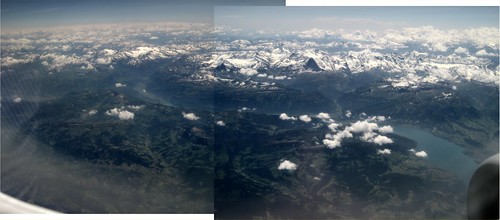
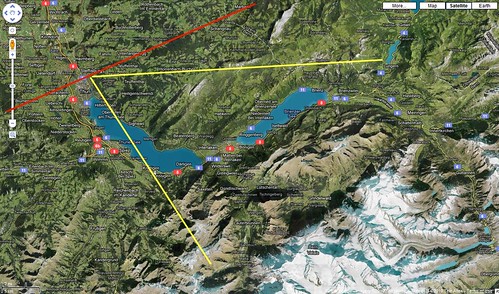
After a reader posted a comment identifying the lake in an aerial photo of Switzerland that I had included in a blog post, I got curious about the details of what was in that picture, and where I was when I took it. Google Maps should make this easy, right? Well, yes, more or less. But I'm not the best photo-interpreter and it took me a while. It was fun though.
Because the lakes in the picture (Thuner See and Brienzer See) are much occluded by mountains, it took me a while to figure out where I was and what direction I was probably looking. The first breakthrough was when I noticed I had taken two shots very close together with the same zoom setting. This showed me a much bigger area including parts of both lakes. I stitched the two into the panorama shown above (the Flickr page will allow you to get the original size picture if your care) . The second helper was a small airfield I noticed in a valley near the end of one of the lakes. Switzerland doesn't have many airports, and with the help of Google, I identified it as "Meiringen Mil" (LSMM) apparently some sort of dispersed military airfield (embedded among farms, but the runway seems to be 6500 feet, small jet capable). It's near the city of Brienz at one end of Brienzer See so this pretty much solved it as far as placing myself and my field of view on Google maps (see below - also can be zoomed much higher on Flickr). It turns out I was looking toward the city of Interlaken which is between the lakes (get it?) though it is mostly hidden by a mountain in the foreground. The red line is my estimated flight path, and the yellow lines the estimated field of view for the above panorama. Mystery solved!
Friday, July 02, 2010
3D Universe Atlas on TED
This is a really cool "TED talk" although it is shorter than usual (about 7 minutes) and mainly narrates a video that takes you from the Himalayas to the edge of the visible universe and back, using the Digital Universe visualization software. I've downloaded and played with a version of that software and found it to be a bit difficult to use. But it sure produces amazing visuals.
Thursday, July 01, 2010
My Own Ariane 5 Launch

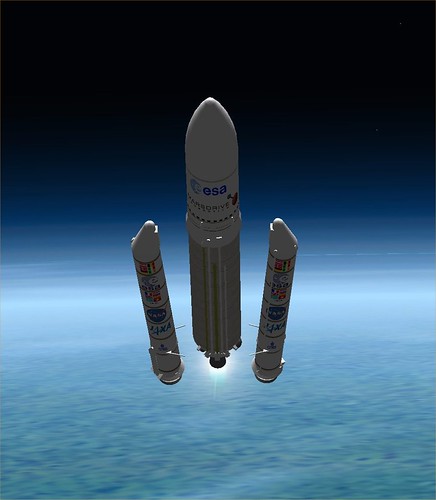
Seeing the full-size Ariane 5 launcher at the space museum in Toulouse last week reminded me of my own Ariane 5 launching days back in 2006. Of course those were virtual launches in Orbiter, and at the time I was working with Andy McSorley, Mark Paton, and Grant Bonin on an Orbiter simulation of the proposed "Mars for Less" approach for getting humans to Mars sooner rather than later. This involves launching the Mars-bound spacecraft in modules using a "medium" booster (of which Ariane 5 is a good example, with a payload to LEO of around 20 metric tonnes). The modules would be designed to assemble in orbit essentially by docking, without the complex, EVA-based construction methods used for the ISS. The whole project became a rather complex add-on for Orbiter (there's also an "extra" package for it here). Andy and Mark came up with some great models and programming for it.
I wrote a number of blog posts on this at the time and posted many pictures on Flickr. I also presented the technical paper (PDF, PDF slides here) that we wrote about this at the 2006 Mars Society Convention in Washington, DC. It was fun. The Orbiter screen shot shown here is one of my favorites. The Ariane 5 carries the logos of various space agencies since we assumed that a human Mars mission would be a multinational effort.
Sunday, June 27, 2010
Cité de l’Espace (Space City)
The other Toulouse attraction I visited last week was Cité de l’Espace, "Space City," an indoor/outdoor space museum (or perhaps theme park). Its trademark exhibit is a full-size mock-up of the Ariane 5 launch vehicle. It is 53 meters tall and I first spotted it from several miles out on approach to the Toulouse airport from the southeast when I was flying in from Frankfurt. It's shown above with another major outdoor exhibit, a full-size, walk-through mock-up of Russia's late, great Mir space station. I knew that Mir was big, but I was surprised at just how big it really was. It's set up with walkways around and through its several modules so you can really get an idea of what it was like inside.
Other outdoor exhibits included a full-size Soyuz spacecraft, a full-size mock-up of the ESA XMM-Newton x-ray telescope (launched in 1999, still operational, shown at left), the large scale solar system model I blogged about the other day, a "galaxy maze," the "avenue of the infinite" (a powers-of-ten demonstration of the scale of things in the universe), and more (including some play areas specifically for smaller kids).
The main building houses a large number of interesting exhibits arranged by themes such as observing the earth, living in space, exploring the universe, weather, communications, etc. All the exhibits are well done and some of them are interactive in various ways. Another large building houses a planetarium and an IMAX theater where I was happy to be able to see the very recent "HUBBLE (3D)" (this and the planetarium were included in the admission, though I didn't have time for a planetarium show). I had paid an extra fee for a location-aware translation system with headphones which worked well for the exhibits. I was able to read the French descriptions just fine so I didn't really need it for those, but I figured it would allow me to hear the original narration for the Hubble film. Unfortunately this didn't work for me, but the French narration and dubbed voices for the astronauts were quite clear and easy to understand.
I didn't have much time, but I managed to see most of the exhibits and even grab a quick lunch at the Astronaut Cafe and a few small souvenirs at the well-stocked gift shop. Aside from the space exhibit area at the Air & Space Museum in Washington, DC, this is probably the best space-themed museum I have ever visited. If you're ever in the area, it's definitely worth a visit. I have a few additional pictures on my Flickr site and may post some more in the next few days.
Other outdoor exhibits included a full-size Soyuz spacecraft, a full-size mock-up of the ESA XMM-Newton x-ray telescope (launched in 1999, still operational, shown at left), the large scale solar system model I blogged about the other day, a "galaxy maze," the "avenue of the infinite" (a powers-of-ten demonstration of the scale of things in the universe), and more (including some play areas specifically for smaller kids).
The main building houses a large number of interesting exhibits arranged by themes such as observing the earth, living in space, exploring the universe, weather, communications, etc. All the exhibits are well done and some of them are interactive in various ways. Another large building houses a planetarium and an IMAX theater where I was happy to be able to see the very recent "HUBBLE (3D)" (this and the planetarium were included in the admission, though I didn't have time for a planetarium show). I had paid an extra fee for a location-aware translation system with headphones which worked well for the exhibits. I was able to read the French descriptions just fine so I didn't really need it for those, but I figured it would allow me to hear the original narration for the Hubble film. Unfortunately this didn't work for me, but the French narration and dubbed voices for the astronauts were quite clear and easy to understand.
I didn't have much time, but I managed to see most of the exhibits and even grab a quick lunch at the Astronaut Cafe and a few small souvenirs at the well-stocked gift shop. Aside from the space exhibit area at the Air & Space Museum in Washington, DC, this is probably the best space-themed museum I have ever visited. If you're ever in the area, it's definitely worth a visit. I have a few additional pictures on my Flickr site and may post some more in the next few days.
Megaplanes: Airbus A380 and Beluga
Last week I was in Toulouse for a conference, but I fortunately had some time in the schedule for a little aerospace sight seeing as well. Toulouse is the center of the French aerospace industry, home of CNES (the French NASA), EADS Astrium, EADS Airbus, and other aerospace companies. There is also an excellent space museum which I will write about separately.
As you might expect, Airbus production facilities are located next to the Toulouse airport. I realized when I landed that there might be tours available, and since I had a morning free the next day, I hoped I might be able to join one. I got lucky and there was a tour available the next morning. It was only in French that day, but my French is good enough that this wasn't a problem. The "Airbus Visit" tour is run by a separate company and it focuses on the giant A380.The visitor center includes a simulated "telemetry room" where you get a briefing about EADS Airbus and the A380 project, including a narrated replay of the A380's first flight in 2005. The monitors in the room show various videos (from cameras mounted on the test aircraft as well as chase aircraft and helicopters) and graphical displays of some of the 260,000 flight test parameters. This was pretty cool.
Then we boarded a bus to drive over to one of the final assembly buildings where three A380's were nearing completion. They reminded me more of green submarines than aircraft - incredibly huge airplanes. From the very high observation gallery, we could see the tiny members of assembly teams at work below us (no photos allowed on the tour, alas, but this 2009 article has some). From the outside gallery, we could see several other A380's in the nearby electronic testing area. No photos there either, but on my departure from TLS, I was able to take a couple of decent shots of those planes from the air. The picture above shows four A380's under test (one Qantas, one Lufthansa, two others unknown). You can see tour buses parked in front of the blue building in the background, which was the one with the observation gallery we visited. It looks like the adjacent buildings could accommodate up to eight aircraft for final assembly.The next part of the tour brought us back to the visitor's center to go inside a full-size mockup of the A380 fuselage. The two levels were configured with different seating and amenities for use in marketing to airlines. A very roomy airplane. I passed on the final part of the tour which was a visit to the very first Concorde SST because I was out of time (I went inside a Concorde in Seattle last August - nice, but really not such a roomy airplane).
Back at TLS for the flight home, I could see many other Airbus aircraft at the facility across from the passenger terminal, including three of the five "Airbus Belugas," modified Airbus A300 aircraft that are used to transport large aircraft sections from various other Airbus sites in Europe to Toulouse for final assembly. The Belugas are also chartered for various other bulky freight transport chores as described in this Wikipedia article. On the flight from TLS to Munich, we passed over Switzerland and I took a few photos of the Alps. Window glare, clouds, and haze made it tough but a couple of pictures were OK. I've just spent 30 minutes with Google Earth trying to figure out what lake is in the picture below. I think it's near Mont Blanc (possibly Lac L'Emosson), but I'm really not sure. It sure is nice to have a window seat when flying over the Alps even when the pictures don't come out so great. I also need a new digital camera.
As you might expect, Airbus production facilities are located next to the Toulouse airport. I realized when I landed that there might be tours available, and since I had a morning free the next day, I hoped I might be able to join one. I got lucky and there was a tour available the next morning. It was only in French that day, but my French is good enough that this wasn't a problem. The "Airbus Visit" tour is run by a separate company and it focuses on the giant A380.The visitor center includes a simulated "telemetry room" where you get a briefing about EADS Airbus and the A380 project, including a narrated replay of the A380's first flight in 2005. The monitors in the room show various videos (from cameras mounted on the test aircraft as well as chase aircraft and helicopters) and graphical displays of some of the 260,000 flight test parameters. This was pretty cool.
Then we boarded a bus to drive over to one of the final assembly buildings where three A380's were nearing completion. They reminded me more of green submarines than aircraft - incredibly huge airplanes. From the very high observation gallery, we could see the tiny members of assembly teams at work below us (no photos allowed on the tour, alas, but this 2009 article has some). From the outside gallery, we could see several other A380's in the nearby electronic testing area. No photos there either, but on my departure from TLS, I was able to take a couple of decent shots of those planes from the air. The picture above shows four A380's under test (one Qantas, one Lufthansa, two others unknown). You can see tour buses parked in front of the blue building in the background, which was the one with the observation gallery we visited. It looks like the adjacent buildings could accommodate up to eight aircraft for final assembly.The next part of the tour brought us back to the visitor's center to go inside a full-size mockup of the A380 fuselage. The two levels were configured with different seating and amenities for use in marketing to airlines. A very roomy airplane. I passed on the final part of the tour which was a visit to the very first Concorde SST because I was out of time (I went inside a Concorde in Seattle last August - nice, but really not such a roomy airplane).
Back at TLS for the flight home, I could see many other Airbus aircraft at the facility across from the passenger terminal, including three of the five "Airbus Belugas," modified Airbus A300 aircraft that are used to transport large aircraft sections from various other Airbus sites in Europe to Toulouse for final assembly. The Belugas are also chartered for various other bulky freight transport chores as described in this Wikipedia article. On the flight from TLS to Munich, we passed over Switzerland and I took a few photos of the Alps. Window glare, clouds, and haze made it tough but a couple of pictures were OK. I've just spent 30 minutes with Google Earth trying to figure out what lake is in the picture below. I think it's near Mont Blanc (possibly Lac L'Emosson), but I'm really not sure. It sure is nice to have a window seat when flying over the Alps even when the pictures don't come out so great. I also need a new digital camera.
Thursday, June 24, 2010
Why Space Is Not Easy
I’m attending a small technical conference on “stray light” in Toulouse, France this week. It’s sponsored by CNES (the French space agency) and by several European aerospace companies. It’s basically an optical engineering conference on a very specialized area of optics called “stray light.” As you can imagine, this means light that you don’t want showing up on the detectors of your optical system. A familiar example is a “ghost image” that you might see on a photo that you shoot towards the sun. You might see rings or hexagonal shapes or patches in your picture, obscuring part of the actual picture. These are internal reflections from the lenses or apertures that normally would be too faint to see unless the source is very bright (like when the sun is partly or fully in the frame).
In spacecraft optical systems (telescopes or imaging systems for Earth or other planets), this is a big problem. The sensors for these systems are very sensitive, and there are many ways for photons you don’t want to bounce around and find their way to your sensors, even if you are careful and don’t point directly at the sun, moon, or Earth (the brightest sources for most spacecraft). Preventing or reducing stray light is an important part of design and fabrication of such optical systems and can even determine the success or failure of a mission.
A case in point from a paper presented by Mr. Thierry Viard of Thales Alenia Space in sunny Cannes, France. The COROT spacecraft was launched in December 2006 to search for exoplanets with short orbital periods, especially large terrestrial (Earth-like) planets. COROT is a relatively small and low-cost spacecraft, so launching it to a dark, distant Lagrange point (e.g., L2) was not possible. An 800 km polar orbit would have to do, which meant that the very bright Earth would always be nearby (in addition to the sun and moon, though the sun would always be kept “behind” the spacecraft by pointing to a different area of the sky depending on the season).
The “transit” method of detecting exoplanets depends on recording very slight changes in the brightness of rather dim stars as a small planet passes in front of the star as viewed from our direction. The telescope had to be designed with a form that would minimize the chances of light from “off-axis” objects (those outside of the desired pointing area) getting to the detectors. Several optical criteria used in the chosen design form helped with this, in addition to extensive “baffles” (black metal rings that only allow light from certain directions to get in).
But this was not enough for COROT to succeed. The engineers also determined that cleanliness would make or break this mission. The slightest dust in the spacecraft could also scatter light to the detector, and such scattering had to kept to about 10 photons per pixel per second from the nearby Earth (which is putting out about 10^20 photons per second per pixel, a huge, huge number). This required keeping particle contamination (dust) to something under 200 parts/million, which is very clean even for a clean room used to building delicate spacecraft. And there was no way to even test this without risking even more contamination, so it had to be based entirely on simulations. Pretty scary!
But guess what? The COROT optics team succeeded. When they first imaged the starry sky, it was pitch black except for the bright, distinct stars. Just as designed. They detected their first exoplanet in May 2007, and the first Earth-like exoplanet , COROT-7b (1.7 times Earth’s radius) in 2009.
Of course there is much more to this or to any spacecraft than the optical systems. This is just an example of the clever engineering, hard work, extreme attention to detail, and ultra-high quality needed for any successful space mission. Space is not easy.
Images courtesy CNES
In spacecraft optical systems (telescopes or imaging systems for Earth or other planets), this is a big problem. The sensors for these systems are very sensitive, and there are many ways for photons you don’t want to bounce around and find their way to your sensors, even if you are careful and don’t point directly at the sun, moon, or Earth (the brightest sources for most spacecraft). Preventing or reducing stray light is an important part of design and fabrication of such optical systems and can even determine the success or failure of a mission.
A case in point from a paper presented by Mr. Thierry Viard of Thales Alenia Space in sunny Cannes, France. The COROT spacecraft was launched in December 2006 to search for exoplanets with short orbital periods, especially large terrestrial (Earth-like) planets. COROT is a relatively small and low-cost spacecraft, so launching it to a dark, distant Lagrange point (e.g., L2) was not possible. An 800 km polar orbit would have to do, which meant that the very bright Earth would always be nearby (in addition to the sun and moon, though the sun would always be kept “behind” the spacecraft by pointing to a different area of the sky depending on the season).
The “transit” method of detecting exoplanets depends on recording very slight changes in the brightness of rather dim stars as a small planet passes in front of the star as viewed from our direction. The telescope had to be designed with a form that would minimize the chances of light from “off-axis” objects (those outside of the desired pointing area) getting to the detectors. Several optical criteria used in the chosen design form helped with this, in addition to extensive “baffles” (black metal rings that only allow light from certain directions to get in).
But this was not enough for COROT to succeed. The engineers also determined that cleanliness would make or break this mission. The slightest dust in the spacecraft could also scatter light to the detector, and such scattering had to kept to about 10 photons per pixel per second from the nearby Earth (which is putting out about 10^20 photons per second per pixel, a huge, huge number). This required keeping particle contamination (dust) to something under 200 parts/million, which is very clean even for a clean room used to building delicate spacecraft. And there was no way to even test this without risking even more contamination, so it had to be based entirely on simulations. Pretty scary!
But guess what? The COROT optics team succeeded. When they first imaged the starry sky, it was pitch black except for the bright, distinct stars. Just as designed. They detected their first exoplanet in May 2007, and the first Earth-like exoplanet , COROT-7b (1.7 times Earth’s radius) in 2009.
Of course there is much more to this or to any spacecraft than the optical systems. This is just an example of the clever engineering, hard work, extreme attention to detail, and ultra-high quality needed for any successful space mission. Space is not easy.
Images courtesy CNES
Tuesday, June 22, 2010
Not In My Back Yard...
...but I wish it was! What a great educational aid it would be to have a scale model solar system with Earth the size of maybe a basketball (roughly 56 million to one). The orbits are in order but of course not to scale for orbital distance - that would require a lot of land. This could be my next landscape architecture project (though my wife probably has other ideas).
Update: the sun doesn't appear to be in scale, but it's rather foreshortened in this view so you can't tell that it's really just a small chord of the sun's circular disk and it could easily be 9.7 Jupiter radii if you extended it.
Sunday, June 20, 2010
JT & CK: Great Concert
I don't go to many concerts these days, especially when it requires driving in and out of Boston. But last night's James Taylor and Carole King "Troubadour Reunion" concert at the TD Garden was worth the effort. My wife and I drove in early, parked under the Garden, and had dinner at a nearby Irish pub before the concert, so we were pretty relaxed by the time it started. JT and Carole were in excellent form, doing mostly their best-known songs from the early 70's. I've been to a few JT concerts over the years (he's one of my idols and almost certainly the reason I tried to be a singer-songwriter myself), but this was the first time I've heard Carole King live. "Tapestry" is one of my favorite albums, and I have to admit it gave me chills to hear her perform "It's Too Late," "So Far Away," "Natural Woman," and "Will You Love Me Tomorrow?" The band was great too, including three core members they both performed and recorded with way back in 1970. Great stuff.
Thursday, June 17, 2010
Shuttle Launch Prep in 3' 52"
This is so cool. It's a time-lapse video that shows the full six-week preparation sequence of the shuttle Discovery for STS-131 condensed into three minutes, 52 seconds. It's from Air & Space Magazine (one of my favorite magazines). Thanks to astropixie for the tip.
I'm going to miss the space shuttle.
Update: I removed the embedded video - it's too annoying that it plays automatically (with the commercial) every time the page loads. Watch here.
I'm going to miss the space shuttle.
Update: I removed the embedded video - it's too annoying that it plays automatically (with the commercial) every time the page loads. Watch here.
Wednesday, June 16, 2010
American Aerospace: Cool Blog
I haven't been reading and writing much space and aviation stuff recently. Aside from work, I've had a few distractions such as working with my brother to build a new enclosed porch on my house, finishing my second album, and most exciting of all, seeing my daughter get married this past Sunday. But with a new version of Orbiter to play with, I'm sure space will be back in the mix over the next few weeks.
In the meantime, let me steer you to a cool blog from Seattle, American Aerospace. It features a series of nicely written descriptions of various American space and aviation milestones, including this piece (May 31) on one of my favorites, Robert Goddard, "the original rocket man."
You might also check out the latest Carnival of Space (#158) hosted this week by the Aartscope Blog.
In the meantime, let me steer you to a cool blog from Seattle, American Aerospace. It features a series of nicely written descriptions of various American space and aviation milestones, including this piece (May 31) on one of my favorites, Robert Goddard, "the original rocket man."
You might also check out the latest Carnival of Space (#158) hosted this week by the Aartscope Blog.
Monday, June 14, 2010
Orbiter 2010 has "Shipped"
Great news for space flight fans - Orbiter 2010 has been released and is available for free download. This is the first new version of Orbiter since fall of 2006. There's also a nice update to the main Orbiter web site. Things are continuing to be crazy busy for me, so I've just managed to download the new version and haven't even installed it yet. But I plan to delve into it over the next couple of months. My first priority will be to test all the scenarios and tutorial steps in my Go Play In Space book to make sure they still work well with the new Orbiter version. I'm also considering doing an update to Go Play In Space specifically for the 2010 version (as I did when I created the second edition for the 2006 release of Orbiter).
This version of Orbiter has some cool new features, but the majority of Martin Schweiger's development efforts were devoted to internal and architectural changes which separated the "orbital mechanics engine" from the graphics and user interface components, to allow other developers to create "front ends" that take advantage of new developments in graphics software and hardware without requiring Martin to do all of that himself. This was major surgery for a program of Orbiter's complexity, but it will offer benefits in the long run. This press release (PDF) summarizes the other changes, which are substantial (including support for much higher quality planetary surface textures, more accurate atmospheric models, and a powerful built-in scripting language).
Note that Orbiter itself still does not include sound, so be sure to download and install Dansteph's Orbiter Sound 3.5 which works with Orbiter 2006 and 2010. Note also that while Orbiter includes a number of built-in spacecraft and many scenarios, there are hundreds of free add-ons that expand upon its standard features, most of them available from Orbit Hangar. Also be sure to check the Orbiter Forum to keep in touch with the world-wide Orbiter community.
This version of Orbiter has some cool new features, but the majority of Martin Schweiger's development efforts were devoted to internal and architectural changes which separated the "orbital mechanics engine" from the graphics and user interface components, to allow other developers to create "front ends" that take advantage of new developments in graphics software and hardware without requiring Martin to do all of that himself. This was major surgery for a program of Orbiter's complexity, but it will offer benefits in the long run. This press release (PDF) summarizes the other changes, which are substantial (including support for much higher quality planetary surface textures, more accurate atmospheric models, and a powerful built-in scripting language).
Note that Orbiter itself still does not include sound, so be sure to download and install Dansteph's Orbiter Sound 3.5 which works with Orbiter 2006 and 2010. Note also that while Orbiter includes a number of built-in spacecraft and many scenarios, there are hundreds of free add-ons that expand upon its standard features, most of them available from Orbit Hangar. Also be sure to check the Orbiter Forum to keep in touch with the world-wide Orbiter community.
Message from Tomorrow has "Shipped"
My new album "Message from Tomorrow" has finally "shipped" (well I did ship a few CD's to CD Baby for sale, and a few to out of town friends). The 14 original songs are available for download on iTunes, amazon.com, and on cdbaby.com itself. I've been a little surprised by comments I've received on what people like, but I guess that really just shows my own biases. The favorite song so far seems to be "Out of Nowhere" (written with my friend Rob Simbeck), followed by "Autumn Song" and "Message from Tomorrow."
Lyrics for the album are available as a PDF on the download page of my music web site, which I hope to update to something a little more modern and interesting in the next couple of months. I also hope to get back to doing some gigs now that I have some new material. This will probably start with some open mic events since it's been a few years since I performed at anything other than a family or office get-together.
Thursday, June 03, 2010
Subscribe to:
Posts (Atom)