Showing posts with label movies/DVD. Show all posts

Sunday, August 25, 2013

Space Settlements


A few weeks ago I saw the movie Elysium, mainly because I was intrigued by trailers showing a huge Earth-orbiting space settlement, very much like those proposed in the 1976 book The High Frontier by Gerard K. O'Neil. I had that book back in the day (actually I may still have it). Back then they were called space colonies or habitats. The movie was both entertaining and irritating. The imagined technologies and the visuals were very cool, including Elysium itself, a rotating torus-type space habitat that is supposed to be large enough to house 500,000 of the super-rich in 2154 (the much-less-than-one-percent), when the Earth's surface has become just too ugly to stand (or something). There's a lot of shooting and other typical action movie stuff, and a plot based on the huge disparity between the haves (living in luxury in space) and the have-nots (living in squalor in Los Angeles, apparently). Matt Damon is the sort-of hero in a wildly implausible story. I wanted to see more of the Elysium habitat, but that was not the point of this movie. I'm not really sure what was, other than that grossly unequal wealth distribution might have unintended consequences. True, but hard to believe this could be the result.


I hope that someday we do develop space settlements that are not gated communities for the super rich. Who will they be for, and why will we need them? I pretty much agree with the National Space Society (NSS) that humanity should strive to have places to live beyond the Earth for a variety of reasons. To provide a backup in case of extreme disaster on this planet, a way to preserve human and other life. To give access to additional resources. For economic growth that could arise from new frontiers and technologies. Because we can do it. And because it's really cool! I'm also a member of the Mars Society, and I think that eventually we will be able to colonize Mars (starting as early as 2023 if the Mars One project succeeds). But Mars is very far away, and if we can learn to capture near-Earth objects and use their materials to robotically build things in space, large space settlements might be practical, and they can be built in near-Earth orbit (like Elysium), or at other places in the Earth-Moon system, and eventually in other places in the solar system. 

So I would say, plan for all possibilities. There's an essay by Rick Tumlinson in the current issue of the NSS magazine ad Astra called "All of the Above." In it he says, "the opening of space to human development is the most important activity of the human species" (in the long run, this is certainly true). He suggests that there is no "one true path" to achieve this, but that there are three key components:
  1. Regular, reliable, and low-cost access to and from space.
  2. Utilization of the resources of space, wherever they are, for whatever purpose we need (i.e., "live off the land")
  3. Governments that understand and support the idea of an open and expanding frontier in space, by, of, and for the people.
I agree with these points, though I'm sure not all the governments who will be active in space in the coming decades will sign up for #3. 


The same issue of Ad Astra has a space habitat on the cover. It's not Elysium, but the movie may have affected the timing since the article discussed was written in 2007. "Kalpana One" is not a torus, but a cylinder, and it's much smaller than Elysium, in consideration of the amount of mass needed to construct it, as well as radiation shielding and various safety factors. It is sized such that a 2 rpm rotation rate produces one G of rotational pseudo-gravity (low radiation and Earth equivalent G are essential, especially for growth and development of children). It might house 3000 people. It's really cool that so much analysis has gone into this. You can read the article here.

I've read a lot of science fiction on subjects like this. In terms of what things could be like if we open up and settle the solar system, I especially like Kim Stanley Robinson's 2312. Is the NSS agenda really just unlabeled science fiction? I don't think so. I think that technology is accelerating at such a rate that we really need to be planning for things like space settlements and Mars colonies. They aren't going to happen next year. But with the usual caveats (e.g., assuming we don't plunge ourselves into nuclear war or world-wide depression), some of these things could happen in the lifetime of my children. Or at least my grandchildren. 

Saturday, July 13, 2013

Our Robotic Future, Creeping Up

The other night I decided to watch the 2004 movie I, Robot. I had only seen it once before, in the theater 9 years ago. It popped up as I was browsing films in iTunes. While it's not the greatest SF or Will Smith movie I have ever seen, I enjoyed it, though I was skeptical of the level of AI and mechanical performance of the fictional year 2035 robots. Even before the latest super-smart NS-5 model that drives the movie's plot, the human-size, bipedal robots in wide use seemed to have good speech understanding and athletic ability, and even more impressively, they could interact seamlessly with humans in social situations ranging from home kitchens to bars to crowded streets. Could robot technology really reach that level 31 years from the film's release, just 22 years from now?

A few years ago, I might have said no, but now I'm not so sure. One data point: the recently announced Atlas robot from Boston Dynamics, which I read about today in this NY Times article. This 150 kg robot is hydraulically operated and is designed to work in human environments. It is an R&D model that will be programmed by several teams next year in a DARPA competition to demonstrate capabilities needed for human assistance missions. It's no cakewalk. From the Times article: "The contest involves programming the robot so that it is able to climb into a vehicle, drive to a destination, get out of the vehicle, cross a rubble field, open a door, use a power tool and turn a valve." Wow. You can watch the big lug in action in this DARPA video. It's clear this will NEVER be used for direct military purposes, despite the little hand exercise that looks like a wild west gunslinger spinning his 45's around. They probably only do that in movies anyway.

I'm not sure what to make of all this. I do believe that technology is developing at an exponential rate, and with sufficient computing power, strong but lightweight materials, and advanced batteries, I can imagine "Atlas" evolving into "Sonny" in 20 years. Sure. I've read a lot of other articles about how the use of robots is expanding into activities that require close interaction with humans, and how recent models can even be programmed by simply moving their arms to teach them the needed motions. Smarter, cheaper, easier to use robots are certainly not going to help our unemployment problems. Even if it never gets to the point of a robot bartender, a lot of jobs that could not easily be automated in the past will be up for grabs. Maybe even bartender.

Two things are clear. Boston Dynamics was thinking ahead when they loaded Atlas's chest with blue LED's. This is the same as the NS-5 in I, Robot, so when someone overrides their programming and makes them turn bad, it will be a simple matter to replace the blue lights with red bad-robot LED's (white hats and black hats are so twentieth century). The second thing is that when Skynet sends a Terminator from the future back to our time to locate some key technology, they should send it to Boston, and not Los Angeles.

Saturday, July 06, 2013

Europa Report - Good Movie

I just bought Apple TV and connected it to our HDTV. Coolest thing ever. With my heavy stake in Apple i-devices, iTunes music, and even a few movies and TV series bought over the years, it's the perfect thing. I can stream music from iCloud through my living room stereo, share content from the iPad or iPhone on the big screen, view rented movies at full (1080p) HD, and much more. Great little $99 device with no additional subscription required. Much nicer web interface than the Panasonic BluRay player we have used up to now (and still may use for Amazon movies since Apple TV doesn't support those).


But I digress. The very first movie I rented through Apple TV was Europa Report, and I really liked it. It's an unusual situation that this first-run film is available on iTunes ahead of its theatrical release on August 2, but that works for me, especially with Apple TV.

Europa Report is mostly "hard SF," my preferred SF genre. The science and the technical treatment of human space flight on a long interplanetary mission are mostly realistic and quite well done, on par with 2001: A Space Odyssey. It's a planned 3-year mission to explore the surface and sub-surface of Jupiter's icy moon Europa. The space-station like spacecraft is fairly large and has a rotating component to provide artificial G in the crew quarters. The six person crew (4 men, 2 women) works well together, though they experience tension, boredom, isolation, and other mundane effects of a long mission in a cramped environment (the movie is only 90 minutes, but the production manages to convey the length of the mission pretty well). They also experience a number of crises, which also mostly seem realistic, triggered by events such as a solar storm, equipment failures, and accidents.

I won't give away any key plot details, but as the picture above suggests, they do reach Europa, their crewed lander reaches the surface, and they are able to drill through some 2.7 km of ice with a probe that sends back video and data from a sub-ice ocean. I will let you see the movie to find out what they learn and what happens. It's pretty dramatic and exciting.


I do have a few minor complaints. Why does a lander intended only for non-atmospheric use have deployable landing gear? Why would they not follow better safety and backup procedures on EVA's? I won't say more lest I reveal plot details, but some of the dramatic events seemed preventable to me if certain common sense procedures had been followed. Of course it's a movie, so dramatic events are needed. And these are minor complaints - on the whole, this movie required much less suspension of disbelief than 90% of the space movies I have seen. There is serious consideration given to zero-G, radiation, crew psychology, communication delays, spacecraft operations, and much more, all in the context of a good story with real-seeming characters. Multi-year spaceflight seems much more of a tough job than an adventure in this movie, though the adventure part is definitely there (sort of like the old saying about war - long periods of sheer boredom interspersed with moments of stark terror).

I would give the movie 4.5 out of 5 stars if I were one to give stars to movies (and BTW, there are no "stars" in this movie - the actors are all unknowns to me, but they do a fine job).

Friday, May 03, 2013

Ender's Game Teaser

Orson Scott Card's Ender's Game is one of my favorite SF books. I know I'm not the only one, and for years there have been rumors of a film version. I haven't followed this too closely, but apparently it's finally happening (release date November 1, 2013). So far there is only a brief teaser trailer, introduced by stars Harrison Ford and Asa Butterfield (who plays Ender Wiggin). The full trailer is due May 7. The zero-G "Battle Room" plays a central role in the book, and the teaser shows a couple of brief shots of this, captured below. It looks really cool. I hope the movie is good. I just ordered the Kindle version so I can re-read it again (too lazy to go find the paperback!).


UPDATE (5/16/13): Ah yes, Ender Wiggin, not Wiggins. I saw the full trailer and didn't like it as much as I hoped. I suppose there are practical reasons for making Ender and the other Battle School kids older than they are in the book (Ender is six when he starts International Fleet Battle School, which he attends for only about three years before advancing to other things). And in his brief trailer scenes, Asa Butterfield doesn't quite look and act as I imagined Ender would look and act after re-reading the book last week. But there's a lot of potential there and I will keep an open mind and just wait for the film.

Tuesday, February 07, 2012

Le Voyage Dans La Lune (1902!)

Today's Amazon MP3 Daily Deal is a new album by the French band Air for $3.99. Normally I'm not a big fan of Air's electronic/pop music, but this is an interesting special case. They composed a new soundtrack for the 1902 silent movie "Le Voyage Dans La Lune" which has recently been restored to its hand-colored original state (the video is included with the MP3 download). This 15 minute film is said to be the very first "science fiction" movie. Loosely based on Jules Verne, it depicts a trip to the Moon in a hollow artillery shell fired by a huge cannon.

The trip is fast and the shell hits the Man in the Moon right in the eye (so much for the science!). The band of intrepid French explorers soon encounters angry Moon natives and of course fighting ensues. They retreat to their capsule, which has been conveniently placed on a cliff with a rope attached to the nose, which one of the men uses to pull the spacecraft over the edge (I had always wondered about the return plan with an artillery shell spacecraft and no known cannons on the Moon). It quickly falls to Earth for an Apollo-like water landing, whence the explorers are rescued and hailed as heroes.

Considering this was made a year before the Wright Brothers flew, it's really pretty impressive despite a few liberties taken with the physics. For the price of a latte and 15 minutes, it's an amusing piece of space pre-history. And the music is OK.

Tuesday, November 30, 2010

2001: Aries at Clavius #3


2001: Aries at Clavius #3, originally uploaded by FlyingSinger.
I just renewed my Flickr Pro account for another year and was looking through my "photos" (most of them are actually Orbiter screen shots). This is one of my favorites, recreating a scene from 2001: A Space Odyssey (using the great World of 2001 add-on). The Aries moon shuttle is making a near-vertical approach to Clavius Base. The animated dome is retracting.

Saturday, October 02, 2010

Moon (the movie) Revisited

I saw the movie "Moon" on an international flight some months back. It was seat-back video in economy on a 777, so we're not talking big screen here. I was probably tired too. I wanted to like it, but I thought it was stupid. When it showed up as a streaming Netflix movie (in HD), I decided to give it a no-cost second chance. I'm glad I did, because on a good size screen, the visuals were really cool and "realistic" in a 2001 sort of way. I liked Sam Rockwell's character, and this time I caught the early clues as to what was going on, so it didn't seem quite so arbitrary and confusing. Still quite implausible, but it paid off my suspension of disbelief well enough to forgive the original premise.

That premise is a lunar far-side Helium-3 mining base (in the semi-near future) that is essentially 100% robotically operated, except for a single human troubleshooter employee who is stationed there alone for a three-year tour, during which the lunar communication relay satellite that would allow direct communication with Earth seems to always be out of commission. I won't spoil it otherwise, but Sam eventually figures it out, with some significant help from his sidekick, a robot named Gerty (voiced by Kevin Spacey). Part of what's implausible is that with robotic AI technology as smart and sensitive as Gerty, why couldn't the base be completely robotic (with some help from telepresence systems that would allow Earth or lunar near-side humans to do the troubleshooting without living in total isolation for three years - or something like that).

One parallel with 2001 is a robotic assistant who (which?) goes crazy. Unlike HAL, Gerty doesn't become a psychotic murderer, but he does go so far outside of any conceivable programming that you could only call it crazy helpful (it's nice when your robot buddy tells you how to selectively erase some of his memories to prevent the boss humans from learning about something you're trying to hide that he/it would otherwise have recorded and would report). But hey, it's just a movie, and a pretty enjoyable (though sad) one at that.

Monday, September 20, 2010

Carnival of Space #170

I've been a Very Bad Blogger recently. Aside from work and a doggie health crisis, I'm still pretty infatuated with HDTV/Blu-Ray and all the cool stuff streaming through our Netflix "Instant Queue." Things like the 2008 PBS documentary Carrier (10 episodes about the USS Nimitz), In Search of Beethoven, Imagine: John Lennon, and It Might Get Loud (musical conversations with guitarists Jimmy Page, The Edge, and Jack White). Not much space stuff unless you count The Iron Giant (an animated favorite that looks great in HD). I also have the 2009 Sam Rockwell movie Moon in my queue. I saw it once on an airplane and although I didn't love it, I'd like to see it on a bigger screen. 

So no wonder there's no time for blogging! But space blogging by other people marches on, as you will quickly see from this week's Carnival of Space #170, hosted by National Geographic's Breaking Orbit blog.

Sunday, August 29, 2010

More HD Space Exploration

I'm still infatuated with HDTV, Blu-Ray, and streaming high quality movies over the internet. I'm not planning to buy a lot of Blu-Ray discs since there is so much content available on cable and online (not to mention a lot of DVD's I own that now look substantially better). But I did want to have a few "demo discs" including a couple of space-related ones.

One that I bought was "For All Mankind," a 1989 theatrical-release documentary that collects many of the best segments of NASA film from the Apollo era into a single "meta-moon-mission." As director Al Reinert explains in the making-of feature, all the Apollo missions pretty much followed the same script, so why not use the best film from each mission? He even went as far as to use some Gemini footage (mainly Ed White's EVA) because it was just gorgeous, in part because the Gemini missions' earth orbits were much higher than the Apollo, shuttle, or ISS orbits, so you could get a much better sense of the roundness of our planet. He also used some of NASA's "engineering film" including the famous shot of Saturn V stage separation shot from the separating boosters. Since these were film cameras, the film had to be recovered, which was quite a trick. Each camera would eject its film canister housed in a small re-entry vehicle equipped with parachutes and a radio homing beacon. On-station USAF C-130's with special aerial recovery equipment would home on these beacons and snatch the parachutes from the air (a technique that had been developed to recover Corona "spy satellite" film in the early 60's). The narration consists mainly of comments by the Apollo astronauts, recorded by Reinert in audio-only interviews. The Blu-Ray transfer is awesome - it was probably 16 mm film in most cases,  but the quality is quite impressive, especially in the scenes of lunar rendezvous with the LM silhouetted against the lunar surface.

I also watched the new Blu-Ray copy of 2001: A Space Odyssey, much of it with the audio commentary by actors Keir Dullea and Gary Lockwood. The film-like quality of the 1080p display is gorgeous and highlights Kubrick's great attention to detail in every aspect of this film. The spacecraft models are amazing. Dullea did some of his own stunts in this film, and he talks about one scene that was just wild, entering the emergency hatch when HAL famously refuses to open the pod-bay doors (here's a three-minute clip of the scene). In his haste to try to save "Frank," "Dave" had forgotten his helmet and gloves, making an EVA into the emergency airlock just a bit dicey.

The pod's door and outer airlock door were on the ceiling of a two-story set, with Dullea falling toward the camera positioned on the inner airlock door (on the floor) when he was supposedly ejected from the pod by pressurized air (this was why a stunt double wasn't used - his face was rushing towards the camera). He was suspended by a heavy rope, the other end of which was handled by a circus trapeze performer who weighed more than Dullea (a critical point). There were knots in the rope to signal the stopping points, and when the first knot reached him, the circus guy stopped the rope (preventing Dullea's face from impacting the camera) and then jumped off a platform with the rope attached to his foot, using his weight to suddenly yank Dullea back toward the outer airlock door (and ceiling of the set!) where he could use the emergency airlock close handle. It was done in one take, and it really looks like this takes place in zero-G. Dullea must have had total faith in Kubrick and that circus performer! An amazing scene in an amazing movie.

Sunday, August 22, 2010

Apollo 13 Revisited

My first HDTV and Blu-Ray player provided the (de?)motivation for a lazy, movie-watching weekend. I had to try out all the different parts of my new toys, including a WiFi connection that allows access to various internet-based services, some free (Pandora internet radio, YouTube), some not free (Netflix, Amazon Video On Demand). I ordered a Blu-Ray copy of 2001: A Space Odyssey from Amazon (mostly because it was only $8.99), but it won't arrive until next week. In the meantime, Amazon provides a free VOD rental of the film, but unfortunately not the HD version. I watched a little to see how the WiFi connection would work (quite well), but decided to wait for the Blu-Ray disc to watch the whole thing later this week. I've bought 2001 on VHS and DVD and now Blu-Ray. It's a space classic and a home video test case, I guess. With Blu-Ray and a 42 inch 1080p screen, it may start to approach the original movie experience of 1968 (which I barely remember, though I know I made my mother take me to see it).

The one BD that I bought and received so far is a BBC nature show, Nature's Most Amazing Events, and the action, scenery, cinematography, and visual quality did not disappoint. The new Blu-Ray player also does a nice job "upconverting" DVD's so I watched a couple of old favorites, Memphis Belle and Apollo 13. I have the 2-disc anniversary edition of Apollo 13, but for some reason I had never watched the making-of special or listened to Jim and Marilyn Lovell's commentary, both great. I really love that movie, both for the many authentic details of the Apollo era and for the emotional intensity. 13 was to be the fifth manned lunar voyage and the third landing, and the public and the media in 1970 had already come to think of it as routine (e.g., the networks didn't interrupt prime time to televise the crew's live color TV "en route to the moon" broadcast - that was so 1969!). But of course the oxygen tank explosion soon made it anything but routine, and the drama of three astronauts' lives hanging by a thread in the "LM lifeboat" captured the world's attention for almost a week. Riveting stuff even though you know the ending.

The making-of special shows what a great combination Tom Hanks and Ron Howard were for this film. Hanks was a space fanatic and astronaut wannabe. Howard wasn't so much, but he is a fanatic for detail and authenticity (technical and emotional) in all of his films. The fact that they were able to get NASA's cooperation to film parts of the film in sets installed in the KC-135 "vomit comet" was an amazing coup and added tremendously to the you-are-there feeling. All that filming had to be done in 30 second segments as the zero-G training jet flew parabolas over and over. All of the "whole body" shots were done this way, but in many scenes where only the actors' heads or torsos were visible, they had to mime the zero-G effects by swaying their bodies to simulate it. It all looks real to me!

I'm sure I will quickly recalibrate my technology "normal meter" so in a couple of weeks, HDTV will just be routine, and I'll go back to not watching much TV. This happens with all technology (except the iPod Touch -  I use it extensively every day, and it still amazes me). But I'm glad it's giving me a reason to revisit some space favorites like Apollo 13 and 2001.

Sunday, March 28, 2010

Evo Devo on Nova

I watched a wonderful 2-hour Nova special on my iPod this weekend, one of several recent Nova episodes available as "Vol. 4" at the iTunes store (only $1.99 per episode - bargain!). "What Darwin Never Knew" explores the mechanisms of evolution at the level of embryonic development, a field now called evolutionary developmental biology (or evo devo). It is based largely on two books by biologist Sean Carroll, including The Making of the Fittest which I read and discussed here in 2008 (I called that post "Evolution: Under the Hood"). Carroll himself is one of a number of researchers who are interviewed about their research in this episode of Nova.

Charles Darwin was an amazing scientist - his explanations of the power of natural selection to produce "endless forms most beautiful" has truly stood the test of time. But there was a lot that Darwin couldn't know that scientists can and do know know now, thanks to their ability to read and interpret the genetic code. Of course "interpret" is the tough part, since just knowing the sequence of DNA (e.g. the remarkably similar genomes of humans, chimps, fruit flies, etc.) is just the first step. It's a great detective story involving genes that activate other genes that in turn control still other genes. Scientists have not only found intermediate fossil forms such as a fish with leg-like front fins, they have figured out how the genetic control methods work to make huge changes in function (fins, hands, wings, etc.) from relatively small changes in the DNA.Great stuff!

Update: Embryos of fish, dogs, and other creatures are amazingly similar. See if you can tell what's what in this interactive quiz.

Tuesday, January 19, 2010

Carnival of Space #137


Just a quick post to let you know that this blog still has a pulse - faint and irregular, but like that poor chap in Monty Python and the Holy Grail who gets thrown on the plague wagon, "I'm not dead." I'm thinking that right around February 12 or so I'll start to have some time and mental energy to think about blogging again.

In the meantime, there's a lovely Carnival of Space to explore over at One Astronomer's Noise. There are links to a number of interesting looking blog posts as well as a few references to the movie Avatar, which I'm dying to see. Busy as I am right now, I actually tried to see it twice - bought tickets and everything. Once was a user error (we bought tickets for the 2D version by mistake and decided to see a different movie and see the 3D version later). The second time I was in the theater watching previews with the 3D glasses when the digital projector broke. Bummer. We got replacement tickets for that and I hope to see it soon. It sounds like a great escape, but for now it's back to the reality of PowerPoint and meeting planning.

Sunday, November 08, 2009

Journey to Palomar


Busy week, but I had a little time to kill with my iPod handy, and I finally watched Journey to Palomar, a PBS science special that I bought back in September (from the iTunes store for $1.99). This is an excellent documentary about George Ellery Hale (1868-1938) and his lifelong quest to build the biggest telescopes in the world while also managing to find time to do groundbreaking work in solar astronomy and especially spectroscopy.

In persuading financial backers and managing some of the biggest scientific projects of his time, he was directly responsible for the existence of the Yerkes telescope in Wisconsin (102 cm/40 inch refractor), two telescopes at Mount Wilson, CA (the 1.5 meter/60 inch Hale Telescope and the 2.5 meter/100 inch Hooker Telescope), and the 5.08 meter/200 inch Hale Telescope at Palomar Mountain, California (completed 10 years after his death - the project was put on hold during WWII). He also helped to establish Caltech in Pasadena. He accomplished all this and more while overcoming a lifelong struggle with mental illness. I knew very little of this amazing man, and I highly recommend this 90 minute documentary. In addition to the biographical aspects, there is great information (including amazing film clips) on the design and construction of the telescopes.

Saturday, May 23, 2009

400 Years of the Telescope

I missed this PBS special when it was broadcast earlier this year, but tonight I got to see "400 Years of the Telescope" at my astronomy club meeting (yes, I do live an exciting life). Narrated by Neil deGrasse Tyson, the one-hour special does a good job tracing the history of telescope technology and its application to astronomy, from Galileo to Hubble (man and telescope) to the next generation of really huge ground-based telescopes now under development. Good stuff for general audiences, with enough "behind the scenes" views and interview segments with astronomers to make it interesting for people like me who already know most of this stuff.

There's lots of great background material on the web site, including a very good teacher's manual called "Glass and Mirrors" with simple demonstrations on how lenses and telescopes really work, using simple lenses as well as pieces of foam and sticks to simulate light rays and explain things like focal points and why images from concave mirrors (and spoons) can be inverted. Good optics materials!

Sunday, April 12, 2009

Trailer for "Moon" Movie


I wrote about "Moon" in January. Now the official trailer is out for a June 12 release (at least in New York and Los Angeles). It looks really cool.

Thursday, February 26, 2009

Space Inspiration

My daughter asked my advice on behalf of a 13 year old girl she knows who expressed an interest in space, specifically in becoming an astronaut. I decided that most of the email I wrote her would fit pretty well in my blog, so here it is.

I’m trying to think of ideas for the girl we discussed. It's cool that she's interested in space, and I'd like to encourage her. I have a few books that she might like that you can borrow, including To Space and Back which Sally Ride wrote about her career and space flights. Here’s Dr. Ride's basic bio.

This also looks like a good book but I don’t have it: I Want to Be an Astronaut by Stephanie Maze (OK, I checked it out and it was $8 so I just bought it and shipped it to you for Monday – you can either lend it to her or give it to her if you think that would be meaningful to her to have it, your call. If you think lending it to her would be better, I’ll just add it to my outreach collection.)

I also have an extra copy of a photo book about the Earth or the Solar System. I bought it for a prize for one of my outreach presentations but you can give it to her if you want. It has great photos. Very inspiring!

Another inspiring woman is Anousheh Ansari. She grew up in Iran dreaming of space flight. She eventually got to America and became an engineer, then started a technology company with her husband and got quite rich. She paid $20 million for her own flight to the space station in 2006. She now works to inspire other people to follow their dreams. Her 2006 space blog is also on her site.

I found this site which has short science videos by an 8 year old boy named Enzo who is a science enthusiast. He’s cute and the videos seem to be informative but it may be too young or corny for a 13 year old. He has some on rocketry and space as well as other science subjects.

You asked about "space camp" possibilities – the “real” space camp is in Huntsville, AL though there may be some regional space-themed camps in this area, I'm not sure.

I would also suggest the DVD “October Sky” which is based on the true story of Homer Hickam, the son of a coal miner in WV who got interested in rockets in 1957 when Sputnik was launched. He overcame a lot of “you can’t do that, you’ll just be a coal miner like your pa” stuff with the help of a supportive teacher and friends. He eventually became an engineer for NASA, and had a great career including helping to train astronauts, though he didn’t become an astronaut himself. The book is also very good, Rocket Boys by Homer Hickam.

The truth is that even for a well motivated, high achieving, physically perfect person, the odds of becoming an astronaut are about the same as becoming a rock star or movie star, pretty slim – so far. But in the next 20 years, there will more development of private space projects possibly including space tourism, space station “hotels”, even moon bases. None of this is certain but some of it will happen. So there will probably be more opportunities than now, even for “jobs in space.” You won’t have to be a military pilot as many astronauts have been up to now (many of them are NOT pilots, but if not, they are usually scientists, engineers, or doctors). If you get interested in space, you’ll probably find other things about science interesting too. Space will also be important in monitoring climate change and maybe solving energy problems in the future.

The not-so-secret little secret of all this stuff is that you have to do well in school, take hard subjects like math and science, and stay REALLY focused to have a chance to do any of these things (you should probably also be an athlete if you want to be an astronaut). I wanted to be an air force pilot and an astronaut when I was a kid more than anything in the world (it was the 60’s and space was really big, so to speak). I was heartbroken at 12 when I needed glasses and realized I couldn’t go to the Air Force Academy which was my plan since I was maybe 8 years old.

But the interests I built up in learning about aviation and space stuck with me, and I also got interested in computers and science and math and had a good academic career (with a short detour to try to be a rock star) and an interesting professional career based on computers, physics, and optics. So inspiration DOES work, but it’s not an exact science. She may only be interested in space for a week. But it's worth a shot - she could also be the first person on Mars.


Saturday, February 14, 2009

Speed & Angels: Great!

I learned about this documentary in a conversation with the van driver who brought me home from the airport last night, and I was surprised and pleased when I found I could watch the whole thing online with good quality and only a few commercials on hulu.com. Speed & Angels is a 2008 documentary that follows two young Navy officers as they take the final steps in becoming F-14 Tomcat pilots.

Meagan and Jay each faced some major challenges in even getting the chance to be Navy fighter pilots, something each of them had dreamed about since childhood. Jay was planning to attend the Naval Academy, but in his senior year in high school, he was accidentally shot in the face by a Marine at a party. The bullet did a lot of damage to his teeth, jaw, and tongue before lodging in his spine. It was amazing that he was not killed or paralyzed, but he was obviously a fighter, and after a number of surgeries and multiple applications for medical waivers, he was pronounced medically fit for Annapolis and later for pilot training. Of course he ended up with the call sign "Faceshot."

Meagan had wanted to be an F-14 pilot since she saw Top Gun when she was 12. She didn't face Jay's medical hurdles, but even though it's been possible since 1993, it's still tough for a woman to make it in military aviation, which is still fundamentally a man's world. But Meagan was determined. She excelled in school and in athletics, majored in aerospace engineering at the Naval Academy, and qualified for jets in pilot training, with the call sign "Slick." She and Jay were in the last class of F-14 pilots to be trained (the Tomcat was retired in 2006, and Jay and Meagan have both since transitioned into the F/A-18 Super Hornet).

I really loved the personal feel of this movie. It seemed that Jay and Meagan were totally open about their hopes and fears, and the comments from their families and friends also gave great insight into the kind of people who make this sort of extreme commitment. I've read a lot of books about fighter pilots, I've seen a lot of interviews, and I've even met a few personally. The nature of the work requires extreme self-confidence, but fighter pilots are also people, and this really comes through in Speed & Angels.

The flying scenes are also great, especially the in-cockpit perspectives in dogfight training and carrier landings. The amount of information that these pilots need to process and the extreme precision required in everything they do in the jet are just incredible. It's amazing that people can learn to do this stuff. It's got to be one of the most demanding jobs that humans can do.

Finally there's a love of flying that permeates this movie. That's what really motivates these pilots to put up with the pressures and the hardships that come with a life devoted to military aviation. I've never flown fast jets (though that's what I wanted to do when I was a kid, and I'd still love to give it a try), but I have flown small planes, including Piper Cubs and a couple of flights in a Stearman biplane like the one that Jay buys and flies "just for fun" in the closing minutes of the film. That joy of flying comes through strongly in this excellent documentary.

P.S. "Speed & Angels" is an expression used in dogfight training. The two jets that will engage in a practice fight start out side-by-side, and each pilot announces "speed & angels" to confirm that they are at the agreed upon airspeed and altitude (angels) and ready for the start of the fight.

Sunday, January 25, 2009

Moon: The Movie


Moon is an upcoming science fiction movie planned for release in June 2009. Based on the trailers available here, it certainly will look cool - an updated future quite reminiscent of 2001: A Space Odyssey. We shall see how the story and characters work out - it sounds promising, but some space-related "hard SF" movies that looked like they would have been good turned out to be disappointing in the storyline and character departments (I'm thinking specifically of Mission to Mars though there are others).

Monday, August 25, 2008

Fly Me to the Moon 3D in Brief

A friend and I went to Boston's excellent Museum of Science today. One of the things we saw was a 20 minute version of the current theatrical release movie Fly Me to the Moon 3D. This was actually a lucky thing, because I got to see what were probably the best 3D scenes in the movie (Saturn V launch, flies cavorting in zero-G, Moon approach and landing) while enduring only a few brief moments of the fly family and other cheesy dialog. I know it's a kids' movie, and you have to be willing to suspend some disbelief, but come on.

The movie is notable in that it was produced fully and exclusively for 3D, and the 3D effects were truly impressive. I was thinking I'd have to see the full movie just to be able to mention it in my outreach presentations. But now I believe I can squeak by with just this mini-version. I still hope kids like it.

Thursday, July 10, 2008

The Other 2001

2001 v3 Orion Station V
2001: Aries at Clavius #3
Moon Bus and TMA
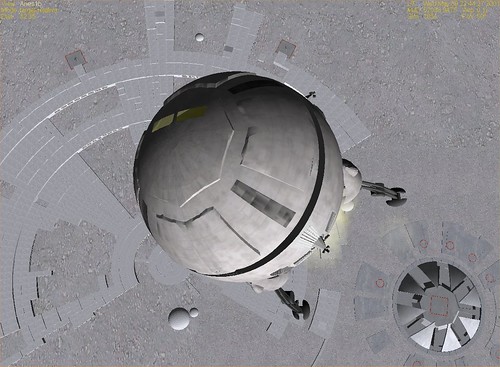
I've written about it before, but I was reminded just now by a discussion thread at Orbiter-forum of one of the most amazing add-ons ever created for Orbiter, World of 2001 (be sure to download and watch the 3 minute video "Floyd's Journey" to get an idea of the quality of this add-on). In 1968, just as Apollo astronauts were about to reach the Moon, Stanley Kubrick and Arthur C. Clarke showed us the astounding potential of our space future in their film 2001: A Space Odyssey.

This huge and multi-faceted add-on by the team of Erik Anderson (Sputnik), Alain Hosking (80mileshigh), and Wolfgang Schwarz (Nautilus) allows you to experience some of that world first-hand. It includes most of the space vehicles and bases from the film plus others that were only mentioned in the script or the book. It does not include the Discovery and related vessels which are available in a separate add-on by David Bartles. You also need to import your own Strauss waltzes to play through Orbiter Sound.

The "world of 2001" shown in the film is a world that could have come to pass (in some form) if we had continued to invest in space at the rate of the Apollo era for 20 more years. That was not sustainable, although the fact that Pan Am was operating some of the spacecraft in the film suggests that commercial interests might have played a big role once the necessary infrastructure was in place. In the film, the Soviet Union and presumably the Cold War were still going strong, and that was what drove Apollo, though it's hard to imagine a space race that was a proxy for war lasting long enough to create the level of space activities seen in 2001 (without a real war occurring somewhere in there) if that was the main driver. Of course they couldn’t know in 1968 what would happen to the Soviet Union by the late 1980's. And of course we did have Vietnam as another sort of proxy for the conflict between the US and USSR (or between communism and the West).

I may be just a romantic space geek, but I sure would have preferred Kubrick's 2001 to the crappy 2001 we ended up experiencing. Now it will probably take until 2051 to get to 2001, but with private space and other governments' help (through cooperation and/or competition), maybe we'll still get there.