Check out the space and astronomy bloggers sharing some of their recent writing at the 319th Carnival of Space, hosted this week by Dear Astronomer.
As a reminder, if you are interested in the JPL Solar System Ambassador program, September is the month to apply.
Space flight, simulators, astronomy, books, flying, music, science, education: whatever the obsession of the moment might happen to be.
Showing posts with label solar system. Show all posts
Wednesday, September 18, 2013
Sunday, September 08, 2013
Be a Solar System Ambassador!
If you live in the US and have an interest in space, planetary exploration, astronomy, and/or science-related educational outreach, please check out the NASA/JPL Solar System Ambassadors volunteer program VERY SOON. September is the only month of the year that new ambassador applications are accepted for ambassadors to start in January 2014.
Although I have been an Ambassador since 2007, for various reasons, I have not been very active in the Ambassador program myself in the last few years. I hope to get more active again starting in 2014. Regardless of my own situation, I strongly believe in this program, and because of reductions of federal government funds related to sequestration, the need for volunteers is stronger than ever. That's because NASA's own employee-based educational outreach programs have been cut. Since the Solar System Ambassadors are volunteers, JPL plans to increase the number of new ambassador appointments for 2014 so there can be more volunteers available who can be involved with programs for schools, museums, libraries, astronomy clubs, and other educational events.
It's easy to apply, and you don't have to be an expert in space or astronomy to participate. Having an interest in educational outreach and a willingness to spend some time on it are more important than space flight expertise. JPL provides various materials and phone conferences that can help you prepare for presentations. These are fun and educational in themselves.
Although I have been an Ambassador since 2007, for various reasons, I have not been very active in the Ambassador program myself in the last few years. I hope to get more active again starting in 2014. Regardless of my own situation, I strongly believe in this program, and because of reductions of federal government funds related to sequestration, the need for volunteers is stronger than ever. That's because NASA's own employee-based educational outreach programs have been cut. Since the Solar System Ambassadors are volunteers, JPL plans to increase the number of new ambassador appointments for 2014 so there can be more volunteers available who can be involved with programs for schools, museums, libraries, astronomy clubs, and other educational events.
It's easy to apply, and you don't have to be an expert in space or astronomy to participate. Having an interest in educational outreach and a willingness to spend some time on it are more important than space flight expertise. JPL provides various materials and phone conferences that can help you prepare for presentations. These are fun and educational in themselves.
Wednesday, August 28, 2013
Carnival of Space #316
The 316th Blog Carnival of Space is running now at Next Big Future. I especially liked the one about colonizing Venus with balloon-like floating cities some 50 kilometers above the surface, where the atmospheric pressure is roughly the same as Earth at sea level (though the atmosphere itself is not exactly breather-friendly). This idea was floated some years ago, but it was fun to hear about it again.
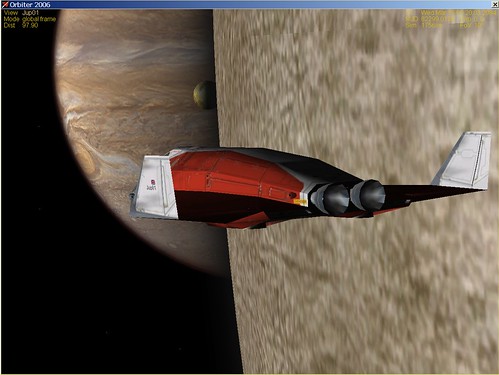
The picture here is not exactly a floating city, but it is the only graphic I could quickly locate purporting to show something navigating the clouds of Venus. Simulated clouds of Venus with an Orbiter add-on "space yacht" based on the cover art for a 1970's album by Yes called Yessongs. Google any of that that doesn't make sense to you.
P.S. There are many strange and marvelous add-ons available for the Orbiter space flight simulator. I have pictures of many of them on my Flickr site.
Labels:
add-on,
blog,
Orbiter,
solar system,
space settlements,
technology
Friday, June 07, 2013
iPad Astronomy
I love my iPad Mini. It follows me everywhere and is the most wonderful little tool for reading books and magazines, creating music, studying Japanese, and exploring the Universe, to name only a few frequent uses I have for it. I have around 13 astronomy and space related apps on my iPad right now, including my favorite "game," F-Sim Space Shuttle (I probably have bought a dozen more astronomy/space apps not currently installed - 32 gigabytes is not as big as it sounds). Back in April, I wrote about one of my favorite apps, Exoplanet. Recently I've found a few other astronomy apps that are really awesome. Here's some info on two of them.
Luminos is currently my favorite general astronomy or "planetarium" app. It is beautiful and packed with features, more than I have really managed to learn so far, although I can't say the interface is poor - it's just that there's a lot of stuff to see and do. It is comparable to Stellarium, the (free) planetarium program I have used the most on Windows, but of course more portable and with a touch-based UI. I like that in addition to the usual planets, stars, and deep-space objects, it also includes small bodies (comets and asteroids) and satellites. Everything is easily configurable for how much information to collect, update, and display.
Cosmographia is one of two really beautiful astronomy apps from Fifth Star Labs LLC (the other one is Sky Guide, which is based on real astrophotography and has the interesting feature of assigning musical tones to different types of sky objects when you touch them). Cosmographia is focused on the solar system, and it reminds me in some ways of my favorite (free) space flight simulator for Windows, Orbiter, though it doesn't include the user-controlled space flight aspects of Orbiter. It is wonderful for tooling around the solar system, exploring the planets and their moons, as well as various minor objects and spacecraft including including Cassini (Saturn), ISS (Earth), Galileo (Jupiter), the two Voyagers (now leaving the solar system), and several others. Each of these typically includes one or more "highlights" which are scripts you can select to run a simulation of an event such as a close fly-by of Enceladus by Cassini (select the spacecraft, then the circled i for info, then scroll down to the mission highlight links at the bottom).
This is the part that most reminds me of a replay in Orbiter (though in Orbiter you have the ability to define or change spacecraft encounters by flying the spacecraft yourself, assuming you have learned the operations and orbital mechanics needed to do this, as explained in my free e-book Go Play In Space). The planetary and spacecraft graphics are beautiful, and there is also extensive information on each of the objects. You have full control over time, so you can also use this app to see the positions of the planets at any given time and date, as well as control time acceleration to speed things up and observe the motions. The app is very configurable. You can see and control orbit trails, stars, asteroids, labels, etc. You can even watch Curiosity (MSL) approach Mars and enter its atmosphere - in theory anyway. If you choose one of these highlights, it works for a while, but when it gets close to Mars - poof! MSL just disappears, showing up as a labeled dot on the surface that you can't zoom into. Aside from that small defect, this app looks and works great, and I highly recommend it to fans of the solar system and space exploration.
Luminos is currently my favorite general astronomy or "planetarium" app. It is beautiful and packed with features, more than I have really managed to learn so far, although I can't say the interface is poor - it's just that there's a lot of stuff to see and do. It is comparable to Stellarium, the (free) planetarium program I have used the most on Windows, but of course more portable and with a touch-based UI. I like that in addition to the usual planets, stars, and deep-space objects, it also includes small bodies (comets and asteroids) and satellites. Everything is easily configurable for how much information to collect, update, and display.
Cosmographia is one of two really beautiful astronomy apps from Fifth Star Labs LLC (the other one is Sky Guide, which is based on real astrophotography and has the interesting feature of assigning musical tones to different types of sky objects when you touch them). Cosmographia is focused on the solar system, and it reminds me in some ways of my favorite (free) space flight simulator for Windows, Orbiter, though it doesn't include the user-controlled space flight aspects of Orbiter. It is wonderful for tooling around the solar system, exploring the planets and their moons, as well as various minor objects and spacecraft including including Cassini (Saturn), ISS (Earth), Galileo (Jupiter), the two Voyagers (now leaving the solar system), and several others. Each of these typically includes one or more "highlights" which are scripts you can select to run a simulation of an event such as a close fly-by of Enceladus by Cassini (select the spacecraft, then the circled i for info, then scroll down to the mission highlight links at the bottom).
This is the part that most reminds me of a replay in Orbiter (though in Orbiter you have the ability to define or change spacecraft encounters by flying the spacecraft yourself, assuming you have learned the operations and orbital mechanics needed to do this, as explained in my free e-book Go Play In Space). The planetary and spacecraft graphics are beautiful, and there is also extensive information on each of the objects. You have full control over time, so you can also use this app to see the positions of the planets at any given time and date, as well as control time acceleration to speed things up and observe the motions. The app is very configurable. You can see and control orbit trails, stars, asteroids, labels, etc. You can even watch Curiosity (MSL) approach Mars and enter its atmosphere - in theory anyway. If you choose one of these highlights, it works for a while, but when it gets close to Mars - poof! MSL just disappears, showing up as a labeled dot on the surface that you can't zoom into. Aside from that small defect, this app looks and works great, and I highly recommend it to fans of the solar system and space exploration.
Labels:
astronomy,
NASA,
Orbiter,
solar system,
space history,
technology
Thursday, May 30, 2013
Why Would Aliens Care About Us?
I somehow came across this blog post the other day, "Why we'll never meet aliens." I'm familiar with the Fermi Paradox (if there are smart aliens, where are they?). There are a lot of assumptions built into that question, and a lot of possible explanations. But as imaginative as humans are (or imagine themselves to be), it's hard to get around the sample size problem. Everything we know about how intelligent creatures can be expected to behave is based on observing ourselves. If you expand that to other Earth life forms that are intelligent (other apes, whales, crows, etc.) or even just "interesting," you can certainly expand the range of possible adaptations (hive behavior, long lifetimes, different types of senses, metamorphosis, etc.). But all of these life forms evolved on this planet, and only one of them is known to possess the means to communicate or travel across space, or even to be curious about worlds other than this one. That is us. Are us. Sample size, N=1 for my purposes here.
One of the functions of science fiction is to go beyond that limited view, to imagine very different forms of life, intelligence, culture, and technology. There are zillions of examples of this, from the abysmal to the sublime. In "popular" SF (I'm thinking of most SF movies), writers tend to stay pretty close to human forms or at least motivations. This makes it easier to understand the story in terms of good guys and bad guys. Sometimes the bad guys (mysterious aliens) do pretty dumb things, like coming to Earth to take our water, because they need hydrogen (dudes, hang a right at Mars and check out Jupiter). That's one of the arguments of the "never meet aliens" blog post I found. They don't need us! They've got faster than light travel and they know where to find hydrogen (and anti-hydrogen) if they need some. They've been scooting through wormholes for millions of years, and they've seen all the possible forms of life. Humans? Yawn.
I mostly buy that. By the principle of mediocrity, our star and planet are nothing special (we've recently identified hundreds of planets orbiting other stars). We don't know how easily life starts (N=1 again), but we probably aren't very special in that regard either (although life had to emerge first SOMEWHERE in the universe, and it could be that we are that special - there's no way to know right now - just like someone wins the lottery, just never you). So I agree, it doesn't appear that we have much to offer an advanced alien life form.
Or do we? What is likely to be interesting or valuable to really old, advanced, intelligent entities? Maybe information. We have a lot of that here. Not so much in our computers and networks (though it's getting there), but rather in all the genetic material for all the millions of lifeforms on this planet. Although there may be similar beings elsewhere (filling similar ecological niches, much the way wolf-like creatures evolved independently in Australia - they happen to be marsupial and extinct, but OK), there is likely to be no life form elsewhere with exactly the same genetic signature as any particular species here on Earth. Evolution is a very big, parallel processing computer program that has been running for millions of years and generating millions of locally optimized solutions to the problem of living in some part of this world. The solutions (and programs) are recorded on tiny "reels of tape" called DNA.
That's the basic idea of a great SF trilogy I read in the last few days, Lilith's Brood (which collects all three original books) by Octavia Butler, although it's a lot more interesting than I've made it sound so far! Written in the late 1980's, it starts with a nuclear war on Earth that very nearly wipes out humanity. But it turns out that a race of life-craving and life-preserving aliens have been studying us for some time from gigantic spaceships lurking in our stellar neighborhood, and they come in and rescue and heal a large number of surviving humans. Why? For a captive breeding program, basically. Wait, no, it's not what you think! Mars Needs Women, right? Vonnegut's zoo on Tralfamadore? No, it's not like that, but in a way it is, and that's what makes these books so confusing and engaging.
This blog post is already longer than I intended, so I won't attempt to summarize or review the books in detail. Some consider them to be an allegory on colonialism and slavery. I can see that, but I thought they were more about what it means to be alive, to be "a people," and what it is that is valuable about life, any life. And why anything would "want" to live. While there is plenty of incidental technology (most of it could be considered extreme genetic engineering), that is not the main point. The Oankali have starships (organically grown!) but there is no discussion of their propulsion or the nature of space-time. Almost all of the book is about interpersonal relationships.
The Oankali are natural genetic engineers who can sense and manipulate genetic material as easy as you and I use a fork and knife. They crave new life forms, and they engage in genetic "trade" - integrating novel genetic "programs" into their own bodies to drive their own evolution (human cancer was a real find, like a fancy power tool if you learn how to harness its power, as they quickly do). They don't intentionally destroy life - unless you consider hijacking your reproductive system for the purpose of creating hybrid or "construct" children to be "destroying life." They certainly destroy "life as we know it," but humans would have become extinct if the Oankali had not come along. The Oankali value, preserve, and extend life, but they do not value any particular form of life. Their people have "traded genes" with many planets' species, and in so doing have changed their physical nature completely. While they will incorporate human DNA and adopt some human characteristics in the process, it is not in their "charter" to preserve the the culture or other defining characteristics of humans and human society. This is where the colonial and slave trade parallels really come to the fore - although the Oankali don't label the humans as "primitive" as Europeans once labeled native people they conquered (all genetic information is potentially useful!), neither do they honor or preserve most of the things humans consider important.
It sounds weird, I know, but the writing and characters are really wonderful. I still don't really know what I think about all of it. But I do believe that if there is any reason for other intelligent beings to be interested in us, it could be in the immense complexity and diversity of DNA that is within the genes of every plant and animal on Earth, including us. They can fill their hydrogen tanks at the nearest gas giant before they drop by here.
One of the functions of science fiction is to go beyond that limited view, to imagine very different forms of life, intelligence, culture, and technology. There are zillions of examples of this, from the abysmal to the sublime. In "popular" SF (I'm thinking of most SF movies), writers tend to stay pretty close to human forms or at least motivations. This makes it easier to understand the story in terms of good guys and bad guys. Sometimes the bad guys (mysterious aliens) do pretty dumb things, like coming to Earth to take our water, because they need hydrogen (dudes, hang a right at Mars and check out Jupiter). That's one of the arguments of the "never meet aliens" blog post I found. They don't need us! They've got faster than light travel and they know where to find hydrogen (and anti-hydrogen) if they need some. They've been scooting through wormholes for millions of years, and they've seen all the possible forms of life. Humans? Yawn.
I mostly buy that. By the principle of mediocrity, our star and planet are nothing special (we've recently identified hundreds of planets orbiting other stars). We don't know how easily life starts (N=1 again), but we probably aren't very special in that regard either (although life had to emerge first SOMEWHERE in the universe, and it could be that we are that special - there's no way to know right now - just like someone wins the lottery, just never you). So I agree, it doesn't appear that we have much to offer an advanced alien life form.
Or do we? What is likely to be interesting or valuable to really old, advanced, intelligent entities? Maybe information. We have a lot of that here. Not so much in our computers and networks (though it's getting there), but rather in all the genetic material for all the millions of lifeforms on this planet. Although there may be similar beings elsewhere (filling similar ecological niches, much the way wolf-like creatures evolved independently in Australia - they happen to be marsupial and extinct, but OK), there is likely to be no life form elsewhere with exactly the same genetic signature as any particular species here on Earth. Evolution is a very big, parallel processing computer program that has been running for millions of years and generating millions of locally optimized solutions to the problem of living in some part of this world. The solutions (and programs) are recorded on tiny "reels of tape" called DNA.
That's the basic idea of a great SF trilogy I read in the last few days, Lilith's Brood (which collects all three original books) by Octavia Butler, although it's a lot more interesting than I've made it sound so far! Written in the late 1980's, it starts with a nuclear war on Earth that very nearly wipes out humanity. But it turns out that a race of life-craving and life-preserving aliens have been studying us for some time from gigantic spaceships lurking in our stellar neighborhood, and they come in and rescue and heal a large number of surviving humans. Why? For a captive breeding program, basically. Wait, no, it's not what you think! Mars Needs Women, right? Vonnegut's zoo on Tralfamadore? No, it's not like that, but in a way it is, and that's what makes these books so confusing and engaging.
This blog post is already longer than I intended, so I won't attempt to summarize or review the books in detail. Some consider them to be an allegory on colonialism and slavery. I can see that, but I thought they were more about what it means to be alive, to be "a people," and what it is that is valuable about life, any life. And why anything would "want" to live. While there is plenty of incidental technology (most of it could be considered extreme genetic engineering), that is not the main point. The Oankali have starships (organically grown!) but there is no discussion of their propulsion or the nature of space-time. Almost all of the book is about interpersonal relationships.
The Oankali are natural genetic engineers who can sense and manipulate genetic material as easy as you and I use a fork and knife. They crave new life forms, and they engage in genetic "trade" - integrating novel genetic "programs" into their own bodies to drive their own evolution (human cancer was a real find, like a fancy power tool if you learn how to harness its power, as they quickly do). They don't intentionally destroy life - unless you consider hijacking your reproductive system for the purpose of creating hybrid or "construct" children to be "destroying life." They certainly destroy "life as we know it," but humans would have become extinct if the Oankali had not come along. The Oankali value, preserve, and extend life, but they do not value any particular form of life. Their people have "traded genes" with many planets' species, and in so doing have changed their physical nature completely. While they will incorporate human DNA and adopt some human characteristics in the process, it is not in their "charter" to preserve the the culture or other defining characteristics of humans and human society. This is where the colonial and slave trade parallels really come to the fore - although the Oankali don't label the humans as "primitive" as Europeans once labeled native people they conquered (all genetic information is potentially useful!), neither do they honor or preserve most of the things humans consider important.
It sounds weird, I know, but the writing and characters are really wonderful. I still don't really know what I think about all of it. But I do believe that if there is any reason for other intelligent beings to be interested in us, it could be in the immense complexity and diversity of DNA that is within the genes of every plant and animal on Earth, including us. They can fill their hydrogen tanks at the nearest gas giant before they drop by here.
Labels:
books,
science,
social issues,
solar system,
technology
Wednesday, May 01, 2013
JPL's Basics of Space Flight
Serendipity works in mysterious ways. While updating the Kindle app on my iPad, the installation got hung up somehow. I tried various things and finally deleted the app and all its data, i.e., all my local e-books. No worries for the purchased Kindle books as Amazon keeps backups for you on its cloud server. But I also had a bunch of PDF files. I wasn't sure exactly which ones, so I searched my laptop's external drive for larger PDF files. I found several PDF books I had lost or forgotten about, including a wonderful book called The Ascent of Science, and a JPL work called "The Basics of Space Flight."
I wrote about JPL's "Basics" back in 2007. It's a really great educational web site developed by JPL spaceflight engineer Dave Doody. The web site has a number of interactive features (including quizzes) and is maintained and updated by JPL. There have been PDF versions available too, but they have carried a disclaimer that they are not maintained, and past versions were not very nicely formatted (essentially PDF captures of the web pages). When I found a PDF dated 2001, I decided to check JPL for a newer version. Sure enough, I found a 2011 version that Doody had reformatted specifically for e-book and print purposes. It's really great.
The home page for the JPL Basics of Space Flight website is here, and this is definitely the most complete and up-to-date version if you wish to explore interactively. If you want a nicely formatted, albeit slightly older and non-interactive PDF version, click here (it's about 17 megabytes). There is also a paperback version available from Amazon.
In reading the introduction to the PDF, I learned about a more technical book that Dave Doody published in 2009, Deep Space Craft: An Overview of Interplanetary Flight. I read a few pages through Amazon's "Look Inside" feature, and it's definitely a piece of space-geek heaven. But it's a $92 textbook and I wasn't going to buy it (no Kindle version, and I very rarely buy paper books these days). But just now I saw a "like new" copy from a third party seller for $32 so I decided to go for it. What can I say about an addiction?
I wrote about JPL's "Basics" back in 2007. It's a really great educational web site developed by JPL spaceflight engineer Dave Doody. The web site has a number of interactive features (including quizzes) and is maintained and updated by JPL. There have been PDF versions available too, but they have carried a disclaimer that they are not maintained, and past versions were not very nicely formatted (essentially PDF captures of the web pages). When I found a PDF dated 2001, I decided to check JPL for a newer version. Sure enough, I found a 2011 version that Doody had reformatted specifically for e-book and print purposes. It's really great.
The home page for the JPL Basics of Space Flight website is here, and this is definitely the most complete and up-to-date version if you wish to explore interactively. If you want a nicely formatted, albeit slightly older and non-interactive PDF version, click here (it's about 17 megabytes). There is also a paperback version available from Amazon.
In reading the introduction to the PDF, I learned about a more technical book that Dave Doody published in 2009, Deep Space Craft: An Overview of Interplanetary Flight. I read a few pages through Amazon's "Look Inside" feature, and it's definitely a piece of space-geek heaven. But it's a $92 textbook and I wasn't going to buy it (no Kindle version, and I very rarely buy paper books these days). But just now I saw a "like new" copy from a third party seller for $32 so I decided to go for it. What can I say about an addiction?
Labels:
NASA,
orbital mechanics,
solar system,
space history,
technology
Tuesday, July 24, 2012
KSR's 2312 is Very Cool
Although I'm only halfway through it, I am really loving Kim Stanley Robinson's latest science fiction novel, 2312. It's an impressively detailed work that imagines human civilization expanding to nearly the entire solar system over the next 300 years (with Earth itself still suffering a lot of problems stemming from climate change and other factors). There's a city called Terminator on slowly-rotating Mercury (the city itself rides on huge rails in sync with the rotation to stay just at the edge of the transition between the dark side and the deadly sun-lit side of the planet, propelled by solar-heating expansion of the rails!). There are some 19,000 inhabited "terrariums" which are hollowed-out asteroids that rotate to create artificial G. Many different climates, biomes, and social systems are implemented in these asteroid worlds, some of which are in orbits that take them across huge distances in the solar system. So to transfer from Earth to a moon of Saturn, you would first ride a space elevator to orbit, and then take a shuttle that would transfer you to a suitable Saturn-bound asteroid world. Instead of spending weeks in a cramped spacecraft, you might spend those weeks in a 1G beach resort, or in an endangered animal preserve, or in an agricultural world growing food for export to Earth, or even in a low-G "flying world" where you might live something like a bird. Hundreds to thousands of people live in each of these small worlds.
There are a lot of powerful technologies assumed to exist, starting with fusion power, space elevators, self-reproducing assemblers, and quantum computers (personal versions are called qubes). But there is no magic here. While it's not inevitable that these technologies will become practical or widespread, they are physically possible. As usual (from having read Red Mars and Green Mars), KSR is at least as interested in social possibilities as he is in technical ones. And there are some weird ones in 2312. There's also a mystery and a love story or two buried in this book.
It's also interesting what a writer like Robinson can do with a very specialized piece of science - such as the braided or perhaps kinked F-ring system of Saturn (pictured above). Doesn't that look sort of wave-like? And where there are waves, surely you will have surfers, right? Some residents of the cities on Saturn's moons like to fly to one of the "shepherd moons" that give the F-ring its gravity-sculpted structure, and from there, they have figured out how to surf these narrow waves made of ice blocks! Yes, they wear spacesuits with thruster rockets, and they surf the F-ring. He even makes it sound sort of plausible. This is shown in one incidental scene between two of the main characters, Swan and Wahrom.
A funny thing about Swan: She is from Mercury, and she is an impulsive risk taker who has tried all sorts of bizarre things in her young 110 year life (most "spacers" live to around 200, with periodic DNA repair and other longevity treatments). She is really a wild character, an artist whose whole life seems to be a sort of over-the-top performance art. Just when I started reading about Swan, I happened to start listening to the new Fiona Apple album, and I watched her bizarre video for "Every Single Night." From this coincidence, Swan and Fiona have fused in my mind. So I picture Fiona when I read about Swan's latest odd adventure.
Although some reviewers are bothered by certain devices that KSR uses in this book, such as lists and excerpts of supposedly technical or historical documents (from the future), I think these brief inter-chapter devices allow KSR to fill in the back story and set the many scenes in a relatively compact way so he can cover the whole solar system and multiple characters and story lines without drowning the reader in too much detail (it's about 570 printed pages, though I am reading it on Kindle myself). Highly recommended if you like imaginative hard SF. There's a cool interview with Robinson from June 2012 here.
There are a lot of powerful technologies assumed to exist, starting with fusion power, space elevators, self-reproducing assemblers, and quantum computers (personal versions are called qubes). But there is no magic here. While it's not inevitable that these technologies will become practical or widespread, they are physically possible. As usual (from having read Red Mars and Green Mars), KSR is at least as interested in social possibilities as he is in technical ones. And there are some weird ones in 2312. There's also a mystery and a love story or two buried in this book.
It's also interesting what a writer like Robinson can do with a very specialized piece of science - such as the braided or perhaps kinked F-ring system of Saturn (pictured above). Doesn't that look sort of wave-like? And where there are waves, surely you will have surfers, right? Some residents of the cities on Saturn's moons like to fly to one of the "shepherd moons" that give the F-ring its gravity-sculpted structure, and from there, they have figured out how to surf these narrow waves made of ice blocks! Yes, they wear spacesuits with thruster rockets, and they surf the F-ring. He even makes it sound sort of plausible. This is shown in one incidental scene between two of the main characters, Swan and Wahrom.
A funny thing about Swan: She is from Mercury, and she is an impulsive risk taker who has tried all sorts of bizarre things in her young 110 year life (most "spacers" live to around 200, with periodic DNA repair and other longevity treatments). She is really a wild character, an artist whose whole life seems to be a sort of over-the-top performance art. Just when I started reading about Swan, I happened to start listening to the new Fiona Apple album, and I watched her bizarre video for "Every Single Night." From this coincidence, Swan and Fiona have fused in my mind. So I picture Fiona when I read about Swan's latest odd adventure.
Although some reviewers are bothered by certain devices that KSR uses in this book, such as lists and excerpts of supposedly technical or historical documents (from the future), I think these brief inter-chapter devices allow KSR to fill in the back story and set the many scenes in a relatively compact way so he can cover the whole solar system and multiple characters and story lines without drowning the reader in too much detail (it's about 570 printed pages, though I am reading it on Kindle myself). Highly recommended if you like imaginative hard SF. There's a cool interview with Robinson from June 2012 here.
Labels:
books,
future,
science,
social issues,
solar system,
space settlements,
technology
Monday, February 13, 2012
Wow! Scale of the Universe 2 (Interactive Flash)
Yes, there are a lot of things that are "the coolest thing ever," but this is definitely in the running for that illustrious and ever-changing title. "The Scale of the Universe 2" is an interactive Flash activity with a slider that goes from a scale of 10**(-35) meters (ten to the minus thirty-fifth power, very small) to 10**27 meters (bigger than the known universe).
This "interactivity" was created by Cary Huang. It's similar to the famous "powers of ten" movie except you can control it in both scale and speed (about 13 seconds to go from smallest to largest at maximum scroll rate) and you can click on objects to learn more about them. It comes complete with spacy background music. Awesome! Thanks to Matt Bors for posting this on Facebook.
Labels:
astronomy,
education,
games,
science,
simulation,
solar system,
technology
Tuesday, December 13, 2011
Exploring Space With Your Computer (Again)

In April 2009, I contributed to the International Year of Astronomy daily podcast series with a podcast called "Exploring Space With Your Computer." It featured audio dramatizations of a mission to Europa and the final seconds of the Apollo 11 moon landing, as simulated in the free Orbiter spaceflight simulator. It also discussed the free planetarium program Stellarium and a few other free tools for exploring space from the comfort of your computer keyboard. I used sound effects from Orbiter and also wrote and recorded a spacey-sounding musical soundtrack for the podcast. It was fun to do.
The daily astronomy podcast program has continued beyond 2009, and today "Exploring Space With Your Computer" is being featured as a "classic" thanks to someone's unexpected cancellation. It's nice to be featured, even as a rerun. I posted a set of Orbiter screenshots illustrating my simulated space adventures on Flickr. You can read more about the podcast (including web links) in this 2009 blog post. The podcast series is continuing into 2012 - maybe I'll even find time to do a new podcast next year.
Labels:
astronomy,
blogs,
education,
Flickr,
music,
Orbiter,
simulation,
solar system,
space history
Wednesday, September 07, 2011
JPL Wants YOU!
September is the only month in which you can apply to become a JPL Solar System Ambassador. This is a great volunteer program for educational and community outreach on space exploration and astronomy themes. If you have an interest in space exploration, enjoy sharing your enthusiasm with others, and would like to learn more about space exploration yourself, this program might be just the thing for you! Although I haven't been as active recently as I was a few years ago, I've really enjoyed the outreach events I have done and the training I've received as a Solar System Ambassador. And you have to admit it's a cool title.
You can find more information and a link to the application here. The program only operates in the United States.
Sunday, July 11, 2010
Pocket Solar System
There are a number of great astronomy and space apps for the iPhone and iPod Touch, and I've discussed some of them here before. I just got a new one called Solar Walk - 3D Solar System (it's "3D" because it actually supports red/green 3D glasses for some images, though I didn't find this to be very exciting on the iPod Touch). Although it's easy to tool around the solar system in Orbiter (free space flight simulator for Windows), Solar Walk is available in my pocket and is better for certain "big picture" questions about the solar system.
Case in point: the recent prominent alignment of Venus, Mars, and Saturn in the early evening western sky. Here's a screen shot from Star Map on the iPod Touch showing their positions this evening around 19:40 local time:
Why are they showing up that way? If you launch Solar Walk and touch the little orbital diagram icon, you can pull up an interactive "orrery" that shows the correct relative positions of the planets in their orbits for any given date and time. Here it is for this evening at about the same time as the above sky shot:
So you can see how this apparent alignment occurs from the positions of Venus, Mars, and Saturn in their orbits (of course the sizes of the planets and orbits in this diagram view are not correct - they need to be visible on the small display - but the angular positions are correct). Solar Walk also lets you zoom in on the planets and their moons - enough to see the main features of each planet, though not very close up. There is also a fair amount of information on each body and on the spacecraft that have visited it as in this screen about Saturn:
There's nothing right now on dwarf planets and asteroids, but what it has is really useful for understanding and explaining what is happening with the main members of our solar system.
Case in point: the recent prominent alignment of Venus, Mars, and Saturn in the early evening western sky. Here's a screen shot from Star Map on the iPod Touch showing their positions this evening around 19:40 local time:
Why are they showing up that way? If you launch Solar Walk and touch the little orbital diagram icon, you can pull up an interactive "orrery" that shows the correct relative positions of the planets in their orbits for any given date and time. Here it is for this evening at about the same time as the above sky shot:
So you can see how this apparent alignment occurs from the positions of Venus, Mars, and Saturn in their orbits (of course the sizes of the planets and orbits in this diagram view are not correct - they need to be visible on the small display - but the angular positions are correct). Solar Walk also lets you zoom in on the planets and their moons - enough to see the main features of each planet, though not very close up. There is also a fair amount of information on each body and on the spacecraft that have visited it as in this screen about Saturn:
There's nothing right now on dwarf planets and asteroids, but what it has is really useful for understanding and explaining what is happening with the main members of our solar system.
Labels:
astronomy,
education,
solar system,
technology
Saturday, July 10, 2010
Sweet, Rosetta!
ESA's Rosetta spacecraft today made its closest approach to the asteroid 21 Lutetia and ESA has posted some high-res images but so far no captions. I think this one with Saturn in the distance is very cool. I played around a bit with a cool Rosetta add-on for Orbiter back in 2007 and 2008. The screen shot below shows an unrealistically close simulated pass (43 km!) of asteroid Steins which actually took place in 2008. Steins is located in the main asteroid belt between the orbits of Mars and Jupiter, as is Lutetia, but Lutetia is a much bigger asteroid, about 100 km in diameter, the largest one yet to be visited by a spacecraft. The Steins encounter took place during Rosetta’s first incursion into the main asteroid belt while on its way to visit Comet 67P/Churyumov-Gerasimenko. You could certainly say that Rosetta gets around.
Tuesday, June 22, 2010
Not In My Back Yard...
...but I wish it was! What a great educational aid it would be to have a scale model solar system with Earth the size of maybe a basketball (roughly 56 million to one). The orbits are in order but of course not to scale for orbital distance - that would require a lot of land. This could be my next landscape architecture project (though my wife probably has other ideas).
Update: the sun doesn't appear to be in scale, but it's rather foreshortened in this view so you can't tell that it's really just a small chord of the sun's circular disk and it could easily be 9.7 Jupiter radii if you extended it.
Thursday, April 22, 2010
SDO: Amazing Sun Images
These will be all over the web but I simply have to point out the amazing first-light images and videos from NASA's Solar Dynamics Observatory (SDO). You can probably find some video clips on YouTube, but it's worthwhile to download the 29 MB QuickTime to see all the detail in the March 30 prominence that is shown in still frame here. You can find more first light images in this gallery.
Sunday, March 07, 2010
Voyager's Grand Tour
I've been reading a book I found on a sale table at the Toadstool Bookshop in Keene, NH last weekend (great bookstore, BTW). Voyager's Grand Tour: To the Outer Planets and Beyond by Henry Dethloff and Ronald Schorn (2009). Among other things, the authors do a great job of setting the scene in terms of how little anyone knew about the outer solar system before Voyager 1 and Voyager 2 flew by Jupiter and Saturn between 1979 and 1981 (and in the case of Voyager 2, Uranus and Neptune from 1986 to 1989). Pioneers 10 and 11 had gathered some information (we were really clueless before 1973), but the quality and quantity of imagery and scientific data was so much greater for the Voyagers.
The moons of the outer planets were hardly known at all, but were somehow considered unlikely to be very interesting. Voyager 1 dramatically altered that view when it sent back imagery and data showing that there are active volcanoes on Io. The Voyager program was an amazing success. Of course we now know much more about Jupiter (Galileo orbiter) and Saturn (Cassini orbiter), but Voyager 2 is still the only spacecraft to have visited Uranus and Neptune.
Labels:
astronomy,
books,
NASA,
solar system,
space history
Wednesday, February 17, 2010
New 3D Sun App
I just learned about 3D Sun, a new free app for iPhone and iPod Touch. It uses data from NASA's STEREO solar observation satellites to produce a zoomable, spinnable, false-color image of the sun in several selectable wavelengths, updated on a daily basis. It also provides news and alerts on solar events. I downloaded it and tried it out - it's pretty cool considering you're holding the sun in the palm of your hand.
Wednesday, October 21, 2009
Warm-Blooded Plants and Freeze-Dried Fish
Somehow I stumbled on a 1997 Atlantic article by Freeman Dyson, "Warm-Blooded Plants and Freeze-Dried Fish." It's about space exploration and the prospects for humans to (eventually) explore and even colonize the solar system and beyond. Dyson is a distinguished scientist and writer and is well-known (I debated between renowned and notorious) for his independent and often contrary views on certain issues, most recently on the (possibly not-so-terrible) effects of climate change.
In the 1997 space article, I found myself agreeing with a lot of what he had to say (recall that 1997 was the year of Mars Pathfinder and NASA's period of "fast, cheap, and out of control" unmanned spacecraft, which clearly influenced some of his comments). For example, the case for continuing the shuttle and space station programs was not especially compelling (though they would go on for 12+ more years, even surviving a second shuttle disaster). But there are a lot of interesting things in the solar system, and with our rapidly advancing technologies and (eventual) ability to do things in space much more cheaply, places like Mars and Europa could (eventually) be well-worth exploring, though searching for freeze-dried fish orbiting in the vicinity of Europa is perhaps not the best strategy for finding life there (the Europafish would have been ejected by energetic objects crashing through the ice to Europa's hidden ocean - admittedly not a high-probability event). Warm-blooded plants and Mars plants that grow their own green-houses - if nature hasn't evolved them, we could (eventually) genetically engineer them. Maybe even really big ones to use as human shelters on Mars (greenhouse trees!).
Dyson ends up talking about harvesting comets and colonizing the Kuiper Belt - a pretty far-out notion indeed (though not as far as the Oort Cloud Housing Developments). I kept using the word "eventually" in the above discussion. Dyson's key point in all this is the need to be realistic about the goals and the timing. He says, "When emigration from Earth to a planet or a comet becomes cheap enough for ordinary people to afford, people will emigrate." But regardless of what Apollo accomplished in 10 years, the time scale for human expansion into the greater solar system is probably more like hundreds than tens of years.
This is where I'm afraid he may be right, though it's possible that accelerating technologies and/or one or more major global crises (man the lifeboats!) will speed things up a bit. But I still think it's right to aggressively pursue manned and unmanned space flight now, perhaps with more of it given over to the commercial side. As I wrote in 2007 in a discussion of John Barnes' "Kaleidoscope Century" SF series:
In the 1997 space article, I found myself agreeing with a lot of what he had to say (recall that 1997 was the year of Mars Pathfinder and NASA's period of "fast, cheap, and out of control" unmanned spacecraft, which clearly influenced some of his comments). For example, the case for continuing the shuttle and space station programs was not especially compelling (though they would go on for 12+ more years, even surviving a second shuttle disaster). But there are a lot of interesting things in the solar system, and with our rapidly advancing technologies and (eventual) ability to do things in space much more cheaply, places like Mars and Europa could (eventually) be well-worth exploring, though searching for freeze-dried fish orbiting in the vicinity of Europa is perhaps not the best strategy for finding life there (the Europafish would have been ejected by energetic objects crashing through the ice to Europa's hidden ocean - admittedly not a high-probability event). Warm-blooded plants and Mars plants that grow their own green-houses - if nature hasn't evolved them, we could (eventually) genetically engineer them. Maybe even really big ones to use as human shelters on Mars (greenhouse trees!).
Dyson ends up talking about harvesting comets and colonizing the Kuiper Belt - a pretty far-out notion indeed (though not as far as the Oort Cloud Housing Developments). I kept using the word "eventually" in the above discussion. Dyson's key point in all this is the need to be realistic about the goals and the timing. He says, "When emigration from Earth to a planet or a comet becomes cheap enough for ordinary people to afford, people will emigrate." But regardless of what Apollo accomplished in 10 years, the time scale for human expansion into the greater solar system is probably more like hundreds than tens of years.
No law of physics or biology forbids cheap travel and settlement all over the solar system and beyond. But it is impossible to predict how long this will take. Predictions of the dates of future achievements are notoriously fallible. My guess is that the era of cheap unmanned missions will be the next fifty years, and the era of cheap manned missions will start sometime late in the twenty-first century. The time these things will take depends on unforeseeable accidents of history and politics. My date for the beginning of cheap manned exploration and settlement is based on a historical analogy: from Columbus's first voyage across the Atlantic to the settlement of the Pilgrims in Massachusetts was 128 years. So I am guessing that in 2085, 128 years after the launch of the first Sputnik, the private settlement of pilgrims all over the solar system will begin.
But space (private, public, whatever) could be part of a solution, could be a tool or a lifeboat or even a source of major help for this troubled Earth. Someday we may need every kind of tool we can get, and when we do, we will be glad for whatever preparation we have made in learning to live somewhere other than here. I don't expect everyone to get inspired by it - my most hopeful scenario for educational outreach is that a handful of kids get excited about learning something, get themselves educated, and start to tie a few knots for the flimsy rope bridge we are building toward the future, even while some other kids are playing with matches, trying to light the ropes on fire. And maybe some of the ropes are actually carbon nanotubes stretching thousands of kilometers into the sky.The process of building and living for months aboard the ISS may seem expensive now, but if we ever do have a major crisis in which the survival of our species requires getting a small fraction of us off the planet in a hurry, we will be grateful for this experience when we are hollowing out our first asteroid and building our first housing project on Mars.
Labels:
future,
ISS,
Mars,
private space,
solar system,
space settlements,
technology
Tuesday, April 21, 2009
Great Cassini Photo Collection
The Boston Globe has a great photo journalism series called The Big Picture which covers a wide range of newsworthy and photo-worthy subjects. Most recently: Cassini's Continued Mission with 24 awesome images of Saturn and its rings and moons. It's "continued" because Cassini's original four-year mission ended in June 2008, but the spacecraft remains in great health and the funding was made available. The extended "Cassini Equinox" mission will run through September 2010, with further extensions possible after that. NASA/JPL image.
Subscribe to:
Comments (Atom)