Monday, November 17, 2008

Mozart Music Videos


Mozart's career predated most of the music video era (OK, he missed it by a good 200 years). But you can still find Mozart videos on YouTube (a search for "Mozart" returns about 100,000 results!). Many of them are recorded performances, while others are essentially musical slide shows. In the latter category there are a few "top 10" types of videos, with excerpts of the video maker's favorite Mozart compositions. I usually don't like to break up Mozart's work, preferring to listen to a full composition rather than selected movements. But some of the video slide shows are interesting, and may even serve to remind me of pieces I had forgotten about, such as the wonderful Horn Concerto in E flat (K.495).

The video here is a good example although they could have done a better job cross-fading between the excerpts. Whether this truly represents the "best of Mozart" is hard to say, but several of the pieces here are favorites of many people. If you don't know Mozart, you could perhaps start to get an idea of the richness and diversity of his work here - and if you hear something you like, seek out a complete performance on the web or at the library. Another approach is to go rent the movie Amadeus. While it takes major liberties with the facts of Mozart's final years, it captures some of his spirit, and it does contain an excellent selection of his music.

Here are the eight pieces excerpted in this 9 minute YouTube slide show, with the start time in minutes for each piece:
  1. Overture from The Marriage of Figaro, K.492
  2. Clarinet Concerto in B Flat, 1st Movement, K.622 (1:44)
  3. Wind Serenade "Gran Partita," 3rd Movement, K.361 (2:28)
  4. Piano Concerto 21, 2nd Movement, K.467 (3:30)
  5. Symphony No. 40 in G minor, 1st Movement, K.550 (4:50)
  6. Eine Kleine Nachtmusik, 1st Movement, K.525 (6:03)
  7. Horn Concerto No. 4: 3rd Movement, K.495 (6:50)
  8. Requiem: Introitus (Requiem aeternam),K.626 (7:41)

Happy birthday ISS

Happy Birthday ISS (10 years)

It's a few days early, but I want to wish the International Space Station a happy 10th birthday. The Russian Zarya module was launched on November 20, 1998, and of course many modules have been added since then to create the gigantic orbiting laboratory we have today. Right now the crew of the shuttle Endeavour (STS-126) is visiting the ISS to deliver and install the expanded life support and other facilities needed to support six station crew members. It's great that they will have a big team on hand for the tenth anniversary - I imagine they have some sort of celebration planned in addition to the turkey dinners they've carried up for Thanksgiving.

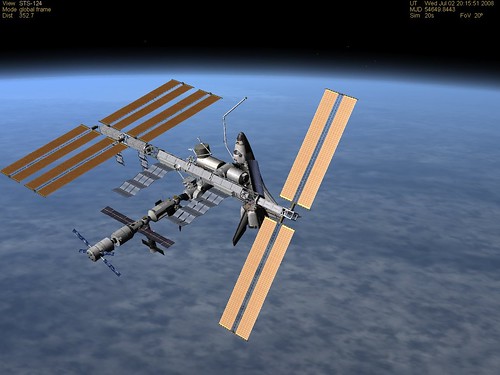
The picture is from Orbiter, showing the ISS in July 2008 during STS-124. There's another view (above New England) on Flickr. If you want to re-enact the evolution of the ISS on your own, you can do so with the help of David413's great ISS Fleet add-on for Orbiter. There are a few predefined scenarios including STS-88, the first shuttle flight to the ISS in December 1998, which delivered the Unity node, the first American component of the ISS.

The PDF manual for the ISS Fleet has pictures of all the ISS configurations with designations like ISS4A (circa 2000). There isn't a scenario for every configuration, but you can easily modify one of the scenarios in the ISS Fleet Scenarios folder with a text editor. Find the line that says ISS:ISS2A (for example, after "BEGIN_SHIPS") and change it to ISS:ISS4A (say) and save it under another name (maybe ISS4A.scn). Your new scenario will include the station with that configuration. The other parts of the scenario (shuttle, positions, date, etc.) won't change from the starting file. Note that the ISS Fleet is a separate add-on from the Shuttle Fleet (find the most recent shuttle/ISS fleet add-ons and mission scenarios including STS-126 here).

Carnival of Space #79

This week's Carnival of Space is number 79 (I missed a few in the hustle and bustle of the election and a trip to Austria). Your host is One Astronomer's Noise (tag line "one astronomer's noise is another astronomer's data"). Nicole is an astronomy graduate student at the University of Virginia, and she's presented us with a bunch of interesting posts to explore. Naturally the "stars" of the week aren't stars at all, they're the exoplanets of Fomalhaut and HR8799 (pictured) that have recently been directly imaged. Check out the latest Carnival of Space.

Sunday, November 16, 2008

Solar System Tour Guide


This 28 minute video is from "Serious Play," a conference held at the Art Center College of Design in Pasadena, California this past May. The speaker in this case was Dr. Charles Elachi, director of the nearby Jet Propulsion Laboratory. As JPL's director (and in previous positions), he has had a lot of involvement with planetary exploration, and he devotes most of his talk to Mars missions, including the Mars Rovers, Phoenix (which would launch a few weeks after he gave this talk), and the upcoming Mars Science Laboratory. There are some good simulation segments in the presentation, as well as a bit of humor.

Team of Rivals?

Many people are going through election withdrawal. Me too. I was never as involved with a presidential election as I was with this one - practically and emotionally. I spent a lot of time making phone calls to New Hampshire, and spent a few weekend days canvassing up there for Obama. I donated and raised money. I watched the polls, read the news and the blogs, and I worried. Obama's decisive victory was an enormous relief.

Now we're in the transition, with a backdrop of economic news that seems to get worse and worse. As the many challenges continue to grow, everybody wonders whether Obama will be able to deliver on the promises of the campaign.

Time will tell, but he is clearly trying to keep the American people informed and involved even during the transition as he works to build the team that will help him to govern effectively from day one. By registering with the web site change.gov, you can contribute your ideas and comments. You can also follow transition developments through blog posts, news items, and videos. Yesterday the President-elect delivered his second weekly post-election radio address, and for the first time it was released as a YouTube video as well. This looks like a twenty-first century version of FDR's Depression era radio "fireside chats." I hope he will continue to deliver these weekly addresses directly to the American people once he is in the White House - and I expect that he will.

Although they are trying to keep the cabinet selection process confidential, it has been widely reported that Hillary Clinton is under consideration for Secretary of State. This is a strong indication that Obama is working to build a "team of rivals" in the spirit of Lincoln's first cabinet. He mentioned that he admires Doris Kearns Goodwin's book Team of Rivals: The Political Genius of Abraham Lincoln and he has stated that he intends to build a bipartisan team from the best people available. While this sounds like a bold idea for the sake of the country, a team of rivals in the modern political world of microscopic scrutiny and instant communication could also be tough to manage. I'm thinking the Obama Administration is going to be as innovative and exciting as the campaign was, and I'm looking forward to it. Meanwhile I've bought Team of Rivals and have just started reading it. With interwoven biographies of four people (Lincoln, Seward, Chase, and Bates), it's a long book, but so far it's quite an enjoyable read.

P.S. Doris Kearns Goodwin spoke about learning from past presidents (with examples from Lincoln and Lyndon Johnson) at a TED conference in February 2008, video here. She summarizes many of the key points of Team of Rivals in this brief talk.

Friday, November 14, 2008

Night Launch

I watched NASA TV for a couple of hours this evening, culminating in the beautiful night launch of the shuttle Endeavour on STS-126. I would sure like to see a night launch in person, but I'm not sure I'll be able to work that out before they retire the shuttles in 2010 (or maybe later if they decide to fund some additional missions, as President-elect Obama had discussed during the campaign - before the current economic crisis). At least I got to see one shuttle launch, which was also Endeavour (on STS-118 back in the summer of 2007). An awesome experience.

Planets!

If you pay attention to space and astronomy news, you've certainly heard about this already - it was even a top five popular news items on Yahoo earlier today. But I have to chime in to say that direct imagery of planets orbiting stars other than the sun is simply an amazing accomplishment, one that I didn't expect we would see for a few more years. But thanks to the ever amazing Hubble Space Telescope and the wonders of adaptive optics coupled with large ground based telescopes, we've now seen exoplanets "with our own eyes"- four planets orbiting two different stars!

"With our own eyes" is not literally true, of course, but compared to inferences made from photometry curves (when a planet passes in front of the star, the star's light dims) or gravitational "wobble" (tracking small deviations in the star's position caused by orbiting planets), this is truly the realm of "seeing is believing." It opens the door to spectral analysis of the light reflected from these faraway planets, and although we can only see quite large planets now (several times the mass of Jupiter), it may not be too long before we can detect a "pale blue dot" like the one seen by the Voyager spacecraft when they looked back toward home en route to the outer planets of our solar system.

I grabbed today's Astronomy Picture of the Day for the nice labeling of the planet Fomalhaut b and its accompanying dust ring. Talk about a needle in a haystack! This is a planet that is 25 light-years from Earth, pretty much a next door neighbor in the the cosmic scheme of things.

Thursday, November 13, 2008

Beyond the Moon

The Planetary Society has released a "Roadmap to Space," a free 20 page PDF document on the future of human spaceflight that proposes an approach somewhat different from the Vision for Space Exploration. Under the Vision, NASA seems to have become fixated on returning to the moon, with Mars and anything else in the solar system as mere afterthoughts. This "roadmap" (actual title "Beyond the Moon") still supports NASA building the Ares launch vehicles and the Orion spacecraft, but bypasses the moon as a primary target or even a necessary intermediate stage.

Instead they propose that Orion be modified to support flights "beyond the moon," most likely to visit near-Earth asteroids (NEA's, as discussed here) as a way of showing that we can move beyond duplicating what we did 40 years ago with Apollo. They claim we could save money by deferring the building of lunar bases and the new lunar lander. Mars would be the explicit ultimate goal, with moon landings to be done in the interim only as needed to prove out landing systems and the like. Deep space missions to NEA's might better prepare us for the long flights needed for Mars, though I would want something a bit more roomy than Orion for any multi-month mission.

Many people think the moon is interesting in its own right, as a possible source of materials and as a large and stable platform in near-Earth space. But there is a certain allure in doing something totally new... boldly going where no man (or woman) has gone before. The Planetary Society's pitch is clearly aimed at the new president, in hopes that he will refocus the Vision on something really new, and in the process get more people interested in the space program (and fund it, too). I'm not sure if we can sneak past the moon or not, but trying for something farther out would certainly result in more robust and flexible systems for long-duration spaceflight (some of which could be tested on the ISS). Whether the public imagination can truly be engaged with long space voyages to small objects depends a lot on how it's done, and on how much involvement the public can have. Maybe NASA can learn some lessons from the Obama campaign in building a base of support through the internet.

Wednesday, November 12, 2008

Landing with Lasers

One of the things that's nice about spaceflight in the simulated solar system of Orbiter is that you always know exactly where you are and how fast you are moving in 3D. It's easy since this is the information that the program is numerically predicting with every tick of the simulator clock. It can simply use coordinate transforms to express your position and speed relative to the body you are orbiting or trying to land on. Piece of cake.

In real life, knowing your position and velocity is not quite so easy. On or near the Earth, you've got GPS, and ground based Doppler radars can measure position and speed with quite good accuracy even as far away as the moon. Going the other way, ground based receivers can determine a lot of information from the radio signals transmitted by even very distant spacecraft. JPL obviously has this down, since they routinely maneuver the Saturn-orbiting Cassini spacecraft to pass within a few kilometers of Titan and the other moons of Saturn.

But what about landing on the moon or on Mars? The Apollo lunar module used radar to provide ground reference data down to a few tens of meters altitude when the commander would take over to manually avoid boulders and craters and land safely. Future lunar landers will need to land accurately even without a pilot on board (there will be unmanned cargo flights). So they will need very precise position and velocity information.

Fortunately we have optics. Laser radar (LIDAR) can use pulsed lasers to measure distances very accurately, but for a new lunar landing laser system, NASA will use three continuous-beam lasers and is applying the Doppler technique to get continuous and more accurate velocity information as well. In an optical context, the Doppler shift shows up as a very small "red shift" or "blue shift" in the wavelength of the light that bounces off the surface and is collected by the receiver lenses. And this is only part of the story - you will still need other systems to image and evaluate rough terrain and obstacles. The Technology Review article doesn't go into too many details on the method, but it gives a good general idea of how a laser system like this will guide future astronauts to precise and safe landings on the moon and eventually on Mars.

Tuesday, November 11, 2008

Farewell Phoenix

The Mars Phoenix mission is over. It was planned for three months and lasted for five, but as a fixed robotic lander in the north polar region of Mars, there came a point where its solar panels simply could not produce enough power from the low sun to keep it going, even with special power management techniques like selectively shutting down parts of the spacecraft to save power for other systems. So this really isn't a surprise and Phoenix accomplished a lot of good science in its time, doing experiments 149 out of 152 days. The picture above is from Orbiter (the excellent Phoenix add-on by Brian Jones).

If all goes well (including funding), NASA will launch another Mars visitor in fall of 2009, the highly mobile Mars Science Laboratory, a Mars-ready "SUV" with the heart (and brains and instruments) of a planetary scientist. MSL won't be dependent on the sun to keep its wheels rolling, its instruments warm and measuring, and its radios transmitting.

P.S. The Astronomy Picture of the Day for November 12 has a brief summary of the Phoenix mission including some good links.

Amie Miriello

Serendipity strikes again. Amie Miriello is a young singer-songwriter from Connecticut. I saw an ad for her album in the new Paste Magazine (OK, the smile in that picture might have caught my eye). I quickly went to the iTunes store on my iPod and previewed a few songs. They sounded good. So I ended up downloading her album I Came Around (for $7.99 from Amazon.com, as it turns out, to get DRM-free MP3's). She's great!

Sunday, November 09, 2008

Optimism About Optimism

While the economy is still in trouble, the election of Barack Obama has generated a tremendous amount of optimism in the US and indeed around the world. Certainly it's foolish to think that President Obama will be able to quickly solve every problem we face, but he will probably be given the chance to try quite a few things and maybe even make some mistakes before most people withdraw their support and abandon their optimism. If he keeps us informed as he has promised to do, I think the good will can last for a long time, even if some problems take longer than we would like to work out.

I was glad to read that Obama does not intend to delay starting work on the core programs of energy, health care, education, and middle class tax cuts because of the economic crisis. Starting work on these areas (or at least laying the ground work) will demonstrate the resolve to build long term economic solutions, in parallel with necessary crisis management. I think we need to give Mr. Obama some breathing room and a chance to build up his team (and to actually become the president on January 20). There's already a lot of second-guessing on his early staff choices, but I guess that's what pundits do. With the election over, I'm trying to get out of the part-time pundit business and back to space, science, education, and other related topics. But of course, sometimes the politics will be related to those things. So I make no promises.

I read an article today in Newsweek about the need for a "Green New Deal" - not only to create long term solutions for climate change and energy, but to support expansion of an energy technology industry that can create new jobs in the short run, jobs that are based on producing real products (and energy), not on manipulating flows of paper. This is essentially what Obama has proposed in his campaign, to invest $150 billion over the next 10 years to create those green technologies and green jobs. Falling oil prices could make it much harder for private industry to invest in new energy R&D, but government should still invest strongly in this essential next generation infrastructure.

I've also read a number of blogs and forum posts on the subject of Obama and space, with people speculating on what he will do about NASA's administrator, extending shuttle flights beyond 2010, and developing the Constellation program, among other things. I don't know how this will all play out, but I was somewhat encouraged by the fact that in his acceptance speech late Tuesday night, Obama briefly mentioned space and science, albeit in the context of "things they said could never be":
A man touched down on the moon; a wall came down in Berlin; a world was connected by our own science and imagination.

He also mentioned at various times during the campaign how his grandfather had taken him to see some returning Apollo astronauts at a Hawaii Air Force base (that would have to have been Apollo 13 which splashed down in the Pacific on April 17, 1970 when Obama was 9). He mentioned this in the context of past NASA missions offering a source of inspiration, something he believes NASA no longer does as well as it did in the past. This doesn't mean that Obama is a major space fan, but he certainly understands the need for inspiration in education and in the development of science and technology.

I'm hoping that he will strongly support the development of private space along with continued support of NASA's human and robotic space flight missions. In the long run, this could certainly tie in with energy production (solar power satellites) in addition to the many benefits that space already provides. This is something that may take a little longer to work out, though the decision on whether to extend shuttle operations past 2010 will require a fast decision since the work force and supporting infrastructure are already being redeployed in some cases. But I'm optimistic that President-elect Obama will be looking to the future even in the face of many current problems.

When We Left Earth

On the long plane ride home from Salzburg yesterday, I had time to watch a few videos I had loaded on my iPod, including two episodes of the Discovery Channel documentary miniseries "When We Left Earth - The NASA Missions." I missed this when it was broadcast on the Discovery Channel earlier this year, so I was pleased to find the six episodes for sale on iTunes for only $1.99 per episode (about 50 minutes each).

The two episodes I watched were on Project Gemini and the early Apollo missions (up to Apollo 11's first moon landing). The series includes some previously unreleased NASA footage, and all the footage was digitally restored and enhanced - it looks really great. The Gemini episode was focused on the rapid pace and on the many key capabilities that had to be demonstrated in preparation for the Apollo moon missions. These included EVA (space walks), rendezvous and docking, and long duration flight (up to two weeks on Gemini 7, in a two-man capsule with a volume similar to the front seat of a very small car - Frank Borman and Jim Lovell said the cabin environment was especially nasty on the last three days of the mission). Gemini 6 was launched while 7 was still in orbit in order to rendezvous with it, and the close up film of this meeting in space is especially dramatic. I had forgotten that two Gemini missions were launched on my birthday, June 3 (Gemini IV in 1965, Gemini IX in 1966).

The Apollo 11 episode is good too, although cramming Apollo 1 (the fire), 7, 8, 9, 10, and 11 into one hour doesn't really do justice to the accomplishments of the pre-landing missions. It is really cool that Neil Armstrong agreed to appear in the interview segments (I wish he had also agreed to appear in last year's In The Shadow of the Moon).

Friday, November 07, 2008

Making Mozart Real

I haven't quite gotten my "space groove" back, though I have enjoyed reading this week's post-election email traffic from members of the Space Policy Advisory Group which I joined a while back through the Obama campaign website (no calls yet from Barack on how he should handle space, but I'm standing by). More on that in a few days as I emerge from election obsession and a busy week of teaching.

Tomorrow morning I will leave Salzburg where I have enjoyed revisiting my old obsession with Mozart, listening to his music (live and on iPod) and visiting two residences that are now museums. In one of those I saw the Mozart family portrait from which the above detail is taken. Mozart's sister Nannerl said that this was the best likeness of Wolfgang as a young man.

I've also been rereading a wonderful biography, Mozart by Marcia Davenport. I have read several other biographies of Mozart and also have a couple of recent ones in hardcover that I have not yet read (too heavy for this trip). But Davenport's 1932 book brings Mozart and his world to life in most lively and readable style. It may be too informal for some, but it's the ideal companion for a trip to Salzburg. It seems to be out of print but many used copies are available through Amazon and other sources.

Wednesday, November 05, 2008

714 Front Pages

I'm still stunned and I can't believe I'm up this late after so little sleep last night. But I still can't stop myself from reading about Barack Obama's amazing win (and watching CNN Europe at the same time). Now I have to stop and get some sleep, and we will all soon have to go back to "real life" (whatever that is). In the meantime check out 714 front pages from today's newspapers in 66 countries. This is what history looks like. And feels like I guess.

Tuesday, November 04, 2008

Mr. President

I turned on CNN just as they were projecting that Barack Obama will be the next president of the United States. I didn't sleep as well as I'd hoped and I had started looking at web sites on my iPod in the dark around 3 am (9 pm EST) when a big win was already looking pretty likely with Pennsylvania and Ohio in the bag.

This is amazing and I am so proud of my country and especially proud of all the people who got involved and worked for the Obama campaign and helped to make this historic moment a reality.

Waiting for Christmas Morning


My plan to get to bed early here in Salzburg is being helped along by some nice pasta, a good bit of Italian wine, and a complimentary kirschwasser, but I have a few quick things to post before setting my alarm for 4:30 am (10:30 pm EST Tuesday) and hitting the sack...

I've got CNN on with the sound off. The sound is mostly annoying anyway since there's really nothing to report yet (2:55 pm EST as I write this). Video clips of long lines at various polling places around the USA brought a tear to my eye. Then John McCain was there blabbing to his base, with wife Cindy and Joe Lieberman standing in the background. Joe, you suck.

Friends sent me a last minute must-watch (the funny and inspiring video above, even if it is one day late) and a must-read, this powerful and moving essay on how co-presidents Bush and Cheney have gutted this great country, by conservative Obama supporter Andrew Sullivan.

I'm hoping I can really sleep from soon until 4:30 am local time and that when I wake up, it will be Christmas morning in Salzburg, and like that real Christmas morning around 1965 when Santa brought me that amazing electric road-race set, I'll get just what I wanted.

P.S. This is such an emotional election - I just about lost it when I saw another blog post that said "Will Toot's vote count?" (Yup.) Here's a news item on that (the blog post won't load).

Monday, November 03, 2008

American Memories in Austria

It's election eve, early evening back home, almost bedtime here in Salzburg. I had a good first day teaching and enjoyed a wonderful meal this evening with some friends and colleagues in the old part of the city. Since returning to the hotel, I've been reading news articles and blogs on the election, wishing I could stop myself. The polls look good for Obama, but every article includes the required "yes, but..." that reminds me unnecessarily not to get my hopes up no matter how many points up he may be in the polls, or how unlikely a McCain comeback may be. And now I've just learned that Obama's grandmother has passed away in Hawaii, just a day before the election. Not unexpected, but really sad.

Like so many millions of Obama's volunteers and contributors, I feel I have a stake in this election, beyond the normal but important role of voter. Whatever happens tomorrow, I love that so many people have cared about this election, cared about what it means to this country and its future, and that they have stepped up to do whatever they can to make a difference. I met quite a few of these people at Obama offices and campaign events in New Hampshire. Good people, working together on a good cause. People with all sorts of backgrounds, most of them doing this for the first time (me too, except for a few weeks way back in 1972). All so focused and positive. Barack Obama has truly brought out something good in this country. I feel privileged to have done my small part, and while I wish I could have been there in these critical final few days, I know that those who are there are doing a great job getting out the vote. Thanks for all your help (you know who you are!).

Now I just have to get some sleep, teach my second day tomorrow, force myself to go to bed early Tuesday evening (hours before any polls close), then get up at maybe 4:30 am on Wednesday (10:30 pm EST Tuesday), and see where we stand.

Sunday, November 02, 2008

Salzburg Scenes


If I had to be stuck where I couldn't possibly help get out the vote for Obama in these nerve-wracking final days, I could have done worse than Salzburg. What a gorgeous city, and what amazing weather for an early November weekend (clear, sunny, warm). Here are a few pictures I took while wandering around today. Note that there is a small science connection here: a block away from a house where Mozart lived for many years, I noticed a plaque indicating the birthplace of physicist Christian Doppler (1803-1853), discoverer of you guessed it, the Doppler Effect of red-shift and other fame. And there are two Sound of Music connections in the pictures above. The cow is obvious (promoting the bus tour that I didn't take...this time), but do you know the other one?

Für immer Mozart

This is a beautiful weekend in Salzburg, and I took advantage of yesterday's nice weather to walk around the old city and to make a little Mozart pilgrimage, visiting the small museum in the Mozart Geburtshaus (birthplace) at 9 Getreidegasse. Then last night I heard a concert of chamber music by Mozart, Haydn, Schubert, and Dvorak up in the Fortress Hohensalzburg (shown above). It included Mozart's Oboe Quartet in F (K.370), one of my favorites, and of course also Eine Kleine Nachtmusic (K.525). My seat was about three meters from the first violin. It was great.

Today I have to do some final preparation for my seminar this week, but since it's another clear day, I'm thinking I may return to the Fortress to check out the daylight views of the city from up there.

Note: The gold ball with a man on top in the foreground of the photo is a sculpture in the square next to the Salzburg cathedral.