Wednesday, May 20, 2009
Live Long and Prosper, Hubble!
I was again busy with other things (I recorded a brand new song, more later), but yesterday the STS-125 crew released the freshly serviced Hubble Space Telescope from the shuttle's robotic arm. This cool crew video shows the final steps of the release process as well as the first couple of minutes of the Hubble back in free flight, out to a range of about 200 feet. Beautiful!
Be sure to watch it in HQ if you can - some great still photos here. Thanks to astropixie for the tip!


Monday, May 18, 2009
STS-125: Mission Accomplished!
 Although they still need to re-deploy Hubble to orbit on Tuesday, the STS-125 astronauts performed the fifth and final EVA today, and completed all the planned upgrades for the telescope. I was busy today moving my daughter home from school, so I didn't get to follow any of the final EVA, but the summary I read on SPACE.COM indicates that it went extremely well. As an optical engineer as well as a space and astronomy enthusiast, I'm especially happy to know that the world's best-known and most-loved optical system is ready to take on the universe for another five years or more.
The NASA photo above shows John Grunsfeld on today's final EVA.
Creative Concentration: What It Is?
 What do the following things have in common?
Writing this blog
Studying Japanese
Learning to fly light airplanes
Writing and recording an astronomy podcast
Learning to fly simulated spacecraft in Orbiter
Writing and recording songs
Being a Solar System Ambassador
For me, these have all been forms of "adult play," what Lynda Barry calls creative concentration (I'm not doing all these things now, but I have invested significant time and energy in all of them over the last 35 years or so). I just discovered this idea of "creative concentration as adult play" in her amazing book, What It Is, a sort of graphical... something or other. Journal. Writing workshop. Comic book. Memoir. Self-help book. All of the above. More than the above.
I've always had a feeling that creativity is an important part of my life. I strive to put creativity into the work I do in my job, and I have had success and satisfaction with that. But it's the work that I don't have to do that seems to demand the most in the creativity department. It takes a lot of time and energy (and sometimes money) - so why do this stuff at all? Is there a shortage of songs that I need to make up? Does the world need this blog? Does it need another private pilot? Does it matter that I know how to dock a simulated space shuttle with a simulated space station? Probably not to anyone but me. But one of the points that Barry indirectly makes in What It Is is that creating something is an experience worth having - regardless of what it is that is created.
Of course it's hard to avoid the inner critics, with questions like "does this suck?" and "what's the point of this?" - but it's important to learn to ignore them at least during the creative process, and to recognize that when you re-read or review something you write or otherwise create, that "critic" is not the same part of your mind as the part that did the creating. The critic has a different agenda (like maybe preventing embarrassment). Barry suggests for writing exercises that you not read them over for at least a week! Of course my "critic" re-read this blog post an hour after it was written and discovered an incomplete sentence!
As I read this over, I realize that it sounds like "the journey is its own reward" or some similar cliche. But it's more than that. She has pages upon heavily-illustrated pages that ask questions like what is playing? What are thoughts? What is self-consciousness? When did you stop drawing pictures, and why? There are also exercises adapted from her writing workshops, so there are specific things you can do with this book. But overall, it seems more like a primer on trying by not trying, on seeing the extraordinary in the ordinary, on discovering (or rediscovering) the wonder of your own creativity.
I feel lucky to still have some of that sense of wonder, especially with music - when I write a new song and record a simple demo, I will listen to it over and over, amazed that this little collection of words and harmonious sound structures, which didn't exist yesterday, now does exist. Maybe it's good, maybe it's not, but it's still amazing, and I sometimes even experience that "floaty feeling" that Barry describes from her childhood (for her it came from drawing lines on paper and having them become something).
I think I need to try drawing again too!
Sunday, May 17, 2009
STS-125 Going Well
 STS-125 astronauts Mike Massimino and Mike Good are just leaving the airlock to start the fourth EVA of the ongoing Hubble servicing mission. The Atlantis astronauts are doing amazing work on this mission. EVA's one and two were pretty tough - they accomplished their tasks, but they ran into problems that caused the EVA's to run long. Yesterday's third EVA was expected to be even tougher, with the unprecedented on-orbit circuit board replacement repair of the ACS camera considered a long shot for success. But astronauts Grunsfeld and Feustel accomplished all phases of this repair in about three hours of the six and a half hour space walk.
The picture here is from EVA #1 and shows Andrew Feustel reflected in the John Grunsfeld's helmet visor. There are tons of great high resolution digital photos at NASA's Space Shuttle Gallery including STS-125 photos as recent as yesterday (EVA #3).
Saturday, May 16, 2009
"The Planets" by Dava Sobel
 Though I'm trying to save trees by buying most of my reading material in electronic form these days, I still have a thing for books, especially good books that are really cheap, like the $4.99 hardcover copy of The Planets by Dava Sobel that I found in a bookstore last week. I've known about this 2005 book for some time, but I thought of it as something of a collection of anecdotes that I'm probably familiar with anyway, so I never bothered to read it.
Silly me. Of course it is pretty much a collection of anecdotal essays about the planets and their places in history and human culture as well as in science. But if you have any interest in astronomy and human history, it's a great read, and Sobel does a fine job of tying together the many threads of the planets' roles in human thought, with a different theme and/or viewpoint for each chapter. Perhaps the most unusual is the chapter on Mars, which is written from the point of view of ALH 84001, a meteorite found in Antarctica in 1984 and later shown to have come from Mars (carrying microscopic evidence of something interesting - possibly ancient microorganisms). This solar system "old timer" (4.5 billion years old) has seen a lot and tells a good story.
Sobel is an excellent writer, which I knew from having read her book Longitude in 2007 when I visited the Greenwich Observatory in England (Sobel is also a fellow JPL Solar System Ambassador). I understand that her book Galileo's Daughter is also very good, and I just ordered a used copy (unfortunately it's not currently available in the Kindle format I use on my iPod Touch where I'm currently reading Neal Stephenson's ginormous but very entertaining novel Quicksilver with only about 15,000 page flicks to go).
Friday, May 15, 2009
Super-Cool Spacecraft
 The Hubble Space Telescope is a cool spacecraft, and the STS-125 astronauts are busy working on making it better than ever. Despite difficulties with some bolts, yesterday's EVA team removed the workhorse WFPC2 and replaced it with the new WFC3 camera system. Today the second EVA team has replaced RSU's (Rate Sensor Units, part of the telescope's attitude sensing system) and is now working on replacing batteries.
Update: I wasn't following the EVA earlier in the day and I missed the trouble that Mike Good had with installing one of the new RSU's, requiring the installation of an older but refurbished unit that was carried as a backup. Those NASA folks think of everything, but the trouble put them significantly behind schedule and required extending the EVA duration to allow enough time to do the critical battery task. I bet those guys sleep well tonight! Even for well-trained astronauts in great physical shape, a 7.5+ hour space walk has got to be exhausting.
As cool as Hubble is, the Herschel spacecraft that was launched by ESA earlier this week is super-cool. Literally. This advanced telescope for far-infrared and millimeter-wave observations has a supply of liquid helium on board to keep its sensors cooled below 2 K (less than 2 degrees above absolute zero). As an optical engineer, I'm impressed that this Cassegrain telescope has a 3.5 meter primary mirror, the largest yet launched into space (Hubble's primary is 2.4 m in diameter). Using these long wavelengths, Herschel will be able to image very distant, cold, and dust-shrouded objects to investigate the early history of the universe.
Herschel was launched with a companion spacecraft called Planck, which is a microwave observatory designed to study tiny fluctuations in the cosmic microwave background radiation (CMB), allowing scientists to infer the structure of the early universe as early as 380,000 years after the Big Bang (that's only about 0.003% of the estimated age of the universe, 13.5 to 14 billion years). ESA has a lot of online information on both Herschel and Planck.
 Both satellites will operate quite far from Earth, at the Sun/Earth L2 Lagrangian point. They will be established in separate Lissoujous orbits around the L2 point. If you would like to see what this looks like for yourself, you can do so in Orbiter, courtesy of Brian Jones and Papyref, whose latest add-on simulates the Herschel and Planck spacecraft and also provides a special tool for viewing their orbits around the L2 point (screen shot at top). The models and included materials for this add-on are quite detailed. There is one L2 scenario provided, plus two launch-related scenarios (these require additional add-ons for the Ariane 5 launch vehicle and the ESA Kourou launch site.
Super cool!
Wednesday, May 13, 2009
Hubble Top 100
 Hubble images are all over the web, but here's an especially nice page I found at the ESA Hubble site. Click on one of the top-100 thumbnails, and you get a descriptive page for that image, with links to download it in many sizes. Cool. There's also an ESA SM4 blog following the mission in great detail.
Planetary Exploration Theme
 I've got another IYA podcast coming up on June 4. It's called "JPL's Greatest Hits" and I completed it over the weekend. It's more or less a DJ-style top-10 list of what I consider to be JPL's greatest space exploration missions from 1958 to today. It was tough to settle on just ten, but that's what a top-10 list is all about. Of course it's just my opinion in any case.
I won't reveal my top ten before the podcast "airs" (you can probably guess most of them, or choose your own top 10 from this list), but I will reveal some new music I created for it. I actually re-used a couple of suitably spacey instrumentals that I wrote for my April 14 IYA podcast, "Exploring Space with Your Computer," but in keeping with the theme of boldly going where no one has gone before (as JPL has done throughout the solar system), I wanted to add a suitably "heroic" theme. So over the weekend I wrote and recorded "Planetary Exploration Theme," and I posted the MP3 on my Garageband page.
HST Grappled & Berthed
 The STS-125 mission to the Hubble Space Telescope continues to go well. I followed parts of the final approach, line up, and grappling steps on NASA TV the afternoon. You could see how detailed planning and practice pays off in smoothness and precision. Atlantis was maneuvered to exactly the right orientation with respect to HST, with the telescope centered just 30 meters or so above the payload bay, and the long axes of the telescope and shuttle perpendicular. Then the commander used vertical thrusters to smoothly rise until the pre-positioned RMS arm was nearly lined up with the HST's grappling fixture, where relative motion between the two spacecraft was frozen (something like the simulated Orbiter view above).
 Mission specialist Megan McArthur then made short work of grabbing the fixture (nearly final end-effector camera view from NASA TV above), moving the RMS's end effector essentially straight forward by what appeared to be a meter or so. I had to go to a meeting and missed the berthing step, but when I came back, they were just withdrawing the RMS. Now they are all set to start working on the telescope (view of HST solar panel below).
Tuesday, May 12, 2009
HST SM4 Media Reference Guide
 If you want some deep background information on the Hubble Space Telescope and this week's SM4 service mission, you can download a 133 page Media Reference Guide for the mission here (PDF). This guide was produced for NASA by Lockheed Martin, and it includes: Introduction, HST Servicing Mission 4, HST Science and Discoveries, Science Instruments, HST Systems, and HST Operations. It has a lot of colorful and informative graphics, including a number of still shots from photorealistic NASA animations of service mission operations (two of them shown here, on page 2 of the guide).
Carnival of Space #102
 The Spacewriter's Ramblings presents the one hundred and second Carnival of Space in the unusual format of a five-ring circus. Check it out!
Monday, May 11, 2009
Playing with HST

 My Orbiter skills are a bit rusty, and after what I thought was an on-time launch of Atlantis (simulating this afternoon's real launch tonight), I had a pretty substantial misalignment between my orbital plane and that of the Hubble. I played around with the plane alignment tool, but I was impatient and I made things worse. Time to review chapter 5 of Go Play In Space on rendezvous and docking (which I wrote, but that doesn't mean I can remember everything - it takes practice to maintain any complex skill). But not tonight!
So no time to do the whole rendezvous thing, but I did spend a few minutes on one of Dave's STS-125 Expansion Pack FD3 (flight day 3) scenarios, "Ready to Grapple" - I managed to sneak up on the telescope with linear thrusters, stabilize position, and grapple it with the shuttle RMS (robotic arm) system. It's pretty easy when the scenario gives you a good starting position so there aren't too many variables to keep happy (above, a couple of snapshots from my simulated maneuvers tonight).
Hey, this is cool, STS-125 is really in orbit and will grab HST for real on Wednesday. Why not sooner? Orbital mechanics-wise, I'm sure they could rendezvous more quickly (especially if they planned the launch for that), but there are lots of things to do to get ready. The crew's days will be pretty full, as this flight plan shows.
Now I have to go look up what happens if an EVA astronaut sneezes inside her helmet (someone asked me this at work today - preliminary answer here, some cool info here, more later I guess) and then get to bed.
Go Atlantis! Go Hubble!

 I've got NASA TV playing in the background, and it looks like a beautiful day to launch Atlantis at KSC. The countdown seems to be going well, and the long-delayed final Hubble service mission should be underway soon.
Alan Boyle at MSNBC Cosmic Log has a nice article on "Hubble's New Superpowers" - "superpowers" to be made possible by two powerful new instruments the STS-125 astronauts will install, along with the repairs that will return malfunctioning instruments to original performance or better. And Paul Gilster at Centauri Dreams discusses the enhanced observations that will be made possible by Hubble's upgrades.
UPDATE: Great launch! The Hubble chase begins - I'll have to try out the launch and rendezvous tonight in Orbiter. It will take the astronauts until Wednesday afternoon to catch up with HST, but I have time acceleration...
Saturday, May 09, 2009
12-String Reunion
 It's funny how things work sometimes. I forgot that I was supposed to bring a guitar to a family get-together in Keene, NH today (hey, I thought it was a yard work "party"). A few blocks from the destination, I noticed that "Retro Music" (I store I had driven by dozens of times) was not a used CD store, but a used musical instrument store. After we unloaded the car, I headed over there "just to check it out." What a cool store! They have a great selection of guitars and really good prices (Keene is a college town, among other things, so maybe this is why there's a store like this in such a small place).
I had been thinking of getting a cheap classical guitar. My younger daughter "borrowed" the one I bought a few years ago and now that guitar is away at college. This is actually a great thing, as she is turning into quite a good guitar player and singer too, and I love that. But I miss having a classical guitar - some things just sound better on the softer strings, and that sound has inspired a few songs that I wouldn't have written on my steel string guitars.
Retro Music had just a couple of classicals, including a Washburn C80S for $135 (no case). This is a low end guitar made in China, but it has a solid top and it plays and sounds remarkably good for that price. Sold! Then I glanced up at one of the other acoustic guitar racks and noticed a Fender 12-string for $125...
Flashback! Some 35 years ago I was a college student in Pittsburgh. I was spending a lot of time doing music when I should have been studying and stuff, and there were certain necessities. One of these was a Japanese 12-string guitar made by Aria. Not a super expensive guitar, and not my only guitar, but I really loved that thing and wrote some songs on it that I thought were really cool. Now they make me cringe, but that wasn't the guitar's fault! Then one day I foolishly lent this guitar to a brother who shall remain nameless. He somehow confused the verbs "lend" and "give" and when I asked for the guitar back, he told me he had sold it! Yeah, I was pissed. But we move on.
To make a long story short, I came back from Retro Music with two guitars and a couple of cheap gig bags to carry them in, and I'm really thrilled. The Fender is also a low end guitar (DG 10/12, from Korea) but the sound and action are really quite nice. I love it, and I finally have a 12-string to replace my beloved Aria (sure, I could have bought one before now - I just didn't know how much I missed it).
So now I am in guitar nirvana. I have two nice acoustic steel-strings, an OK electric guitar, an OK bass, and now also a classical and a 12-string. Nothing fancy, but guitars that will suit my moods and do their jobs. Oh, the songs I will play! Oh, the songs I will write. OK, I'm infatuated - but I'm going with it for now.
P.S. Tuning a 12 string can be a bear, but now I've got electronic tuners so I'm sure this will not be a problem unless the neck starts to warp.
Friday, May 08, 2009
Hubble's WFPC2: Farewell
 It's not gone yet, but with the final Hubble service mission (STS-125) set to launch on Monday, WFPC2 will soon be replaced by the new WFC3 instrument. WFPC2 was built by JPL as a backup for the original WF/PC (Wide Field and Planetary Camera) that was installed in HST when it launched in 1990. When the error in HST's primary mirror was discovered, WFPC2 was already in construction, and it was quickly realized that relatively minor optical adjustments could be built into it to correct for the primary mirror's aberration without using the auxiliary correction optics (COSTAR) that would be needed for Hubble's remaining on-board instruments.
WFPC2 was so modifed and completed by JPL and was installed by astronauts on the first service mission in 1993. It turned out to work very well indeed. WFPC2 served as Hubble's primary instrument for imaging in the visible spectrum from 1994 on (until ACS, the Advanced Camera for Surveys, was installed in 2002, and again since 2007 when ACS failed). WFPC2 incorporates some clever optical engineering, including the ability to optically align certain components by remote control while in orbit. This was especially critical, since the built-in aberration compensation for HST's primary mirror depended on very accurate alignment between the "output beam" of the main telescope and the "input optics" of WFPC2.
The results speak for themselves - many of the most iconic and beautiful Hubble images that we know and love were produced by WFPC2 (not to mention a lot of great science). JPL's web site has several articles and an image gallery looking back on WFPC2's discoveries.
One of those images is the famous "Pillars of Creation" in the Eagle Nebula. The picture above shows the characteristic stair-step shape of WFPC2's segmented field of view.
UPDATE (5/10/09): JPL has just posted an article giving additional background on the WFPC2 story, "The Camera That Saved Hubble... Twice: JPL's Wide Field and Planetary Camera 2."

Thursday, May 07, 2009
"3D" ISS and MSL
 NASA has used Microsoft's Photosynth technology to create interactive "3D" image collections that allow you to explore the ISS (inside and out) and JPL's new MSL (Mars Science Laboratory) rover. This technique essentially maps a large set of photos from multiple views onto a sort of 3D "frame" and provides you with a graphical browser that allows you easily and (fairly) smoothly transition between the different views.
While it's somewhat like walking or flying around the object, and it preserves the full resolution of the original photos, it really doesn't give me a good 3D impression. Photosynth may be more flexible (you can use collections of photos that were not intended to be joined in this way, even taken by different people at different times), but it doesn't seem very smooth and natural to me. I've seen some QuicktimeVR "virtual tours" that I like a lot better, like this space shuttle interior.
Tuesday, May 05, 2009
LRO Preview

 There's a cool preview of the LRO (Lunar Reconnaissance Orbiter) mission today on the Planetary Society Blog, written by guest blogger Jim Bell of Cornell University, a participating scientist on the LRO mission. The launch window for LRO opens on June 2.
For Orbiter users who want to preview or follow this mission, Brian Jones has created a great add-on for LRO. As usual, Brian has provided excellent models and user documentation to simulate this upcoming mission in substantial detail. The screen shots above show his Orbiter model in lunar orbit.
Brian has created Orbiter add-ons for a number of real-life space missions that I have tried out and written about in past blog entries. These include MRO, Dawn, Phoenix, Genesis, and Rosetta. I just noticed a more recent add-on that is very interesting, the IEAT (Ion Engine Attitude and Throttle) MFD, an Orbiter control panel that helps with guidance and control of continuous thrust spacecraft such as Dawn. No time to try this out now, but I just downloaded it. I saw a great display on Dawn at JPL's Open House on Saturday, including one of its ion engines.
Monday, May 04, 2009
JPL Open House 2009
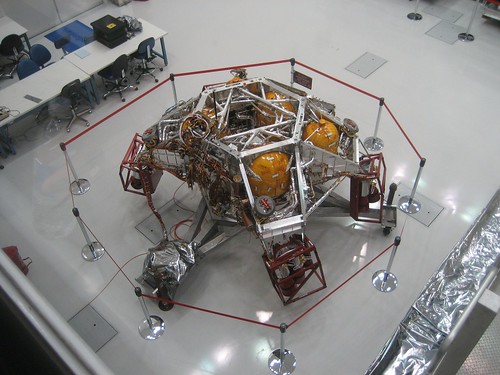
As I have now mentioned several times, I spent all day Saturday at JPL's Open House. Since I knew I would be "working" from 1:00 to 5:00 pm (as a volunteer Solar System Ambassador, not as a JPL employee), and since I didn't know how crowded it might be, I gave myself one mission for the morning - to see the Mars Science Laboratory (MSL) rover in the large assembly clean room. I figured this might be my only chance to see this flight hardware before it goes to Mars (though it's now planned to launch in 2011, so I could probably see it next year too). It turned out that my wife and I were the first to arrive at building 179, and we got a real good look at the subassemblies and talked a while with the JPL guides there. The picture above is of the big rocket platform that will slow MSL to a hover and gently lower the rover to the surface in "skycrane" fashion.
 Since it was not really that crowded, I was actually able to see just about everything I wanted to see, with the exception of a couple of movies that had long lines. I saw models, sample hardware, pictures, and video from various past and future missions (Galileo, Dawn [ion engine shown here], Spitzer, Kepler, GRAIL, Phoenix, Cassini, Mars Pathfinder, Explorer 1, and more, in no particular order). I got to talk with JPL personnel on several current and future missions, including several MER Rover drivers, as well as Dr. Fuk Li, Manager of Mars Exploration Programs, a really interesting and nice guy. I also saw a number of research and development robots.
 But the main event for me was the four hours I spent hanging out in the Mars Exploration Program area, answering visitors' questions about Mars and especially about the MER Rovers, Spirit and Opportunity. I and the other volunteers were helped in this by "Bubba," the MER Full-Scale Mobility Test Vehicle. Bubba was rolling around my end of the Mars Program tent under the control of software on a notebook computer which was in turn controlled by several actual Rover Drivers from MER Operations. In spite of this control system, Bubba would sometimes "sneak up on me" as I was talking with some visitors - someone would say "moving rover behind you," and I would be surprised to see it back there. I think having this moving rover coming close to the fence was a major part of the appeal. The other cool thing was the way it could climb over a rather large "Mars rock" placed in front of its wheels.
Visitors had all sorts of questions, from very general ones (what is that?) to very specific ones (what technology is used in the MER solar panels? they are high-efficiency, multi-layer, gallium arsenide/germanium solar cells) to some that no one could really answer (how much longer will the MER Rovers survive?). I was able to answer almost all of the questions I received and also share with the visitors information about NASA's overall Mars program strategy ("follow the water" and so on) as well as some interesting stories I had learned in my readings and from volunteers who have worked on MER. Since there were usually three or more people answering questions, I could really take as long as needed with each visitor or group. Some of them stayed for a long time and asked a lot of follow-up questions. There were a lot of excited kids, but also a lot of adults who were glad to be able to ask a whole series of questions. Many found this Mars stuff to be more interesting than they expected in one way or another.
 Doing this was really fun, and having a life-size, realistic-looking, and moving Mars Rover was an even better "prop" than Orbiter for engaging people about "space stuff." I think I need to get me one. Or at least come back next year and do it again at JPL.
More pictures on Flickr.
UPDATE: Clifford Johnson of Asymptotia came to the JPL Open House on Saturday and wrote a nice post about it here. He also took a video with brief clips of several of the exhibits, and he happened to catch me at the start of the video, talking and pointing at the Mars Rover (0:10 to 0:18).
Carnival of Space #101
 The latest Carnival of Space is hosted this week by David Portree's Robot Explorer blog. It's an excellent collection of posts - check it out.
Sunday, May 03, 2009
Mojave Crater (Mars) Anaglyph
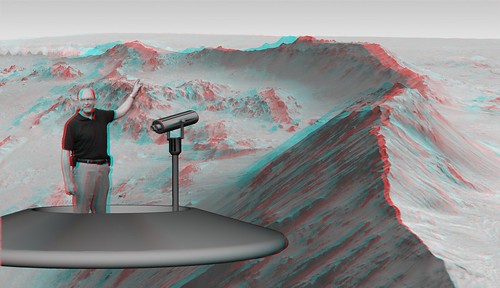
I'm not sure when I will have time to write about JPL's Open House in more detail - probably in the next day or so. It was really a wonderful experience, especially the four hours I spent helping out in the Mars Program area, talking about Mars and the MER Rovers with many visitors and with some of the JPL Mars Program staff members. I have already posted some pictures at Flickr, and now I've added one more that I downloaded from a JPL site...
This red/cyan anaglyph image was taken at the JPL Open House yesterday. You stand in front of a green screen for a few seconds while they capture a stereo image of you pointing behind or something (you want some front-back depth). They then superimpose this image with an anaglyph of Mojave Crater on Mars, created from MRO imagery. They give you a web site and an image number so you can later view and/or download your image from the web.
You will need red/cyan "3D glasses" to properly view this image (click the image above to go to my Flickr page where you will be able to choose from several sizes to view - the original image is 1778 x 1024 pictures, too big for most monitor resolutions). The 3D effect is pretty striking (especially the crater rim). Mojave Crater is a 58.5-km-diameter impact crater in the Xanthe Terra region of Mars. The image was created from two Mars Reconnaissance Orbiter (MRO) High-Resolution Imaging Science Experiment (HiRISE) observations ofMojave Crater.
Oh yeah, they also added the flying saucer thing to hide my feet on the non-green-screen floor.
Subscribe to:
Posts (Atom)