Sunday, August 31, 2008

Travel Book Dilemmas

I worry too much about having enough reading material for trips. I even installed a book reader (Mobipocket) and a few "emergency" books on my Blackberry for spare time tiny-screen reading (of course there's plenty of reading material on my notebook too).

But still there must be books, and one dilemma is the hardcover, as in a book I am reading at home right now, Moon Lander: How We Developed the Apollo Lunar Module by Tom Kelly. It's good so far and I want to keep reading, but hardcovers are so bulky for trips. I'll probably take it anyway, along with a couple of backup paperbacks. One of these will be Hemingway's A Farewell to Arms, which I may have read in high school or college but don't remember. I'm hoping that some of Hemingway's spareness in prose will rub off on me. Not likely, I know.

Saturday, August 30, 2008

Terrible Beauty

Satellite weather imagery is one of the best applications of space technology, and a real life saver when it comes to tropical storms like Gustav, which tore into western Cuba and is now strengthening and heading for landfall somewhere on the U.S. Gulf coast. New Orleans is under mandatory evacuation. This recent satellite image is a frame of an animated GIF from wunderground.com - the animation has a terrible kaleidoscopic beauty. The interactive tracking map (static frame below) from the same web site shows Gustav strengthening to Cat 5 in the mid-Gulf at 11 pm Sunday night, then weakening to "only" Cat 4 the following day, with the projected path reaching New Orleans with 138-150 mph winds, gusting to 167-184 mph. Cross your fingers (this is about as effective as praying).

Obama's Amazing Speech & McCain's Hail Mary


I'm heading to Glasgow, Scotland on Sunday for a conference, and I've been busy getting ready for that. I also helped my younger daughter move in for her freshman year in college. Yes, that does make me feel somewhat older. OK, old. So I haven't had much time for blog reading and writing this week, but I did watch a few of the speeches at the Democratic Convention, and I must comment on Barack Obama's amazing acceptance speech the other night. If you haven't heard this speech, it's well worth the 43 minutes to watch the video. There is plenty of information on the web and in Obama's books if you want to know who he is, what he stands for, and how he intends to lead this country. But this speech is a perfect introduction and summation.

The big news that McCain used to divert attention from Obama's nomination was of course his bizarre vice presidential pick, Alaska Governor Sarah Palin. Palin has no national or international experience, and McCain himself has met her only once or twice. The choice smacks of political desperation, not to mention hypocrisy in McCain's repeated criticism of Obama as too inexperienced. McCain is 72 years old and has a history of skin cancer, so his VP choice is arguably more important than most, even though McCain claims to be in good health. Can anyone seriously suggest that Sarah Palin is prepared to be president?

Of course sometimes a desperate "hail mary" play succeeds, and if Sarah Palin is really as amazing as this web site suggests, she may bring as much to the ticket as Chuck Norris could have if McCain had tapped him for the veep spot.

P.S. I also want to recommend the 9 minute DNC Obama biography video that played before his speech, and this hilarious spoof Obama bio video from the Daily Show.

Wednesday, August 27, 2008

Networked Cars and Cosmonaut Hell

The September issue of Wired magazine is really cool. The cover story is about an amazing plan to fundamentally reshape cars and how we use them, by building a network of charging stations that will power electric cars whose batteries are owned and operated by the network company. Better Place is a strange sort of car company - more like a software or network company than a traditional car builder. They are partnering with Nissan-Renault to build the cars, and they have signed up Israel and Denmark as "beta test" countries.

Yes, countries. Without the infrastructure of charging and battery swap stations, and the network and computer software that help drivers make best use of the resources, the plan won't work. So they need small countries that are willing to support this development with tax breaks and other subsidies, with the payoff being a transportation system that (eventually) doesn't need oil. I know it sounds wild, and it's hard to see how the infrastructure for this could scale to a big country such as the U.S. (they might start with Hawaii). But read the article - they are really serious about this!

There are other cool articles too, especially the one about Richard Garriott. If all goes well this October, he will become the sixth private spaceflight participant to fly to the ISS on a Russian Soyuz. His training experiences at Star City were quite interesting (see the video on the Wired web site). You can also learn more about Garriott's $30 million mission at his own web site.

But wait, there's more: an article about Neal Stephenson (one of my favorite authors) and his upcoming book Anathem. And an article about Red One, an amazing new professional digital video camera that finally achieves film quality (4096 x 2304 pixels). A very wired Wired this month.

Baracky II


Yes, that's "Baracky" as in "Rocky." This video is "hard hitting" and pretty funny. Informative too.

Tuesday, August 26, 2008

Small But Interesting Objects

Emily Lakdawalla of the Planetary Society wrote an interesting piece last week, "Things that probably won't ever be called planets, but maybe they should." It's a reasonable sounding approach to the "planet debate" that was triggered by Pluto's "demotion" - "planet" is not a status to aspire to, but simply a name for an object that is smaller than a star, a name that can be qualified as needed with many descriptive words: terrestrial, gas giant, ice giant, dwarf, minor, etc.

But whatever you call them, there are many objects worth exploring here in our solar system, and we have already sent spacecraft to visit many of the "minor" ones. Emily provides a photo album in this post. She also made a collage of all of the visited objects at a common scale, which she posted today. The 1600 x 1200 png file (537 KB) is really cool - it's quite an impressive range of sizes.

This also reminded me that ESA's Rosetta spacecraft will soon be making a flyby of asteroid 2867 Steins on its way to a May 2014 rendezvous with comet 67P/Churyumov-Gerasimenko. The picture above shows Rosetta (add-on by Brian Jones) with Steins as simulated in Orbiter. I'm at 145 km, a bit closer than the intended 800 km distance for next week's flyby.

Monday, August 25, 2008

Fly Me to the Moon 3D in Brief

A friend and I went to Boston's excellent Museum of Science today. One of the things we saw was a 20 minute version of the current theatrical release movie Fly Me to the Moon 3D. This was actually a lucky thing, because I got to see what were probably the best 3D scenes in the movie (Saturn V launch, flies cavorting in zero-G, Moon approach and landing) while enduring only a few brief moments of the fly family and other cheesy dialog. I know it's a kids' movie, and you have to be willing to suspend some disbelief, but come on.

The movie is notable in that it was produced fully and exclusively for 3D, and the 3D effects were truly impressive. I was thinking I'd have to see the full movie just to be able to mention it in my outreach presentations. But now I believe I can squeak by with just this mini-version. I still hope kids like it.

Friday, August 22, 2008

Carnival of Space #68

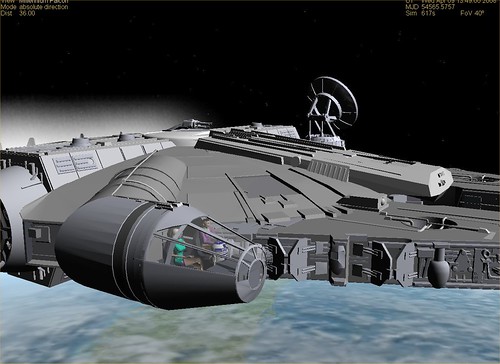
Millennium Falcon LEO Closeup
We're about to head out for a weekend in Maine and New Hampshire with a friend visiting from Nashville, but before I take off to the webless wilderness, I'm checking out Carnival of Space #68. It's running this week at Crowlspace, with the subtitle "star-travel won't be easy." It's only about two hours to Ogunquit, but it looks like it will be a few more years before we'll be able to make the Kessel run in less than twelve parsecs.

Thursday, August 21, 2008

My Obama Fundraising Page

I created a personal fundraising page for the Obama campaign. I had thought about doing this before, though I had mixed feelings about asking family and friends for contributions. They know there's an election this fall, and if they want to contribute to a candidate, it's easy enough to do. But I also realized some people might be supportive but just haven't made a move yet. Maybe they would contribute if someone asked them to. If not, they could just ignore my email:
Sorry to invade your privacy with political "stuff" but this is something I think is really important. I set up a personal fundraising page at barackobama.com, and here's what I wrote on that little web page (I removed the first paragraph of boilerplate):

Although I have occasionally given money to candidates in the past, I have not gotten personally involved in a political campaign since I was a college student and worked for George McGovern in 1972! And while I've personally contributed money to the Obama campaign, asking other people to contribute money is just a bit beyond my comfort level. But guess what? When something is really important, it's time to push the envelope and forget about your comfort level. Because I care about this country and about our future, I believe we need Barack Obama to win this fall. And it's going to take money.

So I'm taking sort of a leap here. I've set my own personal fundraising goal for the campaign, which you can see in the thermometer to the right of this page:

http://my.barackobama.com/page/outreach/view/main/BruceMA

Please take a moment to check out this page, and contribute if you can. Any amount will help. And if you care to, tell a friend. If you want to know about why I support Obama, I'd be happy to talk with you about it.

Thanks!
Bruce

Of course my page is open for anyone to contribute, and if you decide to, thanks in advance. If you prefer to contribute in another forum, or to another candidate, or not at all, that's fine too.

We now return to our originally scheduled space, astronomy, science, and education "stuff."

Wednesday, August 20, 2008

Teach Yourself Space

When I was a kid, I fell in love with flying and with space. I was 9 to 16 years old in the core space age years of 1962 to 1969, from John Glenn's first orbital Mercury flight to Apollo 11 landing on the Moon. I was also a cadet in Civil Air Patrol for several years in that period, learning aerospace subjects and taking a lot of Piper Cub orientation flights that gave me my first experience in controlling an airplane (cadets could do everything but land).

I did everything I could to learn about space and aviation. In the sixties, I had network TV, LIFE magazine, and a lot of reports and posters that I requested from NASA and the US Air Force. I read library books, and when I occasionally got to the big library in Glens Falls, NY (we lived in a rural area and I usually got books from the Bookmobile) , I would read space mission reports in Aviation Week magazine. I also built a lot of plastic models - mostly military aircraft, but I also built every available spacecraft model - Mercury/Atlas, a large-scale Gemini spacecraft, and of course the Apollo spacecraft and Saturn V booster.

Now in the age of the world-wide web, the amount of material that is available to someone interested in learning about space science and engineering is really staggering. In addition to NASA's huge presence on the web, there are many other sources of space and aviation information, pictures, and video. We have flight simulators, including Orbiter, an excellent and free space flight simulator. We even have aerospace courses from MIT available on the web!

The latest space course from MIT's OpenCourseWare program is 16.89J from spring 2007, Space Systems Engineering. The project theme of this particular class related to the design and development of possible lunar telescope facilities, including scientific and technical issues as well as project management, budget, timeline, and other "big picture" issues. The materials for this course are limited compared to some MIT OCW courses. No PDF, audio, or video lecture materials are provided, but they do provide PDF's of the final Lunar Telescope Facility class presentation and report which are pretty impressive.

One of the most complete space-related OCW courses is Aircraft Systems Engineering from fall 2005, which focused on the space shuttle. Instructors included MIT professor and former astronaut Dr. Jeff Hoffman, and the OCW material includes lecture notes, audio, and video. A more recent one that also looks cool is Engineering Apollo: The Moon Project as a Complex System from spring 2007. No videos, but it does have brief lecture notes and a number of student reports from the class, plus some historic NASA documents.

Tuesday, August 19, 2008

Light Up The World

White light LED's could literally light up the world for developing countries, making a huge difference in the lives of billions of people. A few years ago, a professor from the University of Calgary in Canada, Dave Irvine-Halliday, realized that lighting is a big problem for the nearly two billion people in the world who have no electrical service. Their lives are ruled by daylight, sometimes supplemented by dim, smoky kerosene lamps that allow them to do some limited activities after dark if they can afford the fuel.

Irvine-Halliday (pictured here with some sample hardware, new and old) realized that then-new white-light LED's could offer a solution - a bright, efficient light source that could be run from simple batteries, which in turn could be recharged by a small array of solar cells. Such simple LED lamps can provide enough light after dark to read, prepare meals, and even engage in small home-based businesses (crafts, making clothing, performing repairs, etc.). He founded the Light Up The World foundation to promote the development and distribution of such lighting. As it says on the LUTW web site:
Light Up The World Foundation (LUTW) is the first humanitarian organization to utilize renewable energy and solid-state lighting technologies to bring affordable, safe, healthy, efficient, and environmentally responsible illumination to people who do not have access to power for adequate lighting. LUTW remains the world’s leader in this endeavour: globally active and setting standards in the field.
LUTW is raising money for this effort, but they are also encouraging the use of microcredit loans to allow people to buy the necessary hardware with small payments that would otherwise go to buying kerosene for lamps. This also creates opportunities for local small businesses. They can assemble and sell lamps, batteries, and solar cells and even make money recycling batteries.

This is a great application of optics, solid-state physics, solar photovoltaics, and other advanced technologies to solve a simple problem in a simple way, with immediate and local benefits. It's a great idea and a great cause to support. For more information, you can explore the LUTW web site, or read this technical paper (PDF) from SPIE.

Monday, August 18, 2008

Space Gets More Candidate Support

As reported by Jeff Foust in The Space Review this week, space policy is heating up this summer. In apparent reaction to Obama's recent Florida remarks on space, John McCain's web site was updated with an expanded article expressing support for NASA and for human and robotic space exploration.

Now the Obama campaign has expanded even more on Obama's Florida remarks with a seven page PDF position paper entitled "Advancing the Frontiers of Space Exploration." This is quite detailed and includes ideas for better coordination on space activities among federal agencies, more support for private space activity, and better use of NASA's resources to educate the public and engage more students in science and engineering.

Saying something doesn't make it so, I know, but establishing space exploration as an important part of America's future is a good first step.

Sunday, August 17, 2008

Creature (UI) Comforts


Curiosity got to me and I downloaded the free trial version of the Spore Creature Creator. I am most impressed with the UI (user interface) for this thing, and with the way the animation is implemented for anything you can build. If you watch some of the background videos from the Spore development team (especially this one on procedural animation), you can see that you are not as free as you seem to be in what you create - but it certainly covers a wide range.

I played around and created a couple of odd dinosaur-looking creatures without making many changes to the basic parts beyond stretching and orienting them. But as you can see from this demo on advanced creature creation, just about everything is up for grabs. Basically whatever the UI allows you to create, works.

I have vacillated between uninstalling this thing and paying the $10 to upgrade to the full one to see what the full set of parts looks like. What it looks like is a time sink, so I really think I need to remove it. Having seen some of the videos of the different phases of the game, I believe it will be a tremendously creative environment for "kids of all ages" - but I'm not so sure it will encourage science as much as (say) animation and graphic arts. In other words, I'll wait for some reviews and articles before deciding whether to use "educational outreach" as an excuse for buying and playing this thing! Whatever it ends up being, it certainly is impressive.

Distant Mirrors (and Cribsheets)

Speaking of astrobiology (as I was in my last post), I just discovered this May article from SEED magazine. It discusses what sorts of signs of life a distant planet might display, using as an example the only planet that we know with certainty harbors life - Earth. It turns out they have done the experiments with several departing planetary exploration spacecraft, pointing their instruments back at Earth to examine our variations in brightness and color in various wavelength bands.

When they do this, they see a planet with tremendous variation in color and reflectance, thanks to our oceans, clouds, and land areas. These variations could allow an observer with similar data to determine that we have areas of water and non-water, as well as how fast our planet is rotating. If they observed a wide range of spectral bands, they would find Earth to be quite bright in some long wavelengths (radio, TV, radar, etc.). With spectroscopic analysis, they would find the chemically unstable combination of oxygen and methane in our atmosphere (along with other gases), suggesting that some dynamic process is constantly replenishing these gases (that would be life, in our case).

This gives scientists ideas for how they will examine exoplanets as our near-future instruments become good enough to discover and examine smaller and more Earth-like planets, especially any that lie within the habitable zone of their stars. Even if the planet is initially represented by only one color pixel, the spectrum of that pixel, and changes in its brightness over time may give clues about its atmosphere, rotation, and the presence of large areas of water or other liquids.

Habitable zone? If you need help with that, I recommend cribsheet #14 from SEED, a quick single page review of exoplanets, how we find them (over 300 so far, most very massive and Jupiter-like), and how we will be able to study these distant worlds in the near future. SEED has useful cribsheets on a lot of other subjects too. Check out plate tectonics, nuclear power, and light.

Saturday, August 16, 2008

Astrobiology: the Game?

In any discussion of space exploration with someone who is not already a space geek, the subject of life beyond Earth will usually come up. Whether it's the possibility of simple life on Mars, or speculation about possible intelligent life elsewhere in the universe (and whether "they" have visited here), this is one part of space exploration and astronomy that many people can connect with.

Back in the sixties, Carl Sagan co-authored a book with I.S. Shlovskii called Intelligent Life in the Universe. I remember reading this in college (around 1973) and being impressed and fascinated with the interdisciplinary combination of astronomy, physics, geology, and biology. In fact this was an early work on what is now called astrobiology, a subject that was not all that respectable at the time.

Nowadays astrobiology is relatively mainstream and is a field where a lot of the really big questions can be explored. As the Wikipedia article notes, these include:
What is life? How did life arise on Earth? What do astrophysical observations tell us about the present and future of life on Earth? What kind of environments can life tolerate? How can we determine if life exists on other planets? How often can we expect to find complex life? What will life consist of on other planets? Will it be DNA/carbon based or based on something else? What will it look like?
In a couple of weeks, Will Wright's long awaited "video game" Spore will be released, and as this article points out, it is very much astrobiology turned into entertainment. I'm really intrigued by this and will probably buy it, but as with other electronic diversions other than Orbiter (and flight simulators some years ago), I probably won't have time to explore it much. Even though it appears to play a bit loosely with some of the ideas of evolution and natural selection (it is a game, after all), I hope that it encourages interest in science, and better yet, helps to portray science as a creative and exploratory activity, which of course it is.

Friday, August 15, 2008

Carnival of Space #67

Carnival of Space #67 is available for your reading pleasure at David Chandler's Next Generation, a blog focused on the work of college students who are involved in astronomy and/or space exploration.

Thursday, August 14, 2008

How Camera Lenses Are Made


I'm an optical engineer who works with optical design software, though most of the optical systems I have ever designed have been for training or software testing purposes - nothing I've ever designed has been built. I have gotten to tour a lot of optical shops and factories over the years, including a fairly large one in China a couple of years ago. They had a lot of people and machines making very tiny lenses for mobile phone cameras.

The video clip above is from the Discovery Channel. It shows the largely manual manufacturing steps for a pretty large lens for a video application. High quality, low volume optics are still manufactured this way, though large volume fabrication in Asia is typically much more automated than this (but there are still a lot of people involved). Canon has a great "Virtual Lens Plant" site if you want to learn more about optical fabrication.

For more information on what optical engineers do, watch this career-oriented video (about 15 minutes, in two parts).

So where are the SPHERES?

I've changed my blog template, at least temporarily. For reasons I don't have time to investigate right now, the background of my usual "dots" template has disappeared. I have occasionally messed up the blog's format by making some sort of mistake in a post, and other times I've lost formatting because of something Blogger has done (which they usually fix in a day or two).

So I will use this one for the moment. Maybe it will be better for printing since the main text is on the left. Who prints a blog? Well, I print out each month of posts and put them in a loose-leaf notebook, just in case this computer and internet thing suddenly disappears.

Astronomical Medicine

SEED magazine has interesting profiles and podcasts on some "revolutionary minds," including Michelle Borkin, a young astronomy researcher at Harvard who is working with a team in applying medical imaging and visualization software to astronomical data. The term "astronomical medicine" is pretty wild - who is the patient in this case? And will the insurance be accepted in this part of the Galaxy?

I forwarded this to Martin Schweiger, the developer of Orbiter, who in his real job does research on medical imaging software. He agreed that this is really interdisciplinary research, "Although on the other hand, the connection isn't so far-fetched. I am using the radiative transfer equation to describe light propagation in tissue - and that was originally developed for modeling stellar atmospheres." So maybe it's really medical astronomy?

Michelle Borkin has some nice images, movies, and background material on her web site.

Wednesday, August 13, 2008

Matching for Obama

The other day I got another contribution request from the Obama campaign. This is not surprising - a presidential election is expensive, and I have already made a number of small contributions to the campaign. As I've said a couple of times before, I'm not turning this into a political blog, but I believe this election is really important. A win for McCain would extend the Bush disaster for at least four more years. It's all hands on deck for America.

There's a new wrinkle in the latest request. To encourage prospective first time contributors, they tell them that another supporter (for example, me, for the amount I've already agreed to contribute) will match their contribution, and they optionally put the matching contributor indirectly in touch with the new one. I can write a message to my "match" explaining why I support Obama, and if they want to, they can write back. So far I've done four of the matching contributions, and gotten three replies. It's just a small personal touch, but I think it's pretty cool. Try it.