While I'm still quite interested in all sorts of "space stuff," it's been a very long time since I did anything with the Orbiter space flight simulator. When I first discovered Orbiter in 2005, I was pretty excited. I was always interested in space, in flight simulators, and in physics, and Orbiter combined all those interests into one very cool piece of (free!) software. As part of the process of teaching myself how to use Orbiter, I wrote a tutorial manual called Go Play In Space, and I did a substantial update for the 2006 version of Orbiter. In late 2010, I started to work on an update for the 2010 version, but I got sidetracked by other interests and priorities, and never finished that project.
Last week I noticed a YouTube video by David Courtney called called "Orbiter 2014 Beta - A Quick Look" (David has recorded a large number of excellent tutorial videos on Orbiter 2010). Wow, it's alive! Orbiter creator Martin Schweiger has released an early beta of a new version that includes 3D terrain (with high-res data so far for most of Earth as well as Mars and the Moon), along with various improvements in the physics engine and user interface. I read some of the discussions at the Orbiter Forum and decided to at least check it out.
The terrain for the new version must be downloaded and installed separately from the Orbiter beta itself (there are instructions and also a beta installation video by David Courtney). I installed the high-res terrain tiles for the US west coast, since I'm familiar with the Los Angeles area, which has some interesting mountain and valley terrain. I flew the default Deltaglider around for a while, and the general impression is similar to Microsoft Flight Simulator, though it's not quite as detailed.
You might question why 3D terrain is even necessary in a space flight simulator, since most of the time you are too far from any planet's surface for this to make any difference. I guess it comes down to realism, and "because you can." I have spent a lot of time with the wonderful AMSO add-on for Orbiter, simulating Apollo missions in great detail, and it is certainly cool to land in the great lunar terrain that is supplied with that add-on (check out this AMSO Apollo 17 video, complete with real mission audio - skip to 9:00 or so to see the mountainous terrain up close).
I'm happy to see Orbiter development continuing, and I hope to do something with the 2014 version. Updating Go Play In Space is a lot of work (it's a 181 page book), but it really needs a 2010-2014 update, so maybe that will happen, time and energy permitting!
Space flight, simulators, astronomy, books, flying, music, science, education: whatever the obsession of the moment might happen to be.
Sunday, April 27, 2014
Saturday, April 26, 2014
Crab Communicado
I've read a number of alien contact stories over the years, and I just finished one that I thought was well-written and especially inventive in terms of alien behavior and culture, A Darkling Sea by James L. Cambias. It takes place in an unspecified not-too-distant future, after interstellar travel (involving something called "gimelspace") has been developed and contact made with at least one other high-technology species, the Sholen. They and the "Terrans" have established some agreements regarding non-interference with other alien worlds. Humans in a small research station are exploring the under-ice ocean of a Europa-like moon orbiting a gas giant in another star system (not the home system of either the Terrans or the Sholen).
Beneath this dark ocean, many forms of life have evolved, all based on energy and chemicals coming from thermal vents, similar to those found in parts of the Earth's deep-ocean seabed. But in addition to simple worm-like and fish-like creatures, the thermal vents of Ilmatar also support a crab-like intelligent species who navigate and communicate with sound (no light, so vision has not evolved here), and who seem to possess social structures and simple technology, including a form of agriculture. In compliance with the non-contact treaty, the humans have studied the Ilmatarans from afar, but some of the researchers want to get much closer, and this leads to a tragic incident that provokes conflict with the Sholen.
I won't give away more of the story, which is told in alternating points of view of human, Ilmataran, and Sholen characters. The Ilmatarans have a very old culture (millions of years), and although their technology is quite limited (no deep-water electronics!), they have language (including a writing system based on knots tied in fibers), agriculture (cultivating various plant-like species in settlements built around active thermal vents), the ability to build various structures, and a social and legal system. Landowners have apprentices and servants, and markets exist to make use of surpluses and division of labor. There is an education system of sorts (though child welfare is in a sorry state, with many of the very young apt to be eaten by adults or other young), and there is even a tradition of science, mostly focused on the study of life forms and thermal vent systems.
The Ilmataran scientists are very curious, though they cannot imagine that there are other intelligent life forms in the universe, or indeed that there is a "universe" beyond the thick ice layer above them (which they assume extends to infinity). There ultimately is contact and communication among the three species, and quite a bit of conflict and action. Although there are aspects that require substantial suspension of disbelief (e.g., gimelspace is barely mentioned, but it must provide a path through spacetime that allows faster-than-light travel), it's a well-constructed hard-SF world with no annoying "magic" stuff -- a very engaging and satisfying first novel.
Beneath this dark ocean, many forms of life have evolved, all based on energy and chemicals coming from thermal vents, similar to those found in parts of the Earth's deep-ocean seabed. But in addition to simple worm-like and fish-like creatures, the thermal vents of Ilmatar also support a crab-like intelligent species who navigate and communicate with sound (no light, so vision has not evolved here), and who seem to possess social structures and simple technology, including a form of agriculture. In compliance with the non-contact treaty, the humans have studied the Ilmatarans from afar, but some of the researchers want to get much closer, and this leads to a tragic incident that provokes conflict with the Sholen.
I won't give away more of the story, which is told in alternating points of view of human, Ilmataran, and Sholen characters. The Ilmatarans have a very old culture (millions of years), and although their technology is quite limited (no deep-water electronics!), they have language (including a writing system based on knots tied in fibers), agriculture (cultivating various plant-like species in settlements built around active thermal vents), the ability to build various structures, and a social and legal system. Landowners have apprentices and servants, and markets exist to make use of surpluses and division of labor. There is an education system of sorts (though child welfare is in a sorry state, with many of the very young apt to be eaten by adults or other young), and there is even a tradition of science, mostly focused on the study of life forms and thermal vent systems.
The Ilmataran scientists are very curious, though they cannot imagine that there are other intelligent life forms in the universe, or indeed that there is a "universe" beyond the thick ice layer above them (which they assume extends to infinity). There ultimately is contact and communication among the three species, and quite a bit of conflict and action. Although there are aspects that require substantial suspension of disbelief (e.g., gimelspace is barely mentioned, but it must provide a path through spacetime that allows faster-than-light travel), it's a well-constructed hard-SF world with no annoying "magic" stuff -- a very engaging and satisfying first novel.
Labels:
books,
future,
SF,
space settlements,
technology
Sunday, April 13, 2014
My Mozart-Mac 80's Mashup
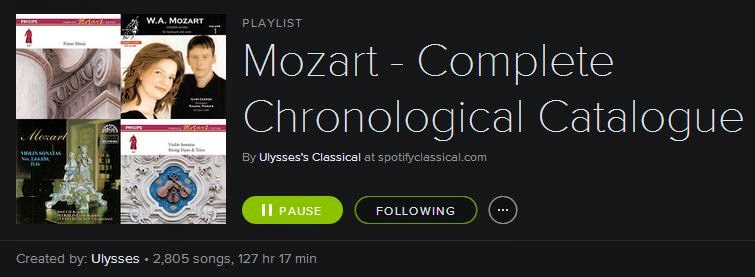
In the pre-web days of the 1980's and early 1990's, I went through a couple of serial obsessions (hobbies, I guess) that I once attempted to merge. I was reminded of this today when I discovered a cool Spotify playlist, "Mozart - Complete Chronological Catalogue."
I bought an early Mac a few months after Apple announced it, around March 1984. It was expensive - the Mac (128 KB RAM!), external floppy drive (no hard drive!), and dot-matrix printer cost about $3500, and a few months later I spent another $900 to upgrade to a "Fat Mac" with a whopping 512K of RAM (yes, KB, not MB)! That $4400 would be about $10,000 in 2014 dollars, but I loved that goofy little computer. I was a complete Mac fanatic until 1994 when I bought my first PC, for work-related reasons, and I haven't had a Mac since (though I have drunk deeply of Saint Jobs' i-device Kool-Aid).
In 1987, Apple came out with a program called HyperCard that allowed Mac users to create "stacks" of hyperlinked "cards" that could contain text, data, and images, with a scripting language that would let you turn these stacks into interactive graphical databases and other sorts of programs (here's an interesting look back at HyperCard from 2012). These were very much like web sites, except that all the data and images had to reside on the Mac itself (around the same time, there started to be hard drives and local networks for Macs, but it was still basically a single-user, single-computer program).
I loved HyperCard, and was always looking around for things to do with it (in the mid 90's, I would use the much more powerful HyperCard 2.0 to create a working prototype for a graphical user interface for a software project at my company, but that's another story). Around the same time (fall 1984 actually), the movie Amadeus was released, but I didn't actually see it until sometime in 1985, oddly enough in Japan. I had long been aware of Mozart's music, but I didn't become a big fan until I saw Amadeus and bought the soundtrack album.
I started reading about Mozart, and buying and listening to more of his music. When I later looked up the meaning of the "K numbers" (K.201, etc.) and realized that there were some 626 Köchel-cataloged works by Mozart, I got an idea for a HyperCard project (I'm guessing this was in 1988-89, so I had already been collecting Mozart CD's for a few years). I could use it to build a linked and illustrated database of all of Mozart's works. I didn't realize at first how big a project this might be, in part because there are really more than 626 individual pieces of music, and in part because in those pre-web days, all of the information I would need was in books, and I would need to enter it all by hand. I'm not sure what I intended to do about graphics beyond the limited clip-art of the day (and I never got far enough to worry about copyright).
I must have worked on this for several months, and I had the structure and logic pretty well worked out, for perhaps 100 pieces or so (probably the ones I had on CD). But researching and creating the "content" for hundreds of additional Mozart works was an overwhelming task, pretty much like writing a book. Around the same time, the brief era of CD-ROM "multimedia" software was starting, with titles such as "Multimedia Mozart: The Dissonance Quartet" (actually that was on the Mac in 1991, and I didn't have it until I got an early Windows PC with CD-ROM in 1994). Although multimedia was becoming a big deal, I realized that creating a full Mozart catalog as a HyperCard stack was too big a project for me, and I never finished it.
Now of course we have the web, with all the information you could want on Mozart and everything in the world at our fingertips. Zillions of people have created databases, websites, blogs, music streaming sites, YouTube, Facebook, and all the rest of the time-sucking internet. Today I was updating some of my Spotify playlists with favorite classical music, and I decided to look around at what others may have done for Mozart. That's when I discovered the complete Mozart playlist. Its author "Ulysses" (perhaps not an individual, since there's a Spotify app called "Ulysses' Classical") also has "complete works" playlists for Debussy, Wagner, Brahms, and others. Pretty freaking amazing. Of course these playlists only include one version of each work, but Spotify contains any number of alternate performances you can quickly find if those are not to your liking (I immediate checked out Symphony No. 25, K.183, and I don't especially like the Bruno Walter version the list maker chose - though I'm sure it's a classic, I remain a Neville Marriner man on that piece).
While 25 years ago I dreamed of having an interactive database of information to read about Mozart's works, now you can find any sort of information on the web, and find and stream any of Mozart's music (and millions of others') in seconds. The Ulysses playlist for Mozart's works has 2,805 "songs" (works, movements, and sections of works), with a play time of 127 hours, 17 minutes. I will have to block out some time. So far I am up to K.12.
UPDATE: After I wrote this, I clicked around a bit more and discovered that there is a modern programming environment inspired by and quite similar to HyperCard. It's called LiveCode and with the help of a KickStarter campaign (the videos give you a good idea of what it can do), it was recently turned into an open source project, with the goal of greatly expanding the community of users and developers. The software is now free (with certain restrictions) for non-commercial use. I downloaded and played briefly with a "hello world" test project, and it is amazingly similar to the HyperCard I remember, except that it supports multiple platforms (Mac, Windows, Linux, and even app creation for mobile devices running iOS or Android). If I had time for another infinite time sink in my life, I would totally be playing with this. I probably will anyway! If I wanted use it to develop an iOS app, I would have a slight problem in that the Apple tools for porting and testing iOS code only runs on Macs (not Windows). Good thing I don't have any app ideas! Oh, wait...
Monday, April 07, 2014
Salieri and Me
One of the things that has always annoyed me about myself is my lack of fluency in most of the things I do. By fluency, I mean the seemingly effortless way that many Europeans switch among 3-5 languages (while I struggle to follow a simple conversation in French or Japanese), or the way Paul Simon writes a song, or Eric Clapton plays guitar. Back when I was still flying, I spent some time (in 2011!) with an instructor working on a tail-wheel rating that I never quite finished. Although I managed to do things safely, I was frustrated that I could never come close to the smoothness and consistency with which my instructor handled the airplane.
Closer to my professional life, I discovered in college that my brain’s “math engine” didn’t work very well beyond matrix algebra and calculus. I was the only science or engineering major I knew whose verbal SAT scores were higher than the math scores. I always felt that my “real” science major friends could “think in math,” while I somehow had to emulate the math in my verbal brain, a trick that didn’t work very well for abstract subjects like quantum mechanics. When I did software development early in my career, it was similar. Basic algorithm development, coding, and debugging were all OK – but despite my physics and optics background, I just could not get my head around complex optical analysis algorithms (or invent new ones, as I was expected to do). Is this why I eventually ended up in marketing and sales (albeit for some highly technical software products for optical science and engineering)?
While this is only a partial list, right away you might spot a problem: too many interests. If you dabble in a lot of different things, how can you expect to be an expert in any of them? That is a good point, but my interests are my interests, and I have trouble just dropping something I love (though I have pretty much done this with flying, a demanding hobby where dabbling is dangerous). Other conclusions might follow. Things that seem effortless seldom really are. You have probably heard about the 10,000 hour rule. I’m not sure it’s exactly a rule, but the idea is that you need to do something for 10,000 hours or more before you can expect to be really fluent or expert in it. My most recent flight instructor probably has 10,000 hours of flight time (I have about 125). Paul Simon has probably written 1000 or more songs – I have written maybe 200. I almost never practice playing the guitar (when I try, I usually end up writing a song fragment instead – or if I’m lucky, maybe a complete song). Although I can still recall chord progressions and lyrics for songs I learned in my teens or twenties, I can hardly remember new songs I learned or practiced a couple of months ago (including my own songs!). Fortunately I am quite good at making and playing from lyric/chord sheets!
I love Mozart’s music, and I’m a big fan of the movie Amadeus, even though it is only loosely based on Mozart’s life, with many aspects exaggerated for dramatic effect. One of these is Salieri’s extreme jealousy of Mozart’s musical talent, even to the point of working to sabotage Mozart’s career. The evidence suggests otherwise, but it makes for a good story, and for some good lines for Salieri. In the movie and in real life, Salieri did very well as the court composer for Emperor Joseph II. But in the movie, he compares his own musical gifts to those of Mozart, and comes up short: “All I wanted was to sing to God. He gave me that longing... and then made me mute. Why? Tell me that. If He didn't want me to praise him with music, why implant the desire? Like a lust in my body! And then deny me the talent?”
Forget Mozart, I can hardly compare myself musically to Salieri, a professional who wrote more than 40 popular operas and who enjoyed status, fame and fortune until his death in 1825 at the ripe (for the time) old age of 75. But I sometimes share his frustration in seeing what is possible in a Mozart, Paul Simon, or Eric Clapton, even though I have not begun to put in the time or effort (not to mention the prerequisite talent) to create or achieve at such a sublime level. There’s a character in The Hotel New Hampshire by John Irving (no relation) who says, “You've got to get obsessed and stay obsessed.” I don’t think I have really done even that – if I had, surely I would be working on songwriting, Japanese, higher math, guitar, something, every single day. But many days I just go to work, or if I’m home, I hang out, I read a book, watch a movie, or play around with apps on my iPad. And check Facebook five or six times. Or 10. Of course I do have the serial obsession thing going on – when I do lock onto a well-defined project (like getting my pilot’s license or recording an album), I manage to focus on that pretty tenaciously for weeks or months at a time (which is not always a good thing).
But aside from English (speaking, reading, and maybe writing), I have achieved fluency in one important skill: rationalization! After beating myself up (rather gently) for a few paragraphs, I can turn around and think things like “lifelong learning is fun” or “creativity is its own reward” (as argued in this lovely letter from Kurt Vonnegut), and congratulate myself for at least trying to speak foreign languages, create music, understand general relativity, or fly airplanes (despite my relatively poor sense of direction and lousy parallel parking skills).
Finally, I cannot end this blog post without acknowledging that to a high level of approximation, I’m whining here. Anyone who has had a chance to write, play, and record music with amazing friends and musicians, learn to fly with dedicated and talented flight instructors, and travel enough to have found French and Japanese worth studying – shouldn’t be complaining! But hey, it's a blog.
Closer to my professional life, I discovered in college that my brain’s “math engine” didn’t work very well beyond matrix algebra and calculus. I was the only science or engineering major I knew whose verbal SAT scores were higher than the math scores. I always felt that my “real” science major friends could “think in math,” while I somehow had to emulate the math in my verbal brain, a trick that didn’t work very well for abstract subjects like quantum mechanics. When I did software development early in my career, it was similar. Basic algorithm development, coding, and debugging were all OK – but despite my physics and optics background, I just could not get my head around complex optical analysis algorithms (or invent new ones, as I was expected to do). Is this why I eventually ended up in marketing and sales (albeit for some highly technical software products for optical science and engineering)?
While this is only a partial list, right away you might spot a problem: too many interests. If you dabble in a lot of different things, how can you expect to be an expert in any of them? That is a good point, but my interests are my interests, and I have trouble just dropping something I love (though I have pretty much done this with flying, a demanding hobby where dabbling is dangerous). Other conclusions might follow. Things that seem effortless seldom really are. You have probably heard about the 10,000 hour rule. I’m not sure it’s exactly a rule, but the idea is that you need to do something for 10,000 hours or more before you can expect to be really fluent or expert in it. My most recent flight instructor probably has 10,000 hours of flight time (I have about 125). Paul Simon has probably written 1000 or more songs – I have written maybe 200. I almost never practice playing the guitar (when I try, I usually end up writing a song fragment instead – or if I’m lucky, maybe a complete song). Although I can still recall chord progressions and lyrics for songs I learned in my teens or twenties, I can hardly remember new songs I learned or practiced a couple of months ago (including my own songs!). Fortunately I am quite good at making and playing from lyric/chord sheets!
I love Mozart’s music, and I’m a big fan of the movie Amadeus, even though it is only loosely based on Mozart’s life, with many aspects exaggerated for dramatic effect. One of these is Salieri’s extreme jealousy of Mozart’s musical talent, even to the point of working to sabotage Mozart’s career. The evidence suggests otherwise, but it makes for a good story, and for some good lines for Salieri. In the movie and in real life, Salieri did very well as the court composer for Emperor Joseph II. But in the movie, he compares his own musical gifts to those of Mozart, and comes up short: “All I wanted was to sing to God. He gave me that longing... and then made me mute. Why? Tell me that. If He didn't want me to praise him with music, why implant the desire? Like a lust in my body! And then deny me the talent?”
Forget Mozart, I can hardly compare myself musically to Salieri, a professional who wrote more than 40 popular operas and who enjoyed status, fame and fortune until his death in 1825 at the ripe (for the time) old age of 75. But I sometimes share his frustration in seeing what is possible in a Mozart, Paul Simon, or Eric Clapton, even though I have not begun to put in the time or effort (not to mention the prerequisite talent) to create or achieve at such a sublime level. There’s a character in The Hotel New Hampshire by John Irving (no relation) who says, “You've got to get obsessed and stay obsessed.” I don’t think I have really done even that – if I had, surely I would be working on songwriting, Japanese, higher math, guitar, something, every single day. But many days I just go to work, or if I’m home, I hang out, I read a book, watch a movie, or play around with apps on my iPad. And check Facebook five or six times. Or 10. Of course I do have the serial obsession thing going on – when I do lock onto a well-defined project (like getting my pilot’s license or recording an album), I manage to focus on that pretty tenaciously for weeks or months at a time (which is not always a good thing).
But aside from English (speaking, reading, and maybe writing), I have achieved fluency in one important skill: rationalization! After beating myself up (rather gently) for a few paragraphs, I can turn around and think things like “lifelong learning is fun” or “creativity is its own reward” (as argued in this lovely letter from Kurt Vonnegut), and congratulate myself for at least trying to speak foreign languages, create music, understand general relativity, or fly airplanes (despite my relatively poor sense of direction and lousy parallel parking skills).
Finally, I cannot end this blog post without acknowledging that to a high level of approximation, I’m whining here. Anyone who has had a chance to write, play, and record music with amazing friends and musicians, learn to fly with dedicated and talented flight instructors, and travel enough to have found French and Japanese worth studying – shouldn’t be complaining! But hey, it's a blog.
Sunday, March 30, 2014
Wish I Could Fly Like This
I'm not sure I would want this for my job, as much as I love flying and as exciting as it certainly seems to be. But I would love to do it once. I know from my slow-speed and not-very-recent Cessna piloting experience that any flying requires tremendous focus and attention to detail. But when you're doing it 50 to 250 feet above the ground, at 400+ miles per hour, you can't lose focus for a second.
That makes this video especially impressive, especially in HD on a large screen. It is apparently from a motion simulator ride at the Science Museum in London. The Eurofighter Typhoon is the RAF's current front-line fighter and an amazing machine. This is a first-person point of view video taken from the back seat of one of these airplanes on a high-speed, low-level flight through the mountains of northern Wales. I love the pilot's calm British accent as he calls out things like "there's 8 G." Very cool indeed. Sometimes I really miss flying, even though I've never done anything approaching this, except in flight sims on a PC, which is certainly fun but not exactly the same thing.
There are tons of first-person flight videos on-line. Another one I like is this one, taken from the back seat of a US Navy Blue Angels F/A-18 Hornet during an airshow performance. The videographer's excitement is frequently audible.
Sunday, March 23, 2014
Rocking the COSMOS
Of course you would expect fantastic visuals in 2014, and the CGI effects are definitely first-rate. I also like the simple animation style used for historical segments. I think Tyson is actually a better host and narrator than Sagan - he comes across as confident and authoritative, yet approachable and down to earth, and he's clearly comfortable on camera. But what really impresses me is the writing, especially the way that it humanizes science and scientists. Scientists are not perfect people, and science is not just a bunch of complicated facts and figures. Scientists are human beings who have retained and cultivated the curiosity of children. Science is an often messy process that builds on its past successes but is not afraid to discard what was accepted in the past in favor of new ideas that better fit the facts. It is based on evidence.
In tonight's episode, I really liked the way they portrayed Newton as a flawed and even petty person who happened to be a genius - except when he wasn't, as in his lifelong pursuit of alchemy and Biblical numerology. We are indeed fortunate that Edmund Halley (no slouch in the brains and energy departments himself) was able to recognize Newton's genius, and to encourage and advocate for him (even to the point of publishing the first edition of Newton's groundbreaking Principia at his own expense). Halley's use of Newton's new mechanics to correctly predict the return of the comet that bears his name was a great ending, handled in a nicely emotional and dramatic way. I also liked Neil's comment, "if you're watching this in 2061, you'll certainly know that Mr. Halley's comet is back again."
Along the way, Neil explained a bit about gravity, planetary motion, and comets, with some excellent visualizations. I think it's important that they get the science right, but that they also make it a great story with characters you can care about. They might not cover as many topics as some science fans might like, but I think they have a better chance of engaging younger viewers who might not care all that much about "science stuff" (yet!).
I'm really looking forward to the rest of the series, and to the release of a Blu-Ray edition with lots of cool extras before too long. I hope that young people do find it engaging, and that some of them will be inspired to study and pursue science, as many young scientists around today were inspired by Sagan's original Cosmos in 1980.
Saturday, March 22, 2014
A Universe of Music
I continue to be obsessed with Spotify. I thought I was familiar with a lot of music, but Spotify shows me every day that I have barely scratched the surface of the world of music that I could really love. How did I miss The Jam? The Smiths? Paul Butterfield? Dozens of great albums by artists I do know? Oh well - nothing to be done about it but to explore and listen.
I've been using playlists to help expand my horizons - some of them found, most of them built myself (which is very easy to do). Some examples:
- 1000 Recordings to Hear Before You Die - This is based is based on Tom Moon's excellent book. I found one playlist (821 selected songs from most works in the list) and I started my own (complete albums, but only about 1200 songs so far).
- Rolling Stone Magazine's 500 Greatest Albums - I found this playlist with 6300 songs.
- Everybody's Dummy - This is one of my favorite album review blogs, with a lot of classic rock that I enjoy, as well as a lot of cool discoveries, so I made a playlist of his highly rated albums "4.5+ on Everybody's Dummy."
- Voyager Golden Record - Inspired by the great new Cosmos series on Fox, I just started a playlist of sounds and music from the Voyager Interstellar Record, a gold data disc that is attached to each of the two Voyager spacecraft that have just recently crossed the solar system's outer boundary. I also bought the Kindle version of Murmurs of Earth, a book written by Carl Sagan, Ann Druyan, and others about the creation of the Voyager Interstellar Record (the disc also includes a large number of images).
Cosmic Inflation! And Physicists on Facebook!
I could probably just "reblog" this post from Astropixie (thanks Amanda!), but I guess I'll write a few words myself...
Cosmic inflation! Physics was in the news recently when new measurements appeared to confirm theoretical predictions about some expected properties of the cosmic microwave background (CMB) and how this relates to events that took place not long after the Big Bang. It's complicated but this wonderful comic by Jon Kaufman, one of the Ph.D. students who worked on the project, explains it pretty well. If you read the footnote on the comic, you'll learn that one of Jon's tasks on the project was to hang out for months at the South Pole, recharging the liquid Helium in the telescope that was used for the measurements (sometimes the South Pole just isn't cold enough!).
How cool is it that they can measure the polarization of the CMB? And how cool is it that there is something called PHD Comics?
So of course this result will need to be confirmed by additional independent measurements, but physicists and astronomers seem to be pretty psyched about it. They're even discussing it on Facebook. What a world! What a universe!
Tuesday, March 04, 2014
Bulk Rate Planets in the COSMOS
From the March page of my 2014 Year in Space Calendar:
Kepler's light sensor is so sensitive it can detect a drop of 0.01% of a star's brightness - equal to a fruit fly passing in front of a car's headlight.
Go optics! Go detector engineering! Go zillions of software systems that allowed Kepler to steadily stare at its tiny patch of sky for months on end, looking for those tiny drops in brightness that might indicate a planet passing in front of its star. It worked great, and last week NASA announced that thanks to some advances in the algorithms used to process all that sensor data, more than 700 planet candidates had been determined with high confidence to be actual exoplanets, orbiting stars in solar systems that are light years from our Solar System. 715 new worlds, orbiting 305 different stars. Pretty amazing stuff. NASA also released a brief video explaining how these new planets were confirmed. According to the cool Exoplanet app on my iPad, there are now 1,767 confirmed exoplanets.
Speaking of amazing science stuff, I'm really psyched to watch the new TV series COSMOS: A Spacetime Odyssey, a 13-part series debuting on March 9 on FOX, National Geographic, and many TV networks around the world. It is hosted by Neil DeGrasse Tyson, who as I have occasionally mentioned, is one of my personal heroes for his work in science education. He's a worthy successor to another favorite scientist and author, the great Carl Sagan. Sagan's original COSMOS TV series and book are still great, but 1980 was a long time ago in terms of space exploration and astronomy, so I am really looking forward to this "major rewrite" of that show. Sagan's widow, Ann Druyan, herself a tireless promoter of science education, is one of the people behind the new series.
Tuesday, February 25, 2014
Spotification!
Spotify is my latest serial obsession. I'm surprised I hadn't checked it out before now, but I guess I felt I had enough music and enough ways to explore new music already. Then a few weeks ago, my daughter sent me a Spotify playlist she thought I would like ("Upbeat Indie & Synthpop"), so I opened a free account, and I was pleasantly surprised. Unlike Pandora, Spotify lets you play just about any song or album anytime (at least on desktop PC/Mac apps and recently on tablets - smartphone apps still have some limitations). If you start playing Yes, you can keep listening to Yes if you like, not to a mix of artists similar to Yes (unless you want to do a radio-like thing). I soon found myself digging for long-lost albums, and pretty much everything is there. I was able to listen to "Tales of Topographic Oceans," a rather overblown 1973 Yes album I had not heard in maybe 30 years (some nice sounds, but that's about the right frequency for that album). I streamed from my iPad to my Apple TV so I could hear it on the living room stereo. Pretty sweet!
Like Pandora, the basic free account has commercials, and at first they didn't seem too frequent or obnoxious. But once I started to spend a lot more time making playlists and listening, I decided it would be nice to not have commercials, so about a week in, I signed up for a Premium account for $10 a month. This also has the nice benefit that you can download a large number of playlists for offline listening (something like 3,300 songs). This is nice for listening in airplanes and cars or wherever wifi isn't available (though it streams quite well in 3G or 4G on an iPhone 5).
So now I'm in spending hours discovering new and old music and building and listening to playlists (my own and others'). Apart from all the cool new music, it blows my mind how many albums and artists from my core interest areas I have missed. For example, Aimee Mann's "Bachelor No. 2" (2000) has been a favorite album for many years. Why did I never check out her previous album, "I'm With Stupid" (1995). It's amazing! And how did I miss so much cool music by Ry Cooder? Neil Young's live acoustic albums? David Lindley's "El Rayo-X?" I am also checking artists I have always wondered about, like Moby, Frank Zappa, the Kinks, the Smiths, Kate & Anna McGarrigle, and even David Bowie and Luther Vandross. Plus many long-lost albums and artists that I had on vinyl in the 60's through the 80's - Poco, Stephen Stills solo albums, Seals & Crofts, John Mayall, Joe Cocker, Leon Russell, and many more.
It's pretty much all out there (some 20 million songs). What is not out there? Well, the Beatles (of course I've got all their stuff). Bob Seger, AC/DC, Tool. Pete Townshend's solo albums (I guess Pete is not happy with streaming services - all the Who albums are there, though). Led Zep was added recently (as were all three Bruce Irving albums!). There's more than I can really handle. I have one playlist called "Ultimate Deluxe Extras Albums" which is filled with boxed sets, deluxe versions, alternate takes, etc. You want "Bridge Over Troubled Water - Demo Take 6?" Got it! Some 1,300 tracks and counting. I have a wonderful old (~1996) book called the MusicHound Essential Album Guide that has helped me to identify some 5-star albums I have missed over the years. Most are on Spotify, though a few of the older ones are missing (for major artists, the older albums can often be found collected in box sets and other repackaged formats).
Is Spotify sustainable? Is it good for artists? I'm not sure, but it exists now, and as with every new entertainment technology, artists and the industry will have to learn to adjust. I heard that it doesn't pay very well (I read one quote from an artist who said he made $16 for a million streaming plays - I think this was Roger Waters of Pink Floyd), but it pays better than pirated music. I like to support artists and musicians (I'm a "recording artist" myself, though fortunately I'm not relying on the tiny income from my music sales), and I have bought tons of music over the years. One reason I decided to try it is that I found myself spending hundreds of dollars a year on mp3 albums, many of which I would listen to once (or maybe not even hear all the tracks, especially if I bought several new albums in close succession).
I still plan to try to buy some CD's or mp3 albums from artists I find myself listening to a lot, though with so much music to choose from, it's hard to see how I will listen "a lot" to anything. For now, it really doesn't seem to be a problem that I don't "own" the music on Spotify. I can pick what I want to hear, when I want to hear it, with no ads, and even take selected playlists offline on my laptop, iPhone, or iPad. I really like Spotify and I hope it continues and that it benefits artists as well as listeners.
Someday I do hope to return to blogging about space, science, and education. But as the profile says, whatever the obsession of the moment happens to be...
Friday, January 17, 2014
I Like Graham Nash - His Book, Not So Much
I just finished Wild Tales: A Rock & Roll Life by Graham Nash, whose high harmonies were the secret sauce in the amazing vocals of Crosby, Stills & Nash (& sometimes Young). I loved CSN/CSNY and their various solo/duo projects back in the 70's, when I was an aspiring singer/songwriter myself. Nash's songs had an appealing simplicity and his harmony choices really made the CSN vocal sound. He's pictured above circa 1969 with then-girlfriend Joni Mitchell. It didn't last, but at least they both got songs out of the deal, e.g., Graham's "Our House," and Joni's much better song, "Willy" (which was his nickname), though "Our House" was a much bigger hit.
There was much in this book that I already knew, but much that I wanted to hear about from Nash's perspective. While I enjoyed some parts of the book, Nash definitely needed an editor to make his prose more readable and the compulsive name-dropping and bragging less obnoxious. He did what he did and he knows who he knows - he's a talented guy and a celebrity, and he's entitled to be proud of his achievements and to share the details as he wishes. But others far more accomplished than Graham Nash have written autobiographies without sounding quite so pompous, shallow, and repetitive. Even Sting managed to pull this off. I read the first half and struggled to skim the rest. I'll grant that Graham Nash is a talented songwriter and singer, and I'll take his word on his skills in the visual and fine arts - but as a writer of prose... he should have had a ghost writer (or if he DID have one, he should have fired him or her!).
Tuesday, December 31, 2013
Blog Lang Syne
We're having an especially laid-back New Year's Eve this year. Chinese takeout (not original, I know). No parties. The Google doodle is about as wild as it gets around here tonight (just now I was listening to a cool new U2 song, "Ordinary Love," and it really seemed like the dancing digits were keeping time to the music - I've only had one glass of wine so far, so I don't think that's it). We don't even have a TV on. I don't watch much TV anyway, and the New Year's Eve TV festivities just don't seem the same without Dick Clark (I was never actually a fan of Dick or really of any of those time-filler shows). Maybe we will turn it on near midnight and watch the ball drop - old habits die hard.
I've been spending my year-end week off from work mostly on music and reading, plus a few small house projects. I've written a couple of new songs, nothing I'm too excited about, and I made a little progress on organizing the many song fragments from the year - mainly identifying promising things to work on for a new album project in 2014. In my typical fashion, the new songs "jumped the queue" - they were things I just started, not based on any of the promising fragments I want to finish. This is the way I am with books and other people's music too. There are always dozens of books in my meaning-to-read queue (mostly Kindle books sitting on one or more mobile devices). Do I read them? Sometimes, but more often I learn about some new book from Amazon or NPR or (new) Scribd and boom, there it is on my iPad, and I'm starting to read it.
The same with other people's music. Surely 31,516 songs must be enough variety. But somehow I'm listening to a brand-new temporary favorite that Amazon had for $3.99 the other day, lousy with sylvianbriar by Of Montreal (who are actually Of Georgia). The lyrics are semi-structured nonsense but the music is cool and it just sounds better and better, especially on the monitor speakers in my recording rig ("Sirens of Toxic Spirit" really reminds me of the Kinks). I also really enjoyed a new (3 songs a week for free) download from Freegal, a modern violin concerto by composer Nicholas Maw, played by violinist Joshua Bell. I learned about this through a Kindle book I peruse now and then, 1,000 Recordings to Hear Before You Die by Tom Moon. Forced serendipity.
Adding to my mostly happy overwhelm-ment are recording and songwriting tools on the PC and iPad. Synths galore! I just got the greatest Mellotron emulation ever on the iPad! Upgraded to Sonar X3! Upgraded to Band-in-a-Box 2014! Aside from being a software marketer's dream when it comes to upgrades and cheap apps, I find that all of these new tools have new songs hidden in them. But they also have learning curves in them. Fortunately I enjoy tinkering with this stuff, the technology as well as the musicality. While I still love software manuals, there are just so many great tutorial videos on the web from which I now learn most of the new technology.
So as 2013 fades away, I feel lucky to have a great family, pretty good health, a job and a home, and an over-abundance of most of the things I enjoy, except for time. So happy new year to all.
Thursday, December 26, 2013
Scribd: Getting Even Cloudier
I've noticed that more and more of my "media experiences" are streaming from the internet. With the help of Apple TV or the wifi connection in our Blu-Ray player, we rent movies from iTunes or Amazon Instant Video. Although I have local mp3 copies of most of my music, I do most of my music listening from two cloud sources, Amazon Cloud or Apple's iCloud. Sometimes for variety or laziness I will stream music from Pandora or iTunes Radio. I even stream pictures of my granddaughter from my daughter's iPhone (Apple's shared photostream).
Now I've started "streaming books." For several years, I've been doing most of my reading with Kindle e-books, buying several a month from Amazon. This is convenient but somewhat wasteful, since I read most books only once, and Kindle books cannot be shared or sold. Books are very small files compared to video or music, and they usually download in seconds. This also means that books could easily be "streamed," i.e., read directly over the web, once someone comes up with a business model to support this.
Now someone has, a company called Scribd ("the world's digital library") that's been around for years as a document sharing site, mainly for free documents (I have long had my Orbiter tutorial book Go Play In Space on Scribd for free PDF download). I haven't really looked at Scribd for a long time, but it's clear that they have been busy, and they have expanded into "non-free" books. Their latest thing is a subscription service which gives you online reading access to many commercial e-books for a flat rate of $8.99 a month. It's currently limited to only a few publishers, and mainly "back catalog" books, with relatively few current best sellers, similar in that respect to Netflix for movies.They currently offer over 100,000 titles, and they are working to add publishers, so I'm sure this number will increase over time.
They have a 30 day free trial, so I'm trying it. I'm pretty sure I will continue, because I have already found at least 10 books that I have previously considered buying on Kindle, as well as a dozen more that are new finds. My idea is that rather than buying 2-4 books a month on Kindle (for maybe $20+ a month), I'll probably read a couple of Scribd books and buy maybe 1-2 Kindle books if they aren't available on Scribd. It doesn't bother me that I won't "own" those books (I'm guessing I don't technically own my Kindle books either, only a license to download and read them whenever I want). I'm OK with the "paid borrowing" model, and Scribd allows you to download up to 10 books onto mobile devices for offline reading. The Scribd app for iOS works really well on iPhone and iPad, similar in most respects to the Kindle app. Since $8.99 is less than the typical cost for a single Kindle book, Scribd will be a good deal even if it only keeps me from buying one Kindle book a month. This makes me wonder how long it will be before Amazon or Google buys Scribd (maybe they will wait a couple of months and see how the subscription service does).
So I like this. Now if I could only eliminate my real book bottleneck - the fact that I can still only read one book at a time, and that there are still only 24 hours in a day. Severely limited mental bandwidth! As soon as they invent a multi-threaded brain, I'm ready to upgrade.
Now I've started "streaming books." For several years, I've been doing most of my reading with Kindle e-books, buying several a month from Amazon. This is convenient but somewhat wasteful, since I read most books only once, and Kindle books cannot be shared or sold. Books are very small files compared to video or music, and they usually download in seconds. This also means that books could easily be "streamed," i.e., read directly over the web, once someone comes up with a business model to support this.
Now someone has, a company called Scribd ("the world's digital library") that's been around for years as a document sharing site, mainly for free documents (I have long had my Orbiter tutorial book Go Play In Space on Scribd for free PDF download). I haven't really looked at Scribd for a long time, but it's clear that they have been busy, and they have expanded into "non-free" books. Their latest thing is a subscription service which gives you online reading access to many commercial e-books for a flat rate of $8.99 a month. It's currently limited to only a few publishers, and mainly "back catalog" books, with relatively few current best sellers, similar in that respect to Netflix for movies.They currently offer over 100,000 titles, and they are working to add publishers, so I'm sure this number will increase over time.
They have a 30 day free trial, so I'm trying it. I'm pretty sure I will continue, because I have already found at least 10 books that I have previously considered buying on Kindle, as well as a dozen more that are new finds. My idea is that rather than buying 2-4 books a month on Kindle (for maybe $20+ a month), I'll probably read a couple of Scribd books and buy maybe 1-2 Kindle books if they aren't available on Scribd. It doesn't bother me that I won't "own" those books (I'm guessing I don't technically own my Kindle books either, only a license to download and read them whenever I want). I'm OK with the "paid borrowing" model, and Scribd allows you to download up to 10 books onto mobile devices for offline reading. The Scribd app for iOS works really well on iPhone and iPad, similar in most respects to the Kindle app. Since $8.99 is less than the typical cost for a single Kindle book, Scribd will be a good deal even if it only keeps me from buying one Kindle book a month. This makes me wonder how long it will be before Amazon or Google buys Scribd (maybe they will wait a couple of months and see how the subscription service does).
So I like this. Now if I could only eliminate my real book bottleneck - the fact that I can still only read one book at a time, and that there are still only 24 hours in a day. Severely limited mental bandwidth! As soon as they invent a multi-threaded brain, I'm ready to upgrade.
Saturday, December 14, 2013
Year in Rear View
In 2013, I continued tilting at windmills. The ones above happen to be in Austria, just east of Vienna, driving back from an October customer visit in the eastern Czech Republic. We passed through Brno, which I realized today was the location of the monastery where Gregor Mendel performed his important and eventually famous early experiments in genetics, carefully recording the results of his experimental breeding of pea plants. On that same business trip, I also spent a day in Sofia, Bulgaria, on my first visit to that country. I'm still traveling quite a lot on business, though usually to the same places I have visited many times before, such as Japan, France, and Germany. Bulgaria made me wonder how many countries I have visited since I first started international travel in 1981 (there was also a 1977 family cruise that took me briefly to some Caribbean islands and to Caracas, Venezuela). A rather meager 32 countries (see below* for the list, if you care). And still only 40 US states. What a slacker I am!
I'm not actually tilting at windmills, of course. I guess I just mean that I have not entirely given up on trying to do things that are important to me, mainly creating music. One of the best things I've done in recent years was to throw myself a rock-and-roll birthday party back in June. It was cool to play a bunch of my own songs as well as a number of classic rockers with a rock band for a room full of family and friends. I also continue to collect and listen to large amounts of other people's music, old and new. I love discovering new sounds. And I still work regularly on writing new music. The most recent song that I completed and demoed was a jazz ballad called Love is All You Need.
Alas I have largely given up on flying airplanes, though one never knows what might happen as long as I am theoretically able to pass a flight medical exam. I would still go on a space flight if I ever got the chance, though I'm not planning on spending a lot of money on this, which leads me to doubt how serious a goal this may be. I still tilt away at a couple of foreign languages (French and Japanese). I also strive to read perhaps a book a week, though I have given up on a one-time goal of reading the "Great Books of the Western World." I realized a while back that I don't have much patience with any prose that was written much before 1900. That makes most of the Great Books a real stretch for me.
Of course there is more to life than music, books, and travel - there are also Apple i-devices! And apps! And more importantly, a wonderful family. I'm quite lucky in that regard, and I am especially enjoying watching my granddaughter Stella grow up. She's already 14 months old!
If I could wish for anything it would be for the gift of completing songs. I constantly generate many new musical ideas and a fair number of lyrical ideas, but I probably start 20 songs for every one that I finish.I've decided to devote as much time as I can during the last week of the year (when the company is closed) at gathering up the most promising song fragments of 2013 and turning at least some of them into completed songs and demos. I must have 40 or more promising fragments sitting in various apps and files on my iPad, iPhone, and PC. I'm sure there are enough for a new album in 2014.
I also didn't see the Northern Lights in 2013.
* Countries and territories I have visited, in approximately chronological order: USA (40 states), Canada, Mexico, St. Vincent (British Virgin Islands), Martinique (French department), Curacao (Dutch dependent), Venezuela, United Kingdom (England, Wales, Scotland), Japan, France, Germany, Austria, Switzerland, Belgium, Netherlands, Italy (including Vatican City), China (including Hong Kong), Israel, Taiwan, South Korea, Luxembourg, Czech Republic, Ireland, Norway, Denmark, Sweden, Australia, India, Monaco, Spain, Russia, Slovakia, Bulgaria.
I'm not actually tilting at windmills, of course. I guess I just mean that I have not entirely given up on trying to do things that are important to me, mainly creating music. One of the best things I've done in recent years was to throw myself a rock-and-roll birthday party back in June. It was cool to play a bunch of my own songs as well as a number of classic rockers with a rock band for a room full of family and friends. I also continue to collect and listen to large amounts of other people's music, old and new. I love discovering new sounds. And I still work regularly on writing new music. The most recent song that I completed and demoed was a jazz ballad called Love is All You Need.
Alas I have largely given up on flying airplanes, though one never knows what might happen as long as I am theoretically able to pass a flight medical exam. I would still go on a space flight if I ever got the chance, though I'm not planning on spending a lot of money on this, which leads me to doubt how serious a goal this may be. I still tilt away at a couple of foreign languages (French and Japanese). I also strive to read perhaps a book a week, though I have given up on a one-time goal of reading the "Great Books of the Western World." I realized a while back that I don't have much patience with any prose that was written much before 1900. That makes most of the Great Books a real stretch for me.
Of course there is more to life than music, books, and travel - there are also Apple i-devices! And apps! And more importantly, a wonderful family. I'm quite lucky in that regard, and I am especially enjoying watching my granddaughter Stella grow up. She's already 14 months old!
If I could wish for anything it would be for the gift of completing songs. I constantly generate many new musical ideas and a fair number of lyrical ideas, but I probably start 20 songs for every one that I finish.I've decided to devote as much time as I can during the last week of the year (when the company is closed) at gathering up the most promising song fragments of 2013 and turning at least some of them into completed songs and demos. I must have 40 or more promising fragments sitting in various apps and files on my iPad, iPhone, and PC. I'm sure there are enough for a new album in 2014.
I also didn't see the Northern Lights in 2013.
* Countries and territories I have visited, in approximately chronological order: USA (40 states), Canada, Mexico, St. Vincent (British Virgin Islands), Martinique (French department), Curacao (Dutch dependent), Venezuela, United Kingdom (England, Wales, Scotland), Japan, France, Germany, Austria, Switzerland, Belgium, Netherlands, Italy (including Vatican City), China (including Hong Kong), Israel, Taiwan, South Korea, Luxembourg, Czech Republic, Ireland, Norway, Denmark, Sweden, Australia, India, Monaco, Spain, Russia, Slovakia, Bulgaria.
Labels:
books,
music,
social issues,
songwriting,
travel
Tuesday, December 03, 2013
Shaman: Inside the Paleolithic Mind
There were some amazing artists in France 30,000 years ago or so, judging by the incredible paintings discovered in 1994 on the rock walls of the famous Chauvet Caves. Culturally speaking, 30,000 years is a long time, but in biological evolutionary terms, it's a mere blink of the eye. The people who painted in those caves were genetically and probably mentally just like you and me. What would those ancient artists and their relatives and friends have been like? I suppose no one knows for sure, but thanks to "science fiction" author Kim Stanley Robinson, I feel like I have a few insights into what they and their environments may have been like. I even looked over the shoulder of one of them as he created the panel above, deciding what to draw, and how to depict the animals' motions and even emotional states. Until all the torches went out...
I just finished KSR's latest book, Shaman, and as with most of his books, I'm impressed by the many threads of human life that he manages to collect and connect in one book. I think of Robinson as more of an anthropological fiction writer than a typical SF writer. Whether he is writing about humans on Mars, Mercury, Europa, in Renaissance Italy, or in prehistoric France, the humanity of humans seems to be the main event. Of course this includes their intelligence and resourcefulness as well their emotions and every other aspect of personality. And lest we forget, their environment - whether it is Mars or Washington, DC, or prehistoric France, humans are affected by their environment and by technology, science, politics, and other things. When you're a world-builder like KSR, you want to build detailed and believable worlds, and he definitely is among the best in that department.
Although it is packed with amazing and real-feeling detail (no doubt the fruits of extensive research), Shaman is first and foremost a good story, the coming of age story of a boy named Loon, destined to be the next shaman of his tribe. At twelve years old, he is left in the wild with only his wits on a two-week "wander" that will establish him as an adult in his pack, and ideally teach him many things about himself. This is an exciting start to the book. Not all of it is as fast paced as this, though there are some chapters late in the book that are real page turners. There is also a lot of gritty detail when it comes to sex, hunting, food preparation, death, and many other aspects of daily life. Getting to know this world is essential to understand the people and their motivations, which are every bit as complex as those of people today.
I won't give away more, except to say that I read somewhere that it was meant by the author to take place in the area of Chauvet Cave in France. It seems clear that to some extent, KSR "reverse engineered" aspects of the story and characters from the Chauvet Cave paintings. I would suggest that if you read the book, that you have available a website (like this one) or book showing the paintings. In certain passages, you can follow along in great detail as the characters view or create sections of those walls. I plan to see Werner Herzog's film "Cave of Forgotten Dreams" as soon as I can to see and learn more about the Chauvet art. Shaman has really brought those ancient artists and their works to life for me.
I just finished KSR's latest book, Shaman, and as with most of his books, I'm impressed by the many threads of human life that he manages to collect and connect in one book. I think of Robinson as more of an anthropological fiction writer than a typical SF writer. Whether he is writing about humans on Mars, Mercury, Europa, in Renaissance Italy, or in prehistoric France, the humanity of humans seems to be the main event. Of course this includes their intelligence and resourcefulness as well their emotions and every other aspect of personality. And lest we forget, their environment - whether it is Mars or Washington, DC, or prehistoric France, humans are affected by their environment and by technology, science, politics, and other things. When you're a world-builder like KSR, you want to build detailed and believable worlds, and he definitely is among the best in that department.
Although it is packed with amazing and real-feeling detail (no doubt the fruits of extensive research), Shaman is first and foremost a good story, the coming of age story of a boy named Loon, destined to be the next shaman of his tribe. At twelve years old, he is left in the wild with only his wits on a two-week "wander" that will establish him as an adult in his pack, and ideally teach him many things about himself. This is an exciting start to the book. Not all of it is as fast paced as this, though there are some chapters late in the book that are real page turners. There is also a lot of gritty detail when it comes to sex, hunting, food preparation, death, and many other aspects of daily life. Getting to know this world is essential to understand the people and their motivations, which are every bit as complex as those of people today.
I won't give away more, except to say that I read somewhere that it was meant by the author to take place in the area of Chauvet Cave in France. It seems clear that to some extent, KSR "reverse engineered" aspects of the story and characters from the Chauvet Cave paintings. I would suggest that if you read the book, that you have available a website (like this one) or book showing the paintings. In certain passages, you can follow along in great detail as the characters view or create sections of those walls. I plan to see Werner Herzog's film "Cave of Forgotten Dreams" as soon as I can to see and learn more about the Chauvet art. Shaman has really brought those ancient artists and their works to life for me.
Sunday, December 01, 2013
Why My Blog May Look Different
Just in case you are reading on a mobile device and something looks different...
A friend pointed out that my space shuttle (etc.) blog background image makes the text difficult to read on mobile devices. It may depend somewhat on the device and browser (e.g., Facebook vs. Safari on iPhone), but it's different from the full-screen browser behavior, and I don't know why.
So for now I have switched to a non-customized "Simple" blog template for mobile browsers.This is pretty much all white except for the text and pictures, so readability seems good. I will check into this when I have more time later this month. Maybe it's time for an iOS 7-like simplification of my blog's graphical look. Or something.
A friend pointed out that my space shuttle (etc.) blog background image makes the text difficult to read on mobile devices. It may depend somewhat on the device and browser (e.g., Facebook vs. Safari on iPhone), but it's different from the full-screen browser behavior, and I don't know why.
So for now I have switched to a non-customized "Simple" blog template for mobile browsers.This is pretty much all white except for the text and pictures, so readability seems good. I will check into this when I have more time later this month. Maybe it's time for an iOS 7-like simplification of my blog's graphical look. Or something.
Saturday, November 30, 2013
Musical Gluttony 2013?
I was just thinking about what a music fanatic I am. I am constantly looking for and/or listening to music. I don't go to very many concerts these days (a few a year), but I do spend a lot of time creating music (writing and recording), and in June I also hosted a special rock and roll birthday party for myself with around 50 friends and family. It was a blast. Here are a few highlights of my musical year 2013.Creating & Performing
My third album Look at You was mostly a 2012 project as far as writing and recording the songs, and I wrote about that back in January when i got copies of the CD's and released it on CD Baby, iTunes, Amazon, etc. Although it hasn't exactly been a hit, I have gotten a lot of favorable comments, and I think it's my best work so far. You can stream all of the songs from this and my first two albums on my SoundCloud page. I've been writing a lot of new songs this year, and though only a few are complete, I'm hoping to start work on a new album project in early 2014, working as usual with my friend and producer Roger Lavallee. He's the key to turning the things I hear in my head into real sounds.
Roger was also the "music director" for my special June birthday party, He asked his friends Greg Olson and John Donovan to play drums and bass to form a temporary backing band with Roger, my friend Rob Simbeck, and myself on guitars and vocals, and my brother Doug Irving on keys and vocals. We did around 10 of my songs (e.g., my own "Lady Heartache") and a bunch of classic covers including Jumping Jack Flash, Light My Fire, Back in the USSR, Rob Simbeck's "Born & Raised on Rock & Roll," and many more. I've got a few video clips on YouTube (click the hyperlinked song titles above). It was really a lot of fun.
Live Music
Other than my own party, I only got to a handful of live music events this year, including fine concerts by alt/indie bands Alt-J and The XX (where I also discovered a new favorite band, Lord Huron). Locally I really enjoyed The Brit Wits and and an acoustic evening featuring Roger Lavallee and Bill Beck.
Musical Gluttony?
I just took a look at my Amazon digital orders for 2013 (which isn't even over yet). I've placed 104 MP3 orders so far this year. That's a lot, but quite a few were single songs, and perhaps a dozen were free sampler collections. Most of the classical music I bought (21 albums) was in large composer or theme-based MP3 collections (16 of the 21), each containing 99-300 tracks (songs or movements), usually bought on sale for $1 to $5 for the complete collection. This probably added some 3000 MP3 files at a cost of perhaps $50. But I also bought 34 non-classical, non-free MP3 albums, plus 15 CD's, probably another 700 songs, perhaps around $300 for all those, considering that I usually buy music when it is on sale as a new release or Amazon promotion.
This does not include a bunch of free or nearly free music that I got from Freegal, NPR, Noisetrade, SoundCloud, Paste Magazine, and other online sources. So it's not hard to understand how I came to have some 31,000 MP3's in my Amazon Cloud library, most of which I have also downloaded to iTunes. This begs the question of how I manage to listen to even a tiny of fraction of this flood of music. It's a lot of shuffling, but I would guess that there are large chunks of music that I "own" but have not yet heard, especially the hundreds of Baroque and classical pieces in the VoxBox and Big Box collections.
Best of 2013
This is not any sort of comprehensive "best of" list. Even with the flood of new music that I receive, I don't hear enough of what's new to really judge. I do pay attention to artists and genres that I like, and I am helped by NPR, Paste, SoundCloud, etc. (and occasionally by Pandora and even the old-fashioned FM car radio) to learn about new stuff I may like. Of course Amazon's recommendation software also does a good job of figuring out what I like based on my browsing and purchasing history. Here is my personal top 9 (I tried to add #10 but could not really pick one). - Laura Mvula, Sing to the Moon - Probably the best new artist in 2013, at least of what I've heard. Still sounding so fresh and original. I wrote more here.
- Lord Huron, Lonesome Dreams - Sort of country rock, but spacier, with great lyrics, melodies, and arrangements.
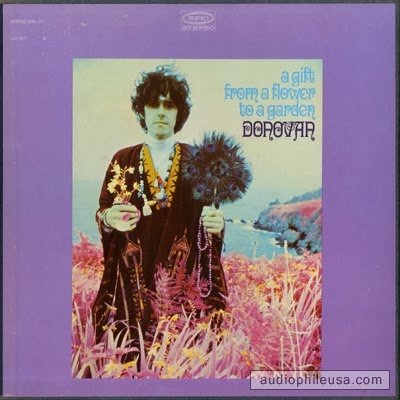
- Donovan, A Gift from a Flower to a Garden - I rediscovered this album a few weeks ago. It was a favorite of mine in my junior and senior years of high school. Sometime in 1968 (probably summer), I convinced my mother to let me join the Columbia Record Club, which offered cheap multi-record intro offers with the requirement to buy a certain number of albums at list price (tough for a high school kid with little money). This 1967 album was part of the intro package I received (others I recall include Strange Days by the Doors, Bookends by Simon and Garfunkel, Disraeli Gears by Cream, and Vincebus Eruptem by Blue Cheer). As I hear it now, I can see that Donovan probably influenced my early songwriting more than anyone besides the Beatles (later I would appreciate and emulate Paul Simon, James Taylor, and Cat Stevens, among others). I had not heard some of these Donovan songs in maybe 40 years, but I still could sing along with every lyric.
- Dawes, Stories Don't End - Another almost-70's-country-rock band updated for the 21st century. Great stuff.
- Big Schubert Box (Bach Guild, still 99 cents!) - It's tough to pick a favorite from among various huge classical collections I bought for mere pennies. This is a great one, as are Rachmaninoff Complete Piano Music (VOX BOX), Sibelius Complete Symphonies (Bis), and Chopin Piano Works (VOX BOX).
- Alt-J, An Awesome Wave - Strangely hypnotic or hypnotically strange? Yes, on many levels, and a great live show too.
- Paul McCartney, Wings Over America - Another rediscovery after watching a concert film from this great 1976 tour. I had the vinyl album in the late 70's, but it was lost and forgotten. McCartney is truly amazing (I saw him live in Boston in 2002).
- Led Zeppelin, Celebration Day - Another oldie but goody, Led Zep's London reunion concert in 2007. Wish I could have been there. Plant's voice doesn't quite have the ultrasonic range of of the original recordings, but it's still a powerful instrument, and Page's guitar playing is always amazing.
- The Wild Feathers - This is brand new, since I just learned about the band and bought the album last night, but I have a good feeling about this band. Another sort-of-country-rock band with impressive songwriting, arrangements, and harmonies. I'm glad the 70's are cool again.
Thursday, November 21, 2013
Bulgaria, Bad Knees, and Japanese
October and November tend to be my busiest business travel months, with at least one trip each to Europe and Asia. In October I did a customer visit tour in "only" four countries: UK, France, Bulgaria (sunset in the hills near Sofia, above), and Czech Republic (though I slept one night at the Vienna airport and drove through part of Slovakia). London, Nice, Manchester, Wales, London, Sofia, Vienna, Paris, and then home. This is a light five-day schedule for our European distributor.
Not much chance for fine European dining on this type of trip (unless gas station sandwiches and airline lounge snacks are your thing), but it's actually kind of fun. Although most business discussions are in English, I do try to practice a little French now and then, mostly in restaurants and by buying and reading science magazines like this recent special Mars issue of Science et Vie.
A special wrinkle on this trip was a bad knee. After months of increasing pain, I was recently diagnosed with a torn meniscus in my right knee. I was worried about long flights, big airports, train station stairs, and long car rides, but most of it went OK with the help of a new rolling backpack computer bag and a special effort to pack light. The fact that I don't have to carry books anymore helps a bit on this - I have hundreds of Kindle books on my iPad Mini, iPhone, and Kindle, and now the airlines even let you use these small devices in "airplane mode" from gate to gate (at least inside the US). After an MRI and two orthopedic opinions, I will have arthroscopic surgery to repair the meniscus next month. So I should be good as new (plus or minus a few decades) by January.
I spent last week in Japan, after working several weeks to prepare for optical/software presentations and product demos that I don't typically do in my day to day work these days. Since long ago I studied and still enjoy optics and pretending to design lenses (we call these "demos"), I look forward to these fall trips when I get to meet with some of the Japanese engineers who have designed many of the camera zoom lenses, DVD player lenses, and what-not that I have bought and used over the years. This trip involved even longer flights as well as many trains and train stations. In spite of all the stairs in the subway stations, my knee felt pretty good, which made me realize (this week) that most of my knee pain is triggered by driving, not by walking and climbing stairs.
I still like to play with Japanese when I'm in Japan, and thanks to the iPhone and iPad, I can now carry around the best Japanese dictionary I ever owned, which happens to be a free app called Imiwa? (the name means "what about the meaning?"). I use this to refresh my fading knowledge of Japanese, taking notes on various interesting words or phrases that I hear or see. I also bought a few copies of a children's magazine that I haven't bought in many years, Takusan no Fushigi ("A World of Wonders" in English). Intended for Japanese children 8 years and up, each monthly issue focuses on a particular non-fiction topic, from a museum of curiosities in Paris, to the life cycle of a certain moth, to the workings of Air Traffic Control (ATC, October 2012, at left), among many others (hundreds of titles published since the 1980's when I first discovered them when exploring Japanese bookstores on my early trips).
Just for fun, I read the ATC one on my flight home (cool because I like flying stuff as well as Japanese). A key point is that most of the kanji ("Chinese characters") are printed with furigana, small phonetic characters that give the pronunciation. Japanese adults don't need these, but Japanese children (and I) do for all but the basic kanji, of which I know around 200 or so. Since I know how ATC works (from private flying and from listening to United's channel 9 for many years), it was fairly easy for me to follow the text, which consisted mostly of radio exchanges between pilots and controllers (although in fact ATC in Japan and in most of the world is done almost entirely in English, because the many international pilots cannot understand Japanese). I still had to look up probably every fourth or fifth kanji-based word (many flight-related words in Japanese are adapted from English and spelled phonetically in katakana, so those are easy to read).
This trip was also the first time in 31 years of travel to Japan that I tried fugu (known as blowfish or pufferfish). I've wanted to try it for years, but it's too expensive for an expense report, and no one ever invited me! Fugu has a bad reputation because its liver is deadly poison, and if it is not prepared properly, the poison can contaminate the meat, and you can die (this sometimes happens to amateurs who try to prepare fugu at home without special training). Restaurants are of course very careful, and it is actually quite safe, and pretty tasty. It is cut almost translucently thin for sashimi (photo above - it is light pink, but the dark pattern of the plate shows through making it look gray in places in the photo), but we also had it in soup, fried, and broiled. Oishikatta! (It was delicious.)
This was also the second time I had tried hirezake, a rather strange drink. It is warm sake with the fin of a fugu soaking in it. It sounds strange (ok, it IS strange), but it tastes pretty good. So I guess technically, I had "experienced" fugu once before. It's also popular enough that you can buy it in individual cans from some drink vending machines. Japan has many vending machines that dispense small cans of cold or warm beverages (typically coffee or tea). In this case, the sake is warm, and the fish fin (possibly not always fugu?) is in a separate small container on top that you add to the sake yourself. I guess you don't want that super-soggy-fish-fin taste in your hot Japanese rice wine, do you?
Wednesday, October 09, 2013
Innovation to the Rescue
I think of myself as a rational optimist. A couple of years ago, I read and reviewed a book of that title by Matt Ridley. Ridley's central theme is the crucial role of trade in the growth of civilization and human well-being - starting with the trade of goods and services that allowed people to become specialized, resulting in more of everything for everyone. But when people learned to trade in ideas, that led to innovation, stimulating the growth of science, technology, and social institutions - things like universities, democracy, and the market economy are all inventions of the human mind (usually many human minds).
I just read another book on this same general idea, the critical role of innovation and the exchange of ideas. I really like The Infinite Resource: The Power of Ideas on a Finite Planet by Ramez Naam. Ideas and innovations truly are an infinite resource, and Naam believes (as do I) that in most situations, market forces are the most effective way to implement ideas and solve problems. He also believes that the major area where the market has failed is in "tragedy of the commons," situations such as pollution of air and water, over-fishing, and greenhouse gas emissions. When there is no direct cost for the use or abuse of such shared resources, these "externalities" cannot be affected by market forces. When such factors do have associated costs, these can drive innovation to find better solutions faster than (say) direct government regulation. Reduction of acid rain and the recovery of the Antarctic "ozone hole" are examples of the success of this approach. It could work for greenhouse gases, too, even if ideas like a carbon tax or carbon trade credits sound scary to some people. Even if some energy prices were to go up temporarily, it would provide the incentive for innovative people and companies to find ways to lower costs and gain a competitive advantage. Innovation needs something to work on, and when it has it, it can work fast.
Naam believes that we have plenty of resources on this planet to support 10 billion or more people in American-level affluence if we can learn to use resources more efficiently, especially the huge influx of solar energy that hits the Earth every day. Certainly "old solar" (fossil fuel) resources like oil, gas, and coal are finite. As he says, "Every solar panel built makes solar energy cheaper. Every barrel of oil extracted makes oil more expensive." He also advocates some innovations that are controversial, such as genetically modified organisms (GMO's) in the food supply and increased nuclear power as part of our energy solution. I agree with him on these points. The alternatives are worse - we need GMO's to improve yields and nutritional value, and to reduce pesticide use (and forest clearing) if we are to support billions more humans in the next 30+ years. And although we are everywhere bathed in more than enough solar energy to run the planet with safe, local, non-carbon-emitting power for billions of years, until innovation leads to more advanced storage systems for dark and windless times, solar and wind power can only be part of the energy solution. Burning more coal is bad for a number of reasons, including carbon emissions and radiation (coal plants release more radiation into the atmosphere than nuclear power plants).
I think this book is well worth reading for fresh perspectives on innovation, environmental issues, and much more. I will finish with a couple of quotes that I like:
I just read another book on this same general idea, the critical role of innovation and the exchange of ideas. I really like The Infinite Resource: The Power of Ideas on a Finite Planet by Ramez Naam. Ideas and innovations truly are an infinite resource, and Naam believes (as do I) that in most situations, market forces are the most effective way to implement ideas and solve problems. He also believes that the major area where the market has failed is in "tragedy of the commons," situations such as pollution of air and water, over-fishing, and greenhouse gas emissions. When there is no direct cost for the use or abuse of such shared resources, these "externalities" cannot be affected by market forces. When such factors do have associated costs, these can drive innovation to find better solutions faster than (say) direct government regulation. Reduction of acid rain and the recovery of the Antarctic "ozone hole" are examples of the success of this approach. It could work for greenhouse gases, too, even if ideas like a carbon tax or carbon trade credits sound scary to some people. Even if some energy prices were to go up temporarily, it would provide the incentive for innovative people and companies to find ways to lower costs and gain a competitive advantage. Innovation needs something to work on, and when it has it, it can work fast.
Naam believes that we have plenty of resources on this planet to support 10 billion or more people in American-level affluence if we can learn to use resources more efficiently, especially the huge influx of solar energy that hits the Earth every day. Certainly "old solar" (fossil fuel) resources like oil, gas, and coal are finite. As he says, "Every solar panel built makes solar energy cheaper. Every barrel of oil extracted makes oil more expensive." He also advocates some innovations that are controversial, such as genetically modified organisms (GMO's) in the food supply and increased nuclear power as part of our energy solution. I agree with him on these points. The alternatives are worse - we need GMO's to improve yields and nutritional value, and to reduce pesticide use (and forest clearing) if we are to support billions more humans in the next 30+ years. And although we are everywhere bathed in more than enough solar energy to run the planet with safe, local, non-carbon-emitting power for billions of years, until innovation leads to more advanced storage systems for dark and windless times, solar and wind power can only be part of the energy solution. Burning more coal is bad for a number of reasons, including carbon emissions and radiation (coal plants release more radiation into the atmosphere than nuclear power plants).
I think this book is well worth reading for fresh perspectives on innovation, environmental issues, and much more. I will finish with a couple of quotes that I like:
Our problem in the near term is not that resources are in short supply. It's that we use those resources incredibly inefficiently, with side effects we have yet to eliminate.
For all practical effects and purposes, our growth is unbounded. If we choose wisely, and tap into the right resources, while acting together to put limits on the negative side effects and externalities of our actions, then we can grow for at least centuries to come, and perhaps longer.
Our only limit, for the foreseeable future, is our collective intelligence in innovating, and in putting in place the systems to guide our collective behavior.Easier said than done, I know, and if you live in the US, such optimism may be especially hard to fathom at the moment, as the Republican controlled House of Representatives holds us all hostage in an ideologically (and idiotically) driven federal government shutdown and threatened debt default. But I still believe that enough humans on this planet are sane and clever that we will probably make it through the next few hundred years, with more humans every year living better off than ever before. Just maybe not in the US.
Sunday, October 06, 2013
Stella, You Are Stardust!
My granddaughter Stella celebrated her first birthday this weekend. Pretty amazing that it's been a year already. It's a lot of fun being a grandparent and watching her grow. My daughter organized a great party with a lot of family and friends, and I took the opportunity to play Look at You, the song I wrote for Stella's birth last year. Stella laughed and clapped along - she's heard this song a few times and I like to think she knows it's her song, but in fairness, she seems to love all music and laughs and claps along with almost any song. Something we have in common.
Stella also shares my love of books, so I bought a few for her birthday, including a really cool one I decided to hold onto for a while. Although "Stella" actually means "star" (in Latin and Italian), I think she's not quite ready for the astronomy and other science concepts in You Are Stardust, a book I discovered through Brain Pickings (OK, so maybe I bought the book for myself, but I promise to share it with Stella in a year or so).
As Carl Sagan (and various others) said and wrote, "we are all made of star-stuff." This reflects the knowledge gained by astrophysicists that we are all products of "stella" evolution -- all of the chemical elements other than hydrogen were originally "cooked up" through nuclear fusion in stars that later exploded, spreading those materials as dust and gas that later condensed into new stars and their surrounding planets, such as our sun and its surrounding solar system - including the Earth and everything and everyone on it. And it only took a few billion years! You Are Stardust turns this idea into a beautifully illustrated story about the connectedness of everything in nature, starting with:
Stella also shares my love of books, so I bought a few for her birthday, including a really cool one I decided to hold onto for a while. Although "Stella" actually means "star" (in Latin and Italian), I think she's not quite ready for the astronomy and other science concepts in You Are Stardust, a book I discovered through Brain Pickings (OK, so maybe I bought the book for myself, but I promise to share it with Stella in a year or so).
As Carl Sagan (and various others) said and wrote, "we are all made of star-stuff." This reflects the knowledge gained by astrophysicists that we are all products of "stella" evolution -- all of the chemical elements other than hydrogen were originally "cooked up" through nuclear fusion in stars that later exploded, spreading those materials as dust and gas that later condensed into new stars and their surrounding planets, such as our sun and its surrounding solar system - including the Earth and everything and everyone on it. And it only took a few billion years! You Are Stardust turns this idea into a beautifully illustrated story about the connectedness of everything in nature, starting with:
You are stardust...For background on the making of the book and the illustrations, including the science behind it, check here. The illustrations are photographs of 3D dioramas created by artist Soyeon Kim. They are really lovely. There is also an iPad app based on the book which looks cool, though I have not yet decided to spend $4.99 and 392 megabytes of storage on it.
Every tiny atom in your body came from a star that exploded long before you were born.
You started life as a single cell. So did all the other creatures on planet Earth.
Subscribe to:
Posts (Atom)