Tuesday, March 16, 2010

Launching the Space Age in 1926

On this day in 1926, Robert Goddard launched the world's first liquid fueled rocket in a field in Auburn, Massachusetts. It reached an altitude of 41 feet and traveled 184 feet downrange. At the time, Goddard was a professor of physics at Clark University in nearby Worcester, MA. He had published papers on rocketry and had discussed the possibility of a rocket reaching the moon. He was ridiculed for these ideas, most famously in a 1920 New York Times editorial which questioned Prof. Goddard's understanding of basic physics, "since there is no air in space for the rocket engine to push against." It wasn't until 1959 that Goddard would be recognized as the father of modern rocketry and the space age, and it wasn't until July 1969 (after Apollo 11 had landed on the moon) that the Times would correct its 1920 editorial and say "the Times regrets the error."

There's more on this historic event at Mass Moments. Thanks to my main Clark University contact for reminding me of this historic day!

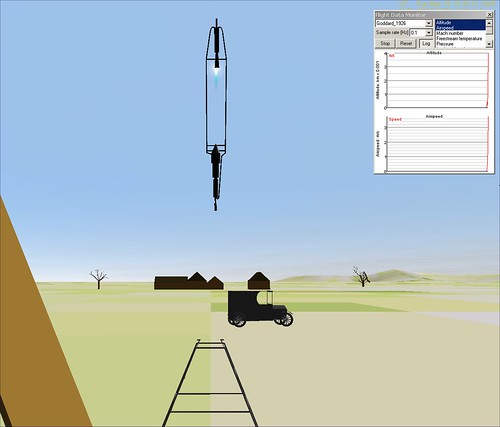
If you'd like to try your (virtual) hand at re-creating Goddard's first launch, you can install Mark Paton's "Early Rockets" add-on for the Orbiter space flight simulator. One of my test flights is shown below.

Goddard's First Liquid Fuel Rocket 3-16-26

Sunday, March 07, 2010

Voyager's Grand Tour

I've been reading a book I found on a sale table at the Toadstool Bookshop in Keene, NH last weekend (great bookstore, BTW). Voyager's Grand Tour: To the Outer Planets and Beyond by Henry Dethloff and Ronald Schorn (2009). Among other things, the authors do a great job of setting the scene in terms of how little anyone knew about the outer solar system before Voyager 1 and Voyager 2 flew by Jupiter and Saturn between 1979 and 1981 (and in the case of Voyager 2, Uranus and Neptune from 1986 to 1989). Pioneers 10 and 11 had gathered some information (we were really clueless before 1973), but the quality and quantity of imagery and scientific data was so much greater for the Voyagers.

The moons of the outer planets were hardly known at all, but were somehow considered unlikely to be very interesting. Voyager 1 dramatically altered that view when it sent back imagery and data showing that there are active volcanoes on Io. The Voyager program was an amazing success. Of course we now know much more about Jupiter (Galileo orbiter) and Saturn (Cassini orbiter), but Voyager 2 is still the only spacecraft to have visited Uranus and Neptune.

Stellarium Revisited (now with satellites)

I haven't looked at Stellarium for quite while so I decided to see what might be new. If you're not familiar with it, Stellarium is a great freeware (open source) planetarium program. I installed the latest version (0.10.3, January 2010) and was pleased to find that it now supports plug-ins, including one called Satellites that uses NORAD TLE (three-line elements) data to add many artificial satellites to the sky objects the program can display. I fast-forwarded the time to see what might be around near sunset tonight and found that the ISS will be making a visible pass from west to northwest between about 18:34 an 18:40 EST - it won't get very high for me on this pass but it's a clear night so I should be able to spot it through and above the trees. Of course there are other resources on the web like Heavens Above for finding ISS and other visible satellite pass data for your location, but this is an especially nice visualization method.

Stellarium is a great program, and the developers keep adding features and improving the interface. It's available for Windows, Mac, and Linux.

Monday, March 01, 2010

Carnival of Space #143

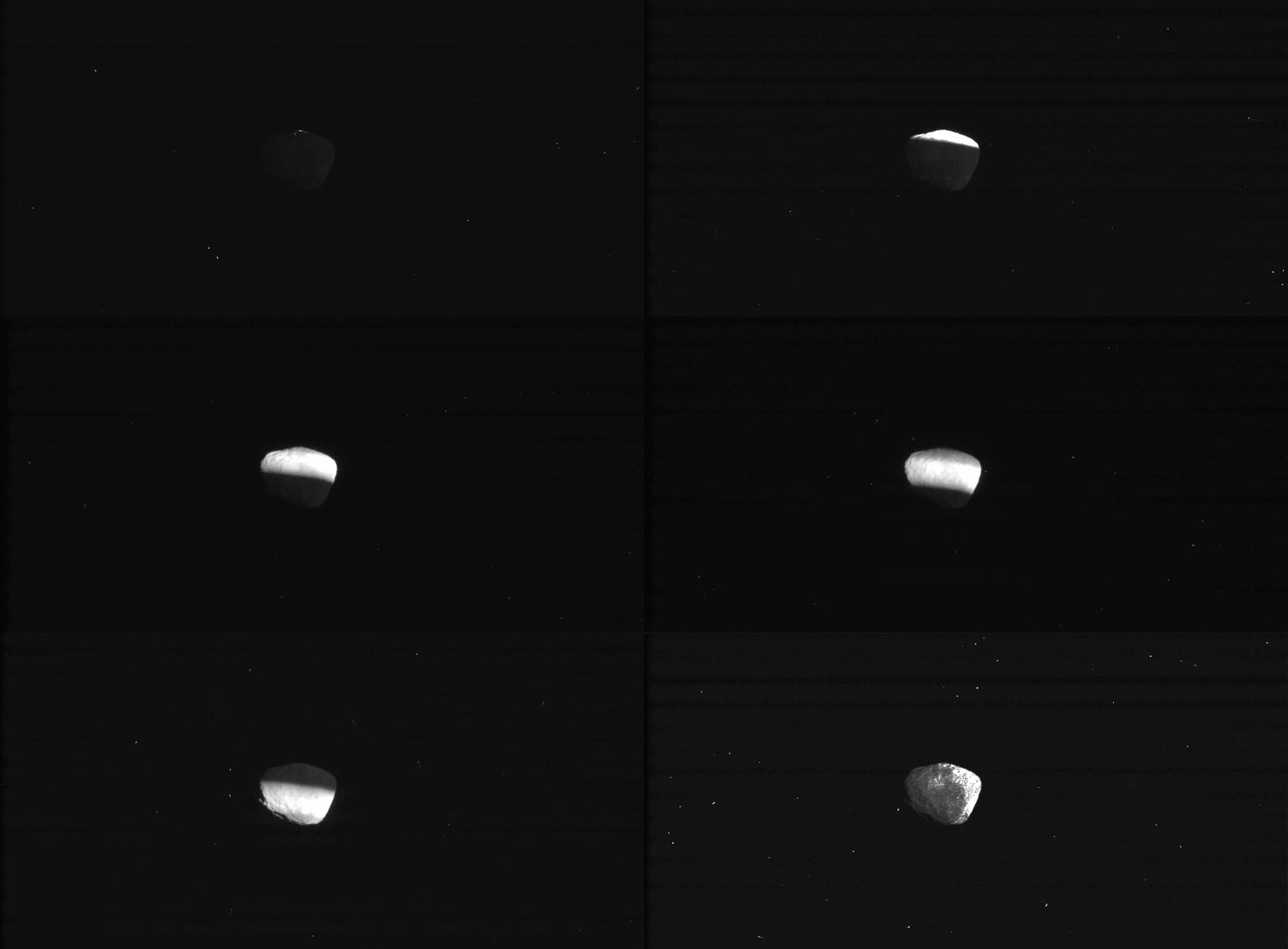
Carnival of Space #143 is at Next Big Future. The amazing Mars avalanche picture above was created from HiRISE imagery by Bernhard Braun and is discussed in the carnival post from Universe Today.

David Shrigley. Simple. Sick. Funny.

I was going through some papers and found some postcards by David Shrigley. I bought them a few years ago at a bookshop in Oxford, England. His artwork is simple (when he draws people, they remind me of Beavis & Butthead, remember them?). His ideas are often quite bizarre. But he cracks me up. Here are two I have that I was able to also find online by searching for "David Shrigley postcards." He has a few books. I should buy one of them in case I lose the postcards again.

Sunday, February 28, 2010

Musical Collaboration with Software?

The weekly Kurzweil AI Newsletter steered me to this great article on composer and musical creativity researcher David Cope (here's a 2009 NPR interview with him). Cope is a composer who has spent many years developing software to help him explore and understand musical creativity. The software he developed (EMI or Emmy, and his newest creation, Emily Howell) actually composes music. Cope's basic hypothesis on musical creativity is that it is fundamentally imitation and redeployment of music the composer has heard before. His first program (EMI, mp3 samples here) was based on the analysis of many pieces of music to extract what you might call the style of the original composer, though it really goes deeper than style to include sources and influences. EMI (Experiments in Musical Intelligence) could then create new pieces of music in that style (or combination of styles), music that was often considered by experts to be of high quality and practically indistinguishable from music by the original composer - until they were told that the composer was a computer, after which they judged the music to be derivative and mechanical, as well as relatively uninteresting since they are new works written in old styles (e.g., Bach).

Emily Howell in some ways seems like a new interactive "front end" for EMI. Using it, Cope communicates musical ideas and goals. The software responds to these goals with modifications to the music "under construction" (it uses the output from EMI as its musical source material). In this way, composition becomes much more of a collaborative process between Cope and Emily Howell, and the results are rather impressive, based on the samples I have heard, with a sound more like modern music than re-fried classics. Emily Howell's first album is supposed to be released soon on Centaur Records.

As a songwriter (but definitely not a "composer"), I find this cool and exciting. It's really just taking musical tools to a new level. In their early days, synthesizers and sequencers were considered to be threats to studio musicians and orchestral players, but they have truly expanded the palette of tools that musicians have available (though I'm sure some musical jobs have been lost or displaced in the process, while others have been created). I write most of my songs with a guitar or keyboard and record most of them with the help of a talented (human) producer and musician who can arrange things I can't arrange and play things I can't play. In addition to recording software (SONAR), I sometimes make use of a program called Band-in-a-Box which generates fairly sophisticated automatic accompaniment through MIDI-based synthesizer voices. These are great for demos and they have inspired some of my best songs by allowing me to easily play around with different styles,arrangements, and instruments. I'd be happy to work with a smarter version of BIAB (like Emily Howell) if it becomes available at an affordable price.

Wednesday, February 24, 2010

xkcd: "Height"

I occasionally read the funny/nerdy comic xkcd. I saw this drawing of "the observable universe from top to bottom" ("Height") a long time ago and have always wanted to blog something about it. So here it is. Be sure to click the small image and scroll to examine all the funny bits visible at full scale. Heights above the Earth's surface are accurate on a log scale. You can also buy a poster of this from the artist.

P.S. Looks like I wrote about this in 2008 too. Oops.   It's cool enough to blog twice.

Make Mars "The Destination?"

I really go back and forth on this. I've been a member of the Mars Society since 2005, I've read several of Robert Zubrin's books, and I even attended and presented a paper at the 2006 Mars Society Conference. I've spent a lot of time reading and simulating and thinking about Mars, and there's no doubt that as a non-Earth destination, Mars is as good as it gets in this particular star system.

So when I read Bob Zubrin's latest essay on why NASA needs a human spaceflight destination, and why that destination needs to be Mars, I want to believe. On some level, I do believe. I was a child of Apollo (and the Beatles) and I probably became an engineer because of it. I was inspired. Developing technologies that will someday be great building blocks for some TBD exploration program (as in the current Obama proposal for NASA) - that's maybe practical, but it's sure not inspirational. Developing a commercial space industry is an essential step in becoming a space-faring civilization, and it will probably create some pretty good high-tech jobs in the USA, but it's probably not inspirational at anywhere near the Apollo level.

On the other hand, Apollo was exceptionally non-sustainable, a proxy-for-war crash program to beat the Soviets to the Moon, and given the political climate and the cost of the Vietnam War, we were damn lucky that we got up to Apollo 17 - I'm sure there were plenty of people in Washington ready to pull the plug as soon as Neil and Buzz splashed down. It surely inspired a lot of people and left a legacy of technology that fueled the US economy for many years. But there's no single threat at the level of the Cold War around which you could build a political consensus for an intense Mars-focused program right now (unless you could somehow show that this would reduce short-term unemployment).

I guess I'm really hoping that the analogies between the early aviation industry and the early commercial space industry will come true. That someone will develop the DC-3 and later the 707 and 747 of commercial space, and that from these developments, the path to Mars (and to the Moon and the asteroids) will become clearer and easier than it is now. But is that a realistic hope? I don't know. Probably not in my lifetime (guess I better work on extending that).

Then there's the whole Lifeboat thing. What if we "sink" this planet? Yeah, I don't know. It's definitely easier to just have a glass of wine and watch American Idol. But I'm trying to avoid that (the Idol part anyway).

Tuesday, February 23, 2010

NASA Changes: Yes, that's it exactly

A lot has been written about the recent changes in NASA's mission and funding, including the cancellation of the under-funded Constellation "back to the Moon" program and the proposal to rely more on commercial space companies to support Earth orbital operations for both cargo and astronauts. I basically agree with this decision, and I hope that Mars will eventually be emphasized (and funded) as the next big destination for human space flight. I was busy with other things when much of this discussion was going on, but I just found an essay by Michael Belfiore that really sums up my feelings. He wrote a guest analysis for Popular Mechanics on February 1 entitled Human Space Flight Needn't Rely on NASA. This is a very clear-headed and succinct essay on this issue, and its final line on the new direction for NASA rings true:
JFK's let's-go-to-the-moon-in-this-decade battle cry it isn't. But in some ways it's even more exciting, because it points the way to truly sustainable development in space.
The picture above shows Elon Musk of SpaceX standing by his company's Falcon 9 launch vehicle which will launch for the first time this spring.

Beatles Revisited

The Beatles have been one of my favorite bands since I first started listening to them in 1967 (yes, I was a few years late to the party - the first Beatles record I bought was the single "Hello Goodbye" b/w "I Am The Walrus" in December 1967). Recently I've been on a Beatles nostalgia kick, triggered by two books I've been reading, Can't Buy Me Love by Jonathan Gould and Revolution in the Head: The Beatles' Records and the Sixties by Ian MacDonald.

Of course I've read a lot of things about the Beatles over the years, but these books are especially enjoyable because they focus on the cultural context and on the songs. Gould's book is something of a cultural history of the 50's and 60's with fairly detailed descriptions of the Beatles' songs and albums as well as their musical influences. MacDonald's book (which I actually just got) is more of a detailed, critical song-by-song analysis, and while much of their music was amazing, this author's not afraid to point out that some of what the Beatles put out was actually pretty crappy (good example: Harrison's "Blue Jay Way," though I have to admit I listened to it a zillion times back in the day and still know it by heart - "Magical Mystery Tour" was the first Beatles album I bought - what did I know?).

I've been reading Can't Buy Me Love on my iPod Touch (Kindle e-book), and it's really cool to be able to quickly pull up and listen to any song he's discussing since I have all the Beatles' songs on there. Ain't technology great sometimes? It was also cool that in the early part of the book, when Gould was writing about the boys' time in Liverpool, that I could think back to the "Magical Mystery (Bus) Tour" that I took there back in 2008. We even stopped in front of the church where John and Paul met in 1957.

That's me in front of the Strawberry Field gate.

Free NASA App for iPhone


With the changes underway in its mission and funding, I'm not sure if there will be a Lunar Electric Rover in NASA's future, but you can still learn about it and "drive" it in a free iPhone/iPod Touch app that's now available. It's not the most exciting game you'll find for the iPhone, but the graphics and background info are pretty cool. It's available from the iTunes App Store (search for NASA Lunar Electric Rover Simulator).

Wednesday, February 17, 2010

New 3D Sun App

I just learned about 3D Sun, a new free app for iPhone and iPod Touch. It uses data from NASA's STEREO solar observation satellites to produce a zoomable, spinnable, false-color image of the sun in several selectable wavelengths, updated on a daily basis. It also provides news and alerts on solar events. I downloaded it and tried it out - it's pretty cool considering you're holding the sun in the palm of your hand.

Carnival of Space #141

I've missed a few space carnivals the last couple of months, and time marches on - we're up to carnival number 141! This week it's hosted by Starry Critters which is a pretty cool blog. It features many images from Hubble, Spitzer, and other telescopes, chosen for their resemblance to plants or animals, and presented in zoomable and pannable Flash viewers in each blog post. The one above is from a February 11 post, titled "Flower of Orion" (taken by ESO's ground-based VISTA survey telescope).

Tuesday, February 16, 2010

Getting Back to Normal (sort of)

I'm still in the "gravity well" of the international meeting that I organize every February, but I'm slowly climbing out of it. Everything went well last week, including the off-site entertainment day which this year was at the Disney Resort in Anaheim, California, my first trip to Disneyland in quite a few years. It was fun - I did a couple of the nostalgic space-themed rides like Space Mountain (really just a roller coaster in the dark) and Star Tours (a full motion simulator ride). But the best thing I saw was a "live" stage show demonstration featuring Honda's humanoid robot ASIMO. It walks, climbs stairs, stands on one foot, runs, and even dances. Pretty amazing. It apparently understands some voice commands, but it was hard to tell its abilities in this since the show was heavily scripted (if it wasn't heavily scripted, ASIMO is certainly ready to pass the Turing Test).

Lots of things have been happening in the space world while I've been on my blog vacation. Although there are a lot of uncertainties ahead for NASA under its new charter and budget, I agree with the general direction (even though some of it is more of a lack of direction). Nothing about space flight is anywhere near "routine," and the analogies with the early development of the aviation industry (air mail contracts leading to the early airline business) are not very exact. But if we are ever to be a space-faring civilization, government space agencies can't continue to run the whole show. Transferring the LEO business to commercial operators seems like the right thing to do.

I've got a backlog of things to write about once I get my schedule more under control, including several really good books (all read on my iPod Touch - I'm mostly reading e-books these days). One was a SF book called Eifelheim by Michael Flynn, and another was Girls Like Us by Sheila Klein, a musical and cultural biography of Carole King, Joni Mitchell, and Carly Simon.

I also have to mention a couple of flying notes. One is the free on-line book See How It Flies by John S. Denker. I discovered this back when I was taking flying lessons in the early 2000's. Denker is a physicist and a flight instructor and this book is an incredible merging of the scientific and technical with the practical aspects of flying airplanes. I rediscovered it this past week when I was moving my files to a new PC. I have some background in physics and flying and I still love both, though I do sadly little of either these days. Denker clearly has a deep knowledge of both, and his explanations and graphics are great.

The final flying note is a video link sent by a friend, a 5 minute HD clip of the US Navy Blue Angels in action. I'm always a sucker for a great flying video. I've seen the Blues quite a few times, but this video gives some amazing perspectives on their art (that's a still frame above).

Tuesday, January 19, 2010

Carnival of Space #137


Just a quick post to let you know that this blog still has a pulse - faint and irregular, but like that poor chap in Monty Python and the Holy Grail who gets thrown on the plague wagon, "I'm not dead." I'm thinking that right around February 12 or so I'll start to have some time and mental energy to think about blogging again.

In the meantime, there's a lovely Carnival of Space to explore over at One Astronomer's Noise. There are links to a number of interesting looking blog posts as well as a few references to the movie Avatar, which I'm dying to see. Busy as I am right now, I actually tried to see it twice - bought tickets and everything. Once was a user error (we bought tickets for the 2D version by mistake and decided to see a different movie and see the 3D version later). The second time I was in the theater watching previews with the 3D glasses when the digital projector broke. Bummer. We got replacement tickets for that and I hope to see it soon. It sounds like a great escape, but for now it's back to the reality of PowerPoint and meeting planning.

Sunday, January 10, 2010

Parrot AR.Drone: Too Cool!


I love getting cool apps for the iPod Touch, even though in many cases I don't end up using some apps very much. This is especially true for games - I've gotten a number of free and 99 cent or so games, but I rarely end up playing them more than a couple of times. I'm really not a big gaming person, though I did go through a 6-year period of intense flight sim usage in the 90's (a slight exception). I love "airplane and space stuff" but even in that category (flight sims, lunar landers), I never really got hooked on any iPod apps.

This one could be different, though it will require a substantial external hardware investment. Assuming the price of the Parrot AR-Drone isn't too ridiculous, I'm looking forward this year to getting a small quad-rotor helicopter that comes equipped with two video camera and a WiFi hub. The flying WiFi hub lets you connect to it from an iPhone or iPod Touch and fly the helicopter by tilting the iPod while you watch the view from its nose-mounted video cam beamed back to the display!  Battery life will probably be an issue since this small remote controlled thing will use its power to transmit a WiFi signal and to power the video cameras and other on-board electronics in addition to the four rotors.But still - it looks amazing. If you are "remotely" interested in this sort of thing, check out the videos. It's being developed by a French company and I guess they introduced it at CES in Las Vegas last week. They apparently already have an application developer kit so there will be various "augmented reality" apps for small-scale aerial combat along with who-knows-what.

A flight sim that really flies! How cool is that?

Wednesday, December 30, 2009

New tune: "Autumn Song"


Sorry I haven't been blogging much lately. I've been busy with other things, one of which is finally finishing the tracks for the "fall 2009" release of my new album, "Message from Tomorrow." Yesterday Roger and I recorded the final new track (lucky number 13) which I just posted on MySpace. I wrote "Autumn Song" back in September, intending it as a simple folk-type song suitable for playing around with harmonies. Without going to the typical drum/bass rhythm track approach that we do on most songs, I asked Roger to see what sort of things he might add with electric guitars. He warned me that he'd been listening recently to Daniel Lanois (an artist and producer who I also like very much), and you can definitely hear that influence in the heavily delayed guitar parts, including some cool slide guitar work. All the vocals are me.

You can listen to or download "Autumn Song" from MySpaceMusic here.

Monday, December 14, 2009

WISE Mission


NASA's WISE infrared telescope spacecraft is scheduled to launch this morning from Vandenberg AFB in California. WISE will perform an infrared all-sky survey at much higher resolution and sensitivity than any previous IR surveys. The bar is not very high on this, since NASA's previous all-sky IR survey satellite was IRAS which launched in 1983 with a whopping 62 detectors (of course other infrared telescopes such as Spitzer have higher resolution but are not suitable for all-sky surveys). WISE will capture everything that radiates in its wavelength band, from asteroids to brown dwarfs to galaxies, and there are bound to be surprises and dramatic discoveries as there always are when new technologies are deployed in space telescopes to look more closely at the universe. The video above is a great overview of the mission.

Note: If you follow this blog, you will have noticed that there hasn't been much to follow recently. I blame this on various distractions, some of which are necessary, and some not so necessary. Sort of a blogging recession. But hey, these things happen, and I hope to return to more regular blogging in early 2010, probably after February 12 when I wrap up an important company event that I organize every year around this time.

Thursday, November 26, 2009

The Carbon Bathtub


I saw a cool little article and graphic in National Geographic that's very helpful in understanding the dynamic nature of the level of CO2 in our atmosphere. In the analogy of filling a bathtub which has a slow drain, it is very easy to see that even if you turn down the faucet (i.e., reduce the production of CO2), the level in the atmosphere can continue to rise (as long as the in-flow rate exceeds the out-flow rate).

Cool Hubble Stuff Online


Last month on PBS there was a Nova special on the final Hubble service mission that I didn't want to miss - but unfortunately I missed it anyway. Tonight I finally got to watch "Hubble's Amazing Rescue" online, and it's truly an amazing documentary. Nova's team closely followed the mission through two years of training and preparation and on the May 2009 mission itself, and they also interviewed the astronauts after the mission. It's great to meet some of the spacewalk trainers and to see the minute detail that went into the preparation for this mission. When you see the number of things that could have gone wrong, the success of the mission is even more impressive.

I also found this post about the instruments removed from Hubble and brought back to Earth. The WFPC-2 camera and the COSTAR corrective optics are now on display at the Air & Space Museum in Washington.

Update: Dwayne Day visited the Hubble artifacts in the Air & Space Museum and wrote a nice article on them ("Instruments of God's Creation") for this week's Space Review.  

Monday, November 23, 2009

Sunday, November 22, 2009

GigBaby! Recording App

I'm still trying to get caught up with various stuff since my Japan trip and also trying to get in the right creative frame of mind to finish my album project. Not much progress on that this weekend, but at least I played some guitar (and listened to a lot of music, some of it classical as I ripped a bunch of my classical CD's now that I have a 32 GB iPod Touch with room for lots more music - I forgot how much I like some of Haydn's late symphonies).


I also fooled around with some test recordings - on the iPod Touch! I knew there were some multi-track recording apps for the iPhone and iPod Touch, but I never looked into it. This weekend I stumbled on something called GigBaby! which is a 4-track recording app for just 99 cents (there's a free version too - I tried it for a few minutes before making the big spending decision). It's rather bare-bones compared to Sonar on the PC (of course!), but it's pretty cool. It has a bunch of pre-defined rhythm tracks you can choose in various styles (though none of them has much of a groove going one). It lets you set the tempo and then record up to four overdubbed audio tracks via an external microphone (the iPhone can also use the built-in mic). The sound quality is reasonably good, and there is a WiFi sharing capability that lets you move tracks between iPhones/iPods and back them up onto a PC or Mac. No stereo panning, no reverb or other effects, but for getting down a simple song, harmony, or instrumental idea, it's quite good. And it's all happening on a device I have in my pocket anyway. Nice!

Their web site doesn't look like much, but they have a decent little PDF manual. This Apple pocket computer never ceases to amaze me.

Back to the (USSR) Future


I found a small booklet nestled between a couple of volumes of my old Berkeley Physics Series texts in my office. I didn't remember it at first, and the title puzzled me - "The USSR in Outer Space: The Year 2005." Wasn't the USSR long gone in 2005?  The booklet has a Boston Museum of Science price sticker on it ($3.95), and that triggered a vague memory of a special exhibit on the Soviet space program - but when was that? A few Google searches revealed the answer: summer 1990 (I must have pictures somewhere). And the USSR officially ended December 25, 1991. But what's with the 2005?

Turns out the booklet is an optimistic look ahead at where the Soviets planned to be in space in 2005, apparently written in 1988 (it talks about a number of near future plans for 1989 and 1991-92, and mentions the "new" Mir space station, whose first module had launched in early 1986 and which had been occupied at least part-time since 1987 - it would be expanded in fall 1989 and continuously occupied until 2001).

There were big plans beyond space stations. The book describes a wide range of planetary probes, Earth orbiting resource monitoring satellites, as well as communication and navigation satellites. Orbital fabrication research too. There are some photos of the the shuttle lookalike Buran vehicle (landing after an unmanned test flight).

Some of this has come to pass, eventually including the International Space Station. But the estimate of a manned landing on Mars around 2005-2010 was unfortunately a bit too optimistic.  

Monday, November 16, 2009

Carnival of Space #129


This week's Carnival of Space is hosted by Tiny Mantras. Tiny Mantras is not your typical space blog since the space content is largely driven by the interests of the blogger's four year old son. But you gotta love a site that features Jupiter face painting as well as a nicely equipped Cosmic Jukebox.

Japan Reloaded


Back in the 1980's and 1990's, I used to spend about two weeks a year in Japan, and although that isn't a lot of time, it was enough to keep me somewhat engaged with Japanese language study, and I found my skills gradually improving with every trip. In recent years, things have changed. I need to spend more time in other countries and not so much in Japan. I kind of miss it.

So I was really happy to spend last week in Japan, the first extended trip in about four years (I spent a couple of days there in 2007). I was visiting customers, mostly in and around Tokyo, though we did spend one day in Nagoya. I had spent a little time reviewing Japanese and exercising the new iPod app Kotoba!, an amazing electronic Japanese dictionary that I've written about before. My Japanese worked well enough with taxi drivers, restaurants, asking directions, etc. though I was frustrated at how much I had forgotten. I guess it can't be helped (shikata ga nai) - use it or lose it.


Aside from trains, restaurants, and customer sites, I spent most of the time at the New Otani Hotel in the Akasaka area of Tokyo. This is a pretty nice hotel, with a great view of the nearby State Guest House, formerly known as the Akasaka Palace. The Google Maps view at left shows how close this building was. Saturday morning I was eating breakfast on the 40th floor of the Garden Tower, thinking about the fact that President Obama was also in Tokyo at the moment, and wondering if he was staying at the State Guest House next door. A number of visiting presidents had stayed there, but I couldn't find any information on where Obama was staying on his current visit (not surprising I guess). It didn't look very busy from 40 floors up, so I decided to take a walk in the rain and check it out.

But first I took a detour through the New Otani's best feature, its beautiful Japanese garden, complete with red bridges, koi ponds, a waterfall, a tea ceremony house, and a Christian chapel. Passing the chapel, I noticed an unusual book mixed with the usual propaganda. It was called Manga Messiah and it was rather unusual propaganda, the New Testament in Japanese comic book format (subtitle: "Has he come to save the world... or destroy it?"). Not my usual cup of ocha, but I had to check it out. This required a brief chat with a very nice Japanese-speaking American former missionary who was staffing the chapel that morning. Seeing that the book included full furigana (pronunciation hints for the kanji), I really wanted it in spite of the subject matter. We talked about Japanese study and other safely non-religious stuff, and as I started to put the book back in the rack, she said I could keep it! Cool. Maybe it's a stealth conversion thing. I'll be careful.

After the garden walk, I found my way to the wall surrounding the nearby State Guest House and walked a kilometer or so past the front gate of the palace grounds. With a total of maybe ten police officers on the whole perimeter that I walked, I was quite sure that the Obama party was staying elsewhere this trip! Then I went back to my room to finish packing and check out for the flight home Saturday evening.


Earlier in the week, I did manage to grab a couple of hours one afternoon to check out a bookstore in Akihabara. It wasn't the best bookstore I've seen in Tokyo, but it was handy and fairly big, and I mainly wanted to refresh my supply of small Japanese notebooks. For years I've used these small notebooks for language notes, travel notes, flight lesson notes, etc. Of course now I do most of that on the PC and/or iPod and/or blog, but I still like these little notebooks, especially the ones with wacky quasi-English cover art. I didn't find anything as wacky as the one pictured here, my all-time favorite from the "Frisky Naughty Penguin Series" (1986), but I got a couple of cute ones. I also bought a great 2010 calendar with scenes of Mount Fuji. I probably could have bought that somewhere closer to home, but it was just the right size for my office so I went for it.


After that I searched the children's book section for anything worth buying to help me build vocabulary (and keep some interest in Japanese going once I got home, always a problem). I found a cool little book for only ¥960, Chikyuu-Uchuu, (Earth-Space). This is a small, colorful paperback with descriptions of basic geology, meteorology, astronomy, and a smattering of space flight stuff. Lots of color photos and diagrams. It's probably middle-school level or below, but it's perfect for me because all of the kanji characters have furigana for pronunciation, just like Manga Messiah! Except that the vocabulary and world view are just a bit different, I'm guessing.

Wednesday, November 11, 2009

Carnival of Space #128


The carnival of space hails this week from Melbourne, Australia (a nice place, I was there in 2006), even though the picture above shows scenes from Sydney (I liked it there too). AARTScope Blog presents a wide range of space and astronomy topics including a couple of cool videos.

Monday, November 09, 2009

Carl Sagan and the Big Picture on Mars


I'm having a crazy week and shouldn't even be thinking about blogging. But here are two cool things courtesy of other bloggers.  Astropixie has a great quote from the late Carl Sagan in honor of his birthday on November 9 (he would have been 75). Carl Sagan was one of my favorite people, and while I hesitate to put myself in any category with him, his ability to make science accessible to everyone certainly inspired me in my attempts to do educational outreach using space and astronomy themes.

And here's another space-related post from The Big Picture - Mars from MRO. Incredible images. Carl liked to talk about how Mars and the other planets are places, and I'm sure he would be pleased with how intimately we've gotten to know the place called Mars over the last few years, thanks to the Mars Rovers, MRO, and other robotic explorers. Thanks to Bad Astronomy for the tip.

Sunday, November 08, 2009

Journey to Palomar


Busy week, but I had a little time to kill with my iPod handy, and I finally watched Journey to Palomar, a PBS science special that I bought back in September (from the iTunes store for $1.99). This is an excellent documentary about George Ellery Hale (1868-1938) and his lifelong quest to build the biggest telescopes in the world while also managing to find time to do groundbreaking work in solar astronomy and especially spectroscopy.

In persuading financial backers and managing some of the biggest scientific projects of his time, he was directly responsible for the existence of the Yerkes telescope in Wisconsin (102 cm/40 inch refractor), two telescopes at Mount Wilson, CA (the 1.5 meter/60 inch Hale Telescope and the 2.5 meter/100 inch Hooker Telescope), and the 5.08 meter/200 inch Hale Telescope at Palomar Mountain, California (completed 10 years after his death - the project was put on hold during WWII). He also helped to establish Caltech in Pasadena. He accomplished all this and more while overcoming a lifelong struggle with mental illness. I knew very little of this amazing man, and I highly recommend this 90 minute documentary. In addition to the biographical aspects, there is great information (including amazing film clips) on the design and construction of the telescopes.

Wednesday, November 04, 2009

Beam Me Up, Scotty!


Here's a small step for space elevatordom and a giant leap for laser power beaming optics (or something like that). At the Space Elevator Games 2009 in California, the LaserMotive team qualified today for a $900,000 prize. They did it with a small laser-powered machine that pulled itself almost one kilometer up a helicopter-suspended cable. The laser was on the ground and had to track the climber to lock the beam onto the bottom-facing solar panels to keep it powered and climbing at an average speed of 3.72 m/sec (5 m/sec would qualify for the $1.1 million prize).Congratulations to the LaserMotive team! Two other teams will be climbing tomorrow. This is the first time that anyone has qualified for a prize in the Space Elevator Games (last time the goal was 100 meters - a big jump to 900 meters this year). Check out this cool video to see what's involved with this technology challenge (prizes funded by NASA).

This is not quite a space elevator, but remember, a geosynchronous journey of 35,790 kilometers begins with the first half-mile or so.

Galactic Suite 2012 - Really?


I guess I'm really slipping when it comes to keeping up with private space. Before seeing this Reuters item the other day, I had never heard of the Galactic Suite Space Resort project. Based in Spain, this company says they are on track to welcome their first orbital guests in 2012, by which time they will have apparently built a a tropical island training center and launch site, a modular space station, and an orbital rocket plane to carry four pax and two crew from the island to the resort. By 2012? It's not even clear that Virgin Galactic will be flying suborbital passengers by 2012, and they've been working on it for a while. Dudes, it's almost 2010!

Maybe they are actually in league with Bigelow Aerospace (which also mentioned 2012 for a space station, back in 2007).  Their announced price of $4.5 million for three days at the orbital resort compares very well with ~$30 million for a Soyuz ride to the ISS, but wait a minute.  I just watched a video that said they will use Russian flights until their space plane is ready, though Soyuz can only carry one passenger now, maybe two on an upgraded single-pilot version. Doesn't really add up, does it?  I'm very skeptical, even though Galactic Suite claims to have an ace in the hole in the form of an anonymous billionaire space enthusiast who has granted $3 billion to finance the project. I wonder if his name is Dr. Evil?

They have a few cool graphics on their web site, but not a whole lot of information. That pretty much seems to sum it up.

Tuesday, November 03, 2009

Carnival of Space #127


The latest Carnival of Space is number 127, hosted this week by Next Big Future. NASA's recent launch of the Ares I-X is one of the popular topics of discussion this week.

Monday, November 02, 2009

Screen Capture for iPhone and iPod Touch


I should have looked this up ages ago. Whenever I've written about an app on the iPod Touch, I've usually grabbed screen shots from the developer's web site because I didn't know how to capture my own. Turns out it's really easy. You go to the screen you want, briefly hold the power button (on top edge), then press the Home button (bottom of screen). The screen will flash and you'll hear a shutter release sound. The 320x480 bitmap image shows up in your Saved Photos folder, from which you can email it to yourself or (if you really want something confusing), set it as your wallpaper.

The four shots above are (clockwise from top left) my home page of app icons (first of four), a search page from the Kotoba! Japanese dictionary app, a night sky view with Mars selected in Starmap, and my Main Morning App, the New York Times.

Sunday, November 01, 2009

How to Fly a Plane


This was another distraction, but a nice one. I saw the original British edition of Nick Barnard's book How to Fly a Plane in an airline lounge on my whirlwind Europe tour last month (I think it was the S.A.S. lounge in Oslo). I took a quick look and noted the title for later research. I found a cheap used copy on Amazon so I ordered it. I finally read it tonight over dinner.

It's pretty cool and something of a nostalgia trip for me since I've flown very little since getting my license in 2001, sad but true. I keep thinking I'll get back to it but the time and expense make it tough to do it regularly enough to be safe. This book is not intended as a flight instruction aid, but more as a fairly detailed account of what's involved in flying, and what the various experiences feel like. The basic stuff is pretty accurate as far as it goes, and it's interesting in that they use a very modern, glass cockpit Diamond Star TA40 TDI as the basic training aircraft (a far cry from the tired old Cessna 152's I trained in).

But I especially liked the "first flights" section which describe what it's like to fly a modern high-performance glider (I've done a bit of that), a classic open-cockpit German biplane (a Jungmann, similar to the Boeing Stearman which I've flown a couple of times), a Sukhoi 29 aerobatic trainer (I wish!), a P-51 (I wish more!), and a British Hawk jet trainer (sigh).  So it's a combination of nostalgia and envy when you come right down to it. Of course I have "flown" aircraft like these in various flight sims over the years, but Barnard focuses more on the sights, sounds, and physical actions in the cockpit, for which sims are not very good (you can't simulate the classic smell of hot engine oil in the cockpit of a Piper Cub on a summer day when you're flying with the door open). He's an aerobatic pilot (in Britain) and it sounds like he's really flown most of these aircraft (though I'm not too sure about the Airbus A380).

Saturday, October 31, 2009

Wandering: Japanese, DARPA, Le Guin


I spent about three hours listening for trick-or-treaters this evening. We got a few, and while I listened and ate some of the candy, I also wandered through some Japanese review in preparation for an upcoming trip. I started to study Japanese in 1981 and through the 80's and 90's, I used to spend 2-3 weeks a year on business trips in Japan. This was enough motivation to keep me working at least a little on Japanese so I could use it and improve my skills on every trip. Since 2000, I've been spending more time in other Asian countries and only getting to Japan for maybe a week every two years. It's so much more fun to go to a country where you know enough of the language to feel really comfortable (France and Japan for me), but duty calls me to China, Taiwan, and Korea where I know almost nothing of the local language. 仕方がない (shikata ga nai, it can't be helped).C'est la vie. Whatever.

I'm too busy to spend as much time reviewing as I would like, but I find that the major job of any language review is to reactivate some part of my brain where language knowledge seems to be lurking - get the Japanese juices flowing, as it were. So I dig out old books like "Say It In Japanese" and just read random pages, saying phrases out loud to get the speech centers moving too. I have a lot of Japanese study books and dictionaries (it's amazing how many I have on this list of 252 Japanese books). I like to take notes, and I have used various Japanese word processors, most recently the excellent (and free) JWPce.


This exploration process is now easier and more fun than ever, thanks to several apps on the iPod Touch, especially Human Japanese and the free Kotoba! dictionary which has recently been updated. Kotoba! v2.0 now includes example sentences, full copy/paste support, verb conjugations, and a "corkboard" feature which saves the history of words accessed as well as designated favorites - it's certainly the best Japanese study and reference aid EVER. I can copy and paste into the Notes app, email the notes to myself, and copy/paste them into a JWPce document.

It's not all about Japanese. I've also been stockpiling Kindle and now Barnes & Noble e-books on the iPod for those long Asia flights (when I'm not studying Japanese or sleeping). One of them is a new book about DARPA by Michael Belfiore, The Department of Mad Scientists (How DARPA Is Remaking Our World, from the Internet to Artificial Limbs). I've just read a chapter or so, and it's really interesting.

Long post but there's one more book-related distraction. I've been occasionally following Read All Day, the blog of a woman who just completed reading and reviewing a book a day for 366 days (and I thought I liked to read). She doesn't read much SF, but one she did read was a collection of stories by Ursula K. Le Guin, The Fisherman of the Inland Sea. It sounded good so I ordered a used copy (no ebook available, alas). This also reminded me that I've been meaning to re-read Le Guin's classic The Left Hand of Darkness, so I dug out the paperback for that.

Update: Here's a little astronomy-related fragment of today's Japanese review on the iPod with one of the example sentences from Kotoba! v2. You pretty much need to be able to read the hiragana and katakana phonetic character sets to be able to make much use of Kotoba!, and most of the examples are standard Japanese with mixed kanji and kana. You may have to do as I do and use the copy/paste feature to translate any kanji in the sentence that you don't know how to pronounce.


その必ずしも 肉眼で見えるわけではない。(Sono hoshi wa kanarazushi mo nikugan de mieru wake dewa nai.) We cannot necessarily see the star with the naked eye.
hoshi 星 star or planet as in 火星(かせい)Mars
必ずしも [かならずしも] (not) always, (not) necessarily, (not) all, (not) entirely
肉眼 [にくがん, にくげん] naked eye, the physical eye (lit. "meat eye")

Friday, October 30, 2009

Big Picture: Saturn at Equinox


Here's another great photo collection from The Big Picture blog at the Boston Globe: Saturn at Equinox. These are very recent Cassini images of Saturn, Titan, Janus, Tethys, and other moons. I love this animated GIF of strips of shadows and light cast onto Janus through gaps in Saturn's rings.

Wednesday, October 28, 2009

Apollo 17 Site from LRO at 50 km


NASA's Lunar Reconnaissance Orbiter (LRO) was moved to its final mapping orbit on September 15. Now orbiting just 50 km above the lunar surface, it passed over the Apollo 17 landing site on October 1 and took some great images showing the LM descent stage, Lunar Rover tracks, deployed scientific instruments, and even the American flag. These images are about twice the resolution of previous LRO Apollo site images (from higher orbit). The video here gives you a little tour.

Tuesday, October 27, 2009

Robot Armada of the Future


Here's a really cool news feature from JPL on future possibilities for robotic exploration of the solar system. When you think of exploring somewhere like Titan, it's hard to imagine doing it by the Mars Rover method - with engineers sending up a batch of commands every day and controlling every move when it's so far away (about 85 light-minutes one way right now). This article describes development work on autonomous, communicating robots that could eventually lead to rovers, crawlers, climbers, balloons, and orbiters, working together to explore according to general guidelines and goals. They would respond to developments like a cryovolcanic eruption or what-have-you more or less like an astronaut or geologist would (with curiosity and caution). I'm sure such a scenario is a few years off, but it's cool that Wolfgang Fink and others are working toward this goal now.  I'm sure there will be many down-to-Earth spinoffs in the meantime from Fink's company,  Cyberdyne Systems Corporation.

Just kidding.

Big Telescopes Get Lucky (Imaging)


Over lunch I read a cool article in the November Optics and Photonics News. The article is called "High Resolution Imaging with Large Ground-Based Telescopes" by Craig Mackay, and it's not available online yet, though there is quite a lot of material on the subject at the "Lucky Imaging WebSite," hosted by the University of Camridge, where Mackay is an astronomer. The home page includes a good overview of the subject as well as many links to more detailed articles and even a Ph.D. thesis if you want lots of detail.

I'll let you read elsewhere for the details, but "Lucky Imaging" takes advantage of the statistical properties of atmospheric turbulence in combination with fast, low-noise, electron-multiplying CCD's and some very clever techniques to achieve diffraction-limited imaging from ground-based telescopes in visible wavelengths, where adaptive optics methods (AO) have not been especially successful (AO works better in the infrared). We're talking Hubble quality resolution or better, especially when this technique is implemented on the latest very large telescopes. It has already been demonstrated on the Palomar 5 meter telescope in combination with an AO system. The animated GIF above compares an uncorrected Palomar image of the Cat's Eye Nebula (NGC6543) with the same object using the AO plus Lucky Imaging technique (Hubble's Cat's Eye images look better than this due to several factors including longer exposures, but this gives an idea of the improvement Lucky Imaging makes possible).

Monday, October 26, 2009

So Why Only One?


When I was writing my post about Carnival of Space #126 a few minutes ago, I searched Google for "Gish Bar sun god" (I was curious even though I knew the title of The Gish Bar Times blog must refer to the geological feature on Io, not the Babylonian god). One of the top search results was a Google Books entry from The Dictionary of Ancient Deities by Patricia Turner and Charles Russel Coulter. Google Books only has a preview of this 2001 reference book, but it displayed the page containing "Gish Bar" anyway - very cool. I guess that's the point of Google Books (that all those scanned books just become part of the web's searchable database of information on everything).

This book didn't have much to say about Gish Bar (Babylonian sun god, that's about it). But the really striking thing is that this is a dictionary of some 10,000 entries, all of which are gods that humans of many cultures have dreamed up over the last few thousand years. Gish Bar's neighbors include Girru (fire god, Sumer), Gitche (high god, Algonquin), and Gjall (hard to explain, Teutonic), Gnowee (sun goddess, Wotjabaluk people of Australia), and "Goddess of Illusion" (a.k.a. "Maya", India). I think that last name pretty much sums up all of them!

Carnival of Space #126


Some space blogs (like this one) are all over the map. Others pick a theme and stick with it. Case in point: The Gish Bar Times. It's pretty much all Io, all of the time. Except when it's hosting the Carnival of Space, as it's doing this week. The blog's name "Gish Bar" certainly refers to Gish Bar Patera, a complex, volcanically active crater on Io (as opposed to Gish Bar the Babylonian sun god).

The image above is one I captured some time ago in Orbiter of Io with Jupiter. The image below is one I just grabbed in Orbiter with labels turned on so I could see where Gish Bar Patera is located on Io's surface. I added the "magnifying glass" using PaintShop Pro. Io sure has a lot of paterae.


Sunday, October 25, 2009

Better e-Reading from BN?

I still read a lot of books. I haven't bought an Amazon Kindle, though I've been tempted a few times. The main drawback (aside from cost) would be having to carry around another device. I travel with a laptop PC, a Blackberry, and an iPod Touch. It's not so much the weight or bulk of the Kindle (something like 10 ounces, 289 grams), but it's another thing to think about, keep charged, not lose, etc. Fortunately Amazon makes a free Kindle Reader app for the iPhone and iPod Touch, so I've been able to get the benefits of Kindle e-books (easy to carry multiple books, relatively low cost) without an actual Kindle.

Now Barnes & Noble has muddied the waters for me with its new nook e-book reader. It's the same size and cost as the Kindle 2 ($259) and uses the same e-Ink screen technology to display the books. But it has an additional color LCD screen used to provide a touch-screen interface and a number of additional attractive features (direct PDF support, AT&T wireless plus WiFi for downloading books, memory expansion, replaceable battery).  In a clever marketing twist that leverages their many brick-and-mortar stores, BN will allow you to read any e-book for free via free WiFi inside any of their stores. You can also lend an e-book to a friend with a BN account, which is cool (only 14 days, only once, and you can't access the book while it's "checked out," much like a physical book).

But perhaps most interesting (for me anyway) is their expanded support for other devices. Like Amazon's Kindle, they provide a free e-book reader for the iPhone and iPod Touch. But unlike Amazon, they also have compatible reader applications for Blackberry, Windows PC's, and Macs. I can't see reading on the Blackberry if I have the iPod Touch available, but I've already installed and tried their PC e-reader and read parts of a purchased book on both the PC and on the iPod Touch. I had to unlock the book for each device (with the credit card number used for purchase, a slight inconvenience there), but otherwise it's great to have the option of looking at a much bigger page when I have my notebook available (though the iPod is much better for reading on planes and in bed).

This multi-platform support might lead me to buy more e-books from BN rather than Amazon, similar to the way I buy most music now from Amazon rather than iTunes (mainly because Amazon's MP3's are more portable than Apple's proprietary music format). Will it lead me to buy an actual nook? I don't know, but I certainly will go into a Barnes & Noble and try one out (another advantage of BN's physical stores).

Competition is cool (sometimes)!

Fall Day in New England


Wachusett Reservoir, October 25, 2009.

Saturday, October 24, 2009

NASA In My Pocket


I occasionally check iTunes for any new iPhone/iPod Touch apps that might be of interest, especially free ones.  Tonight I found a brand-new NASA app for iPhone, called (appropriately enough), "NASA app for iPhone." It's free and works also on iPod Touch (needs WiFi connection).

This app offers a handy way to learn about and track NASA missions with photos, videos, a mission orbit tracker (e.g., a map shows where the ISS is now), and NASA Twitter Feeds and Mission Updates. It's nice how this app integrates access to all sorts of NASA resources, many of which are actually separate web sites run by separate NASA centers.

This is especially convenient for me because for some reason, the security software on my notebook doesn't like the nasa.gov web site and won't let me load it without temporarily turning off the firewall, which I really hate to do (oddly enough it has no problem with jpl.nasa.gov, but most other nasa.gov URL's will not load).

Distracted by Dragons

Lots to do this weekend, but I've told myself that as a citizen deeply concerned about humanity's future in space, I must make time to read the final report of the Augustine Committee, "Seeking a Human Spaceflight Program Worthy of a Great Nation." I've downloaded the PDF and I have it open on my computer ready to read. But first I must get past Napoleon and the damn dragons.


I've been sucked into Naomi Novik's "Temeraire" series. As I've written about before (here and here), this is an "alternate history" series that takes place in the early nineteenth century and revolves around the Napoleonic Wars in Europe. It's reasonably good historical fiction with one major addition: intelligent dragons that interact with humans in various ways. In the first book (His Majesty's Dragon), they were pretty much featured as platforms for aerial warfare, but in the second book (Throne of Jade), Temeraire and Laurence traveled to Imperial China, where dragons are deeply integrated into the culture and respected as independent, intelligent beings (though there is still plenty of fighting). The third book (Black Powder War) brought Temeraire and Laurence to Turkey after a harrowing cross-country journey from China. There were new characters and many adventures, but I found it hard to get through some parts of this book - certain contrivances threatened my willingness to suspend disbelief, and I found the plot "dragon" in some parts (sorry!).  I even resolved to quit the series with this book.

But Novik managed to hook me in the end when Temeraire and Laurence finally arrived home to find that a horrible dragon plague was threatening to leave Britain wide open to Napoleon's invasion plans. This made me curious enough to download and read the next book, Empire of Ivory. This book takes place mostly in South and southern-central Africa, where there is reason to believe a cure for the dragon disease can be found, and of course more disasters and adventures ensue, and we meet a civilization with a human/dragon culture quite different from either the Chinese or European models. For me, Empire of Ivory was much better than Black Powder War (though if you should decide to read these books, I strongly suggest you read them in order and not skip any - characters and plot elements from the earlier books are important in the later books, and there isn't too much back story explanation in the later books).

This brought me to the last published book in the series (Victory of Eagles) which finds Temeraire and Laurence imprisoned as traitors (long story!) and temporarily out of the action as Napoleon's invasion of Britain looms. It's quite a page-turner (or screen-flicker since I'm reading all these books in Kindle format on the iPod Touch) and it's keeping me from my music plans, the Augustine report, and some promised housework. Fortunately the sixth book (to be set in Australia) is not due for a while so I'll be able to get some stuff done once I finish this one later today.

I normally don't go in for fantasy (for example, I like the Lord of the Rings and Harry Potter movies, but could never finish any of the books). But Novik's dragon books don't strike me as fantasy - the world she builds is richly detailed and historically and culturally realistic in most respects. The fact that there are talking dragons just happens to be the way things evolved, and it just works for me as long as I don't think too much about the flight physics and implausible payloads of these enormous dragons. Somehow it's all made possible with "air sacs" (hmmm - helium sacs maybe?).