Showing posts sorted by relevance for query space solar power. Sort by date Show all posts

Sunday, July 27, 2008

Solar Power Satellites

The basic idea of solar power satellites (SPS) has been around since 1968, but with high and rising energy costs and with improvements in solar photovoltaic technology, the idea seems to be getting more attention now. There was an opinion piece in the New York Times last week that outlined the basic ideas of SPS, noting that the required technologies all exist now, and that with lighter and higher efficiency solar cells, the mass of an SPS could be much less than the monster systems envisioned in the seventies. The ISS could be used for testing some SPS technologies in space (even though it is in low Earth orbit and therefore doesn't stay over one point on Earth as a real SPS would presumably do from GEO). There are other promising developments:
  • An October 2007 report to the National Security Space Office called "Space-Based Solar Power As an Opportunity for Strategic Security" (available here). Strange maybe, but at least DoD is an interested party with money!

  • Japan has been testing SPS technology including power-beaming and plans to have an SPS in space by 2030 (JAXA concept picture shown).

  • A new organization called SSAFE (Space Solar Alliance for Energy Future) was announced last fall by NSS. SSAFE is a coalition of 13 research and space advocacy groups advocating investments in space-based solar power. NSS also has an extensive on-line library of books and other materials on space based solar power.
A recent article in Air & Space Magazine also talks about the issues of space-based solar power. While there is great promise, and progress is being made, there are also many problems, including public perception of the safety of beaming power to Earth with microwaves (really not a major issue) and the fact that ground-based energy technologies are also developing faster now, reducing possible energy cost advantages of space-based solar. But in the long run, placing arrays of efficient solar cells in a place where the sun always shines is too good an idea to waste!

Sunday, September 20, 2009

Solar Power Sats


I've written a few times before about space solar power, and I was pleased to see a post about developments in this area on Friday's  Cosmic Log. After reading Alan Boyle's post entitled "making space power pay," I wondered if anyone had yet created an Orbiter add-on to model a solar power satellite. Orbiter add-on developers have simulated many futuristic systems such as space elevators and the Stanford Torus space colony, and solar power satellites are probably a better bet for the next 20 years (Orbiter add-on developers tend to favor manned spacecraft, but there are many examples of historic, current, and futuristic unmanned spacecraft as well).

So I checked on Orbit Hangar and did a Google search. I didn't find a powersat add-on, but I found a request for one in an Orbiter-forum post back in May. The requester was William Maness of PowerSat Corp., whom Alan Boyle quotes in his blog post. Maness was looking to contract an Orbiter add-on developer to create a powersat model for Orbiter that could be used in some visualizations and simulations of their proposed powersat system (a very cool deployable/inflatable concept). There was some interest and a lively discussion, though wasn't clear from the forum discussion whether he got someone to do it. But based on this video from PowerSat, it looks like they did, at least for visual purposes. Some parts of this video really look to me like Orbiter scenes (from 0:31 to 0:57 -  probably enhanced with video editing mainly to show the microwaves beaming down to Earth). Maness mentioned in the post that he hoped to simulate a launch to LEO on a SpaceX Falcon 9 as well as more specific technical aspects such as sun tracking and continuous thrust engines (presumably electric ion engines) to gradually boost the powersat from LEO to to its operational GEO orbit. Orbiter can do that sort of thing with some clever custom add-on programming.

There are obviously many challenges to developing and deploying solar powersats, but it's pretty exciting to be seeing even such early commercial development, and to think that Orbiter may have a small role to play in developing and promoting these systems.

Tuesday, April 15, 2008

Why Space? (A Meta-post)

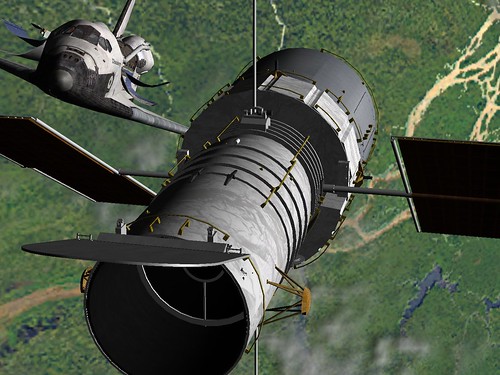
HST on STS-125 August 2008 (1)
Last week, Fraser Cain of Universe Today (who also organizes the Carnival of Space) sent out a call to space bloggers for brief comments on why we should spend money on space exploration “when there are so many problems here on Earth.” He gathered the responses into a very nice blog post. I was busy and traveling and didn’t have time to submit something. My past comments on this subject suggest that I would have had trouble with the “brief” part anyway.

Having read the original posts and some of the comments, I decided to write a sort of “meta post” and look at this whole thing from a level up. It seems that the pro’s included various “it’s what we do” arguments (inspiration, sense of wonder, scientific curiosity, the need for a challenge, the human drive to explore, it’s the modern version of building a cathedral, etc.), several “backup plan” arguments (what if something destroys the Earth, we want to avoid the dinosaurs’ fate, create colonies, etc.), various economic arguments (stimulate science and technology, generate technology spin-offs, generate high tech jobs, generate solar power in space, exploit valuable lunar or asteroid materials, etc.), and education, which I think overlaps several of those categories. Probably there are some others too, like contributing to world peace through international cooperation in space, and several who said “we have enough wealth and brains to explore space and solve problems on Earth.” I agree with most of these!

On the negative side, some people say things like “why should my tax dollars pay for your inspiration?” and “let people in the future worry about asteroids, we have enough problems now” and “there’s no way it will ever be economic to do that” (mine the Moon, build solar power satellites, etc.). They also say things like “if you want widgets, develop widgets, don’t build rockets and hope widgets get developed along the way” and “we should inspire our kids to save the Earth and take care of people, not go to space.”

There are a lot of good points here on both sides of the issue. It’s clear that telling someone that NASA’s budget is “only” 0.6% of the federal budget doesn’t hold much weight if that person doesn’t care about space (it’s still 17 billion bucks). People who are inspired by football or Impressionism may not buy the space cathedral argument.

It’s also not really a single question or issue. If you ask “why should the US government spend money on NASA to do this or that,” you narrow it down for Americans, but Americans are not the only ones exploring space (though NASA’s budget is the biggest government space budget). There’s human vs. robot exploration (plus combined approaches). There are other countries and there are private space technology developers too. Space is there, and it’s been shown to be valuable technically, economically, and politically at various levels, so space will continue to be exploited and explored by someone, sometime. These are really questions about priorities more than anything else.

It may not sound very passionate or original, but I think the answer can be summed up in a few well-worn clichés. Things like “all things in moderation,” “don’t put all your eggs in one basket,” “listen to both sides of the story,” “if at first you don’t succeed, try again,” “never say never,” and “don’t stop thinking about tomorrow” (OK, that’s a song lyric). I really think that a diversity of goals and approaches, cooperation and competition, plus economic self-interest will ultimately get us there in space (wherever “there” is), and if some things happen a few years later than I would like, it’s not the end of the world (usually). Is this too Pollyannaish, “everything will just work out?” Maybe so, but there are a lot of interested parties and a lot of good things happening already, and as long as you don’t impose the constraint that “America must dominate in space,” I think amazing things will happen in space over the next 10 to 20 years.

As for NASA, I do wish that they could figure out how to do a better job on educating the public about what they do (so much of it is awesome), and I wish they would allocate just a bit more money to new private space development. There is also one thing that everybody should remember: all the money ever spent “on space” was really spent here on Earth, for salaries, education, technology, many things, and yes, this money has also bought us a lot of inspiration in addition to many practical benefits.

Thursday, August 07, 2008

Space Based Solar Power Videos


The above video is "a message for the next president of the United States" on the subject of space based solar power. I agree with the motivation, concepts, and the long-term need, though I'm not sure about all their numbers. They say that our usable oil reserves will only last 45 years. They say that even if we tap all available Earth-based alternative energy sources, we will still be short about 66% of world-wide energy requirements in 2100. There are a lot of assumptions and extrapolations in figures like those on both the supply and demand sides, and they don't say anything about their sources or calculations (a lot of the background seems to be here). But they finally suggest that you Google "space based solar power" to learn more, which is a good idea. I do love the line, "when it comes to energy, it's time to drill up, not down." Read the transcript here.

Thanks to Louise Riofrio for the tip. She referenced NSS, and NSS also provides a link to a 5 minute ESA video on space based solar. That video is much less political and includes a really interesting graphic of historical energy use. NSS is a great resource on space based solar power.

Thursday, January 03, 2008

Carnival of Space #35: Bonus!

Like missing socks that somehow show up behind the dryer, a few more posts were just forwarded to me. They aren't exactly "post-deadline papers" since they were actually submitted pretty early. I decided to make this a new post rather than editing the previous one - that way it will show up separately in the various feeds and perhaps some earlier visitors will take another look.

Advancednano reports on space based solar power: There are two efforts to develop larger scale low earth orbit solar power. Currently the largest solar power systems in space are hundreds of kilowatts. The new plans are for a megawatt to tens of megawatts of power. The difference is having several smaller (260 meters instead of several kilometer square) receiving stations on the ground.

Brian Dunbar of Space for Commerce asks an intriguing question: Could the gold standard be the killer app driving space development? And he makes a good point: You can't trust politicians about energy policy, but you can trust in wealth creation.

Speaking of intriguing questions, Selenian Boondocks has a commercial message from the future: "Is the unreliability of lunar transportation getting you down? Are you tired of going splat just because someone forgot to tighten a bolt? Now unintentional lithobraking can be a thing of the past!" The answer: lunar ejection seats, of course!

Clark at HobbySpace.com was looking back at 2007 and came up with a list of events, announcements, hardware progress, financial news, and other developments that occurred in 2007 in the NewSpace industry and community.

Robot Guy was also looking back at 2007, and he summed it up with a great top ten space stories list (Ed, I still didn't get your email, so I hope this was the post you wanted to submit - it's a good one).

And finally (I think!), as 2007 was drawing to a close, instead of looking back, Stuart Atkinson of Cumbrian Sky was wondering what wonders and surprises 2008 will bring. It looks like this will be another exciting year in space!

Tuesday, January 22, 2008

Peak ALMOST Everything

Last night I stumbled on this article, which is an edited version of the introduction to Peak Everything: Waking Up to the Century of Declines by Richard Heinberg. It's a very interesting and sobering article, and I was intrigued enough to order the book from Amazon (oh my aching reading stack!). Heinberg has written previously on "peak oil," the idea that as the world runs out of cheap oil (and natural gas), that major changes are in store for human societies across a wide front, because so much of what we take for granted depends on cheap oil. This applies to more than driving our cars and heating our homes - most aspects of industry, agriculture, and transport are impacted, not to mention global politics and war. And it's happening now, or very soon, not hundreds of years in the future.

I haven't read any of Heinberg's books yet, but based on this article, he doesn't seem to be an alarmist. He says there is clear evidence that over the course of this century, we will reach peaks on many things besides oil and gas. A peak is followed by a decline (by definition), though the rate and impact of the decline can vary tremendously. Of course there can be substitutes, and humans have been and are tremendously resourceful in getting around limitations, at least for a while. But he says:
Our starting point, then, is the realization that we are today living at the end of the period of greatest material abundance in human history - an abundance based on temporary sources of cheap energy that made all else possible. Now that the most important of those sources are entering their inevitable sunset phase, we are at the beginning of a period of overall societal contraction.
I'm looking forward to learning more about this from the book, but two thoughts occur to me now. What about solar? And what about space?

I wrote recently about a "grand solar" plan described in a current article in Scientific American. This approach has a lot of promise at least for the US where we have large regions (mainly the southwest) where solar energy "farms" could be very efficient. We are swimming in solar energy if we could only harness it efficiently, and if the coming end of cheap oil and other resources is going to lead to massive social declines and more war and chaos, why isn't solar energy the new Manhattan Project?

And then there is space, where solar energy is abundant and constant (though a ground based solar plan is probably more practical in the short run than solar power satellites), and where there are massive material resources on the moon and in near-Earth asteroids. Certainly the Earth is finite, but the inner solar system has tremendous additional resources, including metals, gases, water, Helium-3, etc. These resources in space will take years to develop, but they could lead to new sources of important and rare materials such as platinum, new energy sources (solar power satellites, helium-3 fusion reactors), and even new places for humans to live (space habitats, Moon and Mars colonies).

Of course these are not short-term solutions. But knowing that we are running out of easily accessible energy and material resources on the Earth, it seems to me that we should be working on this more than we are. We should be expanding our national and international efforts in space technology and development, and working on ways to encourage commercial development and investment in future solutions from space. This may not seem as pressing as many of our current problems (maybe giving every American a few hundred dollars in tax rebates is a good way to spend another $145 billion in borrowed government money and will hold off a recession, or maybe not). But in the long run, I think it's literally a matter of survival.

Sunday, June 10, 2007

Space Island Group

One of the sponsors and exhibitors at yesterday's Space Expo 2007 in Connecticut was Space Island Group, a commercial company "dedicated to the development of commerce, research, manufacturing, and tourism in space." Sounds good to me - I was surprised I hadn't heard of them before, and that they were not (as far as I could tell) present at ISDC 2007, where there was a special forum on the financing of space ventures as well as a lot of private space activity.

Space Island Group is talking about building solar power satellites in the near future, and they say they have some things going with China and India to pursue this. I heard the figure $2 billion bandied about. Their promotional handout talks about "20,000 jobs in Earth orbit by 2020." They are also big on using to-be-developed shuttle ET- and SSME-derived heavy lift launch vehicles (different from NASA's Ares V and the DIRECT proposal, as far as I can tell), and on using the empty external tanks to build various structures in Earth orbit.

I'd like to find out more about Space Island Group (the president and CEO, Gene Meyers, was at Space Expo, and I met him very briefly just as I was leaving - I was quite busy with Orbiter "flight instruction" and didn't have much time for the other exhibits, alas). It would be great if solar power satellites could be developed and commercialized over the next 15 years. Does anyone know anything about their plans and partners?

The picture here (space station built from shuttle external tanks) is from an Orbiter add-on, not one of the many cool graphics on Space Island Group's web site.

Thursday, January 10, 2008

It's the Sun, Stupid!

It's pretty obvious that the Earth gets a lot of sunlight. The solar energy received by the Earth in 40 minutes is equivalent to world energy use for a year. So why aren't we using more of this bountiful and free resource? Of course there are many reasons, including the fact that it's dark at night, skies are often cloudy, and the technology to convert solar energy to electricity is still relatively expensive and inefficient.

There are solutions to these problems, for example, orbiting (probably GEO) solar power satellites (SPS) could solve the night and cloud problems, converting constant sunlight to electricity which would be transmitted in concentrated microwave beams down to arrays of antennas on Earth for conversion back to electricity. We could even eventually use lunar materials for SPS construction outside of Earth's deep gravity well. I'm a big fan of space development, but it's clear that there are a lot of problems to solve before we can put huge SPS systems into space. The heavy lift infrastructure just isn't there yet. Could space elevators help? Sure, but even if they turn out to be feasible, development and deployment are certainly years away. Isn't there something we can do with the sunlight reaching the Earth's surface, using what we already know how to do?

According to this fascinating article in the January 2008 Scientific American, there is. The "grand solar plan" provides specific details on how we could build a practical solar energy infrastructure based on known technologies with modest and expected improvements over the next 40 years. According to the authors, this plan could provide 69% of the U.S.'s electricity and 35% of its total energy by 2050. It would require construction of very large ground-based solar arrays in the American southwest and utilize compressed air storage in underground caverns to store energy for use at night. It would also require building long distance HVDC (high voltage direct current) power lines to distribute the power efficiently from the southwest to other regions.

This plan would require the federal government to invest more than $400 billion over the next 40 years to complete the plan, but this investment would have many benefits including greatly reduced dependence on foreign oil and gas supplies. Developing the political will to follow such a plan is perhaps the biggest hurdle, but the authors point out that the annual expense would be less than the current U.S. Farm Price Support Program. The Iraq War has already cost us more in dollars alone.

There's much more to it than this, and I urge you to read the full article and look at the accompanying graphics and diagrams. It's a well thought-out plan, and while I'm sure there are pitfalls and complications beyond those discussed in the article, it certainly seems feasible. It's not a Manhattan Project or an Apollo that depends on numerous technology breakthroughs to succeed. It's really an infrastructure development project that builds on existing technologies and industries and makes wonderful use of one of the few things that are free in this world: sunlight!

Thursday, November 10, 2005

Nuclear power: Going Small

Here's an interesting article from MIT's Technology Review. It discusses the development of small nuclear reactors that could be deployed at low cost in developing countries to provide power to a small area without requiring extensive infrastructure such as a national power grid. Of course there are safety and security concerns, and these are addressed in the article. The article is based on comments made in a talk at MIT by this year's Nobel Peace Prize laureate, Mohamed ElBaradei.

With world-wide demand for power growing rapidly, global CO2 emissions will become a bigger and bigger problem if we simply burn more coal and other fossil fuels to meet this demand. Solar, wind, and other alternative energy sources should be developed and exploited, and as space technology advances (especially the space elevator), we may eventually be able to meet much of the demand with solar power satellites. But that's not a near-term solution. In the near-term, nuclear power has to be a big part of the solution.

Sunday, May 29, 2011

Orbital Resonance and 2084 (Save Us, Elon!)

I recently re-read Orbital Resonance by John Barnes, one of my favorite SF writers. This book is part of Barnes' "Kaleidoscope Century" series about which I have written before. Written in the early 1990's, the series imagines an alternate near-future in which a series of disasters have devastated Earth in the early twenty-first century (names such as Tailored Rice Blast, mutAIDS, the Eurowar, and the Great Die-Off suggest the scale of Earth's troubles). Space flight has advanced sufficiently to allow construction of some off-planet "lifeboats" including several space colonies formed from captured asteroids and an embryonic terraforming project on Mars. These space activities can only include a tiny fraction of Earth's population, but they provide hope that humanity can survive even if Earth does not. And of course they have their own troubles.

Orbital Resonance takes place aboard The Flying Dutchman, a huge space colony built and operated by NihonAmerica Corporation which is on a special "resonant" orbit that cycles between Earth and Mars, transporting cargo and colonists. The ship is largely self-sufficient and houses a permanent population of 7,200, most of whom have been born on the ship and are under 20 years old. Melpomene Murray is the narrator. Thirteen "ground years" old, she is one of these young ship-born members who know of life on Earth only from videos and from the stories of the parents. Space-ship engineering is quite important and advanced, but social engineering is equally important. While most adults manage to adjust to life in this confined, disciplined, variable-gravity environment, the kids have grown up on the ship, and their schooling and socialization have been tailored to help them cope and eventually take over from the adults here.  They are the future. But has the social engineering been successful? That's the story of this book.

Of course psychology is still not an exact science, and when a new boy from Earth joins Mel's class, the social balance is disturbed in various ways. Despite their impressive skills and knowledge, these are after all still adolescents, with all the hormonal and other issues that implies. Mel doesn't consider herself to be special (that's part of the team-oriented socialization process), but it turns out that she and a few of the other kids are special, with fewer of the social/developmental controls that have been placed on most of the kids. The adults are grooming them for leadership positions. But the kids don't especially like the ways they have been manipulated. I'll leave the rest for you find out if you choose to read it (as I have done three times now).

Of course I love "space stuff" and there is plenty of it here, but the book is not primarily about space, nor is it primarily about Earth's disasters, though these form the essential backdrop for why this ship and its three sister-ships exist. I read another book recently that is explicitly concerned with Earth disasters, a $1.99 "Kindle Short" called 2084: An Oral History of the Great Warming by James Powell. There's really very little about space or any other advanced technologies in this book. Its premise is that we do more or less nothing about human contributions to climate change (i.e., the path we are on now), and that due to various plausible feedback loops and uncertainties in the climate models, we end up with a 6° C (10.8° F) average temperature rise and a one meter (3.3 feet) average sea level rise by 2050. A variety of bad things ensue, many of them indirect side effects of climate change. They are told as "remembered anecdotes" by eyewitnesses to events that took place over many years.

There are obvious ones like the loss of many of the world's low coastal cities (most of Florida's coastal cities as well as most of the Netherlands are lost, not to mention most of Bangladesh). Loss of water supplies devastates the US Southwest, sub-Saharan Africa, and many other areas and leads to wars over water supplies, including a nuclear war between India and Pakistan. There are so many mega-storms that they are no longer named, but numbered by year, like 2048-9, and a huge storm in 2042 inundates and destroys major parts of New York City. Most of the US mid-west becomes too warm and dry to grow wheat, while Canada's climate makes it the new breadbasket - and leads to invasion and war with the United States! This sounds implausible, but consider that problems with water, food, and immigration (huge numbers of climate refugees heading for Europe, USA, and other areas) have led to the rise of Fascist governments in many countries, including the USA. There's more - a total of 18 anecdotes in this brief, fictional "oral history."

It's not the greatest writing (e.g., I was annoyed by the abundance of "local color" foreign expressions that the author inserted in most anecdotes, apparently to remind you that this was not an American "speaking"), but it is very thought-provoking. It is something of a worst-case, because although we can't be sure that technology will save us, surely some of the developments of today will help, with bio-engineered fuels and solar desalinization, for example. I'm not assuming space colonies (though I certainly favor an off-planet insurance policy for mankind), but lower cost access to space combined with robotic tech could probably lead to practical solar power satellites that would greatly help the energy supply - I'm thinking SpaceX Falcon 9 Heavy. Yes, Elon Musk will save us! I know he can do it.

Monday, September 15, 2008

Views of Space Settlement

From recent posts, you might think the theme of this blog has morphed from space/education/science/astronomy/etc. into politics, but that is definitely not my long term plan. I normally maintain a Newsweek-level interest in politics, keeping up with important developments, but not getting too distracted by them. This fall's presidential election is a major exception, and I have gotten more involved with it than I expected, with fund raising and even canvassing and making phone calls for the Obama campaign, in addition to writing about it. I believe it's really important, and I can't help it - I want my country back. But I haven't given up on the "space stuff" by any means.

I just received the fall issue of Ad Astra from NSS (National Space Society). It's a pretty good issue with an article about the new NSS Space Ambassadors educational program (I've already applied), reports on ISDC 2008 in Washington, as well as articles on the ISS, Mars Phoenix, COTS, and more. There is also an article about the winners of this year's space settlement art contest, with some really cool examples. I can produce some pretty cool space images using Orbiter, but a talented artist can really transport you to that futuristic space environment. NSS puts out a calendar based on the space settlement art entries, and I just ordered the 2009 edition.

Bonus: I just noticed a link on the Ad Astra page for a free PDF (1.5 MB) of an excellent multi-article report on space based solar power from the spring 2008 issue.

Thursday, August 23, 2007

Moon Oil or Moonshine?

There's an article called Mining the Moon in today's email update from MIT's Technology Review. It discusses lab experiments on helium-3 fusion, several containment options, the potential for mining helium-3 on the Moon, and the fact that multiple countries (China, India, Japan, others) seem to be interested in this possibility, notwithstanding the fact that no "break even" demonstration of He3-He3 fusion (or any other kind for that matter) has yet been done. Some nuclear physicists maintain that while helium-3 fusion offers many potential advantages (especially the possibility that most of the reaction products can be charged particles rather than neutrons, allowing for control of the particles with electromagnetic fields, requiring much less shielding and producing much less nuclear waste), it's not the easiest fusion reaction to start and maintain. For background, helium-3 is an isotope of helium that has two protons and one neutron (common helium is helium-4 with two protons, two neutrons). Helium-3 is very rare on Earth but seems to be relatively common on the Moon, having been "planted" in the lunar regolith (soil) by billions of years of unprotected bombardment by high energy particles from the Sun (the Earth is protected from most of these particles by our magnetic field).

I'm still glad I chose in 1977 to get a graduate degree in optics rather than nuclear engineering, but this helium-3 fusion stuff is certainly intriguing. If we can get it to work, and develop Moon bases that can cost-effectively mine huge volumes of regolith, extract the helium-3, and ship it back to Earth (relatively small masses would provide a lot of electical power here on Earth), it could be a clean and abundant energy source for many years to come. Of course that's a lot of "ifs," and there's a lot of R&D to be done. Could the Moon be the Persian Gulf of the next century (in the "abundant source of energy" sense, not in the eternal conflict sense, I hope)? Or is it all a lot of moonshine, as at least one critic has said? It's certainly seems promising enough to invest a few billions of government and private sector R&D money every year in both the fusion and space development technologies, though I would also want to see more work on solar power satellites as another option (both might contribute to future energy supplies, and the powersats might even be built from lunar materials). Ground based solar too!

For a more detailed analysis (nearly a business plan) of the prospects for lunar helium-3 as a future energy source, Harrison Schmitt's Return to the Moon is a good place to start. It's not exactly an easy read (I read most of it last month), but it really works through the background and the problems and gets started on possible solutions. It also has tons of references.

Another good resource is this 2006 paper (The Advent of Clean Nuclear Fusion: Superperformance Space Power and Propulsion, 1 MB PDF) by Robert Bussard. This paper is actually not about He3-He3 fusion, but about an alternate neutron-free reaction based on fusion of protons (H+, hydrogen nuclei) and boron-11 to produce three alpha particles (helium-4 nuclei) which are charged particles that can be confined "electrodynamically." The paper summarizes years of research on small-scale prototypes for this approach, and it also sounds promising if it is truly as scalable as the author suggests. One of Bussard's interests in this is approach is as a high-efficiency space propulsion system (more info here). Bussard is also known for the Bussard ramjet space propulsion concept, which also uses fusion, but "scoops up" its hydrogen fuel from the interstellar medium, potentially solving the fuel mass problem for interstellar journeys.

Monday, December 19, 2005

Space Spiders

I just saw this in the latest email from KurzweilAI.net - space spiders! The idea is to have small "spider" robots construct large structures such as solar power arrays by crawling over a flexible web-like substrate deployed in space without the use of a conventional (large and heavy) rigid framework. A sub-orbital test of the concept will launch January 18 in Japan. The "Furoshiki satellite" is a joint project with NASDA, ESA, Vienna University of Technology, and Kobe University. Such large structures could be used for solar power satellites, antennas, and other things.

Sunday, December 31, 2006

My Space (not MySpace) 2006

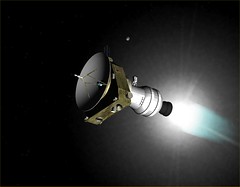
New Horizons Heading for Pluto
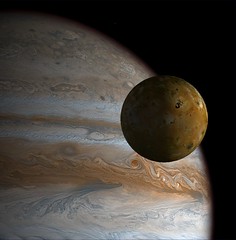
Io Close-Up with New L8 Jupiter

It's the end of another year, and as I tried to do last year at this time, I'd like to write something that sums up the year, makes a brilliant statement, and shows progress (or something). The usual sort of thing. It doesn't feel quite like "brilliant" this evening, but here goes "something" anyway.

In the domain of this blog (which mostly excludes home, family, and work issues, all of which are thankfully going pretty well), 2006 was an interesting year. There were plenty of developments in space, starting from the arrival of Stardust and the departure of New Horizons (pictured in Orbiter above - its target was a planet when it launched but is now called a dwarf planet, though Pluto itself hasn't changed). The arrival of MRO in Mars orbit was another big development, and it is now returning amazing high-resolution imagery of the Red Planet, just as Mars Global Surveyor went off the air after many years of faithful service and zillions of great pictures of the Martian surface (it went out with a bang as signs of very recent liquid water flows were reported based on repeated MGS observations of promising sites). There were also two successful shuttle missions to the ISS, the announcement of NASA's plans for a Moon base, and the good news that a shuttle mission to extend the life of the Hubble Space Telescope was approved. The amazingly long lived Mars Rovers also continue to give us a "local presence" on Mars.

A new version of the Orbiter space flight simulator came out in May, and I was on the beta testing team, mainly so I could update my book Go Play In Space to be available when the Orbiter 2006 was released (Andy McSorley made substantial contributions to the second edition). I spent a lot of time expanding and updating the book, and worked with Andy and later also with Mark Paton on an Orbiter add-on based on the book The Rocket Company. Andy, Mark, and I also spent a lot of time this year on Mars for Less (MFL), a human Mars mission plan developed by Grant Bonin. I had the idea to create a "virtual prototype" of MFL in Orbiter, and Andy and Mark agreed to do most of the work to create an Orbiter add-on for MFL. It turned out to be very complex indeed, but it really proved the point that Orbiter could be used as a tool for fairly detailed mission design (including the challenging EDL phase I showed in a recent YouTube video).

The original point of the MFL exercise was to write a paper for presentation at the Mars Society Conference in Washington, DC in early August. The paper was accepted and written (co-written with Andy, Mark, and Grant), and I presented it at the conference, which was a real thrill. You can find the paper and the presentation at the main Orbiter web site (under References), and more information on the MFL project at Andy's web site.

Part of the reason for my recently increased interest in space and astronomy is related to educational outreach. I think space and astronomy have the power to inspire people of all ages to think positively about science and technology and the future. As many people were, I was inspired by the blog posts of Ms Anousheh Ansari, a self-described private "space ambassador" who visited the ISS this year. She fulfilled her life-long dream and did her best to share her experiences with others through her blog. Although I don't expect to ever go to space myself, I will be a "space ambassador" of sorts starting in 2007 - a JPL Solar System Ambassador, in fact. I will write more about that in the next few weeks, after it's offically announced on JPL's web site (the 2007 ambassadors are not listed there yet). Since Orbiter provides an excellent way to virtually explore the Solar System (as shown in the Orbiter image above, Io with Jupiter), I plan to make extensive use of Orbiter in my presentations, to supplement the materials that JPL will supply.

Sunday, November 09, 2008

Optimism About Optimism

While the economy is still in trouble, the election of Barack Obama has generated a tremendous amount of optimism in the US and indeed around the world. Certainly it's foolish to think that President Obama will be able to quickly solve every problem we face, but he will probably be given the chance to try quite a few things and maybe even make some mistakes before most people withdraw their support and abandon their optimism. If he keeps us informed as he has promised to do, I think the good will can last for a long time, even if some problems take longer than we would like to work out.

I was glad to read that Obama does not intend to delay starting work on the core programs of energy, health care, education, and middle class tax cuts because of the economic crisis. Starting work on these areas (or at least laying the ground work) will demonstrate the resolve to build long term economic solutions, in parallel with necessary crisis management. I think we need to give Mr. Obama some breathing room and a chance to build up his team (and to actually become the president on January 20). There's already a lot of second-guessing on his early staff choices, but I guess that's what pundits do. With the election over, I'm trying to get out of the part-time pundit business and back to space, science, education, and other related topics. But of course, sometimes the politics will be related to those things. So I make no promises.

I read an article today in Newsweek about the need for a "Green New Deal" - not only to create long term solutions for climate change and energy, but to support expansion of an energy technology industry that can create new jobs in the short run, jobs that are based on producing real products (and energy), not on manipulating flows of paper. This is essentially what Obama has proposed in his campaign, to invest $150 billion over the next 10 years to create those green technologies and green jobs. Falling oil prices could make it much harder for private industry to invest in new energy R&D, but government should still invest strongly in this essential next generation infrastructure.

I've also read a number of blogs and forum posts on the subject of Obama and space, with people speculating on what he will do about NASA's administrator, extending shuttle flights beyond 2010, and developing the Constellation program, among other things. I don't know how this will all play out, but I was somewhat encouraged by the fact that in his acceptance speech late Tuesday night, Obama briefly mentioned space and science, albeit in the context of "things they said could never be":
A man touched down on the moon; a wall came down in Berlin; a world was connected by our own science and imagination.

He also mentioned at various times during the campaign how his grandfather had taken him to see some returning Apollo astronauts at a Hawaii Air Force base (that would have to have been Apollo 13 which splashed down in the Pacific on April 17, 1970 when Obama was 9). He mentioned this in the context of past NASA missions offering a source of inspiration, something he believes NASA no longer does as well as it did in the past. This doesn't mean that Obama is a major space fan, but he certainly understands the need for inspiration in education and in the development of science and technology.

I'm hoping that he will strongly support the development of private space along with continued support of NASA's human and robotic space flight missions. In the long run, this could certainly tie in with energy production (solar power satellites) in addition to the many benefits that space already provides. This is something that may take a little longer to work out, though the decision on whether to extend shuttle operations past 2010 will require a fast decision since the work force and supporting infrastructure are already being redeployed in some cases. But I'm optimistic that President-elect Obama will be looking to the future even in the face of many current problems.

Saturday, February 28, 2009

Space-based Solar Power

The winter 2008 issue of ad Astra arrived this week (a bit late for some reason). It has a special report on NEO's (near Earth objects), including an article by Rusty Schweickart, the former Apollo astronaut who has been working for years to raise awareness of the asteroid threat through the B612 Foundation. These articles are not online, but this page is a good overview with many links.

This issue also has a couple of articles on space-based solar power (SSP), and while checking online for possible links to these articles, I found a 19 minute video introduction to SSP that I hadn't seen before, "Powering the Planet." It offers a good introduction to the potential and the technology of SSP systems. This NSS page has a good overview of SSP and many links to other resources, including several links added in January and February 2009. Although their plate is pretty full right now, I hope the Obama administration will consider SSP in its long-term energy plans, as was discussed in late 2008 on Change.gov.

Monday, June 30, 2008

WALL-E: The Trash Route to Space Colonies

On Sunday my daughter and I saw the new Pixar/Disney movie WALL-E. It's hard not to like the Pixar films, no matter how silly they may be, and WALL-E is no exception. It's funny, sweet, and artistically and technologically amazing. How do you relate to a robotic trash collector that can basically say only its name? It's easy! How do you create a personality with only video camera "eyes" and robotic claws to work with? The Pixar people know how. You have to suspend a lot of disbelief when the robot star is obsessed with an ancient (VHS!) video of Hello Dolly, has a cockroach for a best friend, and falls in love with an exploration robot named EVE. But no more than to accept the sharks who swear off eating fish in Finding Nemo (what do they eat then, fish sticks?). The Pixar movies are just so well crafted that your suspension of disbelief is amply rewarded, and you end up wanting to see the movie again. It's something like "emotional engineering." Skillfully done. And fun.

SPOILER ALERT: WALL-E is also about the environmental destruction of the Earth, and about space colonization (sort of). It seems that by 2100, Earth had become so polluted and so clogged with trash (space junk too) that it was no longer fit for humans. So the company that had apparently come to run everything launched a huge, robotically operated colony space ship (private space!) to take everybody (I guess) off-world for five years while other robots remained behind to clean up the Earth, and probe robots (like EVE) would visit occasionally to see if it was safe to return. WALL-E (the movie) takes place in 2700, in which year WALL-E (the robot) is the only remaining clean-up robot, still dutifully gathering trash, compacting it, and piling it into huge towers (he charges his batteries with solar power, and repairs himself when needed from his collection of spare parts). Something apparently went wrong with the five-year plan. I'll let you see the movie to learn more.

You shouldn't expect a big, sophisticated message from an animated film in which the good guy is a trash compactor robot who accidentally wakes humanity out of a sort of technological and consumerist coma and ultimately reboots civilization (and also gets the girl!). But WALL-E does carry some messages. As far as I can tell, we are too obsessed with consumerism, we are destroying our environment, we are too dependent on technology (especially robots and computerized entertainment), and all of this could result in our becoming helpless consumer zombies. It combines a large dose of fear of science and technology with an almost complete dependence on science and technology. In other words, it's a lot like real life!

Saturday, March 21, 2009

Space Station Spreads its Wings


I haven't had time to follow the STS-119 mission or much of anything else in the news during this business trip, but I was happy to note that the power system of the ISS is complete and operational. All eight solar arrays are now deployed, with a combined total of 262,400 solar cells producing about 120 kilowatts of power.

The added solar panels also make the ISS a much brighter visual object in the night sky. Amateur astronomers have already photographed the expanded ISS with impressive detail as shown in the above photo by Netherlands astronomer Ralf Vandeburgh (courtesy of SpaceWeather.com).

When Discovery departs the ISS, they will do the usual fly-around and take pictures of the fully expanded football-field-size space station. Until then, one way to see what this will look like is to use Orbiter with the latest Shuttle Fleet and ISS Fleet add-ons and the STS-119 expansion pack available at Orbit Hangar. I haven't had time to keep up with all the updates, so the picture here is from the Orbit Hangar page for this add-on, courtesy of Dave Hopkins.

Tuesday, December 16, 2008

SSP at Change.gov

One of the great things about the Obama transition is that the public is invited to participate, to have "a seat at the table," as they put it on the change.gov web site. They have invited proposals from outside groups (37 pages of links so far) with the provision that all documents submitted will become public (they are PDF files on the web site). You can read them and then join in the discussion through forums associated with these proposals. Open government!

I just learned about a proposal on space solar power (SSP) that is under discussion there. I read the brief proposal and browsed many of the comments. Although there are some off-the-wall comments as in any public forum, the discussion is impressively multi-level and well informed. I rated a number of comments (thumbs up or down) and added a general comment to one of the most informative posts. If you care about this issue, you should go read, vote, and comment.

Of course there is no guarantee that SSP will be pursued by the Obama administration. It's one of hundreds of proposals. But the fact that these discussions are happening is in itself such a hopeful sign. This combined with the impressive cabinet and other appointments that have been announced shows that change is indeed coming. We will soon have leaders in Washington who don't have their heads in the sand! Or wherever the current administration's heads have been.

P.S. It's not very clear on change.gov, but the forums are run by IntenseDebate.com, and to register for the forums, you need to set up a free account there, even if you have registered at change.gov for other things (as I had done).

Tuesday, July 24, 2012

KSR's 2312 is Very Cool

Although I'm only halfway through it, I am really loving Kim Stanley Robinson's latest science fiction novel, 2312. It's an impressively detailed work that imagines human civilization expanding to nearly the entire solar system over the next 300 years (with Earth itself still suffering a lot of problems stemming from climate change and other factors). There's a city called Terminator on slowly-rotating Mercury (the city itself rides on huge rails in sync with the rotation to stay just at the edge of the transition between the dark side and the deadly sun-lit side of the planet, propelled by solar-heating expansion of the rails!). There are some 19,000 inhabited "terrariums" which are hollowed-out asteroids that rotate to create artificial G. Many different climates, biomes, and social systems are implemented in these asteroid worlds, some of which are in orbits that take them across huge distances in the solar system. So to transfer from Earth to a moon of Saturn, you would first ride a space elevator to orbit, and then take a shuttle that would transfer you to a suitable Saturn-bound asteroid world. Instead of spending weeks in a cramped spacecraft, you might spend those weeks in a 1G beach resort, or in an endangered animal preserve, or in an agricultural world growing food for export to Earth, or even in a low-G "flying world" where you might live something like a bird. Hundreds to thousands of people live in each of these small worlds.


There are a lot of powerful technologies assumed to exist, starting with fusion power, space elevators, self-reproducing assemblers, and quantum computers (personal versions are called qubes). But there is no magic here. While it's not inevitable that these technologies will become practical or widespread, they are physically possible. As usual (from having read Red Mars and Green Mars), KSR is at least as interested in social possibilities as he is in technical ones. And there are some weird ones in 2312There's also a mystery and a love story or two buried in this book.


It's also interesting what a writer like Robinson can do with a very specialized piece of science - such as the braided or perhaps kinked F-ring system of Saturn (pictured above). Doesn't that look sort of wave-like? And where there are waves, surely you will have surfers, right? Some residents of the cities on Saturn's moons like to fly to one of the "shepherd moons" that give the F-ring its gravity-sculpted structure, and from there, they have figured out how to surf these narrow waves made of ice blocks! Yes, they wear spacesuits with thruster rockets, and they surf the F-ring. He even makes it sound sort of plausible. This is shown in one incidental scene between two of the main characters, Swan and Wahrom.


A funny thing about Swan: She is from Mercury, and she is an impulsive risk taker who has tried all sorts of bizarre things in her young 110 year life (most "spacers" live to around 200, with periodic DNA repair and other longevity treatments). She is really a wild character, an artist whose whole life seems to be a sort of over-the-top performance art. Just when I started reading about Swan, I happened to start listening to the new Fiona Apple album, and I watched her bizarre video for "Every Single Night." From this coincidence, Swan and Fiona have fused in my mind. So I picture Fiona when I read about Swan's latest odd adventure.


Although some reviewers are bothered by certain devices that KSR uses in this book, such as lists and excerpts of supposedly technical or historical documents (from the future), I think these brief inter-chapter devices allow KSR to fill in the back story and set the many scenes in a relatively compact way so he can cover the whole solar system and multiple characters and story lines without drowning the reader in too much detail (it's about 570 printed pages, though I am reading it on Kindle myself). Highly recommended if you like imaginative hard SF. There's a cool interview with Robinson from June 2012 here.