Sunday, November 30, 2008

Etoys!

This weekend I stumbled upon something wonderful: Etoys! Etoys is a visual programming environment that is geared toward education. It was formerly called "Squeak" (hence squeakland.org) and is fundamentally an implementation of Smalltalk, one of the first object-oriented programming languages. It's actually more than that, because Etoys incorporates a lot of ideas from other programming languages and environments including LOGO, starLOGO, and HyperCard. Etoys runs on Windows, Mac, and Linux computers and is a standard part of the software supplied on the One Laptop Per Child (OLPC) "XO" computer. It also runs as a plugin for most web browsers (works great with Firefox). It's incredibly cool and fun to explore Etoys. And it's free!

I have played around with educational programming software for years, starting with LOGO back in the early 1980's. I also spent a lot of time in the late 80's and early 90's playing with HyperCard on the Mac. I even wrote a working prototype of a proposed graphical user interface for my company's optical design software using HyperCard (the Mac ran only the UI, the application itself ran on a Sun workstation, via a serial port connection).

So I love this kind of visual software construction set. I spent a lot of hours this weekend learning Etoys and I can imagine using it as a component in my space/astronomy educational outreach efforts, though I don't know exactly how right now. I found a few examples that others have done for astronomy. Showing how the moon orbits the Earth and rotates to keep the same face showing is a pretty typical Etoys demo. I found a more elaborate one at EtoysIllinois (recently renamed from SqueakCMI) - the Copernican Revolution (by Avigail Snir), which graphically compares geocentric and heliocentric models of planetary motion.

There's a lot more to say about this, and I'm sure I'll be writing more about Etoys in the weeks to come. As Alan Kay has written, personal computers have been threatening to revolutionize education for decades, but so far have mostly provided more efficient ways to produce paper documents and research things through the web (although computer games have probably taught kids a lot about certain kinds of problem solving). LOGO was an early attempt to use computers to teach young children different ways of thinking, but it never really took off. Could the combination of OLPC, Etoys, and web-mediated mentoring provide a breakthrough? It's possible - I think the materials are certainly powerful enough to inspire any child. But it ultimately comes down to teachers. Kay makes an analogy with pianos and music teachers. A piano in every classroom won't magically awaken musical thinking and feeling for every kid, but a good music teacher can succeed with only voices, hands, and feet as instruments. The computer too is only a tool, but with ideas like OLPC and Etoys, and with some teachers who know how to use these tools, maybe computers will finally realize their potential in education.

P.S. One tip for Windows users of Etoys. The right mouse button doesn't work for me, but the middle mouse button (wheel) does what the right button is said to do (i.e., opens the "halo" of property buttons for an object). Maybe this is a setup or preference thing, but it took me a little while to figure this out. You can also use the ALT key with the left mouse button for this.

Friday, November 28, 2008

Carnival of Space #81

The latest Carnival of Space is now open for your reading and hyperlinking pleasure. It is hosted by Tracy Zollinger Turner at Tiny Mantras. Tracy is "tiptoeing through the solar system" under the leadership of her very young and very space-obsessed son Declan. His knowledge and passion are impressive!

Wednesday, November 26, 2008

I Want a Turn!


What fun it must be to experience extended free-fall on board the ISS, where there's room enough to "fly around" like this and play in various other ways that are impossible down here. I want a turn!

Thanks to Why Homeschool for the tip on this video.

Tuesday, November 25, 2008

The Matrix Runs on Windows


This video is hilarious. They have the look and feel of Keanu Reeves and The Matrix nailed - and Windows too.

My Space Message to Change.gov

I decided to submit a space-related message to the Obama Transition Team through their change.gov web site. I'm sure they have received thousands of messages on every possible agenda point, but I figured it couldn't hurt, and I could always turn it into a blog post:

I know there are many things to decide and do in the early days of the Obama Administration. Space may not be the top priority, though I have read that GSA considers the decision on extending shuttle flights beyond 2010 as a top-13 early decision. I'm not an aerospace professional - I'm an optical engineer who does space-related volunteer educational outreach as a NASA/JPL Solar System Ambassador. I believe that space exploration can help to inspire our next generation of engineers and scientists, and I believe that space can also help us develop the technologies and jobs that will help us with energy and environmental problems in the years to come.

I have three suggestions that are probably already being considered, but I'll mention them anyway:

1. Ares vs. Direct 2.0 or other launch vehicle options - I hope that an independent study will be done to look at the viability of NASA's planned Ares I/V launch vehicle program vs. other possible options. I know that NASA says the Ares rockets will work well and that proposed alternatives have fatal flaws. But it's definitely worth a careful second look. I'm sure the Direct team (and others) are pushing this message.

2. Increase emphasis and funding for private space ventures - The COTS program is in place and SpaceX is developing launch, cargo, and crew vehicles for ISS support. But funding for this should be increased and expanded to support other companies as well. Private space may be able to close the shuttle/Orion gap for US-based crew access to the ISS sooner than other options.

3. Increase NASA's role in education and inspiration - NASA already does a lot of educational outreach but more could be done, including expansion of community-oriented programs like the JPL Solar System Ambassador program. I am one of some 500 volunteers throughout the US, and this program already reaches tens of thousands of people every year with encouragement (and minimal funding) from NASA. Space exploration past, present, and future has a lot of great stories to tell, and NASA should do more to bring these stories to life for members of our communities, especially but not limited to kids.

Monday, November 24, 2008

Enceladus: Saturn's Soda Fountain


Enceladus is a small, icy moon of Saturn that is something of an overachiever. It shoots geysers of water vapor, nitrogen, CO2, and methane from vents that pop open around its south pole. Obviously there has to be some liquid water under the surface for this to happen, and since Saturn is rather far from the sun, the energy needed to keep some of the water liquid (and eject geysers into space) has to come from something else. Enceladus seems to have a rocky core (judging from its density), so some heat could come from radioactive decay of minerals in the core - but this isn't enough to account for the geysers and the temperatures measured around the south pole vents. Tidal forces from Saturn and Dione don't provide enough energy with its current orbit either. But somehow plucky little Enceladus is still firing away with those geysers...

I know what you're thinking: a giant alien nuclear reactor! Well sure, that could be it, but the Cassini scientists are still looking at natural solutions, like accumulated heat from earlier periods when its orbit could have been more more eccentric and tidal forces larger. In any case it's a pretty wild little ice moon.

These highlights are from an article by Carolyn Porco (Cassini imaging team leader) in the December Scientific American. The video is also from SciAm - it gives some background and provides some great animated visuals of Saturn's soda fountain.

Sunday, November 23, 2008

Americans Flunking Civics

There's a news item today about how little Americans know about their government institutions, US history, and economics at a very basic level. It's pretty bad - fewer than half of all Americans can name all three branches of the federal government, for example. But this was not the main point of today's news since ISI has been giving this quiz and reporting the results for several years (summary here). The news was that a measurable subset of the latest test takers reported that they either are or have been elected officials - and these people did even worse (average 44%) than the general public (49%). The whole Sarah Palin thing starts to make a little more sense now. You don't need to know much about government - just do it! And be sure not to blink.

P.S. You can take the civics quiz yourself here, it's only 33 multiple choice questions. Pretty basic stuff. I got 100% on it. Every American should!

Our Eyes on Mars

The new Air & Space Magazine arrived with a cool article about Michael Malin and Mars. Malin is responsible for the cameras that have given us so many amazing images of Mars in the last ten years or so. It would have been more like 15 years if the Mars Observer had achieved orbit (contact was lost in August 1993). Malin's backup MOC (Mars Observer Camera) was carried a few years later on Mars Global Surveyor which reached Mars orbit in September 1997. This simple but powerful camera was able to image surface details at much higher resolution than the Viking Orbiters had provided, revealing sedimentary layers as well as drainage gullies and other clear evidence of flowing water in Mars' geological history. It's hard to believe that they had to fight to even get this sort of camera on these Mars missions, but Malin and his team persevered and the images returned from these and other Malin Space Science Systems (MSSS) cameras (on Mars Reconnaissance Orbiter and Phoenix) have helped to reveal Mars as a much more diverse and dynamic planet than was once believed.

The article is by Andrew Chaikin and is an excerpt from his recent book, A Passion for Mars: Intrepid Explorers of the Red Planet. Air & Space also has a web-only photo essay feature showing some Mars images selected by Malin and his team as favorites. The MOC image above shows the "fossil" delta in Eberswalde Crater, clear evidence of past flowing water (it reminds me of some aerial pictures I took over southern Utah last year). The MSSS web site has a huge, well-indexed gallery of Mars images.

Lisa Hannigan

Lisa Hannigan is an Irish singer who sang and toured with Damien Rice a few years ago (I first became aware of her through a video of Rice's song "Volcano"). I really love her voice and I hoped that she would record a solo album. I found out last night that she finally has. Her first album Sea Sew was released in Ireland in September and in the US on November 4 (at least in MP3 form through iTunes and Amazon - the CD will be out in January in the US). Her voice is beautiful and the songs and arrangements are great too.

Saturday, November 22, 2008

Carnival of Space #80

There's a special Thanksgiving edition of the Carnival of Space at Starts with a Bang this week. Check it out.

Shuttle & ISS Slide Show


I just noticed that you can embed Flickr slide shows in a blog so I decided to try it. This is a slide show from my Shuttle & ISS photo set, though most of the images are actually screen shots from Orbiter.

Wednesday, November 19, 2008

Ready, SET...

I don't know where I saw this - probably in someone's blog, just like you're seeing this. I'm not usually much of a puzzle person. I've never even tried sudoku! It's not that I don't enjoy games and other things that exercise my mind (I spent 20 years learning Japanese - I could speak OK but only got to a second grade reading level - kanji characters are great puzzles!). It's more a fear of becoming addicted to yet another time sink...

But I tried SET anyway, and it's pretty cool. You have to find sets of three objects that meet the "all same" or "all different" rules on the four properties (color, symbol, number, and shading). It feels like a mild left and right brain workout - a bit of pattern recognition, logic, and short term memory. At first it looks easy, but finding that sixth set can take some time. I did notice some improvement on my third puzzle so I guess I'm starting to see some method in this even though I don't really know what it is.

You can find a daily SET puzzle here, and the New York Times has more here.

LIFE as I knew it

Google has another cool feature thanks to a partnership with LIFE magazine. They have put millions of photos from the LIFE photo archives online. In the 1960's, LIFE magazine was my window on the world of space flight. The photo above of Ed White's Gemini 4 EVA is a prime example. Just do a Google image search on any term and add source:LIFE to the search string to access this amazing collection of photos. Of course as a teenager in the 1960's, LIFE wasn't only about the stars in the sky. The stars of Europe and Hollywood were pretty interesting too. I remember names like Claudia Cardinale, Senta Berger, Sophia Loren, and of course Marilyn Monroe, among others. The LIFE archive is also great for history, from Abraham Lincoln to Lucky Lindy to the Cuban Missile Crisis. Very cool.

Tuesday, November 18, 2008

Updike on Mars

I got the December National Geographic yesterday and read a brief article about Mars by author John Updike, illustrated with some of the dramatic and beautiful photos that have helped to make Mars a place, not just a planet, courtesy of the Mars Rovers and MRO, among others. Updike's article is online here, and there is a nice video tour of Mars narrated by the photo editor for Updike's article.

Monday, November 17, 2008

Mozart Music Videos


Mozart's career predated most of the music video era (OK, he missed it by a good 200 years). But you can still find Mozart videos on YouTube (a search for "Mozart" returns about 100,000 results!). Many of them are recorded performances, while others are essentially musical slide shows. In the latter category there are a few "top 10" types of videos, with excerpts of the video maker's favorite Mozart compositions. I usually don't like to break up Mozart's work, preferring to listen to a full composition rather than selected movements. But some of the video slide shows are interesting, and may even serve to remind me of pieces I had forgotten about, such as the wonderful Horn Concerto in E flat (K.495).

The video here is a good example although they could have done a better job cross-fading between the excerpts. Whether this truly represents the "best of Mozart" is hard to say, but several of the pieces here are favorites of many people. If you don't know Mozart, you could perhaps start to get an idea of the richness and diversity of his work here - and if you hear something you like, seek out a complete performance on the web or at the library. Another approach is to go rent the movie Amadeus. While it takes major liberties with the facts of Mozart's final years, it captures some of his spirit, and it does contain an excellent selection of his music.

Here are the eight pieces excerpted in this 9 minute YouTube slide show, with the start time in minutes for each piece:
  1. Overture from The Marriage of Figaro, K.492
  2. Clarinet Concerto in B Flat, 1st Movement, K.622 (1:44)
  3. Wind Serenade "Gran Partita," 3rd Movement, K.361 (2:28)
  4. Piano Concerto 21, 2nd Movement, K.467 (3:30)
  5. Symphony No. 40 in G minor, 1st Movement, K.550 (4:50)
  6. Eine Kleine Nachtmusik, 1st Movement, K.525 (6:03)
  7. Horn Concerto No. 4: 3rd Movement, K.495 (6:50)
  8. Requiem: Introitus (Requiem aeternam),K.626 (7:41)

Happy birthday ISS

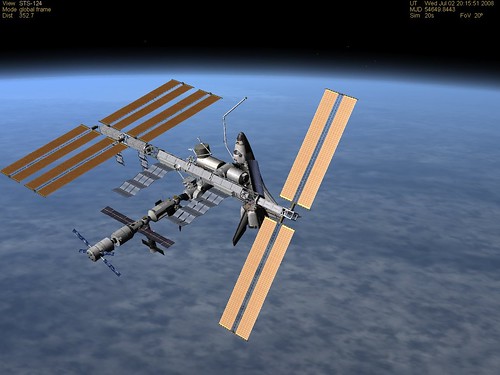
Happy Birthday ISS (10 years)

It's a few days early, but I want to wish the International Space Station a happy 10th birthday. The Russian Zarya module was launched on November 20, 1998, and of course many modules have been added since then to create the gigantic orbiting laboratory we have today. Right now the crew of the shuttle Endeavour (STS-126) is visiting the ISS to deliver and install the expanded life support and other facilities needed to support six station crew members. It's great that they will have a big team on hand for the tenth anniversary - I imagine they have some sort of celebration planned in addition to the turkey dinners they've carried up for Thanksgiving.

The picture is from Orbiter, showing the ISS in July 2008 during STS-124. There's another view (above New England) on Flickr. If you want to re-enact the evolution of the ISS on your own, you can do so with the help of David413's great ISS Fleet add-on for Orbiter. There are a few predefined scenarios including STS-88, the first shuttle flight to the ISS in December 1998, which delivered the Unity node, the first American component of the ISS.

The PDF manual for the ISS Fleet has pictures of all the ISS configurations with designations like ISS4A (circa 2000). There isn't a scenario for every configuration, but you can easily modify one of the scenarios in the ISS Fleet Scenarios folder with a text editor. Find the line that says ISS:ISS2A (for example, after "BEGIN_SHIPS") and change it to ISS:ISS4A (say) and save it under another name (maybe ISS4A.scn). Your new scenario will include the station with that configuration. The other parts of the scenario (shuttle, positions, date, etc.) won't change from the starting file. Note that the ISS Fleet is a separate add-on from the Shuttle Fleet (find the most recent shuttle/ISS fleet add-ons and mission scenarios including STS-126 here).

Carnival of Space #79

This week's Carnival of Space is number 79 (I missed a few in the hustle and bustle of the election and a trip to Austria). Your host is One Astronomer's Noise (tag line "one astronomer's noise is another astronomer's data"). Nicole is an astronomy graduate student at the University of Virginia, and she's presented us with a bunch of interesting posts to explore. Naturally the "stars" of the week aren't stars at all, they're the exoplanets of Fomalhaut and HR8799 (pictured) that have recently been directly imaged. Check out the latest Carnival of Space.

Sunday, November 16, 2008

Solar System Tour Guide


This 28 minute video is from "Serious Play," a conference held at the Art Center College of Design in Pasadena, California this past May. The speaker in this case was Dr. Charles Elachi, director of the nearby Jet Propulsion Laboratory. As JPL's director (and in previous positions), he has had a lot of involvement with planetary exploration, and he devotes most of his talk to Mars missions, including the Mars Rovers, Phoenix (which would launch a few weeks after he gave this talk), and the upcoming Mars Science Laboratory. There are some good simulation segments in the presentation, as well as a bit of humor.

Team of Rivals?

Many people are going through election withdrawal. Me too. I was never as involved with a presidential election as I was with this one - practically and emotionally. I spent a lot of time making phone calls to New Hampshire, and spent a few weekend days canvassing up there for Obama. I donated and raised money. I watched the polls, read the news and the blogs, and I worried. Obama's decisive victory was an enormous relief.

Now we're in the transition, with a backdrop of economic news that seems to get worse and worse. As the many challenges continue to grow, everybody wonders whether Obama will be able to deliver on the promises of the campaign.

Time will tell, but he is clearly trying to keep the American people informed and involved even during the transition as he works to build the team that will help him to govern effectively from day one. By registering with the web site change.gov, you can contribute your ideas and comments. You can also follow transition developments through blog posts, news items, and videos. Yesterday the President-elect delivered his second weekly post-election radio address, and for the first time it was released as a YouTube video as well. This looks like a twenty-first century version of FDR's Depression era radio "fireside chats." I hope he will continue to deliver these weekly addresses directly to the American people once he is in the White House - and I expect that he will.

Although they are trying to keep the cabinet selection process confidential, it has been widely reported that Hillary Clinton is under consideration for Secretary of State. This is a strong indication that Obama is working to build a "team of rivals" in the spirit of Lincoln's first cabinet. He mentioned that he admires Doris Kearns Goodwin's book Team of Rivals: The Political Genius of Abraham Lincoln and he has stated that he intends to build a bipartisan team from the best people available. While this sounds like a bold idea for the sake of the country, a team of rivals in the modern political world of microscopic scrutiny and instant communication could also be tough to manage. I'm thinking the Obama Administration is going to be as innovative and exciting as the campaign was, and I'm looking forward to it. Meanwhile I've bought Team of Rivals and have just started reading it. With interwoven biographies of four people (Lincoln, Seward, Chase, and Bates), it's a long book, but so far it's quite an enjoyable read.

P.S. Doris Kearns Goodwin spoke about learning from past presidents (with examples from Lincoln and Lyndon Johnson) at a TED conference in February 2008, video here. She summarizes many of the key points of Team of Rivals in this brief talk.

Friday, November 14, 2008

Night Launch

I watched NASA TV for a couple of hours this evening, culminating in the beautiful night launch of the shuttle Endeavour on STS-126. I would sure like to see a night launch in person, but I'm not sure I'll be able to work that out before they retire the shuttles in 2010 (or maybe later if they decide to fund some additional missions, as President-elect Obama had discussed during the campaign - before the current economic crisis). At least I got to see one shuttle launch, which was also Endeavour (on STS-118 back in the summer of 2007). An awesome experience.