Friday, January 16, 2009

365 Days of Astronomy Podcasts

I've mentioned the 365 Days of Astronomy podcasts a couple of times, including the fact that I'll be doing the one on April 14. But what I may not have mentioned is that these podcasts are really quite good, and in many cases, of interest even to people who don't think of themselves as astronomy fans. A few notable examples: January 3 (Five Years of Spirit on Mars), January 6 (Top 10 Reasons Stargazing is Cool), and January 10 (a vivid description of Galileo's 1610 discovery of the moons of Jupiter).

So if you aren't listening, you should, and if you know people with even the slightest curiosity about nature, encourage them to listen too. You can listen (or read) directly on the web site, or listen or subscribe through iTunes (for free). And if you're an astronomy or space hobbyist or blogger, or even just a casual stargazer who saw something cool in the sky, consider contributing a podcast yourself. There are probably still some openings for later in the year.

Thursday, January 15, 2009

Space Renaissance!

Becoming Spacefaring: Integrated Space Policy is a very interesting post by FerrisValyn that appeared on the Daily Kos a couple of days ago. It's a well organized argument in support of the commercial development of space, going well beyond exploration and current "utilities" like comsats and GPS to establish a space-based economy. Space is outside the direct experience of most humans (not to mention outside the atmosphere), but the analogy with the use of the oceans and the air by seafaring and "airfaring" nations is still apt. There are a lot of resources and opportunities out there. We'll eventually use them, but whether that starts soon or in a hundred years probably depends on decisions made in the next couple of years.

A version of this report was provided to the Obama transition team - and we'll soon see how much the issue of space will show up on Obama's radar. I read some reports that the new NASA adminstrator is likely to be a retired USAF general, Maj. Gen. Jonathan Scott Gration. He is said to be close to Obama but is unknown and inexperienced in the space domain. Is that a bad thing? I don't know. It will certainly be a change from Mike Griffin.

Somehow this article (and its follow-up on technology investment) led me to Space Renaissance and the call for a Space Renaissance Forum, which I signed. The ideas are very similar to what FerrisValyn proposes, and they are calling for a presence at the upcoming G20 summit in April to try to put space development on the world economic agenda. I like some of their "basic concepts" which may not seem so basic to everyone:
  • Earth is not sick: She's Pregnant!
  • Space Tourism, key to open the High Frontier
  • Humans are resources, not problems!
  • Space is safer than Earth
  • Space is easier than Earth
  • Space is more convenient than Earth
I think we're about due for a new Renaissance.

Wednesday, January 14, 2009

Carnival of Space #86

My brain may be on music, but space goes on and on and on...

CollectSpace
has collected a nice selection of space and astronomy blog posts at the 86th Carnival of Space.

My Brain On Music

I've decided on a name for my style: serial obsession. It's been physics, computers, music, Japanese, flying, space, blogging, and a few other things (it was even "getting an MBA at UCLA" for a couple of years back in the 80's, but I didn't manage to finish it, too much business travel, see "Japanese"). Now it looks like music is making a big comeback. This is a great thing - it's creative and fun to write and record music. There are a lot of toys, many of them free, all of them with some sort of learning curve (or at least an exploration curve). So it's not quick. Hours go by and I don't realize it. Enjoyable hours.

One of the non-free toys of recent days is Sonik Synth 2 (it was $99 at Zzounds.com, a great deal compared to suggested price of $399). This is a soft synth plugin that comes with 8 GB of sound samples and hundreds of presets. It works great in Sonar and with my cheesy Casio keyboard. You can blend and modify these samples in limitless combinations, with a very simple interface, and it sounds fantastic. Everything from realistic pianos, organs, and orchestras to emulations of dozens of vintage hardware synthesizers. I have to write songs to use these sounds!

So this is Your Brain On Music - or my brain in this case (that's also the title of a book I bought two years ago and am finally reading, about the neuropsychology of music). I won't give up space or blogging (or my job!), but I know how these things work. One thing leads to another and before you know it, it's 2:30 in the morning. Or it's October, and you've recorded a new CD. I hope that happens anyway. I listened to my 2003 CD the other day, and I still like it, but I think I can do better now.

Sunday, January 11, 2009

Podcast: Live from Io!

Jupiter Rising on Io
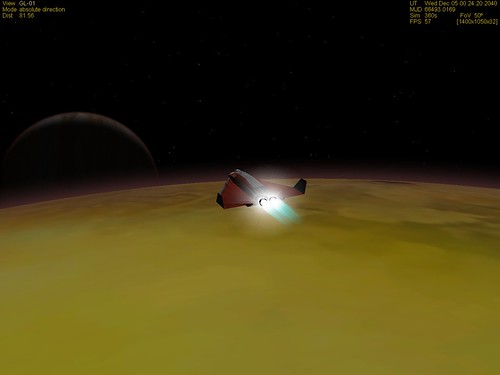
I signed up to do a podcast for 365 Days of Astronomy, and my "broadcast" date will be April 14. My topic will be "Exploring Space With Your Computer," so I need to figure out how to turn this very visual topic into an 8 minute audio-only talk (of course most topics in astronomy are visual, so I'm not alone with this problem). Naturally I will talk about Stellarium and Orbiter (among other things), and I plan to use some sounds from Orbiter to "illustrate" my talk as I tool around the solar system in some of my favorite Orbiter spacecraft. I will probably open the talk from a spacecraft orbiting Io since I always enjoy watching Jupiter rise.

I also plan to include some background music, and I thought that some spacey, Eno-like, new agey music would be nice to set the mood - the kind of thing you often hear in planetarium shows. So I'm working on writing and recording some music for my podcast. This isn't my usual style of songwriting but I have some ideas and a good bag of audio tricks on my computer, and I can mix it all up nicely with Sonar.

So far I'm collecting sounds and some additional tools and creating some test pieces. One of these new tools is a weird little program called Sounder. It has a very Windows 3.1 look and feel (latest version seems to be from 1997), and it has a very odd approach to the musical interface. Little icons bounce around in windows, sounding a musical note on each bounce. You can pick the instruments from all the MIDI sounds available in your sound card or keyboards, and you can choose various other things like the note palette, the window sizes, the number of objects, their x and y speeds, etc. It's pretty easy to get something that sounds cool, and if you play around with the controls, you can shape the sound in various ways.

So far I've just recorded some of these things into Sonar as audio, though I read that there is a way to use some MIDI tools to capture Sounder's MIDI stream into sequencer software (which Sonar also is), which would give more control including the ability to edit note sequences and assign the sounds to various soft synths (of which there are about a million you can download, not to mention "sound fonts" of various sampled instruments). I've also recorded some samples from music tools on the iPod Touch, such as Pocket Guitar and Bloom.

This is really great fun and it's a nice "mission" that should help me to get back into writing and recording music, which is one of my goals this year. Of course I still have to remember to write and record the podcast itself. It's due by March 14

Friday, January 09, 2009

Robots & Astronauts Online


I just learned about a really cool web site called slideshare.net, where you can (you guessed it) share your PowerPoint and other sorts of presentations with the world or with selected people. It's similar to Flickr for photos and YouTube for videos, and it is also free. You just have to set up an account to upload things. There are zillions of presentations to search and view and you don't need an account for viewing. You can also embed presentations in web sites as I have tried to do above.

So I set up a FlyingSinger account and uploaded a PowerPoint presentation I developed and used a lot last summer and fall, "Robots, Astronauts, and You: Exploring Space." Just for the heck of it. You can view it online, and I also set it up for download. The online viewer doesn't include animations or sounds which I used quite extensively in this PowerPoint, so some of the slides may look a little odd. The downloaded PPT file (21 MB!) contains all the sounds and slide transitions. The Orbiter space flight simulator is available for free download at www.orbitersim.com.

Air Traffic Flow Worldwide


A friend sent me this video and it's really cool. It shows the worldwide flow of airline flights over a 24 hour period. Note the big burst of overnight flights from North American to Europe, the blossoming of flights over North America that migrates west with the emerging daylight (westbound Europe flights too). This is a great example of a dynamic information graphic. Go to the YouTube page and click the "watch in high quality" button if you have the bandwidth.

Tuesday, January 06, 2009

Very Space

I was intensely focused on the periscope, and after we docked, I looked out my window and suddenly the radiators and solar panels show up. There's this bloody great structure there, and it's very dramatic. You dock with the sun behind you, so it's very, very stark, and everything around it is completely black. It's very stunning, very space, and very cool.
-Mark Shuttleworth

Technology Review has a great feature this week, "an oral history of the launch of space tourism." Over a period of six months, they interviewed five of the six private citizens who have taken flights to the ISS on Russian Soyuz spacecraft (Mark Shuttleworth, Greg Olsen, Anousheh Ansari, Charles Simyoni, and Richard Garriott). They were interviewed separately, but the article interweaves their individual comments about the phases of their Soyuz/ISS missions. It's interesting to read their differing reactions to their nominally similar experiences, to see what was important and notable to each of them, what they thought was great and what they complained about. Charles Simyoni seemed to complain the least. He liked it so much, he's going back this spring (he exercised a $5 million option for a return ticket).

Several thought that the hardest part was learning Russian! That wouldn't bother me - I studied Russian for four semesters in college and I'm sure I could get it back without much trouble, especially if it were part of preparing for a spaceflight! I'd sign up to go in a minute, but I don't think it's something I can put on my American Express.

There's also a video with excerpts of the interviews here.

Monday, January 05, 2009

Staying Ten Years Old


Here's a cool TED talk from 2006 by scientist Penelope Boston. She has specialized in searching for life in extreme places, from the Antarctic to high deserts to caves to Mars. She talks about the importance of "staying ten years old" (and curious) and the idea that "perspective is everything" (looking at Earth as an "exoplanet"). Some of the caves she has explored are incredibly hostile to human life, full of sulfuric acid and lethal levels of poisonous gases - but various non-human life thrives in these nasty places. Based on the surface discoveries of the Mars rovers and high-resolution images from Mars orbit, she believes there is a good chance (25 to 50 percent) that there is life on Mars now, most likely in caves, and quite likely very different in chemistry and biology from life on Earth. She even gets into how caves on other planets may help future humans to survive there.

Update: For a fictional (hard SF) view of life in caves on Mars, The Martian Race by Gregory Benford is really good. One of my favorite Mars exploration novels.

Sunday, January 04, 2009

The Future of Human Spaceflight

In December, a report called "The Future of Human Spaceflight" was issued by MIT's Space, Policy, and Society Research Group. I just read the report, and I have to say that it makes a lot of sense. Most fundamentally, it recommends a more careful evaluation of the objectives and risks of human spaceflight, suggesting that "primary objectives" of exploration, national pride, and international leadership are worthy of significant risk to human life. As the report says,
Human spaceflight achieves its goals and appeals to the broadest number of people when it represents an expansion of human experience.
Think Apollo astronauts walking on the moon - definitely a new realm of human experience. Science, economic development, technology spin-offs, and education are "secondary objectives" - potentially valuable but not necessarily worth the costs and risks of direct human involvement. I guess I agree with this, though I think it's somewhat short-sighted in terms of economic development and educational inspiration.

Apollo was very much about "primary objectives" (especially national pride and international leadership in the Cold War). But the "secondary objectives" paid off handsomely for the US in development of high tech industry and in the inspiration of baby boom kids like me who went on to become the engineers and scientists who drove the technological and economic development of the US in the 1970's and beyond. Could the US have achieved those results by directly investing in Earth-focused technology and education? Possibly, but it was really the fact that there were human astronauts that got me intensely interested in science and technology (after first wanting to be an astronaut).

In any case, they definitely see a continuing role for human spaceflight, but they suggest that we be more clear on why we're doing it. In practical terms, they recommend completing the ISS, retiring the shuttle on schedule, keeping the ISS operational as an international laboratory until 2020 (current plans end at 2016), and clarifying the moon/Mars strategy that was defined (rather vaguely on Mars) in the 2004 Vision for Space Exploration. They briefly mention expanded use of commercial space flight services and they also discuss ideas for increased international cooperation on space, including China and India. I think this report is a useful document for people interested in human spaceflight and the future of NASA, whether you're a space fanatic like me, or the president-elect of the United States.

Saturday, January 03, 2009

Amazing Art at RISD


My daughters invited me to visit the Museum of Art of the Rhode Island School of Design (RISD) with them this afternoon. We saw a special exhibit of the glass art of Dale Chihuly. Somehow I had never heard of Chihuly, but he does astounding things with glass. Photos can't do justice to the colors and sensual shapes of his sculptures, some of which are huge and contain hundreds of elements. Simply beautiful "optics." Check his web site for samples of his work and information on other exhibits (the RISD one closes tomorrow).

The other special exhibit we saw at RISD was "Building Books: The Art of David Macaulay." David Macaulay is perhaps best known for The Way Things Work (1988, updated as The New Way Things Work in 1998). I first discovered him when my first daughter was a young child and I bought several of his "building" books ostensibly for her (Cathedral, Castle, Pyramid). His books and art are wonderful in explaining the intricate details of how things are built and how things work. It was cool to see many of his original illustrations and to learn about some of his more recent and different works. Like Chihuly, Macaulay is a RISD graduate and former professor. This exhibit continues until February 1, 2009.

Friday, January 02, 2009

Cheap Entertainment: Carnival of Space #85

The International Year of Astronomy is finally here. To start the astronomical festivities, you might check out some of the best recent space and astronomy blog posts at the Carnival of Space, hosted this week by Cheap Astronomy. As its name suggests, Cheap Astronomy is about doing and enjoying astronomy without a lot of fancy equipment. The site offers a number of resources and tips to help you do just that.

If you'd like to (literally) hear more about astronomy, check out 365 Days of Astronomy which this year will present a daily podcast on a wide variety of astronomical subjects by a wide variety of speakers. You can listen on the web site or subscribe to the podcast via iTunes. Yesterday's podcast was an introduction to the series, and today's episode discusses tips for your first telescope.

Thursday, January 01, 2009

Newtonian Convergence

I'm experiencing an odd sort of Newtonian convergence today. I'm reading Gleick's Isaac Newton, including descriptions of the many things he observed and read and wrote about in his notebooks, observations that led to his laws of motion (not to mention the calculus and other major topics in physics).

I'm also re-reading sections of Seymour Papert's 1980 book Mindstorms (subtitle: Children, Computers, and Powerful Ideas). In fact I've just read the chapter called "Microworlds: Incubators for Knowledge" in which Papert discusses how computer-based "microworlds" can provide children with a way to gain direct experience with "laws of motion" including Newton's famous three Laws of Motion. It's easier and less abstract when you have actually played with objects that behave in a Newtonian fashion (as opposed to objects like real blocks that tend to not continue in motion at a constant speed after you apply a force to them with your hand - friction makes Aristotle's ideas of motion seem more plausible at first to most people). You can also play with laws of motion other than Newton's, and if you have explored a "Turtle geometry" microworld, you will already be familiar with some "laws of motion" though you may not have called them that (e.g., the FORWARD 10 command moves the turtle by the 10 steps in its current direction, and the TURN 30 command changes the direction by 30 degrees).

Papert used Logo in his microworld education work, and I'm now using Etoys, which in many ways is a direct descendant of Logo. My evolving "Moonhopper" project is basically a prototype microworld for playing with Newtonian physics. I still have a lot to figure out on this, not so much about how to simulate frictionless motion with gravity and rocket thrusters (this is pretty easy in Etoys), but on how to structure this into a teaching unit so a middle school kid can follow a general game plan and discover these powerful ideas for him or herself. This is exactly the kind of exploratory learning that Papert discusses in Mindstorms and that the Etoys/Squeak and similar environments can encourage.

Wednesday, December 31, 2008

Moonhopper, MIDI, and Top 100 Blogs

So here is my 366th blog post on the 366th day of the year. Funny how that worked out. I'm having a scattered but mostly enjoyable winter break though it is going faster than I'd like. Aside from some brief travel to visit my Mom in New York, we've just been hanging around the house. One thing I've been working on is learning Etoys programming for a possible space-themed middle school science teaching unit. So far I've written a simple prototype "Moonhopper" project for exploration of 2D motion with gravity, hover engines, thrusters, etc.

On a completely different tack, I've resurrected the ailing desktop PC I used to use for recording projects. This 2002-era Dell had become incredibly slow and unstable. I reinstalled Windows XP, upgraded to 1 GB of RAM, and reinstalled my music applications including Band in a Box 2007 and SONAR 3 (several versions old now but still OK for me). The computer is reasonably zippy now. I even started to write a new song, the first in over a year. I'm also reconnecting and testing my MIDI and audio gear so I'll be ready to record.

I've also got another book underway, Isaac Newton by James Gleick. He really brings the strange and brilliant Sir Isaac to life.

Finally, thanks to Hobby Space (RLV/Space Transport News), I learned about a great list of the top 100 space and astronomy blogs at Find-Schools-Online.com and was flattered to find Music of the Spheres on the list at #27 (not a ranking, it's arranged by category). Cool!

A safe and happy new year to all!

Sunday, December 28, 2008

Falcons & Dragons at Orbit Hangar


The other day I wrote about SpaceX and the ISS resupply contract they recently received from NASA. I showed an Orbiter screen shot of the Falcon 9 launch vehicle, and commented that I wasn't sure of the status of SpaceX add-on developments for Orbiter.

Checking into this over at Orbit Hangar, I first learned that the Orbit Hangar web site itself has just been given a major overhaul, with a new look and new search and browsing features. Cool! And there have been some SpaceX add-on developments since I last looked in maybe March 2008. There is a "beta" of Glider's "SpaceX Launchers and Dragon 0.58" from April or May 2008. Based on limited testing with the Falcon 9 and Dragon on supplied scenarios, this looks pretty good and is mostly working, though I had some difficulty with rotational control using thrusters. The Dragon capsule and service module are separate spacecraft, so you need to use [F3] to choose the right one for some actions (e.g., K will open the solar panels if the service module is selected).

There is also "Falcon 9 - Dragon Beta 3" by MajorTom, dated April 13, 2008. I didn't test this one. At one point, Glider and MajorTom were working on merging their SpaceX projects and I think this probably happened, but I'm not sure. Glider's version seems more complete but there isn't much documentation.

The latest development is based on Glider's add-on, "SpaceX Lunar Tourism" by Henry the Orbiter. This simulates a hypothetical free-return mission (once around the Moon and back to Earth). It involves two launches, a Falcon 9 Heavy (27 first stage engines!) carrying a "TLI Kicker Stage" and a regular Falcon 9 carrying the Dragon with the pilot and six tourists. The Dragon docks with the TLI stage in low Earth orbit, and the TLI Kicker Stage is fired to send them around the Moon. I only tried a few scenarios including post-TLI, around the Moon, and returning to a hard impact in southern Africa (I skipped the mid-course corrections and re-entry preps, oops). It was cool to watch the Moon get bigger and bigger, to not hit it, and to see the Earth emerge on the other side! This add-on includes some documentation on SpaceX, Glider's add-on, and the Moon mission.

Soldier's Heart

I finally finished Goodwin's Team of Rivals, and it is every bit as good as reviewers have said, one of the best works of history and biography I have read. The subtitle refers to the "political genius" of Abraham Lincoln, and he clearly was a genius in many ways - in choosing people, in understanding complex situations, in disarming tensions, and most of all in timing. He would weather severe criticism and delay action in situations where even his closest friends and supporters questioned whether he understood the nature of the crisis. But with well-timed action, Lincoln would resolve the crisis with the fewest possible side effects. In chess terms, he was looking ahead through many possible moves and counter moves, but this was not only an intellectual judgment. He understood the complex interplay of tensions and feelings among his cabinet members and generals as well as with the soldiers and with the general public in the North and even in the South.

Lincoln's intellect was great, as was his ability to communicate complex issues simply but accurately. But it was his empathy that held it all together. He truly felt the pain of all the players - his cabinet members, his generals, and the soldiers he would often visit throughout the Civil War. But somehow he was able to absorb and dissipate all this pain and maintain his spirits and his ability to focus.

Team of Rivals shows you the Civil War from the point of view of Lincoln, his family, and his cabinet members. They had plenty of direct contact with the war and its effects - many of the biggest battles were within 100 miles of the White House, and some much closer. But the war itself is still somewhat abstract. So when I came across a Civil War book my daughter had read in school some years ago, I decided to do a quick supplemental read.

I actually read Soldier's Heart once before. Gary Paulsen is one of my favorite authors, even though he is known mainly as an author for young readers. The subtitle of Soldier's Heart is "Being the Story of the Enlistment and Due Service of the Boy Charley Goddard in the First Minnesota Volunteers," and it is the brief, slightly fictionalized story of a real 15 year old boy who lied about his age to enlist in the Union army 1861. He fought in several major battles, but there is little in the way of big picture perspective here - it is pure experience and feelings, as visceral as any war book I have ever read. I strongly recommend both Team of Rivals and Soldier's Heart.

Saturday, December 27, 2008

Great Space Book

My sister did the impossible this year: she gave me a space book that I had wanted but didn't yet own. Spacecam by Terry Hope (subtitle "Photographing the final frontier from Apollo to Hubble") is something of a sampler, with "looking out" chapters on man in space (Moon and Earth orbit), the planets, and beyond the solar system (mainly Hubble images), and three "looking back" chapters with wonderful Earth imagery (geography, weather & climate, dramatic incidents). The 300 mostly large color photos are well chosen and printed with high quality. The captions are useful and mostly accurate (though I noticed a few errors).

Thanks, Sis!

Wednesday, December 24, 2008

The Good Earth

Apollo 8, December 24, 1968.

Tuesday, December 23, 2008

F9/Dragon for ISS Resupply

NASA announced today that the SpaceX Falcon 9 launch vehicle and Dragon spacecraft have officially been selected for ISS Cargo Resupply Services. This system will replace the shuttle for US cargo deliveries to the ISS after 2010. More details here. SpaceX also announced that the first Falcon 9 test vehicle will be fully integrated at Cape Canaveral by December 31. I don't know when the first F9 test launch will take place in 2009, but this certainly is progress.

The picture shows a Falcon 9 model in Orbiter, a few minutes after launch from the Cape. Notice the nine first stage engines burning. The payload isn't a Dragon but a satellite in a large faring as shown on the SpaceX Falcon 9 main page. I haven't checked for a while on SpaceX add-on developments for Orbiter. There were several things in work earlier this year but I don't think anything was completed. I have some Falcon and Dragon screen shots from Orbiter on Flickr.

Helping Out

My family and I have been lucky (so far) in not being greatly affected by the current recession. So as the year comes to a close, I'm making some additional donations to causes I support. One is the UN High Commissioner for Refugees (UNHCR). A major USA for UNHCR donor has provided a $1 million challenge grant to match individual contributions dollar for dollar until the end of the year in support of Darfur refugees, so it's a good time to donate if you can.

I was also reminded in a "personal email" from Michelle Obama that there are many people here in the US who need help too, and one way to help people in your own area is to donate to a local food bank. You can check the phone book or enter your location at Feeding America to find a food bank near you.

It's also a good thing to remember those who are serving in the armed forces. I wish the US weren't involved in two wars, but unfortunately we are and will be for a while longer. One thing you can do is donate to the USO so they can send out care packages to men and women who are doing some really tough jobs far from home.

Happy holidays!

Sunday, December 21, 2008

Apollo 8 Launch: 40 Years!

It was forty years ago today... Sergeant Pepper taught the band to play...

Oops, wrong anniversary. But forty years ago today, the first manned moon mission was launched. Apollo 8 carried Frank Borman, Jim Lovell, and William Anders on their historic moon-orbiting flight. It was also the first manned launch of the mighty Saturn V booster. Astroprof has done a great job summing up the mission and the circumstances that led up to it, so I'll refer you to his post for the details.

In honor of this anniversary, I fired up Orbiter and AMSO to do a virtual recreation of the Apollo 8 launch, and my virtual astronauts are now in Earth orbit awaiting my calculations for the TLI (trans-lunar injection) burn. I better make sure they don't miss their window.

My Orbiter screen shot shows something that was never actually photographed, the separation of the launch escape system from the command module a few seconds after first stage separation (about 3 minutes after launch, GET = ground elapsed time).

Apollo 8 CSM Earthrise

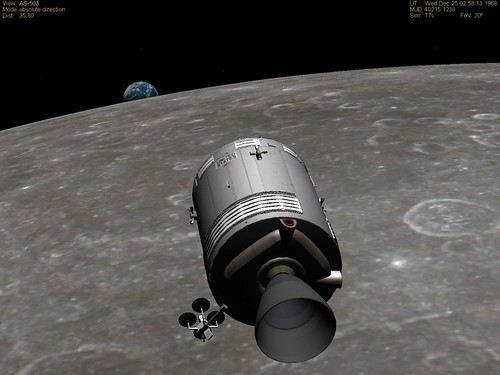
[Update: I decided to add another "never actually photographed" view from Orbiter, simulating the famous Apollo 8 Christmas Eve Earth rise photo. There are more Apollo screen shots from Orbiter on my Flickr site.]

The Universe


I wake
& the universe knows itself,
carbon, calcium,
flesh, bone & brain
peering from the bed
at its hydrogen
burning

-Rob Simbeck


That just about sums it up! Rob is an award-winning writer, musician, and speaker who lives in Nashville. We've been friends since we met as fellow students at Carnegie-Mellon University and started writing and performing music together just a few short decades ago. His web site displays a pretty good cross section of his work, including articles, books, music industry artist bios, songs, and poetry. I highly recommend his book Daughter of the Air, a biography of pioneering female aviator Cornelia Fort.

Saturday, December 20, 2008

REAL Science in the Capital


In 2007 I read Kim Stanley Robinson's "Science in the Capital" trilogy, Forty Signs of Rain (2004), Fifty Degrees Below (2005), and Sixty Days and Counting (2007). Set in the near future, they portray some dramatic effects of rapid climate change and the efforts of scientists at the National Science Foundation (and elsewhere) to solve these problems. These are political novels as much (or more than) science fiction, and I really enjoyed all three books. Robinson is best known for his Mars Trilogy, and while some of his characters are quirky, the science is well researched, and the portrayal of the scientists and their work seems very plausible. What seemed harder to believe in the dark depths of the Bush adminstration was the election of a president who takes science and scientists seriously.

Things are different now. President-elect Obama today announced the four top members of his science team, including Harvard physicist and environmental scientist Dr. John Holdren as presidential science advisor. Read or watch today's weekly address in which Mr. Obama describes the importance of science and technology and introduces his top science team. I was really encouraged by his remarks including these closing lines:
I am confident that if we recommit ourselves to discovery; if we support science education to create the next generation of scientists and engineers right here in America; if we have the vision to believe and invest in things unseen, then we can lead the world into a new future of peace and prosperity.

Carnival of Space #84


From space politics to space aliens, from conferences on Earth to avalanches on Mars, from local planets to exoplanets to the best of 2008, Carnival of Space #84 offers you 25 byte sized chunks of the universe to explore, hosted by Next Big Future. The video here is #5 in Bad Astronomy's post on the top 10 astronomy images of 2008 - the moon transiting Earth as captured by the Deep Impact/EPOXI spacecraft back in May. Amazing!

Friday, December 19, 2008

Trace: Tiny Time Waster

There are zillions of "apps" for the iPhone and iPod Touch, most of them games, and many of them free or costing only 99 cents (I read an article somewhere saying that some people are making tens of thousands of dollars a month selling low-cost apps on iTunes). Aside from music and video (movies and YouTube), my most frequently used apps are the New York Times reader, eReader (for reading ebooks), WeatherBug, and StarMap. I have quite a few musical instrument apps too, but it seems the main use of those is to show people how cool the iPod Touch is. Otherwise, a real guitar or keyboard works much better.

I've also downloaded many games, though I usually end up deleting them after trying them a few times. I'm really not a big game person. But Trace is a tiny exception. It's great for wasting little slices of time here and there. You've got this little stick figure character you can move with arrow and jump buttons. You have to walk him across the screen to a little yellow sun target, avoiding various fixed and moving obstacles that will send you back to the start. You do this by drawing lines with your finger - your character uses these lines as platforms or bridges over and around the obstacles. Sound easy? Sometimes it is, but often you have to solve a puzzle or use careful timing to get through. The graphics are child like and often funny. It's really a lot of fun. And it's free!

The screen above is from "Space," one of six "worlds" in the game. Each world has its own music (which you can turn off) and about 20 levels. This video shows examples from most of the worlds (this shows an earlier version of the game where the character was just a little red line).

Astronomical Computer from 150 B.C.E.


This is really cool. A British museum curator has built a working replica of a 2,000 year old Greek machine that is actually a precision mechanical computer for astronomical calculations. He spent years studying the rusted and broken pieces of the "Antikythera" that were recovered from under the sea near Greece in 1902.

This is quite impressive, although as some YouTube commenters have brilliantly pointed out, calling it a "computer" is questionable since this primitive device doesn't even support Instant Messaging.

Wednesday, December 17, 2008

More Space Proposals

There are a few other space-related proposals that are open for discussion in the Change.gov "seat at the table" area:

1. Coalition for Space Exploration Policy Recommendations - The report is mainly a summary of special Gallup polls showing strong public support for space exploration. The Coalition is made up of mainstream aerospace industry companies (Boeing, Lockheed-Martin, ATK, etc.) and space advocacy groups.

2. X Prize - The X Prize organization offers some suggestions on how NASA can work better.

3. Association of Space Explorers International Panel on Asteroid Threat Mitigation - As they say in their description:
Because NEO impacts represent a global, long-term threat to the collective welfare of humanity, an international program and set of preparatory measures for action should be established.

The ASE report is a 54 page PDF that is available for download at the above link. There are very few comments so far. I added this one:

We humans evolved to deal very well with certain time spans (seconds to hours to a few years) and to judge well the probabilities and impacts of certain types of events and threats (predators, prey, day/night, weather). With very short or very long time spans and for very small probabilities, our instincts aren't very good, but fortunately, we have science, and the ability to learn from things that are distant and abstract. Asteroids are like that. Long periods can pass with no big asteroid events, but there's nothing special about this time compared to 65 million years ago or 1908. Now is as likely a time for an asteroid to hit as any other. This proposal is basically asking us to spend what is really a small amount of money and a bit more attention to a low probability risk with big consequences. It really is like insurance and fire extinguishers - something we should assign a little money and attention to while we devote a lot more money and attention to more immediate problems.

The proposal is also suggesting improvements in international planning and cooperation on this important issue, and explaining why such cooperation is essential.

The Obama transition team is inviting Americans to participate in the various discussions of issues that may be important to them. If you care about space exploration and the risk of NEO impacts, please add your voice to these discussions.

Tuesday, December 16, 2008

SSP at Change.gov

One of the great things about the Obama transition is that the public is invited to participate, to have "a seat at the table," as they put it on the change.gov web site. They have invited proposals from outside groups (37 pages of links so far) with the provision that all documents submitted will become public (they are PDF files on the web site). You can read them and then join in the discussion through forums associated with these proposals. Open government!

I just learned about a proposal on space solar power (SSP) that is under discussion there. I read the brief proposal and browsed many of the comments. Although there are some off-the-wall comments as in any public forum, the discussion is impressively multi-level and well informed. I rated a number of comments (thumbs up or down) and added a general comment to one of the most informative posts. If you care about this issue, you should go read, vote, and comment.

Of course there is no guarantee that SSP will be pursued by the Obama administration. It's one of hundreds of proposals. But the fact that these discussions are happening is in itself such a hopeful sign. This combined with the impressive cabinet and other appointments that have been announced shows that change is indeed coming. We will soon have leaders in Washington who don't have their heads in the sand! Or wherever the current administration's heads have been.

P.S. It's not very clear on change.gov, but the forums are run by IntenseDebate.com, and to register for the forums, you need to set up a free account there, even if you have registered at change.gov for other things (as I had done).

Discovery Now

If you'd like a daily (or just occasional) audio fix of "space stuff," check out Discovery Now, a free 90 second daily podcast on aerospace topics from the National Institute of Aerospace. Of course you can't go very deep into anything in 90 seconds, but you might learn something interesting. Recent topics include VASIMIR rockets, geysers on Enceladus, Galileo (the dude, not the spacecraft), and "supercomputers for smooth flying." You can access the MP3's or subscribe to the podcasts through their web site, or you can get them through iTunes. The Discovery Now web site also has a few lesson plans on space related topics.

Monday, December 15, 2008

From Oz: Carnival of Space #83

Be sure to check out this week's Carnival of Space - it's the Antipodean Edition, hosted by Ian Musgrave's Astroblog. Ian hails from Adelaide, Australia, and he provides startling photographic evidence of what it's like to live on the bottom of a world (Earth in this case). When I was in Australia in June/July 2006, I saw the southern sky for the first time, and on a visit to a very dark national park at Jervis Bay, the super-bright Milky Way over our heads was a dazzling sight. But it was amazing how quickly the upside down feeling passed.

Saturday, December 13, 2008

How Big Is Our Galaxy?

Not much time for blogging this weekend. A nasty New England ice storm knocked out our power yesterday (along with hundreds of thousands of other Massachusetts and New Hampshire homes). We were lucky enough to get power back after only 15 hours or so, while news reports indicate that it may take three days or more for many in the region. We have a lot of downed tree branches but no damage to the house. Internet access was messed up too. But it could have been much worse. I'll be busy the rest of the weekend, a Neil Young concert tonight, a family event tomorrow.

So I'll leave you with an interesting fact from a recent NASA document for kids, "Extreme Space Facts." I've heard a lot of "how big" analogies for sizes and distances of astronomical objects, but this one was new for me:

How big is our galaxy? If the Solar System, from the Sun all the way out to Pluto, were shrunk to the size of a U.S. quarter [a coin about 24 mm in diameter], the Milky Way would be the size of North America.

The picture is a Hubble image of the barred spiral galaxy NGC 1300. Evidence from radio and infrared astronomy suggests that our Milky Way Galaxy is also a barred spiral.

Thursday, December 11, 2008

Get Ready for IYA 2009

I just sat in on an excellent 90 minute phone/web training session for JPL Solar System Ambassadors and other educators. The subject was IYA 2009 - the upcoming International Year of Astronomy, celebrating 400 years since Galileo first used a telescope to observe the cosmos (watch the great IYA2009 introductory video here - choose high quality if you can).

There are many events being planned, with extensive web support from various organizations, much of it already in place. There's a designated theme for each month of the year, starting with "Telescopes and Space Probes: Today's Starry Messengers" in January. That January page includes links to other pages with activities, videos, and PowerPoints as well as a PDF "IYA Discovery Guide" for the month (all 12 guides are listed here). January's guide includes methods and tips for observation with and without a telescope, as well as a profile of Venus, the featured observing object for the month. Galileo observed the phases of Venus with his telescope (see Galileo's 1610 sketches below) and showed that this was direct evidence that Venus is orbiting the sun rather than the Earth (and that Venus orbits closer to the sun than does the Earth).

The January page also points to an excellent presentation from the Night Sky Network, "How Telescopes Changed Our Understanding of the Universe." It identifies many of the key questions about our place in the cosmos and how ever improving telescopes helped us to answer those questions. The explanatory graphics in this PowerPoint are great.

There's so much to explore, and if you are an educator (formal or in- ) and/or a member of an astronomy club as I am, January 10 will be a special target day for doing a star party or other observational event. The goal is to kick off the year by getting as many people as possible observing the universe around us that night. I better get busy preparing for all this stuff!

International site: www.astronomy2009.org
US site: astronomy2009.us
NASA site: astronomy2009.nasa.gov

Monday, December 08, 2008

(Video!) Carnival of Space #82


This always happens (OK, it's the second time). I neglect to submit a post for the Carnival of Space, and Dave Mosher of Space Disco is the host and does something really cool and different with the carnival. This time it's a video of all the posts. And there are a lot of good ones. But none of mine, since I was fooling around with visual programming software this past week instead of walking my space beat like a responsible space blogger. But as Mr. Spock was always telling Captain Kirk, "Dude, you snooze, you lose."

Nice job Dave.

Lecture: What Killed the Dinosaurs?

You probably know something about what wiped out the dinosaurs, but do you know how scientists figured this out? I just listened to a very interesting lecture on this subject from The Teaching Company. I've bought a few of their DVD and audio courses and I noticed this free lecture listed on my account page. I thought it might be for customers only, but a Google search also found it, so I guess it's available to anyone (at least for now). The lecturer is Professor Peter Ward, a paleontologist at the University of Washington.

P.S. The Teaching Company is having one of their frequent sales and many of their courses are deeply discounted.

Saturday, December 06, 2008

Scratch: Lifelong Kindergarten!

I've finally figured out my place in the world: Lifelong Kindergarten! That's the name of a research group at MIT's Media Lab, with the motto "sowing the seeds for a more creative society" (for more on what LLK means by this, read this article by LLK's director Mitchel Resnick). On their mission page they say
Our ultimate goal is a world full of playfully creative people who are constantly inventing new opportunities for themselves and their communities.
"Playfully creative" is probably the best way to describe the implicit goal that seems to connect all the crazy threads of my life - songwriting, guitar, performing, flying, foreign languages, diverse reading, writing, programming, traveling, exploring various technologies, teaching, etc. I like nothing better than to learn something new that is complex, full of potential, and somehow connected to my other interests.

Case in point: Etoys and now also Scratch, a similar drag-and-drop visual programming language developed and released (for free) by the MIT Media Lab. I've downloaded, installed, and played a bit with it, using its very intuitive "snap together" programming blocks. I haven't been able to explore any of the many user projects uploaded to the Scratch gallery because the Scratch server won't open for me - perhaps it's just overloaded. But I did find a great site called learnscratch.org which has at least 30 example projects with detailed tutorials, and I tried a bunch of them. The picture here is a simple piano keyboard project (each key is a separate "sprite" with its own scripts).

I'm still learning Etoys and have barely started to explore Scratch. It's clear that Scratch is more immediately intuitive and in some respects more polished than Etoys. It also seems to have a more extensive "infrastructure" including a social networking aspect through the Scratch web site (which I would love to see - I was only able to get to the download page very late last night and nothing will open on the site today). It's probably easier to get started teaching younger children with Scratch than with Etoys. But I have a feeling that Etoys is more powerful and extensible for the middle school space/physics projects that I hope to develop starting in the next few weeks.

Both of these environments are amazingly empowering and bring new meaning to the word "interactive" (both also operate equally well in many different world languages). One of my favorite SF books is Orbital Resonance by John Barnes (I've written before about his Meme Wars series). It takes place on a "lifeboat" space colony "resonating" between Earth and Mars in the near future (after a series of Earth-threatening catastrophes), and the narrator is a very bright 13 year old girl. The colony's education system is radically different from our current system and is geared toward creating smart, flexible, capable citizens and leaders to help the human race survive its precarious situation. Many of the school projects that are assigned involve creating complex computer simulations of scientific, technical, and social systems, a necessary part of understanding problems and making good decisions in their very challenging circumstances. I wondered how kids in such a world could manage to do that so quickly and efficiently. Now that I've seen Etoys and Scratch, I have a lot better idea of how something like that might really be possible.

P.S. MY BAD on problems with the Scratch web site. It was a firewall security problem that I sometimes have with certain web sites. I just visited the Scratch site and it's got a lot of really great features and a very active user community.

Friday, December 05, 2008

AOPA Internet Flight Planner

Although I haven't done any flying as a private pilot in over three years, I still have a strong interest in aviation and hope to get back to regular flying one of these days. So I keep renewing my AOPA membership, and for 2009 I added the optional subscription to AOPA Flight Training in addition to the standard AOPA Pilot magazine. It's been so long that I will need to review a lot of basic things if I seriously hope to get back in the cockpit.

While renewing, I checked out the AOPA web site and noticed they have introduced a new web-based flight planning tool, developed by Jeppesen. I planned a simple flight just to check it out, and it's pretty nice, quite adequate for planning VFR flights (though of course you still need to carry current paper charts). Very cool, and free to AOPA members. I wish I could go flying today - it's a great VFR day.

Thursday, December 04, 2008

MSL in 2011

JPL has announced that the Mars Science Laboratory (MSL) will launch in 2011 rather than in fall 2009 as originally planned. There's just too much development and testing still left to do on the giant new rover to safely make the 2009 Mars launch window. Better safe than sorry, as long as they can manage to keep the program's funding going until 2011. MSL is a big, expensive project and while the 2004 Mars rovers have been a great hit with the public, NASA funding is bound to be tight in the next few years, and there are other NASA unmanned science programs competing for those limited funds.

On the bright side: more time for kids to name the new rover with the help of Pixar's fictional robot WALL-E (I just bought and watched the WALL-E DVD, and I liked it even better seeing it the second time, even if the space physics is just a wee bit unrealistic). This also gives more time for some enterprising Orbiter add-on developer to create a MSL add-on! In the meantime, Scott Conklin's excellent MER-2003 add-on will let you play around with Spirit and Opportunity if you'd like to do some virtual launching, landing, and roving.

The JPL picture above shows three generations of Mars rovers including tiny Sojourner and SUV-sized MSL.

Wednesday, December 03, 2008

She Hates Me (et cetera)

If you put 13,000 songs on shuffle in iTunes, you can get some pretty strange combinations. Here's a brief sequence that popped up last night:
  • Delta Lady - Joe Cocker
  • Poor Side of Town - Johnny A.
  • Somebody to Love - Queen
  • Overture from Figaro - Mozart
  • She Hates Me - Puddle of Mudd (this song always makes me laugh, but PG-13+)
  • Echoes - Dar Williams
  • Villa-Lobos Etude No. 1 - Kazuhito Yamashita (classical guitar)
  • Death by Numbers - Noah and the Whale
  • Queen of Hearts - Rodney Crowell
  • Wah Wah - George Harrison

Monday, December 01, 2008

A Forgotten Vinyl Fave

I found a forgotten box of vinyl record albums in the basement the other day. One of the albums was Nether Lands, a 1977 record by the late Dan Fogelberg. While I like some of Dan's music, I was never really a major fan - except for this album! When I read some of the lyrics, I suddenly realized what a favorite this record was back in the day. How could I have forgotten it? I thought about transferring the vinyl record to MP3, which I have done with some old records with disappointing results. I looked on Amazon and found the CD was available for $4.99, and today it arrived (I'm such an Amazon junkie that I have a "Prime" account which gives me free two day shipping on almost everything).

What a great record! There are no big hit singles - it's one of those albums that works best as an complete work. Good lyrics, beautifully recorded acoustic instruments, cool harmonies, lush but not overbearing orchestration. Nice.

One Laptop Per Child


Following up on my Etoys post from yesterday, here's some information about OLPC. The video is from December 2007 so it's not completely up to date on OLPC status and the "Give One, Get One" program, but Nicholas Negroponte is a great speaker, he gives you the essential background on the program, and of course he's one of the people who made OLPC happen. For more up to date information, check out the OLPC Blog (the November 23 entry has a video of a recent interview with Negroponte on Charlie Rose).

There is a new Give One, Get One (G1G1) program now supported by Amazon.com (give an XO laptop to a child in a poor country for $199, give one and get one for yourself for $399). There are also some international G1G1 programs now.