Sunday, October 21, 2007

New England Soaring

Tow Plane Pre-Cable Release
Today was a perfect New England fall day - cloud-free blue sky, countless maple trees turning to brilliant oranges and reds, and pleasantly warm to boot. Noticing this as I walked the dog this morning, I went into one of my periodic "why do I have a pilot's license yet I never fly except for economy seats on United" self-critical rants. Then I remembered an email I had seen about a special gliding day at Sterling (3B3) for Worcester area pilots - hey, isn't that today?

It was! So I drove over to Sterling (about 12 minutes from home), paid my $75, and joined the GBSC (Greater Boston Soaring Club) waiting list for an introductory flight. There were about 10 pilots from the Worcester pilots' association, but with the great weather, private glider owners were also out in force, and with only two tow planes, there was quite a line of gliders waiting for launch. But there were plenty of other pilots hanging around talking about flying and stuff, so it was actually fun to spend the afternoon outdoors at this classic little airport. Other planes were coming and going as well, including a beautiful Boeing Stearman biplane in vintage Army PT-17 colors (blue and yellow - see Flickr) and a helicopter (Robinson R22 I think).

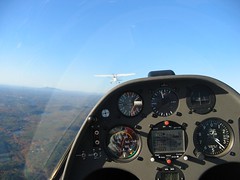
I finally got my turn around 4:00 pm, and by a complicated but lucky fluke, I got to fly in a sleek, high performance, retractable-gear Schempp-Hirth Duo Discus glider rather than in one of the club planes (which certainly would have been fine). My pilot was one of the owners, and we got a tow up to about 3500 feet (about 3000 feet above ground level). He first had me try my hand at staying in proper position with the tow plane, which is harder than it looks. I over-corrected, he repositioned, and I did a little better, but soon it was time to pull the cable release handle.

I've flown gliders 2 or 3 other times, so I was expecting it to be very quiet and peaceful - just the wind noise. You don't even need a headset, you can just talk in the cockpit. The scenery was great as expected, though still mostly greens - the foliage won't peak for a couple of weeks I suppose. But Mount Wachusett, the Wachusett Reservoir, and the nearby towns looked great anyway (I took a few quick pictures but mostly wanted to focus on flying and enjoying the experience). I made a few turns to try to get a feel for the handling. As is typical with power-trained pilots, I didn't use enough rudder at first, and I was shy with the bank angle, which is typically 30-45 degrees for gliders. This is considered a steep turn in a powered airplane where you usually tend to stay around 20-30 degrees. Steep turns are really more fun.

My pilot felt and heard (audio variometer) signs of some rising air , but it was too localized and we didn't gain appreciable altitude. We tried a couple of areas where there had been rising air earlier, but they were pretty dead. We stayed within easy gliding range of the airport, and after about 20 minutes, we were overflying the airport in preparation for landing. Total flight time was about 23 minutes. It was really fun.

I really like soaring and I'm thinking of joining GBSC in the spring and taking the lessons needed to solo and get a glider rating (I could join and maybe start sooner, but they basically pack up the gliders at the end of November, hopefully before the snow flies). Powered-flight pilots usually only need a couple of hours of lessons, but I'm pretty rusty, so who knows? It's not a race, and I enjoy the learning process as much as anything.

Friday, October 19, 2007

Sorting Out Space (Carnival #25)

The 25th Carnival of Space is up at Sorting Out Science, and it's an especially readable and well organized carnival post. Well worth a visit and a few side trips. Sorting Out Science (SOS!) is a new blog for me, subtitled "Science for people who never realized that science could be interesting." It looks like a good one.

Thursday, October 18, 2007

Post #584: Figuring Out Myself

"Figuring out myself" sounds like it could be something deep and philosophical. Maybe another time. In this case, I simply noticed that since I started blogging on October 18, 2005 (two years ago today!), that I have blogged more in certain categories than others. Of course this is a heavily biased result, since I originally started the blog to talk about the Orbiter space flight simulator, and I defined the categories myself. But being an engineer, I decided to make a chart anyway.

Although it remains quite spacey and techy, I have expanded the scope of the blog, talking about space and astronomy in general, as well as education (especially when I started to do educational outreach events as a JPL Solar System Ambassador). I even used the ambiguous title "Music of the Spheres" to justify talking about music from time to time. "Technology" came to include my iPod and Prius and other cool stuff, and I added a video category when I discovered how to embed YouTube videos in blog posts.

The chart covers only topics with more than 25 posts. It shows that out of 584 posts including this one, my original theme (Orbiter) accounts for 153, followed by NASA (113), books (113), astronomy (105) and a bunch of other topics, mostly space related: Mars, space history, shuttle, Moon, private space. Music doesn't do so well (32, one out of 18 posts), and flying even worse (27). So much for old obsessions.

I tried tracking numbers of visitors for a while, but that got to feel like an obsession about an obsession, so I went back to my original idea that I write this geeky stuff because I like to write, and I hope that those who share some of my interests will enjoy reading it, no matter who, where, or how many you may be, and that you'll occasionally comment on something, or just say hi.

Wednesday, October 17, 2007

Seeker and Orbiter

I just got the November issue of Sky & Telescope, and it includes a review of a new software product called Seeker, from Software Bisque (maker of TheSky6 and other astronomy products). Seeker is dedicated to 3D exploration of the solar system, including some spacecraft. You can fly instantly to any planet, moon, or included spacecraft and enjoy the views. It sounds pretty cool, and it costs $129 (introductory price of $99).

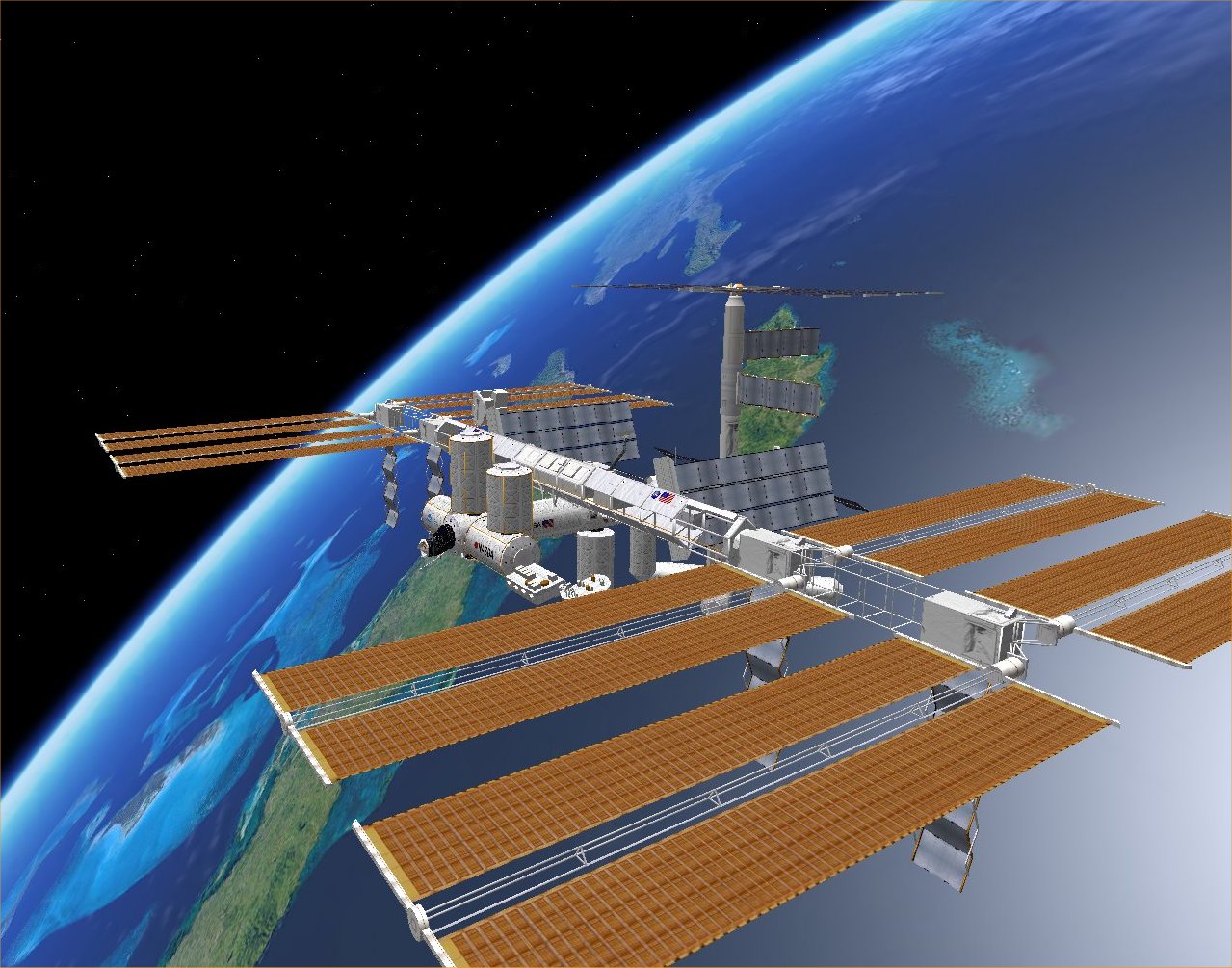
That's all great, but I also want to point out that a small subset of Orbiter (which is a free space flight simulator) can do what Seeker seems able to do (touring the solar system), and a lot more besides. Orbiter's 3D graphics are certainly as good or better (click on the samples above to see bigger images, the top one from Orbiter, the lower one from Seeker).

How Google Maps the Earth

There's a great little article in today's Technology Review update on how Google manages to do what it does in Google Earth and Google Maps. Even in this simplified explanation, it's clear that there's a lot going on under the hood when you type in some address and Google Earth flies you there almost instantly. The article links to some nicely illustrative video clips and still images.

Tuesday, October 16, 2007

Music of the Ears (and Eyes)


As long as I'm spending more time with music than with space these last few weeks (damn that new iPod!), I thought I'd write about some music I've discovered recently. Nothing to do with space, but it's "music of the spheres," OK? I don't know how to link directly to iTunes, but that's where I've bought most of this stuff. So I'll link to Amazon instead.

The Village Sessions - Last December, John Mayer recorded acoustic versions of six of the songs from Continuum and it's really great stuff. He's an amazing songwriter and I'm really jealous of how cleanly he plays the acoustic guitar (forget his lead guitar, I'm not even in the same universe on that). The songs really stand up well to this simple treatment.

Iron & Wine - Iron & Wine is basically singer/songwriter Sam Beam, though he's recorded with a few different people. I've only downloaded a few songs from his four or so albums so far, but they have a quiet beauty that is really mesmerizing. He has a new album called The Shepherd's Dog which came out a few weeks ago.

Lisa Hannigan - You can't really get much music by Lisa Hannigan, but I am totally in love with her voice. She's an Irish singer who has recorded and performed mostly with Damien Rice on O and other CD's and videos, and on a song called Unplayed Piano which I found on iTunes. I read somewhere that she's recording a solo album but I don't know when it will be out.

Bruce Springsteen, Magic - I'm mostly a fan of his first 4 or 5 albums from the 70's plus a few songs from his later periods, but his new CD with the E-Street Band really grabs me like that early stuff.

Gone Gone Gone - Robert Plant and Alison Krauss? Who'da thunk? But wow, it really works. This is the first single from their CD Raising Sand, which is coming out in a couple of weeks. I love Alison Krauss and Led Zep and I love the groove and the harmonies on this rockabilly tune.

Jeremy Fisher, Goodbye Blue Monday - This is one I just found the other day on the new Paste Magazine sampler CD (#36) with a song called Scar That Never Heals. Another cool song is Cigarette (there's a funny video for this on YouTube, embedded herewith).

There's more, including some old Steppenwolf songs that I forgot I used to love in high school! They were an awesome band. And the new KT Tunstall CD is great too, Drastic Fantastic. I'm also reading Bob Dylan's Chronicles: Volume One. My musical tastes are all over the map. No, the solar system.

Monday, October 15, 2007

Ambassador for Space

I just noticed an interview/article with a NASA/JPL Solar System Ambassador, posted by NASA as an educational feature the other day. David DelMonte is an ambassador in the District of Columbia, and I think his comments on the reasons for and rewards of being involved are shared by many of the people who volunteer in the ambassador program (including me).

Googlearning the Moon


As I was preparing last week for my Friday evening middle school presentation on exploring space with your computer, I took a closer look at the educational features that accompanied the launch of the Google Lunar X-Prize a month or so back. There's some pretty nice stuff, much of it created by the Saint Louis Science Center, including excellent grade-specific learning guides.

One thing that I added to my presentation was the scale solar system based on Google Maps. This activity assumes that the Earth is the size of a basketball and places the sun at any address you specify. It then displays a series of rings representing the orbits of the planets in the scale of the map. So with the sun at my office in Westborough, MA, Mercury is just outside our office park, Earth is 2 miles down Route 9, Mars is in Southborough, Jupiter is in Natick, Saturn's in Newton, Uranus is in Boston Harbor, Neptune's in Plymouth (south shore), and Pluto ends up in Provincetown on the tip of Cape Cod. I've driven to and flown over these places, so it's big but still familiar. Of course a walkable scale model is even better for the kids if you've got the time and space for it.

There's a lot more there, so have a look. The video "Earth's Offshore Island" (part 1 linked above) is a great explanation of the Moon's importance and potential. There are more videos in the X-Prize YouTube Channel.

Friday, October 12, 2007

Engineering the Future

I know I'm not alone in my concern for the future of science and especially engineering in America. It seems that so few young people are interested, and that with the test-score-driven agenda required by "no child left behind," it seems that most kids are not getting to do the kind of exploration and imaginative activities that might help them believe that science and technology are really exciting and potentially fulfilling things to pursue.

That's one of the reasons I do space-inspired educational outreach events, hoping to spark some interest in science and technology for at least a few kids. I'm doing a middle school astronomy event tonight with a couple of my astronomy club and Solar System Ambassador colleagues, so I was thinking last night about some things to talk about on my virtual tour of the solar system. With recent Cassini radar findings of even more hydrocarbon (ethane/methane) lakes on chilly Titan, I plan to talk about the idea that Titan, like Mars, Venus, and the Moon, is a place we humans have been. We've landed robot eyes on those places (and human ones on the Moon) and had a look around. Of course we've also driven around Mars with Spirit and Opportunity, and looked at more and more of Mars with high resolution orbital cameras, making the red planet seem even more like the distinctive and increasingly familiar place that it truly is. We've flown close to even more places in the solar system, and the point is, they are places, not just abstract ideas or points in the sky.

To me this is up-close involvement through mostly robotic eyes is exciting stuff, even though as a child of the Apollo era, I thought there would be human eyes and footprints in more of those places by now. But no matter. We're stepping out into the solar system, we've set some goals, we're even seeing private companies start to move toward space. It may not be happening as fast or in quite the way some of us would like to see, but it's happening, and thanks to the internet and other technologies, we can have a ringside seat on the next frontier. Why more people aren't excited about this and wanting to be involved in this and many other scientific and technological developments, I don't know. Too many other distractions, I guess.

But this past week I learned about two engineering education programs that give me reason to be a little more optimistic. One is a high school and middle school curriculum for engineering called Project Lead the Way (PLTW). It's all about hands-on learning and problem solving and it is already in a number of schools all over the US. The other is a new engineering school, the Olin College of Engineering in Needham, Massachusetts. This is a small school (around 300 students so far) but the exciting thing is that it is taking a truly innovative approach to engineering education and to preparing the next generation of engineers and leaders for our technological society. Founded in 2001, it's already rates as one of the top schools in the country.

The picture at the top is courtesy JPL, showing in false color all the areas of Titan's north pole that have been explored by Cassini's radar. I added the Google Earth inset image of the northeastern USA as a scale reference - it's approximate but pretty close. Those hydrocarbon lakes are big.

Tuesday, October 09, 2007

Dawn's Ion Light

Dawn at Ceres - Ion Engine Firing
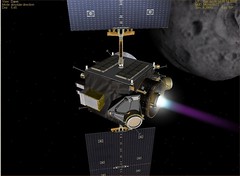
I got a mission status report from JPL on the Dawn mission, which launched successfully back on September 27. The report said that JPL engineers had tested the spacecraft's ion engine for 27 hours this past weekend, a drop in the bucket compared to the 50,000 hours they are expected to thrust over the life of the mission. I wrote about Dawn back in July when it was originally expected to launch, and I simulated some parts of the mission in Orbiter using the excellent add-on package by Brian Jones. The Orbiter picture here shows the ion engine firing in close proximity to Ceres, which Dawn will not actually reach for a few years (2015, after Vesta in 2011).

Monday, October 08, 2007

So Don't Use the A-Word

Sam Harris is a writer and thinker I really admire. While Richard Dawkins (whom I also admire) has an aggressive "take no prisoners" approach in his writing against religion, Harris is different. He is blunt yet subtle, divisive yet inclusive, as paradoxical as those word pairs may seem. In his book The End of Faith, he argues that faith itself is a great danger, that giving a privileged place to irrationality if only it is labeled as "religion" is crazy. As he says in that book, "As long as it is acceptable for a person to believe that he knows how God wants everyone on Earth to live, we will continue to murder one another on account of our myths." That certainly is happening today.

I discussed The End of Faith more extensively in a 2006 post, but tonight I found a great new essay by Harris, based on a speech he gave recently. The points he makes really hit home for me, helping me to better understand the troublesome word "atheism" and what it means to me (and to others). The article is called "The Problem with Atheism," and Harris says it's very much a problem with the word atheism itself, and with what that word most often does, which is to polarize discussions and to tar the person who is labeled an atheist with all sorts of unwarranted assumptions (even if the label is willingly self-applied). It's more productive to think and talk in terms of what one does believe rather than what one does not believe (which for me is a rather long list of the usual imaginary suspects, from Zeus to the Flying Spaghetti Monster as well as God and his/her immediate and extended family, not to mention astrology and extended warranties on small electronics). I don't even believe in "science" - science is a system of knowledge and an approach to understanding the world. It's not a religion or a substitute for it and it doesn't need to be worshiped or believed, just appreciated and applied.

What Harris suggests is what I think I have been doing, or trying to do, all my life - trying to apply reason and evidence and to oppose bad ideas, wherever they may arise. Not as a crusade, and not only "against" religion, but simply as an approach to life. This doesn't mean trying to be Mr. Spock and to apply nothing but logic. There's plenty of room for (and need for) love and compassion in the world. We primates have evolved as social animals, and love and compassion are as important as intelligence and reason in the success of humans in this world. But organized religion, not so much.

In his speech, Harris also returns to and clarifies another topic from The End of Faith, his own interest in matters referred to as "spiritual" or "mystical" - things that are usually associated with religion, but need not be. I won't attempt to summarize his arguments here, except to say that practices such as meditation are well known to have benefits in terms of feelings of well being, reduced stress, and greater insight into your own mind. His point is that even if you reject religion, you needn't reject these sorts of practices as "religious by association."

Harris strikes another blow for reason in this thought-provoking speech - I strongly recommend it whatever your personal beliefs may be.

Saturday, October 06, 2007

“Stars,” Space, and Education

I’m in something of a blogging rut, which happens sometimes. Work and travel have been taking up a lot of time, and even with the help of Bloglines (which is great), I’ve been having trouble keeping up with all the space and astronomy news and blogs that I might like to comment on. Plus I have to admit that having a new iPod is also pretty distracting. I’m embarrassed to find myself doing marginally crucial things like creating new playlists and making sure I have album cover artwork for most of the songs (this is mainly so they look cool in the new Cover Flow view). Can something be lame and cool at the same time? Yes.

I haven’t done a “what’s it all about” post for a while, and I just found a note to myself reminding me of an interesting conversation I had on a Boston-LAX flight back in August. My seat mate was a retired science and art teacher who was also a Vietnam vet. He even had a Mercury-era space connection. I wish I had written about this sooner or at least took some notes, because he had a lot of great things to say. But let’s see where it goes anyway.

I was reading a space-related book, and he asked me something about it. This led to me mentioning that I was doing educational outreach using space and astronomy themes as a JPL Solar System Ambassador. He mentioned that he had been a science teacher in public schools (Los Angeles area) for a number of years, and he had even hosted an after-school science TV program for a couple of years. He later switched to teaching art (he’s also an artist). We also spent a lot of time discussing Vietnam and the sixties – he had served in the Army in the unit that is featured in the book and movie We Were Soldiers Once… and Young (1st Cavalry, 7th Battalion, 1965), a fascinating discussion in itself. But I want to talk about the science education stuff.

We talked about what really happens in classrooms, about “stars” and regular students, about motivation, about why kids are not that interested in science and math, about the role of money and our society’s cues about what’s important and valued. It’s messy and more than a little discouraging.

I told him about my experience with a math teacher at my tiny high school in 1968-69, the guy who took a special interest in me and helped me get some computer experience that led to me getting into a good school so I could study computer science and eventually physics and optics (I ended up working for most of my career with software for optics and other things). He said I was obviously a “star” student – he also had a few of those, some of whom still keep in touch with him after many years. He said the stars are easy – it’s the regular kids you worry about. And the teachers.

He said that many teachers just don’t have the training, ability, or inclination to really teach science well. If they’re not very knowledgeable or excited about it themselves, it’s hard for them to inspire and engage the students. Of course this isn’t a big revelation, but his point was that the “stars” will find a way to progress in spite of poor teachers, as I did with my outside reading and activities like Civil Air Patrol when I was in school. Most of the other kids will muddle through (if that) and conclude that science is boring, useless, and irrelevant.

Another thing we discussed is the way that kids today are obsessed with money, material goods, and status. Of course media and marketing provide a steady stream of messages reinforcing the idea that money and status are firmly linked and highly desirable, and defining the cool and fast ways to get money and status. Needless to say, science, math, and engineering are not on the fast track to coolness among kids of today.

Finally there is the idea that school is about knowing the answers to sets of specific questions (an idea that is reinforced by the standardized tests that define success in today’s schools – success for school administrators and teachers if not for the students themselves). Science comes across as rather annoying when you often have to say “do the math, do the experiment, figure it out” rather saying “the answer is D.” Science is like life - messy, but potentially very satisfying.

So how does this affect me as an informal educator? I’m trying to provide some sort of enrichment activities that engage students and perhaps get them to think that at least some of this science stuff is cool and is worth the effort to do the math or the experiments or observations, to stick with work that can be genuinely hard and sometimes frustrating, but to sometimes experience the thrill of mastering something whose answer is not A, B, C, D, or none of the above.

But it sounds like when I talk about stars, it’s the “stars” I am most likely to reach with my message, the few kids who already have more unusual interests, who are already interested in science, math, and technology. The others will either not get it or not bother to show up if it’s an optional event. I guess I had already calibrated that in my plans – not that I’m giving up on anyone, but I have said many times that if even one or a few kids end up getting interested in science, math, or technology in part as a result of my space cadet activities, it will have been worth it.

But another question is, how did the “stars” get that way? Something inspired them, made them different (and willing to be different, which I can attest is sometimes not the greatest thing to be). What was it? Probably their parents and their home environment (and genes) for starters. Reading and adult-level conversation from an early age were important for me, and then somewhere around age 9 I caught the space bug (I think it started with John Glenn’s Friendship 7 Mercury orbital flight in February 1962, and especially the photo stories in LIFE magazine, supplemented by “NASA Facts” and posters that I soon started writing to request).

I don’t remember any educational outreach people from my early childhood who influenced me, and aside from Mr. Call in high school, I don’t remember any teachers who specifically encouraged my interest in science and math, though I’m sure I was praised for doing well in these subjects. There were some early museum trips (Museum of Natural History and Hayden Planetarium in NYC around age 7 is all I really remember). There were a lot of books. I especially remember the Random House “All-About” non-fiction book series for young readers, and I watched a lot of Disney science and nature specials, which my mother also enjoyed. There was a rock collection and later a chemistry set. The usual nerdy indicators.

I don’t know. Maybe I’m preaching to the converted in my outreach activities (not to mention this thing – who reads a “space blog” besides other space bloggers and space geeks, which I mean as a term of endearment, not scorn). But you never know. You just never know. And I apparently like to write and talk about and play with space stuff, so it’s not like it’s a hardship for me. But I would like to know how we can get more “stars” in our schools – can it happen without another Sputnik, JFK, or Apollo? I don’t know.

But finally back to the space connection for my interesting seat mate on the LA flight. He was a “body double” for spacesuit testing for one of the original Mercury 7 astronauts (I wish I took notes - I think it was Gordon Cooper). As a college student, he somehow heard of a part-time job which involved standing in for the astronauts at a company that was testing the original space Mercury spacesuits (I think it was AiResearch Manufacturing Division, Garrett Corporation, Los Angeles). They took a lot of detailed body measurements, and it turned out that his body dimensions were a perfect match for one of the seven, so he was the stand in for various tests on the suits made for “his” astronaut. He never met any of the astronauts, but it was a pretty interesting and unusual part-time job for a college student and future science teacher!

Sometimes it's cool to talk to the person next to you on a flight. Fortunately I had not yet replaced my iPod at that point!
Thursday, October 04, 2007

Sputnik Day (and Space Carnival 22)

Sputnik 1 in Orbit Sep 10-4-57
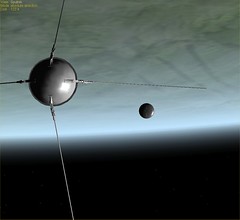
The Space Age started with a bang 50 years ago with the launch of Sputnik 1. The Space Review has published a special edition today focused on Sputnik. One thing I didn't realize was that while Sputnik itself was small and quite difficult to see from the ground, many people reported seeing it as a very bright and flickering object. But what they actually saw was the separated upper stage of the booster which had also achieved orbit. It was quite large and was not stabilized so it tumbled and flashed in the sunlight during its three month orbital lifetime. The picture (from Orbiter) shows Sputnik shortly after separation from the upper stage seen in the background.

I'm also happy to report that Carnival of Space #22 has launched today over at Advanced Nanotechnology. While it includes two articles inspired by Sputnik, the others cover a wide range of space related subjects, reflecting the diversity of space flight as a human endeavor fifty years out of the starting gate.

Tuesday, October 02, 2007

Inspiring Talk on Exploring the Saturn System


Titan is a place - a rather weird place, it seems, but we know it as a place and not merely as an object because of the amazing Cassini/Huygens mission. We have landed a spacecraft on Titan, a beachhead on a distant corner of the solar system. We don't know Enceladus quite as well, but Cassini has given us some intriguing looks at that icy little world as well.

Planetary scientist Carolyn Porco is the leader of the imaging team for the Cassini mission. She gave an 18 minute talk on the Cassini/Huygens mission and on some of the amazing results from Titan, Enceladus, and Saturn itself at the TED conference in Monterey last March. A video of that inspiring talk was released on the TED web site today. It highlights the excitement and the importance of exploration.

Cassini is making another close pass over Titan's southern hemisphere today.

Mars-like Aerial Photos

Looks Like Mars
Last night I also looked over some pictures I took on an August flight from Los Angeles to Boston. I had a wing-free window seat and it was a pretty clear day from LAX to Denver, so I took a bunch of pictures. The glare on the window washed out the contrast in lot of the pictures, and they aren't too sharp either. But I saw some cool stuff, including Solar Two, a now-retired solar energy research facility with a bunch of tracking mirrors illuminating a collection device on a central tower. It's 16 km east of Barstow, CA (see Flickr) and has been converted into some sort of gamma ray telescope called MAGIC.

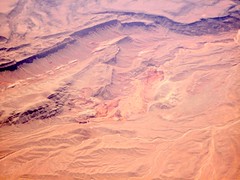
One of the coolest areas I photographed from that flight was southern Utah, parts of which look very much like images from Mars orbiting spacecraft. The picture here was processed quite a bit using Picasa2 and PaintShopPro to play with the luminosity, shadows, contrast, saturation, etc. I don't know exactly where it is but it seems to be near Glen Canyon and Lake Powell.

Astronomical History in the UK

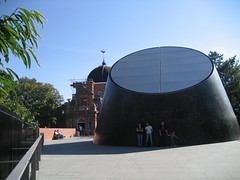
Peter Harrison Planetarium Exterior
I transferred my UK pictures from my digital camera onto my computer last night, and I uploaded a few of astronomical/historical interest to my Flickr site. Although it was mainly a business trip, I was happy to get the chance to meet Orbiter's author, Dr. Martin Schweiger, and my Go Play In Space co-author, Andy McSorley on my weekend in London. I also managed to find time for two astronomy-related "field trips" that I have mentioned in previous posts. The first was the Royal Observatory, Greenwich, and the other was the Museum of the History of Science in Oxford. I have pictures from both visits at Flickr, and I've added some explanatory comments for several of them.

One thing that I didn't realize while I was seeing it is that the modern exterior structure of the Peter Harrison Planetarium pictured here is an astronomical instrument itself! It's a tilted and truncated cone, with the main axis of the cone set north-south and slightly east of the Prime Meridian. The inclined angle of the south side of the cone is related to its latitude (51° 28’ 39” North) such that the sighting line along the south side points at the North Star. The northern side of the cone points to the local zenith, again based on its latitude. Finally the cone has been truncated at an angle such that the exposed surface is parallel to the Earth's equatorial plane. Quite the little astronomical visual aid!

Sunday, September 30, 2007

Space Age Developments

Only 4 days until the 50th anniversary of the space age, and here I am, barely blogging. Business trips are strange - I sometimes have more time for blogging during a trip than I do at home (assuming I have regular internet access, which I didn't on the recent UK trip). Then I have the problem of catching up, damage control, post-trip reporting, etc. when I return to home and office. Not to mention family events and occasional bouts of sleep. But enough excuses!

I have just finished Rocketeers (subtitled "How a Visionary Band of Business Leaders, Engineers, and Pilots Is Boldly Privatizing Space," 2007) by Michael Belfiore, and it provides fascinating closeup views of several of the key organizations and individuals in private space, especially Scaled Composites (Burt Rutan), SpaceX (Elon Musk), and Bigelow Aerospace (Robert Bigelow). A lot of the visits and interviews took place in 2005 and 2006, and while Belfiore has brought things as up to date as possible, this is a fast changing business for a book. I was especially wondering about SpaceX, and I found that this past week, Elon Musk gave a brief interview at nasaspaceflight.com that provides a pretty good update. Things seem to be going well though not quite as fast as I thought. The next Falcon 1 launch should be in January/February 2008, first Falcon 9 launch "late 2008 at the earliest," though test stand engine tests of the 9-engine first stage are starting soon (starting with one engine and building up to 9 by spring of 2008). The Dragon spacecraft could start to fly people in 2011.

Speaking of rocketeers, the latest issue of Air & Space Magazine has a great cover story ("The Real X-Men") on the amazing X-15 rocketplane which was flying suborbital flights to the edge of space from the late 1950's until 1968. Those guys really had the right stuff.

And for the future of space exploration from NASA's point of view, the current Scientific American has a good article on the Orion spacecraft ("To the Moon and Beyond"), as well as an article on five essential things to do in space as we enter the second half of our first century of space exploration. Let's remember to take the long view even if some of us may not be around for all of the second half.

Wednesday, September 26, 2007

Harvest Moon Shorts

The full Moon tonight is the Harvest Moon, the full Moon closest to the autumnal equinox. I'm still too busy to read much or blog but I'll try to be uncharacteristically brief and mention a few things of interest.

If all goes well, Dawn will finally launch tomorrow morning on its mission to the asteroid belt and the early history of the solar system. Good materials on that mission home page.

There's a nice interactive timeline on the history of the Space Age at the New York Times. It features links to PDF's of original articles from the Times.

Amazon has launched its MP3 download service this week, with non-protected 256K MP3 files for some 2 million songs, though only two major labels are initially offering their music this way. It works very well and many songs and albums are a bit cheaper than iTunes. These files will work on nearly any MP3 player including my new third-generation iPod Nano with video, which is awesome. The tiny color display is one of the sharpest I have ever seen (205 dots per inch). It has prompted me to buy a couple of movies to try out the video - probably just a novelty since I can watch DVD's on my notebook in most situations, but it definitely makes it feasible to watch a movie on a plane, even in an economy seat. Very cool.

AND ALSO VERY COOL is this brief interview with former astronaut Franklin Chang Diaz on the upcoming ground test of an advanced space propulsion system called VASIMIR. He is very optimistic about the future of humans in space (and private space) if we can create better and faster propulsion and power systems.

Monday, September 24, 2007

Moonshadow Men

I'm too busy to blog! I'm back from England with just too much to do, but Sunday afternoon I took some time and drove to one of the few Boston area theaters showing the new documentary In the Shadow of the Moon. It was fantastic! It's basically the story of the Apollo Moon program told in the words of 9 or 10 of the 21 men who went to the Moon between 1969 and 1972 (12 Moon walkers, the rest Moon orbiters - it would have been 24 except for the fact that three astronauts went twice, and there would have been 14 Moon walkers except that Apollo 13 didn't land - Apollos 8 and 10 were intentional Moon-orbit-only missions).

The film is based mostly on footage shot by the astronauts themselves (no special effects), combined with recent interviews (no narrator). I especially liked the comments of Mike Collins (Apollo 11) and Alan Bean (Apollo 12) - they seemed the most willing to say it how they really felt it, though I suppose you have to give Buzz Aldrin special credit for saying that he stopped on the last step of the ladder of the LM to urinate just before he hopped down to the lunar surface to become the second human to walk on the Moon!

Although it's "presented by" (not directed by) Ron Howard, it's still a documentary, so it's in limited theatrical release. If you have an interest in space or in history, you should see this film. I think even non-space-buffs will be interested and even moved by the deeds and the words of these amazing men.

Friday, September 21, 2007

Space Age Top 10

I picked up the October 2007 issue of Sky at Night, the BBC’s astronomy magazine. I like this magazine, and it’s a bit cheaper here (£4.25 or about $8.50) than in the US where I have bought it occasionally anyway for the articles and the included CD (this one features a video of a brief 1970 interview with Neil Armstrong on BBC television, among other videos and other content). This issue celebrates 50 years of the Space Age, and one of the features is a list of the 50 “pivotal moments” of the space age, manned and unmanned, good news and bad. In case you're curious, here’s their top 10:

1. First satellite, Sputnik 1 (4 October 1957)
2. First human in orbit, Yuri Gagarin (12 April 1961)
3. First humans on the Moon, Armstrong and Aldrin (20 July 1969)
4. First humans to orbit the Moon, Apollo 8 (24 December 1968)
5. Loss of the shuttle Challenger (28 January 1986)
6. Launch of the Hubble Space Telescope (24 April 1990)
7. First US satellite, Explorer 1 (31 January 1958)
8. First rover on Mars, Pathfinder/Sojourner (4 July 1997)
9. First woman in space, Valentina Tereshkova (16 June 1963)
10. Launch of Voyager 2 for the outer planets (20 August 1977)

While such lists are always somewhat subjective, this top 10 seems pretty reasonable to me, except perhaps for putting Pathfinder before Viking 1 landing on Mars (#23, 20 July 1976), based on the public response to the 1997 mission, which was the first to make images immediately available through the web. It's sad that the destruction of the Challenger makes the top 10 while the first shuttle launch is down at #26 (12 April 1981), but the Challenger loss was certainly a more "pivotal" moment in space age history.

Thursday, September 20, 2007

Oxford, Einstein, Alice, Harry, and Me

I spent a very enjoyable day in Oxford today, starting with a bus tour to get myself oriented in this historic but quite compact city. I then explored some of the beautiful old college buildings, had lunch in a pub, and climbed a couple of towers for the view. I also spent some time browsing in the enormous and wonderful Blackwell book shop.

Oxford has various museums, but the only one I visited was the Museum of the History of Science, which has an amazing collection of optical and astronomical instruments, among other things. Its most famous artifact is a small blackboard that was used by Albert Einstein when he gave a visiting lecture series at Oxford in 1931. It was left with a few equations that he had written to explain in a fairly simple way (for him!) the then recently discovered red shift in the spectra of distant galaxies, and how this relates through his General Theory of Relativity to the apparent expansion of the universe. I also saw parts of a Charles Babbage Difference Engine, a mechanical computing device from 1830! I took some pictures of this as well as other museum objects (and scenes around Oxford) which I may eventually add to my Flickr site.

I had forgotten that Oxford was also the home of Alice's Adventures in Wonderland author Lewis Carroll, whose real name was Charles Dodgson. He was a lecturer in mathematics at Christ Church college in Oxford, where he had also been an undergraduate. I visited the grounds of Christ Church as well as the modern (tourist) version of the shop where young Alice Liddell had once bought her "barley sugar sweets," she of course being the inspiration for and original recipient of the famous Alice stories.

Christ Church also has a Harry Potter connection. Although I'm not a big Harry Potter fan myself, my daughter is, and I have at least seen the films. It turns out that the dining hall used in those films is actually the Dining Hall at Christ Church. I was hoping to see it for myself but it was closed due to a conference. Drat! Yes, I am a creature of pop culture, I must admit. And a science nerd. What an unbeatable combination.

Wednesday, September 19, 2007

The Cosmos for Beginners

In a bookstore in London, I just happened to notice and buy this brand new book, The Cosmos: A Beginner's Guide. For educational outreach purposes, I'm always looking for new material and books to recommend. Although it's written to accompany a new BBC series which I haven't seen, the book stands on its own as a brief, highly readable, nicely illustrated introduction to the universe as we now know it today. I like the way it integrates space exploration and astronomy and includes some of the latest information on the search for "exoplanets" (planets outside our solar system) and on the latest ground based as well as space based astronomy instruments. It's very up to date with references and pictures from early 2007. The book also does a nice job of connecting other science fields (e.g., particle accelerators and "extremophiles," bacteria and other life forms found in extreme environments on Earth) with space and astronomy, as in the quest to understand the universe just after the big bang, and the search for life beyond Earth.

I have many space and astronomy books, but this is one of the few that I have read from cover to cover (many in this genre are closer to reference books). I believe adults as well as older children (say 12 and up) will enjoy this book. It's written in a lighthearted style with excellent explanations and analogies to help readers understand the complexities of astronomical discoveries. I believe the book will be available in the US soon. There's a companion web site for the TV series, but I haven't had time to look at it.

Monday, September 17, 2007

Solar System Ambassadors: Apply Now

I should have mentioned this earlier - fortunately this Space Review article by Tom Hill reminded me. If you are a person in the US who is interested in doing space-related educational outreach, you may want to consider applying to the JPL Solar System Ambassadors program. Rather than repeat what Tom has said in his article, I suggest you read that, and also read the information on the JPL pages about the program.

If it sounds like something you'd like to do, then please apply - but do it quickly as they accept applications during the month of September only (no exceptions, as I discovered late fall 2005 when I first learned of the program - I had to wait until September 2006 to apply). Like Tom, I am in my first year as an ambassador, and I've really enjoyed the events I've presented and participated in with fellow ambassadors, and have found the materials and briefings provided by JPL to be very interesting and helpful.

Where East Meets West

I spent most of Sunday at the Royal Observatory, Greenwich, a place that is rich with astronomical history. Greenwich is essentially the reference site for both time and space on the surface of the Earth. Greenwich Mean Time (GMT, also called UT for Universal Time) has been the international standard for defining time, used in aviation, astronomy, and many other applications (it's actually a bit different now). And Greenwich is also where the Prime Meridian is defined, the zero-line that divides east longitude and west longitude (of course this meridian passes through an infinite number of other places since it's an imaginary line running from the north pole to the south pole).

Speaking of longitude, Greenwich also figures heavily in the history of navigation and timekeeping. The Royal Observatory was founded in 1675 with the mission of compiling a star atlas that could be used for celestial navigation by ships at sea (it took over 100 years to compile). Although latitude (north/south position from the equator) could be determined pretty easily from the Sun or the North Star, longitude was a much more difficult problem, requiring either multiple observations of the stars and Moon, coupled with a detailed almanac, or an accurate way of keeping time at sea, allowing navigators to compare their local noon (Sun at zenith) with the time at a reference location (Greenwich, which is zero longitude) and from that determine their east-west position.

The solution of this problem by carpenter-turned-master-clockmaker John Harrison is told in the wonderful little book Longitude by Dava Sobel, and if you visit the Royal Observatory, you can see the four amazing timepieces (called H1 through H4) that he designed and built over many years to solve this problem, overcome the interference of various rivals, and finally win the government prize of £20,000 that had been established for solving the longitude problem. Harrison was 80 when he finally got the money! I was shocked by how small H4 is - more or less an overgrown pocket watch (you can see pictures and read about the solution of the problem here).

There are many other instruments on display (including the 28 inch refractor shown above), and of course the chance to stand on the meridian line and thus be in both the eastern and western hemispheres simultaneously (a required photo op). There is also a newly revamped astronomy museum with interactive displays and a planetarium, the only part that isn't free (the show about how stars evolve and work was pretty good). I also visited the nearby National Maritime Museum and enjoyed the views of London from the high hill in Greewich Park on which the observatory is located.

Saturday, September 15, 2007

Lovely London

I just arrived in London for a week of business, with this weekend added for a little socializing and sightseeing. The weather is beautiful so it looks like I've lucked out on that for today anyway. It's been a couple of years since I visited the UK - it's great to be back. And you gotta love a country that puts Charles Darwin on its currency - well, I do anyway!

Friday, September 14, 2007

Our Big-eyed Planet

Telescopes in space are wonderful things, but telescopes on the ground can be a lot bigger and cheaper, and with the availability of adaptive optics to partially compensate for the jiggly atmosphere, they can produce image quality that can sometimes even exceed that of the Hubble Space Telescope, at least for some wavelengths.

There's a good article on the state of our planet's biggest eyes in this month's OPN (Optics & Photonics News from OSA), and this article happens to be one that is unlocked for web access by anyone in the online version of this monthly print publication for OSA members. It points out that there are currently twelve 8-meter class optical and infrared telescopes in the world, four of them on Mauna Kea in Hawaii, including the enormous Keck I and Keck II telescopes with their multi-segment 10-meter primary mirrors. And more are on the way. It's a big sky, so we need a lot of big eyes.

Thursday, September 13, 2007

Google To The Moon, Alice!

Now there's an era-spanning headline! Allow me to be among the first million people on the web to talk about the latest space-related challenge from the X Prize Foundation, sponsored to the tune of $30 million by our friends at Google. I don't know about you, but I like people (and companies) with deep pockets who do cool things with their money. In this case the prize is for the first private company that can land a robotic rover on the moon and transmit a gigabyte of images and video back to Earth (plus a few other requirements). That's the Google Lunar X Prize, a.k.a. Moon 2.0. Check out the rollout video.

That will probably cost a lot more than $20 million to pull off (the winner gets $20 million, with $5 million for second place and $5 million for above-and-beyond bonuses). But as with the original $10 million Ansari X Prize won in 2004 by SpaceShipOne, it's a cool and highly visible challenge that is bound to attract some serious contenders, notwithstanding the fact that it's a robotic challenge.

Of course first you have to design the the lander and the rover. Hey, I just took four days of SolidWorks 3D CAD training - I bet I can whip off a Moon rover in a couple of weeks! Then you just need to build it, develop the software for it, launch it, stuff like that. Time to clean out the garage. Maybe start with an add-on for Orbiter and simulate the mission first. Think small, think light, think smart...

Step Right Up! Carnival of Space #20

Welcome to the Carnival of Space, where every week a few intrepid bloggers virtually gather to Think Big Thoughts of Spacefaring Civilizations, tinker with humanity’s backup plan, wish they were astronauts (or rationalize why they’re happy not to be astronauts), marvel at the Universe and at the fact that we manage to figure out some of it sometimes, or make fun of NASA. We boldly blog where many of us have blogged before. OK, I’ll just get on with number 20.

On September 10, Cassini passed through the closest encounter it will ever have with Iapetus, Saturn's "Yin-Yang" moon. Emily Lakdawalla of the Planetary Society Blog assembled a bunch of the images into a crescent view of Iapetus from the approach phase of the flyby. Be sure to check out the rest of the blog for more Iapetus encounter images, including a really stunning one of Saturn, its rings, and almost all its moons, and this cool animation. (The new Iapetus image above is courtesy JPL.)

A Babe in the Universe also has news from the Ringed Planet, and says, “we had a new calculation of Saturn's day with yet another spectacular Cassini photo. The estimate of Saturn's day affects calculation of wind speed and whether those winds are travelling East or West.”

Astropixie reflects on how various human cultures through the ages have recognized and created unique stories for the same patterns of stars in the sky (known as asterisms, which are not necessarily the “classical” constellations, though some are). She gives examples of a few that are up in the northern skies right now!

Inquiring minds want to know: how did supermassive black holes form? Most astronomers think they began as very large stars that collapsed into black holes and started growing from there. Universe Today reports on a theory that they collapsed directly into black holes - and never were stars.

Speaking of stars, everyone knows that stars twinkle, and they probably know that this has something to do with the atmosphere. This week, Astroprof offers a fine explanation of what it actually means to “twinkle” (if you’re a star of the astrophysical variety) and why it happens.

And how will we get to the stars? No one really knows yet, but Centauri Dreams has looked at many ideas on this, including solar sails. Recent Progress on Solar Sails discusses an article that the team at NASA’s Marshall Space Flight Center put together on what is happening there. Paul reports that despite all the funding cuts, solar sail work continues, and issues that will define future missions are being worked out.

Before we get to the stars, we will probably get to some “local” planets and moons (at least I hope so!). This week Colony Worlds discusses some reasons for holding off for a while on urban planning for a number of bodies in our Sun’s neighborhood in Which Worlds Should Humanity Skip?

As “Educator Astronaut” Barbara Morgan begins touring the US to talk to children and their teachers about her recent experiences in space, Stuart Atkinson wonders what challenges and problems will face the teachers of the future, especially those given the responsibility for teaching young Martians about a bizarre, impossibly alien world called Earth...

And speaking of Mars and education, Catalogablog reports on a cool NASA-supported workshop called “Mars Inside and Out.” If you happen to be in Oklahoma City November 8 & 9, check it out! I’m sorry I won’t be able to make it.

Space For Commerce talks about efforts to find a new slogan for NASA, and as much as I respect the people and the accomplishments of NASA, I couldn’t help laughing at some of the examples he reports (“NASA: Keeping the Moon free of pesky humanity since 1972”). Digging deeper and more cynically into the subject (as usual), the Space Cynics blog draws some conclusions about why it’s easier to find a funny slogan than one that really fits the agency’s multiple personalities.

I’ve been focused on many Earthly concerns this week, but earlier this month I capped off a space-shuttle-and-ISS-obsessed summer with a discussion of my efforts to understand the construction of the orbiting Wonder of the Off-World that is the International Space Station. It really is amazing and there are some great resources on the web to help you understand it better.

In the private space sector, RLV and Space Transport News provided an early report on NASA terminating its COTS contract with Rocketplane Kistler. There are several follow-up articles in the last couple of days as well.

Finally, while it’s not the kind of “space blog” I usually read, the closest most people probably come to thinking about space is if they’re deciding what to do about satellite TV. Here’s help from the Satellite TV Guru.

I hope you enjoyed this week's festivities, and thanks to all the space cadets (and cadettes?) who contributed. Next week the carnival will be hosted by its founding father, Henry Cate at Why Homeschool.

But wait... this just in... Henry also submitted this cool late-breaking-entry on Hobbit galaxies and dark matter just as I was about to post-date my entry, click Publish Post, and try to finish the real work I was supposed to do while I was in a SolidWorks class all day!

Monday, September 10, 2007

Google Takes Flight

I only had 5 minutes to play, and I'd need to get a joy stick plugged in to really try it, but I just learned that Google Earth 4.2 has a built-in flight simulator of sorts. It certainly makes sense with all that fast-loading terrain data - it gives you another way to explore it. I was all over the sky trying to use the keyboard controls, but it seems to have some sort of flight model, and two aircraft to fly (F-16 jet and Cirrus SR22). It's no threat to Flight Simulator X (though it's probably crazy to say the words "no threat" and "Google" in the same sentence!), but it's pretty cool. Fire it up for the first time with Control+Alt+A (upper case) - keyboard commands are here, and more info here.

Sunday, September 09, 2007

Apple Makes It Easier and Harder

I've really been missing my iPod which was stolen back in May. I had decided to wait a while to replace it, see what would happen with the iPhone I was lusting after, and just listen to other music sources of which I have quite a few. But two weeks ago I broke down and ordered a 4 GB iPod Nano (just like the stolen one) for $199 from Amazon. I took it on a couple of morning walks last week, and life was good.

Then last week Apple announced a $200 price cut on the iPhone, along with a new line of cheaper and better iPods, including a new video-capable Nano that's $199 for the 8 GB model (room enough for 1000 songs and a movie, hmmm). So I sent my brand new old Nano back to Amazon. Now I'm back in the whole iPhone/iPod dilemma again. I had been thinking of waiting until March 2008 when my current cell phone contract runs out to maybe switch plans and get an iPhone (which by then might be a 1.1 or 2.0 version and maybe AT&T service would be better). I suppose there will always be a daughter or two who will accept a slightly used video Nano next spring if I get one now and do the iPhone thing next year. Sorry, I don't usually think out loud in my blog, but I guess I just decided! Apple sure makes cool stuff - all problems should be this easy to figure out.

Saturday, September 08, 2007

Carnival of Space #19

Sorry I'm a bit late in noting that the nineteenth Carnival of Space is up over at Universe Today.

I will be hosting #20 next week, so please send in your space-blogging submissions as soon as you can, and I will nano-assemble them into an intricate crystalline structure suitable for nano-framing. If that doesn't work out, I'll put them in a blog post.

Thursday, September 06, 2007

Orbiter vs. Reality

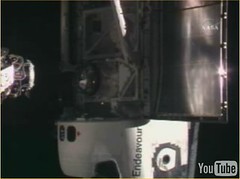
STS-118 Endeavour Docking Video Frame
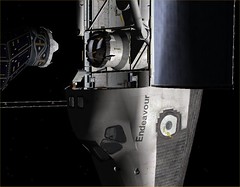
Endeavour STS-118 dock in Orbiter

I was just looking at my Flickr pages and I happened to notice a pair of images I posted early in the STS-118 shuttle mission in August. I had captured a frame from NASA TV of an ISS camera view of the shuttle about to dock. I later ran a Shuttle Fleet docking scenario in Orbiter and tried to capture a similar screen shot, and both are shown here. I have to say it's a pretty good simulation - at small size, the images are strikingly similar. At larger sizes you notice differences in lighting and reflections, but it's still amazing to me what add-on developers and Orbiter's developer (Dr. Martin Schweiger) are able to achieve with this free software!

(I realize now I posted this pair of pictures before, but I'm still amazed, so I'm posting them again!)

Video of (Simulated) Apollo Launch


There have been more updates to the cool AMSO Apollo/Saturn add-on for Orbiter that I wrote about recently (latest patch is 1.15). This is a very extensive and accurate simulation of nearly all phases of the Apollo missions in Orbiter, with excellent graphics quality. I downloaded the latest patch but have not had time install and play with it yet. But I learned about an excellent AMSO-based video that was made by "BigDAS". In spite of YouTube's small video size, I think you can get an idea of the quality of this add-on from this video. Nice work (on the video and especially on AMSO).

Wednesday, September 05, 2007

30 Years of Voyaging

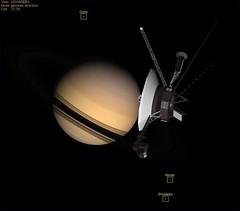
Voyager Saturn Labeled Moons
Thirty years ago today, Voyager 1 was launched from Cape Canaveral on a journey to Jupiter and Saturn. It is now more than 14 light-hours away from Earth (nearly 10 billion miles). The early part of its journey was of course a remarkable success, and with its sister spacecraft Voyager 2 which also flew by Uranus and Neptune, it delivered much of what we know today about the outer solar system, though we later received more details on Jupiter from the Galileo orbiter and on Saturn from the still active Cassini spacecraft.

What's even more remarkable is that both Voyager spacecraft continue to "phone home" as they make their way out of the solar system and into interstellar space. Timothy Ferris has an interesting essay in today's New York Times ("The Mix Tape of the Gods"), remembering Voyager and the gold-plated "interstellar record" of human images, sounds, and music that it carried (I wrote about it last December). Although it's remembered as Carl Sagan's special project, Ferris himself produced the recording that was turned into a literal gold record that could last for billion years.

The picture of Voyager 1 at Saturn is from an Orbiter simulation.

Monday, September 03, 2007

10 New Ways to Fly

The September issue of the Smithsonian's Air & Space Magazine is a really good one - I read it cover to cover and learned a lot of fascinating stuff. The cover shows an artist's concept of a "hypersonic wave rider" under the headline "10 New Ways to Fly." Of course hypersonic flight is one of the ten, but it will be a few years before that really happens, though there are experts quoted in the article who believe we are close to a breakthrough in this long-promised technology (which will probably be applied to high-speed cruise missiles before we see any sort of space plane for people). Here are the ten articles on these amazing flight technologies:
  1. X-racers (Rocket Racing League)
  2. Boeing Dreamliner (innovative cabin design and lighting)
  3. Spy Blimps and Heavy Lifters
  4. Fly Green (on biofuels)
  5. Tilters (V-22 Osprey is operational)
  6. Orion's Brain (flight control software and displays for NASA's CEV)
  7. 20 Hours to Solo (sport pilot license and aircraft)
  8. Lunar clipper (Moon tourism with Russian hardware)
  9. Son of a Buzz Bomb (PDE - pulse detonation engines)
  10. Mach 20 or Bust (hypersonic flight)
All of these articles are available on line (at least for now).

Sunday, September 02, 2007

ISS for Dummies (Me)

I'm really enjoying Tom Jones' astronaut memoir Sky Walking, though it's taking me a while to finish due to various interruptions. I'm now reading the part in which Jones is preparing for his fourth mission, STS-98 on Atlantis in February 2001. This ISS assembly mission (5A, the US Destiny Laboratory Module) was delayed from spring 2000 due to other delays, mainly that of the essential Russian "service module" (Zvezda) which was planned for 1999 but didn't actually launch until July 2000 (this article on the ISS assembly sequence is very handy). With all the problems in Russia at the time, it's a wonder the ISS project ever got started.

The delays gave Jones and the other early ISS assembly astronauts a lot of time to train (often under water) for the complex EVA's and robot arm procedures that would be needed to assemble the ISS in orbit. Of course there have now been many of these assembly missions, and while they are still not easy missions to plan and execute, there is a lot of experience to build on. In 1999-2001, there was not much experience in orbital assembly, despite such impressive EVA accomplishments as the Hubble service missions in 1993, 1997, and 1999. Jones was also the deputy chief of the Space Station Operations Branch for several years before his mission, so he was really immersed (literally and figuratively) in space station issues for a long time. It was a complex and often frustrating situation on many levels.

All of this discussion (and trying to visualize some of the assembly problems he discusses) made me realize that I don't really know that much about the ISS. I'm familiar with the overall structure and have a vague idea of the various modules. I've seen pictures and even some Orbiter models of past and future stages of the ISS. So I took a quick look to see what sorts of "ISS for dummies" material might be around.

The diagram above is from NASA, but I couldn't find this August 2007 (post-STS-118) version except in Wikipedia. The color-coded exploded view gives a pretty good idea of what's what. For a better idea of how everything goes together, this animation from Tietronix (sample frame at left, made for NASA but I couldn't find it on any NASA sites) is the best demonstration of the assembly sequence that I've seen. For ISS operations and a virtual tour, this Interactive Space Station Reference Guide is pretty good. Of course the main NASA ISS page has a link to this and many other ISS related articles and features. I'm sure there are many other good resources, but these can give you a good start in better understanding the ISS.

Now that I think about it, one of the best things I've found for space flight background and ISS information is a book I wrote about in fall 2006, Space Station Science by Marianne Dyson (second edition, 2004). Although aimed nominally at ages 9-12, it's really good for anyone with an interest in the ISS. It may be time for me to read it again.

P.S. Another great resource is NASA's Reference Guide to the International Space Station. Dated August 2006, it's divided into 10 PDF files, several of them quite huge due to the large number of detailed color graphics. The total download is about 76 MB.

Saturday, September 01, 2007

Energizer Bunny Rovers

They keep going, and going, and going. This was reported last week but I've been busy and just noticed that Spirit and Opportunity have resumed driving on Mars. JPL operators had the rovers "laying low" to preserve their limited power reserves while long-lasting Martian dust storms darkened the skies and greatly reduced the output of the solar panels. Those panels and other parts of the rovers are still pretty dirty with built up dust, but power levels have reached high enough levels to start driving. These things are amazing!