Sunday, August 30, 2009

Seattle from a Flying Beaver

Seaplane Tour - U Washington

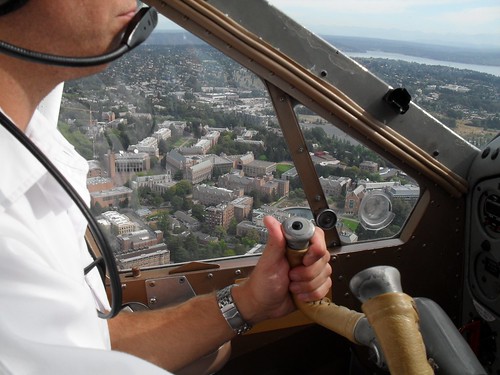
One of the coolest things we did in Seattle this past week was a 20 minute seaplane tour. We flew with Kenmore Air, which flies a fleet of seaplanes for scheduled, charter, and sightseeing service all over the Puget Sound region. We flew a De Havilland DHC-2 Beaver, one of the coolest planes ever. I requested and got the front right seat for the flight (there were only four passengers - the Beaver can seat six plus the pilot).

We took off from Lake Union (a 20 minute walk from our hotel near Seattle Center), flew east over the University of Washington and Lake Washington, then headed south along the eastern shore of the lake to Medina, where we saw Bill Gates' famous lakeside home (I missed it so I asked the pilot to circle back). Then we headed west for downtown Seattle, flying over the two sports stadiums (Safeco Field and Quest Arena, I guess) and then northwest along the Puget Sound waterfront. We got a good view of downtown Seattle, the Space Needle, and the Seattle Center area before turning southeast and back to land to the south-southwest on Lake Union. I was trying to enjoy the scenery, take pictures, and take in some of the pilot stuff, and it more or less worked. I sort of wish I could have heard the air traffic control for the pilot experience, but it was nice having the prerecorded sightseeing info (which must be GPS-driven because it seemed to know where we were even when Todd circled back to show me Bill's house). I plotted the approximate route on the map below. More pix on Flickr.

Friday, August 28, 2009

Europa: Anybody Home?


This is supposed to be a space blog, though you might not know it from my last few weeks of posts. But in the September 2009 issue of Discover Magazine, I just read a great article on plans for the exploration of Jupiter's moon Europa. The likely presence of an enormous ocean of liquid water below Europa's icy surface has many people wondering about the possibility of some form of life there. The missions under study would not directly detect life, but would gather more information about Europa's environment and surface and use ice-penetrating radar to determine how thick the ice layer is and perhaps even directly confirm the presence of water. The 2020 Europa Jupiter System Mission is estimated to cost $4 billion (for NASA's part) and would be coordinated with a separate ESA probe to the Jupiter system, though the funding for both parts of the proposed mission is hardly certain at this point (NASA's probe would orbit Europa, ESA's probe would orbit Ganymede).

The Discover article is already online, and there's a great Science Channel video based on the article here (and embedded above). There's a NASA/ESA "joint summary" report here (PDF 10 MB, 38 pages, January 2009).

If you'd like to do some exploration of the Jupiter system for yourself, you can use the Orbiter space flight simulator as I did back in April when I was preparing for my first IYA podcast. In that podcast, I started out by imagining that I was orbiting Europa and then initiated a transfer orbit to visit Callisto. I simulated that mission in Orbiter so I could talk about what I would see if I really took such a trip (assuming I could survive the radiation).

Track of the Day

Today my song "Message from Tomorrow" is the pop-rock Track of the Day on Garageband.com. That and $2 will get you a ride on the Seattle Monorail (more on Seattle in the next few days), but it's better than not being the Track of the Day. The song has gotten somewhat mixed reviews with a current rating of 3.2 out of 5 stars, ranked 191 out of 274 on the pop-rock chart, but some of the review feedback has actually given me useful ideas for when I do final recording and mixing for this track, which is my main goal when I put songs up on GB.

Another song from the new album is up there too, "Achin' All the Time," and it's actually doing better than "Message from Tomorrow," which surprised me a bit because I thought "Message" was a much stronger song ("Achin'" is #152 with a review average of 4.4 out of 5). There's been useful feedback on this one too, mainly that the chorus is not distinct enough, so I've rewritten the melody and lyrics a bit for when I do final vocals on that one in the next few weeks.

Wednesday, August 26, 2009

Collecting Experiences

I'm in Seattle this week, on vacation and collecting new experiences at an amazing clip. I thought I might mention this since Kevin Thompson gave my blog a plug the other day on his blog, Idle Diffractions (thanks Kevin), and I figured it would be nice to have written a post newer than August 11. So here it is, a sort of smorgasbord blog post from the Great Northwest.

One of my experiences was a full-motion simulator ride today at the Museum of Flight which was very cool. I was flying a simulated F-15. This was only the second time I've experienced a simulator that actually turns you in any direction (including upside down) as part of the simulation, and it was great, especially on the loops and barrel rolls. Other experiences this week have included Paul Allen's (EMP) rock & roll museum and SF museum, and tomorrow I'll be taking a short seaplane flight. I also did a little real (C172) flying recently back in Massachusetts, and with the extensive work I've been doing on my upcoming album Message from Tomorrow, you can see that I've really been doing my best to live up to both parts of my nom-de-web (FlyingSinger).

Finally, I'd like to mention that while in San Diego the first week of this month for SPIE, I did manage to see the great historic telescope exhibit that Kevin raved about in one of his posts. It was indeed an amazing collection of historic optical instruments. I even got someone to take a couple of pictures for me, one of which is here (thanks, Dave).

My experience tanks are nearly topped off (I've also read a few books this summer) and I hope to return to more regular blogging starting in September.

Tuesday, August 11, 2009

NASA Calls a Cab

According to this article, NASA is looking for a "space taxi," or more accurately, proposals for a commercial passenger transportation system to space. They plan to use $50 million of economic stimulus funds as "seed money" for this program. Such a system could help fill the gap in astronaut transportation to the ISS between the 2010 retirement of the space shuttle and the 2015 (probably later) availability of the Orion spacecraft and the Ares I launch vehicle (or whatever NASA ends up developing after the Augustine NASA Review Panel makes its recommendations). The current plan is to buy seats on Russian Soyuz spacecraft at $50 million a flight until a US-based system is available.

It would seem that SpaceX has a leg up on this program with its private Dragon spacecraft program, currently in development (with some NASA funding) to carry cargo to the ISS. Dragon was designed from the start to be extended to carrying passengers, with the addition of a few critical parts like seats and a crew escape system. But the escape system is a big ticket item (estimated at $300 million to develop), so $50 million won't go very far, assuming SpaceX wins the competetive bid. But as Elon Musk says, at least it's a step in the right direction, calling people's attention to the post-shuttle gap.

Of course it's not likely a real "space taxi" will look like my picture. This is an Orbiter add-on called "Space Taxi 2" by "lumpiluk," inspired by a German movie.

Monday, August 10, 2009

Carnival of Space #115

I'll make it brief (this is unprecedented! and no pictures!). The latest carnival of space is now online at New Frontier News.

Thursday, August 06, 2009

Kepler's First Scientific Result

NASA's new planet-hunting Kepler space telescope has detected the changing phases and atmosphere of a planet a thousand light years away(the NASA figure above shows a comparison of ground-based and space-based light curves for hot exoplanet HAT P7b). This "hot Jupiter" exoplanet had already been detected with Earth-based measurements, but Kepler was able to measure a more precise light curve for the planet, allowing scientists to infer an atmospheric temperature (about 2400 C) and to determine that the planet's orbit is circular. This was intended as more of a calibration of Kepler's capabilities, but even at this early stage of the mission, it was able to return useful new information for this previously known exoplanet.

Kepler is looking at thousands of stars in a fixed region of space and will be able to measure similarly precise light curves for all of the stars it will be "staring at" for the next three years or more. A fraction of those stars are expected to have planets in orbital planes oriented to allow Kepler to detect the slight dimming of the stars' light as the planets pass in front of them.

Wednesday, August 05, 2009

Galileoscope!

The Galileoscope is a special low-cost refracting telescope kit that is being distributed as part of the International Year of Astronomy (IYA). Galileo used a simple refracting telescope 400 years ago to observe the craters of the Moon, as well as the phases of Venus and the moons of Jupiter. IYA 2009 recognizes this important 400 year anniversary.

The Galileoscope is not a replica of Galileo's telescope, but rather an easy-to-assemble kit consisting of a 50 mm glass achromatic cemented doublet objective (way better than Galileo's objective lens) and a couple of eye pieces with plastic optics that can be used in three ways. It also includes the tubes and other parts required for assembly (no tools are needed). The basic eyepiece is a Plössl type and provides 25x magnification. There's an auxiliary eyepiece with a negative lens similar to what Galileo used. Its field of view is so small that it's like looking through a soda straw, so the main use of this is to show how bad Galileo had it when he made his early discoveries (though his view was even worse than this). But this eyepiece can be combined with the basic eyepiece and the included Barlow extender tube to provide a 50x eyepiece that works pretty well - good enough to clearly see the rings of Saturn, they say.

I just got a Galileoscope today, assembled it, and tried it out on some nearby trees and buildings. It works quite well, providing clear and sharp views, though the friction-based focusing is hard to set precisely. I haven't tried it on the night sky yet - maybe tonight.

The Galileoscope has been available online for $15 plus shipping, but the price is going up to $20 effective August 10 (their production and shipping costs were higher than expected). This is still a good deal for a telescope of this quality. The instructions (2 pages) that come with it are quite minimal and even a bit confusing, so I recommend that you download the expanded instruction PDF (7 pages with color photos) from the web site. There's also a nice 20 page PDF Galileoscope Observing Guide available for download.

Assembly is easy, but you should look carefully at the shapes and orientations of the plastic eyepiece lenses. There are several different types, and they have to be assembled in a certain order and orientation. They look very similar even though they have different curvatures and thicknesses. One tip: the negative lenses (thinner in the middle) will make distant objects look smaller and right-side up when you hold them a few inches from your eye. The positive lenses (thicker in the middle) will show an inverted image when held up that way. Look carefully to determine the flat vs. curved (convex or concave) sides of the lenses.

If you assemble an eyepiece wrong, things won't look quite right, but don't panic - you can easily take it apart and try again. No screws or glue are used in assembly. Just handle the lenses carefully by their edges to avoid fingerprints.

If Spheres Really Made Music...


What if you used the equations of gravitational motion to make music? What would that sound like? See for yourself with Kepler's Orrery, "a generative music system that uses gravity equations to compose and play ambient music."

I was actually searching for a web site on building an orrery out of Legos (to simulate the detection of exoplanets as done by the Kepler spacecraft, as I saw the other night at Starfest) when I found this application created by artist Simran Gleason. It runs as a Java applet and is also available for the iPhone and iPod Touch (I just downloaded and installed it, 99 cents). The Java version actually gives you more controls such as choosing which MIDI sounds will be used, though the iPhone version is more interactive (you can play god and toss massive gravitational objects anywhere you like with your fingertip).

It isn't strictly Newtonian (and it's not General Relativity either). The author injects elements of randomness, anti-gravity, and friction to avoid overly repetitive music that might take 365 days to play. You can read about how he does it here - it's pretty much doing the same thing that Orbiter is doing when it runs a space simulation, figuring out all the forces acting on each object in the "world" at each time step, calculating the accelerations and collisions, moving the bodies, and repeating. It's just that instead of Apollo 11 landing on the Moon, you get music! The video above is one example of the kind of sounds it can produce (more here). I've only played for a few minutes and now I need to get to bed, but I really like this little gravitational music toy.

Sunday, August 02, 2009

Starry, Starry Starfest

Starfest 2009 went really well last night, thanks to the contributions of many volunteer members of the Aldrich Astronomical Society, not to mention some amazingly clear skies. The Moon looked a lot like the picture shown here (thanks to KCrawfish03 on Flickr for this shot). It was bright, but pretty low in the sky, so it allowed for some great Moon viewing and also allowed some other sky objects to be seen quite well by our telescope viewing guests once it got dark around 9:30.

Before that, we had some really cool presentations in several classrooms at Anna Maria College. I started out as a greeter, helping to explain the options to visitors as they arrived (they had to make some choices since we had a lot of presentations and activities to choose from). I then attended a really nice presentation on the Kepler mission to detect Earth-like planets orbiting other stars. Kevin Boucher's presentation included a demo using a Lego model of planets orbiting a light bulb "star" with a photodetector connected to the PC to graphically demonstrate how Kepler detects planets by accurately tracking the light output of some 100,000 stars.

My presentation "The Once and Future Moon" featured a small pep talk on how, yes, we really did send astronauts to the Moon from 1969 to 1972, including some recent pictures of the Apollo landing sites taken from the Lunar Reconnaissance Orbiter (it's a shame that you still have to talk about that, but Moon hoax conspiracy wackos are still out there). But the main event was a very noisy simulated Saturn V launch in Orbiter, followed by a simulated Apollo 11 Moon landing. The kids (and adults) seemed to really enjoy that, especially when Neil said "the Eagle has landed." Then it was 9 o'clock and I sent them all to get their telescope etiquette briefing so they could go look at the Moon itself through the telescopes behind the science building. I don't know how many guests we had, but it seemed like a lot of people, and they seemed to all be having a pretty good time.

New Blog: Idle Diffractions

A colleague of mine has launched a new blog, focused (as it were) on optics, Idle Diffractions (it's sponsored by the company we both work for). Kevin Thompson is ORA's vice president of engineering and he's a really interesting guy with over 30 years of wide-ranging optical design experience. He also collects optics books including some really, really old ones, and he has a corresponding interest in the history of optics and optical design. His first post talks about the Hubble Space Telescope, a subject on which he has some personal experience. Kevin plans to write more on the Hubble and on many other aspects of optics old and new in the weeks and months to come.

Carnival of Space #114

One of these weeks I'm going to run away and join the carnival (of space) again. It's been a while for me since I've been preoccupied this summer with various non-spacey things. But the rest of the space blogosphere has carried on, as you can see from this week's Carnival of Space #114, hosted by Cheap Astronomy.

Friday, July 31, 2009

And the Pursuit of Happiness!

Can this really be called a blog? If so, then what I am doing is something much less, perhaps just a bl.

I just discovered And the Pursuit of Happiness, Maira Kalman's monthly illustrated feature about American democracy which the New York Times calls a blog. It's wonderful. The current one (July) is about Benjamin Franklin. Earlier posts I looked at just now featured Memorial Day and Lincoln.

I'll have to go read the rest of them when I have time, which I don't now. I have to write a short PowerPoint called "The Once and Future Moon" for my presentation at Starfest 2009 tomorrow night. It has to be short because I will have just 30 minutes and I also have to launch a Saturn V, land Apollo 11 on the moon, and take NASA's future Orion and Altair spacecraft for a quick spin around the moon (all courtesy of the Orbiter space flight simulator). Yes, I did wait until the last minute. I better get busy.

Lyrics, Rhymes, and Serendipity

Last night I was wondering whether my iPod Touch could help me with song lyrics - finding them (other people's) and writing my own, especially when it comes to rhymes. Turns out it can help quite a bit. I found a bunch of rhyming dictionaries at the iTunes App Store and bought two of them for 99 cents each. One is simply called Rhyme and it seems to not require a web connection. The other is called Rhyme Time and only works with a web connection (Wifi for the iPod Touch), because it's essentially a front end to the RhymeZone web site. Because of this, it provides a lot more rhymes.

I also bought a cool app called Lyrics+ which will find and display the lyrics for songs you have on your iPod, and also allows you to search by artist and title. It doesn't have lyrics for everything, but it's pretty extensive (web connection required). I happened to search for Arlo Guthrie and rediscovered an old favorite album that I used to have on vinyl, Washington County. So I bought that on iTunes. Serendipity strikes again! Especially for Apple.

Miracles of Science, the Moon, and MIT

It's great when friends visit from out of town. For one thing, you get to see things in your own area that you'd probably never see otherwise. When my friend Rob Simbeck visited from Nashville last week, we hung out and did music and stuff, but we also took a day trip into Cambridge. After lunch at the geek-chic Miracle of Science Bar & Grill, we spent a few hours at the MIT Museum, which amazingly enough, I had never visited.

The MIT Museum has especially great exhibits on robotics and holography, but I also liked the small exhibit on Apollo. Much of the work on guidance and navigation was done at MIT's Draper Laboratory, including the development of the AGC (Apollo Guidance Computer - try it for yourself, or read the history here). Some of the development hardware was on display, along with a reproduction of a large blackboard showing the Command Module GN&C Block Diagram (interactive version here). Very cool stuff.

It's also cool that forty years later, Draper Labs continues to be involved with systems for landing on the moon, as discussed in this recent article in the MIT Technology Review. Their system for NASA's Altair lander will be a lot smarter and friendlier than the AGC. It will use LIDAR (laser radar) to accurately characterize the lunar surface so the software can recommend the best landing options, as shown in the simulator image above.

Saturday, July 25, 2009

Starfest 2009!

Starfest 2009 (PDF) is the Aldrich Astronomical Society's big annual public astronomy event (parking and admission are free, though donations are welcome). It will be held, rain or shine, next Saturday, August 1, from 6 to 10 pm, at Anna Maria College in Paxton, MA, just a short distance from Worcester. In addition to telescopes, demos, and presentations by members, we are also happy to feature a special presentation by Donald Rethke, also known as "Dr. Flush."

Don is a retired engineer from Connecticut who worked on life support systems for the Apollo program, and also on the development of space toilet systems (hence the nickname). I've seen several of Don's presentations at the New England Air Museum, and he is an engaging, educational, and funny speaker. We are happy to welcome Dr. Flush and his collection of space flight paraphenalia for his first Starfest appearance. He will do two presentation sessions, 6:30 and 7:45 pm in the Zecco Performing Arts Center at AMC.

My presentation will be called "The Once and Future Moon" - a brief look back at Apollo at 40, and a briefer look forward at NASA's plans to return to the moon. Naturally it will include a simulated Saturn V launch and Apollo 11 moon landing using Orbiter.

Tuesday, July 21, 2009

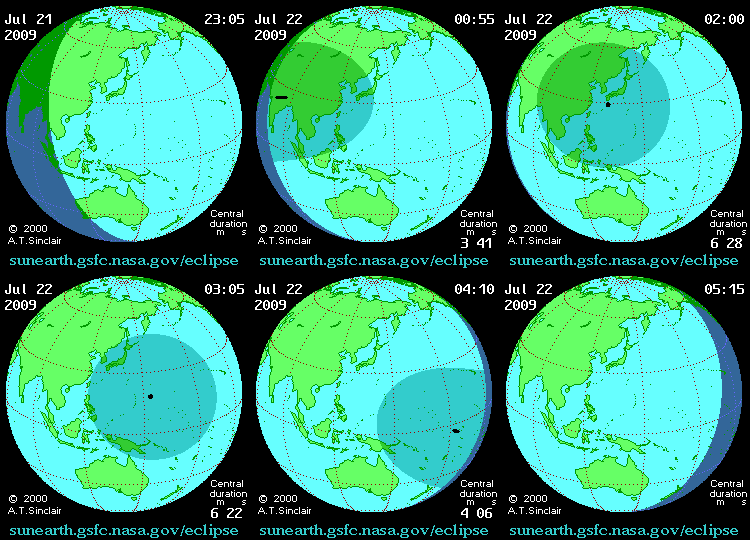
Eclipse Info for July 22

Solar_eclipse_animation_2009-Jul-22
If you happen to be in certain fortunate parts of Asia or the Pacific on July 22, 2009 starting at 00:14:54 UTC, you may be able to witness the longest total solar eclipse of the century. For information on how you can view the eclipse on the web, check the links on this site.

Eclipse predictions including the animated GIF above are by Fred Espenak of NASA's GSFC. Based on past experience, it may not actually be animated on my blog, for reasons I don't understand (if not, see it animated here). I think I may have fixed it with some brute force HTML editing to override Blogger's handling of images.

If this eclipse signals the end of the world as we know it as some superstitious people no doubt believe, then, hey, it's been nice knowing some of you!

Monday, July 20, 2009

We Choose the Moon

I just learned about "We Choose the Moon," a special "live +40 years" web site from AOL and the JFK Museum. It's feeding "real time" audio from Apollo 11, but displaced by 40 years! I happened to "tune in" at about 17 minutes before the Eagle landed (that was at 4:17 pm EDT). So now it's just a few minutes before landing, and it's audio-only, static and all, program alarms, NASA commentary, just like it was for those of us watching TV or listening to radios on this day back in July 1969. Very cool idea! I'll have to tune in for Neil's first steps tonight.

It Was Forty Years Ago Today

It was forty years ago today: of course I'm referring to Neil Armstrong and Buzz Aldrin landing on the moon on July 20, 1969, not when Sergeant Pepper taught the band to play (that was twenty years ago today). I'm having a busy summer, and what celebrating I was able to do for this historic anniversary took place last Thursday (July 16) which was the anniversary of the Apollo 11 launch. I spent the second of three Thursdays in July at the Boston Children's Museum, doing "live" demos to supplement their Living in Space exhibit. I say "live" because I was actually using the Orbiter space flight simulator and the great AMSO Apollo add-on package to perform simulated Saturn V launches and Eagle (LM) landings at Tranquility Base, while sharing my reminiscences of July 1969 with visiting kids and their parents. I had a number of other pre-planned simulation events (e.g., docking the shuttle with the ISS just like the real STS-127 mission now in progress), and with a billed schedule of such 15-20 minute "happenings," the second day was much busier and more fun than the first (for the kids and for me).

Only a few of the kids understood the significance of that historic week forty years ago. More of the parents got it, though most of them were too young to remember it themselves. And what was the significance of that week? If you read Tom Wolfe's NY Times essay on the Apollo 11 landing, you'll learn that it was "one giant leap to nowhere," and that this was because Apollo was actually a high-tech version of sword play between the Soviets and the Americans, and because while NASA had many scientists, engineers, and adminstrators, they had only one flawed (former Nazi, oops) "philosopher," Wernher von Braun - not enough fire power and "Words" to justify pushing on to Mars once the Soviets were beaten in the moon race. Bummer.

I know that NASA only got the budget that it got in the sixties because the space race was a proxy for the Cold War, and I know we've been "stuck in low Earth orbit" since 1972, but I'm still a bit of a romantic when it comes to interpreting Apollo 11, whatever its political genesis, and however delayed its ultimate effects may be. For the first time ever, humans left the Earth and landed on another body in the solar system. That was an insanely bold and cool thing to do, especially with the technology of the 1960's. It was way ahead of its time. But it showed that we could actually leave this planet when we want or need to, and go to other places.

Of course all the other places we will eventually visit and inhabit are much, much farther away than the moon, and the energy and technology required will be much greater. But when the time comes, we can do it, we can go to those places. Of course we should do our best to repair and maintain this planet - Earth is the Cradle of Mankind, and while one normally doesn't stay in the cradle forever, it has been a pretty spacious and human-friendly cradle, so most of us will stay as long as it remains habitable. But there's no guarantee that it will remain habitable forever - there are a lot of ways that we and/or "Nature" could mess that up, and I for one would like to have a long-term backup plan. Robots are great for science and exploration, as are humans, but I'm talking about places where humans can eventually live.

The Apollo program was an impressive proof of concept and down payment on those future developments, not to mention a tremendous inspiration to me and to many thousands of other engineers and scientists of my generation. Whatever Neil's exact words or intended words may have been when he hopped off that ladder, it was indeed one giant leap for mankind, and if there are still people around to remember things a couple of hundred years from now, I would bet that Apollo 11 will be one of the few events of the 20th century that will be considered worth remembering.
Tuesday, July 14, 2009

Apollo 11 on PBS


There are so many things happening to commemorate the fortieth anniversary of the first moon landing, and I just don't have time to absorb most of it. I did read a couple of interesting pieces in the New York Times (iPod edition) this morning, including a nice reminiscence by John Noble Wilford who covered the Apollo program for the Times back in the day (if you search nytimes.com for "wilford moon" you can pull up his original articles, though you have to pay to read such archive articles). Good thing I've been absorbing the Apollo program for a good 45 years myself or I'd really be feeling some pressure this week!

Thursday is the anniversary of the Saturn V launch for Apollo 11 (July 16, 1969), and I'll be at the Boston Children's Museum again, helping out with their "living in space" exhibit. I plan to use Orbiter to launch a few simulated Saturn V's for the occasion. And that evening I plan to watch a PBS special, "Apollo 11: First Steps on the Moon," which will air at 9 pm on my local PBS station (WGBH Boston). The video here is a brief trailer for the show.

New Tune: Achin' All the Time

I posted a new tune on Garageband.com, "Achin' All the Time." I actually wrote it and started the recording on it in 2003, but did some additional work on it recently with Roger at the Tremolo Lounge (pictured) to get it ready for the new album I'm working on. I need to remember to take a camera to my next session so I can get some studio shots with Roger's beagle sidekick Mr. Henry.

This is a song that started out in Band-in-the-Box, using a reggae style backing track. I'm not much of a reggae artist so when we recorded it, we went for more of a straight rock ballad. Steve Mossberg played some keyboard tracks, and I especially like the organ solo he did. Lyrics are on the Garageband page. I also added the song to MySpace Music.

Monday, July 13, 2009

Apollo 11 Memories

We're coming up on the 40th anniversary days for Apollo 11 - the mission launched on July 16, 1969, and the first moon landing was on July 20. I just listened to Nancy Atkinson's 365 Days of Astronomy podcast from July 11, "Apollo 11 Through the Eyes of a Young Girl." Nancy even put some of her memories into musical form with a folk-style song called "Who Flies the Ship When Mike Collins Goes to Sleep?" Neil and Buzz get all the glory, but it's good to remember Mike, too (pictured above, training for Apollo 11 - it's hard to find photos of Mike in space!).

My own memories of this time in 1969 are not musical (yet!), but they are pretty vivid. As I wrote back in 2007, that was the summer between my junior and senior years in high school, and I was lucky enough to spend six weeks of it at Ohio University in an NSF-sponsored Student Science Training Program. There was a TV in the lounge of my dorm (I think it was Washington Hall), and that's where I watched with a bunch of fellow high school science students from all around the U.S. as Neil Armstrong took his first steps on the moon (it wasn't all science - we had some great field trips and I even had time to develop a serious crush on a girl from Virginia).

I had just turned 16 in June and was still planning to be an aeronautical engineer - it really seemed like anything was possible that summer, and that the way to do "anything" was through science and engineering. I finally ended up an optical engineer (with a few detours along the way for computer science, physics, and music), but I certainly attribute my strong interest in science, math, computers, flying, and space to the U.S. space program, especially the Gemini and Apollo programs that I followed intently through my elementary, junior high, and high school years, 1962 to 1970.

Monday, July 06, 2009

Heartwood: Cool Guitar Site & Blog

I'm working on updating my guitar/voice repertoire of "covers" (songs by people other than me), and this has me searching for good quality chord/lyric sheets (and also tabs, though I prefer chord/lyric sheets for most songs). I was specifically searching for the part that Paul Simon plays on the intro of his classic song "Homeward Bound" when I hit the jackpot with Rob Hampton's site, Heartwood Guitar Instruction. Rob is a guitar instructor in Seattle, and his web site has a lot of helpful guitar resources, but it was his collection of free chord/lyric sheets for some 450 songs (some with tabs) that attracted me. There are at least three special things about this collection:
  1. It's done by a guy who can really play, so the chords are pretty accurate, and sometimes even transposed to more playable key/capo combinations
  2. He has students of all ages, so he covers Wilco and Death Cab as well as Neil Young and the Beatles
  3. He provides ad-free Word files in addition to web-formatted (HTML) pages!
This is saving me hours of time in addition to getting me to start playing some songs recorded after 1980 - thanks Rob!

Rob also has a blog which is quite cool, and to make sure you have no trouble determining what it's about, it's called A Guitar Teacher's Lesson Notebook. None of this namby-pamby "music of the spheres" business (is it music? is it astronomy? it's both! it's other stuff too!). He's got great playing and equipment tips, funny stories, inspirational ramblings, videos, photos, etc. (and almost as many guitar effects boxes as my producer Roger - almost).

If you play guitar (or are even thinking about playing guitar), check out Rob's site and blog. His stuff almost makes me wish I lived in Seattle so I could sign up for lessons with him - except he's got a five year waiting list, so I guess I'll stay in New England for now.

Friday, July 03, 2009

Space (and Me) at Boston Children's Museum

July is here and I'm realizing that the educational outreach events I've signed up for are coming up fast. I've got three events at the Boston Children's Museum in July (9, 16, and 30). Several other Solar System Ambassadors are also doing "walk up" events to supplement a temporary exhibit called "Living in Space" (May 24-September 8 in the Global Gallery). This is a traveling exhibit inspired by the International Space Station and intended to show children what it would be like to live, work, and play in space. The hands-on exhibit was created by the Children's Museum of Memphis. I'm looking forward to seeing this myself!

My supplemental "walk up" presentation will include demonstrating shuttle launches, moon landings, and solar system tours with Orbiter, and I will also have 3D glasses and posters of 3D Mars images from JPL. See the BCM calendar for the schedule for other Solar System Ambassadors' presentations.

Carnival of Space #109

You probably already know this since it went up on June 29, but this week’s Carnival of Space is hosted by Jennifer Oullette at Discovery Space's Twisted Physics.

Sunday, June 28, 2009

F-22 Rapture

Yes, I know it's the F-22 Raptor, but after witnessing a jaw-dropping flight demonstration by this airplane at the Rhode Island air show yesterday, "rapture" seems like the right word. I've been to many air shows and I've seen most everything that flies, but the maneuverability of the F-22 is just astounding. It's like gravity is not quite a law, more of an inconvenience for this airplane, though of course it's all done with aerodynamic forces just like any other airplane (but with a lot of computer assistance). It can fly so slow that it almost seems to stop in the air and hover, then execute a turn or a loop in very little distance. It can even "fly backwards" (sort of) - I posted a video on Flickr of the F-22 doing a tail slide maneuver, climbing straight up, stopping, and sliding down backwards for a considerable distance before flipping forward and back into regular flight.

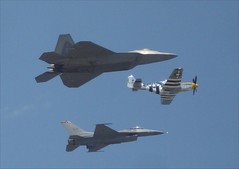
USAF Heritage: F-22 P-51 F-16
The F-22 was definitely the star of the Rhode Island National Guard Air Show 2009 that I attended with my brother yesterday at Quonset State Airport in North Kingstown (sorry, Blue Angels, though you were amazing as always). I had never seen anything like it. But the rest of the show was great too. We had blue skies the entire day (after a solid week of rain) and this made the aerial performances all the more enjoyable. There were several excellent civilian aerobatics performers including the great Sean Tucker, a nice flight demonstration by a pair of vintage P-51 Mustangs, as well as virtouso demo team performances by the Canadian Snowbirds and the US Navy Blue Angels. A Mustang and an F-16 also joined the F-22 for a "Heritage Flight" close formation fly-by which was very cool (shown here - more pictures on my Flickr site).

I got to hang out for a while inside a V-22 Osprey (mainly for the shade and the seat), but unfortunately it didn't fly for the show, which would have been nice to see (this is the Marines' tilt-rotor transport, a hybrid airplane/helicopter). And of course there's that great air show food! All in all a fine day of kid-flashback aviation excitement. And beer.

Friday, June 26, 2009

Voices in My Head

Listening to headphones is such a common experience, but sometimes it still seems really weird. Sound normally comes from somewhere in the external environment, and your two ears help you to figure out the direction and to some extent the distance of a sound source. But with headphones feeding stereo music directly into your ears, you experience a "virtual soundscape" in which sounds seem to come from various directions and distances, but which really come from two small sound sources close to (or even in) each ear. Of course you can also experience this with stereo speakers (or better yet, with surround sound speakers), but it's more natural since the "sound field" actually surrounds you. With headphones, it's really more like the sounds are somehow in your head. I really like the experience, but sometimes it does seem weird.

I'm hearing this very strongly right now with my iPod Touch, using a new Motorola S9 wireless (Bluetooth) headset. This was made possible by the recently released 3.0 version of the iPhone/iPod Touch software that added Bluetooth support among other cool things (especially copy/paste). The fact that there are no wires and that the ear buds fit so snugly in my ears really seems to enhance this "voices in my head" experience. No psychosis or non-native chemicals required.

Since I'm working on arranging and recording vocals for a few of my new songs, I've been listening for inspiration to some of the masters of background vocals, especially the Beatles and the Beach Boys. The Beach Boys' 1972 album Carl and the Passions - So Tough is not usually considered one of their best, but for background vocals, it is simply amazing, especially if you listen through headphones. It's so much more than angelic harmonies (though there are plenty of those). There are many layers and textures, but the voices are still very distinct in the mix.

With help from Roger Lavallee on arrangements and production, I've gotten some pretty good background vocal blends and effects on some of my own recordings (not that I would compare myself to the Beach Boys). One example that's on MySpace Music is my song "Just Dancing." We were definitely thinking of the Beach Boys on the chorus for that track.

Thursday, June 25, 2009

Carnival of Space #108

Remember me? With no posts since June 17, I think I'm officially A Very Bad Blogger. I spent last week in Munich for a trade show. It was very busy, although admittedly some of that busy time was evenings spent with friends and colleagues in beer gardens. Then I had to catch up on all the office work that piles up when you spend a week at a trade show and in beer gardens in Munich (even with a Blackberry). And today I had a vacation day for a recording session. A cool new song is almost done. I've been spending a lot of time practicing guitar, working on arrangements, singing, etc. It's nice to be immersed in music again after a few years of relative inactivity.

So space blogging is light for me these days - but not for these folks. Check out the latest Carnival of Space at Starts With A Bang.

Wednesday, June 17, 2009

The Mercury Big Picture

Another great space-related feature on the Big Picture the other day: Mercury and the MESSENGER spacecraft. The MESSENGER view above shows the area around Sveinsdottir crater (the odd elliptical feature near the center). MESSENGER will enter Mercury orbit in March 2011 after one more flyby of the planet.

Sunday, June 14, 2009

Carnival of Space #107

The Carnival of Space is hosted this week by Innumerable Worlds. There's the usual wide range of space and astronomy topics, but I immediately checked out two posts that offered previews of a new Apollo book by Andrew Chaikin. Cumbrian Sky and CollectSpace were both authorized to show a photo from the book that has never been seen before. It's a frame from a movie camera on the LM that recorded the Apollo 11 EVA, recently digitized at high enough resolution to actually show Neil Armstrong's face (his gold visor was up for a while near the start of the EVA). Very cool!

The Apollo 11 40th anniversary is coming up next month, so there are a lot of books and events planned. Chaikin's book A Man on the Moon is the classic history of Apollo, and he actually has two new books, Voices from the Moon (the source of the "new" pictures) and Mission Control, this is Apollo (with paintings by Apollo 12 LM pilot Alan Bean). Very tempting, but my books are out of control, so I need to be smart about this. Must... resist... two-day-one-click... BUTTON!!!

A Big Look Back at STS-125

The launch of STS-127 was delayed (possibly to July) due to a hydrogen leak problem, but as I was looking through my various space blog feeds this morning, I noticed a May 18 item I had missed before, a Boston Globe "Big Picture" feature on last month's final Hubble servicing mission (STS-125). It's a great selection of (big) pictures. The one here shows Andrew Feustel on the first EVA of the mission.

Saturday, June 13, 2009

Musical Obsession Returns

I don't know if it's official but it's true: I'm in one of my musical obsession phases. The last one was roughly 2001 to 2004, and resulted in my first album, "Jardin du Luxembourg" (shown, also on CD Baby). I'm now working on writing and recording songs for a new album, and that leads me to start thinking about performing again (starting with open mikes to try out new material, just me and my guitar). That might start in the summer at whatever spots I can find in the greater Boston area (there are quite a few as you can see from this list).

In the meantime I've updated my music web site (it still needs a lot of work, which might happen sometime) and set up a MySpace Music page to preview some of the new material including the title track for the new album, "Message from Tomorrow." I even joined Facebook (everybody's doing it).

I will still be writing about space and astronomy and doing educational outreach events, but I expect that music will be getting more time and attention the next few months, in my life and in this blog (I'm glad I used the ambiguous name "Music of the Spheres").

Wednesday, June 10, 2009

Cassini Tour Guide

Busy week, not much time for reading or blogging. One thing I noticed that is really cool is this guest post on the Planetary Society blog. John Smith is a planetary tour designer at JPL, one of just two or three people who work on designing the orbital journeys of the Cassini spacecraft since it arrived in Saturn orbit in 2004. His article is really fascinating, and it doesn't even delve into much in the way of orbital mechanics. It's amazing how many constraints they have to meet to try to achieve the many science goals (all within the constraints of orbital mechanics, i.e., physics).

Just as we optical engineers will say "it's all done with mirrors" (not really), orbital engineers will say, "it's all done with gravity," and of course it is. The "engine" that really allows Cassini to travel in the wide range of orbits needed to visit the various moons of Saturn is actually the gravity of Titan, Saturn's largest moon. Every time Cassini passes near Titan, its orbit can be slightly or dramatically changed, with full control depending on the location and closeness of the orbital path to Titan. Cassini has thrusters and a small fuel supply for attitude control and for minor adjustments to some orbits, but Titan's gravity is what does the "heavy lifting" when it comes to changing the orbit.

I've simulated a few close passes to Titan in Orbiter (with the Cassini add-on or other spacecraft, it doesn't really matter), usually when something interesting has happened recently with Cassini (like finding those methane/ethane lakes) and I want to show this in a space demo. I've always gotten specific orbit data from JPL's Horizon's database so I know it will work (then I play around with the views in Orbiter so it looks really cool in the demo, especially with time acceleration), but you can also use Orbiter to experiment with gravity-assist maneuvers on your own, using the scenario editor and navigation tools like IMFD.

Sunday, June 07, 2009

Modern Science (the band)

I made a mistake when I submitted my new song "Message from Tomorrow" for reviews at Garageband.com - I accidentally put it into the "rock" category instead of pop-rock. That may seem like a small detail, but they try to match up each song with some similar songs for review purposes, and nothing in "rock" was similar to my song. So after 10 days or something I still had no reviews. Bummer.

Unfortunately you can't change categories once a song is submitted, so I deleted the song (losing my review credit) and resubmitted yesterday in pop-rock. Today I got my first review (pretty good). So I started to check on the "competition" in the pop-rock charts. It's tough - some of the top songs have been there since 2005! Then I listened to the track of the day, a song called "I'm the One (Pick Me)" by Modern Science, a Las Vegas band (duo actually). This song is great! So I checked out the rest of their tunes on GB, and ended up downloading their album from their web site (free right now for 128K MP3 version - heavy promo). All ten songs are good, and five of them are amazing. So now I'm a fan and I plan to buy the CD to show my support (I do that sort of thing a lot - I'm a "struggling musician" myself but I have a better than average income thanks to my "day gig").

These guys are really good ("Pick Me" is only #173 out of 309 active songs, but it looks like it arrived very recently - my song is brand new so #309 - you start at the bottom). I'm impressed and a little intimidated (there are many great songs on the pop-rock chart). Glad I'm only in the music game for fun these days!

Saturday, June 06, 2009

Carnival of Space #106

The new Carnival of Space has arrived, hosted by Next Big Future. Of special interest is a photographic preview of a full-scale mock-up of the Altair lunar lander under construction at JSC, courtesy of Louise Riofrio of A Babe in the Universe. The current design will be four stories tall!

Human Japanese!

"Human Japanese" is sort of a funny name (as opposed to "dog Japanese?"), but it's a great piece of software if you are interested in learning or reviewing the basics of Japanese. Back in the early 90's when I was actively learning Japanese and also playing around with HyperCard on the Mac, I tried to develop some interactive Japanese lessons for vocabulary and for learning to read and write hiragana and katakana. I didn't get very far - it's a lot of work for one person and there wasn't much system support for this sort of thing in HyperCard.

But "Human Japanese" (version 2.0) is just the sort of thing I had in mind - self-paced, interactive, friendly, and easy to use, and best of all, it now runs on the iPod Touch (and iPhone) with its amazing touch-screen interface and audio capabilities (used for ~1800 native Japanese speech samples). The program covers basic grammar and vocabulary as well as reading and writing the two phonetic syllabaries, hiragana and katakana.

I played with the free "lite" version for about 10 minutes before deciding to spend $10 on the full version, which is an amazing price for any introductory Japanese text book, let alone an interactive one with embedded audio and animations. Learning Japanese is an interesting and complex task, and I still have a lot of interest in Japanese learning methods and materials, as well as an affection for the language. I would like to retain some level of skill even though I rarely go to Japan these days (my most frequent Japanese task is checking business card translation proofs for colleagues at work who are traveling to Japan).

Based on the quizes I have tried in several chapters, I still know this basic material pretty well, but anything that gives me a reason to play with Japanese is cool, and I really like this app a lot. It's 30 MB with 40 chapters, with many exercises and quizzes, audio for all Japanese text, and a lot of explanatory English text that is actually fun to read. It quickly transitions you to reading and writing Japanese in the Japanese phonetic system rather than in "Roman letters" which is a really useful thing (for further study as well as for reading many signs and menus in Japan).

If you have an interest in Japanese study at any level, I think you would like this learning software. You could learn basic vocabulary and grammar as well how to read and write kana very quickly and easily, and it would also be good for reviewing the basics if you're a bit rusty. It's available now for Windows XP or Vista in addition to the iPhone/iPod Touch version. A browser-based version is planned for Mac/Linux users.

Friday, June 05, 2009

Why Mars? Why Now?

I don't remember how I came across this, but IEEE Spectrum (electrical engineering professional society journal) has a special feature this week called "Why Mars? Why Now?" with some 33 articles, features, and opinion pieces by a range of authors. With sections labeled Challenges, Business, Voyage, Strategy, Exploration, and Space Ambitions, this special feature covers a lot of ground. Articles include "Why a Manned Mission to Mars Seems as Far Away as Ever" (countered by an article "How to Go to Mars - Right Now!" by - you guessed it - Robert Zubrin - go Bob!), "Space is Risky Business" by Elon Musk (he should know), and "10 Favorite Mars Novels" by Kim Stanley Robinson (he should know). And many more, including an interview with Owen and Richard Garriott, father and son space travelers.

Great stuff, though I don't know how long the top level page will stay around since I've never looked at any IEEE special reports before (it's a generic "special-reports" URL), which is why I included some of the direct article links above. This may be a more permanent link, though it's hard to tell since I've had a lot of trouble accessing these articles for some reason (slow and/or very busy server?).

The upshot is that getting humans to Mars is a complex, multifaceted, interesting, and difficult problem, though opinions vary on just how difficult, with Robert Zubrin's "we have the technology - let's do it now" being the most optimistic (he's the president of the Mars Society, of which I am a card-carrying member).

There's also an opinion piece called "The Mars Challenge," by Dr. Leah H. Jamieson, an EE professor at Purdue University. She discusses how first year Purdue engineering students believe that sending people to Mars might be their generation's greatest technological legacy. Space can still inspire, and the long-run benefits of the original Space Race and of the Apollo program seem indisputable to me, more so in the people and the ventures it inspired than in the specific technologies, though there were many impressive and important "spin-offs."Like many other engineers and scientists of my generation, I was directly inspired by the space program of the 1960's to pursue a technical education and career, though I ended up an optical engineer rather than an aeronautical engineer and astronaut as I had planned in the sixth grade.

Could "energy" be the current or next generation's "Apollo program?" It's important enough, but I'm not so sure. I really think there is something magic about working to get people to another world. I know the Cold War was a big part of the Apollo program, and for Mars I would personally prefer that we do it cooperatively with other nations, not in competition. Maybe that's naive and a deal-breaker, I don't know. But I truly believe that a serious effort to get people to Mars sooner rather than later will reap great benefits in inspiration as well as in technology, jobs, and spin-offs. And who knows, maybe even peace. Yup, naive.

Thursday, June 04, 2009

Podcast: JPL's Greatest Hits

As I mentioned a few weeks back, I did a second podcast for 365daysofastronomy.org, and it's available today. It's called "JPL's Greatest Hits" and in it, I talk about what I consider to be the "top 10" space exploration missions that have come out of the amazing Jet Propulsion Laboratory since 1958. It's a pretty subjective list, of course, since JPL has done so many great missions and continues to do so today. But it's fun and I hope also informative.

I had planned to do a few supplementary posts for this podcast, but I got distracted by other things the last few weeks, and I forgot! I will probably add a few posts on specific JPL missions in the next few days, and I have also started a new set on my Flickr site to post some images.

Of course you can get plenty of information and images from JPL's own web site, including this summary page listing all JPL missions. But what you can't get from JPL is a way to "fly" those missions yourself using the free Orbiter space flight simulator, which is something I mention only briefly in the podcast itself. Add-on makers have created amazing simulations of many of JPL's spacecraft, including 9 of my top 10. Some of these include extensive documentation and will allow you to simulate the missions from launch to orbital insertion or landing. Many include deployable or operable parts, so you can really learn a lot about these missions by playing with these simulations.

I have tried nearly all of these add-ons in Orbiter at one time or another, but not all of them recently, so I can't guarantee that some of the older ones will work right out of the box with the current version of Orbiter. Check with the Orbiter Forum if you have trouble, or post a comment here. I won't use the DJ-like backwards countdown for this list. All of these free Orbiter add-ons and many, many more are available at Orbit Hangar. John Graves is clearly a champion of planetary exploration simulations for Orbiter!
  1. Mars Rovers, add-on by Scott Conklin ("Usonian") - Amazingly complete and detailed! See picture above.
  2. Voyager ver. 1.3 by John Graves ("missleman01")
  3. Viking Mars mission by John Graves
  4. Mariner 10 by John Graves (my #4 is the whole Mariner series in my top-10, but only Mariner 10 is available for Orbiter)
  5. Cassini-Huygens Saturn mission by John Graves
  6. Galileo Jupiter by John Graves
  7. Mars Global Surveyor is not available, but Brian Jones' MRO add-on is great!
  8. Surveyor moon landers by Jim Williams
  9. Magellan Venus by John Graves
  10. Explorer 1 by Jim Williams (there is a newer version by "Bigmac" that I have not tried)
Note also that you can enhance the experience of some of these missions by installing optional high-resolution textures for moons and planets, such as the Saturn moon textures by "Fordprefect," Jupiter moon textures by "McWogs," and the Mercury surface texture by Jim Williams.

More to come in the next few days - please check back, and also let me know if you have any questions or special topics you would like me to discuss.

Tuesday, June 02, 2009

Earth, Moon, Mars: Cool Constellation Videos


I got an educational material notification email from NASA today about new interactive activities and videos on the Constellation program. Hosted by astronaut Pam Melroy, the video clips focus on three mission areas for Constellation: Earth orbit, the Moon, and (eventually) Mars. The animations are cool and feature versions of some spacecraft that were new to me, especially the Altair lunar lander and a Mars-bound spacecraft stack with an inflatable "trans-hab" component (NASA licensed that technology to Bigelow, so I guess they figure they'll buy it from him COTS).

The focus is also educational, and for the Mars stuff, they note that while the date for a Mars landing is uncertain ("next few decades"), the first astronauts on Mars are probably kids today, kids who should be staying in school and studying math and science so they can their shot at the Red Planet.

Monday, June 01, 2009

Carnival of Space #105

Carnival of Space #105 has arrived at Space Disco, which is now hosted by Ian O'Neill (Dave Mosher having moved on to a new job). It's quite a colorful carnival this week, and Ian's descriptions of the posts are great. Check it out.