Showing posts with label VSE. Show all posts

Saturday, April 07, 2007

SpaceAdvocate.com

SpaceAdvocate.com is the individual outreach arm of the Coalition for Space Exploration, whose members are companies, professional societies, and advocacy groups with a stake or interest in space exploration. While it's mostly focused on government-based space efforts such as the Vision for Space Exploration, the Coalition does include some private space companies (SpaceX, XCOR) .

SpaceAdvocate.com has resources to help you keep track of key issues in Congress, to identify and contact your elected officials, and to explain the benefits of space exploration to others. Their three-page PDF handout highlights the various benefits of space exploration and includes the helpful reminder that NASA's budget is less than one percent (0.7%) of the total Federal budget. And as I like to point out, those NASA dollars are not actually spent "in space" - they are spent here on Earth, on jobs, technology, education, research, and preparation for the future, among other things. I can't think of many government programs that give us better value, except maybe the NSF.

Thursday, March 15, 2007

Space Futures 2: I Still Like Mike

I've said it before, but I like Mike Griffin. Government could certainly use more people like him. In his role as NASA Administrator, he knows what his job is, he has a grip on the practicalities and the constraints, and he has a vision of where this whole space thing is headed.

This week he published a long essay called Human Space Exploration: The Next 50 Years. Without claiming to have any sort of crystal ball, and while giving extensive credit to the potential contributions of commercial space and international players (partners and/or competitors), he first reviews the past 50 years and then lays out some logical ideas about how the next 50 years will play out, based on some reasonable assumptions. These include that the U.S. government will continue to be the single biggest player in space, that NASA funding will remain roughly level (adjusted for inflation), and that NASA and the industry will try to achieve some sort of stability. By this he means several things - stability in purpose, strategy, requirements, and funding. He points out that Apollo funding was "unstable in both directions" - huge growth followed by rapid and destructive reductions once the main goals were reached. This led to virtual abandonment of both the hardware and the team that were so expensively built. Kind of like going in with all guns blazing in a blitzkrieg war, "winning" as expected, and then having no plan for what to do after the war (that's just a hypothetical analogy, of course).

This actually gave me pause. When I think, "the Moon by 2022, Mars maybe by 2037, why is NASA so slow?" I now have to ask myself, slow compared to what? Apollo? Apollo was war! Damn the torpedoes, full speed ahead, and once we win, melt it all down and discharge the troops. Griffin advocates more of an aviation model for the next generation. Airplanes serve for decades. If an astronaut returns from a Mars mission in 2042 and gets into a 30 year old Orion capsule to re-enter the Earth's atmosphere, so what? B-52's have flown for 50 years, and the basic Soyuz spacecraft design dates back to the sixties. You should design your hardware, your systems, and your programs for the long haul, not for 16 missions. Refine and upgrade, sure, but don't throw it all away and start from scratch if you don't have to. Of course this assumes that you've got a solid design that's worth keeping around for a while (DC-3, B-52, C-130, Soyuz, etc.).

That's only one of many points that Griffin makes in this excellent essay. I like the way he leaves it open for private space and international partners to play a major role, but doesn't assume that they will. That's not in his control, but the resources of NASA currently are, and while there's a lot of less glamorous "stuff" to do for the short run , in the big picture, Griffin sees a slow and steady progression to a sustainable presence in the solar system as a spacefaring civilization. And if the hare should pass Mike's tortoise (apologies for the primitive photo editing!) in a Dragon or some other private spacecraft, I think he will be cheering him on. Let the private guys win whatever races they choose to run. There's plenty of other good stuff to do with NASA's future budgets. Whatever your feelings on NASA's strengths, weaknesses, and direction, this essay is worth reading for a variety of useful perspectives.

Wednesday, March 07, 2007

Why Go Back?

Last Saturday at an astronomy club meeting where we did not get to see the lunar eclipse (due to snow and clouds), a member I had not met before asked me a question: why go back to the Moon? Well, I said, there's a lot of useful science to be done there, related to the origins of the solar system for starters. And if we are ever to become a spacefaring civilization and learn to live beyond Earth, the Moon is a convenient place to practice those special skills and technologies. And then there's the Helium-3, a potential solution to our energy woes, though we don't yet have a fusion reactor that can use it as fuel. We could learn to mine the Moon's surface, and maybe that would help us learn to mine metal-rich asteroids too. Someday we may even need to defend Earth from a rogue asteroid or comet - we better have some experience living and working up there if we're going to pull that off.

That's pretty much what I said, and I think I deliberately avoided statements such "because it's there" or "man must explore" because I was trying to be practical, even though this guy is a member of our astronomy club and is perhaps sympathetic to exploration for its own sake. But in fact I think that exploration, migration, and general restlessness are important parts of our nature. I think space exploration, including human space exploration, is important now and will be even more important in the future, though I can't prove it, and I can't even say that many of the things we'll need or want to do will be best done with human missions - robots are getting more capable all the time. But humans are still smarter and more flexible. And we still want to go! Some will say, fine, if you want to go, then pay your own way, and of course people are working on that approach too. I'm a big proponent of private space, but I also think the government should help build the infrastructure to support private space efforts. The interstate highway system of the future, but not all the trucks and cars.

That's not very coherent, is it? I guess I better work on my "elevator pitch" for "why the Moon?" In the meantime, here's a more elegantly stated view on why the Moon by conservative Washington Post columnist Charles Krauthammer. I like the title he picked (Music of the Spheres!), and the subtitle too (Why a Moon Mission Is Worth the Money). Thanks to Colony Worlds for the tip.

Saturday, March 03, 2007

Moonships Past and Future

Mooncraft past and future 1

I'm setting up some Moon landing scenarios in Orbiter for a demo at an educational event next weekend, so I've got both historic Apollo and proposed Constellation (CEV) spacecraft add-ons installed in Orbiter. This prompted a quick "photo shoot" of some combinations you will never see in real life. Note the relative sizes of these old and new Moon craft. More pix on Flickr.

Wednesday, February 28, 2007

CEV Orion and the Moon

The European Pégase CTV I mentioned the other day is (strictly speaking) an invention of its Orbiter add-on developers, although it has some plausible roots and does have the virtue that it assumes a launch vehicle that has actually flown (the Ariane 5). On the other hand, the Orion CEV is real, at least in the sense that some contracts have been issued as part of NASA's Project Constellation (although its assumed launch vehicle does not yet exist). When Orion will fly and in exactly what form remain to be seen, but if all goes well, there will be a NASA crew vehicle to service the ISS and perform other Earth-orbital duties starting around 2014. There may also be some private competition for the same basic job (if all goes well for some of the private companies).

As uncertain as all that sounds, when it comes to the Moon, things are even less certain, with dates like 2020 being kicked around (at least one and a half presidential administrations after this one). There have been graphical renderings of the LSAM (Lunar Surface Access Module, for which NASA is rumored to to be considering the name Artemis). Francis Drake's Orbiter add-on based on the NASA renderings has been around since December 2005, but I have recently revisited it in combination with his newer Orion CEV model (distinguished by the circular solar panels as shown in the most recent NASA and Lockheed renderings). I reinstalled the Taurus-Littrow terrain by jtibirius (avsim.com), undocked the LSAM from Orion in Moon orbit, and used the amazing Land MFD to take the LSAM down to the dramatic Apollo 17 landing site.

P.S. Here's a cool NASA QuickTime animation that shows the landing I've been playing with. When the astronaut climbs down the ladder, you can really get a feel for how big the LSAM will be compared to the Apollo LM.

Friday, January 19, 2007

On a brighter note...

Mike Griffin at MSC 2006
On a brighter note than that last post, I really like this essay by NASA Administrator Mike Griffin. Why explore space? Read this brief, pragmatic, but future-oriented opinion piece by the man charged with using the limited resources NASA is given to execute the Vision for Space Exploration. You may not agree with all his decisions and priorities, but as he pointed out when I heard him speak last summer at the Mars Society Conference, he is the policy administrator, not the policy maker. It's a tough job, and while I wish NASA would provide more support to private space developments, they have to keep a lot of balls in the air (and spacecraft in space), and I believe that Griffin's heart and mind are in the right place, and that his eyes are focused on our future as a spacefaring civilization. I still like Mike.

Tuesday, September 12, 2006

Orion: The Good, the Bad, and the Ugly

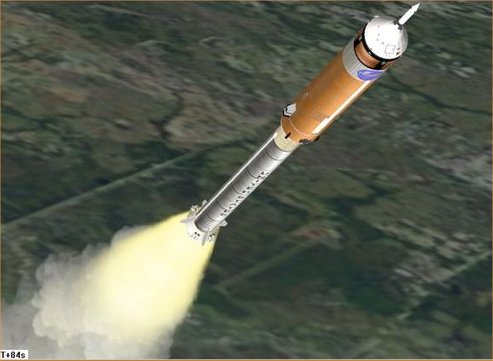
I wanted to also include "something borrowed, something blue" in the title, but it's already too long. Orion is the official name of NASA's Crew Exploration Vehicle (CEV), which we recently learned will be developed by Lockheed-Martin and various partners in a huge multi-billion-dollar, multi-year project that (if it goes as planned) will provide post-Shuttle transportation to the ISS and get US astronauts back to the Moon and (maybe?) to Mars over the next 10-20 years.

There has already been a lot of discussion of what's good, bad, and bogus about the plan. Although the Apollo-capsule-like form has been defended as being "convergent" (it was a good solution in 1969, it's still a good solution), it's still hard to believe this is the best NASA could come up with if its goals were to do the best job possible in building up the infrastructure for future space development, rather than the best job possible consistent with keeping the same level of employment at the agency and at its traditional contractors (with due consideration to getting dollars into key Congressional districts).

That's part of the argument made by Greg Burch in an excellent post on his blog ("The Trouble with Orion," September 2). As a partial counterpoint to this, here is a new Technology Review interview (9/11/06) with a Lockmart business development manager for the Orion project. She says the things you would expect, including the following that seems to echo Greg's point about NASA's fear of a "staffing valley" between the Shuttle program and its successors:
When it gets right down to it, NASA is signing up for a relationship with an industrial partner that's going to last a couple of decades. They wanted to know that it would be a happy marriage, where the spirit of partnership was in real evidence. During Phase I [when NASA paid several bidders to develop designs for Orion], we took the initiative to make sure our project office was co-located in Houston, which made it easy for them to participate in all of our control board meetings and other important events over and above the typical bimonthly reviews. We've got a significant workforce at the Michoud Assembly Facility in New Orleans [where the Shuttle's external tanks are put together]; we made a decision early on to do final assembly and checkout at Kennedy Space Center; we're going to be doing engine testing at Stennis Space Center in Mississippi [NASA's primary rocket propulsion test site]. I think NASA has appreciated that.

Friday, August 11, 2006

Of NASA and NewSpace

Before the week passes and I head for Shanghai for a very busy week of business (and probably no blogging), I want to point out another excellent article in the current Space Review, "Of NASA and NewSpace" by Grant Bonin, one of my co-authors on the paper I presented last week at the Mars Society. I won't summarize Grant's arguments here, but among other things, he points out the potential for single point failures (i.e., putting all your eggs in one basket) that are inherent in the NASA's approach to developing next generation spacecraft and launch vehicles. Although there is some funding planned to encourage development of alternate commercial spacecraft (COTS), it's really not very much in the scheme of things. I hope NASA succeeds with its plans, but I hope that they can also increase the funding to jump-start private space ventures that will provide more options in the future.

Sunday, April 30, 2006

Revisioning the Vision

CEV-LSAM Approach on Moon
I’ve been busy with work and with doing space stuff in Orbiter. On the Orbiter side, I’ve been finishing the second edition of Go Play In Space (and beta testing the upcoming 2006 release of Orbiter in connection with this), and working with a team on an Orbiter simulation of the MarsDrive Consortium’s Mars for Less reference mission. Mars for Less has been developed by Grant Bonin as a modular variation of Dr. Robert Zubrin’s well-known Mars Direct approach, and Grant will be presenting a paper on the mission design this coming week at ISDC 2006 in Los Angeles.

Wrapped up in real work and virtual space, I missed a big story on the real side of space, and I’m grateful to Grant for pointing this out. On March 15, Dr. John Marburger, Director of the White House Office of Science and Technology Policy (OSTP) gave a major speech at the 44th Robert H. Goddard Memorial Symposium in Greenbelt, Maryland. In it, he revisited President Bush’s 2004 Vision for Space Exploration (VSE), and spelled out more clearly that a major question answered by VSE is “whether we want to incorporate the Solar System in our economic sphere, or not.”

The VSE’s answer is “yes,” and Dr. Marburger goes on to justify the focus on the Moon as a crucial step, because it and its resources are fairly close at hand, and more importantly, lie far from the bottom of Earth’s deep gravity well. And “resources” are key, because he also talks about how our space program must be made to serve the goals of scientific, security, and economic interests. It is not only about science, although that is part of it, it’s about making space serve the interests of the people of the US, and mankind in general. It’s a long-run view that is really quite progressive, even (dare I say) visionary. It does put Mars on a distant back burner, which is disappointing but also unfortunately realistic from the perspective of an economic return – I’m all for someone going to Mars as soon as they can, but Mars is quite far away and getting there will require solving many more problems than getting back to the Moon (maybe someone will solve those problems before NASA gets to them).

The speech also puts into perspective the reductions in NASA’s budget for science programs – for one thing, I was surprised to learn that due to unexpected successes in the lifetimes of many spacecraft (e.g., the Mars Rovers), that the US currently has 55 viable spacecraft requiring operations support. There are also relative increases for certain non-space science areas important to US competitiveness (DOE, NSF, NIST). These factors (in addition to continued support for the ISS and Shuttle, and development of next generation manned spacecraft) certainly put pressure on NASA’s budget, and a 3% increase just can’t cover everything. Should NASA have gotten more? In part this is a ROI question – would the American people get a good return by investing more in NASA? I don’t know, but the 3% and this speech certainly show the Administration’s opinion.

There is more to it – it’s a good speech. Such a speech from the OSTP director could be seen simply as one of the President’s men defending the President’s policies, and at one level, it is. But at another level, it makes the case that the VSE really is visionary, setting the stage for making the Solar System part of our practical world. Whether NASA will be able to pull it off, and whether future administrations will support its goals, I don’t know. But it goes far beyond footprints and flags and is extremely space-positive. I rarely give him credit for much, but I do have to give the President credit for pointing us in a spacefaring direction.

There was also an interesting analysis of this speech by Dennis Wingo on Saturday in SpaceRef.com.