Showing posts with label science. Show all posts

Saturday, July 09, 2022

England Aviation Vacation, Part 2


After I got back to North Weald Airfield from my “Castles & Coasts” flight down to Dover, my taxi friend Ali drove me back to Epping Station and I caught a train for Cambridge, stopping for the night at Duxford, the site of another Imperial War Museum at Duxford Airfield, the biggest air museum in Europe.

My Tiger Moth lesson flight was set for 3 PM, but I entered the IWM at 11 AM on a beautiful, clear morning so I could explore the hangars and ramps brimming with historic airplanes.  In the Air & Space hangar I found many favorite jets including the Vulcan bomber, the swing-wing Panavia Tornado, and the Concorde, which I walked through.

In and around the other hangars I found Spitfires, Hurricanes, a PBY Catalina, and a WWII twin-engine RAF Mosquito made mostly of wood, among many others! I walked into a hangar where workers were rearranging aircraft for the upcoming airshow. I wasn’t supposed to be in there, but I spotted an RAF Eurofighter Typhoon before they kicked me out.

In addition to all the amazing ground exhibits, several of the flight performers for the weekend Duxford Airshow were rehearsing their acts low over the runways. Practically a private airshow!

There was a great Battle of Britain exhibit with Spits and Hurri’s and a crashed Messerschmitt Bf-109 in addition to a recreation of the control rooms where they directed those epic aerial battles in 1940 using telephone and radar reports, with a big map table where they pushed around markers to track friendly and enemy aircraft positions.

I loved the American hangar where dozens of huge airplanes were parked and hung from the ceiling, starting with the big iron – B-52, B-29, B-24, and B-17 as well as all the major fighters from P-51 to F-15 and even the Mach 3 SR-71 Blackbird.  

Before my Tiger Moth lesson, I had also signed up for a 15 minute flight around the airfield in the Dragon Rapide, a small passenger biplane from the late 1930’s. This was great because I got to take some good aerial shots of Duxford which wasn’t possible in the Tiger Moth (no personal cameras). It was also very cool to taxi out next to a Hurricane fighter!

Finally it was time for the 40 minute Tiger Moth lesson I had booked months before. I had to empty my pockets for the open cockpit flight (and to remove any competition for the in flight video they would later sell me). I donned a leather helmet, headset, and goggles as well as a fleece-lined leather jacket. I was strapped into the front seat, and after a radio check, we took off on the grass and headed southwest.

Clear of the airport area, the pilot soon gave me the controls for the cruise and a few turns. The stick forces were amazingly light (the pilot was likely trimming for me), so “fly with two fingers” worked quite well. Instruments were minimal, and the forward view was obscured by the nose, so I used the left and right lower corners of the windscreen as reference points to keep the wings level with the horizon. Visibility was otherwise excellent, and I enjoyed the beautiful Cambridgeshire countryside from 1500-2000 feet. We flew over several towns including Royston, as well as the radio telescopes of the Millard Radio Astronomy Observatory, just 5 miles SW of central Cambridge.

After landing, exhausted from hours of walking around huge Duxford Airfield, I took a taxi into Cambridge and checked myself into my apartment hotel for the remainder of my stay. It was a great little flat although I wished I picked one a little closer to central Cambridge. I spent Friday morning exploring the excellent  Fitzwilliam Museum, although I mainly visited the art galleries, including a special David Hockney exhibit.

I didn’t have time for the many galleries of Egyptian, Greek, and other antiquities because I was keen to get to the pub for lunch and a pint of DNA. Specifically, a pint of DNA Ale at the Eagle Pub, famous as the place where James Watson and Francis Crick (above left) popped by from their nearby lab in February 1953 to announce that they had discovered “the secret of life,” otherwise known as the double-helix structure of the DNA molecule. They were regulars so they shared the news at the pub prior to actual publication.

After lunch I signed up for a “guided punt” on the Cam River. This classic Cambridge experience takes you for a couple of hours up and down the Cam, gliding serenely along the “backs of the colleges” of Cambridge. The weather remained perfect, and our punter guide was quite informative and funny as he related history and gossip from ancient up to modern times.

By Friday evening, walking had become very hard, and I soon found the reason – two enormous blisters on my big toes. Although I did my best to treat them, it was clear that another 5–8-mile day at the airshow the next day was not going to be feasible. I texted my regrets to the friend I’d planned to meet there and spent Saturday relaxing and looking at pictures. It was cloudy and raining, but fortunately I had a kitchen and had bought some food and beer, so survival was not at stake.

By Sunday and Monday my first aid and foot padding strategies allowed me to venture out with the help of buses and taxis to minimize my steps. I went out to eat and explored two small but historic museums. The Sedgwick Museum is one of the oldest in Cambridge with a focus on paleontology and geology. The museum also had an excellent exhibit on the life and scientific accomplishments of Charles Darwin. Always a Darwin fan, I really enjoyed this exhibit and all of the fossils and displays at the Sedgwick.

Finally, I spent an enjoyable couple of hours at the nearby Whipple Science History Museum which was dominated by my old specialty, optics. There were hundreds of telescopes and microscopes from various periods, as well as a fascinating collection of globes.  

I recently read a brief biography, The Reluctant Mr. Darwin by David Quammen. In it, the author describes the various reasons that it took over 20 years from the voyage of the Beagle (1831-1836) to the publication of The Origin of Species (1859). A big chunk of that time was devoted to detailed studies of barnacles. Why? At the time, little was known about barnacles, and Darwin thought he might spend a year or so identifying and organizing barnacle species. This might aid his understanding of variation in characteristics between closely related species, as well as contribute to zoology. It turned out to be more complex than he imagined, taking eight years and four books to complete to his satisfaction. Barnacles are small so a microscope was his constant companion, and that very microscope is on display in the History of Science Museum (above).

My flight for Boston was Tuesday evening, June 21, and I planned to take a National Express bus from Cambridge directly to Heathrow. But I had forgotten about a planned rail strike that day, and when I went to book my ride, the only available seats were on the 5 AM bus, since rail travelers were using every available option to get to London. Oh well, I can kill ten hours at an airport. 

But there was a further adventure in store when the bus failed to show. So I shared a two-hour taxi ride with three other Heathrow-bound travelers who were congenial and funny. It was a wonderful vacation, right down to the last near-disaster.


Tuesday, November 09, 2021

Light and Weather in Microsoft Flight Simulator

Fans of flight simulators often talk about how “immersive” a sim is. It’s about how much the sim experience makes you feel like you’re flying a real airplane. Visuals are obviously a key component, and VR can take this to a higher level in terms of feeling truly surrounded by a 3D environment made up of the structures of your aircraft as well as all the natural and human-built objects in the simulated world around you. Sound is also very important, as are physical controls like yokes and rudder pedals (controlling an airplane with a keyboard is definitely an immersion killer). Realistic ATC (Air Traffic Control) communications are important especially for airliners and military flight sims.

Microsoft Flight Simulator 2020 addresses all these components, but to me, lighting and weather are the pieces that really pull it all together. Things we take for granted in real life like shadows, reflections, transparency, refraction, and color shifts are all well-simulated in MSFS. Making things look real also requires careful attention to materials and to how light interacts with them, including their colors and how shiny or rough they appear to be, which also affects color.

MSFS uses techniques called PBR (physically based rendering) to pull this off. Notice how the yellow features in this Stearman paint scheme (above) are reflected and distorted in the shiny blue fabric panels of the wings. The colors are shifted by these reflections as well as by shadows and by the angle from the sun at which you are viewing the surface. PBR techniques are also used to make buildings, runways, and other surface objects appear more realistic, often in combination with photogrammetry. 

Photogrammetry uses photographic imagery for measurement purposes, and in MSFS, this real-world data allows many cities to appear nearly photorealistic. Based on the resolution of the captured data, objects as small as signs on buildings may be readable, depending on your position and altitude. Technologies such as radar and lidar can also be used to accurately measure the height of terrain, and such data is often available to simulation modelers. Although MSFS recreates the entire surface of the Earth, the level of available detail varies by location, with many major cities covered by detailed photogrammetry (like New York City, shown in a VR stereo pair below), while many others depend on AI-based “autogeneration” of 3D objects including buildings, mountains, trees, etc. 


The appearance of objects in a simulation naturally depends on light sources, and MSFS incorporates multiple light sources starting with the sun and the moon (both accurately positioned based on the location, date, and time of day). I believe starlight is also modeled. Human-made light sources include streetlights, vehicle lights, light from building interiors, airport lighting, etc., and what amazes me is  when light sources interact with surface properties (reflecting or scattering) as well as with atmospheric properties like clouds, mist, rain, and snow. The resulting scenes can be uncannily realistic.

Speaking of rain and snow, weather is the other big piece of “immersiveness” I wanted to briefly discuss here. It’s a critical subject in real life aviation and in the sim. Microsoft and Asobo and their partners have placed huge emphasis on making weather look and feel right, and the system they developed is incredibly detailed, flexible, and easy to control.

Not only can you adjust any location's time and weather to your choosing - from clear skies to heavy clouds, to snow and storms – with “Live Weather,” you can even set it to match real conditions taking place in that part of the world. But if you don’t like the time of day, the wind, the height of the clouds, the height of the waves, or the depth of the snow cover, you can change any of that without even stopping your flight, using the interface shown above. 


Rather than drone on and on about this, allow me to recommend two brief developer videos that clearly explain how they managed to make the weather so real, it can get scary at times. Fortunately I can switch to clear skies anytime and (usually) not hit the mountain that was behind that cloud!

Feature Discovery Series, Episode 2: Weather 

Partnership Series: Meteoblue - Weather Forecast System

Friday, January 27, 2017

Nothing Is Unbelievable Now

The word “unbelievable” is obsolete now that Trump is president. Any horrible thing you can imagine someone in government doing or saying is believable now. Trump's appointments and actions seem calculated to hurt the most people possible, especially if they are brown, female, or immigrants. Some of this is ideological but most of it seems more like mean-spirited bullying, a Trump specialty. It doesn't seem that these actions actually HELP anyone, not even Trump's misguided yet hopeful supporters, but he's fulfilling his wild campaign promises, so his fans are like, “hell yeah!” Many of Trump's actions will end up hurting his supporters much more than they will educated know-it-all liberals like me.

But to see this requires accepting facts and sometimes complicated reasoning. Take for example building a wall with Mexico and (maybe) imposing 20% import tariffs on goods from Mexico to “force them to pay for it.” This will raise prices on many goods for Americans (including vegetables and fruits) and probably cost jobs in industries that rely on imported parts. We could have a trade war. Americans will pay for the wall through higher prices and job losses. It will also damage the Mexican economy which will likely increase illegal immigration regardless of any wall.

As was the case during the campaign, there's such a flurry of batshit-crazy "alternative facts" coming out of Trump and his cronies that it's hard to keep it all in focus. And it's only been one week! This is all bad, but it's just the tip of the iceberg because he is also saying and doing scary things in the international arena, like saying again that we "should have kept the oil" in Iraq, and maybe we will get another chance. Statements like this are lighting up social media in the Arab world and putting at even greater risk the thousands of military personnel we still have in place helping our Iraqi allies to fight ISIS. And as Trump has been so fond of saying about others, there is clearly "something going on" with Russia to explain why he has criticized everyone from the US intelligence community to John Lewis to Meryl Streep -- but never Vladimir Putin.

Here are a few other examples just from today's NY Times.

Gail Collins suggests that Trump actually has no strong views on abortion and women's rights (or perhaps on anything but himself) but that he's just following Pence's toxic anti-woman agenda on this. He's a puppet for both Putin and Pence.

http://www.nytimes.com/2017/01/26/opinion/mike-pence-pulls-president-trumps-strings.html

Nicholas Kristoff points out that the stupid lies about inauguration crowd sizes and nonexistent electoral fraud are acting as a smokescreen for real damage caused by early actions like the abortion “gag rule” that blocks US foreign aid to any care-providing organization that even discusses abortion. This goes farther than gag rules from earlier presidents in that it will apply to all health services, including for example efforts to combat the Zika virus. Direct US funding of abortions is already banned, but this expanded policy will kill poor women in places like Africa and lead to more abortions. But Pence and Trump won't see or care.

http://www.nytimes.com/2017/01/26/opinion/president-trumps-war-on-women-begins.html

Charles Blow focuses on Trump's use of lies and criticism of the press to try to control all narratives, supplying “alternate facts” when the truth is too inconvenient, as it usually is. In addition to this, the Trump team is blocking US government agencies that deal with science from using social media and removing references to climate change from government websites. Charles Blow writes in part:

[Trump] is in fact having a running war with the truth itself.

Donald Trump is a proven liar. He lies often and effortlessly. He lies about the profound and the trivial. He lies to avoid guilt and invite glory. He lies when his pride is injured and when his pomposity is challenged.

Indeed, one of the greatest threats Trump poses is that he corrupts and corrodes the absoluteness of truth, facts and science.

http://www.nytimes.com/2017/01/26/opinion/a-lie-by-any-other-name.html

Welcome to 1984.

The cartoon by Nomi Kane is from The Nib, a great political cartoon site:

https://thenib.com/an-embarrassment-of-leaks

Tuesday, January 24, 2017

Fermi Paradox Explained?


I’ve often thought that the whole “where are they?” question about SETI (i.e., the Fermi Paradox) is bogus, both because the universe is just so BIG, and because we still understand so little about it, even though we have learned in recent years that planets and even “Earth-like” planets seem to be quite common throughout the Galaxy. As smart as some of us may be, it seems likely that we are still as clueless about major chunks of physics as scientists in the 1800’s were about quantum mechanics and the scale of the universe. If there are wormholes or quantum foam or gravitational technologies we won't develop for another 200 years, there could be aliens popping in and out all the time, and we wouldn't even know what to look for. It would be like an airliner passing 37,000 feet above some remote tribe of people who have never encountered other humans or modern technology, as unlikely as that may be today.

Such advanced beings might find radio wave communication to be as quaint as rubbing sticks together as an energy technology. I’ve also read articles suggesting that we ourselves are probably approaching the end of our “radio age” due to fiber optics and other technologies. Though we still send out a lot of radio waves, they tend to be more directional (like radar, microwaves, etc.) or short range (cell phone towers, Wifi, Bluetooth, etc.). Maybe technical civilizations only use radio waves for a few years and any continued or specialized use eventually becomes very efficient with very little leakage to space.

Somehow I wandered over to Centauri Dreams, a blog that periodically blows my mind with advanced space exploration ideas. I found an article “CitizenSETI” about a couple of guys (Roger Guay and Scott Guerin) who decided to work out this Fermi thing. A key part is the lifetime of an IC (intelligent civilization), which really means the DETECTABLE lifetime. If that is very short (e.g., humans have been broadcasting for about 110 years and listening for only about 60 years), and if such civilizations are widely separated in time and space, you will have a big “synchronicity” problem – finding times and places where someone is broadcasting AND someone in range is listening.

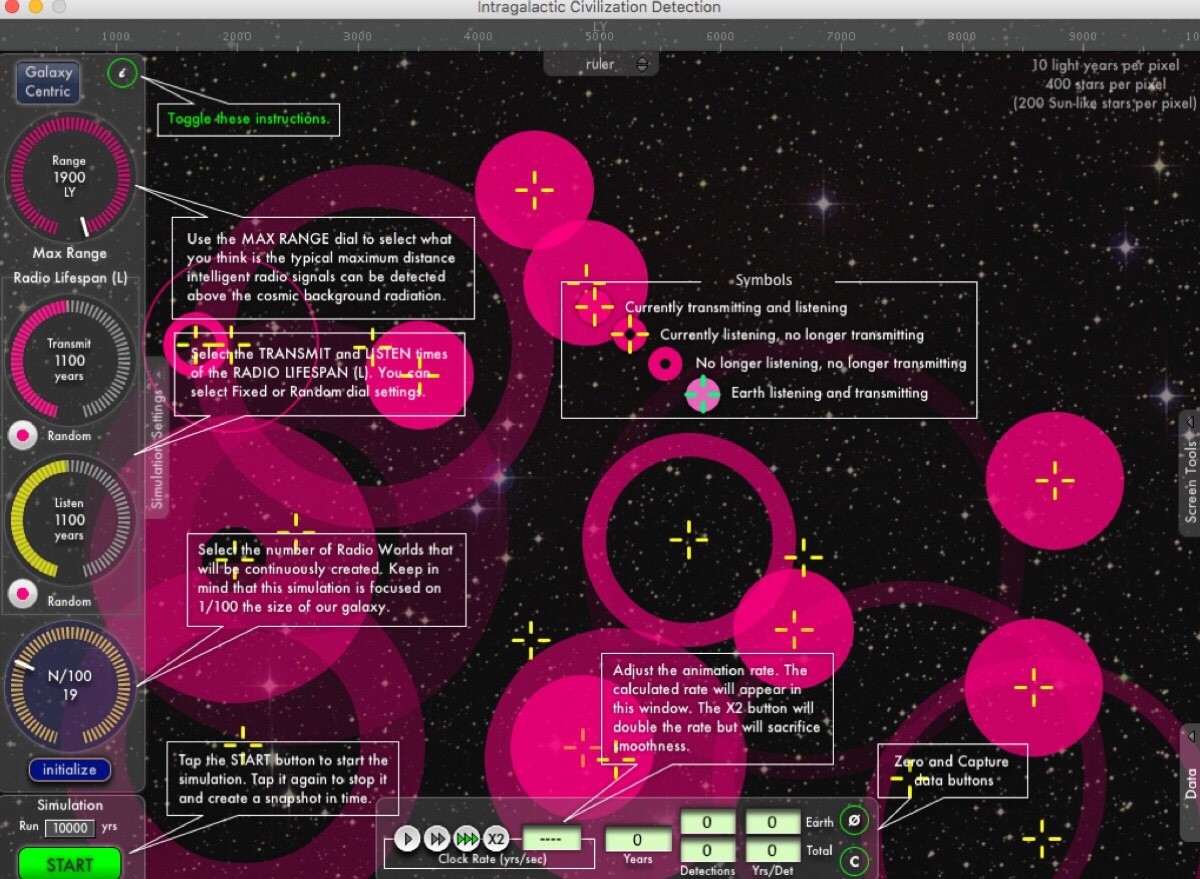
Roger Guay created a simulation with LiveCode, a modernized version of my old, beloved HyperCard for the Mac (screen shot above). In his Advanced Civilization Detection (ACD) program, he can set various assumptions about the spacing, lifetime, and other factors and run this simulation at high speed. Under most reasonable assumptions it creates a sort of “firefly” effect with detectable IC’s flashing in and out of existence and only rarely being seen by other IC’s. If these assumptions and simulations are reasonable, IC’s could be plentiful and it might still take hundreds of years of observation to catch one of these “fireflies” before it flickers out.

I've been interested in this subject since I read Intelligent Life inthe Universe by Carl Sagan and Iosif Shlovsky back in 1974. This was a pretty early work on exobiology (or perhaps astrobiology), a field that still lacks data but provides an interesting framework for thinking about everything we know about ourselves. My guess is that unicellular life has probably evolved in many places but that the leaps to multicellular, intelligent, and technological stages are much rarer, though certainly possible (current sample size is N=1 if you give humanity the benefit of the doubt as an IC).

Based on this simulation work, we are not likely to expand that sample size anytime soon. Here is Roger Guay’s final paragraph on Centauri Dreams:

Conclusions? The ACD simulation dramatically demonstrates that there is indeed a synchronicity problem that automatically arises when ICs attempt to detect one another. And for reasonable (based on Earth’s specifications) Drake equation parameter selections, detection potentials are shown to be typically hundreds of years apart. In other words, we can expect to search for a few hundred years before finding another IC in our section of the galaxy. When you consider Occam’s razor, is not this synchronicity problem the most logical resolution to the Fermi Paradox?


Of course this is hardly the last word on the subject of the Fermi Paradox. In fact, while reading the blog posts that triggered this one, I discovered a recently updated book that goes into much greater depth, If the Universe IsTeeming with Aliens … WHERE IS EVERYBODY?: Seventy-Five Solutions to the Fermi Paradox and the Problem of Extraterrestrial Life (2015) by Stephen Webb. I've read the Kindle sample and I may have to buy it despite my insane backlog of books already waiting to be read. Author Stephen Webb also has an interesting blog. 

Wednesday, May 11, 2016

Sunspots


I love to write, though you might never guess this from my recent blog activity. While this is my first blog post of 2016, I used to blog a lot more -- some 1500 entries since I started this blog in 2005. Most of my writing these days is in a journal I keep on my iPhone and iPad using an app called Day One. I like keeping a journal, but recently I started to think about getting out of my comfort zone and doing something a little different with writing. Looking around, I found a wonderful organization called the Seven Bridges Writers' Collaborative in Lancaster, Massachusetts, just 20 minutes from me. There was an opening in one of their weekly creative writing groups, and I joined the spring session in late March. It's a small, informal group led by Winona Winkler Wendth, an experienced, insightful, and supportive writing teacher. I've enjoyed the writing exercises and the lively discussions each week with the group. And it has successfully gotten me out of my comfort zone, writing things I would never have thought to write, sometimes well, sometimes not so well.

Here is a new one that is very different for me. The prompt was simple -- write 300-500 words starting with "I counted. There were 27." It gave me some trouble for a day or so until I started thinking about the recent transit of Mercury, and about sunspots.

Sunspots

I counted. There were 27. Shining the sun on a paper plate with your telescope works great. I’ve never seen the sun like that. Is 27 a lot of sunspots?

Not really. Sometimes it can be over a hundred. It goes in cycles over something like eleven years. Twenty-seven is actually a pretty low number.

What do they mean?

What do you mean, what do they mean?

Sunspots. If you can’t see them without a special trick like this, why are they even there?

Well, they don’t mean anything. They’re just something that happens because of the way the sun works. Astronomers have figured out that sunspots are cooler areas on the sun, though they are still hotter than anything on Earth, and often they are as big as Earth. They only look small because the sun is so far away.

But how can they not mean anything? Isn’t there a reason for them?

There’s a difference between a reason and a meaning. Scientists can study the sun and figure out why events like sunspots and eclipses happen from information they can see and measure. In the past, people didn’t know as much about how the world works. They might see sunspots or eclipses as special signs, warnings about something bad. Some people still think this way, figuring that anything so strange and different from normal must mean something.

But isn’t that right? Grandma says everything happens for a reason.

Let’s think about what she means. Is she talking about science when she says that?

I don’t think so. She usually says it when someone gets sick or dies or something and people are sad.

Right. If everything were random and unpredictable, that could be pretty scary. But some things in the world happen pretty regularly, like day and night, right?

Sure.

And other things are not quite so regular, but we know something about them. We have weather forecasts, and we expect it to rain sometimes, and we know most summer days will be warmer than most winter days. If it rains and your baseball game is canceled, you might not be happy, but you don’t think it rained because someone didn’t want you to play your game, do you?

Of course not.

Rain happens for reasons you can study and learn about. But those reasons don’t have anything to do with what people want. And the rain doesn’t mean anything by itself, though you can find meaning in it. To some people rain means joy because it helps their flowers grow. Some may write poems and songs about the meanings they find in the world. Other people may be scientists and find joy and meaning in understanding the reasons for rain or sunspots or brain cells. People are the most complicated part of this complicated universe. Everyone studies people, but psychologists, writers, and some others do it in special ways.

Can we get ice cream now, Dad?

Yup.

Friday, December 18, 2015

My Theoretical Interests


I was going through my daily Google spam notification email, thinking about all the theoretical interests I have that now mostly show up as marketing emails. Democratic Party appeals, astronomy magazines, Optical Society information, TAXI songwriting promo offers, musical instrument sale offers, AOPA private pilot news, Japanese and French language study information, and much more. Most of these represent past or perhaps intermittently current interests, now mostly theoretical interests in that I do nothing with them 90% of the time.

Even the 146 apps on my iPad show this. So many astronomy, language study, music making, photography, and game apps that I hardly have time to even look at. But they don't take up any physical room, and you never know when some interest will strike again (hope springs eternal that 24 hours a day is only a temporary constraint). Books are like this too. An ever-growing backlog and I will probably never read 75% of them. I should at least clear out the many shelves of paper books that I am less likely than ever to read now that I'm totally hooked on the convenience of ebooks. But there I have the 10% problem -- I'm sure I will never need 90% of the paper books in my house. But I can't get rid of them until I identify the 10% I might need, and that is not a weekend project.

First world problems, I know, right? Such an abundance of riches. One that still grabs me is The Great Courses (this was the part of my daily spam that triggered this particular rant). College level lecture courses in every subject by some of the greatest professors in the world. I have a number of them as DVD and a couple as audio, and have watched or listened to a few lectures from some of them, but never completed one course. Yet I look every time for more, especially when there's a "big sale" (as there usually is). These days I rarely order any new courses because I know about my theoretical side. Like the way I'm a theoretical pilot and singer-songwriter ("flying singer," get it?).

[begin-rationalization] In fairness to myself, these theoretical interests really do still interest me, even if I don't have time to actively pursue everything. I like to "keep in touch" with private pilot, songwriting, and astronomy magazines and I follow some related organizations and people on Facebook (a source of serendipity as well as a few laughs every day). Every time I go to Japan, I brush up on my reading and conversation and learn a few new things (or buy a new app). On two trips to Korea this year, I taught myself enough Hangul phonetic script to decipher many signs. And I do read a lot of books on all sorts of subjects. Donald Trump has already scared me enough to start giving money to the Dems again (spam and fear are a winning combination, Democrat marketers). And every December (triggered by my company's year-end shutdown), I magically turn back into a singer-songwriter for a week or two, writing and recording some new songs with my producer and friend Roger Lavallee. Plus I have a job that still uses the optics I studied back in the 70s. So I guess I'm not a complete deadbeat. [/end-rationalization].
.

Monday, November 09, 2015

No Explanation Needed


One definition of a tautology is the needless repetition of an idea, statement, or word. It strikes me that some of the "big questions" that are often discussed about the universe and life are little more than tautologies. They may be interesting to discuss, and if you believe in God or another cosmic consciousness or creator, they might even seem to have meaning. But based on what is actually observable, there is a big and complex physical universe that has been chugging along for billions of years, much longer than there have been human brains to do things like wonder why. And for a few thousand years, there have been human brains, some with enough security and free time to do the wondering. That's it!

The "anthropic principle" is the one that bugs me the most. This is the idea that since physical constants and conditions are suitable for stable matter, life, and intelligence, and since we can conceive of these things having been otherwise, someone or something must have set them that way so matter, life and intelligence can exist. But this is a tautology, since we wouldn't even be around if this were not true. If the conditions were wrong, or if there are multiple universes and some don't have these conditions, there would be no "we" around to wonder about this. It clearly assumes some purpose for the universe or a god or creator that could make decisions about this. And if that is the case, who or what created that creator, and in what universe, with what physical constants, defined by whom or what? It's an infinite regress.

Why not stick with what's observable? As far as I'm concerned, the universe simply is. That doesn't mean I can't be awed by its beauty or impressed with its intricacy, or that I can't be curious about its many parts and try to understand how some of them work (that's why I majored in physics). It just means I accept the universe as the natural state of things and that I don't believe it was created for the benefit of humans. We are simply one of the complex manifestations of its properties. Life with a cherry on top (more like cherry Jello).

There's a related question that is often asked about the universe: Why is there something rather than nothing? Again it's a tautology -- if there were nothing, nothing would exist to even think about this. There is no why there.

Sometimes people talk about "the will to live." I have often marveled myself at the enormous efforts that animals (including humans) will make to survive or even just carry on their normal life cycles. Things like certain migrating birds that fly thousands of miles twice a year to feed and reproduce. But the will to live is "baked into" life itself because natural selection eliminates those without it. So it's one of those things that is both amazing and commonplace, even inevitable. Of course it has some side-effects that we and some of our fellow creatures may perceive as happiness or contentment. When my dog and I are well-rested and well-fed and are enjoying the sights and smells of a walk on a sunny fall morning, that feeling came from evolution too. It's still pretty awesome.

And what about "are we alone in the universe?" This is a different kind of question, not a tautology. It's worth thinking about, and even doing some research, although it is not as exact question as some people may believe it to be. Clearly there is insufficient data now to evaluate this, though this may not always be so. Humans are certainly expending some effort to find information related to this question through space exploration and other means, and as we have identified thousands of exoplanets, we know at least that there are other places where life similar to ours could exist.

Many years ago, astronomer Frank Drake defined an equation that aims to estimate the number of intelligent civilizations in the universe. It identified some of the relevant parameters of this question, and defined them as probabilities, although some of them are not well enough defined to plausibly consider as a probability. Things like "the probability that an intelligent life form will develop a technological civilization." This is almost like asking "what is the probability that my karma is purple?" How to you define "karma?" Do karmas come in colors? How to you even define "intelligent life?" Does that mean "capable of developing technology?" Isn't that a tautology?

I just read an article describing a similar equation that considers the probability of detectable life. The "Seager Equation" is geared to our current knowledge of (many) exoplanets and how likely it is we could detect some planetary biosignatures. It is a bit more physical than Drake's equation, and does not consider intelligence or technology. A planet hosting only blue-green algae might have an oxygen-rich atmosphere detectable by spectroscopic methods if conditions like distance, star type, exoplanets in the habitable zone of the star, and others are right. The answer to this question? Her best estimate is 2. Not 42. Not millions. But not zero or .0005. That suggests it is worth looking.

I hope we are not alone in the universe. I hope there is simple life and intelligent life in abundance and that someday we can find it. But if we are alone, that's OK too. We will keep busy and maybe even survive to a ripe old age. We aren't here for any particular reason, but it's a great party, and I'm glad we crashed it.

-----

Nick Bostrom has a book on anthropic bias that apparently goes much more deeply into this subject. I haven't read it, but his web site has a lot of helpful information.

The picture here is by Slovak graphic designer Martin Vargic. It's a chart showing his artist's impressions of 500 of the some 2000 confirmed exoplanets arranged by mean temperature (x) vs. density (y). Although these planets have not been directly observed, the depictions are not completely  fictional, as they are based on temperature, density, metal content, and other factors (the rings are purely for looks -- they are pretty common in our solar system, but only prominent on Saturn).

Tuesday, October 27, 2015

Insane Convictions


For the first time this year, Donald Trump is starting to fall behind in polls of likely Republican primary voters, especially in Iowa but also in one major national poll (New York Times today). This would be good news were it not for the fact that it is Dr. Ben Carson who is catching up with The Donald. Trump's conviction is that he is simply the greatest. He's self-serving and egomaniacal and willing to say or do anything to get attention. He is also extremely rich and quite smart in his obnoxious way. Sometimes I think he is playing all of us, that this is all a big game of some sort, although he probably really does think he could be a good president.

Carson, on the other hand, may be certifiably insane. Here's a guy who had to have been brilliant at one time to achieve what he did as an innovative pediatric neurosurgeon. But he's also a Seventh-day Adventist who seems to be completely dominated by his religious beliefs. It's almost funny that he has talked about his fear of a Muslim president who might try to institute sharia law in the United States. This from a guy who clearly wants to impose his own Christian beliefs on our entire country, starting with no abortions for any reason, although in a recent interview, he seemed unable to connect this with the obvious GOP agenda step of reversing Roe vs. Wade. It seemed like he didn't really know what that was. He has strong, insane convictions, but very large gaps in his knowledge of how our country works. And of reality in general. He looks and sounds like he's on Thorazine or some other antipsychotic drug.

It's a testament to the power of religion to make you believe in strange things that he does not believe in evolution. Here's a man trained as a neurosurgeon who helped develop a surgical procedure to separate conjoined twins joined at the brain. I have to believe that some of the procedures that were developed for this and other surgical innovations were tested and practiced on animals such as dogs, monkeys, and maybe even chimps because of their anatomical similarities to humans. He must have noticed those resemblances and is perhaps even familiar with how bacteria become resistant to antibiotics (through evolution). And that all life on Earth uses the same DNA system that we do, and that the genomes of great apes are nearly identical to ours. I suppose Ben believes that God created all of the similarities just because he felt like it, even though humans were somehow independently created from all the other animals.

Ben also believes that homosexuality is a choice (and not unlike bestiality), that Obamacare is like Hitler, that abortion is like slavery, that people who are shot by mass killers simply failed to defend themselves, and on and on. This Salon article is a nice review of seven of his most insane statements:
  1. Gayness must be a choice, because prisoners who are raped come out gay.
  2. Obamacare is worse than slavery. We live in a Gestapo age.
  3. The Big Bang is a "fairy tale" and the notion of evolution was encouraged by the devil.
  4. There's no war on women; there may be a war on women's insides. [ WTF? -Ed. ]
  5. Nope, I don't see any global warming.
  6. Nope, I don't see any racism.
  7. Planned Parenthood is a plot to kill black babies.
Considering that Carson claims to have been a Democrat in 1992, it's tempting to believe that his current conservative views have been cherry-picked to appeal to right wing Republican voters, although he might truly believe in some or all of them. In this Yahoo Politics article, he even describes how he only learned in 2013 the right way for a Republican to talk about guns. It seems he actually believes that assault weapons should be restricted in urban areas, but of course a Republican can't say anything like this, you always have to start with "the Second Amendment is sacred, no restrictions on guns!"

So what is this dude's appeal? He's personally non-threatening, soft-spoken, ultra religious, and occasionally articulate-sounding. I can see how this sells among evangelicals in a place like Iowa if you don't look too closely at his ideas and beliefs. But I would hope that once the details of his views become better known, that mainstream Republican voters will quickly recognize what an insane and dangerous thing we have here in Ben Carson. We should not be considering handing the keys to the US nuclear arsenal to such an inexperienced and loopy guy, let alone a man who believes that the "End of Times" may soon be upon us.


Sunday, July 05, 2015

Future Physics

This is an interesting essay by a Nobel Prize-winning physicist, Frank Wilczek, “How Physics Will Change—and Change the World—in 100 Years.” A pretty big topic! Can you say anything definitive? Not really, but it reinforces something I have thought about sometimes, that we are nowhere near the finish line in understanding the universe. One hundred years ago, quantum physics and relativity had just arrived. At least now we know better how far things can be from what they seem. But we may still be closer to Jon Snow (“You know nothing!”) than to God. A few points from the essay…
Newtonian physics is a system outside time that describes how things change from some set of initial conditions. This is practical and helpful for lots of problem solving and engineering, but not fundamentally satisfying from a God's-eye view:
For the answer, “Things are what they are because they were what they were,” begs the question, “Why were things that way and not any other?”
Einstein 's space-time integration helps:
In the light of relativity theory, the God’s eye view seems, much more natural. There, we learn to consider space-time as an organic whole, whose different aspects are related by symmetries that are awkward to express when experience is carved into time-slices. Hermann Weyl expressed this memorably:
The objective world simply is, it does not happen. Only to the gaze of my consciousness, crawling along the lifeline of my body, does a section of this world come to life as a fleeting image in space which continuously changes in time.
He also foresees further integration of physics and information and life and mind:
In 100 years, biological memory, cognitive processing, motivation, and emotion will be understood at the molecular level. And if physics evolves to describe matter in terms of information, as we discussed earlier, a circle of ideas will have closed. Mind will have become more matter-like, and matter will have become more mind-like.
He also has a lot to say about technology, though in broad terms, such as vast expansion of computational chemistry (something I briefly worked on at a very primitive level in high school with my NSF Summer Science Program professor in Ohio, simple molecular orbital calculations). Better computers, quantum computers, robotic control of matter to build anything, AI, and even better human senses:
Human perception leaves a lot on the table. Consider, for example, color vision.
Whereas the electromagnetic signals arriving at our eyes contain a continuous range of frequencies, and also polarization, what we perceive as “color” is a crude hash encoding, where the power spectrum is lumped into three bins and polarization is ignored. Compared to our perception of sound, where we do a proper frequency analysis and can appreciate distinct tones within chords, it is impoverished. Also, we are insensitive to frequencies outside the visible range, including ultraviolet and infrared. Many other animals do finer sampling. There is valuable information about our natural environment—not to mention possibilities for data visualization and art—to be gained by expanding color perception.
Modern microelectronics offers attractive possibilities for accessing this information. By appropriate transformations, we can encode it in our existing channels in a sort of induced synesthesia. We will vastly expand the human sensorium, opening the doors of perception.
Now the LHC at CERN is coming back online with even higher energy than the levels that finally outed the Higgs Boson. Some mysteries may be solved and others created. Will advanced physics research lead to advanced technologies that make use of space-time and quanta as we see in SF books and movies like Interstellar? I don't know, but nearly every past breakthrough in physics has led to some new technology. I hope I can stick around long enough to see some of this crazy next chapter of the Adventures of the Human Neocortex.

http://www.pbs.org/wgbh/nova/next/physics/in-100-years/

Monday, May 25, 2015

SevenEves: Bye Bye Moon


When I got super interested in space flight technology and orbital mechanics back in 2005, I played with the Orbiter space flight simulator for a few months and wrote a 181 page tutorial book for it called Go Play In Space. When Neal Stephenson got interested in space technology and orbital mechanics, he researched it for 9 years and wrote 880 pages to create a novel called SevenEves. The only common thread I can claim is that Neal and I both did our homework on the physics of space flight. But Neal did his homework on much more than this, and tied it all together into a fantastic story. Two major stories, actually -- one an extremely detailed, near-future "disaster movie" (the first two thirds of the book), the other an imaginative and ultimately exciting speculation on the lives of the survivors' descendants, 5000 years in the future. How many survivors were there? The book's title gives a clue that's at least partially correct (it's also a palindrome).

I really enjoy most of Neal Stephenson's writing, and when I learned that his next book would be based in space, I pre-ordered it immediately. When it was released last Monday, it jumped the queue of all the books I was reading or planning to read. I saw a couple of early reviews, including a fairly negative one focused on Stephenson's relative lack of character development and other novelish niceties, in favor of nerdish discussions of all technical sorts. To me, this is a feature, not a bug. I loved the wide-ranging and carefully researched details, and I thought the characters were mostly well drawn. The storytelling and pace are good, although I did feel that it bogged down in the first third of part 3 (the 5000 years from now part). In fairness, there's a lot of explaining to do when you introduce a complex future civilization and many new characters, and after all that setup, the last 300 pages are quite thrilling. Good save, Neal!

The book starts with the moon exploding for no apparent reason. It initially breaks into seven major pieces, but a popular public outreach astrophysicist nicknamed "Doob" (clearly modeled on Neil Degrasse Tyson) and his grad students figure out that it will soon break further into trillions of pieces, many of which will reenter Earth's atmosphere, destroying the atmosphere and everything in it. In 25 months (plus or minus 2 months). Scientists in many other countries independently reach the same conclusion.

Two years is not much time to get ready for the end of the world, so most of the 7 billion people and virtually all other living things will die.  And unfortunately, the incoming swarm of debris dubbed "hard rain" is estimated to continue for some 5000 years. So immediate repopulation of Earth's surface will not be possible. People will have to learn to live deep underground or in space, indefinitely -- somehow. The first 600 pages are mainly focused on a gigantic space lifeboat effort, although it's clear that only a relative handful of people (a few thousand at most) can make it to space in that short time, even with all of Earth's resources, industry, and minds focused on this.

Of course this immediately answers the question, what is the International Space Station good for? Why, to serve as the centerpiece of a swarm of hastily constructed and launched habitat spacecraft that will be used to save this small number of humans in hopes of some sort of future. It's fortunate that in this near future world, the ISS has been expanded to include an experimental rotating habitat and a captured asteroid for experimentation with mining using a fleet of small robots. That at least gives the planetless survivors a fighting chance. But to say there are challenges is a vast understatement. There are many close calls and heroic efforts that turn out to be essential -- like a hastily organized mission led by an Elon Musk-like space entrepreneur to retrieve a chunk of a comet.  This huge mass of water is needed for radiation shielding and to make rocket fuel. You can do that (extract hydrogen and oxygen) if you have enough electric power, like a nuclear power plant repurposed from a submarine. Since part 3 takes place 5000 years in the future, you know that somehow humanity makes it, but it is by the very thinnest of margins.

Is this book realistic? You have to just accept the premise that the Moon just blows up for some reason. The "agent" responsible for this is never really explained, but it doesn't really matter. Everything else within parts one and two ("now") is constrained by realistic physics and plausible current or near-future technology. Orbital mechanics is a major constraint and is handled very well. The problems of radiation, microgravity, growing food in space, living in crowded spaces, and many other issues are handled realistically. Space debris is a constant problem, especially once the "hard rain" starts throwing parts of the former moon in all directions. Space construction requires the help of thousands of small robots, but these are not especially smart robots -- plausible extrapolations of things I have read about in MIT Technology Review. All in all, I consider parts 1 and 2 to be some of the best "hard SF" that I've ever read.

Part 3 is more problematic for me, though ultimately enjoyable. The future space construction technology is massive, though still believable by extrapolation of robotic capabilities. But the tight connection between the personalities of the few survivors and the characteristics of the resulting race-driven civilization in 5000 years often did not ring true to me. There are a lot of interesting and plausible ideas, but also a lot that I thought was very silly, seemingly just made up, "because I said so." These are extrapolations of genetic and social engineering over 5000 years. I don't think you can say anything definitive about this based on anything we know, even if you accept genetic manipulation of the human genome as a required and well-understood tool.

Of course it is all just made up by the author. But it is in part 3 that I have to say to myself, "that's why they call it science fiction." It's still more than fantasy or magic, though I wouldn't call it hard SF. But overall, it's a really good book, and most of those 880 pages flew by over the last six days (actually 14,403 Kindle "locations," read mostly on my iPad).

It's a long book, full of interesting ideas and good writing. I learned a lot, as I always do from Stephenson's books. It is ultimately a hopeful book -- humans are resourceful and manage to barely survive, and eventually go on to build a new and very different civilization and to start to repopulate the Earth (with genetically engineered plants and animals, synthesized from a comprehensive DNA database that was saved from "Old Earth," since no actual animals and very few plants were brought to space -- the Old Earth mission planners did manage to preserve much of Earth's knowledge, genetic and otherwise). But as different as their new civilizations are, aggression and racial stereotypes remain -- even though the races are completely new. Even if we were capable of building a future "paradise," even a small handful of people will fail to agree that it is paradise -- some will want something else. Humans are difficult creatures. It will always be so.

The images here are my own screen captures from the Orbiter space flight simulator, loosely inspired by early events in the book. Some of them are from a project I did in 2006 called "Mars for Less," a partial simulation of a human Mars mission using existing launch vehicles and orbital assembly. We used some of the techniques discussed in SevenEves, such tethering two spacecraft together and rotating them to generate artificial gravity. There are better artists' conceptions of some of the objects in the book here. There's a companion website for the book here, including the author's book tour schedule. He's in Cambridge, MA next Friday, so I'm going to hear him speak about the book. I hope to learn a little about how you go from a palindrome and some concerns about space debris to an 880 page book.

Tuesday, December 16, 2014

Great Book: Kindred Beings

I recently read Dr. Sheri Speede's wonderful book Kindred Beings (subtitled "What Seventy-Three Chimpanzees Taught Me About Life, Love, and Connection"). What an amazing book! What an amazing woman! It is no exaggeration to say that this book clearly shows that chimpanzees are people too, just a different kind of people. They are close to humans in much more than DNA. The picture above shows a group of chimps grieving and paying their respects to their dead friend Dorothy at the Sanaga-Yong Chimpanzee Rescue Center, which Sheri Speede founded in Cameroon. While I understand that poor humans in Africa have difficult lives and that some may rely upon “bush meat” to have protein in their diets, it is horrible, bordering on genocide and cannibalism, that these chimp/people are losing even more of their home habitats, are often abused and hunted for food, and are being driven to extinction. There are an estimated 150,000 chimpanzees remaining in Africa. The population has declined by half since 1960.

Nature is not especially kind or fair. It is often quite cruel. To a good approximation, every species watches out only for itself, through the actions of individuals who struggle to eat, to reproduce, to survive. Millions of species have become extinct and more become extinct every year. This was happening long before humans became the dominant species on this planet, with the power to transform habitats en masse, but we have certainly accelerated the process in recent years. Many humans have an interest in life beyond the earth. Is there life elsewhere in the universe? Perhaps even intelligent life? These are great questions, and I am quite interested in this subject myself. But look -- there is highly intelligent life here, and not just we humans. We have especially close cousins in the chimpanzees and other social apes. I wish we could find a way to co-exist with them.

This is just such a moving book. Here is the next to last paragraph:
Chimpanzees engage life fully, in the moment. They wear their emotions for all to see, or hear. Even an adult chimpanzee might cry like a baby if he is being rejected, or throw loud and dramatic tantrums over a perceived injustice. A few minutes later, with the proper recognition or comfort, he can be the picture of contentment. The quality of their friendships and family relationships to a large extent determines the quality of their lives. Watching the social vignettes of chimpanzees through the years has taught me to recognize my own pretenses. We are such similar apes. But they bring a primal pureness and immediacy to their expressions of intimacy, which I have come to cherish in my friendships with them. From knowing chimpanzees I have learned to live more honestly and vulnerably.
For more information about efforts to save chimpanzees in Africa, read this great book, or check out the IDA Africa (In Defense of Animals) website.


I have recently started to keep a journal using an app called Day One that runs on the iPhone. I adapted the above post from an entry in that journal. While I know I have no obligation to write this blog with any particular frequency, I sometimes feel bad that I don't do so more often, especially now that my apparent need to write for myself is being met by journaling. I've been writing this blog since 2005, and I hope that some of what I have written is useful or interesting for others. There are a lot of words here! It is still interesting to me to look back at some of what I have written here, even if I don't write here as much these days. I will probably write more blog posts from time to time, but with no particular goal for frequency.  In a cliche that I'm not supposed to use: it is what it is.

Thursday, August 14, 2014

Origin, Required – Meaning, Optional


Discussions about the meaning of life or the reason for our existence both intrigue and infuriate me. This blessedly short NPR article is the latest thing I have read on this:
http://www.npr.org/blogs/13.7/2014/08/13/340073029/we-dont-need-to-be-created-to-be-relevant/

To me, we don't even need to be "relevant." Everything about this discussion was invented by humans, even the very ideas of meaning and relevance!

Science is the most effective system we have for making sense of the universe. As best science can determine so far, life started somehow, some 3.5 billion years ago, and evolution took it from there. This long process has produced many results, one of which is us, a form of life with powerful curiosity, able to examine its own mechanisms and origins and to define things like intelligence, purpose, love, and even "importance" that some of us who are not still fully occupied with survival may try to connect. There are plausible evolutionary explanations for the tendency to impose upon or find structure in things we observe, to seek connections and cause/effect chains. Our ancestors who were good at these things were more successful in finding food, avoiding predators, and reproducing than their less intelligent colleagues. And for all but the last 10,000 years or so, basic survival was all those skills were needed for (ok, there was art and some other things before that, but practically speaking, not much to show for that in the long period when the hand ax and the campfire were the peak technologies).

In my view, that is the end of the basic story. Our large brains evolved in response to survival challenges, but unlike the lion's sharp teeth or the cheetah's speed, our special evolutionary advantages were problem solving and flexibility, and these could be applied in many ways beyond hunting and gathering. A few breakthroughs in technology and culture launched us into civilization. A long and variable story in itself of course, but we could just as easily have spent another 100,000 years with the same basic stone hand ax. There was nothing pre-ordained about where we ended up and when. But here we are, a bunch of nearly hairless primates who like to dabble in philosophy and the occasional genocide or species eradication. Some more hairless than others, of course.

I understand how people can be dissatisfied with "somehow life started," but in spite of the overall success of science, it may not be able to answer every question we can ask. Maybe not now, maybe not ever for some questions. I don't think that means it's a failure, or that the unanswered questions must be "explained" supernaturally. It can just be, sorry, we don't know that yet. Put some funding into education and maybe someone will figure it out someday.

What drives me crazy are some of the comments (though these NPR comments are pretty good by internet discussion thread standards). Things like, there must be a reason for our being here, for our being able to think about existence. There must be a plan for us. We are conscious, so the universe must be conscious. Maybe the universe IS our consciousness, or someone's consciousness, like some god's consciousness. The watchmaker argument? Maybe there was nothing before us. Maybe the universe IS our thoughts. And all other such malarkey.

Maybe there is life elsewhere, even intelligent life. I'd like to think so, but even if they have existed far longer than we have, it's quite likely that there was no life whatsoever for the first 5 or 8 or more billion years of the universe. Big, expanding, unobserved, just doing its thing for no reason or lack of reason. Nothing to do with us or consciousness or meaning, except maybe in the fortuitous setting of physical constants that allow for stable nuclei, chemical bonds, etc. But even that is basically a circular argument. Who knows how many parallel or cyclic universes exist or existed with completely different and non-life-friendly physics? Maybe zillions. Maybe just this universe. A hole in one on the first try is certainly possible.

So basically, it is what it is! The universe didn't have to exist, but it does. No special reason for any of it, in my opinion. The same for us lucky humans. Lucky to exist, lucky to have a universe where physics and math work if we should ever be curious about that. And we also invented the idea of lucky, along with every other word and concept. But we didn't invent the universe. We just sprung up in it.