Showing posts with label future. Show all posts

Tuesday, August 07, 2018

My Inner Space Child


Not very deep inside me is a still-space-obsessed Inner Child who thinks space flight is the coolest thing ever. As a kid in the sixties, I was super-excited to follow the Mercury and Gemini and Apollo missions as they happened, and I covered the walls of my bedroom with the space posters NASA would send me by the ton whenever I wrote to ask. Space was real then. Apollo 8 orbited the moon in 1968, and in that same White Album year, 2001: A Space Odyssey convinced me that space ships full of people would be tooling around the solar system before I was even 50 years old. I wanted to go!

Of course it didn’t quite pan out that way. The moon landings ended in 1972 and I never got to be a test pilot and an astronaut which was my plan since I was ten. We did have a cool space shuttle for a while, and astronauts on the International Space Station (ISS) still circle the globe every 90 minutes. We’ve also sent a bunch of amazing robots to tool around the solar system on our behalf. This isn’t as exciting as the 2001 movie, but I like all of that stuff too.

Even though my obsession is usually turned down to a low simmer, every once in a while something will trigger my Inner Space Child and I will get super-excited again. Sometimes it’s a book, often by Kim Stanley Robinson. Sometimes it’s a movie like The Martian in 2015. But most often it’s something Elon Musk says or does. NASA is still doing lots of important work but it seems that SpaceX gets all the glory. That’s probably because of Elon Musk’s hyperactive Inner Child, and because Elon (yes, I call him Elon) has huge ambition, a huge fortune, and a huge ego, so he can say, “wouldn’t be cool if we could build a rocket that’s bigger than a football field that could fly dozens of people to Mars” and the SpaceX engineers will all say “I’m on it.” And they are. That’s the already-in-work “BFR” which stands for “Big Falcon Rocket” (sure it does). I’ve also seen it called BFS for Big Falcon Ship, and if it really happens as planned, it will certainly be the first true space SHIP, huge and fully re-usable. Elon says that “short test flights” will begin in 2019. That probably means 2020 or 2021, but still. They are seriously building a space ship to colonize Mars (it will do lots of other stuff too).

This week I got excited when I learned about a new SpaceX add-on for the Orbiter 2016 space flight simulator. Orbiter is a free space-flight simulator that runs on a PC. It has accurate physics and beautiful graphics and it is a Space Nerd Inner Child’s dream come true. I spent about a year obsessed with it when I first discovered it in 2005. I even wrote a book about it, Go Play In Space, which teaches you how to do just that.  I still fire up Orbiter on my PC every now and then, usually when I hear about some new features or some cool new add-on developed by someone in the Orbiter community.

The new add-on is a model of the SpaceX Crew Dragon spacecraft that is set to start carrying astronauts for NASA in 2019 (an “add-on” is a user-developed set of 3D models and computer code that work within Orbiter to simulate a specific spacecraft). This one was the latest work of “BrianJ,” a talented add-on creator who has also made an add-on of the SpaceX Falcon 9 rocket needed to carry the Crew Dragon or other payloads into virtual orbit. In late 2017 another prolific add-on maker (“francisdrake”) created a model of the SpaceX BFR.

To capture the picture above, I created a scenario in Orbiter 2016 with the Crew Dragon docked to the “top” of the BFR in low Mars orbit (BFR's "wings" are actually solar panel arrays that deploy like Japanese fans). For scale, the SpaceX Crew Dragon with its “trunk” is about 27 feet or 8 meters long, taller than a two-story house. So you can see that the BFR is indeed a Big something Rocket. Search for "BFR size comparison" and you will find many illustrations of its incredible size. Also check out this speculative but suggestive cutaway diagram of the interior of the BFR's second stage (the part that will go to Mars). 

But Orbiter add-ons are more than just pictures or even 3D models. They are working models of the spacecraft, so they can be launched, flown to orbit (or to Mars), maneuvered, entered in the atmosphere, and landed. The Falcon 9 first stage and the BFR are “tail sitters” so they land with rockets blazing. I haven’t tried this yet with the BFR, but I have flown BrianJ’s Falcon 9 and Falcon Heavy a few times (the built-in autopilot makes this rather easy). If you’d like to see it without bothering to install Orbiter, you can watch a video like this one. It's really amazing to see the first stage boosters turn around and fly themselves back to their landing pads. 

Is it weird to be so obsessed, still space-crazy after all these years? Maybe. But I prefer to think that I’m nurturing a sense of wonder that never quite left me. Or something like that. 


This picture shows BrianJ's SpaceX Crew Dragon orbiting the moon in Orbiter 2016.

Tuesday, April 24, 2018

What If Space Really Sucks?


I read an interesting essay on The Space Review by Dwayne Day, titled “Mars ain’t the kind of place to raise your kids,” quoting Bernie Taupin in Elton John's song “Rocketman.” That 2017 essay was inspired by the SF TV series The Expanse, which is now in its third season (I bought the first season and watched a couple of episodes on Amazon Video -- I liked it but never returned to it since it’s not my wife’s thing and I have so many other time sinks). He doesn’t talk too much about The Expanse except to describe it as “gritty” and to say that it depicts a settled solar system a few hundred years in the future, and guess what? There’s politics and war and crime and inequality and oppression of asteroid colonists by Earth and Mars people, and resentment of Earth by Martians who are struggling to make their planet livable, and not just a place defined by its independence of Earth. There are many other problems too, e.g., agriculture collapses on Ganymede because the engineered environment is not as robust as natural environments of Earth. This is something that Kim Stanley Robinson addresses in his colony-starship novel Aurora  which I read and wrote about back in 2015 and found really fascinating (as I do most of KSR's books).


I guess the bottom line is that people are people, and that moving to Mars or a space colony or anywhere is no magic bullet. If there are multiple people anywhere, there will be conflicting needs, priorities, goals, etc. that will need to be managed. Even if you build a seemingly robust, prosperous, and somewhat fair and democratic society like the United States, it won’t be prosperous and fair to all its people, and a scam artist like Donald Trump can come along and try to ruin it for everyone except himself and a few of his wealthy supporters and Russian friends. That’s our now. I don’t think Trump will ultimately succeed in ruining the American Experiment, but he might (or he might drag us into wars that will screw up everything for everyone).

To me, space is not a religion or a utopia or even a next frontier that is needed to inspire humanity to be better. I think it is a source of materials, energy, and yes, space for future populations to exploit, in ways that at least have the potential (in the very long run) to relieve pressure on Earth-bound ecosystems and societies. And for now at least, exploiting those resources will not displace or destroy anyone else as the Europeans did when they invaded the “New World.” I think the profit motive will play a key part in having a reason and the means to get more people in space, even if it’s not the only reason, with Elon Musk and SpaceX serving as Exhibit A for this approach. Having a long-run backup plan for humanity doesn’t seem crazy to me – as long as it isn’t coupled with the idea that we can just abandon this planet. Earth is really perfect for us, because we co-evolved with it. So as KSR and many others suggest, we have to make this planet work. That doesn’t preclude also using asteroids, the Moon, and other planets for their living space and resources. But we shouldn't expect them to be perfect societies or utopias. They will be imperfect, human creations, just like everything else humans have created (with the exception of Mozart's music). 

But I also think that AI is going to have a very big part to play in space and in every aspect of life going forward, which may be bad news for old fashioned flesh-and-blood humans like us. If engineered “mind children” are the ones that reach the planets first... well, I don’t know what I think about it. For sure they won’t need life support, just energy sources. And maybe they won’t need meat machines like their parents to slow them down. I hope they still like us and remember to send us a postcard now and then.


Thursday, April 27, 2017

Conscious AI as a Feature, Not a Bug


I really like the SF show Humans and its depiction of an alternate present-day UK where in addition to iPhones and super-fast internet service, humanoid “synths” have come into widespread use as servants, workers, caretakers, and companions. The basic premise is that while these robots are sufficiently human-like to engage in conversation and even sex (complete with body warmth and fluids, apparently), they are “just machines,” and people are not supposed to consider them as “persons,” though many certainly develop relationships with them, as humans do even with dogs and cats. And as with pets (and people), some humans will abuse their synths.

The big plot driver in this show (spoiler alert!) is that some of the synths have secretly been “upgraded” to possess consciousness and emotions, and when some far-fetched circumstances lead to this upgrade being pushed over the network to all synths, we have the makings of an uprising. That’s where they leave us hanging at the end of season 2, with thousands of synths “waking up” and abandoning their dreary posts as gardeners or whatever. There's a lot to swallow to really enjoy this show, but the writing and characters are good, and they manage to earn my suspension of disbelief most of the time. I'm looking forward to season 3 (I hope it's renewed). 

What always bothered me about the show is that despite their stilted speech and claims to not understand many “human things,” normal synths function at such a high level that it’s hard to imagine that they are not self-aware above and beyond whatever technical self-diagnostic systems they may have (so they can know when to recharge their batteries and recognize when another synth is not broadcasting as they apparently are supposed to do). Their ability to converse smoothly, navigate messy home and family environments, to even read human emotional states and anticipate needs, and to explain why they do things (when asked)… these suggest they are much more than “mere machines.” But would this mean they are “conscious?” What does that even mean?

This Nautilus article by a Japanese neuroscientist and AI researcher delves into this: “We Need Conscious Robots: How introspection and imagination make robots better” by Ryota Kanai.  He emphasizes that something like consciousness or at least self-awareness will be needed to allow AI systems to explain their “reasoning,” decisions, and actions to people, so people can feel more confident in and safer with these entities. But he suggests a more immediate need for such awareness – to allow for simple and common delays in their interactions with people and objects caused by distractions or other factors. Sometimes I forget why I walked down to the basement or that I put my coffee cup in the microwave, but most of the time, I “know what I’m doing” at least over a brief time period. This seemingly simple knowledge is connected to consciousness. As Kanai writes:
In fact, even our sensation of the present moment is a construct of the conscious mind. We see evidence for this in various experiments and case studies. Patients with agnosia who have damage to object-recognition parts of the visual cortex can’t name an object they see, but can grab it. If given an envelope, they know to orient their hand to insert it through a mail slot. But patients cannot perform the reaching task if experimenters introduce a time delay between showing the object and cuing the test subject to reach for it. Evidently, consciousness is related not to sophisticated information processing per se; as long as a stimulus immediately triggers an action, we don’t need consciousness. It comes into play when we need to maintain sensory information over a few seconds.
 He also talks about the need for some level of “desire” or curiosity in robots or other AI systems to avoid humans needing to spell out every detail of the simplest request. One aspect of this is “counterfactual information generation” (i.e., thinking about or modeling past or future situations, not only the here-and-now). Kanai writes, “We call it ‘counterfactual’ because it involves memory of the past or predictions for unexecuted future actions, as opposed to what is happening in the external world. And we call it ‘generation’ because it is not merely the processing of information, but an active process of hypothesis creation and testing.” He gives an example of one of their test AI agents learning to drive around a simulated landscape and deciding that climbing a hill would be a useful problem to solve in order to drive the most efficient route (without being taught or specifically asked to do this, as would normally be needed).

In the context of my home, this makes me think about how our aging dog Gracie would always like to go upstairs to sleep in our bedroom during the day, but we keep the gate closed at the bottom to limit her stair-climbing due to her arthritis. She will sometimes push open a loosely-closed door but has never tried to pull open the loosely-closed baby gate (if she learned this, we would just have to keep the gate latched). If we had a Humans-type “synth” and I wanted it to go upstairs and get me my wallet, it would have to know that if the gate or bedroom door were closed, or if something on the stairs were blocking access, it should open the gate or door or move the object. That could be some simple logic programming I suppose (if door closed, open it, unless it's locked, or something), but the more human-friendly approach would be to remember and “want to” complete the goal, independently solving any minor sub-problems along the way.

Kanai writes in conclusion: 
If we consider introspection and imagination as two of the ingredients of consciousness, perhaps even the main ones, it is inevitable that we eventually conjure up a conscious AI, because those functions are so clearly useful to any machine. We want our machines to explain how and why they do what they do. Building those machines will exercise our own imagination. It will be the ultimate test of the counterfactual power of consciousness.
This makes sense to me. If we are to interact comfortably with future robots or other AI systems, it will be helpful if they can maintain a "mental model" of our household, workplace, or other relevant environments, not so they can feel good or bad about themselves, or fall in love or whatever, but because these are things we unconsciously expect in social interactions. Simpler systems or apps, even voice-driven ones like Siri and Amazon's Alexa, can get by with being strictly transactional, to tell me the weather or play me some Talking Heads music as soon as I ask. But conversation and predictability will be a lot smoother if these systems have at least some level of self- and other-awareness and some ability to learn how things work around here. We can decide later whether this is the same as what we call "consciousness," but it is certainly like it in some ways. As AI systems improve, they will behave more and more like conscious entities, whether they are or not.

Then of course we can have that long-anticipated war between the humans and the machines. May the best entity win. But would you mind getting me my slippers first? 

----

Nautilus is a great web-based science magazine that features essays by various writers, often touching on the societal aspects of science and technology. There's a theme for each month's issue to which the essays are at least loosely tied. This month it's consciousness.

Monday, August 03, 2015

Aurora: Generations Through the Void

Aurora is Kim Stanley Robinson's (KSR) new book, a science-fiction novel set about 400 years in the future. I really enjoyed it. The "Accelerando" (singularity) has occurred, and Earth has sent out a number of generation ships traveling at sub-lightspeed (0.1c) toward nearby stars with planetary systems. The story takes place on the Aurora, which is about 160 years into its journey and is nearing Tau Ceti. They are in their deceleration phase, using a continuous series of small hydrogen bomb explosions to slow them down so they can enter orbit around an Earth-like moon orbiting a "small Neptune" planet in the star's habitable zone. The ship has two large, rotating rings which each contain a set of twelve, 4 km long "biomes" that simulate specific environments on the earth, complete with weather, plants, animals, and human towns. There are around 2,100 6th-generation humans on board, and they apparently have their share of technical and social problems.

The story is largely narrated by Ship, a quantum computer-powered AI that operates all the systems on the Aurora. The lead engineer is a woman named Devi, and her adolescent daughter Freya is the main protagonist in the early part of the book. They are sixth and seventh generation descendents of the humans who boarded the ship 160 years earlier. At this time, Freya is going off on her coming-of-age "Wanderjahr" which provides a nice device for visiting and describing various parts of this huge ship. As usual in KSR space societies (and life), there are conflicts and rebels and troublemakers -- it is certainly no Utopia. But it makes for a lot of good storytelling.

Aurora is incrediby detailed, but thought provoking and engaging as KSR's books tend to be for me. It connects in some ways to his 2312 world, where there were human settlements on Mercury, Mars, the moons of Saturn, and in hollowed-out asteroids, but in many ways it's an anti-space, pro-environment book, which is consistent with some of the things I read in a recent interview with KSR. Human beings are animals which have co-evolved with all the other life forms within Earth's environment. It's quite a trick to build a spaceship or a space settlement where humans can live for a while, and an even cooler trick to build one that can function as a closed environment for 170+ years. But in the end, this environment and the environment of some "earthlike" planet are just poor imitations of where humans are meant to be, the Earth.

I say "meant to be" not in some philosophical destiny sense, but purely in an evolutionary and environmental sense, as KSR depicts in this book. Aurora is huge for a spaceship, and equipped with multiple "biomes" modeled on various Earth environments. Everything the designers could think of is there to form a closed life-support system, but they couldn't think of everything -- for example, they did not fully account for variable rates of evolution between large mammals and bacteria. They experience some of problems of island evolution with small populations. The cleverness and persistence of people like Devi and of the ship's AI allow them to overcome many of the problems for many years, all the way to Tau Ceti, where they encounter other problems.

MINOR SPOILER: Not all of the inhabitants of Aurora decide to settle in the Tau Ceti system. The trip back to Earth for a subset of the settlers (the "backers") turns into a struggle and a nightmare for these descendants of the original crew. Those people wanted to go, to be the pioneers, or at least the ancestors of the true pioneers. But they didn't fully realize what they would be inflicting on their children and great-great-grandchildren on the long voyage. Perhaps that is true whenever humans migrate from one place to a new place, but at least all such moves to date have taken place here on Earth where the environment is largely compatible with our bodies.

Although I'm more optimistic than KSR that we can eventually solve many of these problems, I still think that evolution and other things could make such small-population multi-generation ships very inhospitable, at least for some of the people. Unless there turn out to be things like wormholes or other shortcuts through deep space time, I think it's unlikely that humans will ever be taking interstellar voyages, at least not in our original biological bodies. If there are to be centuries-long voyages, I suspect they will be made by post-human beings in non-biological or perhaps hybrid bodies.


Sunday, July 05, 2015

Future Physics

This is an interesting essay by a Nobel Prize-winning physicist, Frank Wilczek, “How Physics Will Change—and Change the World—in 100 Years.” A pretty big topic! Can you say anything definitive? Not really, but it reinforces something I have thought about sometimes, that we are nowhere near the finish line in understanding the universe. One hundred years ago, quantum physics and relativity had just arrived. At least now we know better how far things can be from what they seem. But we may still be closer to Jon Snow (“You know nothing!”) than to God. A few points from the essay…
Newtonian physics is a system outside time that describes how things change from some set of initial conditions. This is practical and helpful for lots of problem solving and engineering, but not fundamentally satisfying from a God's-eye view:
For the answer, “Things are what they are because they were what they were,” begs the question, “Why were things that way and not any other?”
Einstein 's space-time integration helps:
In the light of relativity theory, the God’s eye view seems, much more natural. There, we learn to consider space-time as an organic whole, whose different aspects are related by symmetries that are awkward to express when experience is carved into time-slices. Hermann Weyl expressed this memorably:
The objective world simply is, it does not happen. Only to the gaze of my consciousness, crawling along the lifeline of my body, does a section of this world come to life as a fleeting image in space which continuously changes in time.
He also foresees further integration of physics and information and life and mind:
In 100 years, biological memory, cognitive processing, motivation, and emotion will be understood at the molecular level. And if physics evolves to describe matter in terms of information, as we discussed earlier, a circle of ideas will have closed. Mind will have become more matter-like, and matter will have become more mind-like.
He also has a lot to say about technology, though in broad terms, such as vast expansion of computational chemistry (something I briefly worked on at a very primitive level in high school with my NSF Summer Science Program professor in Ohio, simple molecular orbital calculations). Better computers, quantum computers, robotic control of matter to build anything, AI, and even better human senses:
Human perception leaves a lot on the table. Consider, for example, color vision.
Whereas the electromagnetic signals arriving at our eyes contain a continuous range of frequencies, and also polarization, what we perceive as “color” is a crude hash encoding, where the power spectrum is lumped into three bins and polarization is ignored. Compared to our perception of sound, where we do a proper frequency analysis and can appreciate distinct tones within chords, it is impoverished. Also, we are insensitive to frequencies outside the visible range, including ultraviolet and infrared. Many other animals do finer sampling. There is valuable information about our natural environment—not to mention possibilities for data visualization and art—to be gained by expanding color perception.
Modern microelectronics offers attractive possibilities for accessing this information. By appropriate transformations, we can encode it in our existing channels in a sort of induced synesthesia. We will vastly expand the human sensorium, opening the doors of perception.
Now the LHC at CERN is coming back online with even higher energy than the levels that finally outed the Higgs Boson. Some mysteries may be solved and others created. Will advanced physics research lead to advanced technologies that make use of space-time and quanta as we see in SF books and movies like Interstellar? I don't know, but nearly every past breakthrough in physics has led to some new technology. I hope I can stick around long enough to see some of this crazy next chapter of the Adventures of the Human Neocortex.

http://www.pbs.org/wgbh/nova/next/physics/in-100-years/

Monday, May 25, 2015

SevenEves: Bye Bye Moon


When I got super interested in space flight technology and orbital mechanics back in 2005, I played with the Orbiter space flight simulator for a few months and wrote a 181 page tutorial book for it called Go Play In Space. When Neal Stephenson got interested in space technology and orbital mechanics, he researched it for 9 years and wrote 880 pages to create a novel called SevenEves. The only common thread I can claim is that Neal and I both did our homework on the physics of space flight. But Neal did his homework on much more than this, and tied it all together into a fantastic story. Two major stories, actually -- one an extremely detailed, near-future "disaster movie" (the first two thirds of the book), the other an imaginative and ultimately exciting speculation on the lives of the survivors' descendants, 5000 years in the future. How many survivors were there? The book's title gives a clue that's at least partially correct (it's also a palindrome).

I really enjoy most of Neal Stephenson's writing, and when I learned that his next book would be based in space, I pre-ordered it immediately. When it was released last Monday, it jumped the queue of all the books I was reading or planning to read. I saw a couple of early reviews, including a fairly negative one focused on Stephenson's relative lack of character development and other novelish niceties, in favor of nerdish discussions of all technical sorts. To me, this is a feature, not a bug. I loved the wide-ranging and carefully researched details, and I thought the characters were mostly well drawn. The storytelling and pace are good, although I did feel that it bogged down in the first third of part 3 (the 5000 years from now part). In fairness, there's a lot of explaining to do when you introduce a complex future civilization and many new characters, and after all that setup, the last 300 pages are quite thrilling. Good save, Neal!

The book starts with the moon exploding for no apparent reason. It initially breaks into seven major pieces, but a popular public outreach astrophysicist nicknamed "Doob" (clearly modeled on Neil Degrasse Tyson) and his grad students figure out that it will soon break further into trillions of pieces, many of which will reenter Earth's atmosphere, destroying the atmosphere and everything in it. In 25 months (plus or minus 2 months). Scientists in many other countries independently reach the same conclusion.

Two years is not much time to get ready for the end of the world, so most of the 7 billion people and virtually all other living things will die.  And unfortunately, the incoming swarm of debris dubbed "hard rain" is estimated to continue for some 5000 years. So immediate repopulation of Earth's surface will not be possible. People will have to learn to live deep underground or in space, indefinitely -- somehow. The first 600 pages are mainly focused on a gigantic space lifeboat effort, although it's clear that only a relative handful of people (a few thousand at most) can make it to space in that short time, even with all of Earth's resources, industry, and minds focused on this.

Of course this immediately answers the question, what is the International Space Station good for? Why, to serve as the centerpiece of a swarm of hastily constructed and launched habitat spacecraft that will be used to save this small number of humans in hopes of some sort of future. It's fortunate that in this near future world, the ISS has been expanded to include an experimental rotating habitat and a captured asteroid for experimentation with mining using a fleet of small robots. That at least gives the planetless survivors a fighting chance. But to say there are challenges is a vast understatement. There are many close calls and heroic efforts that turn out to be essential -- like a hastily organized mission led by an Elon Musk-like space entrepreneur to retrieve a chunk of a comet.  This huge mass of water is needed for radiation shielding and to make rocket fuel. You can do that (extract hydrogen and oxygen) if you have enough electric power, like a nuclear power plant repurposed from a submarine. Since part 3 takes place 5000 years in the future, you know that somehow humanity makes it, but it is by the very thinnest of margins.

Is this book realistic? You have to just accept the premise that the Moon just blows up for some reason. The "agent" responsible for this is never really explained, but it doesn't really matter. Everything else within parts one and two ("now") is constrained by realistic physics and plausible current or near-future technology. Orbital mechanics is a major constraint and is handled very well. The problems of radiation, microgravity, growing food in space, living in crowded spaces, and many other issues are handled realistically. Space debris is a constant problem, especially once the "hard rain" starts throwing parts of the former moon in all directions. Space construction requires the help of thousands of small robots, but these are not especially smart robots -- plausible extrapolations of things I have read about in MIT Technology Review. All in all, I consider parts 1 and 2 to be some of the best "hard SF" that I've ever read.

Part 3 is more problematic for me, though ultimately enjoyable. The future space construction technology is massive, though still believable by extrapolation of robotic capabilities. But the tight connection between the personalities of the few survivors and the characteristics of the resulting race-driven civilization in 5000 years often did not ring true to me. There are a lot of interesting and plausible ideas, but also a lot that I thought was very silly, seemingly just made up, "because I said so." These are extrapolations of genetic and social engineering over 5000 years. I don't think you can say anything definitive about this based on anything we know, even if you accept genetic manipulation of the human genome as a required and well-understood tool.

Of course it is all just made up by the author. But it is in part 3 that I have to say to myself, "that's why they call it science fiction." It's still more than fantasy or magic, though I wouldn't call it hard SF. But overall, it's a really good book, and most of those 880 pages flew by over the last six days (actually 14,403 Kindle "locations," read mostly on my iPad).

It's a long book, full of interesting ideas and good writing. I learned a lot, as I always do from Stephenson's books. It is ultimately a hopeful book -- humans are resourceful and manage to barely survive, and eventually go on to build a new and very different civilization and to start to repopulate the Earth (with genetically engineered plants and animals, synthesized from a comprehensive DNA database that was saved from "Old Earth," since no actual animals and very few plants were brought to space -- the Old Earth mission planners did manage to preserve much of Earth's knowledge, genetic and otherwise). But as different as their new civilizations are, aggression and racial stereotypes remain -- even though the races are completely new. Even if we were capable of building a future "paradise," even a small handful of people will fail to agree that it is paradise -- some will want something else. Humans are difficult creatures. It will always be so.

The images here are my own screen captures from the Orbiter space flight simulator, loosely inspired by early events in the book. Some of them are from a project I did in 2006 called "Mars for Less," a partial simulation of a human Mars mission using existing launch vehicles and orbital assembly. We used some of the techniques discussed in SevenEves, such tethering two spacecraft together and rotating them to generate artificial gravity. There are better artists' conceptions of some of the objects in the book here. There's a companion website for the book here, including the author's book tour schedule. He's in Cambridge, MA next Friday, so I'm going to hear him speak about the book. I hope to learn a little about how you go from a palindrome and some concerns about space debris to an 880 page book.

Thursday, May 14, 2015

Baidu's Brain & AI's Rise

Although it's incremental, the improving quality of AI is becoming more and more obvious. This Technology Review article is about Chinese search giant Baidu's new super computer, built specifically for massively parallel "deep learning" techniques, advanced neural network methods which are applied to image recognition. On a standard training/recognition benchmark, it improved only slightly on Google's recent accuracy record (4.58% error rate vs. 4.92%, in March). But the average human performance on the data set is 5.1%, which was first bested by Microsoft (4.94%) in February! This is not factoring large numbers or playing chess, it is pattern recognition, the hallmark of human intelligence. 

We are definitely on a slippery slope here.  It's not just SF, though the SF writers remain well ahead of the technology when it comes to extreme extrapolation and scary scenarios. But even in reality, the accelerating rate of change and the number of different entities in the world working on this stuff suggest we may be in for a wild ride over the next few years. Will there be unintended consequences? Probably. 

For a good overview of what AI means and where it seems to be going, I heartily recommend two recent articles by Tim Urban, author of the wonderful website Wait But Why. "The AI Revolution: The Road to Superintelligence" and "The AI Revolution: Our Immortality or Extinction" are well researched, well explained, and frankly a wee bit scary, even to someone who has followed AI development in fact and fiction for decades. These articles caught the attention of Elon Musk, the billionaire founder of SpaceX and Tesla, an optimistic futurist if there ever was one. Musk believes that ASI (artificial superintelligence) represents an existential risk to humanity beyond even nuclear and biological weapons. 

As a nice side effect of Tim and Elon's shared interest in ASI, Tim is now doing a new series of Wait But Why articles on Elon Musk's ideas, technologies, and companies. Tim has become one of my favorite writers, and Wait But Why one of my top 5 web destinations. Great stuff on a wide range of subjects. If I ever wanted to try to turn my little wooden-headed Pinocchio blog into a "real boy," it would probably be a clone of Wait But Why. 


Thursday, February 05, 2015

Future Fun with Alexa

Avoiding for now the logical question "how many toys does one boy need," my new Amazon Echo arrived the other day ($99 Prime special, normally $200). It sure is cool. You address her as "Alexa" and she has a calm, futuristic sounding female voice. Connected to your home Wifi, she is very good at finding music, news, and all sorts of factual information, even if you ask for the height of the Washington Monument in inches, as my wife did. Her jokes are so-so, but at least she can remember some. 

Aside from all that, Echo sounds quite nice as a small Bluetooth speaker. She's also a very nice voice controlled radio with thousands of available stations via the TuneIn Radio app. She accesses 37,000 songs in my own Amazon Cloud library, as well as a million songs included for streaming on Amazon Prime Music. She also supports playlists on iHeartRadio, which is probably superfluous given all the built-in stuff, but it shows the way third-party apps may expand its capabilities going forward. It's very nice for weather and brief news updates on demand from NPR and BBC. Alexa will also read short summaries of Wikipedia topics you ask for, or she can send the full text to the Echo companion app on my iPhone or iPad. 

The Echo is small but not intended to be portable -- it sits on a table, plugged in and always on, listening for the activation word "Alexa" to come from anyone within earshot. It's a home and family appliance. I can easily imagine it evolving to a more full-featured control center for everything in an Internet connected house - lights, heat, security, whatever. It's not there yet (and neither is my house), but it feels like a good prototype for this type of thing.

So this is a really fun and sexy product, which I don't truly need since I have iPhone, iPad, Siri, and the ability to use the web almost anytime. But it really feels and sounds like the future when Alexa quickly and accurately responds to a request. She doesn't always get it right, of course, so you will often hear "I didn't understand the question I heard," "I'm usually better with factual requests," and other similar responses. 

In this early rollout phase, Amazon is selling the Echo "by invitation only" and is not allowing customer reviews on its website, which seems strange. But there are reviews around the Internet, and I read one last night from the Wall Street Journal. The reviewer unfavorably compares the Echo's "intelligence" with Siri, Google Now, and a similar service from Microsoft. 

But I think they are missing the point of Amazon's incremental approach to integrating AI into their products. As a cloud-based service, Echo will naturally improve over time, but for now it's very good in its narrow role as a voice controllable entertainment device, with some bonus features for requesting general information. Even at the list price of $200, it costs about the same as some Bluetooth speakers of similar quality which are nothing but speakers! It is not intended to understand your life or family situation or to engage in general conversation. Yet.

Saturday, April 26, 2014

Crab Communicado

I've read a number of alien contact stories over the years, and I just finished one that I thought was well-written and especially inventive in terms of alien behavior and culture, A Darkling Sea by James L. Cambias. It takes place in an unspecified not-too-distant future, after interstellar travel (involving something called "gimelspace") has been developed and contact made with at least one other high-technology species, the Sholen. They and the "Terrans" have established some agreements regarding non-interference with other alien worlds. Humans in a small research station are exploring the under-ice ocean of a Europa-like moon orbiting a gas giant in another star system (not the home system of either the Terrans or the Sholen).

Beneath this dark ocean, many forms of life have evolved, all based on energy and chemicals coming from thermal vents, similar to those found in parts of the Earth's deep-ocean seabed. But in addition to simple worm-like and fish-like creatures,  the thermal vents of Ilmatar also support a crab-like intelligent species who navigate and communicate with sound (no light, so vision has not evolved here), and who seem to possess social structures and simple technology, including a form of agriculture. In compliance with the non-contact treaty, the humans have studied the Ilmatarans from afar, but some of the researchers want to get much closer, and this leads to a tragic incident that provokes conflict with the Sholen.

I won't give away more of the story, which is told in alternating points of view of human, Ilmataran, and Sholen characters. The Ilmatarans have a very old culture (millions of years), and although their technology is quite limited (no deep-water electronics!), they have language (including a writing system based on knots tied in fibers), agriculture (cultivating various plant-like species in settlements built around active thermal vents), the ability to build various structures, and a social and legal system. Landowners have apprentices and servants, and markets exist to make use of surpluses and division of labor. There is an education system of sorts (though child welfare is in a sorry state, with many of the very young apt to be eaten by adults or other young), and there is even a tradition of science, mostly focused on the study of life forms and thermal vent systems.

The Ilmataran scientists are very curious, though they cannot imagine that there are other intelligent life forms in the universe, or indeed that there is a "universe" beyond the thick ice layer above them (which they assume extends to infinity). There ultimately is contact and communication among the three species, and quite a bit of conflict and action. Although there are aspects that require substantial suspension of disbelief (e.g., gimelspace is barely mentioned, but it must provide a path through spacetime that allows faster-than-light travel), it's a well-constructed hard-SF world with no annoying "magic" stuff -- a very engaging and satisfying first novel.

Wednesday, October 09, 2013

Innovation to the Rescue

I think of myself as a rational optimist. A couple of years ago, I read and reviewed a book of that title by Matt Ridley. Ridley's central theme is the crucial role of trade in the growth of civilization and human well-being - starting with the trade of goods and services that allowed people to become specialized, resulting in more of everything for everyone. But when people learned to trade in ideas, that led to innovation, stimulating the growth of science, technology, and social institutions - things like universities, democracy, and the market economy are all inventions of the human mind (usually many human minds).

I just read another book on this same general idea, the critical role of innovation and the exchange of ideas. I really like The Infinite Resource: The Power of Ideas on a Finite Planet by Ramez Naam. Ideas and innovations truly are an infinite resource, and Naam believes (as do I) that in most situations, market forces are the most effective way to implement ideas and solve problems. He also believes that the major area where the market has failed is in "tragedy of the commons," situations such as pollution of air and water, over-fishing, and greenhouse gas emissions. When there is no direct cost for the use or abuse of such shared resources, these "externalities" cannot be affected by market forces. When such factors do have associated costs, these can drive innovation to find better solutions faster than (say) direct government regulation. Reduction of acid rain and the recovery of the Antarctic "ozone hole" are examples of the success of this approach. It could work for greenhouse gases, too, even if ideas like a carbon tax or carbon trade credits sound scary to some people. Even if some energy prices were to go up temporarily, it would provide the incentive for innovative people and companies to find ways to lower costs and gain a competitive advantage. Innovation needs something to work on, and when it has it, it can work fast.

Naam believes that we have plenty of resources on this planet to support 10 billion or more people in American-level affluence if we can learn to use resources more efficiently, especially the huge influx of solar energy that hits the Earth every day. Certainly "old solar" (fossil fuel) resources like oil, gas, and coal are finite. As he says, "Every solar panel built makes solar energy cheaper. Every barrel of oil extracted makes oil more expensive." He also advocates some innovations that are controversial, such as genetically modified organisms (GMO's) in the food supply and increased nuclear power as part of our energy solution. I agree with him on these points. The alternatives are worse - we need GMO's to improve yields and nutritional value, and to reduce pesticide use (and forest clearing) if we are to support billions more humans in the next 30+ years. And although we are everywhere bathed in more than enough solar energy to run the planet with safe, local, non-carbon-emitting power for billions of years, until innovation leads to more advanced storage systems for dark and windless times, solar and wind power can only be part of the energy solution. Burning more coal is bad for a number of reasons, including carbon emissions and radiation (coal plants release more radiation into the atmosphere than nuclear power plants).

I think this book is well worth reading for fresh perspectives on innovation, environmental issues, and much more. I will finish with a couple of quotes that I like:
Our problem in the near term is not that resources are in short supply. It's that we use those resources incredibly inefficiently, with side effects we have yet to eliminate.
For all practical effects and purposes, our growth is unbounded. If we choose wisely, and tap into the right resources, while acting together to put limits on the negative side effects and externalities of our actions, then we can grow for at least centuries to come, and perhaps longer. 
Our only limit, for the foreseeable future, is our collective intelligence in innovating, and in putting in place the systems to guide our collective behavior. 
Easier said than done, I know, and if you live in the US, such optimism may be especially hard to fathom at the moment, as the Republican controlled House of Representatives holds us all hostage in an ideologically (and idiotically) driven federal government shutdown and threatened debt default. But I still believe that enough humans on this planet are sane and clever that we will probably make it through the next few hundred years, with more humans every year living better off than ever before. Just maybe not in the US.

Sunday, September 15, 2013

Future Minds

I've been thinking about the future, triggered by three books, two I read last week, and one that I've only read about (so far). The amazing Brain Pickings has something interesting to learn about nearly every day. A recent article (“Tip-of-the-Tongue Syndrome,” Transactive Memory, and How the Internet Is Making Us Smarter) was inspired by a book I haven't read, Clive Thompson's Smarter Than You Think: How Technology is Changing Our Minds for the Better. I'm connecting it with two science fiction novels about the development of human-level artificial intelligence in the near future.

The Brain Pickings article discusses something I often joke about, the "outsourcing" of our brains to Google-powered smart phones and other internet tools. Back in the 80's, the board game Trivial Pursuit was popular, and I played it quite a bit with friends and family. I had a good memory and I read a lot on many subjects, so I was quite good at that game back in the day (sports questions were probably my biggest weakness since I haven't followed any sports since high school). I haven't played the game in years, and although I still read widely, and generally remember the gist of what I read, I feel I no longer retain as many details, in part because I know I can look up anything in a few seconds on my iPhone, iPad, or laptop. I mostly read books on Kindle now, so I can even reload a book and search it for a particular word or phrase in a few minutes.

Thompson's book apparently argues that this brain outsourcing is not necessarily a bad thing. Aside from the usual condemnation every "brain augmenting" technology has received since the birth of writing, the access speed and enormous depth of the information available on the internet make it more like an extension of our brains than earlier, slower developments such as writing systems, printing presses, libraries, and pre-internet computers. I generally like things the way they are now - humans have relied on technology for centuries, and we seem to do a good job adapting to whatever technology allows us to do, whether that means having all the world's knowledge literally at our fingertips, or flying to Paris in just a few hours. As long as it works and allows me some degree of independence, I'll take it (of course I wish there weren't side effects like technological unemployment - there is still work to do, and technology will need to be used to help us solve problems created by other technology, since pulling the plug is no longer an option).

But what if the side effects got even worse, and led to the decline of human beings as the dominant sentient species on this planet? Of course I'm talking about the rise of intelligent machines, or AI. In William Hertling's "Singularity Series," the author explores what could happen if the enormous power of the internet were to lead to the emergence of one or more artificially intelligent "entities." Last week I read the first two of three books in this series, Avogadro Corp. (it's a fictionalized Google) and A.I. Apocalypse. There's a third book I decided for now not to read (more later).

The books work well as "what if" explorations in fictional form. The author knows a lot about computer technology and AI, and seems to also know a lot about the inner workings of high-tech companies such as Google and its Portland, OR-based fictional counterpart in the books, Avogadro Corp. Both books certainly held my interest, though the characters and the "flow" of the writing leave something to be desired. Avogadro Corp. is Mr. Hertling's first novel, and it defines a near-future scenario in which a complex natural-language understanding software system called ELOPe is given a self-improvement and self-protection goal that unintentionally leads it to emerge as an intelligent and self-aware entity. This is one part that I have a hard time buying, but SF usually requires a bit of suspension of disbelief, and if the story works well enough, I will accept this. Computers and networks are fast, so I can buy that once the self-improvement behavior is in place, the system might quickly expand its capabilities by using additional computing and communication bandwidth (i.e., many more servers and communication resources). Would it become devious and aggressive vs. humans? More suspension of disbelief, but OK, maybe.

In the second book, A.I. Apocalypse, the unintentional AI "ELOPe" has been "tamed" and has been working in secret for 10 years with a small team of humans, mainly for the benefit of mankind as a whole. It's pretty cool all the things it can do, and it ("he" in the book) definitely considers itself to be a friend of humanity, even though it is able to set its own goals and think and work thousands of time faster than even the brightest humans. It runs on millions of networked servers distributed around the world, allowing it to do many things simultaneously, including actions to expand its own intelligence, and to give itself physical presence through robots.One of the things it has done behind the scenes is to disrupt the actions of various R&D teams that might lead to the development of a second super-powerful AI that might not be as benign as ELOPe. Of course this happens anyway, the result of a super-smart Russian-American teenager's (coerced) development of a super-powerful computer virus based on evolutionary principles. Scary stuff happens. Read it for more! The writing is still fairly clunky but the story has a lot of cool ideas and moves along well.

So what? The major takeaway here is that IF this sort of AI were to emerge, deliberately or accidentally, its intelligence and other powers might be easily extended by addition of computing and robotic resources such as server farms. Once it gets roughly as smart as a human, it could very quickly get MUCH smarter (and also very widely distributed, spread across many servers all over the world). Evolution in such an environment could happen VERY fast. If the AI (or AI entities) were to develop its/their own goals, and finds itself in competition with humans for various key resources (starting with computing cycles and network bandwidth), what could happen? Hard to say, but it might not be good for humanity, even if it didn't involve Terminator-like direct war between humans and machines. Best to not hook them up to any armed robots or drones (oops).

I'm not reading the third book right now. For one thing, I'm a little tired of the writing, and I have a lot of other things to read and do. For another, The Last Firewall takes place further in the future and is necessarily even more speculative than the first two books. It does seem to hinge greatly on neural implants, with the implication of "if you can't beat 'em, join 'em" - humans will not be able to play in the big leagues of super-fast, super-intelligent entities armed only with our "wetware." I think this is probably true. When the machines get that powerful, we're going to need to have some metal and silicon and fiber optics in the game if we want to still have some skin in the game.

UPDATE: There's a nice review of all three books (with spoilers!) here. Also, I found myself singing one of my own songs in the shower this morning, "Message from Tomorrow." That song briefly addresses addresses some of the trans-human issues raised in these books. And you can dance to it! Here's the cover which depicts a trans-human singer-songwriter in a trans-pastoral setting:

Saturday, July 13, 2013

Our Robotic Future, Creeping Up

The other night I decided to watch the 2004 movie I, Robot. I had only seen it once before, in the theater 9 years ago. It popped up as I was browsing films in iTunes. While it's not the greatest SF or Will Smith movie I have ever seen, I enjoyed it, though I was skeptical of the level of AI and mechanical performance of the fictional year 2035 robots. Even before the latest super-smart NS-5 model that drives the movie's plot, the human-size, bipedal robots in wide use seemed to have good speech understanding and athletic ability, and even more impressively, they could interact seamlessly with humans in social situations ranging from home kitchens to bars to crowded streets. Could robot technology really reach that level 31 years from the film's release, just 22 years from now?

A few years ago, I might have said no, but now I'm not so sure. One data point: the recently announced Atlas robot from Boston Dynamics, which I read about today in this NY Times article. This 150 kg robot is hydraulically operated and is designed to work in human environments. It is an R&D model that will be programmed by several teams next year in a DARPA competition to demonstrate capabilities needed for human assistance missions. It's no cakewalk. From the Times article: "The contest involves programming the robot so that it is able to climb into a vehicle, drive to a destination, get out of the vehicle, cross a rubble field, open a door, use a power tool and turn a valve." Wow. You can watch the big lug in action in this DARPA video. It's clear this will NEVER be used for direct military purposes, despite the little hand exercise that looks like a wild west gunslinger spinning his 45's around. They probably only do that in movies anyway.

I'm not sure what to make of all this. I do believe that technology is developing at an exponential rate, and with sufficient computing power, strong but lightweight materials, and advanced batteries, I can imagine "Atlas" evolving into "Sonny" in 20 years. Sure. I've read a lot of other articles about how the use of robots is expanding into activities that require close interaction with humans, and how recent models can even be programmed by simply moving their arms to teach them the needed motions. Smarter, cheaper, easier to use robots are certainly not going to help our unemployment problems. Even if it never gets to the point of a robot bartender, a lot of jobs that could not easily be automated in the past will be up for grabs. Maybe even bartender.

Two things are clear. Boston Dynamics was thinking ahead when they loaded Atlas's chest with blue LED's. This is the same as the NS-5 in I, Robot, so when someone overrides their programming and makes them turn bad, it will be a simple matter to replace the blue lights with red bad-robot LED's (white hats and black hats are so twentieth century). The second thing is that when Skynet sends a Terminator from the future back to our time to locate some key technology, they should send it to Boston, and not Los Angeles.

Saturday, July 06, 2013

Europa Report - Good Movie

I just bought Apple TV and connected it to our HDTV. Coolest thing ever. With my heavy stake in Apple i-devices, iTunes music, and even a few movies and TV series bought over the years, it's the perfect thing. I can stream music from iCloud through my living room stereo, share content from the iPad or iPhone on the big screen, view rented movies at full (1080p) HD, and much more. Great little $99 device with no additional subscription required. Much nicer web interface than the Panasonic BluRay player we have used up to now (and still may use for Amazon movies since Apple TV doesn't support those).


But I digress. The very first movie I rented through Apple TV was Europa Report, and I really liked it. It's an unusual situation that this first-run film is available on iTunes ahead of its theatrical release on August 2, but that works for me, especially with Apple TV.

Europa Report is mostly "hard SF," my preferred SF genre. The science and the technical treatment of human space flight on a long interplanetary mission are mostly realistic and quite well done, on par with 2001: A Space Odyssey. It's a planned 3-year mission to explore the surface and sub-surface of Jupiter's icy moon Europa. The space-station like spacecraft is fairly large and has a rotating component to provide artificial G in the crew quarters. The six person crew (4 men, 2 women) works well together, though they experience tension, boredom, isolation, and other mundane effects of a long mission in a cramped environment (the movie is only 90 minutes, but the production manages to convey the length of the mission pretty well). They also experience a number of crises, which also mostly seem realistic, triggered by events such as a solar storm, equipment failures, and accidents.

I won't give away any key plot details, but as the picture above suggests, they do reach Europa, their crewed lander reaches the surface, and they are able to drill through some 2.7 km of ice with a probe that sends back video and data from a sub-ice ocean. I will let you see the movie to find out what they learn and what happens. It's pretty dramatic and exciting.


I do have a few minor complaints. Why does a lander intended only for non-atmospheric use have deployable landing gear? Why would they not follow better safety and backup procedures on EVA's? I won't say more lest I reveal plot details, but some of the dramatic events seemed preventable to me if certain common sense procedures had been followed. Of course it's a movie, so dramatic events are needed. And these are minor complaints - on the whole, this movie required much less suspension of disbelief than 90% of the space movies I have seen. There is serious consideration given to zero-G, radiation, crew psychology, communication delays, spacecraft operations, and much more, all in the context of a good story with real-seeming characters. Multi-year spaceflight seems much more of a tough job than an adventure in this movie, though the adventure part is definitely there (sort of like the old saying about war - long periods of sheer boredom interspersed with moments of stark terror).

I would give the movie 4.5 out of 5 stars if I were one to give stars to movies (and BTW, there are no "stars" in this movie - the actors are all unknowns to me, but they do a fine job).

Saturday, May 25, 2013

Carnival of Space #303

It's been a long time since I participated in the Carnival of Space. I've been doing other things like work and music, and I haven't been reading and writing as much about "space stuff" as I once did. I used to post frequently in the Carnival of Space and I even hosted a few, starting with #6 in June 2007.

So now that I'm paying more attention to space stuff again, I expect I'll be following CoS more closely and occasionally even contributing, as I did this week. Carnival of Space #303 (303!) is hosted by Pam Hoffman's Everyday Spacer blog. At my recent blogging rate of maybe 5 posts a month, I can't promise to be an everyday spacer myself, but I will try harder.

Wednesday, May 22, 2013

Phlogiston, Ether, Dark Matter, and Starships


I've been reading about and playing with space stuff again recently. There are so many great astronomy and space apps on the iPad (more later maybe), and so much interesting SF and non-fiction space stuff to read. Going Interstellar, edited by Jack McDevitt,  is a mix of SF stories and non-fiction articles related to interstellar flight, all written with the constraint that only “known physics” could be assumed. This means no warp drives or space-time worm holes, but fusion and anti-matter based propulsion and advanced AI are OK, even though a huge amount of “it’s just engineering” remains before such systems could possibly be built. And for anti-matter propulsion, even if you can build the reactors and starships, the energy costs and logistics of generating, collecting, and containing large amounts of anti-matter are non-trivial to say the least!

This limitation means that the starships in the fictional stories are limited to something like 0.2c (20% of the speed of light). While this is fast, a journey to Gliese 581 (20.1 light years) is going to take 100 or so years, so we are talking “generation ships,” or possibly some sort of hibernation technique to allow humans to survive the long journey (unless the travelers are technologically enhanced or even non-biological, advanced AI’s or hybrids of some sort). “Known physics” still allows a lot of room for imagination. The best story in the book is Michael Bishop’s Twenty Lights to “The Land of Snow,” in which a group of 990 Tibetan Buddhists sets off with the Dalai Lama to found a new homeland on a planet in the Gliese 581 system.

I also recently re-read Ender’s Game, where starships are still sub-light-speed, but there exists an advanced communication system captured from the enemy aliens. The “ansible”  somehow (quantum entanglement? It is never explained) allows instantaneous communication across interstellar distances. This supports the key plot point of a fleet of starships sent toward the enemy’s home world years before anyone knew who would command them. When Ender Wiggin finally arrives at the Earth orbiting Battle School to learn how to save the day, there needs to be a way for his commands to reach Earth’s faraway fleet with no light-speed delay.

All of this got me thinking about dark matter and the question of “known physics.” Of course SF authors have always felt free to assume that new and convenient features of the universe will eventually be discovered so that faster-than-light travel  and other amazing feats can be accomplished. The convenience of writing away the problem you need to solve is one of the luxuries of fiction. Quite possibly boring old Einstein is right and c is the ultimate speed limit. But once upon a time, there was phlogiston theory, which explained combustion in terms of a special essence contained within materials that burn. Chemistry and oxygen eventually provided a better explanation. And what about the ether? In the nineteenth century, physicists quite logically assumed that light waves would require a medium, much as do sound and water waves. Michelson, Einstein  and others showed that no such medium existed nor was needed.


“Dark matter” really sounds like phlogiston or the ether to me. A placeholder until some new Einstein comes up with a better explanation. Will that explanation allow matter or energy to travel faster than the speed of light? Not necessarily. Einstein was a pretty sharp dude and plenty of experiments have shown that going faster than c is pretty damn hard if not impossible.  I’m just saying that it’s quite likely that the physics we have now is nowhere near the final word on how the universe really works. It’s a very good approximation, as was Newton’s mechanics for most of the problems anyone could think to ask until around 1900, and still good enough for most purposes. Einstein’s special and general relativity theories are minor corrections for most mechanics problems even today (even for most orbital mechanics, but not quantum mechanics). Any “bigger and better” physics that may arrive in coming years will still have to reduce down to what we have now for most circumstances. But with any kind of luck, someone will figure out how to build some special circumstances into the back ends of starships, and when the new physics kicks in, we’ll be able to get to Gliese 581 in time for dinner.

Friday, May 03, 2013

Ender's Game Teaser

Orson Scott Card's Ender's Game is one of my favorite SF books. I know I'm not the only one, and for years there have been rumors of a film version. I haven't followed this too closely, but apparently it's finally happening (release date November 1, 2013). So far there is only a brief teaser trailer, introduced by stars Harrison Ford and Asa Butterfield (who plays Ender Wiggin). The full trailer is due May 7. The zero-G "Battle Room" plays a central role in the book, and the teaser shows a couple of brief shots of this, captured below. It looks really cool. I hope the movie is good. I just ordered the Kindle version so I can re-read it again (too lazy to go find the paperback!).


UPDATE (5/16/13): Ah yes, Ender Wiggin, not Wiggins. I saw the full trailer and didn't like it as much as I hoped. I suppose there are practical reasons for making Ender and the other Battle School kids older than they are in the book (Ender is six when he starts International Fleet Battle School, which he attends for only about three years before advancing to other things). And in his brief trailer scenes, Asa Butterfield doesn't quite look and act as I imagined Ender would look and act after re-reading the book last week. But there's a lot of potential there and I will keep an open mind and just wait for the film.

Saturday, April 27, 2013

WIRED is 20!


WIRED is my favorite magazine. If my career and quirky hobbies (space flight simulators, studying Japanese, books, aviation, SF, recording music, etc.) didn't provide enough evidence of my full-blown geekiness, my affection for WIRED would probably make the case. Amazingly enough, 2013 is the twentieth anniversary of this forward looking magazine. I still like it.

I remember finding and buying the very first issue of WIRED in 1993. I was already living in Massachusetts, but in those pre-video-conferencing days, I traveled to my company's home office in Pasadena 5 or 6 times a year. On that trip, I was at UCLA for some reason, schmoozing in the bookstore (I've always loved college campuses and bookstores). That's where I spotted WIRED 1.01, probably attracted by the Japanese katakana ("otaku") and the headline "Digital Sex." I think I subscribed almost immediately, and I still receive the paper magazine, though I mostly read it on the iPad now and will probably stop the paper version soon.

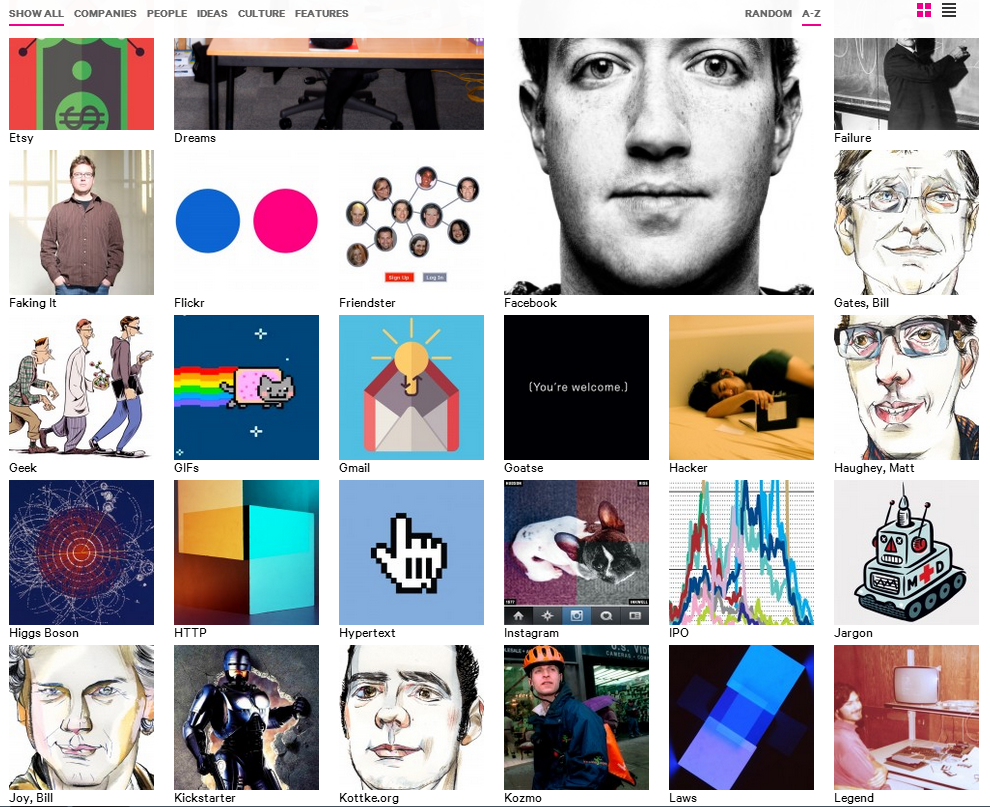
For the twentieth anniversary, the current issue of WIRED has a huge alphabetical list of topics that have been covered over the last 20 years (you can click on these topics on wired.com). From Angry Birds to Geek to Memes to Silicon Valley to xkcd and Mark Zuckerberg, I found many of these things interesting, though for some of them now, I wonder why. Which is actually a good question: why? Why has WIRED been my favorite magazine? I think it has to do with novelty and the future. I'm really interested in new and coming things, though not in all new things. For example, I have almost no interest in fashion, celebrities, or sports, although these areas are full of novelty (or simulated novelty). I tilt more toward the scientific and technological when it comes to novelty, and WIRED has always delivered.

If you click on the topic Geek, there's an explanation of the word, with credit to SF author William Gibson for introducing the modern usage of the word in the mid-80's. He described himself as "a geek who couldn't play baseball" (moi aussi). After some additional background, the item concludes with:
Be it a geek or a geck, both were misfits. And so was Gibson: Inept at sports, he took up science fiction. Foolishness in mainstream pursuits signified talent for their intellectual opposite. Geekiness became a synonym for countercultural braininess. And the rest is history.
While I don't consider myself entirely countercultural or entirely brainy, if there's anything I identify with, it would be countercultural braininess.I may no longer fly my freak flag, but I still roll under the geek banner.

UPDATE: I just noticed that I wrote a fond note about WIRED back in 2008, on the occasion of its 15th anniversary, with the title "Optimism as Strategy." I included a quote from an article in that issue that I think is still relevant to the magazine, the future, and more importantly, to living:
The challenge is obvious, the dangers present, the need great. But be optimistic. I would say that, wouldn't I, since we were often accused during my time at Wired of being overly optimistic. But optimism is not false hope, it's a strategy for living. If you are optimistic about the future, you will step up and take responsibility and attempt to make it better for yourselves and your own children.