Showing posts with label magazines. Show all posts

Friday, December 18, 2015

My Theoretical Interests


I was going through my daily Google spam notification email, thinking about all the theoretical interests I have that now mostly show up as marketing emails. Democratic Party appeals, astronomy magazines, Optical Society information, TAXI songwriting promo offers, musical instrument sale offers, AOPA private pilot news, Japanese and French language study information, and much more. Most of these represent past or perhaps intermittently current interests, now mostly theoretical interests in that I do nothing with them 90% of the time.

Even the 146 apps on my iPad show this. So many astronomy, language study, music making, photography, and game apps that I hardly have time to even look at. But they don't take up any physical room, and you never know when some interest will strike again (hope springs eternal that 24 hours a day is only a temporary constraint). Books are like this too. An ever-growing backlog and I will probably never read 75% of them. I should at least clear out the many shelves of paper books that I am less likely than ever to read now that I'm totally hooked on the convenience of ebooks. But there I have the 10% problem -- I'm sure I will never need 90% of the paper books in my house. But I can't get rid of them until I identify the 10% I might need, and that is not a weekend project.

First world problems, I know, right? Such an abundance of riches. One that still grabs me is The Great Courses (this was the part of my daily spam that triggered this particular rant). College level lecture courses in every subject by some of the greatest professors in the world. I have a number of them as DVD and a couple as audio, and have watched or listened to a few lectures from some of them, but never completed one course. Yet I look every time for more, especially when there's a "big sale" (as there usually is). These days I rarely order any new courses because I know about my theoretical side. Like the way I'm a theoretical pilot and singer-songwriter ("flying singer," get it?).

[begin-rationalization] In fairness to myself, these theoretical interests really do still interest me, even if I don't have time to actively pursue everything. I like to "keep in touch" with private pilot, songwriting, and astronomy magazines and I follow some related organizations and people on Facebook (a source of serendipity as well as a few laughs every day). Every time I go to Japan, I brush up on my reading and conversation and learn a few new things (or buy a new app). On two trips to Korea this year, I taught myself enough Hangul phonetic script to decipher many signs. And I do read a lot of books on all sorts of subjects. Donald Trump has already scared me enough to start giving money to the Dems again (spam and fear are a winning combination, Democrat marketers). And every December (triggered by my company's year-end shutdown), I magically turn back into a singer-songwriter for a week or two, writing and recording some new songs with my producer and friend Roger Lavallee. Plus I have a job that still uses the optics I studied back in the 70s. So I guess I'm not a complete deadbeat. [/end-rationalization].
.

Thursday, November 21, 2013

Bulgaria, Bad Knees, and Japanese


October and November tend to be my busiest business travel months, with at least one trip each to Europe and Asia. In October I did a customer visit tour in "only" four countries: UK, France, Bulgaria (sunset in the hills near Sofia, above), and Czech Republic (though I slept one night at the Vienna airport and drove through part of Slovakia). London, Nice, Manchester, Wales, London, Sofia, Vienna, Paris, and then home. This is a light five-day schedule for our European distributor.

Not much chance for fine European dining on this type of trip (unless gas station sandwiches and airline lounge snacks are your thing), but it's actually kind of fun. Although most business discussions are in English, I do try to practice a little French now and then, mostly in restaurants and by buying and reading science magazines like this recent special Mars issue of Science et Vie.

A special wrinkle on this trip was a bad knee. After months of increasing pain, I was recently diagnosed with a torn meniscus in my right knee. I was worried about long flights, big airports, train station stairs, and long car rides, but most of it went OK with the help of a new rolling backpack computer bag and a special effort to pack light. The fact that I don't have to carry books anymore helps a bit on this - I have hundreds of Kindle books on my iPad Mini, iPhone, and Kindle, and now the airlines even let you use these small devices in "airplane mode" from gate to gate (at least inside the US). After an MRI and two orthopedic opinions, I will have arthroscopic surgery to repair the meniscus next month. So I should be good as new (plus or minus a few decades) by January.

I spent last week in Japan, after working several weeks to prepare for optical/software presentations and product demos that I don't typically do in my day to day work these days. Since long ago I studied and still enjoy optics and pretending to design lenses (we call these "demos"), I look forward to these fall trips when I get to meet with some of the Japanese engineers who have designed many of the camera zoom lenses, DVD player lenses, and what-not that I have bought and used over the years. This trip involved even longer flights as well as many trains and train stations. In spite of all the stairs in the subway stations, my knee felt pretty good, which made me realize (this week) that most of my knee pain is triggered by driving, not by walking and climbing stairs.

I still like to play with Japanese when I'm in Japan, and thanks to the iPhone and iPad, I can now carry around the best Japanese dictionary I ever owned, which happens to be a free app called Imiwa? (the name means "what about the meaning?"). I use this to refresh my fading knowledge of Japanese, taking notes on various interesting words or phrases that I hear or see. I also bought a few copies of a children's magazine that I haven't bought in many years, Takusan no Fushigi ("A World of Wonders" in English). Intended for Japanese children 8 years and up, each monthly issue focuses on a particular non-fiction topic, from a museum of curiosities in Paris, to the life cycle of a certain moth, to the workings of Air Traffic Control (ATC, October 2012, at left), among many others (hundreds of titles published since the 1980's when I first discovered them when exploring Japanese bookstores on my early trips).

Just for fun, I read the ATC one on my flight home (cool because I like flying stuff as well as Japanese). A key point is that most of the kanji ("Chinese characters") are printed with furigana, small phonetic characters that give the pronunciation. Japanese adults don't need these, but Japanese children (and I) do for all but the basic kanji, of which I know around 200 or so. Since I know how ATC works (from private flying and from listening to United's channel 9 for many years), it was fairly easy for me to follow the text, which consisted mostly of radio exchanges between pilots and controllers (although in fact ATC in Japan and in most of the world is done almost entirely in English, because the many international pilots cannot understand Japanese). I still had to look up probably every fourth or fifth kanji-based word (many flight-related words in Japanese are adapted from English and spelled phonetically in katakana, so those are easy to read).


This trip was also the first time in 31 years of travel to Japan that I tried fugu (known as blowfish or pufferfish). I've wanted to try it for years, but it's too expensive for an expense report, and no one ever invited me! Fugu has a bad reputation because its liver is deadly poison, and if it is not prepared properly, the poison can contaminate the meat, and you can die (this sometimes happens to amateurs who try to prepare fugu at home without special training). Restaurants are of course very careful, and it is actually quite safe, and pretty tasty. It is cut almost translucently thin for sashimi (photo above - it is light pink, but the dark pattern of the plate shows through making it look gray in places in the photo), but we also had it in soup, fried, and broiled. Oishikatta! (It was delicious.)

This was also the second time I had tried hirezake, a rather strange drink. It is warm sake with the fin of a fugu soaking in it. It sounds strange (ok, it IS strange), but it tastes pretty good. So I guess technically, I had "experienced" fugu once before. It's also popular enough that you can buy it in individual cans from some drink vending machines. Japan has many vending machines that dispense small cans of cold or warm beverages (typically coffee or tea). In this case, the sake is warm, and the fish fin (possibly not always fugu?) is in a separate small container on top that you add to the sake yourself. I guess you don't want that super-soggy-fish-fin taste in your hot Japanese rice wine, do you?

Saturday, April 27, 2013

WIRED is 20!


WIRED is my favorite magazine. If my career and quirky hobbies (space flight simulators, studying Japanese, books, aviation, SF, recording music, etc.) didn't provide enough evidence of my full-blown geekiness, my affection for WIRED would probably make the case. Amazingly enough, 2013 is the twentieth anniversary of this forward looking magazine. I still like it.

I remember finding and buying the very first issue of WIRED in 1993. I was already living in Massachusetts, but in those pre-video-conferencing days, I traveled to my company's home office in Pasadena 5 or 6 times a year. On that trip, I was at UCLA for some reason, schmoozing in the bookstore (I've always loved college campuses and bookstores). That's where I spotted WIRED 1.01, probably attracted by the Japanese katakana ("otaku") and the headline "Digital Sex." I think I subscribed almost immediately, and I still receive the paper magazine, though I mostly read it on the iPad now and will probably stop the paper version soon.

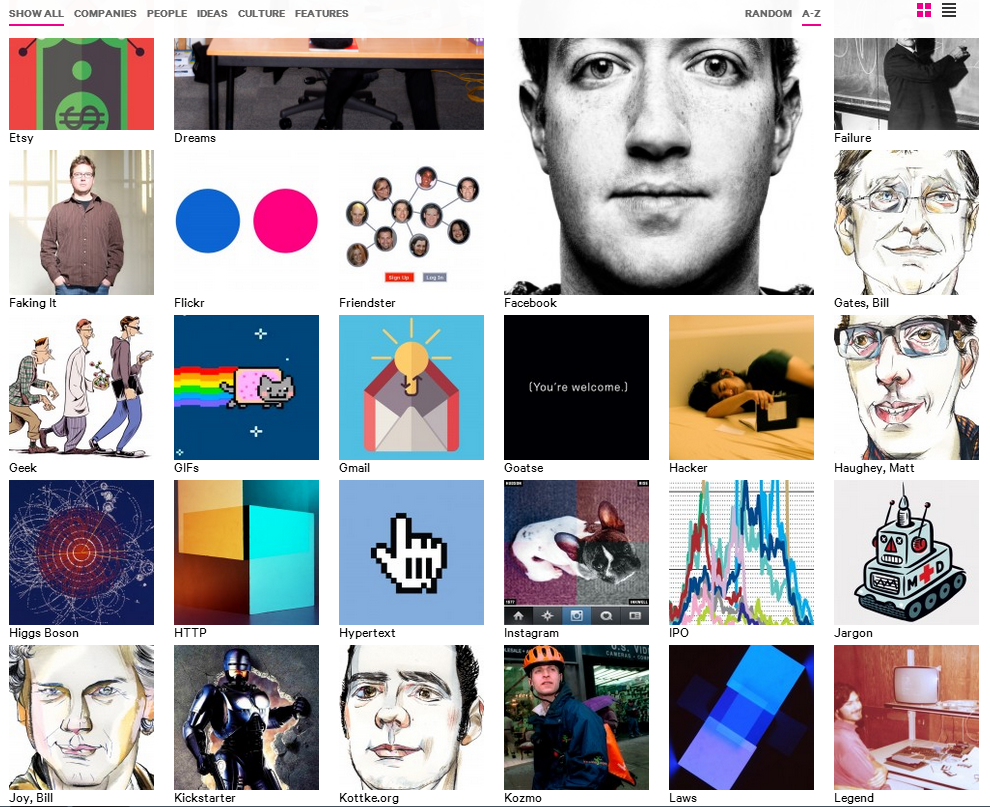
For the twentieth anniversary, the current issue of WIRED has a huge alphabetical list of topics that have been covered over the last 20 years (you can click on these topics on wired.com). From Angry Birds to Geek to Memes to Silicon Valley to xkcd and Mark Zuckerberg, I found many of these things interesting, though for some of them now, I wonder why. Which is actually a good question: why? Why has WIRED been my favorite magazine? I think it has to do with novelty and the future. I'm really interested in new and coming things, though not in all new things. For example, I have almost no interest in fashion, celebrities, or sports, although these areas are full of novelty (or simulated novelty). I tilt more toward the scientific and technological when it comes to novelty, and WIRED has always delivered.

If you click on the topic Geek, there's an explanation of the word, with credit to SF author William Gibson for introducing the modern usage of the word in the mid-80's. He described himself as "a geek who couldn't play baseball" (moi aussi). After some additional background, the item concludes with:
Be it a geek or a geck, both were misfits. And so was Gibson: Inept at sports, he took up science fiction. Foolishness in mainstream pursuits signified talent for their intellectual opposite. Geekiness became a synonym for countercultural braininess. And the rest is history.
While I don't consider myself entirely countercultural or entirely brainy, if there's anything I identify with, it would be countercultural braininess.I may no longer fly my freak flag, but I still roll under the geek banner.

UPDATE: I just noticed that I wrote a fond note about WIRED back in 2008, on the occasion of its 15th anniversary, with the title "Optimism as Strategy." I included a quote from an article in that issue that I think is still relevant to the magazine, the future, and more importantly, to living:
The challenge is obvious, the dangers present, the need great. But be optimistic. I would say that, wouldn't I, since we were often accused during my time at Wired of being overly optimistic. But optimism is not false hope, it's a strategy for living. If you are optimistic about the future, you will step up and take responsibility and attempt to make it better for yourselves and your own children.

Sunday, October 18, 2009

Cheaper Plasma Thrusters


I recently got an offer to subscribe to Popular Mechanics for only $5 for the first year so I signed up. I've always liked PM - it covers a wide range of topics from DIY home and auto repairs (not my forte) to various aspects of high technology. They sponsor an annual "Breakthrough Award" for inventors, and the November issue has an article on this year's winners (there are also video clips demonstrating the inventions). There are several interesting "flying machines" among the ten winners, including NASA's Kepler spacecraft, a high-speed coaxial rotor helicopter from Sikorsky, and a flying dune buggy (second flying car this month!). But my favorite is the "Mini-helicon plasma thruster" invented by MIT astronautics researcher Oleg Batischev.

The innovation here is the simplicity and low cost of this ion engine compared to previous plasma engines used (for example) on NASA's Dawn spacecraft. It uses inexpensive nitrogen rather than xenon gas and a simple radio frequency antenna to excite the plasma. It should be cheap enough to use on "ordinary" satellites to (gradually) push them from low Earth orbit up to geosynchronous orbit. This article offers additional background. To emphasize the simplicity of the design, when a part broke, Batischev and his team built a version of the engine using a Coke bottle for the glass tube and a Coke can as the antenna (picture below)! Talk about cheaper!

Saturday, May 23, 2009

Фобос-грунт (Phobos-Grunt) and LIFE

The June issue of Discover Magazine has an interesting article on the Russian Фобос-грунт (Phobos-Grunt, "Phobos-soil") mission which is currently planned to launch in October 2009 (there is some indication that it could slip to the 2011 Mars launch window instead). This mission will land a probe on the larger of Mars' two small moons, Phobos, pick up a small "soil" sample, and return it to Earth. The article by James Oberg is called "Stepping Stone to Mars" and is now available online.

How is this a stepping stone to Mars? Well, Phobos is an interesting little place. It orbits Mars every 7.65 hours, with one side always facing Mars. This could be a good spot for observing Mars, with radiation protection provided by both Phobos and Mars. Astronauts at a base on this side of Phobos could tele-operate rovers and other surface machinery without the 10-20 minute lightspeed delay faced by Earth-based operators. Phobos is also relatively easy to get to in terms of orbital mechanics "delta-V" (energy), about the same as landing on Earth's Moon, much less than landing on Mars itself. Of course there's a lot of science that needs to be done to determine what sort of object Phobos actually is before we start putting up buildings there.

The material picked up by Phobos-Grunt may also tell us something about the early history of the solar system, or about Mars, or maybe both. If water ice is detected in or on the small moon, it could make Phobos even more favorable as a possible future base for exploring Mars.

The Phobos-Grunt mission will also carry a special experiment from the Planetary Society. It's called LIFE (Living Interplanetary Life Experiment), and it will send a small collection of hearty Earth microbes sealed inside a tiny canister to see how well these simple life forms are able to survive the conditions of interplanetary space over some 34 months. The canister will be attached to the soil return module so it can be studied back here on Earth. This will provide a test of some aspects of the "panspermia" theory (life possibly traveling between planets embedded within meteors) by showing whether or not these organisms can survive these conditions. We know that bacteria can survive in the most severe conditions on Earth, and we have experience with relatively short near-Earth space exposures during which many bacteria have done just fine. Strep and perhaps other bacteria survived 31 months on the Moon inside parts of the Surveyor 3 spacecraft which Apollo 12 astronauts returned to Earth.

Of course this all assumes that this Russian mission launches for Phobos in 2009 or 2011 and makes it there safely. The Russians have had rather poor luck with Mars missions in the last 50 years (first try was October 10, 1960). They are zero for twenty. I hope Phobos-Grunt breaks their losing streak on Mars.

There's a YouTube video on the Phobos-Grunt mission (good graphics and animations, but only Russian narration).

Wednesday, April 15, 2009

Mars 500

While I was in the UK last week, I picked up a copy of BBC FOCUS, which is a great monthly science/technology magazine. The main cover story was on bioterrorism, but I was most interested in "Astro Big Brother" which described an interesting joint Russian/European project, a simulated 520-day human Mars mission.

The Mars 500 mission will be totally Earth-bound at a facility in Moscow, where 6 volunteers (4 Russian, 2 European) will stay for over 500 days in a small, multi-room isolation chamber meant to simulate a Mars- bound spacecraft. Although it will be at one-gee and will not have a self-contained life-support system, the crew will otherwise be physically isolated. They will have a stored food supply to last the duration of the mission (and also the ability to grow some of their own food). They will have communication with mission control, although communication time delays will be simulated based on their calculated distance from Earth. There will also be a Mars surface operations phase during which part of the crew will enter a smaller "landing vehicle" and spend time on a simulated Mars surface.

What's the point? Psychological and other "human factors," pretty much. The crew will have assignments for scientific experiments, system maintenence, etc., but they will mainly have a lot of time with a small group of people in a confined space (the interior looks something like a very low tech house trailer). Of course crews have spent time in confined and isolated spaces before (submarines, Antarctic bases), but probably not for anything like 520 days (17 months, almost a year and a half).

I don't think I'd want to do that unless I was really going somewhere cool. But it makes sense to check this out, even though we're still quite a few years from actually stuffing people into a Mars-bound spacecraft (and some Mars mission profiles are more like two years end to end).

The full mission is supposed to start in October 2009. The main site for the project is here (Russia based, but in English). It doesn't have too many bells and whistles (the ESA pages are better). The BBC FOCUS article is not online, but might be next month when the new issue comes out.

UPDATE: Thanks to a tip from Suzy McHale, I can point to a better set of photographs at the Russian-only "Marc-500" site. I found I could still read enough Russian to find the photograph section and figure out some of the captions. There is currently a 105-day test mission underway with a six-man crew (4 Russians, 2 Europeans). The photo below is from one of the gallery sections with photos from April 12, Yuri's Day, a big day in Russian (and Earth) space history.

Wednesday, February 25, 2009

Space Lifestyle Magazine

I discovered Space Lifestyle Magazine a year or so ago, and I really like it. It's a quarterly web-only magazine that is formatted like a print magazine with a variety of space related articles, many photographs and graphics, and excellent production values. It offers an easy to navigate screen interface but it can also be downloaded as a PDF file.

While the "space lifestyle" hasn't arrived yet for most of us, this magazine prepares us for that day with extensive coverage of private space developments in addition to background articles on space technology, government space activities, and current events (like the recent collision of two orbiting satellites). Space Lifestyle started in summer 2007 and the winter 2009 edition has just gone online. Check it out.

Sunday, February 01, 2009

Giving Pluto Another Chance

I have to say that I have not been one of those who has been especially worked up about Pluto's 2006 "demotion" from full-fledged planethood under the IAU's revised definition of a "planet:"

A celestial body that (a) is in orbit around the Sun, (b) has sufficient mass for its self-gravity to overcome rigid body forces so that it assumes a hydrostatic equilibrium (nearly round) shape, and (c) has cleared the neighborhood around its orbit.

I understand there are issues behind this definition, including the likelihood that Pluto is only one of many Kuiper Belt objects of similar size, and that it's small compared to any of the other "traditional" planets. I don't really care whether it's called a planet or a dwarf planet - definitions are only supposed to help us understand things, they don't really change the nature of the things themselves. The map is not the territory. Et cetera.

But astronomer and author David Grinspoon wrote a short essay in the March issue of Sky & Telescope called "This Is Not a Planet?" (not online yet, but he expands upon the essay in this S&T podcast). He points out that the IAU definition was a rather ad hoc and rushed compromise, and that it's rather weird that something called a "dwarf planet" is not also a "planet." Mercury, Venus, Earth, and Mars are Terrestrial Planets, but also planets. Logically, it would seem that "dwarf planet" is more of a sub-category than a main category.

So in the spirit of inclusiveness toward planet-like objects throughout our solar system (not to mention "exoplanets" in other solar systems), I'm casting my vote for "a dwarf planet is a type of planet, Pluto is a dwarf planet, therefore, Pluto is a planet." As long as they orbit a star and have a roughly spherical shape, I say let 'em in! Of course I don't actually get a vote, but that's how I would vote if I did get a vote.

And oh yeah, welcome to the family, Ceres!

Tuesday, January 27, 2009

Electric Rockets 101

Dawn at Ceres - Ion Engine Firing
There's a good article in the February 2009 issue of Scientific American on electric (or plasma) propulsion systems. It explains the basic principles and the differences between ion drives, Hall thrusters, and magnetoplasmadynamic thrusters (MPDT to their friends). The article does a good job explaining the limitations of each technology and what researchers and engineers are doing to overcome them to improve thrust, efficiency, and long term reliability. These highly efficient propulsion systems will hold the key to faster access to the outer parts of the solar system - an ion drive is already in use on NASA's Dawn mission to the asteroids Vesta and Ceres. The picture above is an Orbiter screen shot I took on a simulated Dawn visit to Ceres.

If you'd like to try an ion drive yourself, you can download Brian Jones' Dawn v.2 add-on for Orbiter and play around with the included scenarios. Also recommended is Asteroid Pack 1.00 which adds Ceres, Vesta, and a few other asteroids to your Orbiter solar system. Because operating with a continuous low-thrust engine is rather different from the usual "burn and coast" method most often used in Orbiter (and in real life), Brian has added some special attitude hold features that are more stable under high time acceleration. He also added a Mars flyby scenario. The real Dawn's Mars flyby is coming up in just a few weeks(February 17). The January 27 entry in the Dawn Journal includes a great explanation of the encounter

Monday, November 24, 2008

Enceladus: Saturn's Soda Fountain


Enceladus is a small, icy moon of Saturn that is something of an overachiever. It shoots geysers of water vapor, nitrogen, CO2, and methane from vents that pop open around its south pole. Obviously there has to be some liquid water under the surface for this to happen, and since Saturn is rather far from the sun, the energy needed to keep some of the water liquid (and eject geysers into space) has to come from something else. Enceladus seems to have a rocky core (judging from its density), so some heat could come from radioactive decay of minerals in the core - but this isn't enough to account for the geysers and the temperatures measured around the south pole vents. Tidal forces from Saturn and Dione don't provide enough energy with its current orbit either. But somehow plucky little Enceladus is still firing away with those geysers...

I know what you're thinking: a giant alien nuclear reactor! Well sure, that could be it, but the Cassini scientists are still looking at natural solutions, like accumulated heat from earlier periods when its orbit could have been more more eccentric and tidal forces larger. In any case it's a pretty wild little ice moon.

These highlights are from an article by Carolyn Porco (Cassini imaging team leader) in the December Scientific American. The video is also from SciAm - it gives some background and provides some great animated visuals of Saturn's soda fountain.

Sunday, November 23, 2008

Our Eyes on Mars

The new Air & Space Magazine arrived with a cool article about Michael Malin and Mars. Malin is responsible for the cameras that have given us so many amazing images of Mars in the last ten years or so. It would have been more like 15 years if the Mars Observer had achieved orbit (contact was lost in August 1993). Malin's backup MOC (Mars Observer Camera) was carried a few years later on Mars Global Surveyor which reached Mars orbit in September 1997. This simple but powerful camera was able to image surface details at much higher resolution than the Viking Orbiters had provided, revealing sedimentary layers as well as drainage gullies and other clear evidence of flowing water in Mars' geological history. It's hard to believe that they had to fight to even get this sort of camera on these Mars missions, but Malin and his team persevered and the images returned from these and other Malin Space Science Systems (MSSS) cameras (on Mars Reconnaissance Orbiter and Phoenix) have helped to reveal Mars as a much more diverse and dynamic planet than was once believed.

The article is by Andrew Chaikin and is an excerpt from his recent book, A Passion for Mars: Intrepid Explorers of the Red Planet. Air & Space also has a web-only photo essay feature showing some Mars images selected by Malin and his team as favorites. The MOC image above shows the "fossil" delta in Eberswalde Crater, clear evidence of past flowing water (it reminds me of some aerial pictures I took over southern Utah last year). The MSSS web site has a huge, well-indexed gallery of Mars images.

Wednesday, November 19, 2008

LIFE as I knew it

Google has another cool feature thanks to a partnership with LIFE magazine. They have put millions of photos from the LIFE photo archives online. In the 1960's, LIFE magazine was my window on the world of space flight. The photo above of Ed White's Gemini 4 EVA is a prime example. Just do a Google image search on any term and add source:LIFE to the search string to access this amazing collection of photos. Of course as a teenager in the 1960's, LIFE wasn't only about the stars in the sky. The stars of Europe and Hollywood were pretty interesting too. I remember names like Claudia Cardinale, Senta Berger, Sophia Loren, and of course Marilyn Monroe, among others. The LIFE archive is also great for history, from Abraham Lincoln to Lucky Lindy to the Cuban Missile Crisis. Very cool.

Tuesday, November 18, 2008

Updike on Mars

I got the December National Geographic yesterday and read a brief article about Mars by author John Updike, illustrated with some of the dramatic and beautiful photos that have helped to make Mars a place, not just a planet, courtesy of the Mars Rovers and MRO, among others. Updike's article is online here, and there is a nice video tour of Mars narrated by the photo editor for Updike's article.

Tuesday, October 28, 2008

Advice to the Next President

Although he hasn't been elected yet, plenty of experts are already dispensing advice to our next president. The new Newsweek has a cover story about all the problems facing the new president, "Nightmare on Pennsylvania Avenue." It includes NY Mayor Michael Bloomberg's advice on the economy, among other things.

MIT Technology Review also has a "Dear Mr. President" article with expert advice on the topics of energy and electronic information systems for health care, and an especially important memo on research from Charles M. Vest, President of the National Academy of Engineering. He says we need to invest in education, research, and innovation, and he gives some specific steps we need to take to accomplish this.

None of these articles speculates on who we will elect next Tuesday. I really hope it's Barack Obama, and even though the polls are looking good and the Democrats are taking many precautions against election fraud, I'm sure the GOP is still working on ways to steal this election as they stole the 2000 election. Like many Obama supporters, I'm a bit stressed about this! There's not much I can do about it, though I am continuing to make phone calls every evening to voters in New Hampshire. This helps to refine the Obama databases in preparation for the final get out the vote effort starting this weekend. I wish I could volunteer in New Hampshire for the final four days, but instead I will be in Europe on business. So I am signing up a few loved ones to go to NH instead of me. I hope Obama's victory doesn't hang on those four electoral votes, but I want them to be there if he does need them!

Sunday, October 12, 2008

NASA's Greatest Hits

In recognition of NASA's 50th anniversary, the November 2008 issue of Air & Space Magazine has a feature on NASA's 50 best photos of all time. Number 1 is shown here - the famous "blue marble" Earth photographed in December 1972 by Apollo 17. The photo gallery (starting with #2) is available online here.

Monday, September 15, 2008

Views of Space Settlement

From recent posts, you might think the theme of this blog has morphed from space/education/science/astronomy/etc. into politics, but that is definitely not my long term plan. I normally maintain a Newsweek-level interest in politics, keeping up with important developments, but not getting too distracted by them. This fall's presidential election is a major exception, and I have gotten more involved with it than I expected, with fund raising and even canvassing and making phone calls for the Obama campaign, in addition to writing about it. I believe it's really important, and I can't help it - I want my country back. But I haven't given up on the "space stuff" by any means.

I just received the fall issue of Ad Astra from NSS (National Space Society). It's a pretty good issue with an article about the new NSS Space Ambassadors educational program (I've already applied), reports on ISDC 2008 in Washington, as well as articles on the ISS, Mars Phoenix, COTS, and more. There is also an article about the winners of this year's space settlement art contest, with some really cool examples. I can produce some pretty cool space images using Orbiter, but a talented artist can really transport you to that futuristic space environment. NSS puts out a calendar based on the space settlement art entries, and I just ordered the 2009 edition.

Bonus: I just noticed a link on the Ad Astra page for a free PDF (1.5 MB) of an excellent multi-article report on space based solar power from the spring 2008 issue.

Wednesday, August 27, 2008

Networked Cars and Cosmonaut Hell

The September issue of Wired magazine is really cool. The cover story is about an amazing plan to fundamentally reshape cars and how we use them, by building a network of charging stations that will power electric cars whose batteries are owned and operated by the network company. Better Place is a strange sort of car company - more like a software or network company than a traditional car builder. They are partnering with Nissan-Renault to build the cars, and they have signed up Israel and Denmark as "beta test" countries.

Yes, countries. Without the infrastructure of charging and battery swap stations, and the network and computer software that help drivers make best use of the resources, the plan won't work. So they need small countries that are willing to support this development with tax breaks and other subsidies, with the payoff being a transportation system that (eventually) doesn't need oil. I know it sounds wild, and it's hard to see how the infrastructure for this could scale to a big country such as the U.S. (they might start with Hawaii). But read the article - they are really serious about this!

There are other cool articles too, especially the one about Richard Garriott. If all goes well this October, he will become the sixth private spaceflight participant to fly to the ISS on a Russian Soyuz. His training experiences at Star City were quite interesting (see the video on the Wired web site). You can also learn more about Garriott's $30 million mission at his own web site.

But wait, there's more: an article about Neal Stephenson (one of my favorite authors) and his upcoming book Anathem. And an article about Red One, an amazing new professional digital video camera that finally achieves film quality (4096 x 2304 pixels). A very wired Wired this month.

Sunday, August 17, 2008

Distant Mirrors (and Cribsheets)

Speaking of astrobiology (as I was in my last post), I just discovered this May article from SEED magazine. It discusses what sorts of signs of life a distant planet might display, using as an example the only planet that we know with certainty harbors life - Earth. It turns out they have done the experiments with several departing planetary exploration spacecraft, pointing their instruments back at Earth to examine our variations in brightness and color in various wavelength bands.

When they do this, they see a planet with tremendous variation in color and reflectance, thanks to our oceans, clouds, and land areas. These variations could allow an observer with similar data to determine that we have areas of water and non-water, as well as how fast our planet is rotating. If they observed a wide range of spectral bands, they would find Earth to be quite bright in some long wavelengths (radio, TV, radar, etc.). With spectroscopic analysis, they would find the chemically unstable combination of oxygen and methane in our atmosphere (along with other gases), suggesting that some dynamic process is constantly replenishing these gases (that would be life, in our case).

This gives scientists ideas for how they will examine exoplanets as our near-future instruments become good enough to discover and examine smaller and more Earth-like planets, especially any that lie within the habitable zone of their stars. Even if the planet is initially represented by only one color pixel, the spectrum of that pixel, and changes in its brightness over time may give clues about its atmosphere, rotation, and the presence of large areas of water or other liquids.

Habitable zone? If you need help with that, I recommend cribsheet #14 from SEED, a quick single page review of exoplanets, how we find them (over 300 so far, most very massive and Jupiter-like), and how we will be able to study these distant worlds in the near future. SEED has useful cribsheets on a lot of other subjects too. Check out plate tectonics, nuclear power, and light.

Thursday, August 14, 2008

Astronomical Medicine

SEED magazine has interesting profiles and podcasts on some "revolutionary minds," including Michelle Borkin, a young astronomy researcher at Harvard who is working with a team in applying medical imaging and visualization software to astronomical data. The term "astronomical medicine" is pretty wild - who is the patient in this case? And will the insurance be accepted in this part of the Galaxy?

I forwarded this to Martin Schweiger, the developer of Orbiter, who in his real job does research on medical imaging software. He agreed that this is really interdisciplinary research, "Although on the other hand, the connection isn't so far-fetched. I am using the radiative transfer equation to describe light propagation in tissue - and that was originally developed for modeling stellar atmospheres." So maybe it's really medical astronomy?

Michelle Borkin has some nice images, movies, and background material on her web site.

Wednesday, August 13, 2008

Titan's Changing Face

Purple Haze - Titan 12-22-05
On Saturn's hazy moon Titan, torrential downpours of methane punctuate centuries of drought on a landscape of sand dunes and badlands.

That quote is from a great article on Titan in the current issue of Physics Today, and I noticed that the full article is available online. "The changing face of Titan" by Ralph D. Lorenz of Johns Hopkins University integrates and summarizes a lot of what has been learned about this strange, cold, but dynamic world from the Huygens probe and especially from the many fly-by passes of the Saturn-orbiting Cassini spacecraft. With the Cassini mission extended for two more years, scientists will have 26 more Titan passes to learn even more.