Showing posts with label Mars Society. Show all posts

Monday, September 14, 2009

Nice to Know It Works!

A few years back, I worked with a few far-flung fellow Orbiter enthusiasts to develop an Orbiter add-on package called Mars for Less (MFL). I wrote about it quite a bit in 2006-2008 and even presented a paper (PDF) on it at the 2006 Mars Society Conference in Washington, DC. Fun stuff, especially since Andy McSorley and Mark Paton did most of the heavy lifting (and re-entering). I mostly did a lot of testing and writing (scenarios, blog posts, and the MSC paper). Mark has quite a knack for spacecraft design and especially for EDL (entry, descent, and landing in the trade). Since MFL is all about saving weight (well, it's also about medium-lift boosters, modular orbital construction, and living off the land on Mars), we wanted a very light heat shield. Mark decided to go with an inflatable one. He'd read some stuff about them, and since Orbiter isn't exactly rigorous about the structural integrity of spacecraft models anyway, he decided to give it a shot. It seemed to work within the aerodynamics of Orbiter. I entered the Mars atmosphere and safely landed dozens of times (mostly thanks to Mark's spiffy autopilot work).You can see a bunch of my Mars for Less screen shots on my Flickr site and a nice 7 minute video (not mine) of the MFL mission here.

So I was really pleased to learn recently that someone has actually tried out an inflatable heat shield. NASA did a suborbital flight test of a 10 foot (3 meter) inflatable heat shield and it worked. Of course this is a lot smaller than what we would need for our manned Mars lander, but hey, it's a start!  Thanks to Colony Worlds for the tip and the photo.

Thursday, September 25, 2008

More "Mars for Less" (Video)


I really like this video. It's a 7 minute condensation of a complete human Mars mission in 2033, as simulated in Orbiter with the Mars for Less add-on. This complex add-on was developed in 2006 by Andy McSorley and Mark Paton, with some help from a few other Orbiter add-on developers (including me). I've written in this blog about the Mars for Less (MFL) mission concept (developed by Grant Bonin and others) and also about the development and eventual release of this add-on (in February 2008). Andy has a nice MFL page here.

After reading a paper by Grant in 2006, I had the idea to develop a MFL add-on for Orbiter. The goal was to show that Orbiter could be a useful platform for virtual prototyping of human Mars missions, and to write a paper about this for the 2006 Mars Society Conference. Since my add-on modeling skills are minimal, I was lucky that Andy and Mark agreed to join me in this project, and they did a great job, even with complex stuff like Mars atmospheric reentry and precision landing. The paper was written and presented in Washington in August 2006, and it went well (you can download a PDF here). My MFL photo set on Flickr is here.

YouTube user "Belisariusorb" apparently flew the whole MFL mission in Orbiter (with various embellishments such as a European Crew Transfer Vehicle, an expanded Mars base, and robotic resupply missions) and created a 7 minute video showing the highlights of the 2+ year mission. Nice job!

N.B. The 24 MB Orbiter add-on is available here, and there is also a "Mars for Less Extra" developed by Mark Paton which improves the aerodynamic performance and realism of the Earth-return vehicle (ERV) for Earth reentry, along with a few other developments.

Tuesday, February 19, 2008

Mars for Less: We Shipped!

CEV approach MTSV Stack
As a software project, it was only natural that Mars for Less for Orbiter would be late, even though it was essentially done back in August 2006. After the big push for the Mars Society paper that summer, I think we just ran out of energy for tying up the loose ends. But thanks to Andy and Mark, MFL has finally "shipped!" Mars for Less V1.6 (24 MB zip file) is now available for download over at Orbit Hangar. Be sure to read and follow the included documentation on this, both for installation advice and usage tips, and note that it does assume pretty good familiarity with Orbiter. A forum discussion thread has been started here.

Monday, February 18, 2008

Mars for Less: Coming Soon. Really.

Right Down the Middle of Valles Dao
It has said "close to being publicly released" on this page since fall 2006, but now the Mars for Less add-on for Orbiter really is coming soon. Andy McSorley and Mark Paton have pulled together the files and finished up the basic documentation, and I've contributed a few edits and a bit of final testing. The add-on itself fills up a 23 MB zip file, and there are a bunch of additional add-ons recommended for the full experience, all described in the documentation. There are many scenarios to try.

I had forgotten how cool this stuff was since I was immersed in it for a few months in spring/summer 2006, working closely with Andy and Mark on the add-on parts and scenarios, and culminating in our paper and presentation at the 2006 Mars Society Conference, "Virtual prototyping of human Mars missions with the Orbiter space flight simulator" (the paper and slides can be downloaded from the bottom of this page).

Andy has pictures on his Mars for Less page, and I have quite a few in Flickr. There's a video too (just the Mars landing, a small but exciting part of the mission). Stay tuned...

Monday, December 17, 2007

Mars Now, Mars Future

I just had a look at Mars with my little Orion StarBlast telescope from my front porch. The sky was clear and Mars was a small, bright, and rather wiggly disk. It was wiggly mostly because I didn't really allow enough time for my telescope to get down to the cold ambient temperature before getting too cold myself and feeling guilty about three other things I needed to do before bed. I admit it, I'm not much of a winter observer! Mars will reach its closest point to Earth tomorrow night (about 88 million kilometers or 55 million miles), but I can't count on it being clear two nights in a row. Maybe I'll go out again (unfortunately I didn't).

Of course Mars is a lot bigger and closer in spacecraft imagery, and even bigger and closer in some people's imaginations. My small contribution to that category is not exactly fiction, but a picture book of possible future human exploration of the red planet. I created this a year or so ago using screen captures from Orbiter (with various add-ons) plus a few NASA images. The pictures illustrate how an early Mars mission might work using the Mars for Less approach, a variation of Robert Zubrin's Mars Direct that uses medium lift launch vehicles and modular docking-based construction of the Mars vehicles in low Earth orbit. The cool thing about this (for me at least) is that I worked with a team of people (Grant Bonin, Andy McSorley, and Mark Paton) to create the Orbiter add-ons so we could simulate flying the whole mission in Orbiter: multiple launches, LEO assembly, navigation, Mars entry, landing, the whole shebang. We wrote a paper on that project that I presented at the Mars Society Conference in August 2006 (PDF slides and text are available). Andy also has a web page with more pictures from the project.

Mars... Just Imagine (3.6 MB PDF) is a free educational picture book that is once again available on-line thanks to my friend "MiGMan" who has added it to the Orbiter section of his wonderful Flight Simulation Museum.

Thursday, August 02, 2007

Stand Still and Look Pretty (Deep)

The Mars Phoenix Lander is expected to launch on Saturday. There's a nice article in today's MIT Technology Review update on the technology and scientific instrumentation that Phoenix is packing. It may lack wheels and have mostly been built out of spare parts from earlier Mars missions (one crashed, one canceled), but its ability to dig deep (up to half a meter) into Mars' soil and to analyze what it finds there is really unprecedented. I knew about the "oven" that will carefully heat samples to record and analyze the gases that are released, but I didn't realize that it also carries both an optical microscope and an atomic force microscope (AFM) for very close examination of soil samples.

A simulated Phoenix is shown just before landing (using an add-on in Orbiter).

Monday, July 02, 2007

Mars Standard Time

I just received an update from the Mars Society on the progress of the Mars analog simulation they are running at FMARS, their Mars surface simulation site on Devon Island in the Canadian Arctic. Four months is substantially longer than previous Mars analog missions, and they have reached the mid-point. The seven member crew has been staying "in sim" and conducting geological and biological field research, following procedures similar to what would be required on Mars, although of course life support requirements are considerably easier on Earth than on Mars, even in the high Arctic.

They have just started something new: operating on Mars time! A Martian "sol" is 39 minutes longer than an Earth day, and since the lighting doesn't change much through the day at their latitude (75° N) at this time of the year, they can operate on Mars time without being bothered much by changes in day and night lighting. This means they will fall out of sync with Earth time by 39 minutes a day, returning to Earth time in 36 days. Pretty wild, though it's not completely unprecedented for Earthlings to operate on Mars time. MER operations team members at JPL did this for a time in early 2004, just after the landings, in order to stay in sync with the rovers on Mars. They found it pretty exhausting and disorienting, like working nights, but worse, and as the rovers continued to operate well past their 90 sol "warranties," the MER teams went back to normal Earth time, scheduling operations and shift changes as needed to provide needed staff coverage. Of course the FMARS crew won't be surrounded by other people operating on normal time, so maybe it will work better.

You have to do something special for time keeping with a 24 hour 39 minute sol. The update says, "To simulate the longer Martian daily cycle, the crew will move its own clock backward 39 minutes per day, black out the hab windows between their clock's 6 PM and 6 AM to simulate night, and schedule meals, sleep cycles, and outdoor work accordingly." Sounds familiar, and not only from daylight savings time changes. In Kim Stanley Robinson's Red Mars, there is the idea of the Martian time slip, a 39.5 minute period between midnight and 12:01 that "stops the clock" each night to allow practical use of an Earth-like 24 hour clock despite Mars' slightly longer rotational period. It sounds like this is what they are doing at FMARS, more or less.

There's a lot of information around on Mars analog missions, including Robert Zubrin's 2003 book Mars on Earth. I also really like Anthony Kendall's FMARS journal of his two months on Devon Island in the summer of 2005.

Sunday, June 24, 2007

Mars Human Factors

Mandya Arti Furnished Base
Astroprof wrote an interesting post the other day called "Mars Mission: The Human Factor." I started to respond on his blog, but I realized that my comments were getting pretty long, so I decided to turn it into a blog post here. Please read Astroprof's post first for context. I have a few related comments, noting that none of this refutes the basically correct notion that many human factors as well as technical issues could be show stoppers on a multi-year Mars mission.

1. Analogs? I agree that Earth based analog missions do have a lot to teach us, and longer duration ones need to be done (with or without alcohol). There are also a lot of people thinking about the problems of long duration missions and human factors - for example, there were many papers related to this that I unfortunately could not attend at ISDC in Dallas. Of course thinking and planning and even simulation don't replace real experience, and the convenience and safety of staying on Earth for the tests makes them less authentic - life support system failure most likely won't kill the crew at an analog site in Russia.

2. SF Writers - SF doesn't replace experience either, but there have been a lot of good ideas explored in Mars novels, such as Benford's The Martian Race (based on Mars Direct) and Robinson's Red Mars (though it starts with the second generation colony ship for the "first 100" settlers, and that thing is huge). Another one that gets very detailed in the systems area of a Mars Direct style mission is Shadows of Medusa by Brian Enke, which offers an interesting solution to crew relationship problems.

3. Inflatable crew space? NASA signed the inflatable trans-hab over to Bigelow for space station development, but this could be licensed back if it works out - this still would not be a Battlestar Galactica-size spacecraft, but it could give a substantial increase in volume for living space for relatively small mass and launch size penalties.

4. Orbital assembly? Zubrin doesn't like orbital assembly very much, but some have proposed variations on Mars Direct using medium launch vehicles (like Ariane-5, Delta IV Heavy, possibly others) and orbital assembly. I worked on an Orbiter simulation of this with Andy McSorley, Mark Paton, and Grant Bonin in a version called Mars for Less (MFL), first designed and published by Grant. I gave the paper at Mars Society in DC August 2006 (see this page for more details and my various MFL blog posts). Our HAB and ERV were smaller than Zubrin's (so they would be even MORE cramped), but this was just a concept thing, and using the transhab idea or linking together additional hab and boost modules could help (orbital assembly should be more scaleable, especially if the modules are designed to assemble by docking with minimal astronaut EVA's needed).

5. Reliability? Long term reliability of critical systems is a big, big question. One of the NASA astronauts who spoke at ISDC talked about the importance and fragility of the toilet system on the ISS. It would often have problems requiring service, and this would become job #1 until it was fixed. Toilets and other parts of life support have to work better than what we have now for 2+ year Mars missions with limited spare parts and backups, and with the life support system being closed (full recycling or very close to it, which has not really been achieved). ISS experience is a valuable start, but if things get too crappy up there (sorry), they can escape in a waiting Soyuz spacecraft on fairly short notice. This is clearly not an option for a Mars-bound crew.

6. Pseudo G by Spinning? Then there's pseudo-G (spin the spacecraft on a tether) which someone should really test out in Earth orbit sometime. Six or more months in zero G could be depressing.

If getting humans on Mars becomes a top priority for the world (or just for a group with enough money and resources), these problems could certainly be worked out, though if I were on the mission, I'd want to know that the critical life support systems had been tested under realistic space conditions for at least two years if that would be the needed lifetime for mission success (pre-landed backups should be available once you reach Mars). It would take time and effort but I believe it still could happen in 15 or so years, though it is unlikely to be the US government's top priority for a while, so it might have to be some other group of countries and/or commercial entities.

Sunday, December 31, 2006

My Space (not MySpace) 2006

New Horizons Heading for Pluto
Io Close-Up with New L8 Jupiter

It's the end of another year, and as I tried to do last year at this time, I'd like to write something that sums up the year, makes a brilliant statement, and shows progress (or something). The usual sort of thing. It doesn't feel quite like "brilliant" this evening, but here goes "something" anyway.

In the domain of this blog (which mostly excludes home, family, and work issues, all of which are thankfully going pretty well), 2006 was an interesting year. There were plenty of developments in space, starting from the arrival of Stardust and the departure of New Horizons (pictured in Orbiter above - its target was a planet when it launched but is now called a dwarf planet, though Pluto itself hasn't changed). The arrival of MRO in Mars orbit was another big development, and it is now returning amazing high-resolution imagery of the Red Planet, just as Mars Global Surveyor went off the air after many years of faithful service and zillions of great pictures of the Martian surface (it went out with a bang as signs of very recent liquid water flows were reported based on repeated MGS observations of promising sites). There were also two successful shuttle missions to the ISS, the announcement of NASA's plans for a Moon base, and the good news that a shuttle mission to extend the life of the Hubble Space Telescope was approved. The amazingly long lived Mars Rovers also continue to give us a "local presence" on Mars.

A new version of the Orbiter space flight simulator came out in May, and I was on the beta testing team, mainly so I could update my book Go Play In Space to be available when the Orbiter 2006 was released (Andy McSorley made substantial contributions to the second edition). I spent a lot of time expanding and updating the book, and worked with Andy and later also with Mark Paton on an Orbiter add-on based on the book The Rocket Company. Andy, Mark, and I also spent a lot of time this year on Mars for Less (MFL), a human Mars mission plan developed by Grant Bonin. I had the idea to create a "virtual prototype" of MFL in Orbiter, and Andy and Mark agreed to do most of the work to create an Orbiter add-on for MFL. It turned out to be very complex indeed, but it really proved the point that Orbiter could be used as a tool for fairly detailed mission design (including the challenging EDL phase I showed in a recent YouTube video).

The original point of the MFL exercise was to write a paper for presentation at the Mars Society Conference in Washington, DC in early August. The paper was accepted and written (co-written with Andy, Mark, and Grant), and I presented it at the conference, which was a real thrill. You can find the paper and the presentation at the main Orbiter web site (under References), and more information on the MFL project at Andy's web site.

Part of the reason for my recently increased interest in space and astronomy is related to educational outreach. I think space and astronomy have the power to inspire people of all ages to think positively about science and technology and the future. As many people were, I was inspired by the blog posts of Ms Anousheh Ansari, a self-described private "space ambassador" who visited the ISS this year. She fulfilled her life-long dream and did her best to share her experiences with others through her blog. Although I don't expect to ever go to space myself, I will be a "space ambassador" of sorts starting in 2007 - a JPL Solar System Ambassador, in fact. I will write more about that in the next few weeks, after it's offically announced on JPL's web site (the 2007 ambassadors are not listed there yet). Since Orbiter provides an excellent way to virtually explore the Solar System (as shown in the Orbiter image above, Io with Jupiter), I plan to make extensive use of Orbiter in my presentations, to supplement the materials that JPL will supply.

Sunday, December 24, 2006

MeTube


I just posted a couple of Orbiter videos of my own on YouTube. These are slight re-works of clips I recorded last summer for my presentation of "Virtual prototyping of human Mars missions with the Orbiter space flight simulator" (300k PDF) at the Mars Society Conference in Washington, DC. This paper used the Mars for Less mission concept developed by Grant Bonin as an example, implemented as an Orbiter add-on by Andy McSorley and Mark Paton. I took the 1:50 clip (above) of the final moments of Mars entry, descent, and landing (EDL, brilliantly designed by Mark Paton) and added an excerpt of a pseudo-classical synthesizer recording that I did back in 2002. I called it "Elegy After Vaughan Williams" because the shifting tonality vaguely reminded me of some of Ralph Vaughan Williams' compositions. I knew I'd eventually find something to do with that little musical doodle.

The other clip is very brief (0:34) and starts with a close-up of a female astronaut (courtesy of Greg Burch) standing at our spartan Mars base in Vallis Dao, pans around her, then zooms out until Mars is just a pixel. The music is an excerpt from Ravel's Daphnis et Chloé ballet. I used this clip on the title slide of the presentation.

Thursday, November 16, 2006

Mars Settlement Study

One of my favorite blogs is Anthonares, a beautifully written blog that covers a diverse range of subjects, often but not always with a scientific slant. Anthony Kendall is a Ph.D. student in hydrogeology at the University of Michigan, and one of his not-so-secret passions is the planet Mars. He spent a month in the summer at 2005 at the Mars Society's FMARS Mars analog research facility on Devon Island in far northern Canada, and he later reported on his simulated Mars mission experiences in a long, detailed blog entry. Very cool indeed.

Recently Anthony has been busy with other things and not blogging as much as he did early in the year (I know the feeling). But a few days ago he posted an entry on an exciting new project he has joined, working with 4Frontiers Corporation on an eight month "Generation II" Mars settlement study. As the Mars hydrogeologist on the 35-person study team, Anthony will be working on water issues using hypothetical Martian aquifier software models and ground-penetrating radar data from ESA and NASA spacecraft. Grant Bonin, one of my co-authors on the paper (300K PDF) I presented at the Mars Society Conference this past summer, is also on the Generation II study, working on mission planning and analysis. Great stuff, guys! I look forward to hearing more about this exciting project that aims to pin down many of the details and realities of future human settlements on Mars.

Tuesday, August 08, 2006

Mars Society - Final Thoughts

I wrote about the first three days of the Mars Society Conference and then fizzled out. So here are a few final thoughts and things I forgot to mention before.

I did mention seeing The Mars Underground on Thursday night, but since then the Space Review has carried an excellent review and discussion of the film by Dwayne A. Day, including some interesting observations on the conference and on the role of Dr. Robert Zubrin in promoting the case for humans on Mars.

The Saturday night banquet was pretty enjoyable for a dry event, though the entertainment and awards were full of insider jokes and references that a first-timer like me wouldn't really get. That's OK - Mars fans are an interesting extended family to watch (and start to join) just the same.

I went to a few track papers on various subjects and was struck on the one hand by the big picture optimism regarding humans on Mars ("we have the technology - all we need is the decision and the money"), and on the other hand by the difficulty of the details. Several papers pointed out the need for more extensive and realistic simulations of missions (by this I mean analog simulations, where people practice aspects of Mars missions in ground-based simulations of spacecraft, in the desert or in the Arctic). While these partial simulations are interesting and useful, more realistic simulations will be needed before we send 4-6 people on the way to Mars with only themselves to keep everything working (and everyone breathing).

We talk about "pseudo G" from tether-rotated spacecraft, and while the physics of this is clear, no one has actually done this with living things on an extended basis, let alone humans. Can a nearly closed life support system be made to work in space (and on Mars) for some four years? Can all the mechanical systems of the spacecraft work well for the time needed? The ISS is not a fair test since it is close to Earth and is resupplied and repaired on a regular basis. Even the issue of aerobraking into Mars orbit is a problem - it's never been done with a 40 tonne spacecraft. People are thinking about and working on this stuff. But if "Mars by 2020" really has a chance, we need to solve the big picture and sweat all these "small" details. I think it's possible, but 14 years doesn't sound like a huge amount of time to do it all, even with Uncle Sam's and Elon Musk's checkbooks.

Saturday, August 05, 2006

Mars Society, Day 3

Not much time to blog this since I have to run to the Mars Society Conference banquet in just a few minutes. Day three was good, starting with a somewhat rambling but pretty inspiring speech from Dr. Robert Zubrin on how far we've come, what's left to do (a lot), why we need to support NASA's Vision for Space Exploration (it's finally destination driven!), and why it has to be Mars as the real prize (it's a tough place but it has everything necessary to build a new branch of human civilization).

I was setting up a slide show for the MarsDrive exhibit and unfortunately missed most of Australian astronaut Andy Thomas's talk (STS-114 and five other flights) - too bad, because judging from the few Q&A responses I heard, he was very open and an excellent speaker. Dr. Chris McKay, one of the founders of the "Mars Underground," the predecessor of the Mars Society, spoke next. He's now with NASA Ames and is concerned with astrobiology, but his talk focused on using the Moon (no life expected there) as preparation for Mars exploration. He argued that the Moon will probably not have colonies as Mars ultimately will, but will remain a research site, more like Antarctica, a place where Ph.D. students do thesis research. But this is still a good thing. Once again HobbySpace has excellent summaries of the three morning speeches here.

In the afternoon I caught a couple of good talks by Reagan Walker, American Director for MarsDrive. One was on software/web based communication support for Mars analog research labs, and the other was an overview of MarsDrive and its aims. There was also a good talk on Mars Direct and Orbiter by Cyrus Phillips and Seth Hollingsead, which included live demos of Orbiter that really seemed to impress the audience. Cyrus, Seth, and Rich Wall also had an Orbiter table in the exhibit area and did a lot of "Orbiter evangelism" for all sorts of attendees, including astronaut Andy Thomas. I missed him there too! Seth told me that Andy asked, "where can I get a copy of this thing?" They gave him one. The picture above was posted by Cyrus in the Orbiter forum (Andy is standing in the blue suit).

My presentation went well also (Orbiter simulation of Mars for Less) - I showed 26 PowerPoint slides and 5 minutes of video clips in 30 minutes, and it seemed to be coherent and well received. People tend to be surprised at the technical and visual quality of Orbiter. The slides (PDF of the handout) are available at Andy's site here. To be continued...

Friday, August 04, 2006

Mars Immersion plus Air & Space

NASM #3: Apollo LM
Day 2 of the Mars Society Conference in Washington was also quite good, but I only caught one plenary speaker (Dr. Scott Horowitz, former astronaut and now NASA Associate Administrator for Exploration) before taking the rest of the morning off to go visit the National Air & Space Museum, just four blocks away. I've been to NASM maybe six times over the years but I still love it. The most obvious new thing in the main gallery was SpaceShip One. I didn't have much time, so I focused on the space side of things, Apollo, X-15, Skylab, etc. I also visited a gallery devoted to the Wright Brothers which was new to me -- it must have been added for the hundredth anniversary of flight in 2003. More pix on Flickr.

I devoted 45 minutes to seeing Tom Hanks' IMAX 3D film about the Apollo Moon missions, "Magnificent Desolation," which I had been meaning to see for a long time. It was fantastic - with the huge screen and 3D, I felt as if I were really viewing the dramatic terrain at Apollo 15's Hadley Rille. The script was also funny and extremely moving. Tom Hanks is a space freak for sure, and this movie is a loving tribute to the finest days of human spaceflight (so far) and to the people who made it happen.

Keeping with the apparent theme of this side trip from the Mars conference, I saw a book I had been curious about, Return to the Moon by Apollo 17 astronaut/geologist Harrison Schmitt. Since it looked pretty good and was autographed by the author, I decided to buy it.

This afternoon I sat in on five or six presentations at the Mars conference, a couple of them quite good, several others rather poorly prepared and presented. Grant Bonin did a very nice job on his updated overview of the Mars for Less mission design. Chris Carberry (political coordinator for the Mars Society) presented "Operation President," an enthusiastic talk about how we can build on past successes in reaching presidential and congressional candidates to be sure that the" Vision for Space Exploration" and Mars in particular will be on the agenda for both Democratic and Republican candidates in the 2008 presidential race.

Thursday, August 03, 2006

Mars Immersion, Day 1

Mike Griffin at MSC 2006
Day one of the Mars Society Conference was really great. It started with a so-so 20 minute speech (PDF) by NASA Administrator Mike Griffin (pictured) followed by 40 minutes of excellent and funny questions and answers on all sorts of NASA, space, and Mars issues. HobbySpace.com has a great summary report including the Q&A. Griffin said he was the "warmup act for Elon Musk," and he sort of was! Musk gave a great talk, showing many slides with diagrams of the in-work Falcon-9 launch vehicle and Dragon manned spacecraft (see HobbySpace again for good summary of Musk's talk).

NASA Associate Administrator for Legislative Affairs Brian Chase gave a talk on political and funding issues, a good warmup for the afternoon "Mars Blitz 2006" where about 100 Mars Society members visited the offices of various Senators and Representatives on Capitol Hill (meeting with staff members in almost all cases). Despite the 100 degree (F) heat and humidity and the fact that we only met with technology/science staff aids, it was an interesting and fun experience wandering the offices, halls, and tunnels of the Hill office buildings. Our Massachusetts group visited Senators Kerry, Kennedy, and Sununu (NH) as well as Rep. Michael Capuano. Although all claimed to strongly support NASA's Vision for Space Exploration which aims for the Moon and (eventually) Mars, we tried to press the case for more Mars focus and a faster schedule.

The evening started with a reception with some good food and OK wine, followed by a pint of Guinness and a screening of an excellent new documentary on the drive for Mars, "The Mars Underground," profiling efforts since 1978 to promote manned exploration of Mars. This film featured a lot of interviews with Mars Society President Robert Zubrin and some excellent computer-generated video of his Mars Direct mission plans. The DVD of this film was said to have distribution in most overseas markets (couldn't find it on Amazon UK) but not yet in the US - but this is expected by December. The soundtrack is really beautiful.

Wednesday, August 02, 2006

Must Be Washingon

I've always loved Washington, ever since I first visited here with my high school senior class, quite a few years ago, when youthful energy and a dare prompted me to climb the steps of the Washington Monument (pictured here, from my hotel window). I don't know what it is - the history? I guess I'm impressed by all the monuments that were built to impress people. I even like the cheesy stuff in the hotel gift shop - the Air Force One t-shirts, FBI baseball caps, and CIA golf balls (?!?) - but don't worry, I didn't buy any of that crap! I'm saving my money for the Air and Space Museum, or maybe the merch tables at the Mars Society Conference itself.

So tomorrow morning, a quick breakfast in my room, register for the meeting at 8, then go hear NASA Administrator Mike Griffin give the keynote address at 9 am. Is this space geek heaven, or what?

Tuesday, August 01, 2006

Mars Cliff Dweller View

Mars Cliff Dweller View
I don't think there are any Martian cliff dwellers yet, though I seem to recall there were some fictional ancient cliff dwellers in Ben Bova's novel Mars - a pretty good book, though not the best of the Mars SF I have read. But I still like the cliff-perspective view in this Orbiter screen shot. It's an outtake from the final "photo session" to capture pictures for the Mars/Orbiter paper I've been working on and will finally present on Saturday in Washington, DC at the Mars Society Conference.

MSC should be a cool event - the keynote speaker Thursday morning will be NASA Administrator Mike Griffin, and Thursday afternoon I will join many other Mars enthusiasts in making the "case for Mars" with my representatives on Capitol Hill. Meanwhile I'm just happy that the presentation and the technical paper are both finally done. Thanks again to my co-authors Andy McSorley, Mark Paton, and Grant Bonin for all the great ideas, hundreds of emails, and zillions of hours of work on this project.

Friday, July 28, 2006

Mars for Less for Orbiter: PPT Done!

MTSV Modules Assembling with CEV
The PowerPoint I will present next Saturday at the Mars Society Conference is finally done! It's 26 slides including six short video clips that total about five minutes (I know, too much material for a 30 minute presentation). I think it's good but in some ways it seems like a relatively small result for all the work that co-authors Andy McSorley, Mark Paton, Grant Bonin, and I put into it over the last 3 or 4 months. But of course it's not the whole story. I still have to finish the technical paper itself, for which Mark has contributed some 10 pages on his Orbiter-based design and testing for Mars EDL (entry/descent/landing - I've got a nice video of the entry and landing). And the spacecraft, launch vehicles, accessories, and dozens of scenarios will be assembled and released as a new Orbiter add-on as soon as we get a chance to clean up all the loose ends.

The picture above is from one of the slides - it shows the two sections of the MTSV about to be assembled in LEO with the help of NASA's CEV and two EVA astronauts. More pix on Flickr.

Saturday, July 22, 2006

Musical Interlude

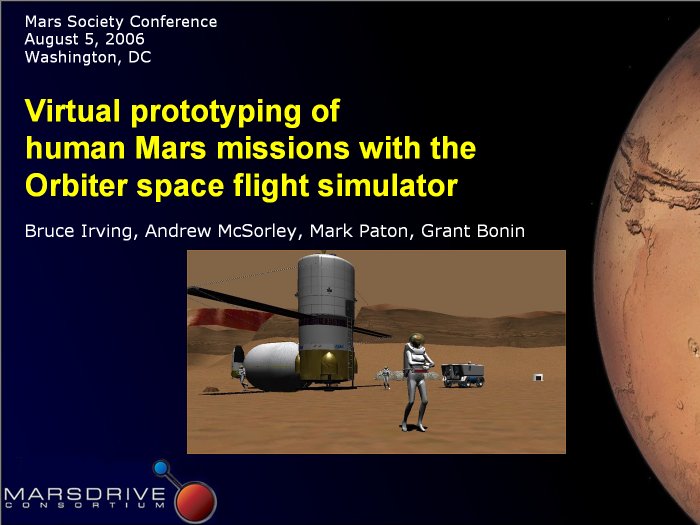
No blogging time the last few days - a long-time friend and musical partner from Nashville has been visiting and we've been writing and recording some new songs, something I haven't really done much of since I entered my current "space cadet" phase in spring of 2005 (when I discovered Orbiter). I'm also working on the final screen shots, video clips, and PowerPoint slides for the Mars for Less paper I will present at the Mars Society Conference on August 5, two weeks from today. Title slide shown above.

Saturday, June 10, 2006

More "Mars for Less"

Ariane-5 Launch Kourou
Andy McSorley and Mark Paton have been working steadily on the Orbiter models for our Mars for Less (MFL) virtual prototype. Most of the major components are complete and have been tested independently. On the Flickr pages, I've shown a number of shots of Andy's work with the Ariane-5 launch vehicle and his "Proteus" modular boosters, plus some of my tests with using tethers and small "droid" spacecraft to assist in (simulated) remote-control orbital assembly of these modules.

I've also shown a few examples in this blog of Mark's prototype MFL spacecraft, with which he has been doing Mars aerocapture and entry tests as well as modeling. We decided to "fatten up" the crew vehicles by assuming a larger launch fairing for the Ariane-5 (or other MLLV that might be used to launch these components). Mark is completing work on this now, so we will soon be able to perform "integration testing" and start capturing data, pictures, and video clips for the paper we will present at the Mars Society Conference in Washington, DC in August (Andy's picture above is a preview of the all-up Mars spacecraft with Francis Drake's CEV docked to deliver the crew). Once the paper is out of the way, we will clean up and document the whole lot and release it as an add-on for Orbiter users to play with. Note that we are making use of various other add-ons as part of these efforts - these will be referenced and credited in our paper and in the eventual release documentation.

The process of turning Grant Bonin's MarsDrive Mars for Less reference mission into a virtual prototype has been an iterative exercise through which Andy, Mark, Grant, and myself have learned a lot about spacecraft, launch vehicles, and Mars mission design. It has identified various design issues that we have been able to visualize and solve using Orbiter (it helps that both Andy and Mark are able and quick when it comes to 3D model building for Orbiter). This is really the point of our paper - that Orbiter is a fantastic, easy to use, and quite accurate tool for such virtual prototyping. It's also educational and fun (and it's free).