With the help of Pandora, I recently discovered a band I really love, The Grip Weeds . Although they have been around since the early 90’s, I had never heard of them until a song of theirs showed up on Pandora (on a station based on Winterpills, a favorite indie band from Massachusetts). They are sometimes labeled as power pop or psychedelic rock, and there is definitely something from the sixties in their sound. While they are not emulating any particular band, I can hear hints of the Who, Buffalo Springfield, Spirit, CSNY, The Beatles and others. Their harmonies and guitar parts are great. Great drumming too. While I love the rocking electric guitar driven songs, some of my favorites are acoustic tunes like "Give Me Some of Your Ways" and "Life and Love, Times To Come" (cool Indian instruments on this one).
I bought their 2008 collection “Infinite Soul: The Best Of The Grip Weeds” and their 2010 double album “Strange Change Machine.” Both are wonderful. You can currently get a free 8-song sampler from SCM by signing up with an email address at their web site. You can buy the 24 song double album as a download there as well for $9.99 which is considerably cheaper than the price at Amazon or iTunes (about $16). The band probably makes more money that way too. They are definitely worth supporting.
Space flight, simulators, astronomy, books, flying, music, science, education: whatever the obsession of the moment might happen to be.
Friday, August 19, 2011
Sunday, August 14, 2011
Beech Tree Book Serendipity
I've always loved bookstores, new and used. For me, serendipity is the major draw of the small independent store. Amazon can offer me anything I want if I know I want it. But what about all the promising books that I probably would want if I only knew about them? This is the role of the physical bookstore, which unfortunately is fast becoming an endangered species (thanks in no little part to Amazon and other internet booksellers).
So I was happy this weekend to discover a brand-new used book and record store literally down the street from my house. Beech Tree Books and Records is located at 9 Maple Street in West Boylston, Massachusetts, less than a mile from me and just a few minutes drive from Worcester. They opened on July 30 and readily admit to being a "work in progress" as they continue to add stock to lightly filled shelves and record and CD bins. But I managed to find two "must have" books on my very first visit, including Rockets, Jets, Guided Missiles, and Space Ships by Jack Coggins and Fletcher Pratt, a 1951 (!) illustrated book for kids, with an introduction by Willy Ley! It's heavy on the V-2 (which was practically the latest in rocket technology at the time) but bravely delves into orbits, space stations, moon landings, and even the exploration of Mars and Titan. What a great find for a space geek like myself. One of my favorite paragraphs from this 60 year old book is from Ley's introduction (with quoted words as written):
What are the next twenty years going to bring? One of the great things to come is under discussion among scientists right now. It is the "orbital rocket," a small rocket which will circle earth outside our atmosphere for "ever." This means, of course, "for a very long time," months, years, decades, possibly centuries. Such an orbital rocket would not carry any people but only instruments, instruments of the type which can be "read" from a distance because they are coupled with an automatic radio transmitter and continuously broadcast their findings.Beech Tree Books and Records is already a great little store with a lot of cool books, records, and CD's already on display at very reasonable prices and with more on the way. If you're in or near central Mass. and you like books, you should definitely check out this store.
Friday, August 12, 2011
Science!
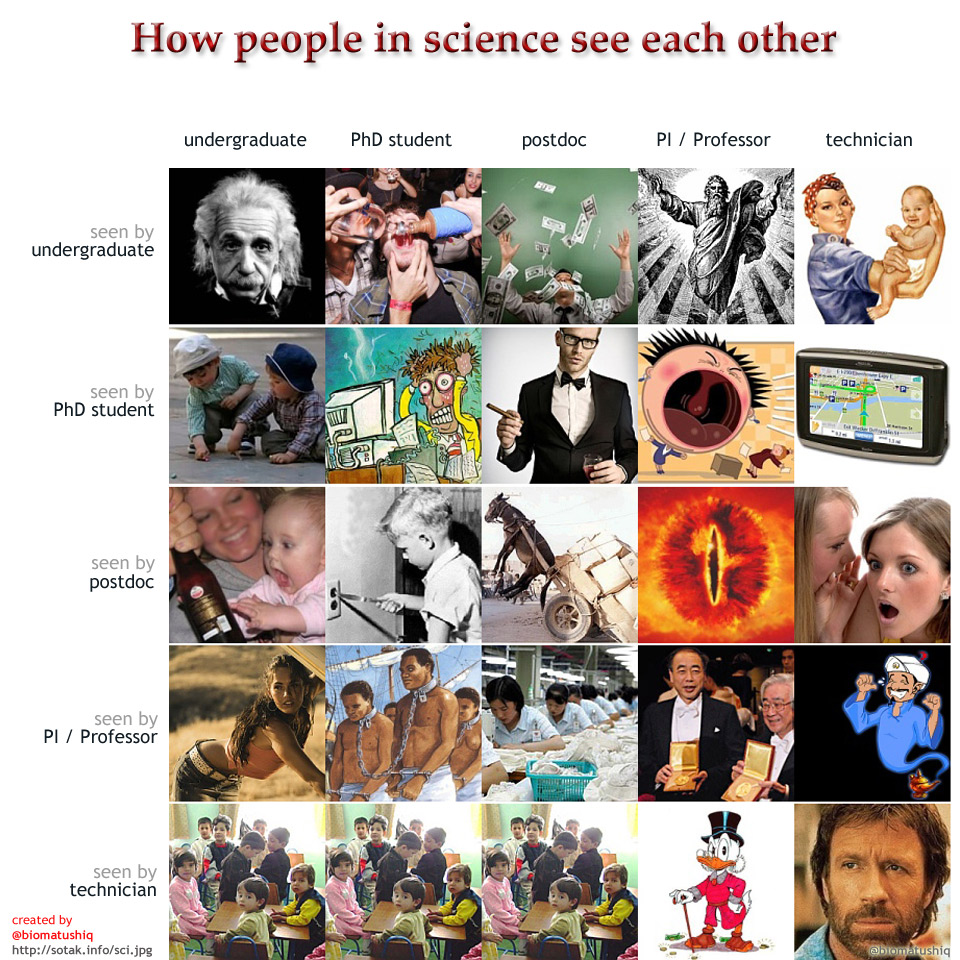
I love this. My son-in-law is a post-doc and he says it's pretty much right. Graphic by Matúš Soták.
Monday, July 25, 2011
SFO to CDG in 2 Minutes!
SF to Paris in Two Minutes from Beep Show on Vimeo.
I found this video on the Airpigz blog. It's really cool. This guy took a still picture out the window of an Air France 747 every two miles from San Francisco to Paris (the camera was on a special mount).
Sunday, July 24, 2011
Ghost Ants? Yes!
When a friend told me about Prophets of the Ghost Ants by Clark Carlton, I made the mistake of "taking a quick look." Since I'm just getting back into flying this summer after a few years away, I've really been trying to focus on study for my flight review, but I kept getting sucked back into this book instead! I really couldn't put it down (and since I was reading it in the Kindle edition on my iPod Touch, it was always at hand).
I'm not usually a fantasy reader (I tend to go for "hard SF"), but this book is somehow in a strange zone that is not quite fantasy, not quite "hard" science fiction, but is "sciencey" enough to reward my suspension of disbelief (great storytelling and characters helped too). The last time this happened was with a book Amazon was giving away as a Kindle loss-leader, His Majesty's Dragon by Naomi Novik. I was skeptical because dragon books are generally pure fantasy, but it was no risk to try. In that book, Novik re-imagines the Napoleonic wars with air power - flying, intelligent, talking dragons that crews of men ride into battle. The historical fiction is played straight (like a naval history novel), and the dragons are simply folded into that world (with great relationships between the dragons and their crews, especially their captains). That worked well enough to sell me six sequels! I think Carlton's "ant world" will be equally fertile (despite a similar disregard for physical scaling laws - dragons as described would be way too heavy to fly, and ant-size humans? I don't know, but it works in the book!).
Some Amazon reviewers have mentioned The Lord of the Rings, and I have to agree that the scope, world-building, compelling characters, and action/battle scenes of this book are of that quality. There is also the "unlikely hero" angle - but otherwise the stories are completely different. And although it's not hard SF, the biology of ants and other insects is an important part of the way these tiny human societies work, and it seems to be pretty accurate (and occasionally disgusting). There's also a tremendous amount of cultural anthropology embedded in this book - not in a scholarly way, but in an Ursula Le Guin sort of way. Under these circumstances and constraints, what would societies be like? What would their folk ways be like? Carlton has clearly thought a lot about these things, and they give the book an amazing depth and richness.
This is a great book. I can't wait for the sequels (and the movie!). Highly recommended!
I'm not usually a fantasy reader (I tend to go for "hard SF"), but this book is somehow in a strange zone that is not quite fantasy, not quite "hard" science fiction, but is "sciencey" enough to reward my suspension of disbelief (great storytelling and characters helped too). The last time this happened was with a book Amazon was giving away as a Kindle loss-leader, His Majesty's Dragon by Naomi Novik. I was skeptical because dragon books are generally pure fantasy, but it was no risk to try. In that book, Novik re-imagines the Napoleonic wars with air power - flying, intelligent, talking dragons that crews of men ride into battle. The historical fiction is played straight (like a naval history novel), and the dragons are simply folded into that world (with great relationships between the dragons and their crews, especially their captains). That worked well enough to sell me six sequels! I think Carlton's "ant world" will be equally fertile (despite a similar disregard for physical scaling laws - dragons as described would be way too heavy to fly, and ant-size humans? I don't know, but it works in the book!).
Some Amazon reviewers have mentioned The Lord of the Rings, and I have to agree that the scope, world-building, compelling characters, and action/battle scenes of this book are of that quality. There is also the "unlikely hero" angle - but otherwise the stories are completely different. And although it's not hard SF, the biology of ants and other insects is an important part of the way these tiny human societies work, and it seems to be pretty accurate (and occasionally disgusting). There's also a tremendous amount of cultural anthropology embedded in this book - not in a scholarly way, but in an Ursula Le Guin sort of way. Under these circumstances and constraints, what would societies be like? What would their folk ways be like? Carlton has clearly thought a lot about these things, and they give the book an amazing depth and richness.
This is a great book. I can't wait for the sequels (and the movie!). Highly recommended!
Saturday, July 23, 2011
Cool Vacation
I'm just back from a really great vacation with my wife in Las Vegas and San Francisco. We did some really cool things and got to spend a lot of time with family in Berkeley. We took a huge number of pictures that I hope we will look at someday. I'll paste a few in here. Here are a few highlights:
An early morning helicopter sightseeing tour from Las Vegas to the western end of the Grand Canyon, descending into the canyon and landing next to the Colorado River where the Papillon Helicopter Company provided champagne and a snack to supplement the amazing views. I've posted a number of photos and videos of this tour on my Flickr site.
The wonderful Cirque du Soleil show "Beatles - LOVE" at the Mirage.
An open-top bus tour of San Francisco. It was my wife's first time there so this was a great way to get an overview of the city despite the fog that blocked most of our view of the Golden Gate Bridge even as we were crossing it (the rest of the city was clear).
A visit to Muir Woods National Monument to see some of the beautiful and ancient redwoods there.
A hike in Tilden Regional Park in the Berkeley Hills - great views of the Bay Area. Followed by a fabulous dinner at the Chez Panisse Cafe in Berkeley.
A walk up SF's Telegraph Hill followed by a fabulous seafood lunch in North Beach and a de rigueur cable car ride.
We also took some time to relax, hang out, and to even enjoy a sunset over the Bay from a park adjacent to the Berkeley Marina.
An early morning helicopter sightseeing tour from Las Vegas to the western end of the Grand Canyon, descending into the canyon and landing next to the Colorado River where the Papillon Helicopter Company provided champagne and a snack to supplement the amazing views. I've posted a number of photos and videos of this tour on my Flickr site.
The wonderful Cirque du Soleil show "Beatles - LOVE" at the Mirage.
An open-top bus tour of San Francisco. It was my wife's first time there so this was a great way to get an overview of the city despite the fog that blocked most of our view of the Golden Gate Bridge even as we were crossing it (the rest of the city was clear).
A visit to Muir Woods National Monument to see some of the beautiful and ancient redwoods there.
A hike in Tilden Regional Park in the Berkeley Hills - great views of the Bay Area. Followed by a fabulous dinner at the Chez Panisse Cafe in Berkeley.
A walk up SF's Telegraph Hill followed by a fabulous seafood lunch in North Beach and a de rigueur cable car ride.
We also took some time to relax, hang out, and to even enjoy a sunset over the Bay from a park adjacent to the Berkeley Marina.
Thursday, July 21, 2011
End of the First Space Plane Era
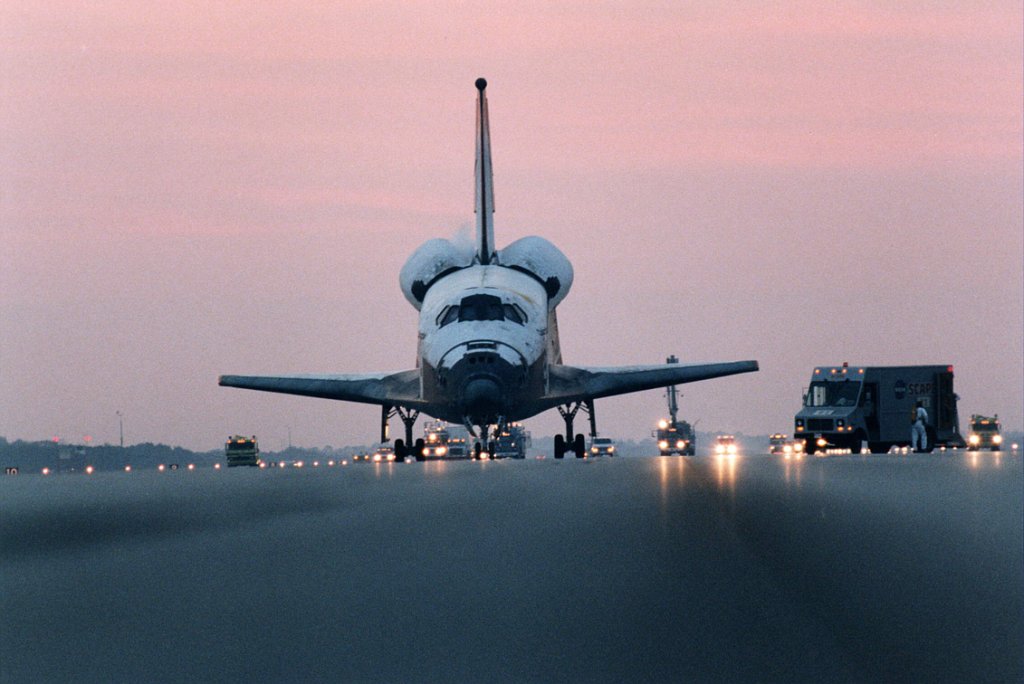
With the final landing of Atlantis (STS-135) early this morning, our first space plane era has ended after 30 years. I'm sure that human spaceflight will continue, and we will have other, better space planes someday. But Atlantis and her sister shuttles were a pretty audacious start, designed and built as they were with the technology of the 60's and early 70's. I'm happy that I got to witness the one launch that I did (Endeavour's STS-118 back in 2007). I would have loved to have flown in one.
I couldn't do that, but I was happy to discover last night that version 2.0 of the great iPhone app F-SIM Space Shuttle was recently released. The new version of this shuttle landing simulator adds wonderful external views and a cool replay feature that allows you to enjoy your successful landings and scrutinize your errors in great detail. The shuttle era lives on in a small way on my iPod Touch and on iPhones and iPads everywhere.
Here's a great personal video of the real STS-135 landing from someone who had a great viewing spot, and here's the official NASA video which includes a few seconds of the cockpit HUD view at the very start (F-SIM Space Shuttle duplicates the HUD view and behavior quite exactly).
I couldn't do that, but I was happy to discover last night that version 2.0 of the great iPhone app F-SIM Space Shuttle was recently released. The new version of this shuttle landing simulator adds wonderful external views and a cool replay feature that allows you to enjoy your successful landings and scrutinize your errors in great detail. The shuttle era lives on in a small way on my iPod Touch and on iPhones and iPads everywhere.
Here's a great personal video of the real STS-135 landing from someone who had a great viewing spot, and here's the official NASA video which includes a few seconds of the cockpit HUD view at the very start (F-SIM Space Shuttle duplicates the HUD view and behavior quite exactly).
Labels:
games,
NASA,
shuttle,
simulation,
space history
Saturday, July 09, 2011
Photographic Moon Book (v3.5)
This is something I just rediscovered on my hard drive while looking for something else. I wrote about Alan Chu's wonderful Photographic Moon Book in 2007. It is an observer's photographic guidebook to the Moon containing nearly 300 annotated images of lunar features as well as some great introductory material on the Moon. Alan has continued to update and improve it. He released version 3.5 in March 2011. It's a free PDF, and it's big - 125 MB. You can download it from Alan's own Hong Kong site, or from a US based mirror site.
When I first found this in 2007, there was also a smaller document called the "Moon Science Primer." Most of this material is in the introductory section of the Moon Book, but the Primer goes a little deeper on some topics. Although Google still has a link to this, there is no link on Alan's home page, and the Google link returns a "not found."
Monday, July 04, 2011
Flying Posts: See "Flight School Retrojournal"
As I discussed recently, I've started to get back into flying, and it's really fun. I'm flying a Citabria 7ECA "Aurora" at Sterling Airport with the airplane's owner, Ed Urbanowski of Urban Aviation. It's a great little airplane, and Ed is a great instructor. Since I've been away from flying for seven years (yikes!), it will probably take a few hours with an instructor to get my skills back into shape. But I'm in no hurry. Safety first and all that.
So far it's going well - but it's only been two flights, and there's a lot to re-learn. Since I already have another blog devoted to (retroactively) documenting my original flight lessons (1997 to 2001, more or less), I've decided to use that blog for my current lessons as well. Even though it's called Flight School Retrojournal, I'll blog all the new stuff too - re-learning old tricks, breaking old habits, getting current, getting signed off to fly tail-wheel airplanes,and all that. So if you are interested in the nitty-gritty of learning (or re-learning) to fly, check out my other blog. There probably won't be a lot of photos, since I've decided to spend every minute in the cockpit focused on flying. I'll save the sightseeing for when I can fly on my own again - maybe this fall.
Sunday, June 26, 2011
Putting the "Flying" Back in FlyingSinger
Recently I've been thinking about what a shame it is that I have my private pilot's license but haven't piloted an airplane in over five years. Of course flying is pretty expensive and requires a lot of time, study, and attention to do it safely, and I've been pretty busy with other things. But I miss it.
Today I was in Marlboro, MA for brunch with my daughters when I happened to drive by Marlboro Airport (9B1). I had never visited 9B1 before, so I stopped to check it out. A student pilot (I assumed) in a Cessna 172 was practicing takeoffs and landings, so I watched for a while. I noticed that the single runway is quite short, with tall trees quite close to the approach end that was in use at the time (runway 32, landing to the northwest). The nearby trees reminded me of Hopedale Airport (1B6) where I took my first few flight lessons back in 1997, although when I went into the FBO to ask about rental and instruction rates, I learned that Marlboro's runway is much shorter than Hopedale's (by about half, 1659 feet vs. 3172 feet!).
Marlboro Airport is about half an hour from home, and since I now work in Marlboro, I started thinking about what it would take to get current in a C152 or C172. Probably a few hours of refresher lessons to prepare for a flight review (BFR) before I can rent an airplane and fly solo again (plus I will need to get a current medical certificate). The short, narrow runway would certainly encourage disciplined flying and provide an additional challenge.
Driving home I realized I should also check out the airport that's closest to my house, Sterling (3B3). I've flown there a few times, including a couple of soaring lessons, and it's a nice little airport with a 3086' asphalt runway and a parallel grass runway that's used by the gliders and tail draggers. So I took the twelve minute drive and got a pleasant surprise - the flight school there is now run by Ed Urbanowski, a flight instructor from whom I had taken a few tail wheel lessons back in 2004 over in Spencer (60M). Ed now instructs full-time and has a Citabria 7ECA Aurora (pictured) in addition to the Piper Cub we flew in 2004 and two Cessna aircraft. I didn't finish the tail-wheel endorsement, and I would still like to do that. Unlike the bare-bones classic Cub, the Citabria has a modern panel and an electrical system (no need to pull the prop!), and it can be soloed from the front seat. It's got a stick rather than a yoke (like the Cub), and it looks like a fun airplane to fly. So I signed up for my first refresher lesson for next Saturday morning. To be continued (finally!)...
I took this "artistic" picture of Sterling Airport on a late afternoon glider flight looking west on the downwind leg.
Today I was in Marlboro, MA for brunch with my daughters when I happened to drive by Marlboro Airport (9B1). I had never visited 9B1 before, so I stopped to check it out. A student pilot (I assumed) in a Cessna 172 was practicing takeoffs and landings, so I watched for a while. I noticed that the single runway is quite short, with tall trees quite close to the approach end that was in use at the time (runway 32, landing to the northwest). The nearby trees reminded me of Hopedale Airport (1B6) where I took my first few flight lessons back in 1997, although when I went into the FBO to ask about rental and instruction rates, I learned that Marlboro's runway is much shorter than Hopedale's (by about half, 1659 feet vs. 3172 feet!).
Marlboro Airport is about half an hour from home, and since I now work in Marlboro, I started thinking about what it would take to get current in a C152 or C172. Probably a few hours of refresher lessons to prepare for a flight review (BFR) before I can rent an airplane and fly solo again (plus I will need to get a current medical certificate). The short, narrow runway would certainly encourage disciplined flying and provide an additional challenge.
Driving home I realized I should also check out the airport that's closest to my house, Sterling (3B3). I've flown there a few times, including a couple of soaring lessons, and it's a nice little airport with a 3086' asphalt runway and a parallel grass runway that's used by the gliders and tail draggers. So I took the twelve minute drive and got a pleasant surprise - the flight school there is now run by Ed Urbanowski, a flight instructor from whom I had taken a few tail wheel lessons back in 2004 over in Spencer (60M). Ed now instructs full-time and has a Citabria 7ECA Aurora (pictured) in addition to the Piper Cub we flew in 2004 and two Cessna aircraft. I didn't finish the tail-wheel endorsement, and I would still like to do that. Unlike the bare-bones classic Cub, the Citabria has a modern panel and an electrical system (no need to pull the prop!), and it can be soloed from the front seat. It's got a stick rather than a yoke (like the Cub), and it looks like a fun airplane to fly. So I signed up for my first refresher lesson for next Saturday morning. To be continued (finally!)...
I took this "artistic" picture of Sterling Airport on a late afternoon glider flight looking west on the downwind leg.
Thursday, June 23, 2011
The Soul of a Not-Quite-Thinking Machine
I just finished a wonderful book, Final Jeopardy: Man vs. Machine and the Quest to Know Everything by Stephen Baker. Baker had inside access to the IBM team that developed Watson, the amazing question-answering computer system that bested two human champions on Jeopardy early this year. The book quickly jumped the queue in my Amazon Kindle app after I read the sample chapter. I've always been fascinated by artificial intelligence, and I had already read a bit about Watson in a New York Times series last fall and through a number of web sources, but I somehow missed this book. It came out in February, shortly after the Watson shows had aired.
While Baker discusses some of the technology behind Watson, it's really the story of a group of talented humans who took on a great challenge. IBM had already been working on natural language-based question answering systems, but when the "Blue J" project started in 2006, they were nowhere near the level of any human player, let alone champions like Ken Jennings and Brad Rutter. The book reminded me most of Tracy Kidder's The Soul of a New Machine which I read sometime in the 1980's.
As interested as I was in Watson, I missed the original Jeopardy broadcast due to travel, and I had seen only a few brief excerpts. While reading the book, I decided I should really watch the whole three-show tournament, which I was able to do (without commercials) in about an hour thanks to YouTube. I was also curious to know more about the technology of Watson than I had learned from Baker and the other general things I had read online. I found a great paper from AI Magazine's fall 2010 issue, "An Overview of the DeepQA Project" (PDF), written by the IBM Watson project leader David Ferrucci and 11 members of his team. It is really incredible to learn about what goes on behind the scenes to allow Watson to answer virtually any Jeopardy question in 3-5 seconds with such incredible precision and confidence. "Confidence" is a big part of why this "QA" technology is different from something like Google's search technology which usually gets you into the neighborhood of an answer, but depends on having a human in the loop to determine the "right" answer. Watson has no human in the loop, so it needs to "know what it knows" to decide whether to "buzz in" on a Jeopardy question. It puts its "hypotheses" through extensive evaluation to determine its confidence in each one as a possible answer.
Of course IBM does not claim that Watson is "intelligent" or that it "thinks" anything like we do, but you could say that human brains are also massively parallel computing systems with thousands of inter-communicating subsystems. Watson's subsystems are in server racks. Our subsystems are squishy. Diversity! So let's give a warm welcome to our new computer overlord cousin, shall we?
While Baker discusses some of the technology behind Watson, it's really the story of a group of talented humans who took on a great challenge. IBM had already been working on natural language-based question answering systems, but when the "Blue J" project started in 2006, they were nowhere near the level of any human player, let alone champions like Ken Jennings and Brad Rutter. The book reminded me most of Tracy Kidder's The Soul of a New Machine which I read sometime in the 1980's.
As interested as I was in Watson, I missed the original Jeopardy broadcast due to travel, and I had seen only a few brief excerpts. While reading the book, I decided I should really watch the whole three-show tournament, which I was able to do (without commercials) in about an hour thanks to YouTube. I was also curious to know more about the technology of Watson than I had learned from Baker and the other general things I had read online. I found a great paper from AI Magazine's fall 2010 issue, "An Overview of the DeepQA Project" (PDF), written by the IBM Watson project leader David Ferrucci and 11 members of his team. It is really incredible to learn about what goes on behind the scenes to allow Watson to answer virtually any Jeopardy question in 3-5 seconds with such incredible precision and confidence. "Confidence" is a big part of why this "QA" technology is different from something like Google's search technology which usually gets you into the neighborhood of an answer, but depends on having a human in the loop to determine the "right" answer. Watson has no human in the loop, so it needs to "know what it knows" to decide whether to "buzz in" on a Jeopardy question. It puts its "hypotheses" through extensive evaluation to determine its confidence in each one as a possible answer.
Of course IBM does not claim that Watson is "intelligent" or that it "thinks" anything like we do, but you could say that human brains are also massively parallel computing systems with thousands of inter-communicating subsystems. Watson's subsystems are in server racks. Our subsystems are squishy. Diversity! So let's give a warm welcome to our new computer overlord cousin, shall we?
Saturday, June 18, 2011
Increasing Cloudiness
A few months ago I started using Amazon's Cloud Drive service to store some of my music online. This was pretty much a no-brainer since I often buy MP3's from Amazon anyway, and these are now stored for you by default (and for free) on their cloud. You can also download them if you so choose. I don't have a huge amount of music there, about 2000 songs, mostly recent Amazon purchases. It includes about 5 GB of selected music I have uploaded, but I didn't really want to "commit" to Amazon's cloud service too quickly (other than the free part) since I assumed other things would be coming along, which of course is true. I do listen to the Amazon Cloud Player quite often since it includes a lot of my recent music, some of which I haven't bothered to download, especially a few 99-track classical collections bought on sale for $1.99 or so. The player has limited features but works quite well.
A few days ago I received an invitation to join Google Music Beta (I had requested this in May when it was announced). This is a pretty good deal, since Google will store up to 20,000 songs for free (at least for now - I haven't really read the fine print, but Google doesn't seem to worry much about storage as long as they have your eyeballs). The catch is that you have to upload all the songs you want them to store for you. To help you with this task, they can look at your iTunes or Windows Media Player music files to figure out what to upload (pretty much automatically, including iTunes playlists).
So it's an easy thing to do, but if you have a lot of music as I do, it's a long process. I've had it running on a good internet connection for two full overnights as well as all day today, and so far it's got about 5,800 of my estimated 20,000 songs online. I haven't paid too much attention to it except to correct occasional album cover art errors (I have a lot of MP3's ripped from CD's, most of which have cover art in iTunes, but Google sometimes gets its own and sometimes chooses wrong). The player is good though also quite basic, but this is "beta" so I assume this web-based interface will improve over time. You can start listening to music as soon as you have a few files there, which is cool. I think of it as a playable off-site backup for my music collection (though there is no provision I can see to re-download your music, so in that sense it's not a real backup).
Come fall I expect to have a third cloud full of music, once Apple introduces its full iCloud service. That will be really cool because it will scan my iTunes collection and re-create it online without my having to upload most of it (I will only have to upload anything I have that isn't in iTunes' 19 million song collection - things like vinyl albums that never made it to CD that I have ripped to MP3). I think iCloud will be the real deal because it will work directly with my iPod Touch as well as our PC's and my wife's iPhone.
A few days ago I received an invitation to join Google Music Beta (I had requested this in May when it was announced). This is a pretty good deal, since Google will store up to 20,000 songs for free (at least for now - I haven't really read the fine print, but Google doesn't seem to worry much about storage as long as they have your eyeballs). The catch is that you have to upload all the songs you want them to store for you. To help you with this task, they can look at your iTunes or Windows Media Player music files to figure out what to upload (pretty much automatically, including iTunes playlists).
So it's an easy thing to do, but if you have a lot of music as I do, it's a long process. I've had it running on a good internet connection for two full overnights as well as all day today, and so far it's got about 5,800 of my estimated 20,000 songs online. I haven't paid too much attention to it except to correct occasional album cover art errors (I have a lot of MP3's ripped from CD's, most of which have cover art in iTunes, but Google sometimes gets its own and sometimes chooses wrong). The player is good though also quite basic, but this is "beta" so I assume this web-based interface will improve over time. You can start listening to music as soon as you have a few files there, which is cool. I think of it as a playable off-site backup for my music collection (though there is no provision I can see to re-download your music, so in that sense it's not a real backup).
Come fall I expect to have a third cloud full of music, once Apple introduces its full iCloud service. That will be really cool because it will scan my iTunes collection and re-create it online without my having to upload most of it (I will only have to upload anything I have that isn't in iTunes' 19 million song collection - things like vinyl albums that never made it to CD that I have ripped to MP3). I think iCloud will be the real deal because it will work directly with my iPod Touch as well as our PC's and my wife's iPhone.
Saturday, June 11, 2011
Shuttle Nostalgia
Today I was looking at some of the great ISS-Endeavour photos taken on May 23 by the ISS Expedition 27 crew from their departing Soyuz spacecraft (there's a wonderful NASA gallery here, cool video here). What a beautiful sight! This got me thinking about the fact that there's only one shuttle flight left, coming up in less than a month if things stay on schedule. Of course this is not shocking news for space enthusiasts, but it is still sad to think there will be no more flights of this amazing spacecraft.
This nostalgia carried me to Amazon where I started to look at shuttle books and videos before realizing, hey, I've already got some great shuttle books and videos that I haven't looked at in ages. Not that this will keep me from buying more (especially this 30 year retrospective coming out in late August), but I ended up re-reading most of the astronaut anecdotes from Space Shuttle: The First 20 Years -- The Astronauts' Experiences in Their Own Words which was published in 2002 (looks like it's out of print now - available only from third-party sellers). This is a fantastic book with a great selection of photographs and reference material on all the shuttle flights through STS-102 in March 2001.
But what makes it special are the astronauts' own words about their experiences, from the mundane to the sublime. Some comments are technical, like John Young discussing the very first reentry on STS-1, "It was a pretty good test flight, and we discovered a lot of things. For example, coming into the atmosphere at Mach 25 we got a really bad sideslip that we didn't expect, where the orbiter slipped sideways four degrees and dropped in altitude. Fortunately the software canceled it out. If it hadn't, we wouldn't be here." Some are humorous stories, like the crew of STS-95 (1998) teasing Senator John Glenn (77 at the time) about being a shuttle "rookie" and staging a little gag involving a fake "Shuttle boarding pass" that Glenn didn't have. There are a number of stories about illusions and other effects coming about from zero-G (like dropping some object just after returning from orbit, subconsciously expecting it to float). Many astronauts comment about the amazing views of Earth and on how the view of the "whole Earth" changed their lives. It's a wide range of subjects - about a third of the more than 250 people who flew on the shuttle from 1981 to 2001 responded, and they were told to talk about whatever experiences they chose.
It's hard to pick a favorite, but there's a cool one that shows how it's all relative. Joe Edwards was the pilot on STS-89, and he talks about thinking that he was born too late for Apollo and too early to make it to Mars. At a memorial service for Alan Shepherd in 1998, he was talking with some other "younger generation" shuttle astronauts about this "born too late" idea when veteran Apollo astronaut Jim Lovell walked over. Jim wanted to say hello and to tell them about his discussion with "Neil, Buzz, and Gene" in which they decided they were born too early. Huh? Lovell said, "Well, you guys get the opportunity to go up to the space station. You get to fly the only reusable spacecraft that's ever been built, and you get to do all of these difficult and challenging things. We were just born too early. All we ever got to do was Apollo."
Well, Jim, that was still something. Apollo is history and in another month or so, the shuttle program will be history too. But I'm sure there will still be some difficult and challenging things for the next few generations of astronauts to do.
This nostalgia carried me to Amazon where I started to look at shuttle books and videos before realizing, hey, I've already got some great shuttle books and videos that I haven't looked at in ages. Not that this will keep me from buying more (especially this 30 year retrospective coming out in late August), but I ended up re-reading most of the astronaut anecdotes from Space Shuttle: The First 20 Years -- The Astronauts' Experiences in Their Own Words which was published in 2002 (looks like it's out of print now - available only from third-party sellers). This is a fantastic book with a great selection of photographs and reference material on all the shuttle flights through STS-102 in March 2001.
But what makes it special are the astronauts' own words about their experiences, from the mundane to the sublime. Some comments are technical, like John Young discussing the very first reentry on STS-1, "It was a pretty good test flight, and we discovered a lot of things. For example, coming into the atmosphere at Mach 25 we got a really bad sideslip that we didn't expect, where the orbiter slipped sideways four degrees and dropped in altitude. Fortunately the software canceled it out. If it hadn't, we wouldn't be here." Some are humorous stories, like the crew of STS-95 (1998) teasing Senator John Glenn (77 at the time) about being a shuttle "rookie" and staging a little gag involving a fake "Shuttle boarding pass" that Glenn didn't have. There are a number of stories about illusions and other effects coming about from zero-G (like dropping some object just after returning from orbit, subconsciously expecting it to float). Many astronauts comment about the amazing views of Earth and on how the view of the "whole Earth" changed their lives. It's a wide range of subjects - about a third of the more than 250 people who flew on the shuttle from 1981 to 2001 responded, and they were told to talk about whatever experiences they chose.
It's hard to pick a favorite, but there's a cool one that shows how it's all relative. Joe Edwards was the pilot on STS-89, and he talks about thinking that he was born too late for Apollo and too early to make it to Mars. At a memorial service for Alan Shepherd in 1998, he was talking with some other "younger generation" shuttle astronauts about this "born too late" idea when veteran Apollo astronaut Jim Lovell walked over. Jim wanted to say hello and to tell them about his discussion with "Neil, Buzz, and Gene" in which they decided they were born too early. Huh? Lovell said, "Well, you guys get the opportunity to go up to the space station. You get to fly the only reusable spacecraft that's ever been built, and you get to do all of these difficult and challenging things. We were just born too early. All we ever got to do was Apollo."
Well, Jim, that was still something. Apollo is history and in another month or so, the shuttle program will be history too. But I'm sure there will still be some difficult and challenging things for the next few generations of astronauts to do.
Sunday, June 05, 2011
Carnival of Space 200!
The Carnival of Space is 200 this week! Of course that is only 200 weeks, but it's still a pretty nice number. I remember when it was just a baby, back on April 26, 2007 when Henry Cates posted the first space carnival (oddly enough) on his Why Homeschool blog. Since then the carnival has been hosted by many different blogs (including mine a few times, though not very recently) and has expanded to cover a wide range of space and astronomy subjects.
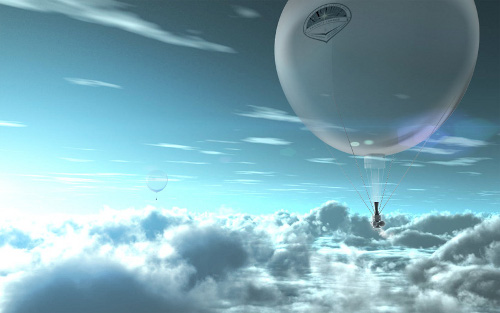
Number 200 is hosted this week by Next Big Future. There are a lot of good posts, but my particular favorite is "Starship Fuel from the Outer System" from Centauri Dreams. It discusses the possible "mining" of Helium-3 from the atmosphere of Uranus. While the technology for this is a few years off (on several levels), it could provide fuel for fusion reactor-driven starships as well as a source of fusion fuel for Earth's energy needs. I've linked above to the beautiful image by Adrian Mann showing an He-3-harvesting "hot air" balloon above the clouds of Uranus's atmosphere.
Thursday, June 02, 2011
Paul Simon Dazzles
Wow, what a concert. I saw Paul Simon last night at the Citi Wang Theater in Boston, possibly one of the best concerts I've ever attended. Paul and his incredible eight-genius backing band played for nearly two hours, covering nearly every part of Paul's incredible career in about 24 songs. Nearly all of the band members played two or more instruments, including horns and the wide range of percussion used on songs from Graceland, Rhythm of the Saints, and the new So Beautiful or So What albums. At 69, Paul's voice, guitar playing, and stage presence are incredibly strong.The band was rock-solid on all the many styles of music that Paul's music incorporates, from delicate harmonies and background vocals on the Simon & Garfunkel classic "The Only Living Boy in New York" to the rollicking Zydeco of "That Was Your Mother" from Graceland.
A few of the songs brought on nostalgic tears - "The Sound of Silence" and "Only Living Boy" from the early days, "Peace Like a River" from the first solo album, "Still Crazy After All These Years" and "Slip Sliding Away" from the mid-seventies, and "Hearts and Bones" from 1983. I was thrilled to hear "The Obvious Child" from Rhythm of the Saints as well as five of the rhythmically and melodically rich songs from Graceland (Crazy Love, That Was Your Mother, Diamonds on the Soles of Her Shoes, Gumboots, and The Boy in the Bubble) - the band was amazing on these songs (they made great use of the two drummers plus supplemental percussion and horns played by three keyboard players). Paul and the band also pulled off some unusual sounds and musical effects on five of the songs from the new album (Dazzling Blue, So Beautiful or So What, Rewrite, The Afterlife, and the quietly haunting Questions for the Angels).
The sound system and engineering were also impressive, allowing all of these complex instrument sounds (plus vocals!) to remain clear and distinct. One surprise in the first encore was an acoustic version of George Harrison's "Here Comes the Sun" - as pretty as this was, I would have traded it for another one of Paul's own classics, perhaps "Mrs. Robinson" or "The Boxer" or "America," but that's OK. He has too many great songs to fit in one evening, and it was all wonderful. I was reminded again and again of the beauty and craft of Paul's songwriting, especially in the rhythms and the lyrics - the attention to every detail and the work needed to make it all sound so natural and inevitable. What an inspiration!
A few of the songs brought on nostalgic tears - "The Sound of Silence" and "Only Living Boy" from the early days, "Peace Like a River" from the first solo album, "Still Crazy After All These Years" and "Slip Sliding Away" from the mid-seventies, and "Hearts and Bones" from 1983. I was thrilled to hear "The Obvious Child" from Rhythm of the Saints as well as five of the rhythmically and melodically rich songs from Graceland (Crazy Love, That Was Your Mother, Diamonds on the Soles of Her Shoes, Gumboots, and The Boy in the Bubble) - the band was amazing on these songs (they made great use of the two drummers plus supplemental percussion and horns played by three keyboard players). Paul and the band also pulled off some unusual sounds and musical effects on five of the songs from the new album (Dazzling Blue, So Beautiful or So What, Rewrite, The Afterlife, and the quietly haunting Questions for the Angels).
The sound system and engineering were also impressive, allowing all of these complex instrument sounds (plus vocals!) to remain clear and distinct. One surprise in the first encore was an acoustic version of George Harrison's "Here Comes the Sun" - as pretty as this was, I would have traded it for another one of Paul's own classics, perhaps "Mrs. Robinson" or "The Boxer" or "America," but that's OK. He has too many great songs to fit in one evening, and it was all wonderful. I was reminded again and again of the beauty and craft of Paul's songwriting, especially in the rhythms and the lyrics - the attention to every detail and the work needed to make it all sound so natural and inevitable. What an inspiration!
Monday, May 30, 2011
Skylon in Orbiter
So Wikipedia tells me that the Reaction Engines Skylon proposal has been around for a very long time - how did I miss it? I guess the idea has heated up mostly since 2009 with the emergence of some funding. The new UK Space Egency/ESA report gives it another boost. It will still need a lot of funding, but Reaction Engines claims that it "will be able to repay its development costs, meet its servicing and operating costs and make profits for its operators whilst being an order of magnitude cheaper to customers than current space transportation systems." Here's hoping that all pans out (and that there's sufficient launch business to support this project as well as SpaceX and other private space ventures - so much depends on the costs-to-orbit they achieve). It would be really great to see a true space plane taking off from a runway, flying to orbit, and returning to the same runway - just like in the movies (and even without a pilot).
This article clearly explains some of the hybrid engine challenges. The Wikipedia article explains some of the smart thinking that has gone into keeping Skylon cool and safe for reentry (cool enough to allow an integral ceramic skin to do most of the work, although active cooling will probably be needed for the wings).It will still land as a glider like the space shuttle - no plans to retain fuel and re-start the air-breathing engines for landing.
I may have missed Skylon (until this very recent blog post), but members of the Orbiter community didn't and there is already a cool add-on version as well as some additional work based on that model. I downloaded the basic one by "inzane" and tried it out just a bit (mainly for screenshots). I wasn't able to make orbit on my first try - probably missed some steps in the instructions. Hey, it's new technology! It's also a very cool-looking 3D model.
Although Skylon is an unpiloted launch vehicle (essentially a huge UAV with some serious autopilot smarts), there have been some studies on possible passenger capabilities, and the Orbiter add-on features a passenger module which is visible in the screenshot above. I posted a few more screenshots on my Flickr page.
This article clearly explains some of the hybrid engine challenges. The Wikipedia article explains some of the smart thinking that has gone into keeping Skylon cool and safe for reentry (cool enough to allow an integral ceramic skin to do most of the work, although active cooling will probably be needed for the wings).It will still land as a glider like the space shuttle - no plans to retain fuel and re-start the air-breathing engines for landing.
I may have missed Skylon (until this very recent blog post), but members of the Orbiter community didn't and there is already a cool add-on version as well as some additional work based on that model. I downloaded the basic one by "inzane" and tried it out just a bit (mainly for screenshots). I wasn't able to make orbit on my first try - probably missed some steps in the instructions. Hey, it's new technology! It's also a very cool-looking 3D model.
Although Skylon is an unpiloted launch vehicle (essentially a huge UAV with some serious autopilot smarts), there have been some studies on possible passenger capabilities, and the Orbiter add-on features a passenger module which is visible in the screenshot above. I posted a few more screenshots on my Flickr page.
Labels:
add-on,
future,
Orbiter,
private space,
technology
Carnival of Space #199
The 199th Carnival of Space is hosted this week by Weirdwarp. There are some really cool posts this week, but I was especially intrigued by the mysterious black Skylon space plane, which was reported by Next Big Future. This unpiloted SSTO (single stage to orbit) vehicle has been proposed by a UK company, Reaction Engines, Ltd. (Skylon press release here, PDF). The news is that an ESA report commissioned by the UK Space Agency concluded "no impediments or critical items have been identified for either the SKYLON vehicle or the SABRE engine that are a block to further developments."
This is exciting stuff, the key to its possible feasibility being the SABRE hybrid air-breathing/rocket engine that would allow Skylon to operate like a jet airplane while within the denser part of the atmosphere, leading to an enormous reduction in the amount of oxidizer that must be carried. The report states that the current design has a gross take off weight of 275 metric tonnes, of which 220 tonnes are propellent, with the ability to place 12 tonnes into an equatorial low Earth orbit. This is something like 4.4% of the total which is pretty good, especially with a fully-reusable vehicle (the calculation for the soon-to-retire space shuttle is about 1.4%, not including the orbiter itself).
The Reaction Engines site says that Skylon is in the "proof of concept" stage, with development estimated at 10 years. There are obviously a few technical issues to overcome (materials, for one, I would imagine), but it's great that ESA at least sees no fundamental showstoppers in the Skylon proposal. Now to get it funded! Reaction Engines estimates development costs of about $10 billion (this seems pretty cheap, even for an unpiloted vehicle).
Bonus: finally a rocket ship that looks like one of Wernher von Braun and Chesley Bonestell's classic Colliers Magazine rocket ships from the 1950's! More or less. Check out the Skylon mission animation video.
This is exciting stuff, the key to its possible feasibility being the SABRE hybrid air-breathing/rocket engine that would allow Skylon to operate like a jet airplane while within the denser part of the atmosphere, leading to an enormous reduction in the amount of oxidizer that must be carried. The report states that the current design has a gross take off weight of 275 metric tonnes, of which 220 tonnes are propellent, with the ability to place 12 tonnes into an equatorial low Earth orbit. This is something like 4.4% of the total which is pretty good, especially with a fully-reusable vehicle (the calculation for the soon-to-retire space shuttle is about 1.4%, not including the orbiter itself).
The Reaction Engines site says that Skylon is in the "proof of concept" stage, with development estimated at 10 years. There are obviously a few technical issues to overcome (materials, for one, I would imagine), but it's great that ESA at least sees no fundamental showstoppers in the Skylon proposal. Now to get it funded! Reaction Engines estimates development costs of about $10 billion (this seems pretty cheap, even for an unpiloted vehicle).
Bonus: finally a rocket ship that looks like one of Wernher von Braun and Chesley Bonestell's classic Colliers Magazine rocket ships from the 1950's! More or less. Check out the Skylon mission animation video.
Labels:
astronomy,
blogs,
future,
private space,
technology
Sunday, May 29, 2011
Orbital Resonance and 2084 (Save Us, Elon!)
I recently re-read Orbital Resonance by John Barnes, one of my favorite SF writers. This book is part of Barnes' "Kaleidoscope Century" series about which I have written before. Written in the early 1990's, the series imagines an alternate near-future in which a series of disasters have devastated Earth in the early twenty-first century (names such as Tailored Rice Blast, mutAIDS, the Eurowar, and the Great Die-Off suggest the scale of Earth's troubles). Space flight has advanced sufficiently to allow construction of some off-planet "lifeboats" including several space colonies formed from captured asteroids and an embryonic terraforming project on Mars. These space activities can only include a tiny fraction of Earth's population, but they provide hope that humanity can survive even if Earth does not. And of course they have their own troubles.
Orbital Resonance takes place aboard The Flying Dutchman, a huge space colony built and operated by NihonAmerica Corporation which is on a special "resonant" orbit that cycles between Earth and Mars, transporting cargo and colonists. The ship is largely self-sufficient and houses a permanent population of 7,200, most of whom have been born on the ship and are under 20 years old. Melpomene Murray is the narrator. Thirteen "ground years" old, she is one of these young ship-born members who know of life on Earth only from videos and from the stories of the parents. Space-ship engineering is quite important and advanced, but social engineering is equally important. While most adults manage to adjust to life in this confined, disciplined, variable-gravity environment, the kids have grown up on the ship, and their schooling and socialization have been tailored to help them cope and eventually take over from the adults here. They are the future. But has the social engineering been successful? That's the story of this book.
Of course psychology is still not an exact science, and when a new boy from Earth joins Mel's class, the social balance is disturbed in various ways. Despite their impressive skills and knowledge, these are after all still adolescents, with all the hormonal and other issues that implies. Mel doesn't consider herself to be special (that's part of the team-oriented socialization process), but it turns out that she and a few of the other kids are special, with fewer of the social/developmental controls that have been placed on most of the kids. The adults are grooming them for leadership positions. But the kids don't especially like the ways they have been manipulated. I'll leave the rest for you find out if you choose to read it (as I have done three times now).
Of course I love "space stuff" and there is plenty of it here, but the book is not primarily about space, nor is it primarily about Earth's disasters, though these form the essential backdrop for why this ship and its three sister-ships exist. I read another book recently that is explicitly concerned with Earth disasters, a $1.99 "Kindle Short" called 2084: An Oral History of the Great Warming by James Powell. There's really very little about space or any other advanced technologies in this book. Its premise is that we do more or less nothing about human contributions to climate change (i.e., the path we are on now), and that due to various plausible feedback loops and uncertainties in the climate models, we end up with a 6° C (10.8° F) average temperature rise and a one meter (3.3 feet) average sea level rise by 2050. A variety of bad things ensue, many of them indirect side effects of climate change. They are told as "remembered anecdotes" by eyewitnesses to events that took place over many years.
There are obvious ones like the loss of many of the world's low coastal cities (most of Florida's coastal cities as well as most of the Netherlands are lost, not to mention most of Bangladesh). Loss of water supplies devastates the US Southwest, sub-Saharan Africa, and many other areas and leads to wars over water supplies, including a nuclear war between India and Pakistan. There are so many mega-storms that they are no longer named, but numbered by year, like 2048-9, and a huge storm in 2042 inundates and destroys major parts of New York City. Most of the US mid-west becomes too warm and dry to grow wheat, while Canada's climate makes it the new breadbasket - and leads to invasion and war with the United States! This sounds implausible, but consider that problems with water, food, and immigration (huge numbers of climate refugees heading for Europe, USA, and other areas) have led to the rise of Fascist governments in many countries, including the USA. There's more - a total of 18 anecdotes in this brief, fictional "oral history."
It's not the greatest writing (e.g., I was annoyed by the abundance of "local color" foreign expressions that the author inserted in most anecdotes, apparently to remind you that this was not an American "speaking"), but it is very thought-provoking. It is something of a worst-case, because although we can't be sure that technology will save us, surely some of the developments of today will help, with bio-engineered fuels and solar desalinization, for example. I'm not assuming space colonies (though I certainly favor an off-planet insurance policy for mankind), but lower cost access to space combined with robotic tech could probably lead to practical solar power satellites that would greatly help the energy supply - I'm thinking SpaceX Falcon 9 Heavy. Yes, Elon Musk will save us! I know he can do it.
Orbital Resonance takes place aboard The Flying Dutchman, a huge space colony built and operated by NihonAmerica Corporation which is on a special "resonant" orbit that cycles between Earth and Mars, transporting cargo and colonists. The ship is largely self-sufficient and houses a permanent population of 7,200, most of whom have been born on the ship and are under 20 years old. Melpomene Murray is the narrator. Thirteen "ground years" old, she is one of these young ship-born members who know of life on Earth only from videos and from the stories of the parents. Space-ship engineering is quite important and advanced, but social engineering is equally important. While most adults manage to adjust to life in this confined, disciplined, variable-gravity environment, the kids have grown up on the ship, and their schooling and socialization have been tailored to help them cope and eventually take over from the adults here. They are the future. But has the social engineering been successful? That's the story of this book.
Of course psychology is still not an exact science, and when a new boy from Earth joins Mel's class, the social balance is disturbed in various ways. Despite their impressive skills and knowledge, these are after all still adolescents, with all the hormonal and other issues that implies. Mel doesn't consider herself to be special (that's part of the team-oriented socialization process), but it turns out that she and a few of the other kids are special, with fewer of the social/developmental controls that have been placed on most of the kids. The adults are grooming them for leadership positions. But the kids don't especially like the ways they have been manipulated. I'll leave the rest for you find out if you choose to read it (as I have done three times now).
Of course I love "space stuff" and there is plenty of it here, but the book is not primarily about space, nor is it primarily about Earth's disasters, though these form the essential backdrop for why this ship and its three sister-ships exist. I read another book recently that is explicitly concerned with Earth disasters, a $1.99 "Kindle Short" called 2084: An Oral History of the Great Warming by James Powell. There's really very little about space or any other advanced technologies in this book. Its premise is that we do more or less nothing about human contributions to climate change (i.e., the path we are on now), and that due to various plausible feedback loops and uncertainties in the climate models, we end up with a 6° C (10.8° F) average temperature rise and a one meter (3.3 feet) average sea level rise by 2050. A variety of bad things ensue, many of them indirect side effects of climate change. They are told as "remembered anecdotes" by eyewitnesses to events that took place over many years.
There are obvious ones like the loss of many of the world's low coastal cities (most of Florida's coastal cities as well as most of the Netherlands are lost, not to mention most of Bangladesh). Loss of water supplies devastates the US Southwest, sub-Saharan Africa, and many other areas and leads to wars over water supplies, including a nuclear war between India and Pakistan. There are so many mega-storms that they are no longer named, but numbered by year, like 2048-9, and a huge storm in 2042 inundates and destroys major parts of New York City. Most of the US mid-west becomes too warm and dry to grow wheat, while Canada's climate makes it the new breadbasket - and leads to invasion and war with the United States! This sounds implausible, but consider that problems with water, food, and immigration (huge numbers of climate refugees heading for Europe, USA, and other areas) have led to the rise of Fascist governments in many countries, including the USA. There's more - a total of 18 anecdotes in this brief, fictional "oral history."
It's not the greatest writing (e.g., I was annoyed by the abundance of "local color" foreign expressions that the author inserted in most anecdotes, apparently to remind you that this was not an American "speaking"), but it is very thought-provoking. It is something of a worst-case, because although we can't be sure that technology will save us, surely some of the developments of today will help, with bio-engineered fuels and solar desalinization, for example. I'm not assuming space colonies (though I certainly favor an off-planet insurance policy for mankind), but lower cost access to space combined with robotic tech could probably lead to practical solar power satellites that would greatly help the energy supply - I'm thinking SpaceX Falcon 9 Heavy. Yes, Elon Musk will save us! I know he can do it.
Labels:
books,
environment,
future,
science,
technology
Wednesday, May 25, 2011
Simon & Simon & Sean
As a still-aspiring-after-all-these-years singer-songwriter, I’ve always been a huge admirer and fan of Paul Simon. So I’m very excited that I will finally get to see him perform live at the Wang Center in Boston on June 1. I bought his recent album So Beautiful or So What when it came out in April, and I think it’s some of his best work, amazingly fresh and original -- so beautiful, and so what if he’s sixty-nine? There’s a wide-ranging interview with Paul in the April 2011 issue of Uncut Magazine (available online here). For all he’s accomplished, he comes across as incredibly modest and down to earth. He says, “Being a legend doesn’t mean anything other than that you’re old.” Perhaps it means a bit more than that in his case.
I recently discovered the music of Paul’s son, Harper Simon. Actually it was hiding in plain hearing on my iPod, at least one song from a Paste Magazine collection, “Berkeley Girl.” I had heard it before but hadn’t realized who it was (though it sounds a lot like a Simon & Garfunkel song). I checked out the rest of his 2009 solo album and found a lot to like. Harper was 37 when he made this first solo album. I found an interview where he explained that he just didn’t have that much to say in his twenties, though he had played in at least one band and had done other musical projects. Although he doesn’t aim to be known as “Paul Simon’s son,” it’s pretty hard to avoid that connection, and coolly enough, his dad even helped out on a couple of the songs on the album. Much of the album was recorded in Nashville, and it does have something of an alt-country feel on a few songs (he also sounds a bit like Elliott Smith at times). He admired the playing of some of the Nashville session players on favorite albums from the sixties, like Dylan's Blonde on Blonde, so he asked around to see if any of them were still playing. Sure enough, some of them were, so he got them on his album. One guitarist happened to have also played second acoustic guitar on the original S&G recording of "The Boxer." Small world?
Another recent find also involves the musical son of a legend (unfortunately not a living one). I occasionally search for my own music on Google, just to see what shows up. When I searched the other day for “Jardin du Luxembourg,” I found my album, but also a recent song with that title by Sean Ono Lennon. I quickly discovered a 2010 album by “Ghost of a Saber Tooth Tiger,” an acoustic duo made up of Lennon and his talented and lovely girlfriend Charlotte Kemp Muhl. Their songs are strangely beautiful, or maybe beautifully strange – ethereal vocals, fine harmonies, odd chord progressions and modulations. Good stuff. Check out their intimate and cute “Tiny Desk Concert” on NPR – Charlotte looks great, and Sean’s facial expressions look so much like his dad, it's kinda weird.
Saturday, April 02, 2011
Cloud Music
When I first read about Amazon's new Cloud Player, I thought it was a gimmick - I've got thousands of songs on a 500 GB pocket drive, backed up on two other external hard drives (not to mention 4,400 songs on my iPod Touch) - why do I need music in "the cloud" - which is just a gimmicky word for the remote storage and computing accessed through the internet, right? Right? Well, I am an occasional early adopter, as well as a sucker for marketing and cheap MP3 deals. The basic "cloud drive" offer is 5 GB of online storage for free, but if you buy any MP3 album from Amazon (something I do quite often anyway, usually on sale for cheap), they will give you 20 GB free for a year. And there was a Norah Jones album I was thinking of buying anyway for $2.99, so I gave it a try.
Although I use iTunes and the iPod Touch, I long ago converted to buying MP3's from Amazon rather than AAC's (or whatever they are called now) from iTunes. Same songs, often cheaper, and more portable, and now, Amazon will also back up your Amazon MP3 purchases on your "cloud drive" - for free. "Free" as in they don't charge your for the storage space used by new Amazon MP3 purchases - the 20 GB is only for music you upload (including MP3's previously purchased from Amazon - the free storage only applies to new MP3 purchases). This really adds value to something I was buying anyway (they even store free MP3's that I "buy" from Amazon - daily free songs plus many sampler and promotional albums).
I realize this sounds like a paid political announcement for Jeff Bezos, but I'm now really sold on this cloud thing. I've bought a few other MP3 albums on sale at Amazon and have even started to upload my own music to the Cloud Drive. I think it's really cool that my backup music storage can be independent of my own hardware, and that I can stream this music anywhere I can run a web browser (except on the iPod Touch, but there's plenty of music there anyway, plus Pandora and other internet radio music if I grow tired of my 4,400 songs). I can also download any of the music I have on the Cloud Drive any time I need to, which I will need to do for anything I plan to listen to on the iPod Touch (there is a Cloud Player app for Android devices, but I'm guessing that Apple will not approve an Amazon Cloud Player app any time soon). Of course it all depends on having an internet connection, but 90% of the time, I do. So it's really cool.
Tuesday, March 29, 2011
Amazing Kepler Exoplanet Graphic
Today's Astronomy Picture of the Day is a stunning graphical depiction of the results returned so far by the Kepler spacecraft. Kepler is staring at a small section of the sky within which it keeps track of the brightness of some 100,000 stars, watching for the slight change in light output that can indicate a transiting planet. The amazing graphic shown above shows the number of stars for which transits have been detected, their correct relative sizes and colors, and the correct numbers and relative sizes of the detected planets (multiple planets for some stars). Our own sun is shown for scale at the far right, below the top row of larger stars. If you zoom in, you can see the silhouettes of Jupiter and our very tiny Earth on the sun's face. There is an incredible amount of information in this single image - it could be in the class of the famous graphic depiction of Napolean's disastrous invasion of Russia.
Carnival of Space #190
The latest carnival of space is hosted this week by Centauri Dreams. I was supposed to host this week but a family emergency came up over the weekend, and Paul graciously agreed to host in my place. It's a small but very interesting collection of articles this week.
Thursday, March 24, 2011
Space Expo Noordwijk
Last week I did one of my occasional whirlwind customer tours in Europe, visiting six customer sites in France, Spain, the Netherlands, and Sweden in five days. There wasn't much free time in the schedule, but one of the customers happened to be ESTEC (European Space Research and Technology Centre) in Noordwijk, Netherlands (close to Leiden, not far from Amsterdam), and luckily there was an hour or so to kill before heading to Amsterdam to catch a flight to Gothenburg, Sweden.
I say luckily, because ESTEC is also the site of Space Expo, a space museum that is also ESA's visitor center (the main Space Explo web site is in Dutch and has multiple pages and pictures - there's also an English site, but it's got very little content). This museum isn't as large as Cité de l’Espace (Space City), which I visited last summer in Toulouse, France, but it's pretty impressive nonetheless. In addition to the expected exhibits on the solar system, stars, space history, etc., there are a number of life-size satellite mock-ups suspended from the ceiling. There are also a number of interactive exhibits where you can launch simulated rockets and the like.
The ISS was represented by a cool model hanging from the ceiling (shown above with overexposed floodlights simulating a double-star solar system). But more impressive were the full size walk-through mock-ups of the Russian Zvezda and the European Columbus ISS modules (I realized again that the ISS is really, really big). There was also a life size Apollo Lunar Module mock-up on a simulated lunar surface with space-suited astronaut manikins for scale and (lack of?) atmosphere.
They have a nice collection of real space memorabilia including an Apollo moon rock, an airlock used on a shuttle Spacelab mission, and a section of the Hubble Space Telescope's first generation solar panels (returned on one of the servicing missions). There are some great large-scale models of Ariane launch vehicles (and full-size cutaway models of some Ariane rocket engines). I have a few additional Space Expo pictures on my Flickr site.
Finally I had to spend a few minutes in the gift shop where I couldn't resist buying a couple of 3D postcards of some of Saturn's moons (from Cassini imagery) as well as a book I will likely never read. It's a "graphic novel" of sorts, and it tells the story of Tania, a fictional European astronaut, as she makes her way through the selection and training program and finally into space. The illustrations are pretty good, and it's nice to have such a story told in graphic form. Unfortunately the text is only in Dutch, which limits my ability to follow all the details (it appears that this book was also published in English, French, and German). The picture at left is the last page of the comic section of the book (there's a final section with photos of real ESA astronauts and more detailed text, all of which I cannot read).
I say luckily, because ESTEC is also the site of Space Expo, a space museum that is also ESA's visitor center (the main Space Explo web site is in Dutch and has multiple pages and pictures - there's also an English site, but it's got very little content). This museum isn't as large as Cité de l’Espace (Space City), which I visited last summer in Toulouse, France, but it's pretty impressive nonetheless. In addition to the expected exhibits on the solar system, stars, space history, etc., there are a number of life-size satellite mock-ups suspended from the ceiling. There are also a number of interactive exhibits where you can launch simulated rockets and the like.
The ISS was represented by a cool model hanging from the ceiling (shown above with overexposed floodlights simulating a double-star solar system). But more impressive were the full size walk-through mock-ups of the Russian Zvezda and the European Columbus ISS modules (I realized again that the ISS is really, really big). There was also a life size Apollo Lunar Module mock-up on a simulated lunar surface with space-suited astronaut manikins for scale and (lack of?) atmosphere. They have a nice collection of real space memorabilia including an Apollo moon rock, an airlock used on a shuttle Spacelab mission, and a section of the Hubble Space Telescope's first generation solar panels (returned on one of the servicing missions). There are some great large-scale models of Ariane launch vehicles (and full-size cutaway models of some Ariane rocket engines). I have a few additional Space Expo pictures on my Flickr site.
Finally I had to spend a few minutes in the gift shop where I couldn't resist buying a couple of 3D postcards of some of Saturn's moons (from Cassini imagery) as well as a book I will likely never read. It's a "graphic novel" of sorts, and it tells the story of Tania, a fictional European astronaut, as she makes her way through the selection and training program and finally into space. The illustrations are pretty good, and it's nice to have such a story told in graphic form. Unfortunately the text is only in Dutch, which limits my ability to follow all the details (it appears that this book was also published in English, French, and German). The picture at left is the last page of the comic section of the book (there's a final section with photos of real ESA astronauts and more detailed text, all of which I cannot read).
Sunday, February 20, 2011
Korean Pocket Sundial
Last week I hosted my company's annual international distributor meeting. One of my Korean guests was kind enough to bring me a small gift, something I had never seen before, a pocket sundial modeled on an ancient Korean sundial called Angbu Il-gu ("cauldron-like sundial"). According to this (what else?) Wikipedia article, the original version of this sundial was invented by Jang Yeong-sil and other Korean scientists sometime in the 1400's during the early Joseon Dynasty.The picture at the bottom of this article shows what the much larger original looked like (museum photo from Wikipedia Commons, courtesy Bernat).
The pocket sundial fortunately included some English notes, explaining that the 13 lines that are roughly perpendicular to the pointer are seasonal lines. The far right line is the winter solstice (lowest sun, longest shadows) while the leftmost line (aligned with the tip of the pointer in my photo) represents the summer solstice. Today is just about two months past the winter solstice, and the shadow's tip touches the second line. The lines that are roughly parallel to the pointer are time lines (half-hour increments), with the longest (center) line representing noon. This picture was take at 12:36 EST, and the shadow is well short of the 12:30 line, but the instructions also mention that some adjustment is needed for longitude, though the English explanation of this isn't very comprehensible. They also didn't mention the use of the compass, but I knew enough to align the red end of the compass needle with north.
I was surprised to get such a cool little gift, although I think my Korean friend knows that I have an interest in astronomy (or at least optics). I was also surprised that it is sunny enough today to test it!
The pocket sundial fortunately included some English notes, explaining that the 13 lines that are roughly perpendicular to the pointer are seasonal lines. The far right line is the winter solstice (lowest sun, longest shadows) while the leftmost line (aligned with the tip of the pointer in my photo) represents the summer solstice. Today is just about two months past the winter solstice, and the shadow's tip touches the second line. The lines that are roughly parallel to the pointer are time lines (half-hour increments), with the longest (center) line representing noon. This picture was take at 12:36 EST, and the shadow is well short of the 12:30 line, but the instructions also mention that some adjustment is needed for longitude, though the English explanation of this isn't very comprehensible. They also didn't mention the use of the compass, but I knew enough to align the red end of the compass needle with north.
I was surprised to get such a cool little gift, although I think my Korean friend knows that I have an interest in astronomy (or at least optics). I was also surprised that it is sunny enough today to test it!
(looks like this was taken right around the same month and time of day as my photo)
Saturday, February 19, 2011
From Bozo to Watson
I’m right on the cusp between insanely busy and merely crazy busy at work. So I thought I would take a breath and write a blog post, inspired by an amazing app I just bought for the iPod Touch.
Wikipedia may have its faults, with user-created content that often needs to be taken with a grain of skepticism. On the other hand, if you have an internet connection, it’s an incredibly broad collection of entry-level (and often in-depth) articles on just about anything you can think of. But what if you don’t have an internet connection? That may seem like a rare condition for many of us, but when I wrote this, I was on an airplane with no Wifi or mobile phone signal. Back on the ground, I walk around with an iPod Touch which provides excellent web access whenever I have a Wifi signal. I also have a BlackBerry “smart phone” which is great for email and which theoretically provides web access whenever I have a 3G signal. I say theoretically because the BlackBerry’s web browser totally sucks – it is slow and unable to load most web sites because it says they are “too big.” What’s an information junky to do?
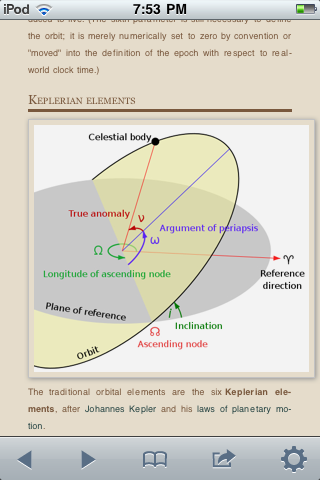
The solution: clear 3 GB of space from my iPod Touch and spend $10 on an app called Wikipedia Offline, and voila, now I’ve got the whole English language Wikipedia in my pocket. More precisely, I have the main text for the entire Wikipedia as of September 2010. By default there are no pictures, though when you are online, you can download the latest version of any article and optionally save it with pictures (as I have shown here - you can also touch the globe button to display the full online version of the article you are viewing). The links to other Wikipedia articles are in there, as are many web links, but none of the “editorial” material that might help you judge whether the information is reliable or not.
Other than those limitations, it’s pretty much all in there, from Bozo the Clown to Watson (the AI program that recently defeated two human Jeopardy game show champions – I updated the article to include recent information on that televised match). And everything in between (A, X,Y,and Z entries are in there too). Orbital elements. Orbiter. Fluffernutter sandwiches. Jayne Mansfield (she did die in car accident, but she was not decapitated). Elton John. A wide range of obscure musical acts (not me, I’m too obscure even for Wikipedia), albums, and movies. Battle of Britain (battle, movie, flight sim, airfields, memorial, etc., etc.).
How is this possible? I mean, 3 gigabytes is a lot of data, and the file is heavily and cleverly compressed. But jeeze. The first movie on my flight was the recent animated film Megamind so I looked it up. It’s in there, with cast and plot summary, although it is listed as forthcoming since the main database is from September 2010. This whole offline Wikipedia thing is really quite astounding.
Wikipedia may have its faults, with user-created content that often needs to be taken with a grain of skepticism. On the other hand, if you have an internet connection, it’s an incredibly broad collection of entry-level (and often in-depth) articles on just about anything you can think of. But what if you don’t have an internet connection? That may seem like a rare condition for many of us, but when I wrote this, I was on an airplane with no Wifi or mobile phone signal. Back on the ground, I walk around with an iPod Touch which provides excellent web access whenever I have a Wifi signal. I also have a BlackBerry “smart phone” which is great for email and which theoretically provides web access whenever I have a 3G signal. I say theoretically because the BlackBerry’s web browser totally sucks – it is slow and unable to load most web sites because it says they are “too big.” What’s an information junky to do?
The solution: clear 3 GB of space from my iPod Touch and spend $10 on an app called Wikipedia Offline, and voila, now I’ve got the whole English language Wikipedia in my pocket. More precisely, I have the main text for the entire Wikipedia as of September 2010. By default there are no pictures, though when you are online, you can download the latest version of any article and optionally save it with pictures (as I have shown here - you can also touch the globe button to display the full online version of the article you are viewing). The links to other Wikipedia articles are in there, as are many web links, but none of the “editorial” material that might help you judge whether the information is reliable or not.
Other than those limitations, it’s pretty much all in there, from Bozo the Clown to Watson (the AI program that recently defeated two human Jeopardy game show champions – I updated the article to include recent information on that televised match). And everything in between (A, X,Y,and Z entries are in there too). Orbital elements. Orbiter. Fluffernutter sandwiches. Jayne Mansfield (she did die in car accident, but she was not decapitated). Elton John. A wide range of obscure musical acts (not me, I’m too obscure even for Wikipedia), albums, and movies. Battle of Britain (battle, movie, flight sim, airfields, memorial, etc., etc.).
How is this possible? I mean, 3 gigabytes is a lot of data, and the file is heavily and cleverly compressed. But jeeze. The first movie on my flight was the recent animated film Megamind so I looked it up. It’s in there, with cast and plot summary, although it is listed as forthcoming since the main database is from September 2010. This whole offline Wikipedia thing is really quite astounding.
Saturday, January 29, 2011
Carnival of Space #182
After a brief hiatus, the Carnival of Space is back, now organized (and hosted this week) by Brian Wang of Next Big Future. Thanks to Brian for taking over, and big thanks to Fraser Cain of Universe Today who has organized the Carnival since fall 2007.
Saturday, January 22, 2011
Rocket Science for Fun
I'm making slow progress on the third edition edits for Go Play In Space for the Orbiter 2010 space flight simulator. I sometimes need to present various aspects of "rocket science" in the course of explaining the intricacies of maneuvering in space (otherwise known as orbital mechanics) in Orbiter. This has led me to look into how other authors handle these explanations, so I've revisited a favorite book and have bought a new one. My perspective is a bit more practical than for many general readers - I am trying to teach my readers how to operate realistically simulated spacecraft, so when they encounter things like ascending nodes, they want to know what they can do with them (like align the plane of their current orbit with that of the ISS in preparation for rendezvous and docking), whereas other readers might just say, "that's nice" and turn the page.
The new book is It's ONLY Rocket Science by Lucy Rogers (I bought the Kindle version). Dr. Rogers is a British mechanical engineer and freelance journalist on space and astronomy topics (perhaps among others).She says on her website that she aims to write about science in plain English, and she pretty much succeeds in this book. For example, her explanations of orbital elements, Lagrange points, and ground tracks are quite clear and include some simple illustrations (including ones for Molniya and geosynchronous orbits). On the other hand, her explanation of rendezvous and docking is rather too brief, and could use some more illustrations for someone who wants the background needed to actually do rendezvous and docking in a real spacecraft (or in Orbiter, for most of us). The book also covers the space environment, rockets and spacecraft, types of missions, propulsion systems, communications, humans in space, and other topics in addition to the basics of orbital mechanics. There's a website with information and book excerpts here.
My old favorite is Wayne Lee's To Rise From Earth (Second Edition), which is sadly out of print (used copies are available on Amazon). I wrote about this book in some detail in 2006. The subtitle "an easy-to-understand guide to spaceflight" is really true, and Lee (who works as an interplanetary space flight engineer at JPL) covers a lot of ground in this book, including a lot of space history with detailed information on the Apollo program and the space shuttle. In the orbital mechanics area, the explanations are detailed, and there are many excellent color illustrations that support the explanations. Rendezvous and docking and ground track explanations are especially well done. As I wrote in 2006:
The new book is It's ONLY Rocket Science by Lucy Rogers (I bought the Kindle version). Dr. Rogers is a British mechanical engineer and freelance journalist on space and astronomy topics (perhaps among others).She says on her website that she aims to write about science in plain English, and she pretty much succeeds in this book. For example, her explanations of orbital elements, Lagrange points, and ground tracks are quite clear and include some simple illustrations (including ones for Molniya and geosynchronous orbits). On the other hand, her explanation of rendezvous and docking is rather too brief, and could use some more illustrations for someone who wants the background needed to actually do rendezvous and docking in a real spacecraft (or in Orbiter, for most of us). The book also covers the space environment, rockets and spacecraft, types of missions, propulsion systems, communications, humans in space, and other topics in addition to the basics of orbital mechanics. There's a website with information and book excerpts here.
My old favorite is Wayne Lee's To Rise From Earth (Second Edition), which is sadly out of print (used copies are available on Amazon). I wrote about this book in some detail in 2006. The subtitle "an easy-to-understand guide to spaceflight" is really true, and Lee (who works as an interplanetary space flight engineer at JPL) covers a lot of ground in this book, including a lot of space history with detailed information on the Apollo program and the space shuttle. In the orbital mechanics area, the explanations are detailed, and there are many excellent color illustrations that support the explanations. Rendezvous and docking and ground track explanations are especially well done. As I wrote in 2006:
Both the book and Orbiter provide an essentially non-mathematical introduction to space flight - the book approaches this through geometry, using a large number of excellent diagrams as well as clear analogies and other text descriptions and many photographs. Orbiter takes the first-person approach of putting you in the pilot's seat and providing various instruments to guide you as you control the spacecraft to change orbits, rendezvous with another spacecraft, or fly to the Moon or to Mars.So if you are a budding astronaut (or Orbinaut), which book should you choose? Ideally you should read both - Rogers covers some topics better than Lee (for example, Lagrange points) and you may find some explanations to be clearer in spite of the small number of illustrations. But if you want to really understand how orbits work and how you change them to get where you want to get in space, you should grab a copy of Wayne Lee's book before the used copies run out. Rogers' 2008 book is still in print (paper and Kindle).
Friday, January 14, 2011
New Shuttle Fleet for Orbiter
In my not-so-copious spare time, I am working on the 2010 update to Go Play In Space, the tutorial and exploration guide e-book that I wrote for the free Orbiter space flight simulator (with help from Andy McSorley on the second edition in 2006, and now from Mark Paton on the 2010 edition). Orbiter has a 2010 edition described here, with enough new and changed features to justify a new edition of Go Play.
The new edition will add a chapter on re-entry (written by Mark), and the rendezvous and docking chapter will use the supplied shuttle Atlantis spacecraft rather than the more powerful (but fictional) Deltaglider spacecraft used in the second edition. It's more realistic in that it's based on a launch (using a launch autopilot written in Orbiter's new scripting language), rendezvous, and docking scenario that happens in real life, although sadly not for much longer. I'm glad to finally be adding some shuttle operations to Go Play In Space.
Speaking of flying the shuttle in Orbiter, there's a brand-new edition out of the amazing Shuttle Fleet add-on for Orbiter 2010-P1 (Shuttle Fleet 4.7 by David413). I've only just downloaded and installed it, but it looks great. It includes support for local light sources which should improve the already impressive visuals. I will be discussing the Shuttle Fleet in the add-on chapter of the new Go Play In Space. The picture above is a nostalgic Shuttle Fleet screen shot of STS-1, the very first flight of the first operational shuttle, Columbia, April 12, 1981. Notice the white-painted external tank that was used on the early shuttle missions (they stopped painting the tanks on later flights to save weight, leaving the now familiar rusty orange color of the insulating foam).
The new edition will add a chapter on re-entry (written by Mark), and the rendezvous and docking chapter will use the supplied shuttle Atlantis spacecraft rather than the more powerful (but fictional) Deltaglider spacecraft used in the second edition. It's more realistic in that it's based on a launch (using a launch autopilot written in Orbiter's new scripting language), rendezvous, and docking scenario that happens in real life, although sadly not for much longer. I'm glad to finally be adding some shuttle operations to Go Play In Space.
Speaking of flying the shuttle in Orbiter, there's a brand-new edition out of the amazing Shuttle Fleet add-on for Orbiter 2010-P1 (Shuttle Fleet 4.7 by David413). I've only just downloaded and installed it, but it looks great. It includes support for local light sources which should improve the already impressive visuals. I will be discussing the Shuttle Fleet in the add-on chapter of the new Go Play In Space. The picture above is a nostalgic Shuttle Fleet screen shot of STS-1, the very first flight of the first operational shuttle, Columbia, April 12, 1981. Notice the white-painted external tank that was used on the early shuttle missions (they stopped painting the tanks on later flights to save weight, leaving the now familiar rusty orange color of the insulating foam).
Friday, January 07, 2011
Cool blog: Everybody's Dummy
Everybody's Dummy is a cool music blog. A few times a week it posts a detailed review of a classic album. I've discovered or rediscovered some great music by artists such as Bob Dylan, the Rolling Stones, the Beatles, Elvis Costello, and Dire Straits. Mainstream artists to be sure, but I don't know everything they have ever done, and it's cool to find an overlooked gem, or just to read an insightful review of an old favorite. The title is from a quote by Lester Bangs, "I'm nobody's dummy. I'm everybody's dummy. I believe everything I read, see, and hear."
Thursday, January 06, 2011
New Year, (Slightly) New Look
Happy new year! I'm back to a crazy work schedule, but every once in a while I get obsessed with some strange little thing. Tonight it was a new feature of Blogger, the ability to define your own blog template background image. I had a perfectly good stock image of the Earth, but was that enough? Of course not! I decided I needed a collage of Orbiter images instead (plus one picture I took of the real STS-118 launch). They said to make it 1800 x 1600 to allow for full screen, and I tried a couple of variations before arriving at the one shown here and in the background. Some of the edges are OK (depending on how your window is sized), but you really can't tell in the background that the upper left image is a closeup of the shuttle. I also just discovered that the 1800x1600 doesn't really fill the screen when Safari scales the web page for the iPod Touch. Oh well, it will have to do for now.
Subscribe to:
Posts (Atom)