 I just happened to find this web site through a Shuttle-related article at NSS. Marianne Dyson is a former NASA flight controller and an award-winning author of children's books on space subjects, Home on the Moon (grade 4-6) and Space Station Science (ages 9-12). Judging from the reviews and awards, these look to be very interesting books for kids (I have just ordered them myself). I have explored her web site, and it has some cool resources and activities. It's great when people with a real space-related background apply their experience and skills to educational writing and outreach as Ms Dyson is doing. As someone who is trying to develop space-related materials for kids, I'm really looking forward to reading her books.
Monday, September 11, 2006
Outreach: Author Marianne Dyson
I just happened to find this web site through a Shuttle-related article at NSS. Marianne Dyson is a former NASA flight controller and an award-winning author of children's books on space subjects, Home on the Moon (grade 4-6) and Space Station Science (ages 9-12). Judging from the reviews and awards, these look to be very interesting books for kids (I have just ordered them myself). I have explored her web site, and it has some cool resources and activities. It's great when people with a real space-related background apply their experience and skills to educational writing and outreach as Ms Dyson is doing. As someone who is trying to develop space-related materials for kids, I'm really looking forward to reading her books.


Sunday, September 10, 2006
SpaceX Update and Pix
 Elon Musk of SpaceX has posted a good update on their Falcon rocket and Dragon spaceship progress, including some of the pictures he showed at his talk at the Mars Society Conference a month ago in DC. Very cool. I like this guy and I get the feeling (or is it just the hope?) that he is really going to succeed in getting people into space and really validating the whole commercial space thing at a level higher than suborbital (or even orbital or $100 million Moon fly-by) space tourism. Not that there's anything wrong with any of that or that I wouldn't go in a heartbeat if I had the money to burn (so to speak).
Elon also included a note on pricing and why he's doing all this, similar to a comment he made at MSC.
I should probably say something about pricing, since some people think that it is only a matter of time before we raise prices dramatically. They are missing the point. I started SpaceX to lower the cost and increase the reliability of (American) spaceflight by at least a factor of ten and I'm hell bent on making that happen. We need to become a true spacefaring civilization, where spaceflight is affordable by normal citizens and extending life to another planet is realistic, and that requires lowering costs dramatically.Go Elon! Now we just need some Orbiter add-on makers to take on the Dragon and the Falcon-9 (and a Bigelow inflatable space station) so we can start to practice those missions.
Explore Mars (A Little) Now
 I found a very cool Mars-related web site the other day, Exploremarsnow.org, but unfortunately it seems to have been abandoned in 2003. I didn't notice this until I had looked around for a while, found a page for signing up as a member (promising access to additional content), and paid for a one year membership ($15) with PayPal. Oops. Read the fine print before signing up for something. Oh well.
It's still a cool if limited site to explore. You can't really explore Mars, but you can explore a detailed and pretty realistic interactive model of a Mars Direct-like "hab" that has landed on Mars, and the graphics and the interactive "walk through" of the various parts of the spacecraft are quite nicely done (red highlights indicate transitions/doors). There are also many mouse-active "hot spots" (yellow highlights) that display pop-up text boxes explaining the selected object. NOTE: Interactive features would only work for me in Internet Explorer, not in Firefox.
This site appears to have won some awards back in 2002-2003 and it really is a great start on an interactive Mars exploration site. It sounds like they just ran out of development funds, though someone is obviously still hosting it. They should leave it up but deactivate the membership stuff. So go have a look around, but don't get carried away and pay to sign up like I did!
Outreach: Optics for Kids
 Although aviation, music, and space have alternated as the major obsessions in my life, my educational background (not to mention my job) is in physics and optics. Long before I started doing space-related educational outreach, I created some presentations and a web site on basic optics, with a little bit of material on science and engineering careers. Optics for Kids (OFK) has been around the web since 1995, and in the late nineties and early 2000's, I was often getting emails from parents, teachers, and students saying that it was a helpful site. OFK even received a few awards, though most of the awarding web sites now seem to be gone.
Optics for Kids has remained on line but until recently, it had the same tired nineties-style design that I created back when I was first learning HTML (which I have since all but forgotten). Thanks to a talented new person at my company, I'm happy to say that OFK has now received a long overdue facelift and a bit of new content. I'm hoping we can further expand the content over the next few months, but at least its form and content are now relatively modern and easy to use. It also now includes a few interactive Flash goodies, courtesy of David Harrison of the University of Toronto. David also has a number of other cool Flash animations for physics.
Friday, September 08, 2006
Perspectives on Size and Scale
 I happened to stumble on an interesting set of images comparing the sizes of the inner planets, then all the planets, then the planets with the Sun, then the Sun with other stars (including super-massive Antares). The images are sort of 3D (almost like photos of models), but the JPG's are so compressed and faded that it's hard to tell. Still extremely cool and humbling - the Sun is but one pixel (and the planets invisible) in this final image where Antares is the big guy (about 370 pixels). This page kicked around a lot of blogs over the last few months and many people wondered from the poor quality if there wasn't a better original source somewhere, but I couldn't find one.
But I did find this Java applet that offers an interactive powers-of-ten zoom from 10**+23 meters (ten to the twenty-third power, or 10 million light years, multiple galaxies in view) down to 10**-16 (one femtometer, the scale of quarks inside a neutron) in 39 order-of-magnitude steps. Also very cool (use of the applet requires that you install/enable Java in your browser, and don't even think about posting an image from the site) .
(The Java applet is from Molecular Expressions, a wonderful site I have visited many times for their optics and microscopy related Java applets, but I never saw the Powers of Ten one before.)
Monday, September 04, 2006
It's Worse Than You Thought
 We all know the world is a dangerous place, but however dangerous you think it might be, it's worse than you thought. I've been looking through the web site of the Lifeboat Foundation, which is dedicated to the study and prevention of "existential risks" - risks that are both global and terminal. The sad fact is that many of the technologies that could make life better in the future have a "dark side" that could make life much worse, or even end human (and perhaps all) life completely.
These technologies include genetics, nanotechnology, robotics, and others. Of course "conventional" terrorism and nuclear weapons are also risks, but the newer fields have the disturbing feature that the resources required to use and abuse these technologies are small (i.e., small lab facilities and powerful computers that are widely available). In the next few years, groups and even individuals working at the molecular level with biological or nanotechnology methods could create destructive organisms or devices, accidentally or intentionally, much like computer viruses today. But these could be real viruses that would infect people, not their computers.
I wish this were science fiction, but alas it is not. The Lifeboat Foundation has 200 high-power people on its scientific advisory board, with 23 sub-boards and 21 research programs. They are also looking at what to do if the various shield programs are not enough and something really bad and global happens anyway. This is the lifeboat side of things, looking at ways to preserve at least some of humankind. So yes, there's a space connection here (Lifeboat Foundation space habitats). But it's much more than that.
I think it's time to find out more about these risks, and to urge our government to take these things seriously and to increase funding for defense against these dangers. Unlike the 9/11 attacks, there may not be time after the fact to figure out what to do. Existential risks require proactive actions. Senator Bill Frist proposed in 2005 a 21st century "Manhattan project" to prepare to respond to epidemics and bioterrorism. That might be a good start at the government level, but the Lifeboat Foundation is casting an even wider net.
We certainly all hope that none of the things the Lifeboat Foundation is concerned about ever really happens. But as General Tommy Franks said once in a different context, "I learned long ago that hope is not a strategy."
Pandora's (Music) Box
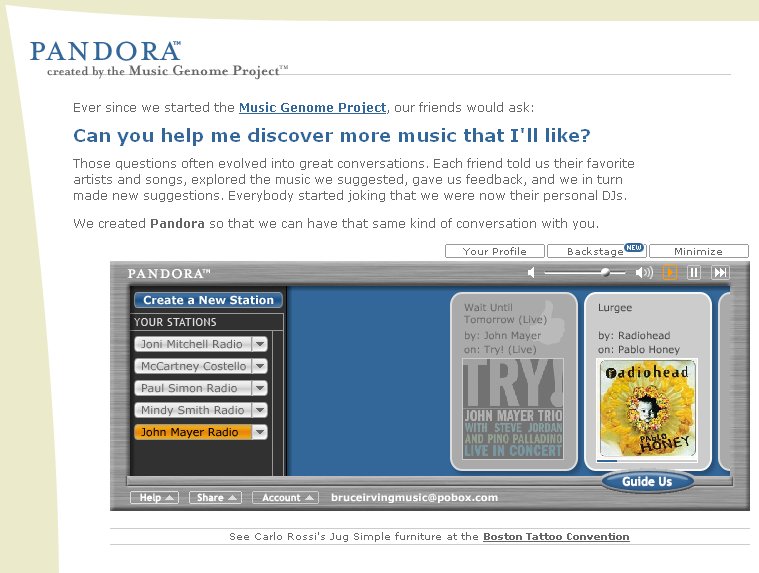 I like a lot of different music - I have broad but still quite specific tastes. I also like discovering new music, so I've tried things like Paste Magazine with its (now monthly) CD of new music, and a brief subscription to eMusic (good service for indie music, but picking new songs to download each month got to feel like a chore).
But I just discovered what may be the best way yet to connect my specific tastes with the desire to hear familiar music and to also find new music that I'm likely to enjoy, Pandora.com. Pandora is an internet radio service (free/ad supported or subscription) with a very smart interface. It starts by asking you to name a favorite song or artist, and it creates a "radio station" based on this. The station starts out playing songs by the particular artist (some of my stations are John Mayer, Paul Simon, and Joni Mitchell).
But here's the genius part. They have categorized tens of thousands of songs by their musical and performance qualities, and by comparing your choices to this huge database, they find other music that you might like. This music is "similar" in deep and often surprising ways, and you can further tune the process by adding additional songs or artists that connect in your mind (e.g., I combined Paul McCartney and Elvis Costello in one station). Sometimes it's wrong, and you can simply say "I don't like this" to skip the song and enhance their profile of your tastes.
It's way cool, and they have recently added a new "backstage" feature that let's you instantly find more information on the song, artist, or album (and of course to quickly and conveniently buy from Amazon or iTunes - I've already bought a few great new songs that Pandora recommended). Their goal was to recreate the experience of discussing your musical interests with an unusally knowledgeable friend or record store employee, and I think they've pretty much nailed it.
Sunday, September 03, 2006
Outreach: Kids4Mars.com
 I'm interested in space for various reasons, one of which is educational outreach. On the most obvious level, this means trying to make the case that space is interesting and important to anyone who isn't already convinced. But I think the most important outreach audience is kids, in part because some parts of space exploration are pretty cool and this might lead some kids to consider studying and maybe eventually working in science and technology. We need future scientists and engineers for more than just space, of course.
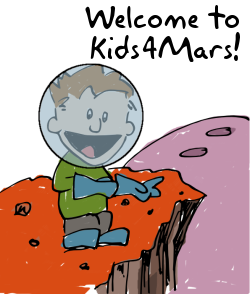
So I and many others (from NASA HQ on down) are trying various things to connect with kids. My MarsDrive colleague Dale Rogers has made a great start on a site called Kids4Mars.com, where he has begun a series of educational cartoons called "Little Red Planet." He's still experimenting with approach and content, but I think he has a nice style going on this, and he understands that less is more. This is something I also understand at some level, but seldom manage to honor (e.g., second edition of Go Play In Space went from 136 to 181 pages).
Kids4Mars is also now the home of the first version of my children's book Mars... Just Imagine (free 3 MB PDF), which I consider to be a work in progress. If you read it and especially if you share it with a child, I'd really appreciate if you would email me with any comments or suggestions you may have. Kids4Mars is also something of a work in progress, and if you visit you will find some pages that say "more coming soon" and asking for contributions of material. If you'd like to help with space outreach for kids, please get in touch with Dale or with me.
Friday, September 01, 2006
The Moon Takes Its Lumps

On September 3, the unmanned ESA spacecraft SMART-1 will be deliberately crashed into the Moon. SMART-1 is the first European spacecraft to reach and orbit the Moon, and it's especially interesting because it did so with solar-electric power, using low-thrust ion engines. You can read more about the spacecraft and its successful mission here.
As is often the case, an Orbiter add-on builder has provided the means to simulate the spacecraft and mission. "BrianJ" released a model of the spacecraft along with a scenario that starts 7 hours before impact on September 3. Read more about it on the Orbiter forum.
This is cool, but even cooler in my opinion is the "accessory" he built for this mission, a 3D mesh and texture set for the entire surface of the Moon. Orbiter's default surface textures are basically paint, photographic images mapped onto a smooth sphere. These look great from a long distance, but are often not so convincing closer in (though it depends on various factors). You can use 3D "meshes" for surface relief as well as for spacecraft and bases, but surface relief is usually confined to a small detail area, such as Vallis Dao on Mars. In this case, Brian used height map data to create a 3D mesh that's draped over the whole surface, along with textures to properly paint the 3D mesh (these are big textures and he warns that older graphic cards may not handle the large amount of data).
I like the effect of this lumpy Moon - instead of a razor sharp horizon from low to medium lunar orbit, you see bumps due to craters and mountains, more reminiscent of Apollo photos from lunar orbit. There are a few minor problems (e.g., surface bases are under the mesh), but for a quick experimental effort, this is quite good. More pix on Flickr.
September 3 Update: News reports indicate that SMART-1 crashed into the Moon as planned at 1:42 pm EDT.
Thursday, August 31, 2006
Mars... Just Imagine (Your Future In Space)

I'm nearly through with an educational spin-off project arising from the Mars for Less add-on project for Orbiter and the Mars Society Conference (MSC) presentation I made in Washington a few weeks ago. It was actually inspired by a presentation I saw at MSC by author Tom Hill. He had worked with an illustrator named Marilyn Glass to write I Want To Go To Mars, a book for very young children (age 3-7 I believe). Although the book is nicely done, and I bought a copy for my Mars collection, it's also very brief and simple. While this is a requirement for the target age group, what about something more detailed for older kids? I started thinking about this, and with PowerPoint as my palette, and Orbiter as my "brush," I started to write Mars... Just Imagine (Your Future In Space). My thought is that it's suitable for kids age 8 and up, and considering that most adults don't know very much about the possibilities of people going to Mars, it might be useful for anyone who wants to start thinking about this in a relatively painless way.
It's almost done, with 17 pages of pictures and text, plus a dozen pages of more detailed background information for each page, what it depicts, how it was made, references, credits, etc. I haven't decided yet how to distribute it. Most likely it will be a free PDF download (as is my earlier e-book Go Play In Space), but I'm also looking into various print-on-demand services, since a children's book seems to be more of a "sit on my lap" item than a computer screen document. I've put the cover (above, thanks to Jason Archer for the graphic) and two sample pages on my Flickr site as a sort of preview.
September 3 Update: The first version of Mars... Just Imagine has been posted here (3 MB PDF) at www.kids4mars.com.
Sunday, August 27, 2006
Kids To Space: Not Just For Kids
 A few weeks ago I bought a new book called Kids To Space: A Space Traveler's Guide by Lonnie Jones Schorer "and America's school children." This weekend I finally spent some time with it, and it's really an amazing resource. First of all, teachers in the US and Canada asked students, ages 3-19, to ask questions about space. From the thousands of questions asked, several hundred were distilled into 94 catagories, and various experts were asked to provide answers. The resulting 303 page book is really fascinating, with questions ranging from "What is there to learn in space?" to the inevitable "How do you go to the bathroom in space?" Experts include astronauts, engineers, scientists, and commercial space pioneers (e.g., Burt Rutan on space transport for the future, and Robert Bigelow on space hotels!). There is also a forward by Apollo 11 astronaut Buzz Aldrin.
Although it is really more of a reference book (a veritable space encyclopedia), it also has a sort of story line (suitable for younger kids) that continues between the major sections, and a large number of space related illustrations done by children of various ages (with many more on the accompanying CD-ROM).
Kids To Space is excellent book for anyone with an interest in our future in space, even if there isn't a kid in sight at the moment.
Wednesday, August 23, 2006
Ray Bradbury and Progress
 I read somewhere that yesterday was author Ray Bradbury's eighty-sixth birthday. He was interviewed on the occasion by Los Angeles public radio station KPCC - you can listen here (RealAudio required). The author of The Martian Chronicles and many other books and stories (first story published on his twenty-first birthday) continues to write for hours a day and is optimistic about our future in space. He noted that when he was a young man, he dreamed of (and wrote about) people going to the Moon, and figured that he might live to see this happen, perhaps when he was an old man. In fact it happened when he was just 49, and we have also robotically explored much of the Solar System within his lifetime. He noted that there has also been amazing progress in medicine and in many technologies within the span of his own life.
He believes we should have never left the Moon and is enthusiastic about plans to return there and to go on to Mars some fifteen years later (maybe a bit optimistic unless things change from current plans, which for NASA suggest a time frame of around 2030, with even that a bit vague). He strongly supports colonization of Mars and human expansion into the rest of the Solar System and beyond.
Interestingly enough for someone who envisions all this advanced transportation in the future, Ray Bradbury lives in Los Angeles and doesn't drive! He says that LA's freeways "don't work" and looks forward to the day that a monorail system will replace them (hmm, Mars might be quicker, Ray). Happy birthday to an amazing writer who has been imagining the future in print for 65 years!
Friday, August 18, 2006
Something So Right

They got a wall in China, it's a thousand miles long
To keep out the foreigners they made it strong...
Paul Simon, "Something So Right"
I'm sure every songwriter can name at least a few songs they wish they had written, and along with everything by the Beatles, a top one of mine is Paul Simon's 1973 song "Something So Right." It's a finely crafted love song that happens to mention the Great Wall of China. I visited a part of the Great Wall near Beijing today, and despite the hazy gray sky, it was amazing to see and experience a small part of this wonder of the world. I climbed a section of it, about an hour up and down steep flights of many, many stone steps of irregular height, sweating profusely and whistling that song to myself.
Thursday, August 17, 2006
Earth from Mars
 The "visible from space" bit in my last post reminded me of a question I'm looking into for a current project: What does Earth look like from the surface of Mars? The idea came up in one of the stories in Kim Stanley Robinson's The Martians, where he describes a bright blue "star" with a darker companion, the Moon, seen by one of the characters from the surface of Mars. I supposed that under best conditions (distance and Earth phase) that it would look a little brighter and bigger than Mars appears from Earth. Google says?
It turns out that Earth was imaged from Mars orbit on 8 May 2003 by the Mars Global Surveyor spacecraft (see above). According to this page, Earth had an apparent magnitude of -2.5 (the Moon was +0.9), and the image required processing for exposure and to apply color to the grayscale image. The distance was 139 million kilometers. For rough comparison, on 27 August 2003, Mars was in opposition and at its closest distance to Earth in over 56,000 years (about 56 million kilometers). It had visual magnitude -2.9 and an apparent diameter of 25 arc seconds. Earth is larger and more reflective than Mars, so if conditions were right, Earth would be distinctly blue and bright from the surface of Mars, though probably not visible as a disk without some optical assistance. I'm not sure the Moon would be visible at all with the unaided eye since it is small and quite dark (but maybe I'm wrong - at +0.9 it should be visible, the naked eye magnitude limit is +6). More research needed but now it's bedtime in Beijing.
Vertigo
 Private pilot (sadly grounded for quite a while now). Frequent flyer (United 1K). Space flight advocate and fan. Afraid of open heights.
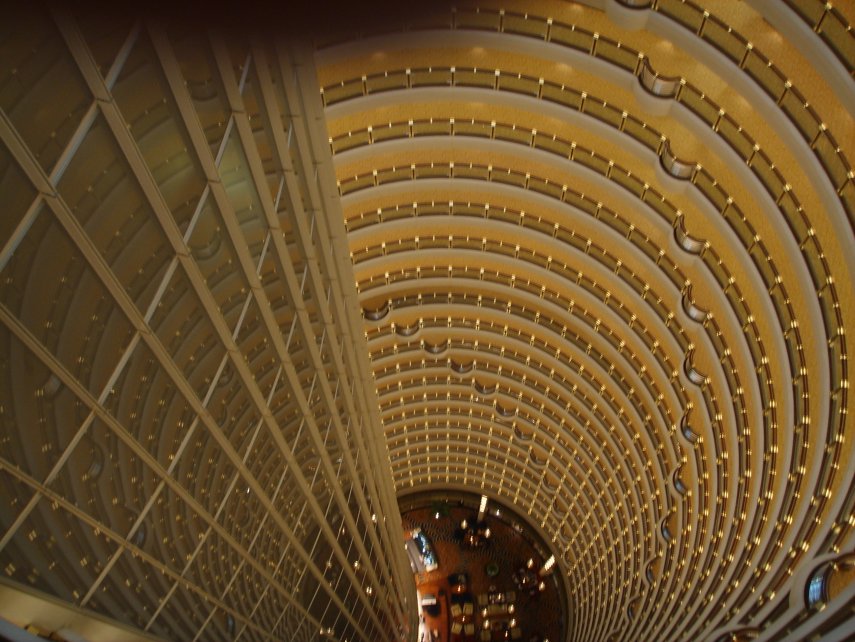
Afraid of open heights?!? Well, not exactly afraid, but looking down the atrium of the Shanghai Hyatt from the 85th floor to the lobby on the 56th did give me a sort of dizzy feeling, even though the railing was quite solid and chest high (so not really an "open height" in any literal sense). It's an amazing sight, as is the night view from the 86th floor restaurant. Shanghai is one visually stunning city.
Now I'm in Beijing and will visit the Great Wall tomorrow. Let's get a space connection in here, one I vaguely recall discussing somewhere before, maybe in this blog. Is the Great Wall the only man-made object visible with the naked eye from space as is sometimes claimed? Depends on where you are in space. From LEO (that's low earth orbit, Shuttle altitude), many man-made objects such as highways, ships, railroads, etc. can be seen depending on conditions, often including the Great Wall. From the Moon? This was claimed somewhere too, but beyond a few thousand kilometers, no man-made features are visible on Earth, and from the Moon, just patches of white, blue, brown, yellow, and sometimes green.
Monday, August 14, 2006
The Bund In Motion
 This was taken with a borrowed digital camera which I did not really know how to use. It shows Shanghai's famous Bund from my hotel window, across the Huangpu River. My friend uploaded and sent me the picture with the overly kind suggestion that it has "some artistic effect." Yeah, that's it, artistic, not just shaking the camera! Here's what it's really supposed to look like (not by me, just the first one I found on Flickr).
Flickr probably has all the photos I need of everything in the world, but I still think I should get myself one of those ultra-thin digital cameras so I can just keep it in my computer bag (I tend to leave the one we have at home unless it's specifically a vacation or something). I sometimes see some cool things on business trips, like the whole Shanghai skyline. Here is another Flickr user's shot of the Shanghai skyline including the giant Oriental Pearl TV Tower which is across the street from my hotel, the same one where the Flickr user stayed (he notes this in his caption, but the TV tower and hotel are on the left, not the right).
Sunday, August 13, 2006
Speed: 431 km/hour, Altitude: 10 mm
 I took the world's first commercial maglev (magnetic levitation) train from Shanghai Pudong Airport to Shanghai this afternoon. The 30 km trip took eight minutes and reached a top speed of 431 km/hour, or about 268 mph. Pretty zippy. This is a lot faster than the operational speed of Japan's Shinkansens, which I've ridden many times (about 270-300 km/h or 168-186 mph, depending on the line and model). The Shanghai Maglev has been in commercial operation since 2004 and has reached 501 km/hour (310 mph) in test runs. When you combine this with its amazing and often weird high-rise architecture, you can really believe that Shanghai is the City of the Future. They are talking about a maglev line from Shanghai to Beijing to make that a 3 hour trip (currently a 2 hour flight or a very long train trip).
I wanted to provide a link to a general article on maglev technology, but when I tried to do this, I realized there is one thing the City of the Future doesn't have today: access to Wikipedia (I can't get to any Wikipedia pages, and I assume the IP addresses for this are blocked in China, from what I've read about internet policies here). Too much "controversial" content I guess. But this link gives the basic maglev info.
Friday, August 11, 2006
Of NASA and NewSpace
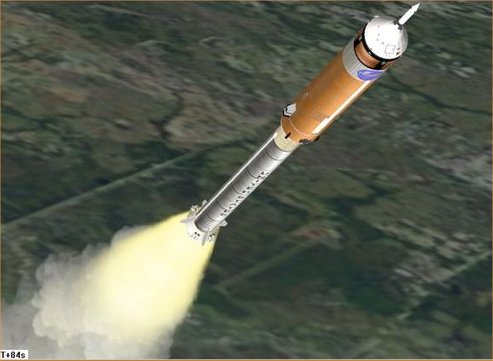 Before the week passes and I head for Shanghai for a very busy week of business (and probably no blogging), I want to point out another excellent article in the current Space Review, "Of NASA and NewSpace" by Grant Bonin, one of my co-authors on the paper I presented last week at the Mars Society. I won't summarize Grant's arguments here, but among other things, he points out the potential for single point failures (i.e., putting all your eggs in one basket) that are inherent in the NASA's approach to developing next generation spacecraft and launch vehicles. Although there is some funding planned to encourage development of alternate commercial spacecraft (COTS), it's really not very much in the scheme of things. I hope NASA succeeds with its plans, but I hope that they can also increase the funding to jump-start private space ventures that will provide more options in the future.
Tuesday, August 08, 2006
Mars Society - Final Thoughts
 I wrote about the first three days of the Mars Society Conference and then fizzled out. So here are a few final thoughts and things I forgot to mention before.
I did mention seeing The Mars Underground on Thursday night, but since then the Space Review has carried an excellent review and discussion of the film by Dwayne A. Day, including some interesting observations on the conference and on the role of Dr. Robert Zubrin in promoting the case for humans on Mars.
The Saturday night banquet was pretty enjoyable for a dry event, though the entertainment and awards were full of insider jokes and references that a first-timer like me wouldn't really get. That's OK - Mars fans are an interesting extended family to watch (and start to join) just the same.
I went to a few track papers on various subjects and was struck on the one hand by the big picture optimism regarding humans on Mars ("we have the technology - all we need is the decision and the money"), and on the other hand by the difficulty of the details. Several papers pointed out the need for more extensive and realistic simulations of missions (by this I mean analog simulations, where people practice aspects of Mars missions in ground-based simulations of spacecraft, in the desert or in the Arctic). While these partial simulations are interesting and useful, more realistic simulations will be needed before we send 4-6 people on the way to Mars with only themselves to keep everything working (and everyone breathing).
We talk about "pseudo G" from tether-rotated spacecraft, and while the physics of this is clear, no one has actually done this with living things on an extended basis, let alone humans. Can a nearly closed life support system be made to work in space (and on Mars) for some four years? Can all the mechanical systems of the spacecraft work well for the time needed? The ISS is not a fair test since it is close to Earth and is resupplied and repaired on a regular basis. Even the issue of aerobraking into Mars orbit is a problem - it's never been done with a 40 tonne spacecraft. People are thinking about and working on this stuff. But if "Mars by 2020" really has a chance, we need to solve the big picture and sweat all these "small" details. I think it's possible, but 14 years doesn't sound like a huge amount of time to do it all, even with Uncle Sam's and Elon Musk's checkbooks.
Saturday, August 05, 2006
Mars Society, Day 3
 Not much time to blog this since I have to run to the Mars Society Conference banquet in just a few minutes. Day three was good, starting with a somewhat rambling but pretty inspiring speech from Dr. Robert Zubrin on how far we've come, what's left to do (a lot), why we need to support NASA's Vision for Space Exploration (it's finally destination driven!), and why it has to be Mars as the real prize (it's a tough place but it has everything necessary to build a new branch of human civilization).
I was setting up a slide show for the MarsDrive exhibit and unfortunately missed most of Australian astronaut Andy Thomas's talk (STS-114 and five other flights) - too bad, because judging from the few Q&A responses I heard, he was very open and an excellent speaker. Dr. Chris McKay, one of the founders of the "Mars Underground," the predecessor of the Mars Society, spoke next. He's now with NASA Ames and is concerned with astrobiology, but his talk focused on using the Moon (no life expected there) as preparation for Mars exploration. He argued that the Moon will probably not have colonies as Mars ultimately will, but will remain a research site, more like Antarctica, a place where Ph.D. students do thesis research. But this is still a good thing. Once again HobbySpace has excellent summaries of the three morning speeches here.
In the afternoon I caught a couple of good talks by Reagan Walker, American Director for MarsDrive. One was on software/web based communication support for Mars analog research labs, and the other was an overview of MarsDrive and its aims. There was also a good talk on Mars Direct and Orbiter by Cyrus Phillips and Seth Hollingsead, which included live demos of Orbiter that really seemed to impress the audience. Cyrus, Seth, and Rich Wall also had an Orbiter table in the exhibit area and did a lot of "Orbiter evangelism" for all sorts of attendees, including astronaut Andy Thomas. I missed him there too! Seth told me that Andy asked, "where can I get a copy of this thing?" They gave him one. The picture above was posted by Cyrus in the Orbiter forum (Andy is standing in the blue suit).
My presentation went well also (Orbiter simulation of Mars for Less) - I showed 26 PowerPoint slides and 5 minutes of video clips in 30 minutes, and it seemed to be coherent and well received. People tend to be surprised at the technical and visual quality of Orbiter. The slides (PDF of the handout) are available at Andy's site here. To be continued...
Subscribe to:
Posts (Atom)