Saturday, April 02, 2011
Cloud Music
When I first read about Amazon's new Cloud Player, I thought it was a gimmick - I've got thousands of songs on a 500 GB pocket drive, backed up on two other external hard drives (not to mention 4,400 songs on my iPod Touch) - why do I need music in "the cloud" - which is just a gimmicky word for the remote storage and computing accessed through the internet, right? Right? Well, I am an occasional early adopter, as well as a sucker for marketing and cheap MP3 deals. The basic "cloud drive" offer is 5 GB of online storage for free, but if you buy any MP3 album from Amazon (something I do quite often anyway, usually on sale for cheap), they will give you 20 GB free for a year. And there was a Norah Jones album I was thinking of buying anyway for $2.99, so I gave it a try.
Although I use iTunes and the iPod Touch, I long ago converted to buying MP3's from Amazon rather than AAC's (or whatever they are called now) from iTunes. Same songs, often cheaper, and more portable, and now, Amazon will also back up your Amazon MP3 purchases on your "cloud drive" - for free. "Free" as in they don't charge your for the storage space used by new Amazon MP3 purchases - the 20 GB is only for music you upload (including MP3's previously purchased from Amazon - the free storage only applies to new MP3 purchases). This really adds value to something I was buying anyway (they even store free MP3's that I "buy" from Amazon - daily free songs plus many sampler and promotional albums).
I realize this sounds like a paid political announcement for Jeff Bezos, but I'm now really sold on this cloud thing. I've bought a few other MP3 albums on sale at Amazon and have even started to upload my own music to the Cloud Drive. I think it's really cool that my backup music storage can be independent of my own hardware, and that I can stream this music anywhere I can run a web browser (except on the iPod Touch, but there's plenty of music there anyway, plus Pandora and other internet radio music if I grow tired of my 4,400 songs). I can also download any of the music I have on the Cloud Drive any time I need to, which I will need to do for anything I plan to listen to on the iPod Touch (there is a Cloud Player app for Android devices, but I'm guessing that Apple will not approve an Amazon Cloud Player app any time soon). Of course it all depends on having an internet connection, but 90% of the time, I do. So it's really cool.


Tuesday, March 29, 2011
Amazing Kepler Exoplanet Graphic

Carnival of Space #190

Thursday, March 24, 2011
Space Expo Noordwijk

I say luckily, because ESTEC is also the site of Space Expo, a space museum that is also ESA's visitor center (the main Space Explo web site is in Dutch and has multiple pages and pictures - there's also an English site, but it's got very little content). This museum isn't as large as Cité de l’Espace (Space City), which I visited last summer in Toulouse, France, but it's pretty impressive nonetheless. In addition to the expected exhibits on the solar system, stars, space history, etc., there are a number of life-size satellite mock-ups suspended from the ceiling. There are also a number of interactive exhibits where you can launch simulated rockets and the like.
 The ISS was represented by a cool model hanging from the ceiling (shown above with overexposed floodlights simulating a double-star solar system). But more impressive were the full size walk-through mock-ups of the Russian Zvezda and the European Columbus ISS modules (I realized again that the ISS is really, really big). There was also a life size Apollo Lunar Module mock-up on a simulated lunar surface with space-suited astronaut manikins for scale and (lack of?) atmosphere.
They have a nice collection of real space memorabilia including an Apollo moon rock, an airlock used on a shuttle Spacelab mission, and a section of the Hubble Space Telescope's first generation solar panels (returned on one of the servicing missions). There are some great large-scale models of Ariane launch vehicles (and full-size cutaway models of some Ariane rocket engines). I have a few additional Space Expo pictures on my Flickr site.

Sunday, February 20, 2011
Korean Pocket Sundial


The pocket sundial fortunately included some English notes, explaining that the 13 lines that are roughly perpendicular to the pointer are seasonal lines. The far right line is the winter solstice (lowest sun, longest shadows) while the leftmost line (aligned with the tip of the pointer in my photo) represents the summer solstice. Today is just about two months past the winter solstice, and the shadow's tip touches the second line. The lines that are roughly parallel to the pointer are time lines (half-hour increments), with the longest (center) line representing noon. This picture was take at 12:36 EST, and the shadow is well short of the 12:30 line, but the instructions also mention that some adjustment is needed for longitude, though the English explanation of this isn't very comprehensible. They also didn't mention the use of the compass, but I knew enough to align the red end of the compass needle with north.
I was surprised to get such a cool little gift, although I think my Korean friend knows that I have an interest in astronomy (or at least optics). I was also surprised that it is sunny enough today to test it!

(looks like this was taken right around the same month and time of day as my photo)
Saturday, February 19, 2011
From Bozo to Watson
I’m right on the cusp between insanely busy and merely crazy busy at work. So I thought I would take a breath and write a blog post, inspired by an amazing app I just bought for the iPod Touch.
 Wikipedia may have its faults, with user-created content that often needs to be taken with a grain of skepticism. On the other hand, if you have an internet connection, it’s an incredibly broad collection of entry-level (and often in-depth) articles on just about anything you can think of. But what if you don’t have an internet connection? That may seem like a rare condition for many of us, but when I wrote this, I was on an airplane with no Wifi or mobile phone signal. Back on the ground, I walk around with an iPod Touch which provides excellent web access whenever I have a Wifi signal. I also have a BlackBerry “smart phone” which is great for email and which theoretically provides web access whenever I have a 3G signal. I say theoretically because the BlackBerry’s web browser totally sucks – it is slow and unable to load most web sites because it says they are “too big.” What’s an information junky to do?
 The solution: clear 3 GB of space from my iPod Touch and spend $10 on an app called Wikipedia Offline, and voila, now I’ve got the whole English language Wikipedia in my pocket. More precisely, I have the main text for the entire Wikipedia as of September 2010. By default there are no pictures, though when you are online, you can download the latest version of any article and optionally save it with pictures (as I have shown here - you can also touch the globe button to display the full online version of the article you are viewing). The links to other Wikipedia articles are in there, as are many web links, but none of the “editorial” material that might help you judge whether the information is reliable or not.
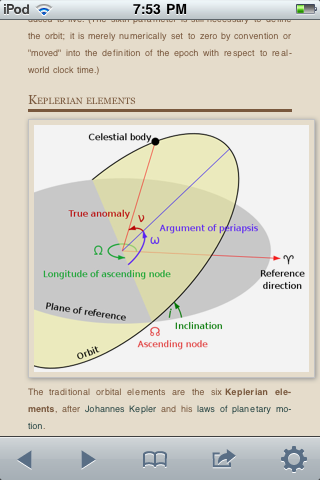
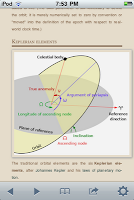 Other than those limitations, it’s pretty much all in there, from Bozo the Clown to Watson (the AI program that recently defeated two human Jeopardy game show champions – I updated the article to include recent information on that televised match). And everything in between (A, X,Y,and Z entries are in there too). Orbital elements. Orbiter. Fluffernutter sandwiches. Jayne Mansfield (she did die in car accident, but she was not decapitated). Elton John. A wide range of obscure musical acts (not me, I’m too obscure even for Wikipedia), albums, and movies. Battle of Britain (battle, movie, flight sim, airfields, memorial, etc., etc.).
 How is this possible? I mean, 3 gigabytes is a lot of data, and the file is heavily and cleverly compressed. But jeeze. The first movie on my flight was the recent animated film Megamind so I looked it up. It’s in there, with cast and plot summary, although it is listed as forthcoming since the main database is from September 2010. This whole offline Wikipedia thing is really quite astounding.



Saturday, January 29, 2011
Carnival of Space #182

Saturday, January 22, 2011
Rocket Science for Fun
I'm making slow progress on the third edition edits for Go Play In Space for the Orbiter 2010 space flight simulator. I sometimes need to present various aspects of "rocket science" in the course of explaining the intricacies of maneuvering in space (otherwise known as orbital mechanics) in Orbiter. This has led me to look into how other authors handle these explanations, so I've revisited a favorite book and have bought a new one. My perspective is a bit more practical than for many general readers - I am trying to teach my readers how to operate realistically simulated spacecraft, so when they encounter things like ascending nodes, they want to know what they can do with them (like align the plane of their current orbit with that of the ISS in preparation for rendezvous and docking), whereas other readers might just say, "that's nice" and turn the page.
 The new book is It's ONLY Rocket Science by Lucy Rogers (I bought the Kindle version). Dr. Rogers is a British mechanical engineer and freelance journalist on space and astronomy topics (perhaps among others).She says on her website that she aims to write about science in plain English, and she pretty much succeeds in this book. For example, her explanations of orbital elements, Lagrange points, and ground tracks are quite clear and include some simple illustrations (including ones for Molniya and geosynchronous orbits). On the other hand, her explanation of rendezvous and docking is rather too brief, and could use some more illustrations for someone who wants the background needed to actually do rendezvous and docking in a real spacecraft (or in Orbiter, for most of us). The book also covers the space environment, rockets and spacecraft, types of missions, propulsion systems, communications, humans in space, and other topics in addition to the basics of orbital mechanics. There's a website with information and book excerpts here.
 My old favorite is Wayne Lee's To Rise From Earth (Second Edition), which is sadly out of print (used copies are available on Amazon). I wrote about this book in some detail in 2006. The subtitle "an easy-to-understand guide to spaceflight" is really true, and Lee (who works as an interplanetary space flight engineer at JPL) covers a lot of ground in this book, including a lot of space history with detailed information on the Apollo program and the space shuttle. In the orbital mechanics area, the explanations are detailed, and there are many excellent color illustrations that support the explanations. Rendezvous and docking and ground track explanations are especially well done. As I wrote in 2006:


Both the book and Orbiter provide an essentially non-mathematical introduction to space flight - the book approaches this through geometry, using a large number of excellent diagrams as well as clear analogies and other text descriptions and many photographs. Orbiter takes the first-person approach of putting you in the pilot's seat and providing various instruments to guide you as you control the spacecraft to change orbits, rendezvous with another spacecraft, or fly to the Moon or to Mars.So if you are a budding astronaut (or Orbinaut), which book should you choose? Ideally you should read both - Rogers covers some topics better than Lee (for example, Lagrange points) and you may find some explanations to be clearer in spite of the small number of illustrations. But if you want to really understand how orbits work and how you change them to get where you want to get in space, you should grab a copy of Wayne Lee's book before the used copies run out. Rogers' 2008 book is still in print (paper and Kindle).
Friday, January 14, 2011
New Shuttle Fleet for Orbiter

The new edition will add a chapter on re-entry (written by Mark), and the rendezvous and docking chapter will use the supplied shuttle Atlantis spacecraft rather than the more powerful (but fictional) Deltaglider spacecraft used in the second edition. It's more realistic in that it's based on a launch (using a launch autopilot written in Orbiter's new scripting language), rendezvous, and docking scenario that happens in real life, although sadly not for much longer. I'm glad to finally be adding some shuttle operations to Go Play In Space.
Speaking of flying the shuttle in Orbiter, there's a brand-new edition out of the amazing Shuttle Fleet add-on for Orbiter 2010-P1 (Shuttle Fleet 4.7 by David413). I've only just downloaded and installed it, but it looks great. It includes support for local light sources which should improve the already impressive visuals. I will be discussing the Shuttle Fleet in the add-on chapter of the new Go Play In Space. The picture above is a nostalgic Shuttle Fleet screen shot of STS-1, the very first flight of the first operational shuttle, Columbia, April 12, 1981. Notice the white-painted external tank that was used on the early shuttle missions (they stopped painting the tanks on later flights to save weight, leaving the now familiar rusty orange color of the insulating foam).
Friday, January 07, 2011
Cool blog: Everybody's Dummy

Thursday, January 06, 2011
New Year, (Slightly) New Look

Friday, December 31, 2010
Books of 2010 and Beyond

Even in a busy year I still manage to read quite a few books (and buy more than I read). Part of the reason is the Kindle app on the iPod Touch. Thanks to this, I can carry around a library of 50-some books that I can easily read on planes or in small bites during many of life's spare moments (when I'm not landing the space shuttle, of course). People ask me how I can read for long periods on such a small screen, but it really doesn't bother me at all. A favorite of the books I read this year on Kindle was Packing for Mars by Mary Roach (so cool and funny, I'm now reading her Bonk, about guess what? ...also informative and hilarious). I also loved Matt Ridley's The Rational Optimist, 1,000 Recordings to Hear Before You Die (more of a browse than a read, but great), Einstein by Walter Isaacson, Can't Buy Me Love (Beatles!) by Jonathon Gould, Eifelheim by Michael Flynn (unusual first contact SF set in the Middle Ages), Girls Like Us (bio of Carole King, Joni Mitchell, and Carly Simon) by Sheila Klein, Cold Choices by Larry Bond (a rare return to the once favorite techno-thriller genre), and Edenborn by Nick Sagan (second volume of his Idlewild SF trilogy - read the other two in paper).
I read a few other books on paper too, including a biography of Paul McCartney by Peter Carlin and Whole Earth Discipline (an environmental eye-opener!) by Stewart Brand. I now usually buy paper books if the Kindle version is unavailable, or if it's a book I want to share with people (like Brand's), or if it's a bargain book. Or a beautiful thing like Imagining Space. Or for some other reason! Currently I'm reading 3 or 4 books on the iPod plus Proust and the Squid by Maryanne Wolf in paper (a fascinating study of how the brain learned to read). My latest Kindle buy was Bill Bryson's A Short History of Nearly Everything. This is an old fave I have read twice, but I love Bryson, and I gave my paper copy to my brother, probably just an excuse to have Bryson's book in my pocket for brief dips into this cool and funny history of science and technology.
Wow, I read more than I thought this year. There are worse habits (and I have a few of those too).
Beatles LOVE and Other Music


Sometime in 2011, I plan to replace my ~2002 home PC so I can run some more recent recording software like Sonar X1 and start working on my next album (maybe play with some recent flight sims too). I have a few older songs I'd like to rediscover and perhaps re-invent, and I'd also like to experiment some more with samples and multi-track vocals. When I start to play with music, I tend to also write new songs (the past few months have not been very conducive to this with my brain saturated with work stuff). I almost ordered a new PC a couple of weeks ago then realized that I would need the time and brain capacity to play with it, so I'll wait until spring or so.
The Awesome Space Shuttle
It's hard to believe that there are now only two or three space shuttle flights left and that these amazing machines will be retired by the middle of 2011. Despite the tragic losses of Challenger and Columbia, this ahead-of-its-time space plane has had an incredible career with 132 space flights since 1981. I've spent a lot of time with shuttle simulations the last few weeks - in the F-SIM Space Shuttle landing app on the iPod Touch, as well as in Orbiter, working to update my free Go Play In Space e-book to a third edition (probably will be ready by early March 2011). One change will be to the rendezvous/docking chapter which will use the included Atlantis shuttle model instead of the futuristic Deltaglider that is used in the rest of the examples.It will follow a tutorial flight recording done by Martin Schweiger, Orbiter's author. It also shows off Orbiter 2010's new Lua scripting capability with the shuttle launch to orbit controlled by a Lua script autopilot.
I found the video shown here through the free NASA App on the iPod Touch - it's a great way to keep track of missions and to find pictures and videos on NASA's various sites. This narrated video consists mainly of video clips from various high-speed cameras that NASA uses for engineering diagnostics on shuttle launches. Because of the high recorded frame rate, they play back in slow motion, so you can see many of the intricate events that take place in seconds on every shuttle launch. They are always impressive and sometimes beautiful.
Thursday, December 30, 2010
My Tiny ISS Connection

Unfortunately, this demo was so popular, that I only managed to catch about 5 minutes of a talk by the Space Expo's special guest, astronaut Cady Coleman. But fortunately, Col. Coleman was kind enough to take a some time at the end of the day to visit with some of the exhibitors, including me. We chatted for a few minutes, and I told her about Orbiter in hopes that she would take some interest in this for educational purposes (or perhaps share it with some colleagues at NASA). She was quite interested to see Orbiter (she said "why didn't I know about this?"), and she asked me to send her some information, which of course I did. I was pretty happy when she replied the next day to my email:
Bruce – it was a pleasure to meet you – and I look forward to being in touch. I can’t wait to start playing – and am soooo thankful that a manual exists…. I’m sure I’ll still have questions, knowing me! My to-do list is a bit long these days – so I may not get to try it out right away - but this is really really neat stuff. I’m assuming that you won’t mind if I share it with other folks in my office? Thanks for taking the time to write – not to mention taking the time to come to the event. I thought it was a great event – although I’ll tell you that I slept well on Sunday night…. I’m sure you did as well. It is good work – but takes a lot out of you! Thanks again - Cady...but I didn't expect to hear much more for a while, once I realized that she was already preparing for a late 2010 Soyuz flight to the ISS. On December 15, she launched on that flight, and she is now part of the Expedition 26 crew of the International Space Station (here are some of her thoughts just before she launched). I also learned today that she actually lives not far from me, in Western Massachusetts (when she's not in Houston, Russia, or space!). So it's not like Cady Coleman and I are best friends or anything, but it is pretty cool to have even this tiny connection to the ISS. Sometime after she gets back to Earth next May, I'll follow up on that email.
The video below features the ISS Expedition 26 Commander Scott Kelly of NASA and Flight Engineers Cady Coleman of NASA and Paolo Nespoli of the European Space Agency offering Christmas and New Year's greetings to all people on Earth on Dec. 21.
Sunday, December 12, 2010
Nice EP from Winterpills

More iPod Shuttle (Landing Tips)

I'm still obsessed with F-SIM Space Shuttle on the iPod Touch. Now that I'm a seasoned pro with some 10 hours (!) of flight time and at least one "good" landing (with 26 "safe" landings, 54 "hard" landings, and an embarrassing number of crash landings), here are a few things I've learned along the way. While it may seem odd that someone with such a poor record and slow learning curve has the audacity to offer landing tips to others, here's the thing: I've made these mistakes enough times to notice what they are, and if you can avoid some of them as a result, you'll be ahead of the game. This only applies to "final approach" landings. I've done a few full HAC approaches, but I still really suck at those, so too soon to give tips.
- Read the "help" landing tutorial and watch a few Autoland demos, paying careful attention to the flight path marker (FPM) and approach cues in the HUD (the tutorial explains these with pictures). After you've landed a few times, also read the landing notes in part 2 of the help - good tips, but you'll need some experience to recognize them.
- If you don't let the FPM get far from where it should be (and you shouldn't), the range of tilt and rotation motions you need is very small. The iPod Touch is so light, it's very easy to make motions you don't want that can really throw off your approach. I find I have to brace my elbows against my body and cradle the iPod carefully to keep it steady and in balance. And have my eyes very close to the screen.
- Make very small adjustments, and don't ever let the FPM get far from the guidance diamond or the flare cues (small triangles).
- Get lined up with the runway center line right away, and keep it lined up. I always try to do this but still sometimes end up off-center when I'm below 500 feet (maybe cross wind?). Sometimes I can correct this, but it's bad to have to try and I often fail. You don't see the real shuttle banking around on short final - you should be wings-level once you are below 1000 feet.
- The FPM shows where the shuttle is heading. If you let it get above the horizon when you flare, you will gain altitude and will probably have trouble with line-up (a slow shuttle doesn't have great control authority) or a soft enough landing.
- You seem to get more "good landing" credit for landing in the 200' touchdown zone than for being on-centerline. My one "good landing" was in the zone but somewhat off-center for 187,000 points. My best "safe" landing was 370,000 points and was well centered, but outside the landing zone.
- If you use "tilt" for brakes (rather than manual brakes which is an option), once the nose wheel touches down, tilting forward provides more braking. But don't do it right away lest you slam the nose wheel down too hard.
Thursday, December 09, 2010
My Doors Memory, Corrected

I have always told a story of how I had cleverly convinced my mother to take a friend and me to a Doors concert at Saratoga Performing Arts Center (SPAC) in the summer of 1968 or 1969, when I was in high school. The setup was that she had taken the family to see Peter, Paul, & Mary at SPAC the previous summer, and wasn't that a great time? OK, so the Doors are a little different kind of music, but it will still be fun. And somehow I missed mentioning the bit on Jim being arrested in Miami for lewd behavior on stage. She agreed, and we went to the concert. It was the loudest thing I had ever heard (though still great, I thought), and many people were smoking as well as sitting on the grass all around us. My mother was really pissed. No more concerts for me!
It turns out the concert we attended was September 1, 1968 (I was 15 at the time), and the infamous Miami bust had not happened yet. I should have realized this because in the summer of 1969 I was at a six-week NSF Science Student Training Program at Ohio University, where I watched with a bunch of fellow high school science nerds from all over America as Neil and Buzz cavorted on the moon . That was great. But it was not the Doors summer. In August of that year I had a crappy summer job washing dishes at a Howard Johnson in Lake George, NY (talk about coming down to Earth). Two of my co-workers offered me a ride to a weekend concert in Bethel, NY that would later be known as Woodstock. But I knew my parents would never go for that after the Doors experience, and besides I needed to earn money to buy some hippy clothes for my upcoming senior year. So I passed on that one. Oh well.
Carnival of Space #180

Wednesday, December 08, 2010
Congrats to SpaceX!

Subscribe to:
Posts (Atom)