Space flight, simulators, astronomy, books, flying, music, science, education: whatever the obsession of the moment might happen to be.
Monday, August 05, 2013
The First Moon Families
Today would have been Neil Armstrong's 83rd birthday, and I happened to see this LIFE Magazine web feature somewhere. It includes photos of Apollo 11 astronauts Armstrong, Buzz Aldrin, and Mike Collins before their Moon mission in 1969, "away from the office," with their wives and kids. I especially like the photo I've posted here.
Sunday, July 28, 2013
Weight, Weight, Don't Tell Me!
Although I have kept personal journals at various times in the past, I don't think of this blog as that sort of thing. It's more of a place to "think out loud" about about stuff I find interesting, and to share those loud thoughts with anyone who cares to visit, and on rare occasion, to add their own thoughts. Music, space, books, etc. Usually not "personal stuff." But for the last 6 months or so, one of my interests has been losing weight. I've just had a minor setback in that department which has taught me a lesson I hope not to forget. So I decided to share it here, for myself and others.
After watching my weight creep up over many years, I hit 223 pounds in January. The fact that this number is just over 100 kg (101.2 kg!) struck my semi-metric brain as some sort of a last straw. Triple digits in pounds can't be helped at my height (about 72 inches or 183 cm), but triple digits in kilograms? No way! So I signed up for Weight Watchers (WW) online program, drawn especially by their iPhone app, which makes it fairly quick and easy to keep track of what I eat throughout the day. I rationalized that the $19 per month for the WW program would be healthier than spending a similar amount each month in afternoon snacks from the vending machine at work (which I was doing).
This tracking process seemed to be the key to it for me. WW has a proprietary "point system" that is roughly equivalent to counting calories, but with smaller numbers and some helpful simplifying assumptions, such as "fruit has zero points" (even though fruits actually do have some calories). There seems to be some clever motivational psychology in their system. You have a budget of daily points, weekly "overdraft" points, and activity points that you can gain by walking and other exercise activities. These extra points kick in when you run out of weekly points, and I gained around 3 activity points a day by taking a 30 minute walk every morning (usually with the dog). The theory is that if your weekly food points total less than your combined daily, weekly, and activity points, you will lose weight.
The good news is that it worked for me. From January 12 to about a month ago, I lost over 30 pounds (~14 kg). With a few minor exceptions, my Saturday weighings showed that I lost weight every week. Then over the last 4 weeks, I seemed to be stuck around 191, gaining or losing a little each week, though never falling below 190 (my final goal is 183 lbs.). But this week I weighed 193, and it was clear to me that the trend line is now heading up.
What happened? Around 4 weeks ago, I stopped tracking food points and started cheating more (I have kept up the daily walks, which the dog won't allow me to forget). It seems I decided that my habits had changed, so I didn't need to track my food points, just my weekly weight. Of course I had "cheated" at other times in the last 6 months, though technically WW lets you eat whatever you want, as long as you stay within your weekly points budget, so it isn't "cheating" per se. As long as I was tracking any treats or extra stuff I ate, I would tend to stay in line the next few days so I wouldn't blow my whole weekly points budget. But once I stopped tracking my food points, it was only my own memory and "will power" that would keep me from cheating several days in a row. Pretty soon I was gaining weight. Not too mysterious.
So what's the lesson? The lesson is that I need to keep tracking my food intake and activities every day to keep myself honest. You don't have to "cheat big" if you are cheating small and often enough. I've already noticed myself making better choices again, helped by keeping a large supply of "point free" fruits and vegetables in the house. Carrot sticks, blueberries, cherries, and even bananas are all "free" and this really helps me to stay on track.
I had been thinking I might cancel the WW subscription and just track my weight on my own. I realize there are other ways (some free) to track my food intake, so I will look at alternatives, especially those that have iPhone apps. But I will keep the WW subscription a few more months until I know I am back on track.
Saturday, July 13, 2013
GREAT Website - Brainpickings.org
I recently discovered a fantastic website called Brainpickings.org. Allow me to quote from the About page:
Brain Pickings is the brain child of Maria Popova, an interestingness hunter-gatherer and curious mind at large, who also writes for Wired UK and The Atlantic, among others, and is an MIT Futures of Entertainment Fellow.As a fellow curious mind at large (without portfolio), I salute and highly recommend Brain Pickings. Although it covers a lot of books, it goes beyond simple book reviews - the book articles are more like heavily illustrated and quoted exploration guides. It also covers other things - pretty much whatever Maria finds interesting, I guess. Happily this includes a lot of science in addition to literature, people, creativity, and much more.
Our Robotic Future, Creeping Up
The other night I decided to watch the 2004 movie I, Robot. I had only seen it once before, in the theater 9 years ago. It popped up as I was browsing films in iTunes. While it's not the greatest SF or Will Smith movie I have ever seen, I enjoyed it, though I was skeptical of the level of AI and mechanical performance of the fictional year 2035 robots. Even before the latest super-smart NS-5 model that drives the movie's plot, the human-size, bipedal robots in wide use seemed to have good speech understanding and athletic ability, and even more impressively, they could interact seamlessly with humans in social situations ranging from home kitchens to bars to crowded streets. Could robot technology really reach that level 31 years from the film's release, just 22 years from now?
A few years ago, I might have said no, but now I'm not so sure. One data point: the recently announced Atlas robot from Boston Dynamics, which I read about today in this NY Times article. This 150 kg robot is hydraulically operated and is designed to work in human environments. It is an R&D model that will be programmed by several teams next year in a DARPA competition to demonstrate capabilities needed for human assistance missions. It's no cakewalk. From the Times article: "The contest involves programming the robot so that it is able to climb into a vehicle, drive to a destination, get out of the vehicle, cross a rubble field, open a door, use a power tool and turn a valve." Wow. You can watch the big lug in action in this DARPA video. It's clear this will NEVER be used for direct military purposes, despite the little hand exercise that looks like a wild west gunslinger spinning his 45's around. They probably only do that in movies anyway.
I'm not sure what to make of all this. I do believe that technology is developing at an exponential rate, and with sufficient computing power, strong but lightweight materials, and advanced batteries, I can imagine "Atlas" evolving into "Sonny" in 20 years. Sure. I've read a lot of other articles about how the use of robots is expanding into activities that require close interaction with humans, and how recent models can even be programmed by simply moving their arms to teach them the needed motions. Smarter, cheaper, easier to use robots are certainly not going to help our unemployment problems. Even if it never gets to the point of a robot bartender, a lot of jobs that could not easily be automated in the past will be up for grabs. Maybe even bartender.
Two things are clear. Boston Dynamics was thinking ahead when they loaded Atlas's chest with blue LED's. This is the same as the NS-5 in I, Robot, so when someone overrides their programming and makes them turn bad, it will be a simple matter to replace the blue lights with red bad-robot LED's (white hats and black hats are so twentieth century). The second thing is that when Skynet sends a Terminator from the future back to our time to locate some key technology, they should send it to Boston, and not Los Angeles.
Saturday, July 06, 2013
Europa Report - Good Movie
I just bought Apple TV and connected it to our HDTV. Coolest thing ever. With my heavy stake in Apple i-devices, iTunes music, and even a few movies and TV series bought over the years, it's the perfect thing. I can stream music from iCloud through my living room stereo, share content from the iPad or iPhone on the big screen, view rented movies at full (1080p) HD, and much more. Great little $99 device with no additional subscription required. Much nicer web interface than the Panasonic BluRay player we have used up to now (and still may use for Amazon movies since Apple TV doesn't support those).
But I digress. The very first movie I rented through Apple TV was Europa Report, and I really liked it. It's an unusual situation that this first-run film is available on iTunes ahead of its theatrical release on August 2, but that works for me, especially with Apple TV.
Europa Report is mostly "hard SF," my preferred SF genre. The science and the technical treatment of human space flight on a long interplanetary mission are mostly realistic and quite well done, on par with 2001: A Space Odyssey. It's a planned 3-year mission to explore the surface and sub-surface of Jupiter's icy moon Europa. The space-station like spacecraft is fairly large and has a rotating component to provide artificial G in the crew quarters. The six person crew (4 men, 2 women) works well together, though they experience tension, boredom, isolation, and other mundane effects of a long mission in a cramped environment (the movie is only 90 minutes, but the production manages to convey the length of the mission pretty well). They also experience a number of crises, which also mostly seem realistic, triggered by events such as a solar storm, equipment failures, and accidents.
I won't give away any key plot details, but as the picture above suggests, they do reach Europa, their crewed lander reaches the surface, and they are able to drill through some 2.7 km of ice with a probe that sends back video and data from a sub-ice ocean. I will let you see the movie to find out what they learn and what happens. It's pretty dramatic and exciting.
I do have a few minor complaints. Why does a lander intended only for non-atmospheric use have deployable landing gear? Why would they not follow better safety and backup procedures on EVA's? I won't say more lest I reveal plot details, but some of the dramatic events seemed preventable to me if certain common sense procedures had been followed. Of course it's a movie, so dramatic events are needed. And these are minor complaints - on the whole, this movie required much less suspension of disbelief than 90% of the space movies I have seen. There is serious consideration given to zero-G, radiation, crew psychology, communication delays, spacecraft operations, and much more, all in the context of a good story with real-seeming characters. Multi-year spaceflight seems much more of a tough job than an adventure in this movie, though the adventure part is definitely there (sort of like the old saying about war - long periods of sheer boredom interspersed with moments of stark terror).
I would give the movie 4.5 out of 5 stars if I were one to give stars to movies (and BTW, there are no "stars" in this movie - the actors are all unknowns to me, but they do a fine job).
Labels:
future,
movies/DVD,
NASA,
private space,
video
Monday, June 10, 2013
Carnival of Space #305
The 305th edition of the Carnival of Space is on view this week at AARTScope Blog. A few members of the diverse space and astronomy blogging community share stories ranging from fast-moving galaxies, to new Mars maps, to a method of turning x-ray astronomy data into music (visualization becomes musicalization!).
Friday, June 07, 2013
Ach, Bach! Und Schubert!
Do I really need more classical music floating in my Amazon Cloud? Probably not, since I already have more music than I can listen to in my lifetime, but Amazon keeps throwing out these crazy deals. This week it's a new Big Box collection from the Bach Guild, and this time it's Schubert, one of my favorite composers, 130 works (or movements) for 99 cents. Some 13 hours of music. Some of these are pretty rare recordings including a version of Symphony No. 7 which Schubert completed in sketch form (but he did not complete the orchestration himself).
And under the classic VoxBox label, another huge collection, Bach Complete Organ Works, played by Walter Kraft, 284 works (or movements), again for 99 cents (14+ hours). These are generally older recordings, remastered, repackaged, and re-released, but they sound great to me. Clearly it's some sort of promotion, but even when these sets go up to $4 or $8 they are still a great value.
Laura Mvula: Beyond Amazing
I discovered and bought Laura Mvula's debut album Sing to the Moon on April 19, and it immediately blew me away. It is still in heavy rotation in iTunes at home and in my car, and it still sounds surprising and fresh every time I hear it. What is it about her music? Part of it is her voice, which is smoky yet clear, an extremely expressive instrument, which she indeed uses as an instrument, with all sorts of tonal colors (the vocal harmonies are unusual and seductive as well). Part of it is the songs, which have structures and melodies that are just somehow different yet catchy and somehow familiar. She is not at all like Joni Mitchell, but her songs and sounds remind me of Joni's work from Blue through Hissing of Summer Lawns. Maybe a little of Paul Simon's Graceland too - again nothing like that work, except that it stands out as truly different, yet as delicious as any comfort food. Songs that are more than songs -- fully formed musical works that sound familiar yet somehow alien. Songs that have melodies, chords, and harmonies not that different from other popular music, yet totally unique. Mvula's work is like that - hard to describe, but just so pleasing to the ears, even after many listens.
Another part of it is orchestration. I read that Mvula is or was a composition student at a music school in Birmingham, England. Her songs are not the least bit "classical," but her use of woodwinds and strings is totally organic to the songs, not simply studio "sweetening." These songs are composed, but still loose and natural. Like Ravel or Rimsky-Korsakov, she turns combinations of orchestral and vocal sounds into beautiful colors. It is not really pop, soul, jazz, R&B, world, or classical. It is Laura Mvula's music!
Yes, I'm in love. I almost wrote something about her back in April, but so much new music becomes just OK after an initial burst of excitement. But Mvula's music is like Willy Wonka's everlasting gobstopper, it just keeps going and going and going...
P.S. Check out her videos: Green Garden, That's Alright, and She. Wonderful.
iPad Astronomy
I love my iPad Mini. It follows me everywhere and is the most wonderful little tool for reading books and magazines, creating music, studying Japanese, and exploring the Universe, to name only a few frequent uses I have for it. I have around 13 astronomy and space related apps on my iPad right now, including my favorite "game," F-Sim Space Shuttle (I probably have bought a dozen more astronomy/space apps not currently installed - 32 gigabytes is not as big as it sounds). Back in April, I wrote about one of my favorite apps, Exoplanet. Recently I've found a few other astronomy apps that are really awesome. Here's some info on two of them.
Luminos is currently my favorite general astronomy or "planetarium" app. It is beautiful and packed with features, more than I have really managed to learn so far, although I can't say the interface is poor - it's just that there's a lot of stuff to see and do. It is comparable to Stellarium, the (free) planetarium program I have used the most on Windows, but of course more portable and with a touch-based UI. I like that in addition to the usual planets, stars, and deep-space objects, it also includes small bodies (comets and asteroids) and satellites. Everything is easily configurable for how much information to collect, update, and display.
Cosmographia is one of two really beautiful astronomy apps from Fifth Star Labs LLC (the other one is Sky Guide, which is based on real astrophotography and has the interesting feature of assigning musical tones to different types of sky objects when you touch them). Cosmographia is focused on the solar system, and it reminds me in some ways of my favorite (free) space flight simulator for Windows, Orbiter, though it doesn't include the user-controlled space flight aspects of Orbiter. It is wonderful for tooling around the solar system, exploring the planets and their moons, as well as various minor objects and spacecraft including including Cassini (Saturn), ISS (Earth), Galileo (Jupiter), the two Voyagers (now leaving the solar system), and several others. Each of these typically includes one or more "highlights" which are scripts you can select to run a simulation of an event such as a close fly-by of Enceladus by Cassini (select the spacecraft, then the circled i for info, then scroll down to the mission highlight links at the bottom).
This is the part that most reminds me of a replay in Orbiter (though in Orbiter you have the ability to define or change spacecraft encounters by flying the spacecraft yourself, assuming you have learned the operations and orbital mechanics needed to do this, as explained in my free e-book Go Play In Space). The planetary and spacecraft graphics are beautiful, and there is also extensive information on each of the objects. You have full control over time, so you can also use this app to see the positions of the planets at any given time and date, as well as control time acceleration to speed things up and observe the motions. The app is very configurable. You can see and control orbit trails, stars, asteroids, labels, etc. You can even watch Curiosity (MSL) approach Mars and enter its atmosphere - in theory anyway. If you choose one of these highlights, it works for a while, but when it gets close to Mars - poof! MSL just disappears, showing up as a labeled dot on the surface that you can't zoom into. Aside from that small defect, this app looks and works great, and I highly recommend it to fans of the solar system and space exploration.
Labels:
astronomy,
NASA,
Orbiter,
solar system,
space history,
technology
Monday, June 03, 2013
Thursday, May 30, 2013
Why Would Aliens Care About Us?
I somehow came across this blog post the other day, "Why we'll never meet aliens." I'm familiar with the Fermi Paradox (if there are smart aliens, where are they?). There are a lot of assumptions built into that question, and a lot of possible explanations. But as imaginative as humans are (or imagine themselves to be), it's hard to get around the sample size problem. Everything we know about how intelligent creatures can be expected to behave is based on observing ourselves. If you expand that to other Earth life forms that are intelligent (other apes, whales, crows, etc.) or even just "interesting," you can certainly expand the range of possible adaptations (hive behavior, long lifetimes, different types of senses, metamorphosis, etc.). But all of these life forms evolved on this planet, and only one of them is known to possess the means to communicate or travel across space, or even to be curious about worlds other than this one. That is us. Are us. Sample size, N=1 for my purposes here.
One of the functions of science fiction is to go beyond that limited view, to imagine very different forms of life, intelligence, culture, and technology. There are zillions of examples of this, from the abysmal to the sublime. In "popular" SF (I'm thinking of most SF movies), writers tend to stay pretty close to human forms or at least motivations. This makes it easier to understand the story in terms of good guys and bad guys. Sometimes the bad guys (mysterious aliens) do pretty dumb things, like coming to Earth to take our water, because they need hydrogen (dudes, hang a right at Mars and check out Jupiter). That's one of the arguments of the "never meet aliens" blog post I found. They don't need us! They've got faster than light travel and they know where to find hydrogen (and anti-hydrogen) if they need some. They've been scooting through wormholes for millions of years, and they've seen all the possible forms of life. Humans? Yawn.
I mostly buy that. By the principle of mediocrity, our star and planet are nothing special (we've recently identified hundreds of planets orbiting other stars). We don't know how easily life starts (N=1 again), but we probably aren't very special in that regard either (although life had to emerge first SOMEWHERE in the universe, and it could be that we are that special - there's no way to know right now - just like someone wins the lottery, just never you). So I agree, it doesn't appear that we have much to offer an advanced alien life form.
Or do we? What is likely to be interesting or valuable to really old, advanced, intelligent entities? Maybe information. We have a lot of that here. Not so much in our computers and networks (though it's getting there), but rather in all the genetic material for all the millions of lifeforms on this planet. Although there may be similar beings elsewhere (filling similar ecological niches, much the way wolf-like creatures evolved independently in Australia - they happen to be marsupial and extinct, but OK), there is likely to be no life form elsewhere with exactly the same genetic signature as any particular species here on Earth. Evolution is a very big, parallel processing computer program that has been running for millions of years and generating millions of locally optimized solutions to the problem of living in some part of this world. The solutions (and programs) are recorded on tiny "reels of tape" called DNA.
That's the basic idea of a great SF trilogy I read in the last few days, Lilith's Brood (which collects all three original books) by Octavia Butler, although it's a lot more interesting than I've made it sound so far! Written in the late 1980's, it starts with a nuclear war on Earth that very nearly wipes out humanity. But it turns out that a race of life-craving and life-preserving aliens have been studying us for some time from gigantic spaceships lurking in our stellar neighborhood, and they come in and rescue and heal a large number of surviving humans. Why? For a captive breeding program, basically. Wait, no, it's not what you think! Mars Needs Women, right? Vonnegut's zoo on Tralfamadore? No, it's not like that, but in a way it is, and that's what makes these books so confusing and engaging.
This blog post is already longer than I intended, so I won't attempt to summarize or review the books in detail. Some consider them to be an allegory on colonialism and slavery. I can see that, but I thought they were more about what it means to be alive, to be "a people," and what it is that is valuable about life, any life. And why anything would "want" to live. While there is plenty of incidental technology (most of it could be considered extreme genetic engineering), that is not the main point. The Oankali have starships (organically grown!) but there is no discussion of their propulsion or the nature of space-time. Almost all of the book is about interpersonal relationships.
The Oankali are natural genetic engineers who can sense and manipulate genetic material as easy as you and I use a fork and knife. They crave new life forms, and they engage in genetic "trade" - integrating novel genetic "programs" into their own bodies to drive their own evolution (human cancer was a real find, like a fancy power tool if you learn how to harness its power, as they quickly do). They don't intentionally destroy life - unless you consider hijacking your reproductive system for the purpose of creating hybrid or "construct" children to be "destroying life." They certainly destroy "life as we know it," but humans would have become extinct if the Oankali had not come along. The Oankali value, preserve, and extend life, but they do not value any particular form of life. Their people have "traded genes" with many planets' species, and in so doing have changed their physical nature completely. While they will incorporate human DNA and adopt some human characteristics in the process, it is not in their "charter" to preserve the the culture or other defining characteristics of humans and human society. This is where the colonial and slave trade parallels really come to the fore - although the Oankali don't label the humans as "primitive" as Europeans once labeled native people they conquered (all genetic information is potentially useful!), neither do they honor or preserve most of the things humans consider important.
It sounds weird, I know, but the writing and characters are really wonderful. I still don't really know what I think about all of it. But I do believe that if there is any reason for other intelligent beings to be interested in us, it could be in the immense complexity and diversity of DNA that is within the genes of every plant and animal on Earth, including us. They can fill their hydrogen tanks at the nearest gas giant before they drop by here.
Labels:
books,
science,
social issues,
solar system,
technology
Saturday, May 25, 2013
Carnival of Space #303
So now that I'm paying more attention to space stuff again, I expect I'll be following CoS more closely and occasionally even contributing, as I did this week. Carnival of Space #303 (303!) is hosted by Pam Hoffman's Everyday Spacer blog. At my recent blogging rate of maybe 5 posts a month, I can't promise to be an everyday spacer myself, but I will try harder.
Wednesday, May 22, 2013
Phlogiston, Ether, Dark Matter, and Starships
I've been reading about and playing with space stuff again recently. There are so many great astronomy and space apps on the iPad (more later maybe), and so much interesting SF and non-fiction space stuff to read. Going Interstellar, edited by Jack McDevitt, is a mix of SF stories and non-fiction articles related to interstellar flight, all written with the constraint that only “known physics” could be assumed. This means no warp drives or space-time worm holes, but fusion and anti-matter based propulsion and advanced AI are OK, even though a huge amount of “it’s just engineering” remains before such systems could possibly be built. And for anti-matter propulsion, even if you can build the reactors and starships, the energy costs and logistics of generating, collecting, and containing large amounts of anti-matter are non-trivial to say the least!
This limitation means that the starships in the fictional stories are limited to something like 0.2c (20% of the speed of light). While this is fast, a journey to Gliese 581 (20.1 light years) is going to take 100 or so years, so we are talking “generation ships,” or possibly some sort of hibernation technique to allow humans to survive the long journey (unless the travelers are technologically enhanced or even non-biological, advanced AI’s or hybrids of some sort). “Known physics” still allows a lot of room for imagination. The best story in the book is Michael Bishop’s Twenty Lights to “The Land of Snow,” in which a group of 990 Tibetan Buddhists sets off with the Dalai Lama to found a new homeland on a planet in the Gliese 581 system.
I also recently re-read Ender’s Game, where starships are still sub-light-speed, but there exists an advanced communication system captured from the enemy aliens. The “ansible” somehow (quantum entanglement? It is never explained) allows instantaneous communication across interstellar distances. This supports the key plot point of a fleet of starships sent toward the enemy’s home world years before anyone knew who would command them. When Ender Wiggin finally arrives at the Earth orbiting Battle School to learn how to save the day, there needs to be a way for his commands to reach Earth’s faraway fleet with no light-speed delay.
All of this got me thinking about dark matter and the question of “known physics.” Of course SF authors have always felt free to assume that new and convenient features of the universe will eventually be discovered so that faster-than-light travel and other amazing feats can be accomplished. The convenience of writing away the problem you need to solve is one of the luxuries of fiction. Quite possibly boring old Einstein is right and c is the ultimate speed limit. But once upon a time, there was phlogiston theory, which explained combustion in terms of a special essence contained within materials that burn. Chemistry and oxygen eventually provided a better explanation. And what about the ether? In the nineteenth century, physicists quite logically assumed that light waves would require a medium, much as do sound and water waves. Michelson, Einstein and others showed that no such medium existed nor was needed.
“Dark matter” really sounds like phlogiston or the ether to me. A placeholder until some new Einstein comes up with a better explanation. Will that explanation allow matter or energy to travel faster than the speed of light? Not necessarily. Einstein was a pretty sharp dude and plenty of experiments have shown that going faster than c is pretty damn hard if not impossible. I’m just saying that it’s quite likely that the physics we have now is nowhere near the final word on how the universe really works. It’s a very good approximation, as was Newton’s mechanics for most of the problems anyone could think to ask until around 1900, and still good enough for most purposes. Einstein’s special and general relativity theories are minor corrections for most mechanics problems even today (even for most orbital mechanics, but not quantum mechanics). Any “bigger and better” physics that may arrive in coming years will still have to reduce down to what we have now for most circumstances. But with any kind of luck, someone will figure out how to build some special circumstances into the back ends of starships, and when the new physics kicks in, we’ll be able to get to Gliese 581 in time for dinner.
Labels:
astronomy,
books,
future,
science,
space settlements,
technology
Thursday, May 16, 2013
Chris Hadfield's "Space Oddity"
Col. Chris Hadfield has returned to Earth from his five months on the International Space Station. His photos, videos, and tweets were amazing. He shared the space experience with the public better than any astronaut had ever done. But he had one more surprise in store before coming home - this music video, a lyrically revised version of David Bowie's "Space Oddity," with vocals and guitar recorded in space! So cool. Great job, Chris! I hope they decide to give you another gig in space real soon (though I heard somewhere that Canada isn't eligible to send another astronaut to the ISS for three years).
Floating in a most peculiar way indeed! Though they should have had him "upside down" for at least part of this shot.
Friday, May 03, 2013
Ender's Game Teaser
Orson Scott Card's Ender's Game is one of my favorite SF books. I know I'm not the only one, and for years there have been rumors of a film version. I haven't followed this too closely, but apparently it's finally happening (release date November 1, 2013). So far there is only a brief teaser trailer, introduced by stars Harrison Ford and Asa Butterfield (who plays Ender Wiggin). The full trailer is due May 7. The zero-G "Battle Room" plays a central role in the book, and the teaser shows a couple of brief shots of this, captured below. It looks really cool. I hope the movie is good. I just ordered the Kindle version so I can re-read it again (too lazy to go find the paperback!).
UPDATE (5/16/13): Ah yes, Ender Wiggin, not Wiggins. I saw the full trailer and didn't like it as much as I hoped. I suppose there are practical reasons for making Ender and the other Battle School kids older than they are in the book (Ender is six when he starts International Fleet Battle School, which he attends for only about three years before advancing to other things). And in his brief trailer scenes, Asa Butterfield doesn't quite look and act as I imagined Ender would look and act after re-reading the book last week. But there's a lot of potential there and I will keep an open mind and just wait for the film.
Wednesday, May 01, 2013
JPL's Basics of Space Flight
Serendipity works in mysterious ways. While updating the Kindle app on my iPad, the installation got hung up somehow. I tried various things and finally deleted the app and all its data, i.e., all my local e-books. No worries for the purchased Kindle books as Amazon keeps backups for you on its cloud server. But I also had a bunch of PDF files. I wasn't sure exactly which ones, so I searched my laptop's external drive for larger PDF files. I found several PDF books I had lost or forgotten about, including a wonderful book called The Ascent of Science, and a JPL work called "The Basics of Space Flight."
I wrote about JPL's "Basics" back in 2007. It's a really great educational web site developed by JPL spaceflight engineer Dave Doody. The web site has a number of interactive features (including quizzes) and is maintained and updated by JPL. There have been PDF versions available too, but they have carried a disclaimer that they are not maintained, and past versions were not very nicely formatted (essentially PDF captures of the web pages). When I found a PDF dated 2001, I decided to check JPL for a newer version. Sure enough, I found a 2011 version that Doody had reformatted specifically for e-book and print purposes. It's really great.
The home page for the JPL Basics of Space Flight website is here, and this is definitely the most complete and up-to-date version if you wish to explore interactively. If you want a nicely formatted, albeit slightly older and non-interactive PDF version, click here (it's about 17 megabytes). There is also a paperback version available from Amazon.
In reading the introduction to the PDF, I learned about a more technical book that Dave Doody published in 2009, Deep Space Craft: An Overview of Interplanetary Flight. I read a few pages through Amazon's "Look Inside" feature, and it's definitely a piece of space-geek heaven. But it's a $92 textbook and I wasn't going to buy it (no Kindle version, and I very rarely buy paper books these days). But just now I saw a "like new" copy from a third party seller for $32 so I decided to go for it. What can I say about an addiction?
Labels:
NASA,
orbital mechanics,
solar system,
space history,
technology
Monday, April 29, 2013
The ISS Song, "live" from the ISS
I know I said that Neil DeGrasse Tyson is my hero, but can I have more than one? Because now Canadian astronaut Chris Hadfield is also my hero. In addition to the great photos and videos sent down daily from the ISS by Col. Hadfield, he also wrote and recorded a song with Ed Robertson of the Barenaked Ladies. Cool enough, but how cool would it be to sing and play the song in space while Ed and friends join in from Earth? You can see for yourself in this video -- the song is called "I.S.S. (Is Somebody Singing)." Chris is also helping to promote Canada's Music Monday on May 6.
It is the International Space Station, so the fact that a Canadian astronaut is bringing so much attention to the ISS should not be a surprise. I just hope that NASA, ESA, and the other ISS partners continue the public outreach that Chris Hadfield is leading so effectively now. He's really given it a human face and voice. Chris won't be the ISS commander forever (in fact, he's scheduled to come down on May 13).
SpaceShipTwo Supersonic!
SpaceShipTwo is Virgin Galactic's suborbital passenger vehicle, currently in testing for commercial joy rides starting in the near future. Today SS2 achieved powered and supersonic flight (Mach 1.22) for the first time, with just a 16 second burn of its scary-awesome rocket engine.
I wanna go! Unfortunately Virgin won't accept my United award miles.
Photo credit: Virgin Galactic
Saturday, April 27, 2013
WIRED is 20!
WIRED is my favorite magazine. If my career and quirky hobbies (space flight simulators, studying Japanese, books, aviation, SF, recording music, etc.) didn't provide enough evidence of my full-blown geekiness, my affection for WIRED would probably make the case. Amazingly enough, 2013 is the twentieth anniversary of this forward looking magazine. I still like it.
I remember finding and buying the very first issue of WIRED in 1993. I was already living in Massachusetts, but in those pre-video-conferencing days, I traveled to my company's home office in Pasadena 5 or 6 times a year. On that trip, I was at UCLA for some reason, schmoozing in the bookstore (I've always loved college campuses and bookstores). That's where I spotted WIRED 1.01, probably attracted by the Japanese katakana ("otaku") and the headline "Digital Sex." I think I subscribed almost immediately, and I still receive the paper magazine, though I mostly read it on the iPad now and will probably stop the paper version soon.
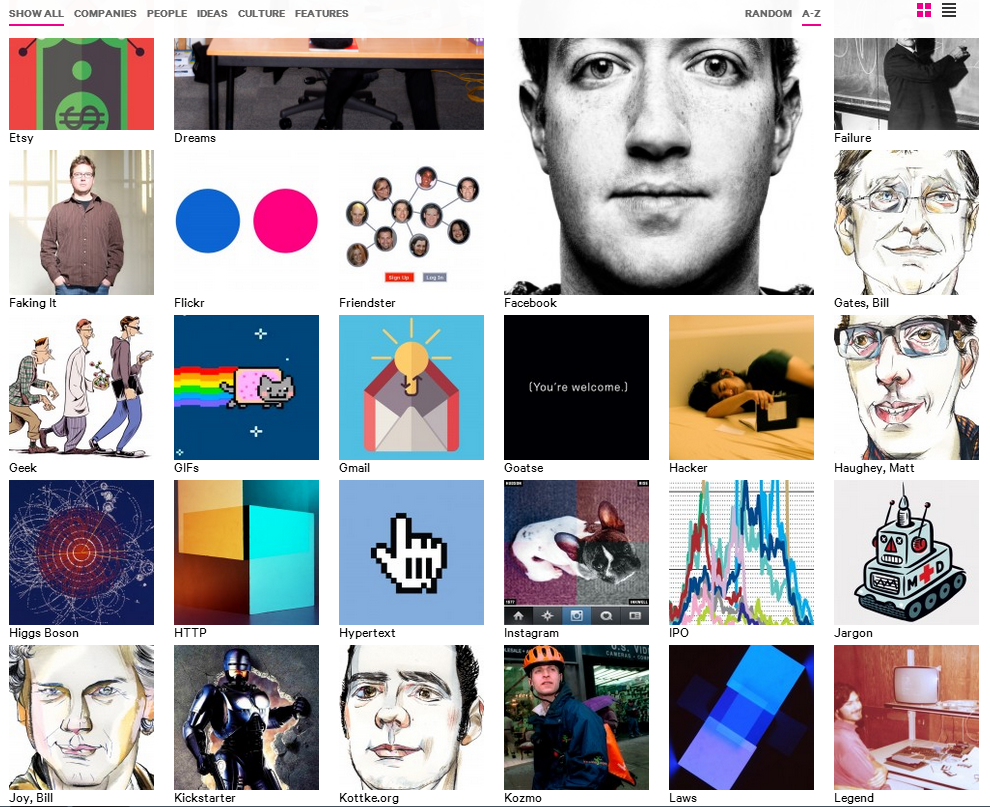
For the twentieth anniversary, the current issue of WIRED has a huge alphabetical list of topics that have been covered over the last 20 years (you can click on these topics on wired.com). From Angry Birds to Geek to Memes to Silicon Valley to xkcd and Mark Zuckerberg, I found many of these things interesting, though for some of them now, I wonder why. Which is actually a good question: why? Why has WIRED been my favorite magazine? I think it has to do with novelty and the future. I'm really interested in new and coming things, though not in all new things. For example, I have almost no interest in fashion, celebrities, or sports, although these areas are full of novelty (or simulated novelty). I tilt more toward the scientific and technological when it comes to novelty, and WIRED has always delivered.
If you click on the topic Geek, there's an explanation of the word, with credit to SF author William Gibson for introducing the modern usage of the word in the mid-80's. He described himself as "a geek who couldn't play baseball" (moi aussi). After some additional background, the item concludes with:
Be it a geek or a geck, both were misfits. And so was Gibson: Inept at sports, he took up science fiction. Foolishness in mainstream pursuits signified talent for their intellectual opposite. Geekiness became a synonym for countercultural braininess. And the rest is history.While I don't consider myself entirely countercultural or entirely brainy, if there's anything I identify with, it would be countercultural braininess.I may no longer fly my freak flag, but I still roll under the geek banner.
UPDATE: I just noticed that I wrote a fond note about WIRED back in 2008, on the occasion of its 15th anniversary, with the title "Optimism as Strategy." I included a quote from an article in that issue that I think is still relevant to the magazine, the future, and more importantly, to living:
The challenge is obvious, the dangers present, the need great. But be optimistic. I would say that, wouldn't I, since we were often accused during my time at Wired of being overly optimistic. But optimism is not false hope, it's a strategy for living. If you are optimistic about the future, you will step up and take responsibility and attempt to make it better for yourselves and your own children.
Monday, April 22, 2013
Happy Earth Day!
Before it slips away and becomes belated as so many occasions seem to do, here's wishing everyone a very happy Earth Day!
The picture above is a screen shot from the Orbiter space flight simulator, which I keep wanting to return to playing with, but never seem to have time. This is a nice, big-picture graphic, but as a celebration of the Earth, it pales in comparison to the daily stream of fascinating Earth images beamed down from the International Space Station by its commander, Col. Chris Hadfield. Just amazing stuff. Follow him on Twitter or Facebook (or on Tumblr) if you really want to get to know the face of this wonderful planet! He also does great science demonstrations (thanks to Astropixie for this tip).
Labels:
Earth,
environment,
ISS,
science,
space history,
technology
Subscribe to:
Posts (Atom)