I've always been happy to give Armstrong the benefit of the doubt and to go with what he meant to say, but I listened to it a few times just now, and it's not just a sound level problem. The words "for" and "man" just run right together like one word - the missing "a" would have to have been said very, very fast to fit in there. The Houston Chronicle has a graphic that zooms in on the audio waveforms, and I guess there's something in there, visually at least. And if you can't believe in Neil Armstrong, who can you believe in? OK, I believe you Neil! It was one small step for a man (but of course a big one for Pete Conrad on Apollo 12). Thank you Mr. Ford.
Space flight, simulators, astronomy, books, flying, music, science, education: whatever the obsession of the moment might happen to be.
Saturday, September 30, 2006
Neil Gets An "A" In Grammar After All
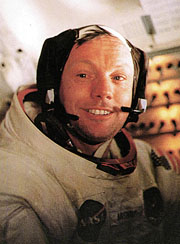
I've always been happy to give Armstrong the benefit of the doubt and to go with what he meant to say, but I listened to it a few times just now, and it's not just a sound level problem. The words "for" and "man" just run right together like one word - the missing "a" would have to have been said very, very fast to fit in there. The Houston Chronicle has a graphic that zooms in on the audio waveforms, and I guess there's something in there, visually at least. And if you can't believe in Neil Armstrong, who can you believe in? OK, I believe you Neil! It was one small step for a man (but of course a big one for Pete Conrad on Apollo 12). Thank you Mr. Ford.
Friday, September 29, 2006
Orbiter 2006 Patch Released
A patch for Orbiter 2006 was released today with a number of new features - see www.orbitersim.com for details of what was added and (free) download information.
One really nice feature is an enhanced 3D model of the shuttle Atlantis, including a more detailed virtual cockpit (VC) with multiple functioning MFD's (display screens for instruments as shown above). Cool.
A minor feature that I really like is the ability to add camera position control to flight recorder playbacks. This is really great for "hands off" demos. I was on the beta team and was able to add camera presets to two of the tutorial replays in time for Dr. Schweiger to include them in the patch release. These are "Atlantis Final Approach" and "Smack! Rescue." If you run these scenarios, the "camera" will switch to different external and cockpit views (set by me) depending on what is happening in the playback. For example, I switch to an underside view to see the landing gear come down when Atlantis is about to land, then to a fixed ground view next to the runway for the touchdown and roll-out.
NOTE: The following is NOT typical "Orbiter stuff" which is mostly done with the mouse and keyboard in a 3D view. This is more or less "advanced" use of a new feature that requires editing some of the files from a recorded flight. You don't have to do this at all!
To add camera presets to your own playbacks, you need to do two main things, both after you have recorded the flight (this assumes you are a bit familiar with scenario files which you will need to text edit). First is to play it back (maybe at 0.1 time "slow motion"), change to various views you wish to use, and save each of these views as a "preset" in the Control-F1 (Views) dialog. Save this scenario file, quit Orbiter, open the saved file with a text editor, copy the "BEGIN_PRESET - END_PRESET" section of this file, then open your recorded .scn file (it will be in the Scenarios\Playback folder), and paste this block into the BEGIN_CAMERA section of that scn file, and save that file. Note how many presets you have saved - you will later refer to them by number starting with zero.
Now go to the /Flights folder (in your Orbiter installation folder), and find the subfolder for your recorded flight (its name will match your recorded .scn file). Find the .atc file for the vehicle you wish to control camera views for, and open it with a text editor (it will be a file like sts-101.atc or gl-01.atc). The .atc file lists mission times (seconds) and various recorded actions such as HATCH OPEN and GEAR DOWN and ENG (engine events). You can insert new times (keep sequential order) with the command CAMERA PRESET n where n is the number of one of your saved preset camera views. For example
22.3 CAMERA PRESET 2
will switch the view to whatever preset-2 is (the third one you saved) at 22.3 seconds into the playback.
Sorry if that sounds complicated! It's really just editing a couple of text files and following the steps. The tricky part is to define good camera views and then to apply them at the right times to see something cool happening in the playback. Take a look at the two supplied examples and you'll see. But remember, this is a specialized thing, not typical of using Orbiter or necessary at all. If you are new to Orbiter, play with it a while before you try this. That's a lot more fun for starters.
Anousheh Returns to Earth
Anousheh Ansari and the crew of ISS Expedition 13 landed safely in Kazakhstan last night. Along with many people around the world, I have really enjoyed reading her blog entries and viewing the couple of videos she made in the last ten days or so. I also read some of the many comments on her blog. She really connected with people, many of whom I assume had no great interest in space exploration before, but who somehow felt that Anousheh's flight and her informal sharing of it through her blog made the experience of space seem real and accessible to ordinary people. It certainly did for me, even though I have read many professional astronauts' accounts of their experiences. I believe this is a really valuable contribution to the world made by this enthusiastic Iranian-American woman.
Wednesday, September 27, 2006
Flickr: 10,000 Views
On Flickr, I just posted another Orbiter screen shot of the shuttle Atlantis (on STS-115) from the perspective of the ISS on the recent mission. Sometimes Orbiter screen shots can look almost real, and this one reminds me of some real shuttle photos I've seen. This should also take me to 10,000 views on my Flickr pages, for what that's worth (not much - I suppose many Flickr sites get 10,000 views a day - but this is pretty esoteric stuff, space flight simulator screen shots). Thanks to all of you who have visited my Flickr site and this blog, both devoted largely to Orbiter and other "space stuff" - the few, the brave, the space obsessed...
Sunday, September 24, 2006
Astronaut Prep School
I’m not talking about an actual prep school for future astronauts. As far as I know there isn’t such a thing, although there is SPACE CAMP in Huntsville, Alabama, a commercial operation with programs for kids of various ages (also has adult programs). There are other space camps too, and I found a web site that has some astronaut selection tips and further references. What I am talking about is specific things to read and do that could help you understand what space flight is really like and whether you might like to try it sometime. It probably won’t surprise you to know there’s a bit of science learning involved in this. There are lots of books about space and astronomy, and while I haven’t read all of them, I have four books (and one free computer program) that I would recommend as a “starter library” for really learning about space flight. Some of these books are nominally for kids, but I think most adults will find them very helpful and enjoyable.
Space Station Science ("Life in free fall," Second Edition, 2004) by Marianne Dyson. If you are interested in learning about the International Space Station (ISS) or about what life in space is really like, this 128 page book is for you. It covers “getting there” (crew training, launch, orbits), space basics (space station systems and operations), living in space (free fall, food, bathrooms, sleep), working in space (space suits, doing science in space, Earth observation), and coming home (back to Earth, the future). It has lots of great photos and illustrations and a number of hands-on activities to help make some of the concepts more clear (and fun). Although it’s aimed at ages 9-12, it is detailed, accurate, and well written, and I would recommend this book to anyone with an interest in space.
Kids to Space by Lonnie Jones Schorer (2006). I discussed this book in a recent blog post. It covers a wide range of space related subjects in Q&A form, with questions that came from thousands of U.S. and Canadian students, and answers from a wide variety of experts. It’s more of a reference book, but I found it to be quite “browsable” – pick a topic such as “breathing” and read through 26 questions and well written answers. There are around 94 topics in this excellent 304 page book (illustrated with kids' pictures of various space subjects).
To Rise From Earth by Wayne Lee (2000). I discussed this book in a January blog post. Sadly, it is out of print, but used copies are available through Amazon. Wayne Lee is a space flight planner for JPL (he worked on landing the Mars Rovers, among other things), and he does a great job explaining how spacecraft, orbits and trajectories work. He also covers the history of space flight. This is the best non-technical introduction to “orbital mechanics” that I know.
Go Play In Space (Second Edition, 2006, free e-book). OK, I wrote this (with Andy McSorley on the second edition). But it’s the only “hands on” introduction to space flight that I know. How can it be hands on? It uses the free PC space flight simulator Orbiter to teach you how to achieve and change orbits, fly to the Moon, dock with the ISS, and even fly to Mars. It has a lot of references and background information too, including a final epilog called “Your Future In Space.”
So there you have it – a four-book, one-simulator “astronaut prep school” you can own for around $50 or less. I would also strongly recommend Marianne Dyson’s book Home on the Moon (Living on a Space Frontier, National Geographic 2003) since astronauts will be heading back there in a few years, but this might be considered supplemental reading in a basic “prep school” library.
Saturday, September 23, 2006
REAL Space Blogging
ISSpressConf.jpg
Originally uploaded by Space Explorer.
I've been following Anousheh Ansari's Space Blog - arguably the only "true" space blog at the moment, since she's actually blogging from space! She's now aboard the International Space Station, though her latest post describes her first experience with long-duration free fall ("zero G") in the Soyuz capsule during the nearly two days that it took to reach and dock with the ISS. She had some problems with "space sickness" which she describes in detail. That part wasn't much fun, but she says it's all worth it for the view and the experience.
Thursday, September 21, 2006
On the Radio (Me)
This blog is called "Music of the Spheres" and sometimes I actually talk about music. For example, now.Some kind soul lent a copy of my CD Jardin du Luxembourg to Steve and Bobbie Sands, hosts of a weekly radio show on FM 95.9 (WATD, Marshfield, MA), and they listened to it. Tomorrow's Dreams features New England artists, and although in my case it might better be called "yesterday's dreams," they've decided to play at least one of my songs on their show this coming Sunday, September 24 (between 3 and 4 pm EST). If you aren't in the Boston area, you can listen to the show streaming over the web.
This will be my first radio airplay since 1973 in Pittsburgh, PA. At that time I was in college and had some crazy ideas about a music career (this was when yesterday's dreams were tomorrow's dreams). I had recorded a 45 (look it up) and my manager got it played on a couple of small Pittsburgh stations. I actually heard two of my songs on the radio a couple of times. I was thrilled, but I turned out not to be the next James Taylor after all, so I went back to school and became an optical engineer.
So there you have it - the latest news on my music career. If it were moving any slower, this would have to be a geology blog.
Update on 9/24: They decided to play a song NOT on the CD (I had sent them an additional CDR with some more recent recordings). They played "Gonna Start Winning," a country-rock tune planned for my next CD if I ever get around to that. It is available as a free MP3 download at Garageband.com.
Great Landing!
The shuttle Atlantis landed safely on runway 33 at Kennedy Space Center in Florida early this morning. I was in the car driving my daughter to an early day at school and missed watching it live, but fortunately I had just learned (from fellow space blogger "DarthVader") of a space media site that makes it easy to find and watch space video clips any time. Space Multimedia is a great site but its videos only work for me in Internet Explorer (not my usual browser Firefox), perhaps due to a security setting or something.
Monday, September 18, 2006
What's in a name?
Another one is "space tourist" vs. "private space explorer" or other terms preferred by Anousheh Ansari and others who have paid their way to orbit (see today's Space Review for more on this one). I can see Ansari's point that her training was more akin to preparing for a Mount Everest climb (adventure travel?) than for a week on the beach, and I'm willing to use whatever name they like, though "space tourist" really works OK too. No biggy.
Finally there's poor, sad little Pluto, "demoted" to dwarf planet. Sorry Pluto, you're just gonna have to get used to the new designation. I just can't see the big deal over the Pluto thing - nothing has changed except a label that we use to discuss some objects in the Solar System. But we're still sending a spacecraft to visit in a few years, little buddy, so don't feel too bad.
Soyuz Live!

This is certainly novel (for me anyway). Ever since I can remember (which is back to the early Gemini launches in the 1960's), we always heard about how the Russian (then Soviet) space program was a big dark secret, in contrast to the American space program which was public and open, with advance notice of launches and live coverage of all flights (at least if there was enough public interest). This was pretty much true, but tonight I stayed up late to watch the launch of a Russian Soyuz spacecraft carrying the ISS Expedition 14 crew (and space flight participant Anousheh Ansari), live (on NASA TV) from the Baikonur space center in Kazakhstan! Amazing. As I typed this, the Soyuz spacecraft (called Vostok) safely reached orbit.The launch occurred right on time at 12:09 am EDT, and while video coverage didn't include the fancy long range optics used to view the Shuttle even at high altitude, they did supply in-cabin video from about two minutes into the launch. Very cool!
It's also good to see and hear Russians and Americans smoothly cooperating in this whole process. Space really does bring people together (sometimes).
Sunday, September 17, 2006
The Weather Makers: Act Now!
Others argue that claims of climate change are "political" and "controversial" and that we should wait for better proof. Sure Hurricane Katrina was terrible, but can anyone really prove that the strength and frequency of hurricanes are related to global warming and not due to other cyclic phenomena? This book makes the case the global warming is deeply involved (in an afterward added just after Katrina in late September 2005), but even if there's only a certain probability that this and other changes are due to human-induced climate change, we still ought to act. A prudent person buys a fire extinguisher before the stove catches on fire.
But it's hard to change, I know. I swear every day that I will eat less and exercise more, and I know I need to, but I usually don't. I'm prudent in many things but I let a lot of things slide. But climate change is not something we can let slide for much longer or problems like Katrina will become more common and devastating. Flannery also talks about all the changes that are less obvious but which may lead to snowballing side effects. Things like damage to coral reefs and forests, and the loss of thousands of species of animals and plants, most of them small, remote, and inconspicuous (in addition to the better known declines of large animals). Whether these lost animals and plants would have led to cures for cancer will never be known, but we do know that they are all components of complex ecosystems which help to keep things in balance in ways we hardly yet understand. Things like changes from old forest to scrubland or grassland that change the amount of water vapor in a region and result in less or more rain in other places. We just don't know how many of the huge rocks we are pushing on are balanced on the edge of a cliff, poised to fall on someone's house or head when we accidentally reach a tipping point we didn't know was there.
Flannery ends the book with things you can do right now. I know already that my next car will be a hybrid, which can reduce my personal transportation emissions substantially, even compared to the 1998 Camry I currently drive. I will look into solar water heating and remind my daughter (a member of the environment club at school) that leaving lights and appliances on around the house is contributing CO2 to the atmosphere, as well as annoying me! Maybe I should shut down the PC in the basement when I'm not using it (um, most of the week - oops).
The point is, I can do something now, and so can you. I'd suggest reading this book as a start, or you might read Plan B 2.0 by Lester R. Brown, another excellent recent work on climate change and what we can do about it, available in book form and also as free PDF chapters. Be the change!
ISS Fly-Around

The shuttle Atlantis (STS-115) undocked from the ISS this morning and performed a fly-around inspection which I watched for a while on NASA TV. With the newly installed P3/P4 truss and extended solar panels, the ISS looks really cool, so I decided to have a look at it in Orbiter.
As usual, "David413" has kindly provided the necessary add-ons and scenarios to simulate the current shuttle mission in Orbiter. His STS-121 Shuttle Fleet 3.9.1 expansion pack is the basic package, and he also released an STS-115 expansion pack (and several updates) for the current mission which includes the newly expanded ISS12A configuration. The picture including Atlantis is from Orbiter (I added a screen capture from NASA TV for comparison - see Flickr for a better Orbiter view of the ISS alone).
Even though the newly installed solar panels will not be operational until the next shuttle mission, they are already animated in the Orbiter version, including an automatic sun tracking feature! You can stabilize the ISS in its proper orientation with "prograde," aim at the Sun (easiest at sunrise as in the supplied sample scenario), then turn on the tracking. Accelerate time and watch the panels rotate to track the Sun (read the PDF file installed in the add-on docs folder for the key command for this and other features). Nice work!
Friday, September 15, 2006
Ms Ansari: Space Ambassador
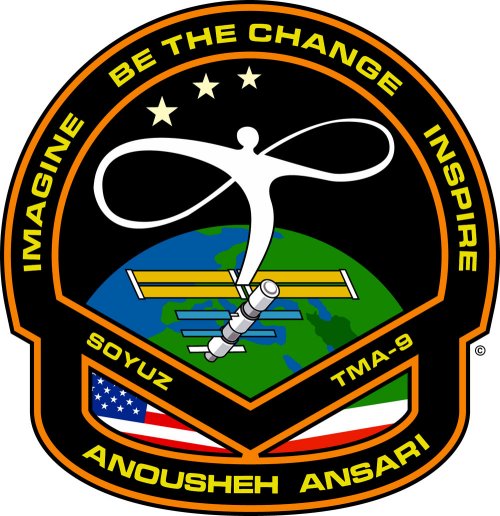
I haven't gotten too excited about previous $20 million-a-ticket space tourists (even though Greg Olsen was somewhat involved with optics, as I am). I'm not even sure if the three previous private space travelers had web sites or blogs (I suppose they at least had web sites). But I'm a bit more psyched about Anousheh Ansari's Soyuz flight to the International Space Station coming in a few days (planned for September 18). Ansari will be the first woman to fly as a "space tourist," as well as the first Iranian-born astronaut. She is also publicizing her flight in part as an educational outreach activity (her web site describes her as the "First Female Private Space Explorer & Space Ambassador"), and in recent days she has started a blog which she intends to continue through her flight to the ISS, sharing her experiences with the world.Her blog is even open for visitor comments, some of which she (or someone) has responded to. The blog has some interesting posts, discussing among other things "the price of a dream," along with a guest entry by X-Prize Foundation chairman and founder Peter Diamandis on the importance of space. The blog also shows the mission patch that she will wear (pictured), which I rather like, especially the "Imagine - Be the Change - Inspire" part. Because of the current international tensions over Iran's nuclear plans, there is some controversy about the Iranian colors (and her plan to also wear some version of the Iranian flag as a patch, along with an American flag), but why shouldn't she honor her heritage?
Some may say that this sort of thing is ego-tripping of the (literally) highest level by another member of the super-rich, but I give Ms Ansari full credit for living her dream of going to space while doing her best to share her experience and to use it to inspire others (she and her family also sponsored the initial X-Prize that was won by SpaceShipOne in 2004, so they seem to take the inspiration business pretty seriously). Best of luck to her. I hope to follow in her footsteps as soon as the tickets become a few orders of magnitude cheaper!
Space Junk: Fact and Fiction
The STS-115 shuttle astronauts have efficiently and successfully installed a new 17 ton section of the International Space Station and deployed its solar panels. They have one more EVA this morning to complete a few miscellaneous tasks. Great stuff - but the big news in the popular media seems to be the two bolts that were accidentally lost on two earlier EVA's, slightly increasing the amount of "space junk" in Earth orbit.Of course space junk is a real problem, something we will have to deal with more in the future as space commerce increases the level of activity in Earth orbit. Someday there might even be specialists in space junk removal, maybe something like the characters in the Japanese anime Planetes, which I learned about from a recent article at the Space Review.
I was intrigued enough to order a copy of the first DVD in the series (used through Amazon), and I watched a couple of episodes the other night. Although I studied and used Japanese for some 20 years (roughly from 1981 to 2001) and visited Japan many times, I never really got much into Japanese manga (comics) and anime (animated cartoons). In fact this was the first anime DVD I ever bought.
Planetes takes place around 2075 when extensive commerce is taking place in space. It concerns the exploits of a space station-based "space debris removal team," and seems to focus most (in the first two episodes) on the frustrations and interpersonal problems of the crew members in this under-appreciated and under-funded "half section." The space setting is pretty much taken for granted, which is the case in much of the space-based SF that I like, and the spacecraft and operations are interesting and somewhat realistic and plausible. The characters and situations are OK, although the main female character is frankly annoying in most of her scenes (I'm watching the English dubbed version, though it would probably make sense for me to listen to the Japanese with English subtitles as a way to get a little Japanese refresher).
I plan to watch the rest of the five episodes on this volume and also view some of the bonus materials (e.g., interviews with real space debris experts at NASA). I don't see myself getting hooked and buying the other five volumes, but it's an intriguing medium for showing what near-future space operations could be like in a fairly realistic (though dramatized) fashion.
Wednesday, September 13, 2006
Mars: Ready for your closeup?
After six months, 426 carefully managed orbital "dips" into Mars' atmosphere, and a few well placed thruster burns, NASA's Mars Reconaissance Orbiter (MRO) reached its near-polar scientific orbit on Monday and will soon (November) be ready to start taking pictures of the Mars surface (and doing a lot of other tasks too). The combination of high resolution sensors and a giant antenna (to enable speedy transmission of all those gigabytes of data back to Earth) means that MRO will return a huge bounty of data on the Martian surface and atmosphere.
I tried to set up MRO's final orbit in Orbiter, but I didn't get the sun-synchronous part right (needs more work but too tired now). The near-polar (planned 92.66 degree inclination) orbit is carefully designed to cross the equator at the same local time on each orbit, providing observations of the surface with nearly constant lighting conditions. The periapsis altitude (low point) of the orbit is about 250 km (and near the south pole), while the apoapsis (high point) is 316 km above the surface (near the north pole). More on the orbit design here (PDF), with general information on the mission here.
P.S. Of course there are no EVA astronauts with MRO at Mars, but I added one for the picture above to show how big this thing is - "bus size" as they say. More pix at Flickr. Note also that the MRO add-on for Orbiter is by Brian Jones, available at avsim.com (file mro.zip).
Tuesday, September 12, 2006
Orion: The Good, the Bad, and the Ugly
There has already been a lot of discussion of what's good, bad, and bogus about the plan. Although the Apollo-capsule-like form has been defended as being "convergent" (it was a good solution in 1969, it's still a good solution), it's still hard to believe this is the best NASA could come up with if its goals were to do the best job possible in building up the infrastructure for future space development, rather than the best job possible consistent with keeping the same level of employment at the agency and at its traditional contractors (with due consideration to getting dollars into key Congressional districts).
That's part of the argument made by Greg Burch in an excellent post on his blog ("The Trouble with Orion," September 2). As a partial counterpoint to this, here is a new Technology Review interview (9/11/06) with a Lockmart business development manager for the Orion project. She says the things you would expect, including the following that seems to echo Greg's point about NASA's fear of a "staffing valley" between the Shuttle program and its successors:
When it gets right down to it, NASA is signing up for a relationship with an industrial partner that's going to last a couple of decades. They wanted to know that it would be a happy marriage, where the spirit of partnership was in real evidence. During Phase I [when NASA paid several bidders to develop designs for Orion], we took the initiative to make sure our project office was co-located in Houston, which made it easy for them to participate in all of our control board meetings and other important events over and above the typical bimonthly reviews. We've got a significant workforce at the Michoud Assembly Facility in New Orleans [where the Shuttle's external tanks are put together]; we made a decision early on to do final assembly and checkout at Kennedy Space Center; we're going to be doing engine testing at Stennis Space Center in Mississippi [NASA's primary rocket propulsion test site]. I think NASA has appreciated that.
High Rise Construction

The current Atlantis mission to the ISS (STS-115) is going extremely well. I've parked NASA TV in Windows Media Player on my PC tool bar so I can keep an eye on on the first EVA as astronauts Joe Tanner and Heidi Piper work on installing the new ISS components they have delivered. It's quite amazing to be able to watch this really high rise construction in real time, sometimes from the first-person perspective of their helmet cameras. I keep reaching for the right mouse button to try to change the views myself, but this isn't Orbiter, it's the real deal!
Monday, September 11, 2006
Outreach: Author Marianne Dyson
I just happened to find this web site through a Shuttle-related article at NSS. Marianne Dyson is a former NASA flight controller and an award-winning author of children's books on space subjects, Home on the Moon (grade 4-6) and Space Station Science (ages 9-12). Judging from the reviews and awards, these look to be very interesting books for kids (I have just ordered them myself). I have explored her web site, and it has some cool resources and activities. It's great when people with a real space-related background apply their experience and skills to educational writing and outreach as Ms Dyson is doing. As someone who is trying to develop space-related materials for kids, I'm really looking forward to reading her books.
Sunday, September 10, 2006
SpaceX Update and Pix
Elon Musk of SpaceX has posted a good update on their Falcon rocket and Dragon spaceship progress, including some of the pictures he showed at his talk at the Mars Society Conference a month ago in DC. Very cool. I like this guy and I get the feeling (or is it just the hope?) that he is really going to succeed in getting people into space and really validating the whole commercial space thing at a level higher than suborbital (or even orbital or $100 million Moon fly-by) space tourism. Not that there's anything wrong with any of that or that I wouldn't go in a heartbeat if I had the money to burn (so to speak).Elon also included a note on pricing and why he's doing all this, similar to a comment he made at MSC.
I should probably say something about pricing, since some people think that it is only a matter of time before we raise prices dramatically. They are missing the point. I started SpaceX to lower the cost and increase the reliability of (American) spaceflight by at least a factor of ten and I'm hell bent on making that happen. We need to become a true spacefaring civilization, where spaceflight is affordable by normal citizens and extending life to another planet is realistic, and that requires lowering costs dramatically.Go Elon! Now we just need some Orbiter add-on makers to take on the Dragon and the Falcon-9 (and a Bigelow inflatable space station) so we can start to practice those missions.
Explore Mars (A Little) Now
I found a very cool Mars-related web site the other day, Exploremarsnow.org, but unfortunately it seems to have been abandoned in 2003. I didn't notice this until I had looked around for a while, found a page for signing up as a member (promising access to additional content), and paid for a one year membership ($15) with PayPal. Oops. Read the fine print before signing up for something. Oh well.It's still a cool if limited site to explore. You can't really explore Mars, but you can explore a detailed and pretty realistic interactive model of a Mars Direct-like "hab" that has landed on Mars, and the graphics and the interactive "walk through" of the various parts of the spacecraft are quite nicely done (red highlights indicate transitions/doors). There are also many mouse-active "hot spots" (yellow highlights) that display pop-up text boxes explaining the selected object. NOTE: Interactive features would only work for me in Internet Explorer, not in Firefox.
This site appears to have won some awards back in 2002-2003 and it really is a great start on an interactive Mars exploration site. It sounds like they just ran out of development funds, though someone is obviously still hosting it. They should leave it up but deactivate the membership stuff. So go have a look around, but don't get carried away and pay to sign up like I did!