Monday, May 30, 2011

Skylon in Orbiter

So Wikipedia tells me that the Reaction Engines Skylon proposal has been around for a very long time - how did I miss it? I guess the idea has heated up mostly since 2009 with the emergence of some funding. The new UK Space Egency/ESA report gives it another boost. It will still need a lot of funding, but Reaction Engines claims that it "will be able to repay its development costs, meet its servicing and operating costs and make profits for its operators whilst being an order of magnitude cheaper to customers than current space transportation systems." Here's hoping that all pans out (and that there's sufficient launch business to support this project as well as SpaceX and other private space ventures - so much depends on the costs-to-orbit they achieve). It would be really great to see a true space plane taking off from a runway, flying to orbit, and returning to the same runway - just like in the movies (and even without a pilot).

This article clearly explains some of the hybrid engine challenges. The Wikipedia article explains some of the smart thinking that has gone into keeping Skylon cool and safe for reentry (cool enough to allow an integral ceramic skin to do most of the work, although active cooling will probably be needed for the wings).It will still land as a glider like the space shuttle - no plans to retain fuel and re-start the air-breathing engines for landing.

I may have missed Skylon (until this very recent blog post), but members of the Orbiter community didn't and there is already a cool add-on version as well as some additional work based on that model. I downloaded the basic one by "inzane" and tried it out just a bit (mainly for screenshots). I wasn't able to make orbit on my first try - probably missed some steps in the instructions. Hey, it's new technology! It's also a very cool-looking 3D model.

Although Skylon is an unpiloted launch vehicle (essentially a huge UAV with some serious autopilot smarts), there have been some studies on possible passenger capabilities, and the Orbiter add-on features a passenger module which is visible in the screenshot above. I posted a few more screenshots on my Flickr page.

Carnival of Space #199

The 199th Carnival of Space is hosted this week by Weirdwarp. There are some really cool posts this week, but I was especially intrigued by the mysterious black Skylon space plane, which was reported by Next Big Future. This unpiloted SSTO (single stage to orbit) vehicle has been proposed by a UK company, Reaction Engines, Ltd. (Skylon press release here, PDF). The news is that an ESA report commissioned by the UK Space Agency concluded "no impediments or critical items have been identified for either the SKYLON vehicle or the SABRE engine that are a block to further developments."

This is exciting stuff, the key to its possible feasibility being the SABRE hybrid  air-breathing/rocket engine that would allow Skylon to operate like a jet airplane while within the denser part of the atmosphere, leading to an enormous reduction in the amount of oxidizer that must be carried. The report states that the current design has a gross take off weight of 275 metric tonnes, of which 220 tonnes are propellent, with the ability to place 12 tonnes into an equatorial low Earth orbit. This is something like 4.4% of the total which is pretty good, especially with a fully-reusable vehicle (the calculation for the soon-to-retire space shuttle is about 1.4%, not including the orbiter itself).

The Reaction Engines site says that Skylon is in the "proof of concept" stage, with development estimated at 10 years. There are obviously a few technical issues to overcome (materials, for one, I would imagine), but it's great that ESA at least sees no fundamental showstoppers in the Skylon proposal. Now to get it funded! Reaction Engines estimates development costs of about $10 billion (this seems pretty cheap, even for an unpiloted vehicle).

Bonus: finally a rocket ship that looks like one of Wernher von Braun and Chesley Bonestell's classic Colliers Magazine rocket ships from the 1950's! More or less. Check out the Skylon mission animation video.

Sunday, May 29, 2011

Orbital Resonance and 2084 (Save Us, Elon!)

I recently re-read Orbital Resonance by John Barnes, one of my favorite SF writers. This book is part of Barnes' "Kaleidoscope Century" series about which I have written before. Written in the early 1990's, the series imagines an alternate near-future in which a series of disasters have devastated Earth in the early twenty-first century (names such as Tailored Rice Blast, mutAIDS, the Eurowar, and the Great Die-Off suggest the scale of Earth's troubles). Space flight has advanced sufficiently to allow construction of some off-planet "lifeboats" including several space colonies formed from captured asteroids and an embryonic terraforming project on Mars. These space activities can only include a tiny fraction of Earth's population, but they provide hope that humanity can survive even if Earth does not. And of course they have their own troubles.

Orbital Resonance takes place aboard The Flying Dutchman, a huge space colony built and operated by NihonAmerica Corporation which is on a special "resonant" orbit that cycles between Earth and Mars, transporting cargo and colonists. The ship is largely self-sufficient and houses a permanent population of 7,200, most of whom have been born on the ship and are under 20 years old. Melpomene Murray is the narrator. Thirteen "ground years" old, she is one of these young ship-born members who know of life on Earth only from videos and from the stories of the parents. Space-ship engineering is quite important and advanced, but social engineering is equally important. While most adults manage to adjust to life in this confined, disciplined, variable-gravity environment, the kids have grown up on the ship, and their schooling and socialization have been tailored to help them cope and eventually take over from the adults here.  They are the future. But has the social engineering been successful? That's the story of this book.

Of course psychology is still not an exact science, and when a new boy from Earth joins Mel's class, the social balance is disturbed in various ways. Despite their impressive skills and knowledge, these are after all still adolescents, with all the hormonal and other issues that implies. Mel doesn't consider herself to be special (that's part of the team-oriented socialization process), but it turns out that she and a few of the other kids are special, with fewer of the social/developmental controls that have been placed on most of the kids. The adults are grooming them for leadership positions. But the kids don't especially like the ways they have been manipulated. I'll leave the rest for you find out if you choose to read it (as I have done three times now).

Of course I love "space stuff" and there is plenty of it here, but the book is not primarily about space, nor is it primarily about Earth's disasters, though these form the essential backdrop for why this ship and its three sister-ships exist. I read another book recently that is explicitly concerned with Earth disasters, a $1.99 "Kindle Short" called 2084: An Oral History of the Great Warming by James Powell. There's really very little about space or any other advanced technologies in this book. Its premise is that we do more or less nothing about human contributions to climate change (i.e., the path we are on now), and that due to various plausible feedback loops and uncertainties in the climate models, we end up with a 6° C (10.8° F) average temperature rise and a one meter (3.3 feet) average sea level rise by 2050. A variety of bad things ensue, many of them indirect side effects of climate change. They are told as "remembered anecdotes" by eyewitnesses to events that took place over many years.

There are obvious ones like the loss of many of the world's low coastal cities (most of Florida's coastal cities as well as most of the Netherlands are lost, not to mention most of Bangladesh). Loss of water supplies devastates the US Southwest, sub-Saharan Africa, and many other areas and leads to wars over water supplies, including a nuclear war between India and Pakistan. There are so many mega-storms that they are no longer named, but numbered by year, like 2048-9, and a huge storm in 2042 inundates and destroys major parts of New York City. Most of the US mid-west becomes too warm and dry to grow wheat, while Canada's climate makes it the new breadbasket - and leads to invasion and war with the United States! This sounds implausible, but consider that problems with water, food, and immigration (huge numbers of climate refugees heading for Europe, USA, and other areas) have led to the rise of Fascist governments in many countries, including the USA. There's more - a total of 18 anecdotes in this brief, fictional "oral history."

It's not the greatest writing (e.g., I was annoyed by the abundance of "local color" foreign expressions that the author inserted in most anecdotes, apparently to remind you that this was not an American "speaking"), but it is very thought-provoking. It is something of a worst-case, because although we can't be sure that technology will save us, surely some of the developments of today will help, with bio-engineered fuels and solar desalinization, for example. I'm not assuming space colonies (though I certainly favor an off-planet insurance policy for mankind), but lower cost access to space combined with robotic tech could probably lead to practical solar power satellites that would greatly help the energy supply - I'm thinking SpaceX Falcon 9 Heavy. Yes, Elon Musk will save us! I know he can do it.

Wednesday, May 25, 2011

Simon & Simon & Sean

It’s been a long time between blog posts. Aside from work and family, I’ve had a bit of a rough time since discovering in March that I had gallstones. Gallstones are often small and don’t present any problems, but when they do flare up, they can cause a lot of painful symptoms. Things got pretty bad in mid-April and I finally had my gallbladder removed on April 26. It’s relatively minor laparoscopic surgery these days, and I was lucky to receive excellent care, but it’s still pretty distracting. I’m mostly back to normal now.

As a still-aspiring-after-all-these-years singer-songwriter, I’ve always been a huge admirer and fan of Paul Simon. So I’m very excited that I will finally get to see him perform live at the Wang Center in Boston on June 1. I bought his recent album So Beautiful or So What when it came out in April, and I think it’s some of his best work, amazingly fresh and original -- so beautiful, and so what if he’s sixty-nine? There’s a wide-ranging interview with Paul in the April 2011 issue of Uncut Magazine (available online here). For all he’s accomplished, he comes across as incredibly modest and down to earth. He says, “Being a legend doesn’t mean anything other than that you’re old.” Perhaps it means a bit more than that in his case.

I recently discovered the music of Paul’s son, Harper Simon. Actually it was hiding in plain hearing on my iPod, at least one song from a Paste Magazine collection, “Berkeley Girl.” I had heard it before but hadn’t realized who it was (though it sounds a lot like a Simon & Garfunkel song). I checked out the rest of his 2009 solo album and found a lot to like. Harper was 37 when he made this first solo album. I found an interview where he explained that he just didn’t have that much to say in his twenties, though he had played in at least one band and had done other musical projects. Although he doesn’t aim to be known as “Paul Simon’s son,” it’s pretty hard to avoid that connection, and coolly enough, his dad even helped out on a couple of the songs on the album. Much of the album was recorded in Nashville, and it does have something of an alt-country feel on a few songs (he also sounds a bit like Elliott Smith at times). He admired the playing of some of the Nashville session players on favorite albums from the sixties, like Dylan's Blonde on Blonde, so he asked around to see if any of them were still playing. Sure enough, some of them were, so he got them on his album. One guitarist happened to have also played second acoustic guitar on the original S&G recording of "The Boxer." Small world?

Another recent find also involves the musical son of a legend (unfortunately not a living one). I occasionally search for my own music on Google, just to see what shows up. When I searched the other day for “Jardin du Luxembourg,” I found my album, but also a recent song with that title by Sean Ono Lennon. I quickly discovered a 2010 album by “Ghost of a Saber Tooth Tiger,” an acoustic duo made up of Lennon and his talented and lovely girlfriend Charlotte Kemp Muhl. Their songs are strangely beautiful, or maybe beautifully strange – ethereal vocals, fine harmonies, odd chord progressions and modulations. Good stuff. Check out their intimate and cute “Tiny Desk Concert” on NPR –  Charlotte looks great, and Sean’s facial expressions look so much like his dad, it's kinda weird.

Saturday, April 02, 2011

Cloud Music


When I first read about Amazon's new Cloud Player, I thought it was a gimmick - I've got thousands of songs on a 500 GB pocket drive, backed up on two other external hard drives (not to mention 4,400 songs on my iPod Touch) - why do I need music in "the cloud" - which is just a gimmicky word for the remote storage and computing accessed through the internet, right? Right? Well, I am an occasional early adopter, as well as a sucker for marketing and cheap MP3 deals. The basic "cloud drive" offer is 5 GB of online storage for free, but if you buy any MP3 album from Amazon (something I do quite often anyway, usually on sale for cheap), they will give you 20 GB free for a year. And there was a Norah Jones album I was thinking of buying anyway for $2.99, so I gave it a try.

Although I use iTunes and the iPod Touch, I long ago converted to buying MP3's from Amazon rather than AAC's (or whatever they are called now) from iTunes. Same songs, often cheaper, and more portable, and now, Amazon will also back up your Amazon MP3 purchases on your "cloud drive" - for free. "Free" as in they don't charge your for the storage space used by new Amazon MP3 purchases - the 20 GB is only for music you upload (including MP3's previously purchased from Amazon - the free storage only applies to new MP3 purchases). This really adds value to something I was buying anyway (they even store free MP3's that I "buy" from Amazon - daily free songs plus many sampler and promotional albums).

I realize this sounds like a paid political announcement for Jeff Bezos, but I'm now really sold on this cloud thing. I've bought a few other MP3 albums on sale at Amazon and have even started to upload my own music to the Cloud Drive.  I think it's really cool that my backup music storage can be independent of my own hardware, and that I can stream this music anywhere I can run a web browser (except on the iPod Touch, but there's plenty of music there anyway, plus Pandora and other internet radio music if I grow tired of my 4,400 songs). I can also download any of the music I have on the Cloud Drive any time I need to, which I will need to do for anything I plan to listen to on the iPod Touch (there is a Cloud Player app for Android devices, but I'm guessing that Apple will not approve an Amazon Cloud Player app any time soon). Of course it all depends on having an internet connection, but 90% of the time, I do. So it's really cool.

Tuesday, March 29, 2011

Amazing Kepler Exoplanet Graphic

Today's Astronomy Picture of the Day is a stunning graphical depiction of the results returned so far by the Kepler spacecraft. Kepler is staring at a small section of the sky within which it keeps track of the brightness of some 100,000 stars, watching for the slight change in light output that can indicate a transiting planet. The amazing graphic shown above shows the number of stars for which transits have been detected, their correct relative sizes and colors, and the correct numbers and relative sizes of the detected planets (multiple planets for some stars). Our own sun is shown for scale at the far right, below the top row of larger stars. If you zoom in, you can see the silhouettes of Jupiter and our very tiny Earth on the sun's face. There is an incredible amount of information in this single image - it could be in the class of the famous graphic depiction of Napolean's disastrous invasion of Russia.

Carnival of Space #190

The latest carnival of space is hosted this week by Centauri Dreams. I was supposed to host this week but a family emergency came up over the weekend, and Paul graciously agreed to host in my place. It's a small but very interesting collection of articles this week.

Thursday, March 24, 2011

Space Expo Noordwijk

Last week I did one of my occasional whirlwind customer tours in Europe, visiting six customer sites in France, Spain, the Netherlands, and Sweden in five days. There wasn't much free time in the schedule, but one of the customers happened to be ESTEC (European Space Research and Technology Centre) in Noordwijk, Netherlands (close to Leiden, not far from Amsterdam), and luckily there was an hour or so to kill before heading to Amsterdam to catch a flight to Gothenburg, Sweden.

I say luckily, because ESTEC is also the site of Space Expo, a space museum that is also ESA's visitor center (the main Space Explo web site is in Dutch and has multiple pages and pictures - there's also an English site, but it's got very little content). This museum isn't as large as Cité de l’Espace (Space City), which I visited last summer in Toulouse, France, but it's pretty impressive nonetheless. In addition to the expected exhibits on the solar system, stars, space history, etc., there are a number of life-size satellite mock-ups suspended from the ceiling. There are also a number of interactive exhibits where you can launch simulated rockets and the like.

The ISS was represented by a cool model hanging from the ceiling (shown above with overexposed floodlights simulating a double-star solar system). But more impressive were the full size walk-through mock-ups of the Russian Zvezda and the European Columbus ISS modules (I realized again that the ISS is really, really big). There was also a life size Apollo Lunar Module mock-up on a simulated lunar surface with space-suited astronaut manikins for scale and (lack of?) atmosphere. 

They have a nice collection of real space memorabilia including an Apollo moon rock, an airlock used on a shuttle Spacelab mission, and a section of the Hubble Space Telescope's first generation solar panels (returned on one of the servicing missions). There are some great large-scale models of Ariane launch vehicles (and full-size cutaway models of some Ariane rocket engines). I have a few additional Space Expo pictures on my Flickr site.

Finally I had to spend a few minutes in the gift shop where I couldn't resist buying a couple of 3D postcards of some of Saturn's moons (from Cassini imagery) as well as a book I will likely never read. It's a "graphic novel" of sorts, and it tells the story of Tania, a fictional European astronaut, as she makes her way through the selection and training program and finally into space. The illustrations are pretty good, and it's nice to have such a story told in graphic form. Unfortunately the text is only in Dutch, which limits my ability to follow all the details (it appears that this book was also published in English, French, and German). The picture at left is the last page of the comic section of the book (there's a final section with photos of real ESA astronauts and more detailed text, all of which I cannot read).

Sunday, February 20, 2011

Korean Pocket Sundial

Last week I hosted my company's annual international distributor meeting. One of my Korean guests was kind enough to bring me a small gift, something I had never seen before, a pocket sundial modeled on an ancient Korean sundial called Angbu Il-gu ("cauldron-like sundial"). According to this (what else?) Wikipedia article, the original version of this sundial was invented by Jang Yeong-sil and other Korean scientists sometime in the 1400's during the early Joseon Dynasty.The picture at the bottom of this article shows what the much larger original looked like (museum photo from Wikipedia Commons, courtesy Bernat).

The pocket sundial fortunately included some English notes, explaining that the 13 lines that are roughly perpendicular to the pointer are seasonal lines. The far right line is the winter solstice (lowest sun, longest shadows) while the leftmost line (aligned with the tip of the pointer in my photo) represents the summer solstice. Today is just about two months past the winter solstice, and the shadow's tip touches the second line. The lines that are roughly parallel to the pointer are time lines (half-hour increments), with the longest (center) line representing noon. This picture was take at 12:36 EST, and the shadow is well short of the 12:30 line, but the instructions also mention that some adjustment is needed for longitude, though the English explanation of this isn't very comprehensible. They also didn't mention the use of the compass, but I knew enough to align the red end of the compass needle with north.

I was surprised to get such a cool little gift, although I think my Korean friend knows that I have an interest in astronomy (or at least optics). I was also surprised that it is sunny enough today to test it!

(looks like this was taken right around the same month and time of day as my photo)

Saturday, February 19, 2011

From Bozo to Watson

I’m right on the cusp between insanely busy and merely crazy busy at work. So I thought I would take a breath and write a blog post, inspired by an amazing app I just bought for the iPod Touch.

Wikipedia may have its faults, with user-created content that often needs to be taken with a grain of skepticism. On the other hand, if you have an internet connection, it’s an incredibly broad collection of entry-level (and often in-depth) articles on just about anything you can think of. But what if you don’t have an internet connection? That may seem like a rare condition for many of us, but when I wrote this, I was on an airplane with no Wifi or mobile phone signal. Back on the ground, I walk around with an iPod Touch which provides excellent web access whenever I have a Wifi signal. I also have a BlackBerry “smart phone” which is great for email and which theoretically provides web access whenever I have a 3G signal. I say theoretically because the BlackBerry’s web browser totally sucks – it is slow and unable to load most web sites because it says they are “too big.” What’s an information junky to do?

The solution: clear 3 GB of space from my iPod Touch and spend $10 on an app called Wikipedia Offline, and voila, now I’ve got the whole English language Wikipedia in my pocket. More precisely, I have the main text for the entire Wikipedia as of September 2010. By default there are no pictures, though when you are online, you can download the latest version of any article and optionally save it with pictures (as I have shown here - you can also touch the globe button to display the full online version of the article you are viewing). The links to other Wikipedia articles are in there, as are many web links, but none of the “editorial” material that might help you judge whether the information is reliable or not.

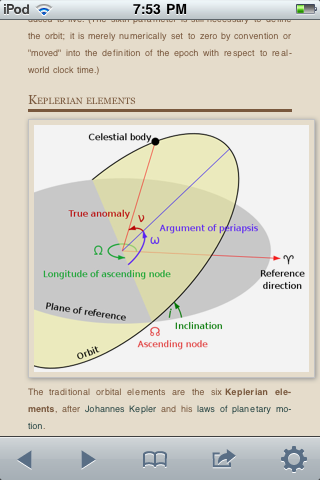
Other than those limitations, it’s pretty much all in there, from Bozo the Clown to Watson (the AI program that recently defeated two human Jeopardy game show champions – I updated the article to include recent information on that televised match). And everything in between (A, X,Y,and Z entries are in there too). Orbital elements. Orbiter. Fluffernutter sandwiches. Jayne Mansfield (she did die in car accident, but she was not decapitated). Elton John. A wide range of obscure musical acts (not me, I’m too obscure even for Wikipedia), albums, and movies. Battle of Britain (battle, movie, flight sim, airfields, memorial, etc., etc.).

How is this possible? I mean, 3 gigabytes is a lot of data, and the file is heavily and cleverly compressed. But jeeze. The first movie on my flight was the recent animated film Megamind so I looked it up. It’s in there, with cast and plot summary, although it is listed as forthcoming since the main database is from September 2010. This whole offline Wikipedia thing is really quite astounding.

Saturday, January 29, 2011

Carnival of Space #182

After a brief hiatus, the Carnival of Space is back, now organized (and hosted this week) by Brian Wang of Next Big Future. Thanks to Brian for taking over, and big thanks to Fraser Cain of Universe Today who has organized the Carnival since fall 2007.

Saturday, January 22, 2011

Rocket Science for Fun

I'm making slow progress on the third edition edits for Go Play In Space for the Orbiter 2010 space flight simulator. I sometimes need to present various aspects of "rocket science" in the course of explaining the intricacies of maneuvering in space (otherwise known as orbital mechanics) in Orbiter. This has led me to look into how other authors handle these explanations, so I've revisited a favorite book and have bought a new one. My perspective is a bit more practical than for many general readers - I am trying to teach my readers how to operate realistically simulated spacecraft, so when they encounter things like ascending nodes, they want to know what they can do with them (like align the plane of their current orbit with that of the ISS in preparation for rendezvous and docking), whereas other readers might just say, "that's nice" and turn the page.

The new book is It's ONLY Rocket Science by Lucy Rogers (I bought the Kindle version). Dr. Rogers is a British mechanical engineer and freelance journalist on space and astronomy topics (perhaps among others).She says on her website that she aims to write about science in plain English, and she pretty much succeeds in this book. For example, her explanations of orbital elements, Lagrange points, and ground tracks are quite clear and include some simple illustrations (including ones for Molniya and geosynchronous orbits). On the other hand, her explanation of rendezvous and docking is rather too brief, and could use some more illustrations for someone who wants the background needed to actually do rendezvous and docking in a real spacecraft (or in Orbiter, for most of us). The book also covers the space environment, rockets and spacecraft, types of missions, propulsion systems, communications, humans in space, and other topics in addition to the basics of orbital mechanics. There's a website with information and book excerpts here.

My old favorite is Wayne Lee's To Rise From Earth (Second Edition), which is sadly out of print (used copies are available on Amazon). I wrote about this book in some detail in 2006. The subtitle "an easy-to-understand guide to spaceflight" is really true, and Lee (who works as an interplanetary space flight engineer at JPL) covers a lot of ground in this book, including a lot of space history with detailed information on the Apollo program and the space shuttle. In the orbital mechanics area, the explanations are detailed, and there are many excellent color illustrations that support the explanations. Rendezvous and docking and ground track explanations are especially well done. As I wrote in 2006:
Both the book and Orbiter provide an essentially non-mathematical introduction to space flight - the book approaches this through geometry, using a large number of excellent diagrams as well as clear analogies and other text descriptions and many photographs. Orbiter takes the first-person approach of putting you in the pilot's seat and providing various instruments to guide you as you control the spacecraft to change orbits, rendezvous with another spacecraft, or fly to the Moon or to Mars.
So if you are a budding astronaut (or Orbinaut), which book should you choose? Ideally you should read both - Rogers covers some topics better than Lee (for example, Lagrange points) and you may find some explanations to be clearer in spite of the small number of illustrations. But if you want to really understand how orbits work and how you change them to get where you want to get in space, you should grab a copy of Wayne Lee's book before the used copies run out. Rogers' 2008 book is still in print (paper and Kindle).

Friday, January 14, 2011

New Shuttle Fleet for Orbiter

In my not-so-copious spare time, I am working on the 2010 update to Go Play In Space, the tutorial and exploration guide e-book that I wrote for the free Orbiter space flight simulator (with help from Andy McSorley on the second edition in 2006, and now from Mark Paton on the 2010 edition). Orbiter has a 2010 edition described here, with enough new and changed features to justify a new edition of Go Play.

The new edition will add a chapter on re-entry (written by Mark), and the rendezvous and docking chapter will use the supplied shuttle Atlantis spacecraft rather than the more powerful (but fictional) Deltaglider spacecraft used in the second edition. It's more realistic in that it's based on a launch (using a launch autopilot written in Orbiter's new scripting language), rendezvous, and docking scenario that happens in real life, although sadly not for much longer. I'm glad to finally be adding some shuttle operations to Go Play In Space.

Speaking of flying the shuttle in Orbiter, there's a brand-new edition out of the amazing Shuttle Fleet add-on for Orbiter 2010-P1 (Shuttle Fleet 4.7 by David413). I've only just downloaded and installed it, but it looks great. It includes support for local light sources which should improve the already impressive visuals. I will be discussing the Shuttle Fleet in the add-on chapter of the new Go Play In Space. The picture above is a nostalgic Shuttle Fleet screen shot of STS-1, the very first flight of the first operational shuttle, Columbia, April 12, 1981. Notice the white-painted external tank that was used on the early shuttle missions (they stopped painting the tanks on later flights to save weight, leaving the now familiar rusty orange color of the insulating foam).

Friday, January 07, 2011

Cool blog: Everybody's Dummy

Everybody's Dummy is a cool music blog. A few times a week it posts a detailed review of a classic album. I've discovered or rediscovered some great music by artists such as Bob Dylan, the Rolling Stones, the Beatles, Elvis Costello, and Dire Straits. Mainstream artists to be sure, but I don't know everything they have ever done, and it's cool to find an overlooked gem, or just to read an insightful review of an old favorite. The title is from a quote by Lester Bangs, "I'm nobody's dummy. I'm everybody's dummy. I believe everything I read, see, and hear."

Thursday, January 06, 2011

New Year, (Slightly) New Look

Happy new year! I'm back to a crazy work schedule, but every once in a while I get obsessed with some strange little thing. Tonight it was a new feature of Blogger, the ability to define your own blog template background image. I had a perfectly good stock image of the Earth, but was that enough? Of course not! I decided I needed a collage of Orbiter images instead (plus one picture I took of the real STS-118 launch). They said to make it 1800 x 1600 to allow for full screen, and I tried a couple of variations before arriving at the one shown here and in the background. Some of the edges are OK (depending on how your window is sized), but you really can't tell in the background that the upper left image is a closeup of the shuttle. I also just discovered that the 1800x1600 doesn't really fill the screen when Safari scales the web page for the iPod Touch. Oh well, it will have to do for now.

Friday, December 31, 2010

Books of 2010 and Beyond

This hasn't been a great blogging year for me - I like to think it's quality more than quantity that counts, but I'm not sure I can back that up! I don't think I can muster a full 2010 year/blog retrospective tonight, but it will be nice to break 100 posts, so I'll write about the one constant throughout my life: books!

Even in a busy year I still manage to read quite a few books (and buy more than I read). Part of the reason is the Kindle app on the iPod Touch. Thanks to this, I can carry around a library of 50-some books that I can easily read on planes or in small bites during many of life's spare moments (when I'm not landing the space shuttle, of course). People ask me how I can read for long periods on such a small screen, but it really doesn't bother me at all. A favorite of the books I read this year on Kindle was Packing for Mars by Mary Roach (so cool and funny, I'm now reading her Bonk, about guess what? ...also informative and hilarious). I also loved Matt Ridley's The Rational Optimist, 1,000 Recordings to Hear Before You Die (more of a browse than a read, but great), Einstein by Walter Isaacson, Can't Buy Me Love (Beatles!) by Jonathon Gould, Eifelheim by Michael Flynn (unusual first contact SF set in the Middle Ages), Girls Like Us (bio of Carole King, Joni Mitchell, and Carly Simon) by Sheila Klein, Cold Choices by Larry Bond (a rare return to the once favorite techno-thriller genre), and Edenborn by Nick Sagan (second volume of his Idlewild SF trilogy - read the other two in paper).

I read a few other books on paper too, including a biography of Paul McCartney by Peter Carlin and Whole Earth Discipline (an environmental eye-opener!) by Stewart Brand.  I now usually buy paper books if the Kindle version is unavailable, or if it's a book I want to share with people (like Brand's), or if it's a bargain book. Or a beautiful thing like Imagining Space. Or for some other reason! Currently I'm reading 3 or 4 books on the iPod plus Proust and the Squid by Maryanne Wolf in paper (a fascinating study of how the brain learned to read). My latest Kindle buy was Bill Bryson's A Short History of Nearly Everything. This is an old fave I have read twice, but I love Bryson, and I gave my paper copy to my brother, probably just an excuse to have Bryson's book in my pocket for brief dips into this cool and funny history of science and technology.

Wow, I read more than I thought this year. There are worse habits (and I have a few of those too).

Beatles LOVE and Other Music

Recently I read something that reminded me of the Beatles LOVE, the Cirque du Soleil show that I saw in Las Vegas in 2008. I loved that show, but for some reason I never got the soundtrack music from it, so a couple of weeks ago I bought an inexpensive used CD on Amazon and discovered that it's quite magical in its own way, even for someone who has all the other Beatles recordings ever made (more or less). LOVE is a loving mash-up of many of the Beatles songs, created by Beatles producer George Martin and his son Giles Martin from the original multi-track masters. It's really a new perspective on some of the Beatles songs.

2010 has been a pretty good music year for me. In June I completed and released my own second CD, Message From Tomorrow, to general non-recognition, but that's OK - like this blog, my music is something I do mainly for me while hoping a few other people will also enjoy it. I also discovered a lot of new music from Broken Bells, Local Natives, Arcade Fire, Winterpills, Aqualung, A Fine Frenzy, Darrell Scott, and others, in addition to buying and starting to listen to a boatload of classical music collections that expanded my horizons on composers including Dvorak, Mendelssohn, Schumann, Grieg, and others. I also saw James Taylor and Carole King in concert - a great and nostalgic time last summer.

Sometime in 2011, I plan to replace my ~2002 home PC so I can run some more recent recording software like Sonar X1 and start working on my next album (maybe play with some recent flight sims too). I have a few older songs I'd like to rediscover and perhaps re-invent, and I'd also like to experiment some more with samples and multi-track vocals. When I start to play with music, I tend to also write new songs (the past few months have not been very conducive to this with my brain saturated with work stuff). I almost ordered a new PC a couple of weeks ago then realized that I would need the time and brain capacity to play with it, so I'll wait until spring or so.

The Awesome Space Shuttle


It's hard to believe that there are now only two or three space shuttle flights left and that these amazing machines will be retired by the middle of 2011. Despite the tragic losses of Challenger and Columbia, this ahead-of-its-time space plane has had an incredible career with 132 space flights since 1981. I've spent a lot of time with shuttle simulations the last few weeks - in the F-SIM Space Shuttle landing app on the iPod Touch, as well as in Orbiter, working to update my free Go Play In Space e-book to a third edition (probably will be ready by early March 2011). One change will be to the rendezvous/docking chapter which will use the included Atlantis shuttle model instead of the futuristic Deltaglider that is used in the rest of the examples.It will follow a tutorial flight recording done by Martin Schweiger, Orbiter's author. It also shows off Orbiter 2010's new Lua scripting capability with the shuttle launch to orbit controlled by a Lua script autopilot.

I found the video shown here through the free NASA App on the iPod Touch - it's a great way to keep track of missions and to find pictures and videos on NASA's various sites. This narrated video consists mainly of video clips from various high-speed cameras that NASA uses for engineering diagnostics on shuttle launches. Because of the high recorded frame rate, they play back in slow motion, so you can see many of the intricate events that take place in seconds on every shuttle launch. They are always impressive and sometimes beautiful.

Thursday, December 30, 2010

My Tiny ISS Connection

In March 2009, I exhibited at the annual Space Expo held at the New England Air Museum at Bradley Airport, Connecticut. As I often have done, I used Orbiter to demonstrate some aspects of space flight, with a second computer set up with a joy stick to allow attendees (mostly kids) to have a try at landing a simulated space shuttle from final approach. This is a good hands-on demo because it only requires two controls (the joystick and the G key, to drop the gear). But it's harder than it looks.

Unfortunately, this demo was so popular, that I only managed to catch about 5 minutes of a talk by the Space Expo's special guest, astronaut Cady Coleman. But fortunately, Col. Coleman was kind enough to take a some time at the end of the day to visit with some of the exhibitors, including me. We chatted for a few minutes, and I told her about Orbiter in hopes that she would take some interest in this for educational purposes (or perhaps share it with some colleagues at NASA). She was quite interested to see Orbiter (she said "why didn't I know about this?"), and she asked me to send her some information, which of course I did. I was pretty happy when she replied the next day to my email:
Bruce – it was a pleasure to meet you – and I look forward to being in touch.  I can’t wait to start playing – and am soooo thankful that a manual exists….  I’m sure I’ll still have questions, knowing me!    My to-do list is a bit long these days – so I may not get to try it out right away - but this is really really neat stuff.  I’m assuming that you won’t mind if I share it with other folks in my office?  Thanks for taking the time to write – not to mention taking the time to come to the event.  I thought it was a great event – although I’ll tell you that I slept well on Sunday night…. I’m sure you did as well.  It is good work – but takes a lot out of you!  Thanks again -   Cady
...but I didn't expect to hear much more for a while, once I realized that she was already preparing for a late 2010 Soyuz flight to the ISS. On December 15, she launched on that flight, and she is now part of the Expedition 26 crew of the International Space Station (here are some of her thoughts just before she launched). I also learned today that she actually lives not far from me, in Western Massachusetts (when she's not in Houston, Russia, or space!). So it's not like Cady Coleman and I are best friends or anything, but it is pretty cool to have even this tiny connection to the ISS. Sometime after she gets back to Earth next May, I'll follow up on that email.

The video below features the ISS Expedition 26 Commander Scott Kelly of NASA and Flight Engineers Cady Coleman of NASA and Paolo Nespoli of the European Space Agency offering Christmas and New Year's greetings to all people on Earth on Dec. 21.

Sunday, December 12, 2010

Nice EP from Winterpills

Winterpills is a cool band from Northampton, MA. I've been listening to their music since their first album in 2005. I've also enjoyed several solo albums by Winterpills singer/songwriter Philip Price as well as "Robot Stories" from his previous band The Maggies. Today on the radio I heard someone mention "new Winterpills," so I looked around and found that they released a new 6-song EP back in October, "Tuxedo of Ashes." It's really good - haunting, harmony-laden, mostly acoustic music. They might remind you a bit of Iron & Wine, gentle music that's tougher than it sounds. Good stuff.