Thursday, October 20, 2011

Great Songwriting Blog

A few weeks ago I was looking for music and songwriting apps for the iPod Touch, and I found one called "Secrets of Songwriting" by Gary Ewer. Essentially an e-book formatted as an app, it was pretty expensive for an app ($16.99), but not so bad for a music book, and as a "multimedia" app, it was able to include examples of chord progressions and melodies as sound samples. So I bought it. Although I found a few interesting ideas, it was really too basic for me, and the app format (no search, no bookmarks, etc.) was frustrating.

The good news was Gary Ewer's songwriting blog, which I discovered through this app. "The Essential Secrets of Songwriting" is frequently updated with tips and with songwriting analyses of hit songs ("Rolling in the Deep" by Adele is a great recent example). Some tips are quite specific and musical (chord inversions, visualizing melodies, modal chord progressions, "making a MIDI orchestra sound real"). Others are more motivation and workflow oriented (identifying goals, dealing with writer's block, starting vs. finishing songs, writing better lyrics). There is a lot of excellent and thought-provoking material on songwriting here, with a huge archive of past articles. I'm taking notes and trying some of these ideas as I am now working on some new songs for my next recording project.

So now I'm happy to have bought Gary's app, supporting a musician/writer who is providing valuable educational material to songwriters everywhere for free through his blog.

Tuesday, October 18, 2011

Europe on 140 Characters a Day

I don’t have a Twitter account, and I tend to be long-winded when I talk or write, so I haven’t especially longed to tweet (I’d rather fly). But I’m also pretty busy these days, so I’m starting to see the value of that 140 character constraint. Sort of like haiku. So I’ll give it a shot here. MS Word can count my characters and keep me fairly honest. Throw in a few pix - mostly from mediocre BlackBerry camera (see explanation below).

Last week I was in Europe for a customer visit tour with our distributor. IT, FR, FR, UK, FR. Busy schedule but not the craziest ever.

A customer visit in Florence? Yes! Worth an extra day. As lovely as they say. Duomo, Boboli Gardens, and Galileo’s mummified fingers (oy).

Drive from Florence to Nice to Cannes for next customer. Tour of giant spacecraft assembly clean rooms. Sunny drive back to Nice Airport.

Toulouse (too tight?). Nice rosy city. Good weather, good customers, good food. Great food, actually. But no wifi (recurring hotel problem).

Fly Manchester England England, drive to Wales. Shortest UK trip ever (12 hours). Long enough to lose digital camera in rental car. :(

Paris! Business first, including a visit to the Observatoire de Meudon, with great views of Paris. Small hotel in the 6th. Duck dinner.


Late flight Saturday, time to relax and hang out in Jardin du Luxembourg on a gorgeous fall day. Wish I had my real camera. Lunch, fly home.

My new travel companion: an actual Kindle (not app on iPod). New model, small, light, ultra-white display, easy to read. Great buy ($79).

Friday, October 07, 2011

Flying History

B-24 Preflight Engine
Wow, busy fall. Not much time for blogging. I didn't even blog about one of the coolest things I've done in a long time. On September 26, I took a flight in a B-24 Liberator! After seeing the Collings Foundation's B-17 fly over my house, I called their flight coordinator and booked a B-24 flight the next morning at Worcester Airport. It was amazing. After takeoff, my fellow bomber enthusiasts and I were able to wander the whole aircraft, from the tail gunner position, to the waist guns, along the narrow catwalk through the bomb bay, up to the flight deck, and to even crawl through the tunnel to the bombardier's nose position.

B-24 Bombardier Pos
We stayed low and the whole flight only lasted about 30 minutes, but it was enough to give me a feel for what it was like to fly such a beast. It's built to carry bombs and fuel with not much in the way of comforts for the crew. I have even more respect now for the WW2 aviators who flew these big noisy things on long missions, often with people trying to shoot them down.

More B-24 pictures on Flickr.

Sunday, September 25, 2011

B-17 at Six O'Clock Low!

I learned this weekend that the Collings Foundation is in town this week, flying their B-17, B-24, and TF-51 war birds out of nearby Worcester airport (KORH). I learned this when a B-17 flew over my back yard Saturday at around 5 pm, then again at about 6 o'clock. That's when it hit me that it had to be sightseeing rides out of Worcester. I checked the schedule and found that there was a 5:30 pm flight today, so I was ready with a camera. Around 5:45 he showed up, higher and well south of me. A little later he was closer and made a few cool turns (still high though, maybe 2000 feet). Then I assumed he was gone, but at 6:15 I heard the rumbling again and ran to the back yard just in time to catch him flying directly overhead! I took a video this time. He was heading back to ORH (I could see him lowering the landing gear when I reviewed the video).

While checking the schedule I took the opportunity to schedule a flight myself in the B-24, with which I have a family connection. That will be 8:30 Monday morning. I'm psyched!

Hearing and Writing Drums

One thing I've always had a problem with in my own recording efforts is drums. I've used all sorts of pre-recorded drum loops in my songs and demos (including a set recorded by Mick Fleetwood), and I've tried to learn the various drum programming tools or plug-ins that are available for use with SONAR, but I never quite "got it." I admired (and envied) my producer Roger's ability to hear me play a new song on acoustic guitar and immediately start to lay out a drum track that works for it in Protools. It's talent and experience, I know. I want some!

I still don't have that ability, but I made a breakthrough this weekend with an old (1991!) book and a new iPod Touch app. The book is Drum Programming (A Complete Guide to Program and Think Like a Drummer) by Ray E. Badness (love that name!). It's a thin book with basic discussion of the features and limitations of drum kits and drummers (including the unfortunate fact of only two arms and two feet). Plus a ton of examples in a very simple tabular notation.

The app is Easy Beats 2, and it's just great. I had played with the free version and wasn't too impressed, but the ability to save and load patterns and drum kits in the full, updated version ($4.99) makes a huge difference. I was quickly able to enter the examples from the Badness book and hear the effects of different kick drum, high-hat, and ride cymbal patterns. It's easy to experiment with changes and new patterns, and you can easily sequence up to 16 patterns into a full song. There are a number of different drum kits, from basic synthesized kits to real recorded kits and more.

Best of all, this simple deconstruction of drum track basics, combined with a DIY "workshop" on drum patterns, now has me listening with fresh ears to the drum parts on all sorts of songs, even songs I've heard a million times or even wrote myself (with drums programmed by Roger). I still haven't done a fully original drum track for a song of mine, but I think I'm getting close. I have ordered a new, powerful laptop PC and the latest version of Cakewalk's recording software (Sonar X1). This will replace my now-dead 2002-vintage desktop PC which would barely run SONAR 3. With this and the many new music tools on the iPod Touch, I'm ready to start a new musical chapter of some sort.

Meanwhile I have a few new musical experiments on SoundCloud.

Saturday, September 17, 2011

A Song Is Born (on my iPod)

I've been trying to learn a bunch of music apps on the iPod Touch, as I have written about recently. The best way to learn them is to create some music, so I have, and I've posted some of these musical experiments on SoundCloud (which is free for some amount of music hosting - pretty cool). Most of them are one to two minute improvised instrumental fragments, but this weekend I wrote and demoed a new song, "Open Up Your Eyes," and that's up there too. The lyrics are incomplete and the demo is pretty rough, but not bad considering that the iPod is providing all the instruments as well as the "studio" for this little project. I think it's cool, but now it's time to do something else with what's left of the weekend.

The Science of Tyrannosaurus rex


The Science of Tyrannosaurus rex: Using digital paleontology to reconstruct one of history's largest carnivores.

These animations and explanations are really amazing and the first one about how T. Rex walked is funny too. The music doesn't really apply now, but T and his friends did manage to stay alive for quite a few million years.

Sunday, September 11, 2011

Songwriting Tools for iOS

I've been playing around with a bunch of songwriting and recording apps on my iPod Touch. I feel like a new songwriting and recording phase is brewing, and until I get a new recording PC to replace my broken old desktop, all I really have to work with is my iPod. Fortunately iOS apps for music have really improved, and many of them now support audio copy/paste or WAV file import/export, so it is possible to chain together the results from several apps.

My "work flow" for songwriting depends on where I am and what tools are available. At home I have a few guitars, a MIDI keyboard, and until recently, a PC with various recording software and hardware. I write songs in various ways - sometimes lyrics first, sometimes melody or rhythm first. But my usual methods are
  1. Guitar/voice - Play around with chord progressions on a guitar (sometimes keyboard) while singing melody ideas (with lyrics or "la la" placeholders or some combination). Record fragments for later review, record a simple demo when more or less complete, usually guitar/voice on SONAR.
  2. BIAB - Play around with chord progressions, styles, keys, tempo in the PC program Band in a Box, tweaking and singing to that track. Import MIDI from BIAB to record demo in SONAR. I documented an example of a song written and recorded with BIAB in early 2009.
  3. Rhythm based - Like (1), except using a drum machine or drum loops in SONAR to drive the song away from habitual strumming or finger picking patterns.
SONAR is a big plus in all of this - it easily integrates audio and MIDI recording with any number of tracks, including various looping and synthesized sound possibilities.

Now with the iPod Touch (third generation, which is important since many of the music apps won't work well on earlier generation Touches and iPhones), I have most of these methods available, including some guitar and keyboard substitutes for when the real things aren't available (clunky but helpful). There is nothing yet as powerful as SONAR or Band in a Box, but audio copy/paste allow combining multiple apps to accomplish similar things. The small screen can be a problem (helped by clever UI design), and input options are limited mainly to an external microphone. I bought some simple interface hardware to allow line-level inputs (keyboard, electric guitar, microphone pre-amp) which helps when I'm home. Here are the apps I'm using now (I won't bother with links - search in YouTube for demos or in the iTunes app store to buy):

ChordBot - Similar to BIAB in that it is based on progressions defined by chord names with your choice of key, tempo, and playing style, but with many fewer styles. It has both WAV and MIDI file export.

Multitrack DAW - I recently wrote about this app. I've upgraded to 24 tracks (total cost about $25). It's no SONAR (no MIDI or looping support and very limited audio effects), but it does the job for basic multitrack audio recording.

Guitar and iShred - These guitar simulation apps (acoustic and electric) use programmable chord buttons with strummable/pickable virtual strings (picture above). Good sounds, good UI, decent copy/paste. Expressive strumming or picking is pretty hard but possible with practice. I also have the PianoStudio app from the same company. Same idea, but you can program complex patterns (or chords) onto buttons with the phrase editor (similar to the piano roll interface in many MIDI-based applications). I'm just figuring out how to use this app. Could be useful for adding piano parts to some recordings since it supports audio copy/paste. It replaces the burden of accurate performance on a tiny screen with the burden of breaking the piece down into parts and assigning them to buttons which you then press in sequence to perform the piece.

ThumbJam - Brilliant UI and great sampled sounds as I have written about before. Recording & looping work well but with very limited editing capability.The wide range of scales could lead to some innovative melodies and song ideas once I stop fiddling with it. Pretty good copy/paste support. There are some odd tempo and looping issues that I'm still trying to overcome, but it really is the most "musical" app I've yet seen for iOS. It uses the touch screen and the accelerometer (tilt and shake) to support truly fluid instrumental performance (just add talent!).

SSW - Simple Songwriter uses button-driven piano block chords that you can play and record. Limited time options (3/4 or 4/4 with controllable tempo), clunky sound on playback (overly time quantized?), and no copy/paste or export, though it might have a song or two in it, at least for a chord progression idea I can write down and use in another app like Chordbot. Key word is "simple."

Loopy - I just got this "beat box" app, and it has an impressively easy interface. Not sure yet if this is really a useful tool for my 70's style songwriting, but it sure is cool.

BeatStudio and DrumTracks - Two of many drum machine type apps that I'm still trying to figure out. Some copy/paste and other transfer options for moving rhythm tracks into Multitrack DAW or ThumbJam. I'm not a very good drummer, but I can come up with some decent sounding things for demo purposes.

I'm still mostly experimenting with UI, copy/paste, and available sounds and rhythms using short examples. I have some promising fragments. I haven't really written a full song or recorded a full demo yet, but I'm getting close. Songwriting isn't all or even mostly about technology - I've written songs with nothing but my voice and paper on a plane (singing the result into my voice mail at the airport after landing - this was before I carried a voice recorder or equivalent device like a smart phone or iPod Touch). I've also written dozens of songs with just a guitar and my voice. But new technologies can inspire new ideas and approaches, and I think these iPod tools will yield some cool results before too long.
Thursday, September 08, 2011

Apollo 17 from LRO!

I just love today's APOD, a low altitude photo of the Apollo 17 site taken recently by NASA's Lunar Reconnaissance Orbiter (LRO). With its orbit adjusted to make a low pass of about 22 km above the surface (about 14 miles or 73,000 feet), it was able to capture a very detailed view of the LM descent stage and other hardware left behind at the site, as well as the tire tracks from the Lunar Rover (LRV). The picture below shows the A17 descent stage just after the ascent stage launched on December 14, 1972 (video frame from the TV camera on the LRV, parked about 150 meters away as shown in the LRO photo above).

This should finally put to rest all the nonsense about how the moon landings were faked, but of course conspiracy theorists will take it in stride - after all LRO is a NASA spacecraft that is (allegedly) orbiting the moon, and how easy would it be to fake this picture with PhotoShop? Child's play! They've kept the secrets of the moon landings covered up for nearly 40 years, why stop now?

Wednesday, September 07, 2011

JPL Wants YOU!

September is the only month in which you can apply to become a JPL Solar System Ambassador. This is a great volunteer program for educational and community outreach on space exploration and astronomy themes. If you have an interest in space exploration, enjoy sharing your enthusiasm with others, and would like to learn more about space exploration yourself, this program might be just the thing for you! Although I haven't been as active recently as I was a few years ago, I've really enjoyed the outreach events I have done and the training I've received as a Solar System Ambassador. And you have to admit it's a cool title.

You can find more information and a link to the application here. The program only operates in the United States.

Saturday, September 03, 2011

Where's the Space?

In case anyone is wondering about the lack of space-related blogging in recent months, I will briefly explain the concept of "serial obsession."  Throughout my life I have had a few major non-career interest areas, and apart from the ever-present themes of books and music listening, I tend to pursue one or two of these interests obsessively for some period of time, ranging from weeks to years, then move on (or back) to something else. The major categories are music creation/performance, languages, flying, and space. The latter two are somewhat linked, at least historically (my interests in space and in flying emerged around the same time, around 1962 when I was 9 years old).

From 2005 to 2008, space pretty much held sway, starting from my discovery of the free Orbiter space flight simulator in early 2005. That led to blogging about Orbiter, writing Go Play In Space, becoming a JPL Solar System Ambassador, educational outreach, and getting involved with an astronomy club (mainly for outreach related to space). Music was the theme for 2009-2010, culminating with the "release" of my second CD (Message from Tomorrow) in June 2010. The rest of 2010 and early 2011 were mostly eaten by my job (company was acquired in October 2010). This summer I have gotten back into flying, as reported in excruciating detail on my flying blog.

So where is space? It is lying fallow at the moment, waiting for its turn to come again on the Great Circle of Obsessions. I'm sure it will come. The budgie's not dead, it's just resting. Just like the US space program (I hope!).

But I do continue to at least peek at the space blogs and at the emails I get from NASA, and yesterday something really cool arrived. JPL announced Eyes on the Solar System, an interactive, 3D, real-data-driven, web-based "browser" for all the contents of the Solar System. It's different from Orbiter in that it is web based and (JPL) data-driven, rather than spacecraft oriented. There are indeed many spacecraft in "Eyes on the Solar System," and you can tag along with any of them, as shown in the picture above (Galileo fly-by of Io in 1995). But you can't launch your own spacecraft - or put another way, you don't HAVE to launch your own spacecraft to explore any place, object, or time in the solar system. It's VERY cool and I plan to explore it and write more about it as soon as I can. Maybe that will be the trigger for the next big space phase. Who knows? As this blog's tag line says, "Space flight, simulators, astronomy, books, flying, music, science, education: whatever the obsession of the moment might happen to be."

Sunday, August 28, 2011

Multitrack DAW on iPod Touch

I've been trying out some of the more recent music creation apps for the iPhone and iPod Touch. I wrote about ThumbJam the other day, and I've just bought and tried out another amazing little app, Multitrack DAW. "DAW" means "digital audio workstation," and this app is a pretty credible rendition for a pocket-size device (and for just $10 with 8 available tracks). It can be upgraded to 16 ($8) or 24 ($15) tracks through an in-app purchase.

Yesterday we prepared our house for the approaching Hurricane Irene, and today we are "hunkered down" and waiting for its powerful wind and rains to pass by. So far so good as far as damage and flooding (none) and electricity (haven't lost it). So in honor of the hurricane (now "only" a tropical storm), and to test out this new recording app on something simple, I recorded a short version of the classic "Goodnight, Irene" with acoustic guitar, multiple vocals, and finger snaps. It works quite well, and the user interface makes excellent use of the small screen space and touch-screen controls. In the screen shot above, you can see the big pan control that pops up when you select the small one on the track.

Multitrack DAW is missing a few things that full-size recording programs like SONAR have, most notably any sort of reverb or delay (it does have compression and EQ). This is not a horrible limitation if you use this app for its most obvious purpose, which is as an always handy "scratch pad" for song and recording ideas. It has very complete file transfer features via a WiFi network, allowing for import/export of individual tracks as well as complete mixes. Once I get a new PC to run SONAR (my old home desktop PC died recently), I will be able to transfer works in progress easily enough.

In the meantime, I will experiment with ways to integrate the various music apps to help me write some new songs. Many of them now support some sort of copy/paste between music apps, though currently there are a couple of competing standards so you can't directly transfer between all music apps. Another limitation is inputs. On the iPod Touch, you can plug in a combination microphone/headphone device for direct audio input. I have also ordered an adapter that allows line-level inputs (with headphone monitoring) so I can directly record other devices (keyboards, guitar processors, quality microphone pre-amps, etc.). This adapter costs more than the app itself (about $30)!

When you think about the old 4-track cassette systems that cost hundreds of dollars and had far less capability, this app is amazing, even if you spring for the extra $15 for 24 tracks for a total of $25. Crazy.

Update: I learned that ThumbJam supports both common iOS music copy/paste formats when it copies, so I can actually copy a track from TJ and paste it into Multitrack DAW. Excellent!

Wednesday, August 24, 2011

ThumbJam: Where the Songs Are

Songwriting comes and goes for me. A project like my 2010 "Message from Tomorrow" CD will typically inspire a bunch of songs, although not as many as I would like. Actually there are usually many songs started, just not very many finished. But fortunately for my first two CD's, I had a small backlog of older songs that I still liked well enough to want to rediscover and record. Now those old chestnuts have mostly been mined, leading me to wonder where the inspiration will come from for my next recording project.

Now I know. I discovered ThumbJam for the iPod Touch (and iPhone), the first music app I've found that I believe can really help me with songwriting and recordings. Basically it's a bunch of  nicely sampled instruments with a simple loop recording system and a brilliant interface for playing the instruments. Rather than trying to make a guitar fretboard or conventional black and white keyboard fit the iPod/iPhone touchscreen, Thumbjam presents a simple full-screen panel of notes in a chosen scale and key (you can play up to 6 notes at a time if your fingers will fit). Simple controls line the edge of the playing area, and the accelerometer is used to provide intuitive control of volume, pitch bending, vibrato, and tremolo. It's crazy good. Check out some of the videos here.

My big obsessions in life are music and flying, and right now I'm in a long-delayed flying phase, but over the next few months, increased business travel and fall/winter weather will reduce the flying as it always does. But I'm already thinking about getting a new PC for recording and flight sims (my 2002 desktop recording PC has finally died). I have recording software, drum machines, guitars, a MIDI keyboard, sample libraries, music apps, etc., and I have used all of these things to inspire and help me write songs. But none of those things brings the control of instrument sounds, scales, keys, and rhythms into an accessible, intimate, intuitive, powerful, and always handy form as Thumbjam does. I've already recorded three new song ideas in the first 3 hours of playing with it. I think it's the beginning of a beautiful friendship.

Friday, August 19, 2011

Great Band: The Grip Weeds

With the help of Pandora, I recently discovered a band I really love, The Grip Weeds . Although they have been around since the early 90’s, I had never heard of them until a song of theirs showed up on Pandora (on a station based on Winterpills, a favorite indie band from Massachusetts). They are sometimes labeled as power pop or psychedelic rock, and there is definitely something from the sixties in their sound. While they are not emulating any particular band, I can hear hints of the Who, Buffalo Springfield, Spirit, CSNY, The Beatles and others. Their harmonies and guitar parts are great. Great drumming too. While I love the rocking electric guitar driven songs, some of my favorites are acoustic tunes like "Give Me Some of Your Ways" and "Life and Love, Times To Come" (cool Indian instruments on this one).

I bought their 2008 collection “Infinite Soul: The Best Of The Grip Weeds” and their 2010 double album “Strange Change Machine.” Both are wonderful. You can currently get a free 8-song sampler from SCM by signing up with an email address at their web site. You can buy the 24 song double album as a download there as well for $9.99 which is considerably cheaper than the price at Amazon or iTunes (about $16). The band probably makes more money that way too. They are definitely worth supporting.

Sunday, August 14, 2011

Beech Tree Book Serendipity

I've always loved bookstores, new and used. For me, serendipity is the major draw of the small independent store. Amazon can offer me anything I want if I know I want it. But what about all the promising books that I probably would want if I only knew about them? This is the role of the physical bookstore, which unfortunately is fast becoming an endangered species (thanks in no little part to Amazon and other internet booksellers).

So I was happy this weekend to discover a brand-new used book and record store literally down the street from my house. Beech Tree Books and Records is located at 9 Maple Street in West Boylston, Massachusetts, less than a mile from me and just a few minutes drive from Worcester. They opened on July 30 and readily admit to being a "work in progress" as they continue to add stock to lightly filled shelves and record and CD bins. But I managed to find two "must have" books on my very first visit, including Rockets, Jets, Guided Missiles, and Space Ships by Jack Coggins and Fletcher Pratt, a 1951 (!) illustrated book for kids, with an introduction by Willy Ley! It's heavy on the V-2 (which was practically the latest in rocket technology at the time) but bravely delves into orbits, space stations, moon landings, and even the exploration of Mars and Titan. What a great find for a space geek like myself. One of my favorite paragraphs from this 60 year old book is from Ley's introduction (with quoted words as written):
What are the next twenty years going to bring? One of the great things to come is under discussion among scientists right now. It is the "orbital rocket," a small rocket which will circle earth outside our atmosphere for "ever." This means, of course, "for a very long time," months, years, decades, possibly centuries. Such an orbital rocket would not carry any people but only instruments, instruments of the type which can be "read" from a distance because they are coupled with an automatic radio transmitter and continuously broadcast their findings.
Beech Tree Books and Records is already a great little store with a lot of cool books, records, and CD's already on display at very reasonable prices and with more on the way. If you're in or near central Mass. and you like books, you should definitely check out this store.

Friday, August 12, 2011

Science!


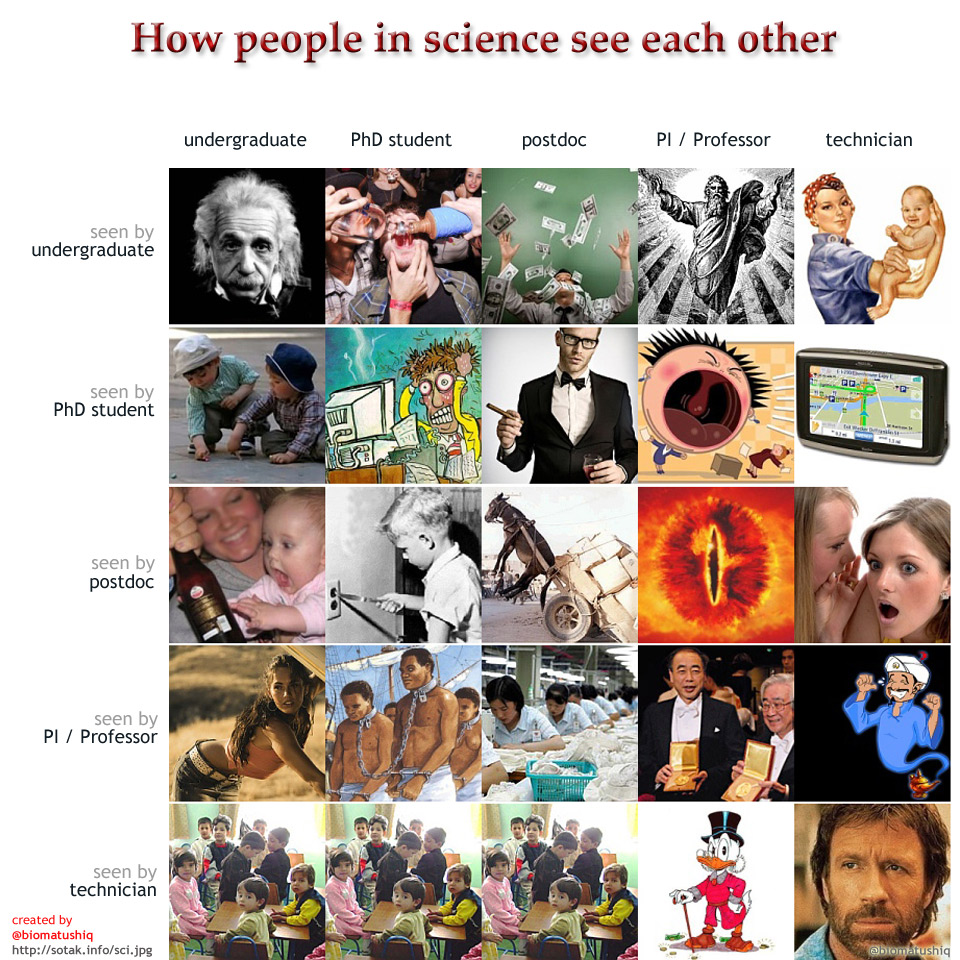
I love this. My son-in-law is a post-doc and he says it's pretty much right. Graphic by Matúš Soták.

Monday, July 25, 2011

SFO to CDG in 2 Minutes!


SF to Paris in Two Minutes from Beep Show on Vimeo.

I found this video on the Airpigz blog. It's really cool. This guy took a still picture out the window of an Air France 747 every two miles from San Francisco to Paris (the camera was on a special mount).

Sunday, July 24, 2011

Ghost Ants? Yes!

When a friend told me about Prophets of the Ghost Ants by Clark Carlton, I made the mistake of "taking a quick look." Since I'm just getting back into flying this summer after a few years away, I've really been trying to focus on study for my flight review, but I kept getting sucked back into this book instead! I really couldn't put it down (and since I was reading it in the Kindle edition on my iPod Touch, it was always at hand).

I'm not usually a fantasy reader (I tend to go for "hard SF"), but this book is somehow in a strange zone that is not quite fantasy, not quite "hard" science fiction, but is "sciencey" enough to reward my suspension of disbelief (great storytelling and characters helped too). The last time this happened was with a book Amazon was giving away as a Kindle loss-leader, His Majesty's Dragon by Naomi Novik. I was skeptical because dragon books are generally pure fantasy, but it was no risk to try. In that book, Novik re-imagines the Napoleonic wars with air power - flying, intelligent, talking dragons that crews of men ride into battle. The historical fiction is played straight (like a naval history novel), and the dragons are simply folded into that world (with great relationships between the dragons and their crews, especially their captains). That worked well enough to sell me six sequels! I think Carlton's "ant world" will be equally fertile (despite a similar disregard for physical scaling laws - dragons as described would be way too heavy to fly, and ant-size humans? I don't know, but it works in the book!).

Some Amazon reviewers have mentioned The Lord of the Rings, and I have to agree that the scope, world-building, compelling characters, and action/battle scenes of this book are of that quality. There is also the "unlikely hero" angle - but otherwise the stories are completely different. And although it's not hard SF, the biology of ants and other insects is an important part of the way these tiny human societies work, and it seems to be pretty accurate (and occasionally disgusting). There's also a tremendous amount of cultural anthropology embedded in this book - not in a scholarly way, but in an Ursula Le Guin sort of way. Under these circumstances and constraints, what would societies be like? What would their folk ways be like? Carlton has clearly thought a lot about these things, and they give the book an amazing depth and richness.

This is a great book. I can't wait for the sequels (and the movie!). Highly recommended!

Saturday, July 23, 2011

Cool Vacation

I'm just back from a really great vacation with my wife in Las Vegas and San Francisco. We did some really cool things and got to spend a lot of time with family in Berkeley. We took a huge number of pictures that I hope we will look at someday. I'll paste a few in here.  Here are a few highlights:

An early morning helicopter sightseeing tour from Las Vegas to the western end of the Grand Canyon, descending into the canyon and landing next to the Colorado River where the Papillon Helicopter Company provided champagne and a snack to supplement the amazing views.   I've posted a number of photos and videos of this tour on my Flickr site.

The wonderful Cirque du Soleil show "Beatles - LOVE" at the Mirage.

An open-top bus tour of San Francisco. It was my wife's first time there so this was a great way to get an overview of the city despite the fog that blocked most of our view of the Golden Gate Bridge even as we were crossing it (the rest of the city was clear).

A visit to Muir Woods National Monument to see some of the beautiful and ancient redwoods there.

A hike in Tilden Regional Park in the Berkeley Hills - great views of the Bay Area. Followed by a fabulous dinner at the Chez Panisse Cafe in Berkeley.


A walk up SF's Telegraph Hill followed by a fabulous seafood lunch in North Beach and a de rigueur cable car ride.

We also took some time to relax, hang out, and to even enjoy a sunset over the Bay from a park adjacent to the Berkeley Marina.

Thursday, July 21, 2011

End of the First Space Plane Era

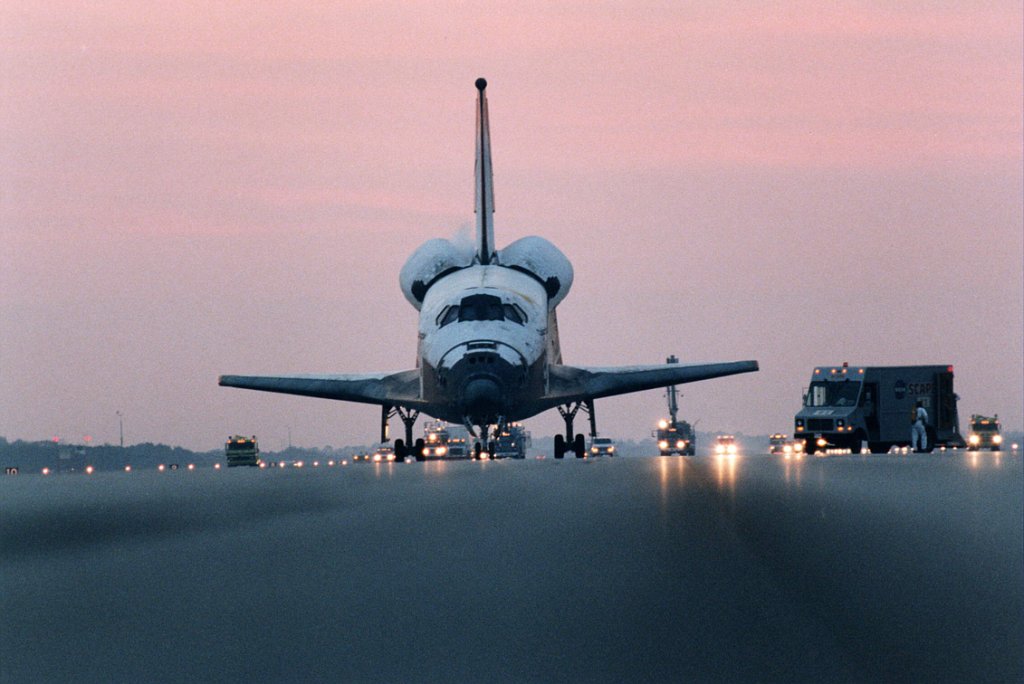
With the final landing of Atlantis (STS-135) early this morning, our first space plane era has ended after 30 years. I'm sure that human spaceflight will continue, and we will have other, better space planes someday. But Atlantis and her sister shuttles were a pretty audacious start, designed and built as they were with the technology of the 60's and early 70's. I'm happy that I got to witness the one launch that I did (Endeavour's STS-118 back in 2007).  I would have loved to have flown in one.

I couldn't do that, but I was happy to discover last night that version 2.0 of the great iPhone app F-SIM Space Shuttle was recently released. The new version of this shuttle landing simulator adds wonderful external views and a cool replay feature that allows you to enjoy your successful landings and scrutinize your errors in great detail. The shuttle era lives on in a small way on my iPod Touch and on iPhones and iPads everywhere.

Here's a great personal video of the real STS-135 landing from someone who had a great viewing spot, and here's the official NASA video which includes a few seconds of the cockpit HUD view at the very start (F-SIM Space Shuttle duplicates the HUD view and behavior quite exactly). 

Saturday, July 09, 2011

Photographic Moon Book (v3.5)

This is something I just rediscovered on my hard drive while looking for something else. I wrote about Alan Chu's wonderful Photographic Moon Book in 2007. It is an observer's photographic guidebook to the Moon containing nearly 300 annotated images of lunar features as well as some great introductory material on the Moon. Alan has continued to update and improve it. He released version 3.5 in March 2011. It's a free PDF, and it's big - 125 MB. You can download it from Alan's own Hong Kong site, or from a US based mirror site.

When I first found this in 2007, there was also a smaller document called the "Moon Science Primer." Most of this material is in the introductory section of the Moon Book, but the Primer goes a little deeper on some topics. Although Google still has a link to this, there is no link on Alan's home page, and the Google link returns a "not found."

Monday, July 04, 2011

Flying Posts: See "Flight School Retrojournal"

As I discussed recently, I've started to get back into flying, and it's really fun. I'm flying a Citabria 7ECA "Aurora" at Sterling Airport with the airplane's owner, Ed Urbanowski of Urban Aviation. It's a great little airplane, and Ed is a great instructor. Since I've been away from flying for seven years (yikes!), it will probably take a few hours with an instructor to get my skills back into shape. But I'm in no hurry. Safety first and all that.

So far it's going well - but it's only been two flights, and there's a lot to re-learn. Since I already have another blog devoted to (retroactively) documenting my original flight lessons (1997 to 2001, more or less), I've decided to use that blog for my current lessons as well. Even though it's called Flight School Retrojournal, I'll blog all the new stuff too - re-learning old tricks, breaking old habits, getting current, getting signed off to fly tail-wheel airplanes,and all that. So if you are interested in the nitty-gritty of learning (or re-learning) to fly, check out my other blog. There probably won't be a lot of photos, since I've decided to spend every minute in the cockpit focused on flying. I'll save the sightseeing for when I can fly on my own again - maybe this fall.

Sunday, June 26, 2011

Putting the "Flying" Back in FlyingSinger

Recently I've been thinking about what a shame it is that I have my private pilot's license but haven't piloted an airplane in over five years. Of course flying is pretty expensive and requires a lot of time, study, and attention to do it safely, and I've been pretty busy with other things. But I miss it.

Today I was in Marlboro, MA for brunch with my daughters when I happened to drive by Marlboro Airport (9B1). I had never visited 9B1 before, so I stopped to check it out. A student pilot (I assumed) in a Cessna 172 was practicing takeoffs and landings, so I watched for a while. I noticed that the single runway is quite short, with tall trees quite close to the approach end that was in use at the time (runway 32, landing to the northwest). The nearby trees reminded me of Hopedale Airport (1B6) where I took my first few flight lessons back in 1997, although when I went into the FBO to ask about rental and instruction rates, I learned that Marlboro's runway is much shorter than Hopedale's (by about half, 1659 feet vs. 3172 feet!). 

Marlboro Airport is about half an hour from home, and since I now work in Marlboro, I started thinking about what it would take to get current in a C152 or C172. Probably a few hours of refresher lessons to prepare for a flight review (BFR) before I can rent an airplane and fly solo again (plus I will need to get a current medical certificate). The short, narrow runway would certainly encourage disciplined flying and provide an additional challenge.


Driving home I realized I should also check out the airport that's closest to my house, Sterling (3B3). I've flown there a few times, including a couple of soaring lessons, and it's a nice little airport with a 3086' asphalt runway and a parallel grass runway that's used by the gliders and tail draggers. So I took the twelve minute drive and got a pleasant surprise - the flight school there is now run by Ed Urbanowski, a flight instructor from whom I had taken a few tail wheel lessons back in 2004 over in Spencer (60M). Ed now instructs full-time and has a Citabria 7ECA Aurora  (pictured) in addition to the Piper Cub we flew in 2004 and two Cessna aircraft. I didn't finish the tail-wheel endorsement, and I would still like to do that. Unlike the bare-bones classic Cub, the Citabria has a modern panel and an electrical system (no need to pull the prop!), and it can be soloed from the front seat. It's got a stick rather than a yoke (like the Cub), and it looks like a fun airplane to fly. So I signed up for my first refresher lesson for next Saturday morning. To be continued (finally!)...

I took this "artistic" picture of Sterling Airport on a late afternoon glider flight looking west on the downwind leg.

Thursday, June 23, 2011

The Soul of a Not-Quite-Thinking Machine

I just finished a wonderful book, Final Jeopardy: Man vs. Machine and the Quest to Know Everything by Stephen Baker. Baker had inside access to the IBM team that developed Watson, the amazing question-answering computer system that bested two human champions on Jeopardy early this year. The book quickly jumped the queue in my Amazon Kindle app after I read the sample chapter. I've always been fascinated by artificial intelligence, and I had already read a bit about Watson in a New York Times series last fall and through a number of web sources, but I somehow missed this book. It came out in February, shortly after the Watson shows had aired.

While Baker discusses some of the technology behind Watson, it's really the story of a group of talented humans who took on a great challenge. IBM had already been working on natural language-based question answering systems, but when the "Blue J" project started in 2006, they were nowhere near the level of any human player, let alone champions like Ken Jennings and Brad Rutter. The book reminded me most of Tracy Kidder's The Soul of a New Machine which I read sometime in the 1980's.

As interested as I was in Watson, I missed the original Jeopardy broadcast due to travel, and I had seen only a few brief excerpts. While reading the book, I decided I should really watch the whole three-show tournament, which I was able to do (without commercials) in about an hour thanks to YouTube. I was also curious to know more about the technology of Watson than I had learned from Baker and the other general things I had read online. I found a great paper from AI Magazine's fall 2010 issue, "An Overview of the DeepQA Project" (PDF), written by the IBM Watson project leader David Ferrucci and 11 members of his team. It is really incredible to learn about what goes on behind the scenes to allow Watson to answer virtually any Jeopardy question in 3-5 seconds with such incredible precision and confidence. "Confidence" is a big part of why this "QA" technology is different from something like Google's search technology which usually gets you into the neighborhood of an answer, but depends on having a human in the loop to determine the "right" answer. Watson has no human in the loop, so it needs to "know what it knows" to decide whether to "buzz in" on a Jeopardy question. It puts its "hypotheses" through extensive evaluation to determine its confidence in each one as a possible answer.

Of course IBM does not claim that Watson is "intelligent" or that it "thinks" anything like we do, but you could say that human brains are also massively parallel computing systems with thousands of inter-communicating subsystems. Watson's subsystems are in server racks. Our subsystems are squishy. Diversity! So let's give a warm welcome to our new computer overlord cousin, shall we?

Saturday, June 18, 2011

Increasing Cloudiness

A few months ago I started using Amazon's Cloud Drive service to store some of my music online. This was pretty much a no-brainer since I often buy MP3's from Amazon anyway, and these are now stored for you by default (and for free) on their cloud. You can also download them if you so choose. I don't have a huge amount of music there, about 2000 songs, mostly recent Amazon purchases. It includes about 5 GB of selected music I have uploaded, but I didn't really want to "commit" to Amazon's cloud service too quickly (other than the free part) since I assumed other things would be coming along, which of course is true. I do listen to the Amazon Cloud Player quite often since it includes a lot of my recent music, some of which I haven't bothered to download, especially a few 99-track classical collections bought on sale for $1.99 or so. The player has limited features but works quite well.


A few days ago I received an invitation to join Google Music Beta (I had requested this in May when it was announced). This is a pretty good deal, since Google will store up to 20,000 songs for free (at least for now - I haven't really read the fine print, but Google doesn't seem to worry much about storage as long as they have your eyeballs). The catch is that you have to upload all the songs you want them to store for you. To help you with this task, they can look at your iTunes or Windows Media Player music files to figure out what to upload (pretty much automatically, including iTunes playlists).

So it's an easy thing to do, but if you have a lot of music as I do, it's a long process. I've had it running on a good internet connection for two full overnights as well as all day today, and so far it's got about 5,800 of my estimated 20,000 songs online. I haven't paid too much attention to it except to correct occasional album cover art errors (I have a lot of MP3's ripped from CD's, most of which have cover art in iTunes, but Google sometimes gets its own and sometimes chooses wrong). The player is good though also quite basic, but this is "beta" so I assume this web-based interface will improve over time. You can start listening to music as soon as you have a few files there, which is cool. I think of it as a playable off-site backup for my music collection (though there is no provision I can see to re-download your music, so in that sense it's not a real backup).

Come fall I expect to have a third cloud full of music, once Apple introduces its full iCloud service. That will be really cool because it will scan my iTunes collection and re-create it online without my having to upload most of it (I will only have to upload anything I have that isn't in iTunes' 19 million song collection - things like vinyl albums that never made it to CD that I have ripped to MP3). I think iCloud will be the real deal because it will work directly with my iPod Touch as well as our PC's and my wife's iPhone.

Saturday, June 11, 2011

Shuttle Nostalgia

Today I was looking at some of the great ISS-Endeavour photos taken on May 23 by the ISS Expedition 27 crew from their departing Soyuz spacecraft (there's a wonderful NASA gallery here, cool video here). What a beautiful sight! This got me thinking about the fact that there's only one shuttle flight left, coming up in less than a month if things stay on schedule. Of course this is not shocking news for space enthusiasts, but it is still sad to think there will be no more flights of this amazing spacecraft.

This nostalgia carried me to Amazon where I started to look at shuttle books and videos before realizing, hey, I've already got some great shuttle books and videos that I haven't looked at in ages. Not that this will keep me from buying more (especially this 30 year retrospective coming out in late August), but I ended up re-reading most of the astronaut anecdotes from Space Shuttle: The First 20 Years -- The Astronauts' Experiences in Their Own Words which was published in 2002 (looks like it's out of print now - available only from third-party sellers). This is a fantastic book with a great selection of photographs and reference material on all the shuttle flights through STS-102 in March 2001.

But what makes it special are the astronauts' own words about their experiences, from the mundane to the sublime. Some comments are technical, like John Young discussing the very first reentry on STS-1, "It was a pretty good test flight, and we discovered a lot of things. For example, coming into the atmosphere at Mach 25 we got a really bad sideslip that we didn't expect, where the orbiter slipped sideways four degrees and dropped in altitude. Fortunately the software canceled it out. If it hadn't, we wouldn't be here." Some are humorous stories, like the crew of STS-95 (1998) teasing Senator John Glenn (77 at the time) about being a shuttle "rookie" and staging a little gag involving a fake "Shuttle boarding pass" that Glenn didn't have. There are a number of stories about illusions and other effects coming about from zero-G (like dropping some object just after returning from orbit, subconsciously expecting it to float). Many astronauts comment about the amazing views of Earth and on how the view of the "whole Earth" changed their lives.  It's a wide range of subjects - about a third of the more than 250 people who flew on the shuttle from 1981 to 2001 responded, and they were told to talk about whatever experiences they chose.

It's hard to pick a favorite, but there's a cool one that shows how it's all relative. Joe Edwards was the pilot on STS-89, and he talks about thinking that he was born too late for Apollo and too early to make it to Mars. At a memorial service for Alan Shepherd in 1998, he was talking with some other "younger generation" shuttle astronauts about this "born too late" idea when veteran Apollo astronaut Jim Lovell walked over. Jim wanted to say hello and to tell them about his discussion with "Neil, Buzz, and Gene" in which they decided they were born too early. Huh? Lovell said, "Well, you guys get the opportunity to go up to the space station. You get to fly the only reusable spacecraft that's ever been built, and you get to do all of these difficult and challenging things. We were just born too early. All we ever got to do was Apollo."

Well, Jim, that was still something. Apollo is history and in another month or so, the shuttle program will be history too. But I'm sure there will still be some difficult and challenging things for the next few generations of astronauts to do.

Sunday, June 05, 2011

Carnival of Space 200!


The Carnival of Space is 200 this week! Of course that is only 200 weeks, but it's still a pretty nice number. I remember when it was just a baby, back on April 26, 2007 when Henry Cates posted the first space carnival (oddly enough) on his Why Homeschool blog. Since then the carnival has been hosted by many different blogs (including mine a few times, though not very recently) and has expanded to cover a wide range of space and astronomy subjects.

Number 200 is hosted this week by Next Big Future. There are a lot of good posts, but my particular favorite is "Starship Fuel from the Outer System" from Centauri Dreams. It discusses the possible "mining" of Helium-3 from the atmosphere of Uranus. While the technology for this is a few years off (on several levels), it could provide fuel for fusion reactor-driven starships as well as a source of fusion fuel for Earth's energy needs. I've linked above to the beautiful image by Adrian Mann showing an He-3-harvesting "hot air" balloon above the clouds of Uranus's atmosphere.

Thursday, June 02, 2011

Paul Simon Dazzles

Wow, what a concert. I saw Paul Simon last night at the Citi Wang Theater in Boston, possibly one of the best concerts I've ever attended. Paul and his incredible eight-genius backing band played for nearly two hours, covering nearly every part of Paul's incredible career in about 24 songs. Nearly all of the band members played two or more instruments, including horns and the wide range of percussion used on songs from Graceland, Rhythm of the Saints, and the new So Beautiful or So What albums. At 69, Paul's voice, guitar playing, and stage presence are incredibly strong.The band was rock-solid on all the many styles of music that Paul's music incorporates, from delicate harmonies and background vocals on the Simon & Garfunkel classic "The Only Living Boy in New York" to the rollicking Zydeco of "That Was Your Mother" from Graceland.

A few of the songs brought on nostalgic tears - "The Sound of Silence" and "Only Living Boy" from the early days, "Peace Like a River" from the first solo album, "Still Crazy After All These Years" and "Slip Sliding Away" from the mid-seventies, and "Hearts and Bones" from 1983. I was thrilled to hear "The Obvious Child" from Rhythm of the Saints as well as five of the rhythmically and melodically rich songs from Graceland (Crazy Love, That Was Your Mother, Diamonds on the Soles of Her Shoes, Gumboots, and The Boy in the Bubble) - the band was amazing on these songs (they made great use of the two drummers plus supplemental percussion and horns played by three keyboard players). Paul and the band also pulled off some unusual sounds and musical effects on five of the songs from the new album (Dazzling Blue, So Beautiful or So What, Rewrite, The Afterlife, and the quietly haunting Questions for the Angels).

The sound system and engineering were also impressive, allowing all of these complex instrument sounds (plus vocals!) to remain clear and distinct. One surprise in the first encore was an acoustic version of George Harrison's "Here Comes the Sun" - as pretty as this was, I would have traded it for another one of Paul's own classics, perhaps "Mrs. Robinson" or "The Boxer" or "America," but that's OK. He has too many great songs to fit in one evening, and it was all wonderful. I was reminded again and again of the beauty and craft of Paul's songwriting, especially in the rhythms and the lyrics - the attention to every detail and the work needed to make it all sound so natural and inevitable. What an inspiration!