Wednesday, May 25, 2011

Simon & Simon & Sean

It’s been a long time between blog posts. Aside from work and family, I’ve had a bit of a rough time since discovering in March that I had gallstones. Gallstones are often small and don’t present any problems, but when they do flare up, they can cause a lot of painful symptoms. Things got pretty bad in mid-April and I finally had my gallbladder removed on April 26. It’s relatively minor laparoscopic surgery these days, and I was lucky to receive excellent care, but it’s still pretty distracting. I’m mostly back to normal now.

As a still-aspiring-after-all-these-years singer-songwriter, I’ve always been a huge admirer and fan of Paul Simon. So I’m very excited that I will finally get to see him perform live at the Wang Center in Boston on June 1. I bought his recent album So Beautiful or So What when it came out in April, and I think it’s some of his best work, amazingly fresh and original -- so beautiful, and so what if he’s sixty-nine? There’s a wide-ranging interview with Paul in the April 2011 issue of Uncut Magazine (available online here). For all he’s accomplished, he comes across as incredibly modest and down to earth. He says, “Being a legend doesn’t mean anything other than that you’re old.” Perhaps it means a bit more than that in his case.

I recently discovered the music of Paul’s son, Harper Simon. Actually it was hiding in plain hearing on my iPod, at least one song from a Paste Magazine collection, “Berkeley Girl.” I had heard it before but hadn’t realized who it was (though it sounds a lot like a Simon & Garfunkel song). I checked out the rest of his 2009 solo album and found a lot to like. Harper was 37 when he made this first solo album. I found an interview where he explained that he just didn’t have that much to say in his twenties, though he had played in at least one band and had done other musical projects. Although he doesn’t aim to be known as “Paul Simon’s son,” it’s pretty hard to avoid that connection, and coolly enough, his dad even helped out on a couple of the songs on the album. Much of the album was recorded in Nashville, and it does have something of an alt-country feel on a few songs (he also sounds a bit like Elliott Smith at times). He admired the playing of some of the Nashville session players on favorite albums from the sixties, like Dylan's Blonde on Blonde, so he asked around to see if any of them were still playing. Sure enough, some of them were, so he got them on his album. One guitarist happened to have also played second acoustic guitar on the original S&G recording of "The Boxer." Small world?

Another recent find also involves the musical son of a legend (unfortunately not a living one). I occasionally search for my own music on Google, just to see what shows up. When I searched the other day for “Jardin du Luxembourg,” I found my album, but also a recent song with that title by Sean Ono Lennon. I quickly discovered a 2010 album by “Ghost of a Saber Tooth Tiger,” an acoustic duo made up of Lennon and his talented and lovely girlfriend Charlotte Kemp Muhl. Their songs are strangely beautiful, or maybe beautifully strange – ethereal vocals, fine harmonies, odd chord progressions and modulations. Good stuff. Check out their intimate and cute “Tiny Desk Concert” on NPR –  Charlotte looks great, and Sean’s facial expressions look so much like his dad, it's kinda weird.

Saturday, April 02, 2011

Cloud Music


When I first read about Amazon's new Cloud Player, I thought it was a gimmick - I've got thousands of songs on a 500 GB pocket drive, backed up on two other external hard drives (not to mention 4,400 songs on my iPod Touch) - why do I need music in "the cloud" - which is just a gimmicky word for the remote storage and computing accessed through the internet, right? Right? Well, I am an occasional early adopter, as well as a sucker for marketing and cheap MP3 deals. The basic "cloud drive" offer is 5 GB of online storage for free, but if you buy any MP3 album from Amazon (something I do quite often anyway, usually on sale for cheap), they will give you 20 GB free for a year. And there was a Norah Jones album I was thinking of buying anyway for $2.99, so I gave it a try.

Although I use iTunes and the iPod Touch, I long ago converted to buying MP3's from Amazon rather than AAC's (or whatever they are called now) from iTunes. Same songs, often cheaper, and more portable, and now, Amazon will also back up your Amazon MP3 purchases on your "cloud drive" - for free. "Free" as in they don't charge your for the storage space used by new Amazon MP3 purchases - the 20 GB is only for music you upload (including MP3's previously purchased from Amazon - the free storage only applies to new MP3 purchases). This really adds value to something I was buying anyway (they even store free MP3's that I "buy" from Amazon - daily free songs plus many sampler and promotional albums).

I realize this sounds like a paid political announcement for Jeff Bezos, but I'm now really sold on this cloud thing. I've bought a few other MP3 albums on sale at Amazon and have even started to upload my own music to the Cloud Drive.  I think it's really cool that my backup music storage can be independent of my own hardware, and that I can stream this music anywhere I can run a web browser (except on the iPod Touch, but there's plenty of music there anyway, plus Pandora and other internet radio music if I grow tired of my 4,400 songs). I can also download any of the music I have on the Cloud Drive any time I need to, which I will need to do for anything I plan to listen to on the iPod Touch (there is a Cloud Player app for Android devices, but I'm guessing that Apple will not approve an Amazon Cloud Player app any time soon). Of course it all depends on having an internet connection, but 90% of the time, I do. So it's really cool.

Tuesday, March 29, 2011

Amazing Kepler Exoplanet Graphic

Today's Astronomy Picture of the Day is a stunning graphical depiction of the results returned so far by the Kepler spacecraft. Kepler is staring at a small section of the sky within which it keeps track of the brightness of some 100,000 stars, watching for the slight change in light output that can indicate a transiting planet. The amazing graphic shown above shows the number of stars for which transits have been detected, their correct relative sizes and colors, and the correct numbers and relative sizes of the detected planets (multiple planets for some stars). Our own sun is shown for scale at the far right, below the top row of larger stars. If you zoom in, you can see the silhouettes of Jupiter and our very tiny Earth on the sun's face. There is an incredible amount of information in this single image - it could be in the class of the famous graphic depiction of Napolean's disastrous invasion of Russia.

Carnival of Space #190

The latest carnival of space is hosted this week by Centauri Dreams. I was supposed to host this week but a family emergency came up over the weekend, and Paul graciously agreed to host in my place. It's a small but very interesting collection of articles this week.

Thursday, March 24, 2011

Space Expo Noordwijk

Last week I did one of my occasional whirlwind customer tours in Europe, visiting six customer sites in France, Spain, the Netherlands, and Sweden in five days. There wasn't much free time in the schedule, but one of the customers happened to be ESTEC (European Space Research and Technology Centre) in Noordwijk, Netherlands (close to Leiden, not far from Amsterdam), and luckily there was an hour or so to kill before heading to Amsterdam to catch a flight to Gothenburg, Sweden.

I say luckily, because ESTEC is also the site of Space Expo, a space museum that is also ESA's visitor center (the main Space Explo web site is in Dutch and has multiple pages and pictures - there's also an English site, but it's got very little content). This museum isn't as large as Cité de l’Espace (Space City), which I visited last summer in Toulouse, France, but it's pretty impressive nonetheless. In addition to the expected exhibits on the solar system, stars, space history, etc., there are a number of life-size satellite mock-ups suspended from the ceiling. There are also a number of interactive exhibits where you can launch simulated rockets and the like.

The ISS was represented by a cool model hanging from the ceiling (shown above with overexposed floodlights simulating a double-star solar system). But more impressive were the full size walk-through mock-ups of the Russian Zvezda and the European Columbus ISS modules (I realized again that the ISS is really, really big). There was also a life size Apollo Lunar Module mock-up on a simulated lunar surface with space-suited astronaut manikins for scale and (lack of?) atmosphere. 

They have a nice collection of real space memorabilia including an Apollo moon rock, an airlock used on a shuttle Spacelab mission, and a section of the Hubble Space Telescope's first generation solar panels (returned on one of the servicing missions). There are some great large-scale models of Ariane launch vehicles (and full-size cutaway models of some Ariane rocket engines). I have a few additional Space Expo pictures on my Flickr site.

Finally I had to spend a few minutes in the gift shop where I couldn't resist buying a couple of 3D postcards of some of Saturn's moons (from Cassini imagery) as well as a book I will likely never read. It's a "graphic novel" of sorts, and it tells the story of Tania, a fictional European astronaut, as she makes her way through the selection and training program and finally into space. The illustrations are pretty good, and it's nice to have such a story told in graphic form. Unfortunately the text is only in Dutch, which limits my ability to follow all the details (it appears that this book was also published in English, French, and German). The picture at left is the last page of the comic section of the book (there's a final section with photos of real ESA astronauts and more detailed text, all of which I cannot read).

Sunday, February 20, 2011

Korean Pocket Sundial

Last week I hosted my company's annual international distributor meeting. One of my Korean guests was kind enough to bring me a small gift, something I had never seen before, a pocket sundial modeled on an ancient Korean sundial called Angbu Il-gu ("cauldron-like sundial"). According to this (what else?) Wikipedia article, the original version of this sundial was invented by Jang Yeong-sil and other Korean scientists sometime in the 1400's during the early Joseon Dynasty.The picture at the bottom of this article shows what the much larger original looked like (museum photo from Wikipedia Commons, courtesy Bernat).

The pocket sundial fortunately included some English notes, explaining that the 13 lines that are roughly perpendicular to the pointer are seasonal lines. The far right line is the winter solstice (lowest sun, longest shadows) while the leftmost line (aligned with the tip of the pointer in my photo) represents the summer solstice. Today is just about two months past the winter solstice, and the shadow's tip touches the second line. The lines that are roughly parallel to the pointer are time lines (half-hour increments), with the longest (center) line representing noon. This picture was take at 12:36 EST, and the shadow is well short of the 12:30 line, but the instructions also mention that some adjustment is needed for longitude, though the English explanation of this isn't very comprehensible. They also didn't mention the use of the compass, but I knew enough to align the red end of the compass needle with north.

I was surprised to get such a cool little gift, although I think my Korean friend knows that I have an interest in astronomy (or at least optics). I was also surprised that it is sunny enough today to test it!

(looks like this was taken right around the same month and time of day as my photo)

Saturday, February 19, 2011

From Bozo to Watson

I’m right on the cusp between insanely busy and merely crazy busy at work. So I thought I would take a breath and write a blog post, inspired by an amazing app I just bought for the iPod Touch.

Wikipedia may have its faults, with user-created content that often needs to be taken with a grain of skepticism. On the other hand, if you have an internet connection, it’s an incredibly broad collection of entry-level (and often in-depth) articles on just about anything you can think of. But what if you don’t have an internet connection? That may seem like a rare condition for many of us, but when I wrote this, I was on an airplane with no Wifi or mobile phone signal. Back on the ground, I walk around with an iPod Touch which provides excellent web access whenever I have a Wifi signal. I also have a BlackBerry “smart phone” which is great for email and which theoretically provides web access whenever I have a 3G signal. I say theoretically because the BlackBerry’s web browser totally sucks – it is slow and unable to load most web sites because it says they are “too big.” What’s an information junky to do?

The solution: clear 3 GB of space from my iPod Touch and spend $10 on an app called Wikipedia Offline, and voila, now I’ve got the whole English language Wikipedia in my pocket. More precisely, I have the main text for the entire Wikipedia as of September 2010. By default there are no pictures, though when you are online, you can download the latest version of any article and optionally save it with pictures (as I have shown here - you can also touch the globe button to display the full online version of the article you are viewing). The links to other Wikipedia articles are in there, as are many web links, but none of the “editorial” material that might help you judge whether the information is reliable or not.

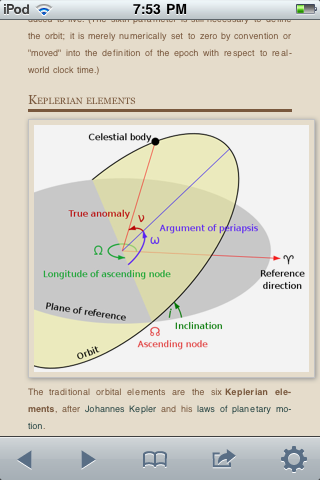
Other than those limitations, it’s pretty much all in there, from Bozo the Clown to Watson (the AI program that recently defeated two human Jeopardy game show champions – I updated the article to include recent information on that televised match). And everything in between (A, X,Y,and Z entries are in there too). Orbital elements. Orbiter. Fluffernutter sandwiches. Jayne Mansfield (she did die in car accident, but she was not decapitated). Elton John. A wide range of obscure musical acts (not me, I’m too obscure even for Wikipedia), albums, and movies. Battle of Britain (battle, movie, flight sim, airfields, memorial, etc., etc.).

How is this possible? I mean, 3 gigabytes is a lot of data, and the file is heavily and cleverly compressed. But jeeze. The first movie on my flight was the recent animated film Megamind so I looked it up. It’s in there, with cast and plot summary, although it is listed as forthcoming since the main database is from September 2010. This whole offline Wikipedia thing is really quite astounding.

Saturday, January 29, 2011

Carnival of Space #182

After a brief hiatus, the Carnival of Space is back, now organized (and hosted this week) by Brian Wang of Next Big Future. Thanks to Brian for taking over, and big thanks to Fraser Cain of Universe Today who has organized the Carnival since fall 2007.

Saturday, January 22, 2011

Rocket Science for Fun

I'm making slow progress on the third edition edits for Go Play In Space for the Orbiter 2010 space flight simulator. I sometimes need to present various aspects of "rocket science" in the course of explaining the intricacies of maneuvering in space (otherwise known as orbital mechanics) in Orbiter. This has led me to look into how other authors handle these explanations, so I've revisited a favorite book and have bought a new one. My perspective is a bit more practical than for many general readers - I am trying to teach my readers how to operate realistically simulated spacecraft, so when they encounter things like ascending nodes, they want to know what they can do with them (like align the plane of their current orbit with that of the ISS in preparation for rendezvous and docking), whereas other readers might just say, "that's nice" and turn the page.

The new book is It's ONLY Rocket Science by Lucy Rogers (I bought the Kindle version). Dr. Rogers is a British mechanical engineer and freelance journalist on space and astronomy topics (perhaps among others).She says on her website that she aims to write about science in plain English, and she pretty much succeeds in this book. For example, her explanations of orbital elements, Lagrange points, and ground tracks are quite clear and include some simple illustrations (including ones for Molniya and geosynchronous orbits). On the other hand, her explanation of rendezvous and docking is rather too brief, and could use some more illustrations for someone who wants the background needed to actually do rendezvous and docking in a real spacecraft (or in Orbiter, for most of us). The book also covers the space environment, rockets and spacecraft, types of missions, propulsion systems, communications, humans in space, and other topics in addition to the basics of orbital mechanics. There's a website with information and book excerpts here.

My old favorite is Wayne Lee's To Rise From Earth (Second Edition), which is sadly out of print (used copies are available on Amazon). I wrote about this book in some detail in 2006. The subtitle "an easy-to-understand guide to spaceflight" is really true, and Lee (who works as an interplanetary space flight engineer at JPL) covers a lot of ground in this book, including a lot of space history with detailed information on the Apollo program and the space shuttle. In the orbital mechanics area, the explanations are detailed, and there are many excellent color illustrations that support the explanations. Rendezvous and docking and ground track explanations are especially well done. As I wrote in 2006:
Both the book and Orbiter provide an essentially non-mathematical introduction to space flight - the book approaches this through geometry, using a large number of excellent diagrams as well as clear analogies and other text descriptions and many photographs. Orbiter takes the first-person approach of putting you in the pilot's seat and providing various instruments to guide you as you control the spacecraft to change orbits, rendezvous with another spacecraft, or fly to the Moon or to Mars.
So if you are a budding astronaut (or Orbinaut), which book should you choose? Ideally you should read both - Rogers covers some topics better than Lee (for example, Lagrange points) and you may find some explanations to be clearer in spite of the small number of illustrations. But if you want to really understand how orbits work and how you change them to get where you want to get in space, you should grab a copy of Wayne Lee's book before the used copies run out. Rogers' 2008 book is still in print (paper and Kindle).

Friday, January 14, 2011

New Shuttle Fleet for Orbiter

In my not-so-copious spare time, I am working on the 2010 update to Go Play In Space, the tutorial and exploration guide e-book that I wrote for the free Orbiter space flight simulator (with help from Andy McSorley on the second edition in 2006, and now from Mark Paton on the 2010 edition). Orbiter has a 2010 edition described here, with enough new and changed features to justify a new edition of Go Play.

The new edition will add a chapter on re-entry (written by Mark), and the rendezvous and docking chapter will use the supplied shuttle Atlantis spacecraft rather than the more powerful (but fictional) Deltaglider spacecraft used in the second edition. It's more realistic in that it's based on a launch (using a launch autopilot written in Orbiter's new scripting language), rendezvous, and docking scenario that happens in real life, although sadly not for much longer. I'm glad to finally be adding some shuttle operations to Go Play In Space.

Speaking of flying the shuttle in Orbiter, there's a brand-new edition out of the amazing Shuttle Fleet add-on for Orbiter 2010-P1 (Shuttle Fleet 4.7 by David413). I've only just downloaded and installed it, but it looks great. It includes support for local light sources which should improve the already impressive visuals. I will be discussing the Shuttle Fleet in the add-on chapter of the new Go Play In Space. The picture above is a nostalgic Shuttle Fleet screen shot of STS-1, the very first flight of the first operational shuttle, Columbia, April 12, 1981. Notice the white-painted external tank that was used on the early shuttle missions (they stopped painting the tanks on later flights to save weight, leaving the now familiar rusty orange color of the insulating foam).

Friday, January 07, 2011

Cool blog: Everybody's Dummy

Everybody's Dummy is a cool music blog. A few times a week it posts a detailed review of a classic album. I've discovered or rediscovered some great music by artists such as Bob Dylan, the Rolling Stones, the Beatles, Elvis Costello, and Dire Straits. Mainstream artists to be sure, but I don't know everything they have ever done, and it's cool to find an overlooked gem, or just to read an insightful review of an old favorite. The title is from a quote by Lester Bangs, "I'm nobody's dummy. I'm everybody's dummy. I believe everything I read, see, and hear."

Thursday, January 06, 2011

New Year, (Slightly) New Look

Happy new year! I'm back to a crazy work schedule, but every once in a while I get obsessed with some strange little thing. Tonight it was a new feature of Blogger, the ability to define your own blog template background image. I had a perfectly good stock image of the Earth, but was that enough? Of course not! I decided I needed a collage of Orbiter images instead (plus one picture I took of the real STS-118 launch). They said to make it 1800 x 1600 to allow for full screen, and I tried a couple of variations before arriving at the one shown here and in the background. Some of the edges are OK (depending on how your window is sized), but you really can't tell in the background that the upper left image is a closeup of the shuttle. I also just discovered that the 1800x1600 doesn't really fill the screen when Safari scales the web page for the iPod Touch. Oh well, it will have to do for now.

Friday, December 31, 2010

Books of 2010 and Beyond

This hasn't been a great blogging year for me - I like to think it's quality more than quantity that counts, but I'm not sure I can back that up! I don't think I can muster a full 2010 year/blog retrospective tonight, but it will be nice to break 100 posts, so I'll write about the one constant throughout my life: books!

Even in a busy year I still manage to read quite a few books (and buy more than I read). Part of the reason is the Kindle app on the iPod Touch. Thanks to this, I can carry around a library of 50-some books that I can easily read on planes or in small bites during many of life's spare moments (when I'm not landing the space shuttle, of course). People ask me how I can read for long periods on such a small screen, but it really doesn't bother me at all. A favorite of the books I read this year on Kindle was Packing for Mars by Mary Roach (so cool and funny, I'm now reading her Bonk, about guess what? ...also informative and hilarious). I also loved Matt Ridley's The Rational Optimist, 1,000 Recordings to Hear Before You Die (more of a browse than a read, but great), Einstein by Walter Isaacson, Can't Buy Me Love (Beatles!) by Jonathon Gould, Eifelheim by Michael Flynn (unusual first contact SF set in the Middle Ages), Girls Like Us (bio of Carole King, Joni Mitchell, and Carly Simon) by Sheila Klein, Cold Choices by Larry Bond (a rare return to the once favorite techno-thriller genre), and Edenborn by Nick Sagan (second volume of his Idlewild SF trilogy - read the other two in paper).

I read a few other books on paper too, including a biography of Paul McCartney by Peter Carlin and Whole Earth Discipline (an environmental eye-opener!) by Stewart Brand.  I now usually buy paper books if the Kindle version is unavailable, or if it's a book I want to share with people (like Brand's), or if it's a bargain book. Or a beautiful thing like Imagining Space. Or for some other reason! Currently I'm reading 3 or 4 books on the iPod plus Proust and the Squid by Maryanne Wolf in paper (a fascinating study of how the brain learned to read). My latest Kindle buy was Bill Bryson's A Short History of Nearly Everything. This is an old fave I have read twice, but I love Bryson, and I gave my paper copy to my brother, probably just an excuse to have Bryson's book in my pocket for brief dips into this cool and funny history of science and technology.

Wow, I read more than I thought this year. There are worse habits (and I have a few of those too).

Beatles LOVE and Other Music

Recently I read something that reminded me of the Beatles LOVE, the Cirque du Soleil show that I saw in Las Vegas in 2008. I loved that show, but for some reason I never got the soundtrack music from it, so a couple of weeks ago I bought an inexpensive used CD on Amazon and discovered that it's quite magical in its own way, even for someone who has all the other Beatles recordings ever made (more or less). LOVE is a loving mash-up of many of the Beatles songs, created by Beatles producer George Martin and his son Giles Martin from the original multi-track masters. It's really a new perspective on some of the Beatles songs.

2010 has been a pretty good music year for me. In June I completed and released my own second CD, Message From Tomorrow, to general non-recognition, but that's OK - like this blog, my music is something I do mainly for me while hoping a few other people will also enjoy it. I also discovered a lot of new music from Broken Bells, Local Natives, Arcade Fire, Winterpills, Aqualung, A Fine Frenzy, Darrell Scott, and others, in addition to buying and starting to listen to a boatload of classical music collections that expanded my horizons on composers including Dvorak, Mendelssohn, Schumann, Grieg, and others. I also saw James Taylor and Carole King in concert - a great and nostalgic time last summer.

Sometime in 2011, I plan to replace my ~2002 home PC so I can run some more recent recording software like Sonar X1 and start working on my next album (maybe play with some recent flight sims too). I have a few older songs I'd like to rediscover and perhaps re-invent, and I'd also like to experiment some more with samples and multi-track vocals. When I start to play with music, I tend to also write new songs (the past few months have not been very conducive to this with my brain saturated with work stuff). I almost ordered a new PC a couple of weeks ago then realized that I would need the time and brain capacity to play with it, so I'll wait until spring or so.

The Awesome Space Shuttle


It's hard to believe that there are now only two or three space shuttle flights left and that these amazing machines will be retired by the middle of 2011. Despite the tragic losses of Challenger and Columbia, this ahead-of-its-time space plane has had an incredible career with 132 space flights since 1981. I've spent a lot of time with shuttle simulations the last few weeks - in the F-SIM Space Shuttle landing app on the iPod Touch, as well as in Orbiter, working to update my free Go Play In Space e-book to a third edition (probably will be ready by early March 2011). One change will be to the rendezvous/docking chapter which will use the included Atlantis shuttle model instead of the futuristic Deltaglider that is used in the rest of the examples.It will follow a tutorial flight recording done by Martin Schweiger, Orbiter's author. It also shows off Orbiter 2010's new Lua scripting capability with the shuttle launch to orbit controlled by a Lua script autopilot.

I found the video shown here through the free NASA App on the iPod Touch - it's a great way to keep track of missions and to find pictures and videos on NASA's various sites. This narrated video consists mainly of video clips from various high-speed cameras that NASA uses for engineering diagnostics on shuttle launches. Because of the high recorded frame rate, they play back in slow motion, so you can see many of the intricate events that take place in seconds on every shuttle launch. They are always impressive and sometimes beautiful.

Thursday, December 30, 2010

My Tiny ISS Connection

In March 2009, I exhibited at the annual Space Expo held at the New England Air Museum at Bradley Airport, Connecticut. As I often have done, I used Orbiter to demonstrate some aspects of space flight, with a second computer set up with a joy stick to allow attendees (mostly kids) to have a try at landing a simulated space shuttle from final approach. This is a good hands-on demo because it only requires two controls (the joystick and the G key, to drop the gear). But it's harder than it looks.

Unfortunately, this demo was so popular, that I only managed to catch about 5 minutes of a talk by the Space Expo's special guest, astronaut Cady Coleman. But fortunately, Col. Coleman was kind enough to take a some time at the end of the day to visit with some of the exhibitors, including me. We chatted for a few minutes, and I told her about Orbiter in hopes that she would take some interest in this for educational purposes (or perhaps share it with some colleagues at NASA). She was quite interested to see Orbiter (she said "why didn't I know about this?"), and she asked me to send her some information, which of course I did. I was pretty happy when she replied the next day to my email:
Bruce – it was a pleasure to meet you – and I look forward to being in touch.  I can’t wait to start playing – and am soooo thankful that a manual exists….  I’m sure I’ll still have questions, knowing me!    My to-do list is a bit long these days – so I may not get to try it out right away - but this is really really neat stuff.  I’m assuming that you won’t mind if I share it with other folks in my office?  Thanks for taking the time to write – not to mention taking the time to come to the event.  I thought it was a great event – although I’ll tell you that I slept well on Sunday night…. I’m sure you did as well.  It is good work – but takes a lot out of you!  Thanks again -   Cady
...but I didn't expect to hear much more for a while, once I realized that she was already preparing for a late 2010 Soyuz flight to the ISS. On December 15, she launched on that flight, and she is now part of the Expedition 26 crew of the International Space Station (here are some of her thoughts just before she launched). I also learned today that she actually lives not far from me, in Western Massachusetts (when she's not in Houston, Russia, or space!). So it's not like Cady Coleman and I are best friends or anything, but it is pretty cool to have even this tiny connection to the ISS. Sometime after she gets back to Earth next May, I'll follow up on that email.

The video below features the ISS Expedition 26 Commander Scott Kelly of NASA and Flight Engineers Cady Coleman of NASA and Paolo Nespoli of the European Space Agency offering Christmas and New Year's greetings to all people on Earth on Dec. 21.

Sunday, December 12, 2010

Nice EP from Winterpills

Winterpills is a cool band from Northampton, MA. I've been listening to their music since their first album in 2005. I've also enjoyed several solo albums by Winterpills singer/songwriter Philip Price as well as "Robot Stories" from his previous band The Maggies. Today on the radio I heard someone mention "new Winterpills," so I looked around and found that they released a new 6-song EP back in October, "Tuxedo of Ashes." It's really good - haunting, harmony-laden, mostly acoustic music. They might remind you a bit of Iron & Wine, gentle music that's tougher than it sounds. Good stuff.

More iPod Shuttle (Landing Tips)


I'm still obsessed with F-SIM Space Shuttle on the iPod Touch. Now that I'm a seasoned pro with some 10 hours (!) of flight time and at least one "good" landing (with 26 "safe" landings, 54 "hard" landings, and an embarrassing number of crash landings), here are a few things I've learned along the way. While it may seem odd that someone with such a poor record and slow learning curve has the audacity to offer landing tips to others, here's the thing: I've made these mistakes enough times to notice what they are, and if you can avoid some of them as a result, you'll be ahead of the game. This only applies to "final approach" landings. I've done a few full HAC approaches, but I still really suck at those, so too soon to give tips.
  1. Read the "help" landing tutorial and watch a few Autoland demos, paying careful attention to the flight path marker (FPM) and approach cues in the HUD (the tutorial explains these with pictures). After you've landed a few times, also read the landing notes in part 2 of the help - good tips, but you'll need some experience to recognize them.
  2. If you don't let the FPM get far from where it should be (and you shouldn't), the range of tilt and rotation motions you need is very small. The iPod Touch is so light, it's very easy to make motions you don't want that can really throw off your approach. I find I have to brace my elbows against my body and cradle the iPod carefully to keep it steady and in balance. And have my eyes very close to the screen.
  3. Make very small adjustments, and don't ever let the FPM get far from the guidance diamond or the flare cues (small triangles).
  4. Get lined up with the runway center line right away, and keep it lined up. I always try to do this but still sometimes end up off-center when I'm below 500 feet (maybe cross wind?). Sometimes I can correct this, but it's bad to have to try and I often fail. You don't see the real shuttle banking around on short final - you should be wings-level once you are below 1000 feet.
  5. The FPM shows where the shuttle is heading. If you let it get above the horizon when you flare, you will gain altitude and will probably have trouble with line-up (a slow shuttle doesn't have great control authority) or a soft enough landing.
  6. You seem to get more "good landing" credit for landing in the 200' touchdown zone than for being on-centerline. My one "good landing" was in the zone but somewhat off-center for 187,000 points. My best "safe" landing was 370,000 points and was well centered, but outside the landing zone.
  7. If you use "tilt" for brakes (rather than manual brakes which is an option), once the nose wheel touches down, tilting forward provides more braking. But don't do it right away lest you slam the nose wheel down too hard.
The picture above is an animated GIF (might have to click on it) of an Autoland demo at KSC at night, passing through clouds (not real time - just captured frames at 0.8 sec intervals). I love that effect, when the KSC ground lights pop out as you pass through the cloud deck (very quickly and steeply, 20 degree approach, remember) . This is a great little sim. Reminds of the old days (~2000) when I used to land a simulated F/A-18 Super Hornet on a carrier at night in Jane's F/A-18 flight sim. I wasn't very good at that either, but it was also fun. I'm glad I was better at landing real Cessna 152's (when I was flying a few years ago) than I've been at landing simulated Hornets and space shuttles. Guess it helps to have your life on the line! And to be approaching at 67 knots rather than 150 to 300 knots.

Thursday, December 09, 2010

My Doors Memory, Corrected

I just happened to read that departing Florida Governor Charlie Crist has pardoned the late, great Jim Morrison for his 1970 conviction on charges of indecent exposure and profanity. Whether or not Jim actually exposed himself on stage at a March 1969 Miami Doors concert, this posthumous pardon will really not do much for his overall image as a drug- and alcohol-crazed wild child. But it did prompt me to check on something and to correct my personal historical and concert record.

I have always told a story of how I had cleverly convinced my mother to take a friend and me to a Doors concert at Saratoga Performing Arts Center (SPAC) in the summer of 1968 or 1969, when I was in high school. The setup was that she had taken the family to see Peter, Paul, & Mary at SPAC the previous summer, and wasn't that a great time? OK, so the Doors are a little different kind of music, but it will still be fun. And somehow I missed mentioning the bit on Jim being arrested in Miami for lewd behavior on stage. She agreed, and we went to the concert. It was the loudest thing I had ever heard (though still great, I thought), and many people were smoking as well as sitting on the grass all around us. My mother was really pissed. No more concerts for me!

It turns out the concert we attended was September 1, 1968 (I was 15 at the time), and the infamous Miami bust had not happened yet. I should have realized this because in the summer of 1969 I was at a six-week NSF Science Student Training Program at Ohio University, where I watched with a bunch of fellow high school science nerds from all over America as Neil and Buzz cavorted on the moon . That was great. But it was not the Doors summer. In August of that year I had a crappy summer job washing dishes at a Howard Johnson in Lake George, NY (talk about coming down to Earth). Two of my co-workers offered me a ride to a weekend concert in Bethel, NY that would later be known as Woodstock. But I knew my parents would never go for that after the Doors experience, and besides I needed to earn money to buy some hippy clothes for my upcoming senior year. So I passed on that one. Oh well.

Carnival of Space #180

I've missed reading, reporting, and submitting posts for a bunch of space carnivals this year. Now I'm finally starting to poke my head up and look around, and hey, there's a lot of cool space and astronomy stuff being blogged every day (and on some of the cold, clear nights we've had recently, there's a lot of cool stuff to see in the actual sky too - nice to see you back, Mr. Orion!). This week the Carnival of Space is hosted by Starry Critters. Check it out. My post came in as a stocking stuffer suggestion, and given the time of the year (and the product fanboy nature of my post), that's OK with me.

Wednesday, December 08, 2010

Congrats to SpaceX!

Congratulations to SpaceX on today's successful first test launch for NASA's COTS program of the Falcon 9 launch vehicle and Dragon cargo spacecraft. The (unmanned) Dragon was successfully recovered in the Pacific off the coast of Southern California. As SpaceX points out, only six other "entities" have pulled off this full operation (launch, orbit, and recover spacecraft) - and they are all countries or groups of countries (USSR/Russia, USA, China, Japan, European Space Agency, and India). Go private space!

F-SIM Shuttle Obsession

I've now got about 6 hours of "flight time" in F-SIM Space Shuttle on the iPod Touch - which is a lot of flights at about 2 minutes each (about 165 flights). I'm still mainly doing final approaches, trying to become consistent enough to get mostly "safe" (and eventually "good" and "perfect") landings and fewer "hard" landings (but still a fair amount of "crash" landings when I lose focus). So far my top score is 193,000 - nowhere near the one million that's apparently possible on a really perfect landing. I wish I had a faster learning curve, but it's still fun. OK, an obsession, but fun. It really requires close concentration and a delicate, balanced touch when tilting the very low-mass iPod Touch to control your flight.It also helps to read the instructions and to watch the Autoland demo multiple times. Every time I do I notice some other little point that helps me improve. I'm still a little weak on the final flare - timing and amount, and also drifting right or left on that pull. It's very touchy.

One thing I did was to look up some HUD video of real shuttle landings on YouTube (here's a good example, and this one starts at about 80K feet at about Mach 2, before the entry to the HAC, and has a lot of pilot conversation). This really confirms the excellent realism of the HUD and the overall "sight picture" and speed sensation in the sim.

The picture above is a real HUD shot from an approach to runway 33 at KSC, 8000 feet, about 300 knots. Below is a similar situation in F-SIM Shuttle (same runway, 6500 feet, 300 knots, picture cropped to approximate field of view of the above picture):

Unfortunately the runway overlay is still on in this shot, but turned off in the real screen shot (I only seem to be able to make screen shots in the Autoland demo, not on my live flights and it's hard to get exactly the same conditions). The HUD frame (needed for orientation on a tilting screen) and symbology brightness are also different, but you can still see the realism.

Sunday, December 05, 2010

Insanely Awesome Human Flight


These wingsuit guys are totally insane and yet this human-scale version of the antics of Rocky the Flying Squirrel is one of the most awesome videos I have ever seen (HD version here).

Friday, December 03, 2010

iPod Shuttle

The title is correct, iPod shuttle, not shuffle. I just bought what is perhaps the coolest iPhone/iPod Touch app yet, F-SIM Space Shuttle, an excellent Space Shuttle landing simulator. You fly it by tilting and rotating the whole device - the accelerometers are sensitive enough to control it with great precision. The question is, is the player sensitive enough to control it with the needed precision? So far the answer for me is "not quite," but after a couple of dozen final approach flights, I'm starting to make hard landings instead of crash landings. Still a ways to go for safe or perfect landings, but there is hope for my not-as-young-as-they-used-to-be reflexes and learning curve. Then I can take on flying the full approach in the HAC (heading alignment cone) from 20 to 50 thousand feet above Kennedy or Edwards. This little sim features what seems to be a pretty nice flight model and it offers day and night landings, clouds, and wind to keep things interesting. Since a shuttle final approach lasts something like 2 minutes, you can crash (I mean land) a lot of times in a half hour session of goofing off (a full approach is about 5 minutes).

The sim currently lacks external views and a replay function, but the developer is working on these. Not bad for $1.99 - that's right, a flight sim for two bucks! Of course it's a very limited domain (only the last few minutes of atmospheric flight, unlike Orbiter which simulates many phases of shuttle operations, from launch to docking to re-entry and landing). But Orbiter doesn't fit in my pocket like the iPod Touch (and Orbiter doesn't score your landing quality the way this sim does - part of the game-like quality that makes it quite addictive if you are into flying stuff). It has great audio (recorded from actual shuttle flights), though the script does get a little repetitive. There is a virtual cockpit mode, but I prefer the fixed front view - there's enough moving around without moving your eye position too.


As with real flight and real landings (which I sadly have not performed very recently), one key seems to be making very small adjustments and corrections sooner rather than big ones later. Unlike most landing situations, there's no engine and no opportunity for a go-around or even a flight path adjustment with power.But the HUD gives you a lot of visual cues, and if you have a light touch on the accelerometers, you can keep everything happy and get the shuttle on the runway in one piece most of the time.

UPDATE: I just saw screen shots of the iPad version of this app. Really amazing visuals. Could this be the reason to get an iPad? Probably not. At least not until the second generation iPad comes out. The main advantage of the iPod Touch is that it is pocket size so my Kindle books, New York Times, music, video, WiFi apps, and now space shuttle sim are always available.

Tuesday, November 30, 2010

2001: Aries at Clavius #3


2001: Aries at Clavius #3, originally uploaded by FlyingSinger.
I just renewed my Flickr Pro account for another year and was looking through my "photos" (most of them are actually Orbiter screen shots). This is one of my favorites, recreating a scene from 2001: A Space Odyssey (using the great World of 2001 add-on). The Aries moon shuttle is making a near-vertical approach to Clavius Base. The animated dome is retracting.

Interview with The Creator...

...the Creator of Orbiter, that is. This is another late-to-the-party thing for me as an unfortunately inactive Orbiter fan (hey, I've been busy) - a June 2010 interview with Dr. Martin Schweiger, the creator and maintainer of the wonderful, free Orbiter 2010 space flight simulator.

Cheap Music Binge

I like the week of Thanksgiving because it's a good time to stock up on cheap MP3 albums at Amazon. In the past week I've bought a few MP3 albums for just $1.99, some of them amazingly good. I'm especially loving The Suburbs by Arcade Fire and the latest X5 classical collection, "The 99 Most Essential Violin Masterpieces" (it's gone up to $2.49 but still an amazing bargain). Most of the pop/rock albums are back to regular prices now.  But many of the X5 Classical collections are still available for $1.99 or so.

Monday, November 29, 2010

Orbiter 2010 Patch 1

 To top off an already busy and exciting year (my older daughter's wedding, finishing my second CD, building an addition on our house), my company was acquired a month or so ago, and now I am busier at work than I have been in years. Evenings, weekends, sleepless nights, travel, culture shock, O.B.S. (Obsessive Blackberry Syndrome) - it's quite a ride. I'm hoping the major transition will only last for a few months so I can eventually get some brain cells back for other things like songwriting and blogging (seeing as this is only my second post in November and it's the 29th).

In the meantime, I did spend a little time this past weekend catching up on Orbiter 2010 developments, including the release at the end of August of the first patch for the 2010 version (I only missed it by three months). In addition to various bug fixes and minor improvements, Orbiter 2010-P1 offers optional celestial background images (not my cup of tea) and the surprisingly dramatic feature of localized light sources, such as docking lights on a spacecraft (see Flash video capture above), or rocket exhaust lighting up the launchpad. As an "optics dude," I especially admire these dynamic lighting effects.When combined with higher resolution Earth textures (L11 for all of Earth, L14 for Florida) and other visual tweaks, Orbiter's 3D space world is more beautiful than ever, and as always, free for the downloading. I haven't had time to look at add-ons, except to notice that the always amazing Shuttle Fleet and ISS Fleet have already been updated for Orbiter 2010.

I've got a couple of weeks off from December 20 to 31, so I'm thinking of running through my Go Play In Space book in Orbiter 2010, to make sure everything works and maybe even do some minor (or even major, if I get inspired) updates to create a third edition of Go Play for Orbiter 2010. Stay tuned...

The picture below shows the improved Earth surface night lighting, at least for Florida (where daylight L14 textures are provided). It looks pretty cool.

Sitting On Top of the World

This has to be one of my absolute favorite space photos, a picture of astronaut Tracy Caldwell Dyson looking at the Earth through the recently added cupola windows on the ISS. Reminds me of the old blues/Cream song "Sitting on Top of the World." I would love to experience that view someday. This was NASA's Astronomy Picture of the Day on November 15.

Wednesday, October 06, 2010

Carnival of Space 172

The Carnival of Space is hosted this week by Lights in the Dark. It's an especially interesting range of topics this time.

More Cheap Classical Music

As I wrote back in July, there is an excellent series of "99 most essential" works from various classical composers offered as MP3 collections from X5 Music Group. The regular prices are in the $6 to $8 range, which is a good deal for many hours of quality classical music. But Amazon sometimes offers introductory specials on new collections for around $2, which is a crazy good deal (about 2 cents per musical piece).

Recently two new composer collections were released, Dvorák ($2.49) and Grieg ($1.99). I had only heard a few of their best known works before, so I was happy to expand my knowledge and my music collection for just a couple of bucks. The MP3 sound quality is good and most of the multi-movement works are included in full (all movements in order), though there are also some excerpts.

Saturday, October 02, 2010

Imagining Space 1950-2050

Wow, I'm beating my last month's blog post output in one day this month (3 posts wasn't hard to top). I don't know how I learned about this book, but I ordered a cheap used copy and it arrived the other day (in great condition - I still love Amazon's third-party used book sellers, even as I spend more and more of my  book dollars on e-books). Imagining Space (Achievements - Predictions - Possibilities, 1950-2050) was written by Roger Launius and Howard McCurdy and published in 2001. The text is well written and surprisingly relevant considering all that has happened in the last nine years. The working assumption is that commercial ventures will dominate space development in the first half of the twenty-first century. Not that there won't be setbacks, and we're still a few years from an orbiting Hilton, but that seems to be starting to happen with the current redirection of NASA. It's still a few years to 2050.

The text is good, but the special treat is the great selection of images. There are some photographs but most of the illustrations are paintings by space artists starting of course with the great Chesley Bonestell, who practically defined the space age with his paintings and magazine illustrations in the 1950's. This sort of colorful, large format book still needs to be paper, and preferably hard cover (though I imagine it would look pretty good on an iPad). 

Moon (the movie) Revisited

I saw the movie "Moon" on an international flight some months back. It was seat-back video in economy on a 777, so we're not talking big screen here. I was probably tired too. I wanted to like it, but I thought it was stupid. When it showed up as a streaming Netflix movie (in HD), I decided to give it a no-cost second chance. I'm glad I did, because on a good size screen, the visuals were really cool and "realistic" in a 2001 sort of way. I liked Sam Rockwell's character, and this time I caught the early clues as to what was going on, so it didn't seem quite so arbitrary and confusing. Still quite implausible, but it paid off my suspension of disbelief well enough to forgive the original premise.

That premise is a lunar far-side Helium-3 mining base (in the semi-near future) that is essentially 100% robotically operated, except for a single human troubleshooter employee who is stationed there alone for a three-year tour, during which the lunar communication relay satellite that would allow direct communication with Earth seems to always be out of commission. I won't spoil it otherwise, but Sam eventually figures it out, with some significant help from his sidekick, a robot named Gerty (voiced by Kevin Spacey). Part of what's implausible is that with robotic AI technology as smart and sensitive as Gerty, why couldn't the base be completely robotic (with some help from telepresence systems that would allow Earth or lunar near-side humans to do the troubleshooting without living in total isolation for three years - or something like that).

One parallel with 2001 is a robotic assistant who (which?) goes crazy. Unlike HAL, Gerty doesn't become a psychotic murderer, but he does go so far outside of any conceivable programming that you could only call it crazy helpful (it's nice when your robot buddy tells you how to selectively erase some of his memories to prevent the boss humans from learning about something you're trying to hide that he/it would otherwise have recorded and would report). But hey, it's just a movie, and a pretty enjoyable (though sad) one at that.

CK12.org FlexBooks - Very Cool!

I stumbled on this while looking through Amazon's list of free e-books for Kindle. I've gotten some really amazing free books since I started using the Kindle apps on my iPod Touch and PC, so I sometimes check. Many of the free ones are public domain books, classics and others, but sometimes you find recent books that publishers are giving away to promote an author or a series (this is how I discovered Naomi Novik's great "Napoleonic Wars with dragons" Temeraire series).

This time I found some interesting free science textbooks from something called ck12.org. I downloaded several (earth science, "people's physics," nanotechnology, calculus, biology) and started reading one on "21st century physics" that is really interesting and well written*, with a sort of dialog format on subjects including gravitation, nuclear energy, particle physics, biophysics (medical imaging), etc. This is apparently intended to supplement basic physics topics found in standard textbooks with updated material on diverse, interesting topics and many web links. But who is offering this? I found this on the web site:
CK-12 Foundation is a non-profit organization with a mission to reduce the cost of textbook materials for the K-12 market both in the U.S. and worldwide. Using an open-content, web-based collaborative model termed the "FlexBook," CK-12 intends to pioneer the generation and distribution of high quality educational content that will serve both as core text as well as provide an adaptive environment for learning.
Cool. I also watched a video and found that these FlexBooks can be viewed in various formats, printed, and even customized by teachers! Wow. This is good. I will learn more.

* the "well written" part varies by topic, with each chapter of this book written by a different author. I just read a chapter on on nanoscience that has several serious errors that completely change the meaning of some sentences.  Textbooks need editors, even if they are free electronic textbooks.

Darrell Scott & A Fine Frenzy


Here are a couple of recent musical discoveries. I've known Darrell Scott from one of his earlier albums ("Real Time," with Tim O'Brien) and from a couple of songs of his recorded by the Dixie Chicks (especially "Long Time Gone" from the Real Time album). But I recently bought his 2010 album "A Crooked Road," which is a real gem. I especially love the title track, so much so that I'm learning it to add to my repertoire of cover songs. The lyrics are great. The live radio performance shown in the video above is a bit different from the album version which has a guitar part in the style of McCartney's "Blackbird," but the live version is easier to play (he's tuned down a half-step in case you want to try it).

The other discovery is a singer-songwriter who calls herself A Fine Frenzy (actually Alison Sudol). She writes gorgeous melodies, and her lyrics and voice are nice too. "One Cell in the Sea" (2007) and "Bomb in a Birdcage" (2009) are both very good albums. She's something like 22 years old.

Monday, September 20, 2010

Carnival of Space #170

I've been a Very Bad Blogger recently. Aside from work and a doggie health crisis, I'm still pretty infatuated with HDTV/Blu-Ray and all the cool stuff streaming through our Netflix "Instant Queue." Things like the 2008 PBS documentary Carrier (10 episodes about the USS Nimitz), In Search of Beethoven, Imagine: John Lennon, and It Might Get Loud (musical conversations with guitarists Jimmy Page, The Edge, and Jack White). Not much space stuff unless you count The Iron Giant (an animated favorite that looks great in HD). I also have the 2009 Sam Rockwell movie Moon in my queue. I saw it once on an airplane and although I didn't love it, I'd like to see it on a bigger screen. 

So no wonder there's no time for blogging! But space blogging by other people marches on, as you will quickly see from this week's Carnival of Space #170, hosted by National Geographic's Breaking Orbit blog.