Friday, April 06, 2012

Too Cool: Driven to Fly!

This is incredibly cool (7 minute video here). A flying car! The Terrafugia Transition® is more like a drivable airplane. It's very light for an airplane or a car, something like a two-seat smart car with wings. It's considered a Light Sport Aircraft.

Terrafugia's FAQ has some useful info including this comment:
The Transition also reduces the cost of ownership of an airplane by burning automotive gasoline, parking in your garage at home instead of renting a hangar, and nearly eliminating ground transportation costs.
Good points! So OK, I have a private pilot's license and a two-car garage that's within a 25 minute drive of at least three airports. I would love to have one. But aside from gasoline, hangar charges, and various insurance issues, a key factor in "cost of ownership" is the price - $279,000. Maybe not this year.

Monday, March 19, 2012

Elon Musk on 60 Minutes

There was a great segment on 60 Minutes last night on Elon Musk and SpaceX. I share his belief in the importance of humankind becoming a space-faring, multi-planet civilization, but Musk has taken this vision and run with it. Big time. The introduction to the interview says:
In the history of space flight - only four entities have launched a space capsule into orbit and successfully brought it back to the Earth: the United States, Russia, China and Elon Musk.
It's impressive and inspiring to me. I wish I were a 30-something engineer again. I would move back to Los Angeles and get a job with SpaceX!

The text version of the interview is here. The video of the whole show (including commercial breaks) is here (there was also a fascinating story on the neurological condition of face blindness). This appears to be just the SpaceX video segment. I don't know how long CBS keeps these 60 Minutes videos on-line.

Tuesday, March 13, 2012

Music Animation Machine

This is very cool. This small program will play back any MIDI music file and display any of 14 different animations based on the musical content of the file (things like note values, intervals, part movement, and others). To use the free Music Animation Machine MIDI Player, you have to download, unzip, save, and run it on a PC (the .exe file runs directly - it doesn't require an installation program). Windows includes a default wave-table synthesizer, so it should work on any Windows machine with a sound card (if you have hardware or software synthesizers or other MIDI playback devices, it should also work with those).
Many of the animations look best when playing classical music which tends to have more distinct moving musical lines than most popular music, and it comes with several sample classical pieces. You can find tons of classical (and other) MIDI files all over the internet. Bach is especially visual (and sounds good too). The space bar starts and stops the playback.

Monday, March 12, 2012

Matt Bors Wins Cartooning Award

My favorite editorial cartoonist by far is Matt Bors. So I was happy to learn that Matt has been awarded the 2012 Herblock Prize for editorial cartooning (check out some of his work on that page, or look through his blogged archives). He is fearless and funny. Nobody gets a pass from Matt Bors - not Obama, not God, not even Steve Jobs! Though like me, he does seem to have special feelings for Rick Santorum. Matt really deserves this award. Congratulations!

Thursday, March 08, 2012

Unexpected Facts

London-based HSBC is one of the largest banks in the world, and they advertise a lot in airports. On my recent trip to China, I noticed some of their current advertising posters which feature interesting or surprising facts with the tag line "We find potential in the most unexpected places. Do you?"

One that especially caught my eye was, "Of all the people in the world who have ever lived to be 65, two-thirds are alive today." I guess that makes sense given that during most of human evolution, life was "solitary, poor, nasty, brutish, and short" (at least according to Thomas Hobbes). Here are a few others I like, found in this article:
  •  0.3% of Saharan solar energy could power Europe.
  • Only 4% of US films are made by women, compared to 25% in Iran.
  • Right now, there are over half a million people traveling the world by air.
  • Over 138 million people work outside their country of birth.
  • There are five times more people learning English in China than there are people in England.
  • The U.S. has more Spanish language newspaper readers than Latin America.
  • Recycling one tin can saves enough energy to power a TV for three hours.
I assume these statements are more or less true, though I don't know the assumptions or calculations involved. I just find them thought provoking.

Wednesday, March 07, 2012

Love/Hate With Apple

I've got this love/hate thing with Apple (I'll admit it's mostly love).

The hate part: today's new iPad announcement that has finally made me really want one. It's hard to explain why. Better screen, faster processor, better camera? I don't exactly know. But it seems like it's ready and would be really great to have for recording and other things.

The love part? A new GarageBand update (v1.2 for iOS) that addresses my two biggest complaints. There's a "piano roll" note editor for MIDI parts (now if they would only add MIDI export!). And they added "smart strings" that sound really good based on my limited playing with them. There's also a multi-device "jam" feature that works over Wifi that might be cool. Best of all, immediate gratification: I downloaded the free update this evening. It seems to work well on my iPod Touch, but it also contributes to the hate part: now that I've really figured out how to use GarageBand efficiently, I want to use it more for songwriting and making demos, even when I'm home. If only that iPod screen were just a little bit bigger... wait...

Sunday, March 04, 2012

Brand New Tune: "Maybe Not"


I just got back from a business trip in China. Nothing much to report besides a very busy schedule, but since I had some 40 hours of time on airplanes, I managed to work on some songwriting, thanks to music apps on my iPod Touch. The one I'm using most these days is Apple's GarageBand (GB). I wrote about this app last month, but since then, I have really figured out how to use it effectively. The interface design is absolutely brilliant (OK, it's Apple, I know). It really is the ideal interactive sketchpad for creating new music (at least music that is based mainly on keyboards, guitars, drums, and vocals, though you can also record any acoustic or electric instrument you like - unless you're on an airplane). The "smart" instruments are able to generate various instrumental riffs and patterns based on the chords you play. You can also play manually though the tiny keyboard and guitar simulations are tough to use on the iPod Touch's small screen (still resisting buying an iPad). Semi-automatic is also possible (e.g., a palette of chords is presented with buttons that are easier to play than the conventional keyboard but still offer some expression and inversion features).

On the way home yesterday (13 hour flight from Shanghai to Toronto), I wrote a new song and made a rough demo, pretty much complete except for vocals which I did today. This song is called "Maybe Not," and the lyrics are pretty strange. But I mostly like it, and even though the demo has some quite rough edges, I uploaded a version to SoundCloud just now, for comparison with the studio version (TBD later this week I hope). A work in progress and a sample of my songwriting process and what is possible on a mobile device these days (with a powerful app like GarageBand).

At the start I inserted 4 bars of the bare bass riff that inspired the whole song. This was an "autoplay" option that GB offered when I chose upright bass, 3/4 time, 92 bpm, and a G minor to D minor chord change. I just started scatting to this as a loop and the song was born. I used "smart drums" and "smart bass" (automatically following the chords, key, tempo, etc. I defined) and played the electric piano chords manually from the "smart keyboard" chord palette.  I'm thinking the bridge may not work. The transition (to a G major chord) is too abrupt but Roger can help me fix that, or I will rewrite it. The last verse probably should get its own lyrics too (and a proper ending). I will post a studio version when it's done, maybe later this week.

Cool Optical Technology

A couple of years ago I attended a technical talk by Dr. Ren Ng, now the CEO of a company called Lytro. He talked about some aspects of the optical and mathematical methods now incorporated in Lytro's "light field camera." It's a pretty amazing technology now available as a product. Roughly speaking, by capturing additional information about the direction of light entering the camera when the picture is taken, digital images can be focused and zoomed after they are captured. This "Shoot Now, Focus Later" article from NPR explains the basics and includes a couple of interactive examples. Dr. Ng's Stanford Ph.D. thesis (PDF) explains a lot more.

Wednesday, February 29, 2012

New John Mayer Music

I really like John Mayer's songwriting, guitar playing, and most of his recordings. He's written a number of songs I wish I wrote. He's got a new album in the works called "Born & Raised," set for release on May 22, and the first single is a gentle, confessional-sounding ballad called "Shadow Days" (streaming from his blog post). It didn't really do much for me on first listen until about two-thirds through when there's an instrumental bridge with a nice George Harrison-like slide guitar lead. It's a decent song but I wouldn't say it's one of his best, though some of his recent tunes have taken a few listens to really grow on me.

I have to admit that the songs from his first three albums still work better for me. He really blows me away on many of these recordings, and I have spent a lot of time listening to, analyzing, and learning some of these songs. One of my favorites is 83 (video), a nostalgic look back at the innocence of childhood. Simple and moving.

Tuesday, February 28, 2012

American Taliban?

As if the aptly named politician Rick Santorum were not already sufficiently stomach-turning (and he was), his recent comments about not believing in the separation of church and state combined with his toxic views on the rights of women have really pushed him beyond outrageous for me. What sort of country would Santorum like to lead if by some horrible fluke he were actually elected president?

I have a pretty good idea from a couple of amazing "science fiction" books I read and reviewed here in 2006. Octavia Butler's dystopian novels Parable of the Sower and Parable of the Talents present a near future America where white ultra-right-wing religious politicians have created a Christian version of Taliban society. It comes complete with Bible-sanctioned suppression of women and even slavery.

Despite the dark circumstances, these books are really wonderful, uplifting, life-affirming, and even spiritual in nature. But the starting point in 2027 is scarily plausible. As I wrote in 2006:
My biggest impression of this pair of books is that the environment within which the story takes place rings all too true. It struck me as the future “facts on the ground” of an America that continued to ignore “inconvenient truths” of global warming, poverty, inequality, and abuse of power until it was too late, and then gave even more power to religious fundamentalists, who blamed the problems of society on the victims, and on superstitious ideas along the lines of “these problems are God’s punishment for the wicked ways of people who are not enough like us – good, God-fearing, white, conservative Christians.”

Monday, February 20, 2012

Streaming My Google Music

Sometime last year, Google announced their Google Music (Beta) program and I asked to be a beta user. It was something of a pain to set up, because at the time, Google had not worked out deals with record labels to allow them to distribute central copies of MP3 files based on some evidence that you already own that music (Apple is doing something like this with their iCloud service). This meant that I had to upload all the music I wanted to have out there, and it took some effort and several days to do this (their music uploader application has since improved so this would be easier now). But I ended up with 19,767 songs on Google's server (it's free for up to 20,000 songs).

This is nice, but in practice it was not very useful because all these songs are also on my PC (on an external drive that I travel with), so it's easier to play them in iTunes if I'm using the PC. I didn't worry about because I thought that Apple's then-coming iCloud music service would solve all my problems since I'm an iPod and iTunes user anyway. But when that service launched, it wasn't as good, easy, or cheap to use as I had assumed (long story).

Cut to the chase, Bruce: I just discovered that there are several Google Music "client apps" for the iPhone and iPod Touch that allow me to access, search, and stream music from my online Google Music collection. I installed a free one called Melodies and it worked well on both wifi and on 3G on my wife's iPhone. So I spent 99 cents to upgrade to the "pro" version, mainly to get the shuffle feature.

This is really great, because even though I carry 4000+ songs on each of my two iPods, there are times when I want to hear something obscure that I haven't bothered to copy to the iPods (where I need to save room for recording and other apps). Here's a more detailed review of the Melodies app.

Thursday, February 16, 2012

Obliviosity (New Song!)

I recently discovered a cool guitar chord I never knew before, Gmaj13. Sort of jazzy and major seventh-ish (major seven chords are a major favorite of mine). This song was the almost immediate result.  That often happens with a new chord, instrument, synth sound, music app, etc. - new sounds suggest new songs. It's a good thing.

As for "obliviosity," it probably should be "obliviousness" but that doesn't sound as good. Am I really that oblivious? Well, one person's obliviosity is another person's ability to focus on a task. So I don't know.

Obliviosity

You said, you were gonna be leaving  
But you wouldn’t say where to
I tried a little bit of reason
A little bit of “what the hell is going on with you?”

OK, so I’m a little bit clueless
It’s like I’m looking at the world through soda straws
But what I might lack in smoothness
I try to cover up with other flaws

Chorus
Obliviosity is my forté
You could even say it’s my specialité
Obliviosity is very very me
If you can figure out how I can get a clue
Could you help me out?
And let me know too?

Bridge
I know I drive you crazy
But I don’t mean to hurt you
I’d give the moon and stars to you
If I only knew where they were…

Words & music by Bruce Irving (c) 2012

Monday, February 13, 2012

Wow! Scale of the Universe 2 (Interactive Flash)

Yes, there are a lot of things that are "the coolest thing ever," but this is definitely in the running for that illustrious and ever-changing title. "The Scale of the Universe 2" is an interactive Flash activity with a slider that goes from a scale of 10**(-35) meters (ten to the minus thirty-fifth power, very small) to 10**27 meters (bigger than the known universe).

This "interactivity" was created by Cary Huang. It's similar to the famous "powers of ten" movie except you can control it in both scale and speed (about 13 seconds to go from smallest to largest at maximum scroll rate) and you can click on objects to learn more about them. It comes complete with spacy background music. Awesome! Thanks to Matt Bors for posting this on Facebook.

Sunday, February 12, 2012

Garageband App Rocks!

You can have too much of a good thing, and I may be approaching that point with music making apps on the iPod Touch. I've got a bunch, some of which have already given birth to songs (or at least fragments of songs), which is their main purpose for me. I wasn't even going to try Apple's Garageband 1.1 app because I already have at least two recording studio apps that are working well for me. But for $4.99, I said what the heck. It's a huge app (over 500 MB), but that's why I bought a new 64 GB iPod Touch a few weeks ago.

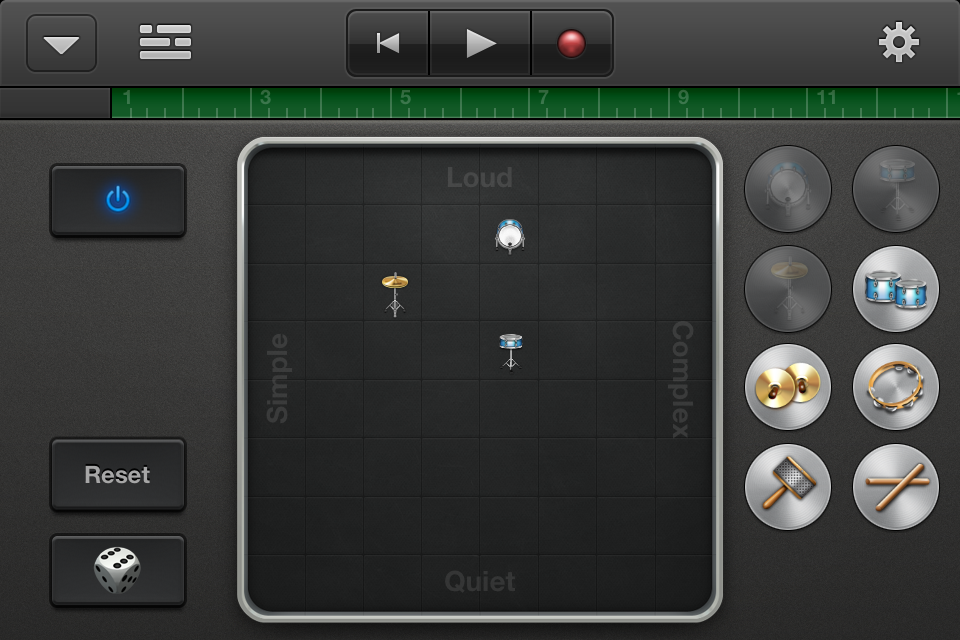
And wow, is it amazing! Although it "only" has 8 tracks and lacks some of the features of Music Studio 2.0 and Multitrack DAW, it's really the ideal sketch-pad for developing song ideas. The biggest things for me are the "smart" instruments that can automatically generate drum, bass, guitar, and keyboard parts with many variations, based on the chord progression I play. Smart drum parts are based on a grid with loud/quiet and simple/complex axes, where you can drag various parts of the virtual drum kit. I set the tempo and then move these elements around until I get a drum part that sounds interesting. Then I choose a key and play around with the pre-defined chords for that key in the smart guitar, keyboard, or bass screens until a song idea appears (you can also define your own chords). I'll record a minute or two of these parts, then "scat sing" into the audio microphone - this will suggest melodies, rhythms, and sometimes words. Then I may switch to real guitar to work out the song structure. Et cetera.

The "smart" parts are all MIDI tracks, playing back with sampled instruments that sound pretty realistic even on the guitar parts. This means the file sizes are pretty small until you start adding audio tracks. One thing that is lacking is a "piano roll" view for editing the individual notes of the MIDI tracks (and there is also no MIDI export or copy/paste). But that's OK, since I don't expect any of these GB tracks to be parts of final recordings. If I do get anything that is so brilliant it needs to be used, I can figure out how to export that track as audio (or something).

Garageband for iOS has many more features. Here's a more detailed review of the 1.1 (iPhone) version. And here's an even more detailed review of the original iPad (1.0) app. While it would be nice to have more screen real estate to work with (i.e., an iPad), Apple has done a great job of adapting the user interface to the small iPhone/iPod Touch screen, and it's really quite easy to use, as well as supremely portable.


Optics for Mars

JPL's new rover "Curiosity" is en route to Mars, set to arrive in August 2012. A recent NASA press release describes an interesting aspect of the optical sensors carried on board the rover. A special test chart is installed to allow for calibration of camera systems for resolution and color. The chart includes a 1909 Lincoln penny (hey, it's Lincoln's birthday today!) as a familiar size and detail reference, more for public engagement than for any specific science or engineering need.If you zoom in on the above image, you can see that the black & white test chart resolution samples are labeled in cycles per millimeter, the typical unit used by optical engineers to define image quality. A "cycle" is a pair of black and white lines (cycling from white or bright to black), so 2.0 cycles/mm means that two black/white pairs will fit into a millimeter of width (so each bar will be 0.25 mm wide). Higher cycles/mm correspond to finer detail in the image (smaller pixels in a digital image). This chart will be used to calibrate the instrument called MAHLI (Mars Hand Lens Imager) that will provide close-up images of mineral and soil samples.

Happy Darwin Day!

February 12, 1809 was a pretty good day for humanity. Abraham Lincoln and Charles Darwin were both born on that day, Lincoln in Kentucky, Darwin in Shrewsbury, England. I'm a big fan of both of these guys. In the U.S., Lincoln's birthday is now celebrated along with Washington's birthday on President's Day (or maybe not). While it may not be widely celebrated in the United States (where only 39% of people "believe in" evolution, more than in Turkey), today is Darwin Day, "an international celebration of science and humanity." So happy birthday, Charlie Darwin. I'm going to wear my "gradual change" t-shirt in your honor (picture above).

Tuesday, February 07, 2012

Le Voyage Dans La Lune (1902!)

Today's Amazon MP3 Daily Deal is a new album by the French band Air for $3.99. Normally I'm not a big fan of Air's electronic/pop music, but this is an interesting special case. They composed a new soundtrack for the 1902 silent movie "Le Voyage Dans La Lune" which has recently been restored to its hand-colored original state (the video is included with the MP3 download). This 15 minute film is said to be the very first "science fiction" movie. Loosely based on Jules Verne, it depicts a trip to the Moon in a hollow artillery shell fired by a huge cannon.

The trip is fast and the shell hits the Man in the Moon right in the eye (so much for the science!). The band of intrepid French explorers soon encounters angry Moon natives and of course fighting ensues. They retreat to their capsule, which has been conveniently placed on a cliff with a rope attached to the nose, which one of the men uses to pull the spacecraft over the edge (I had always wondered about the return plan with an artillery shell spacecraft and no known cannons on the Moon). It quickly falls to Earth for an Apollo-like water landing, whence the explorers are rescued and hailed as heroes.

Considering this was made a year before the Wright Brothers flew, it's really pretty impressive despite a few liberties taken with the physics. For the price of a latte and 15 minutes, it's an amusing piece of space pre-history. And the music is OK.

Sunday, January 29, 2012

New Song: The Play's The Same

Last week I recorded another song for my new album project. "The Play's the Same" is about refusing to grow up. Jethro Tull had an album called "Too Old To Rock 'N' Roll (Too Young To Die)." But how can you be too old to rock 'n' roll? I love Roger's lead guitar parts on this tune. Here's a rough mix (note: I'm using the SoundCloud HTML5 widget below, which works on most recent browsers including non-Flash mobile browsers like the iPhone, but at the moment it may not be working in Firefox - use this link instead):

Saturday, January 28, 2012

Insanely Great Music Apps

Music making apps for the iPhone/iPod Touch keep getting better. In the last few weeks I've gotten several new ones that really raise the bar (all available on iTunes):


Music Studio 2.0 - This seems to be the most full-featured iOS "DAW" right now, integrating audio and MIDI recording like a mini version of Sonar X1 (though still not nearly as full-featured). The audio recording is new in the recent 2.0 version. At about $14, this is one of the more expensive apps I have ever bought, but for what it can do, it's quite a bargain. The MIDI instrument samples are not fantastic quality (file size for one thing - as it is this is a 300+ MB app), but they sound pretty good through headphones, and you can always export the MIDI (and WAV) tracks for further work on PC or Mac-based recording software.

Strumstage - This is the most naturally playable guitar app yet (although iShred and Guitar Studio are close). The key here is that there are only three large "frets" that are used to choose from a palette of seven pre-selected chords (there are pre-defined palettes, plus you can define your own). Since it's easy to finger the chords, you can concentrate on strumming or picking. Take a look at this video to see what I mean. It also has drum and bass backing parts you can choose from a small list (the bass parts key off the chords you are playing). You can spend another couple of dollars and download additional guitars and rhythm kits inside the app.

Animoog - From the makers of classic Moog synthesizers, this app creates some amazing sounds and is almost infinitely controllable. Check out the demo video (makes me wish I had an iPad but it works fine on my new fourth generation iPod Touch). This is a $30 app which I got for 99 cents during its 30 day introductory period. Check out the demo videos on this page.

Ah yes, that new iPod. That has really increased the average cost of these apps. But (rationalization alert!) I had been wanting to get a new iPod Touch for at least a year - higher res display, faster processor, more memory (64 GB), cameras, and especially a built-in microphone. Just being able to record a song idea without having to find and plug in an external microphone is a major advantage. I also bought a new attachment called iRig MIDI which allows me to connect the iPod to a MIDI keyboard or to the MIDI interface on my PC. This works with Music Studio, Animoog, Thumbjam, and many other music apps that support the "Core MIDI" standard on iOS.

Every one of these tools (ok, toys) has at least one song hidden in it, waiting for me to carve it out, like a statue from a block of marble (often the "statue" just looks like a smaller block of marble). I haven't given up on real instruments either. Last week I received a Rover mandolin that I ordered as a Black Friday deal on Amazon for $83 (it was out of stock for two months). It's clearly a starter instrument, but it sounds OK and is surprisingly playable. I've already got two new songs in work based on the five chords I've learned so far.

Monday, January 23, 2012

Songs I Wish I Wrote

As a songwriter, there are many writers I admire and a lot of songs I've heard and said to myself, "I wish I wrote that." I just found a list I started some years ago. I hate top 10 lists, so here's more or less my top 13, excluding Beatles songs of which there are many I wish I wrote (yes, even "Get Back"). Not exactly in order, and I'm sure I've missed some obvious favorites. But I would have been happy to have written any of these songs.When I used to do gigs, my wife thought for years that I wrote "To Make You Feel My Love" and a couple of John Mayer songs. But I owned up and gave credit to Bob and John.
  1. Something So Right (Paul Simon)
  2. More Than You Know (Billy Rose)
  3. Let’s Stay Together (Al Green, Al Jackson Jr., Willie Mitchell)
  4. Your Song (Elton John-Bernie Taupin)
  5. To Make You Feel My Love (Bob Dylan)
  6. Stop This Train (John Mayer)
  7. Don’t Let Me Be Lonely Tonight (James Taylor)
  8. Marie (Randy Newman)
  9. America (Paul Simon)
  10. Wild Horses (Mick Jagger-Keith Richard)
  11. Crazy Love (Van Morrison)
  12. Take It Easy (Jackson Browne, Glenn Frey)
  13. Winning the Battle, Losing the War (Kings of Convenience)
While I aspire to writing the smart love song (see: Paul Simon), I can see I have a soft spot for the sappy love song too. Oh well.

Wednesday, January 11, 2012

You Have To Laugh...

I'm trying to not pay much attention to politics this early in 2012, but the many antics of the Republican presidential candidates are just too much like a car crash - you don't want to look, but you can't help it. There are two guys who spin this stuff with all the decorum and hilarity it deserves: Andy Borowitz with The Borowitz Report, and Matt Bors with his amazing political comics and blog posts. Laughing is better than crying.

Monday, January 02, 2012

New Year, New Music

Happy new year to all! For me, 2011 was a good year for the most part. I visited my daughter in Paris in March (among many other travels). I learned to land a tail wheel airplane (to be continued come spring, I hope). I made progress in learning to work at a large company (after my small company was acquired in fall of 2010). And I started to get back into songwriting and recording, with a big assist from music apps on my iPod Touch. Music apps allow me to use time on long overseas flights and weekends between countries to get some songwriting done.

Songwriting and recording make me happy, especially when I work on the recording with Roger Lavallee, producer and instrumentalist par excellence. I spent a few hours with Roger at the Tremolo Lounge this past week recording two songs "nearly final" and starting on a third. These are brand new songs, the two nearly-final ones written in December, inspired in part by the Black Keys. As a result these are probably the most rocking tracks I have ever done (thanks be to Roger who played all the instruments - I just sang and made comments on the arrangements, solos, mixes, etc.). You can listen to the (fairly smooth) "rough mixes" on SoundCloud if you like:


2012 will include a LOT of business travel, so I'm glad I've figured out how to write songs and make rough demos with my iPod on the road. 2012 will also include a new album, probably by summer or early fall, with a mix of new and old songs (or maybe all new if my writing streak holds up) and maybe half rock and half acoustic/ countryish/ jazzy/ whatever (i.e., my usual eclectic non-style). I plan to record some songs on my new recording gear at home, but I'll probably end up doing most of it with Roger.

And what about space and astronomy? I hope to find time to read, write, and simulate more in 2012. So many interesting things and so little time!

Wednesday, December 21, 2011

Great Model Airplane Video

I just learned that a fellow optical professional in Europe has a cool hobby - shooting HD video from a RC model airplane flying above the beautiful scenery of Switzerland. Although I have known him for some years through my visits to his company, I never knew about the RC flying. Since I'm interested in pretty much anything involving flying, I thought this was just great and wanted to share it.

The above image is a screen shot from this video. The prop is stopped and folded through most of this video (it's essentially an RC motor glider), but the engine is briefly started during the turn to final approach and landing at about 3:10. This video is also great (you can see the prop stop and fold at about 0:18). Some others are here.

Friday, December 16, 2011

Back in the Shuttle Again

Version 2.2 of the amazing iOS app f-sim space shuttle is available at the iTunes store. There is now a beautiful animation of the drag chute's deployment and release after you touch down (visible in the external views, normally seen in replays after you land, though I suppose you could land in the external view). The replay views are great, especially when you've done a decent landing. There is also an optional "windows in the sky" landing aid that I find more distracting than helpful (but it is probably helpful when you are first learning to land with the HUD visual cues). Excellent app. There is also an official video available here.

Update: The "visual approach path" (windows in the sky) is more useful than I thought. Up to now I've mostly done final approaches rather than the full "HAC" approaches which I was never very good at. But with the visual approach aid, full HAC approaches make much more sense, and I was successful on my first two tries. Now I can see what the HUD cues were trying to tell me. This app has amazing replay value (assuming you are a space and flight sim nerd like me).

Thursday, December 15, 2011

The Black Keys!!?!

Why didn't I get the memo? The Black Keys have been around since 2001, and I never noticed them until last week when I happened to buy the current issue of American Songwriter Magazine with them on the cover. Two guys from Akron who make a whole lot of great music with basically drums, guitar, and vocals. I previewed and bought the two most recent albums, Brothers (2010) and El Camino (released this month). Damn, these guys are good. They definitely have a strong blues persuasion but they bend the blues every which way in their infectious (in a good way), hard-driving songs. Great writing, great playing. Sometimes they remind me of Cream (a sixties favorite), but their sound is definitely their own. Check out the videos for "Lonely Boy" (imagine the huge investment in making this video!) and the action-packed and hilarious "Howlin' For You" (truly a big budget video). Great stuff! Man, I gotta write me some new blues-rock songs (trying to get in the mood there).

Wednesday, December 14, 2011

Stratolaunch: Too Cool


And here I was thinking Burt Rutan had retired.

I just heard about this and watched the simulation video. The concept is to scale Burt's "White Knight" carrier/launch aircraft to super-jumbo size (six 747 engines) to provide a runway-launched "first stage" (Scaled Composites) for a large orbital booster (SpaceX) for cargo or people (using the SpaceX Dragon spacecraft). Stratolaunch is a Paul Allen project with commercial operation projected for 2016. Of course nothing is flying yet, but private space looks to have a few tricks up its sleeve for the coming years.


Tuesday, December 13, 2011

Exploring Space With Your Computer (Again)

Podcast - Jupiter & Io Setting Over Europa

In April 2009, I contributed to the International Year of Astronomy daily podcast series with a podcast called "Exploring Space With Your Computer." It featured audio dramatizations of a mission to Europa and the final seconds of the Apollo 11 moon landing, as simulated in the free Orbiter spaceflight simulator. It also discussed the free planetarium program Stellarium and a few other free tools for exploring space from the comfort of your computer keyboard. I used sound effects from Orbiter and also wrote and recorded a spacey-sounding musical soundtrack for the podcast. It was fun to do.

The daily astronomy podcast program has continued beyond 2009, and today "Exploring Space With Your  Computer" is being featured as a "classic" thanks to someone's unexpected cancellation. It's nice to be featured, even as a rerun. I posted a set of Orbiter screenshots illustrating my simulated space adventures on Flickr. You can read more about the podcast (including web links) in this 2009 blog post. The podcast series is continuing into 2012 - maybe I'll even find time to do a new podcast next year.

Sunday, December 04, 2011

Basement Tapes (But No Tapes)

I've been "gearing up" (quite literally) to get back into music recording. I started with powerful new "gaming" laptop and Cakewalk Sonar X1 (recently upgraded to the full Producer Edition with a $99 holiday special). I added a new monitor, a new MIDI keyboard (Oxygen 49), a USB digital audio interface, a new electric guitar (a cheap Epiphone that still plays pretty well), and a mandolin that hasn't arrived yet. With all the soft synths and guitar processing bundled with Sonar, cheap input devices like the Oxygen 49 and the Epiphone "Les Paul Junior" can sound like just about anything (just add inspiration and talent - that's the tough part). I've set all of this up in my own little corner of the basement, as shown above (see if you can spot the paint cans under the desk). I had some of the equipment (microphones, preamps, tambourine, various acoustic guitars, a zillion cables) from my previous recording setup. That was based on a circa-2002 XP desktop and Sonar 3. Major upgrade time.

This is an embarrassment of riches, music production wise. But it won't do me much good if I can't use the software properly, and Sonar X1 Producer has a LOT of bells and whistles to figure out. Fortunately there are some great tutorials on the web. One of the best sources of Sonar guidance is MCI Studio in the UK. MCI is pretty much dedicated to Sonar and offers an impressive range of tutorial videos and other resources. Finally I am learning how to use buses and vocal pitch correction correctly (among other cool stuff, like tips for recording background vocals). MCI stands for "musically creative inspiration." Indeed.

With all of these tools and knowledge, I'm hoping to record more at home on my next recording project, though I'm sure I will still need the impressive talents of my producer Roger Lavallee and the fabulous and nearby Tremolo Lounge for many tracks. I also need some new songs. I'm working on that in my not-so-copious spare time.

Sunday, November 27, 2011

The Beatles Sex! I Mean LOVE!

That post title is an experiment, prompted by a quick look at this blog's stats, courtesy of Google (who also hosts Blogspot blogs, of course). They keep track of everything, as you might expect of Google. Although I'm not blogging as much as I think I'd like to (and once did), I'm still curious about who might be reading my posts, which posts are most popular, how people got here, etc.

Thanks to Google, I know that the top 10 search keywords that brought readers to my blog are beatles love, the beatles love, beatles, music of the spheres, asteroid flyby, the beatles, airbus a380, flyingsinger blog, water cycle, and solar system. Water cycle? Anyway, it's striking that on my nominally space-themed blog, four of the top ten searches are for the Beatles! Hence my post title - if "beatles love" is big, how about "beatles sex?" My most popular post is one that I wrote about the Beatles LOVE show and CD on December 31, 2010. Number two is "Space Models," about my summer 2010 visit to the French space museum in Toulouse. I also know that to date, my blog has received 124,798 page views. (This is not exactly my "all time" page views, but only since Google started tracking my stats around June 2009 - I actually started this blog in October 2005.) I probably should have run some ads. But I know you hate that as much as I do.

Of course 124,798 is probably how many pageviews Lady Gaga gets per minute. But by mentioning Lady Gaga, the Beatles, and sex in this one post, I am positioning myself to give her a run for her money. Don't worry, though. I will not be mentioning Justin Bieber, Amy Adams, fixed mortgages, Ron Paul, or any other trendy terms just to try to drive traffic to my blog. Or sex.

Safe Travels (Don't Die): Go Curiosity!

Lisa Hannigan's wonderful album "Passenger" includes a funny little song called "Safe Travels (Don't Die)." It sounds like it was inspired by a friend who says this to her when she travels, but here I am applying it to NASA's Mars Science Laboratory rover which was launched yesterday. I caught the launch live on CNN, and it was a beautiful sight. So far the spacecraft seems to be in good health, and I do wish Curiosity safe travels on its long 251 day cruise to Mars.

MSL Rocket Platform in JPL Clean Room
I was fortunate enough to see Curiosity in the flesh (so to speak) during assembly in the clean room at the JPL Open House I attended in May 2009. The picture above shows the "sky crane" rocket platform that will gently lower the rover to the surface in August 2012. More pix on Flickr.

Thursday, November 10, 2011

Why Do I Love This Book?

There are a few books that I seem to be able to read many times and feel engaged and rewarded each time. One of these is The Curious Incident of the Dog in the Night-Time, a novel by Mark Haddon. It's a curious book, a detective story of sorts, written from the point of view of Christopher, a 15 year old English boy who has a form of autism or perhaps asperger syndrome. He is extremely high-functioning in the areas of math, logic, science, and use of language. But his ability to understand and relate to people and emotions is quite limited. He generally prefers animals, because their reactions and emotions seem easier to understand than those of people, and they can't lie to you. Christopher is very logical about some things and seemingly very superstitious about others. Some of his behavior is rather bizarre and not very nice - yet for all this he's an extremely engaging and sympathetic character, and you get to see the world very clearly through his eyes. It's really a fascinating book that works on many levels, and I highly recommend it. I won't spoil it by revealing plot details - you can find plenty of reviews and summaries on Google or Amazon if you care to.

But why do I like it so much? I think it's because I relate more strongly to this character than I do to most fictional characters. I even feel a little bit like him in some ways (and not only because he wants to be an astronaut, even though he realizes that this is extremely unlikely for many reasons). I think it's something about the way he detaches himself from emotions and complicated human situations (or tries to). I see myself doing this sometimes. And also something about the way people don't understand him (but who hasn't felt that way sometimes?). I also like the way he makes and values certain observations that most people wouldn't make or value (a bit of the scientific or engineering mind there). I don't know. But I really like Christopher Boone and the chance to view of the world through his fictional but very real-seeming eyes.

Friday, October 28, 2011

Mozart for a Penny a Tune

Amazon's MP3 daily deals can be pretty amazing. Today it is a new "99 Most Essential" classical collection, a "full works" Mozart edition for only 99 cents. The earlier X5 Mozart album was a "greatest hits" collection with 99 of his best-known individual movements. This can be nice at times, but I usually prefer to listen to classical music as the composer intended, which is typically three or more movements in sequence. X5 has been providing full versions for all of their recent composer collections, and now finally for Mozart as well.

These are 23 of Mozart's best known works (it appears to include complete versions of nearly all the works used in the soundtrack of the film "Amadeus"). If you enjoy Mozart as I do, you probably already have most of them on CD or MP3. But for 99 cents, I'm buying it just so I can have these works sitting on my Amazon Cloud Drive to listen to anywhere I have a web connection.

Monday, October 24, 2011

Carnival of Space #220

I haven't been thinking or writing about space recently. Guess the moment isn't structured that way (to take the Tralfamadorian viewpoint). But other people are thinking and writing about space, and some of them are bloggers who have submitted posts for this week's Carnival of Space, hosted by we are all in the gutter (looking at the stars). Love that blog name.

There are many posts this week, on diverse space and astronomy related topics. There are also two contests, one of which is sponsored by the American Museum of Natural History, a place I still remember fondly from my early childhood when we lived close to New York City and my parents would take me there to see dinosaur fossils and other wonders of the universe. A special exhibit, Beyond Planet Earth: The Future of Space Exploration, will run there from November 19 to August 12, 2012. The contest asks for 3 minute videos showing your personal out-of-this world vision for the future of space exploration. I think I could make a cool video using the Orbiter space flight simulator, but the deadline is November 3, and the moment is still not structured that way. I am still stuck in time the way Billy Pilgrim wasn't. Isn't. Won't be.

Saturday, October 22, 2011

Too Much New Music!

I seem to have a real need for the constant stimulation of new music, though this creates the problem of not having time to listen to all of it. I get most new music as MP3's, mostly from Amazon, and most often on sale (sometimes free), though I will pay full price for music I "must have now." Aside from Amazon's daily deals, I learn of new music through Paste Magazine (now called Paste mPlayer), from NPR (new music email list), on Pandora, through Facebook friends' recommendations, and sometimes even from the radio (usually 92.5 The River). Probably other ways too.

Just in the last week I bought a classical collection that was a $1.99 Daily Deal (The 99 Most Essential Autumn Classics), a new Michael Franks album that is wonderful (Time Together) and a cool Donald Fagen album I had never heard until a song from it came up on Pandora while I was doing dishes (Kamakiriad from 1993). Also a bunch of free Amazon samplers, including the very relaxing Native American Flute Lullabies.

So am I listening to all that great new music? No, actually I'm listening to a "must have now" album that I just bought, Katie Herzig's new one, The Waking Sleep. It sounds good so far! I'm actually shuffling that with some of the other recent ones as I write this blog post with two ulterior motives: to test out my new Feedburner feed and "follow by email" widget (found just to the right), and to delay starting on a bunch of "must do now" house work!

Thursday, October 20, 2011

Great Songwriting Blog

A few weeks ago I was looking for music and songwriting apps for the iPod Touch, and I found one called "Secrets of Songwriting" by Gary Ewer. Essentially an e-book formatted as an app, it was pretty expensive for an app ($16.99), but not so bad for a music book, and as a "multimedia" app, it was able to include examples of chord progressions and melodies as sound samples. So I bought it. Although I found a few interesting ideas, it was really too basic for me, and the app format (no search, no bookmarks, etc.) was frustrating.

The good news was Gary Ewer's songwriting blog, which I discovered through this app. "The Essential Secrets of Songwriting" is frequently updated with tips and with songwriting analyses of hit songs ("Rolling in the Deep" by Adele is a great recent example). Some tips are quite specific and musical (chord inversions, visualizing melodies, modal chord progressions, "making a MIDI orchestra sound real"). Others are more motivation and workflow oriented (identifying goals, dealing with writer's block, starting vs. finishing songs, writing better lyrics). There is a lot of excellent and thought-provoking material on songwriting here, with a huge archive of past articles. I'm taking notes and trying some of these ideas as I am now working on some new songs for my next recording project.

So now I'm happy to have bought Gary's app, supporting a musician/writer who is providing valuable educational material to songwriters everywhere for free through his blog.