 Orbiter is completely metric, so when I was writing yesterday's post about force vector visualization, I wanted to mention the conversion from meganewtons (MN) to pounds-force (lbf) for those more familiar with "English units" (i.e., pounds of thrust for rocket engines). There are probably a billion web sites with information on converting units, but I especially like AllConversions.com, because it has a simple format and includes a huge number of units in its drop-down lists.
Sunday, January 14, 2007
Converting Scientific Units
Orbiter is completely metric, so when I was writing yesterday's post about force vector visualization, I wanted to mention the conversion from meganewtons (MN) to pounds-force (lbf) for those more familiar with "English units" (i.e., pounds of thrust for rocket engines). There are probably a billion web sites with information on converting units, but I especially like AllConversions.com, because it has a simple format and includes a huge number of units in its drop-down lists.


Saturday, January 13, 2007
Orbiter for Educators: View the Force, Luke!

Forces are fundamental in physics, and while you can feel some of them (like the force of gravity holding you in your seat), you usually can't see them. Except in Orbiter, which can display colorful vectors to show the forces that are acting on any spacecraft, updated in real time. It's pretty cool. Here's a quick way to demo this, using the flight recording of a launch of the space shuttle Atlantis. I assume you've installed Orbiter and know how to find and launch a scenario (if not, refer to the first post in this series or see Go Play In Space).
1. Start Orbiter, open the folder Playback, and double click the scenario Atlantis Launch.
2. Press [F4] to open the menu, then click Visual Helpers...
3. Click the Forces tab and check the box labeled Body force vectors. Also check the Total box so you can see the "resultant vector" (net result of all forces). Adjust the Scale and Opacity sliders as desired.
4. Press Control-I (info) to display information about the selected object (by default, the shuttle), including its mass and altitude.
As Atlantis launches and climbs to orbit, you'll see a big blue vector representing the thrust (T) , a yellow G vector (represents force of gravity, i.e., weight), a smaller red vector for drag (D), and a white "total force" vector (F). You may also see a smaller set of vectors representing the forces on the payload inside the shuttle's payload bay.
The force vectors are labeled with values in MN (mega-Newtons - 1 MN is about 225,000 pounds of force). Watch as these vectors change size and value as fuel is burned (reducing mass), the atmosphere gets thinner, and the shuttle changes orientation. Notice that thrust is greater than the sum of weight and drag, as it must be if the shuttle is to climb and accelerate. Note that drag increases for a while (due to increasing speed) and then falls off (due to thinner air at higher altitude). When the solid rocket boosters (SRB's) separate at about 2 minutes into the flight, they will have their own force vectors, and the thrust and weight values of the shuttle itself will decrease (no more SRB thrust, and mass is also reduced).
When the shuttle reaches about 153 km altitude, main engines will shut down and the external tank will separate (though the shuttle would really roll upright before separation from the ET). At this point, both the shuttle and the ET will be in orbit, and the only force visible will be "G" or weight. Is this correct? Isn't the shuttle "weightless" at this point? Not really. In orbit, the shuttle will be in free fall, pulled toward the center of the Earth by gravity but constantly "falling around" the curved Earth. With nothing to resist its motion and "push back" (like the chair that you feel pushing against you when you sit), the shuttle and its occupants will continue to fall freely and will not feel their weight. While it's often called "zero G," gravity is not zero when you are in orbit.
Thursday, January 11, 2007
Orbiter for Educators: Solar System Tour

Continuing with the quick stuff you can do with Orbiter, here's how to take a quick tour of the Solar System. Although Orbiter scenarios generally include spacecraft and involve operating them (you can even switch between multiple spacecraft), you also have direct access to Orbiter's camera without bothering to fly anything. Regardless of what any spacecraft may be doing, you can use the Camera dialog box to move the camera to any planet or moon or to any surface base, spacecraft, or space station that is defined in the current scenario. Once there, you can control the field of view and zoom level of the camera, and move it around with the mouse.
Orbiter also gives you control over time - the Time Warp dialog can speed up or slow down time at will, from 0.1x (10% of real time, slow motion) to 100,000x. You can also selectively turn on various text labels so you can tell what planets, moons, stars, and surface features you are looking at. This is controlled by the Visual Helpers dialog. Here's a quick tour of the Solar System:
1. Start Orbiter and Launch a Scenario - See the January 10 post if you need advice on installing and starting Orbiter (remember to go to the Video tab to set your screen resolution before running a scenario). Although you can tour the Solar System in any scenario, the best one to use is Grand Tour which is found in the folder labeled The Solar System. This scenario has good pre-defined viewpoints for most of the planets and moons of the Solar System.
2. Open the Main Menu - Once you see the 3D view of Earth, press [F4] to display the main menu, then click Camera... to display the Camera dialog. You should also open up the Time Warp dialog so you can easily speed up time to see the rotations of the planets and moons. The Visual Helpers dialog lets you turn various labels on and off (helpful with Jupiter's moons when you are zoomed out and speeded up to see them zipping around the Jovial Giant). You can open these dialogs as needed or leave them open on the screen as Orbiter runs.
3. Tour the Planets - Play with Target and other buttons in the Camera dialog to see what they do, then click the Preset button. Double click any item in the list of presets to go to it. Try clicking the 1000x button on the Time Acceleration (Warp) panel to make the motions more apparent (you can also use the T key to speed up and R to slow down). Use the Visual Helpers dialog to turn on Planetarium mode and select various labels and grids.
That's it! You can zip around the whole Solar System in about 10 minutes, but be sure to take time to smell the roses (on Earth anyway). Use the mouse (right button) and mouse wheel to change the view and zoom. For more details and ideas for touring, see the second half of chapter 2 in Go Play In Space.
Space: Not This Way
I had heard about the Big Red Rocket stunt in the second Jackass movie, but I hadn't seen it until a friend sent me a link to this page with a large-size version of the video shown above. It is amazing in its bold stupidity, but it's also strangely funny to watch this guy cheat death and (just barely) serious injury. I think this is not the way to go play in space (i.e., don't try this at home, kids). This is more like it, and it's good to know that the profits from all those books I've bought from Amazon are contributing to our future in space.
Flixxy.com is a pretty cool site - they have picked out some of the best videos on the web. The signal-to-noise ratio is much better than YouTube! There's quite a bit of physics and space stuff along with the usual animal tricks and odd commercials.
Wednesday, January 10, 2007
Orbiter for Educators: (Almost) No Prep

Orbiter is a freeware space flight simulator for the PC that I have written about extensively in this blog and elsewhere. Aside from being a fun way to "Go Play In Space" (the title of a free tutorial ebook I wrote about Orbiter) for people with an interest in space flight, Orbiter also can also be a useful tool for teaching about the solar system, space flight, atmospheric flight, physics, and other subjects. If you're a teacher, you might say, "Great, but when would I have time to learn this thing?" I don't know the answer to that, but the good news is that there are some cool things you can do with very little preparation beyond downloading and installing the software (~20 minutes on a good connection) and following a few instructions. These include giving a cool 3D tour of the Solar System and showing pre-recorded "flight recording" playbacks of the simulated launch and landing of the space shuttle (not just a video - you can control the "camera" and view it from inside or outside the cockpit).
This is not quite "no prep," but it's pretty easy. In later installments I will describe things you can do if you can take a little time to learn more about Orbiter. Here are the basics to get you started, which are described in more detail in Go Play In Space (this is a free 9 MB PDF download).
1. Download and install Orbiter - Go to and print the Download page of www.orbitersim.com, where you will find download and installation instructions and a list of "mirror sites" where you can get the actual files. Download the full Base package (63 MB) for Orbiter, and if possible, also download the high-resolution (L10) Earth textures (79 MB) and hi-res "Planets & Moons" (72 MB). These are not strictly necessary but they make the planets look even better (see chapter 1 of Go Play for more details).
2. Download and install Orbiter Sound - This is a separate but nearly essential "add-on" package that is easy to install and adds all sorts of sounds and even music to the otherwise silent Orbiter (sound is easily configurable). Go to Dansteph's download page, download, and run the file Orbiter Sound 3.0 (10.4 MB) to install it (see chapter 1 of Go Play for more details).
3. Start Orbiter and Choose a Playback Scenario - Double clicking the Orbiter icon displays the Launch Pad, where you can pick and run a scenario from one of many folders (go to the Video tab first to set your screen resolution). Double click the Tutorials folder and then the Atlantis Final Approach playback scenario (a very quick playback with on-screen text explanations). Once the playback starts, it will switch to different views automatically. When it first goes to an internal view, press [F8] to switch to the 3D "virtual cockpit" which looks more like the real shuttle cockpit. You can manually toggle between internal and external views with [F1].
4. Learn the Basic Operations - The main view things are that holding the right button and moving the mouse lets you move the camera around, while the mouse wheel (or PgUp/PgDn) controls camera zoom. The [F4] key displays the main menu. Choose Exit from the menu to quit (or use Control-Q).
5. Watch Atlantis Land - Orbiter is interactive - you can do everything yourself and even take over a playback at any time to fly it yourself - but playbacks are nice for talks because you only have to worry about the views. Another quick tutorial playback is Smack! Rescue (described in chapter 2 of Go Play), and Atlantis Launch, found in the Playback folder.
I'll do a "some prep" article soon to talk about touring the Solar System and taking control of an orbiting spacecraft. Later articles will talk about using add-ons to simulate historic space missions , making forces visible, and other subjects.
Tuesday, January 09, 2007
JPL Solar System Ambassador
 In late 2005, I heard about the JPL Solar System Ambassadors Program, which is a volunteer educational outreach program sponsored by NASA. Its purpose is to bring information about NASA's space exploration projects to local communities, with presentations at schools, museums, star parties, scouting organizations, and the like. It sounded pretty cool to me, and I wanted to sign up, but applications are accepted only in September for the following calendar year, so I missed it for 2006. I applied this past September and was accepted in December for the 2007 calendar year.
Tonight I participated in the new ambassador orientation training, a telephone conference supplemented by downloaded PowerPoint presentations. This makes me somewhat official, although there is still an ethics presentation that's required before I can begin to do events on my own. I'm fortunate that there are already three JPL Ambassadors in Central Massachusetts (my bio is on line, but they haven't updated the maps yet), all of whom are also members of the Aldrich Astronomical Society, which I recently joined myself. This means I'll be able to learn the ropes on some shared events before organizing some on my own.
I love talking about space and astronomy (ya think?), so this is a fun thing for me. I've already helped out with a couple of Aldrich club events, one with middle school kids (age ~11) and the other with Cub Scouts (ages 6-10). I talked about the space shuttle (which was up for the Cubs' event) and the Hubble Space Telescope, demonstrating them with the help of Orbiter. I also gave the kids a quick tour of what they would be seeing in the telescopes outside with the help of Stellarium. Kids of these ages are eager to ask and answer questions and they still seem to think this stuff is pretty cool. So do I!
If you're in Massachusetts and would like to invite a Solar System Ambassador to give a free presentation about space exploration at your school or other organization, contact me or one of the other Massachusetts ambassadors. You can also check this calendar to see if any SSA events are scheduled in your area, or check the U.S. map and contact an ambassador near you to arrange something.
Monday, January 08, 2007
LAUNCH Magazine
 In November 2005, I wrote about ESPACE Magazine, a high-quality French magazine focused primarily on space exploration. Although there are some good astronomy magazines in the US, I mentioned wishing that there was something more like the French ESPACE published here. It looks like there finally is, though it's something of a hybrid that covers both model rocketry and spaceflight (which is really not a bad idea).
LAUNCH Magazine was launched in September 2006 with its first bimonthly issue, though I only discovered the magazine today at Borders Bookstore, where I bought the third issue (January/February 2007, pictured). It's nicely produced and has articles on NASA's Moon base plans, space art, the X-Prize Cup, and the Soyuz spacecraft, as well as various articles on model rocketry. This looks like it will be a pretty interesting magazine for space enthusiasts (I can't afford the time to become a model rocket enthusiast, though I wish I could!).
Sunday, January 07, 2007
Rise of the Space Elevator
 There will be television feature on space elevators on the PBS program NOVA ScienceNOW on Tuesday, January 9 (PBS, check local schedule here). Thanks to Brian Dunbar of Space for Commerce (and Liftport) for pointing this out. A video of the segment will be available on-line starting January 10 (a brief video extra hosted by Dr. Neil de Grass Tyson and showing a small Liftport prototype climber in action is on-line now).
Rise of the Robots
We're not exactly seeing the T2 scenario yet (it's still a long way from a Roomba to a cybernetic Schwarzenegger), but robot development is advancing and they certainly have been in the news lately, including a cover article by Bill Gates in this month's Scientific American ("A Robot In Every Home"). There have already been a number of robot toys, but one of the coolest has to be Pleo, a baby dinosaur that is in development. I read about it in the current Wired magazine and just found the YouTube video that's posted here. While still quite limited (what would I need one for?), its motion is pretty life-like, and I especially like the part where he (she? it!) reaches the edge of the table, looks down, stops, and cries! Could the creepy-but-cuddly Teddy from the Spielberg movie AI be far away? Probably. But the present is starting to look a bit more like the future these days. Bring on the flying cars!
Saturday, January 06, 2007
The Stars of My Driveway
 I'm greatly enjoying Seeing in the Dark by Tim Ferris, and on this unusually warm and rather clear New England evening, I decided I should try a little seeing in the dark myself. Although the waning gibbous Moon, street lights, and the glow of nearby Worcester don't make for especially dark skies, Orion and the Moon itself were attractive enough targets for a little driveway observing. I got OK results with 10x50 binoculars, which gave decent enough views of the Pleiades, the Orion Nebula, the Moon, and a few other objects, but these binoculars are not image stabilized and my arms got tired fast.
So I decided to haul out the cheapo telescope I got for my daughter a couple of years ago in a discount store (during her three week burst of interest in astronomy). It's a Tasco 60 mm refractor with a "Starguide" system that I never really got to work. It has a crude plastic focusing mechanism and a shaky tripod, and even with a couple of better eyepieces that I bought to replace the terrible ones it came with, it's really not good for much more than looking at the Moon, just as I remembered. So back to the binoculars.
I recently joined an astronomy club and have started to help out with star parties, something I will be doing a lot more of this year. This means that I'm thinking more about the skies and I'm getting to peek through some decent telescopes. I think I can see where this is heading but before I buy a real telescope, I think I better talk to some of my fellow club members who have some experience in this area. The fact that I'm an optical engineer means that I know how to design and simulate telescopes in software, but there's a lot of practical stuff that I don't know that much about when it comes to evaluating the many options and buying something decent (as you can probably tell from the fact that I bought that Tasco, though it was basically a very cheap impulse buy).
Friday, January 05, 2007
The Stars of Oz
 I didn't do much blogging from or about Australia when we were there on vacation this past summer (winter down there). It's a fabulous place. Tonight I was reading yet another new (used) book that "jumped the queue," Seeing in the Dark by Timothy Ferris (a fabulous science writer). His descriptions of the dark skies of his youth in Florida reminded me of one of the best things we saw in Oz - the southern night sky, including the Southern Cross, Alpha and Beta Centauri, and the Milky Way, set in the velvety-black skies above Jervis Bay National Park, 170 km south of Sydney. We walked on the beach on an especially clear night and the sky was simply dazzling.
I didn't have a camera capable of capturing anything like what we saw that night, so I checked on Flickr just now to see if someone else might have captured it. The picture here brought back the memory though it's hard to compare to the visual impression of all those bright stars against all that blackness. This photo was taken by "rplzzz" - check out his description here.
365 Days of Skywatching
 There is just so much excellent content on the web for space and astronomy, it's hard to find time to look at all the interesting and useful stuff out there. The good news is that you can always find something that's new to you, even if it's been around for a while. I just discovered a cool blog, What's Up - 365 Days of Skywatching (the archives suggest it started in May 2006). Each day there are great tips for what to look for in the night sky, as well as interesting background information and pictures.
Even better, the author of this blog (Tammy Plotner) has written and collected the observing tips for all of 2007 in a PDF ebook available for free download (it's big, 24 MB). You can also buy a printed copy for $25 from Lulu.com, a pretty good deal for a 410 page book.
Thursday, January 04, 2007
DanSteph, the "Voice" of Orbiter
 Orbiter doesn't include any built-in sound features, but thanks to DanSteph, I would guess that few "Orbinauts" ever think of this fact. Dan's OrbiterSound 3.0 has to be downloaded and installed separately (a painless process), but once it's installed, it is so smoothly integrated with Orbiter, that it's hard to imagine that it's "just" an add-on. It is probably the one truly "must have" add-on for Orbiter - it adds immensely to the experience to hear the perfectly synchronized sounds of mechanical systems, thrusters, and engines (only when inside the spacecraft, unless you are in the atmosphere, when external sounds can be heard, growing fainter as you move away from the sound source). Add-on developers can provide custom sounds and "radio chatter," and it even supports MP3 music, providing a cinematic soundtrack when you are in external views (one of many ways to configure OrbiterSound).
Dan's other widely-used Orbiter add-on is the cool DeltaGliderIII (a version IV is now in beta), which adds to the challenges of flying the basic DG by making you worry about keeping your passengers alive (don't subject them to super-high G forces, extreme temperatures, or lack of oxygen). Dan also developed the professional Microsoft Flight Simulator add-on FsPassengers (Orbiter seems to be his hobby, luckily for us).
Dan's Orbiter Page also hosts a forum (in both English and French) as well as Orbiter-related news items and some feature articles. In addition to all this, he also provides the cool Orbinauts World Map which shows the location and some information about the 612 people who have so far registered as "Orbinauts" (you can find someone called "FlyingSinger" near Boston). The screen capture here shows Europe, with "DanSteph" and "Martins" (Orbiter's creator) highlighted. Dan has contributed so much to la communauté d'Orbiter - merci, Dan!
Band in a Box 2007
 Band-in-a-Box (BIAB) is an "intelligent automatic accompaniment program" that I first heard about and bought in 2002. I bought it mainly as a tool to help me with songwriting, which I do mostly by creating chord progressions and making up melodies and lyrics to go with them. Usually I do this on a guitar, though I sometimes write with a keyboard, and occasionally with BIAB, especially when I'm traveling without a guitar. BIAB lets you to enter chords by name on a simple grid (A, Bb, F#m7b9, etc.), set a time signature and tempo, and choose a style. BIAB then automatically generates and plays multiple instrument parts (drums, bass, guitar, strings, etc.) using the PC's sound card (or an attached MIDI device). There are hundreds of styles in the "mega" version I have, and depending on the style chosen, it can generate some pretty cool sounding stuff, which can really help the writing process. Sometimes I've even used the BIAB tracks (exported as MIDI) as the basis of a recording. One example of this is my song "Dedicated & Sincere" which you can preview here (track 10, 2 minute preview). On this song, all the instruments are from BIAB except for the electric guitar lead (that's me).
PG Music updates BIAB every year, and I upgrade whenever they offer something that strikes my fancy. The 2007 version arrived yesterday, and the coolest thing for me is the new wizard that can determine the chords from any WAV or MP3 song file! Although I can do this by ear for simpler songs, this is quicker and easier. It also has something called "RealDrums" which uses sampled drum performances in place of MIDI-generated drums for playback. This is nice but less essential since I normally import the MIDI into SONAR 3 if I'm going to record with the track, and there I usually replace MIDI drums with sampled drums. But it's cool to have the track sound more realistic right in BIAB.
Now if I can just get myself back into writing some songs...
Monday, January 01, 2007
Goodbye Gravity's Rainbow
 I don't usually even make new year's resolutions, let alone write about them in my blog. But this year I'm making a (sort of) retroactive resolution. I've had a copy (probably two) of Thomas Pynchon's novel Gravity's Rainbow since maybe 1975 (it was published in 1973). GR is considered to be one of the greatest novels of modern times, and it even (somewhat) concerns rocketry and World War II history, two strong interests of mine. I can't say what it's really about since I've never read it. I have tried to read it at least three or four times. It is a mountain of a book, and helpful Amazon spotlight reviewers even provide advice for first time readers seeking to get through it (apparently I'm not alone in having trouble with this).
But I'm not taking that advice. I'm giving up and resigning myself to the fact that I will never read Gravity's Rainbow. That's the retroactive part of my resolution, which I have successfully kept by not reading this book for some 32 years. I'm extending the resolution by also giving up the idea that I should or might or even really want to read it, and I'm giving up the vague, tiny, nagging guilt I carry for not reading this great book that has been on my list for so long. And I'm extending it further to include Pynchon's 784 page Mason & Dixon (bargain table book that just went into the basement), as well as Will and Ariel Durant's 11-volume Story of Civilization and all of the Great Books of the Western World that I traded an excellent Martin classical guitar for back around 1982 (big mistake).
Letting go of guilt - easier said than done, I know. I buy a lot of books, and I read a lot of what I buy, including some monster books, like Neal Stephenson's 928 page Cryptonomicon (I love that book). But I've decided that it's OK not to read some books, even if I bought them and had them on a list forever, and even if they are universally acclaimed.
I feel better. Now if I could only exercise more and lose weight retroactively, I'd be all set.
Sunday, December 31, 2006
My Space (not MySpace) 2006


It's the end of another year, and as I tried to do last year at this time, I'd like to write something that sums up the year, makes a brilliant statement, and shows progress (or something). The usual sort of thing. It doesn't feel quite like "brilliant" this evening, but here goes "something" anyway.
In the domain of this blog (which mostly excludes home, family, and work issues, all of which are thankfully going pretty well), 2006 was an interesting year. There were plenty of developments in space, starting from the arrival of Stardust and the departure of New Horizons (pictured in Orbiter above - its target was a planet when it launched but is now called a dwarf planet, though Pluto itself hasn't changed). The arrival of MRO in Mars orbit was another big development, and it is now returning amazing high-resolution imagery of the Red Planet, just as Mars Global Surveyor went off the air after many years of faithful service and zillions of great pictures of the Martian surface (it went out with a bang as signs of very recent liquid water flows were reported based on repeated MGS observations of promising sites). There were also two successful shuttle missions to the ISS, the announcement of NASA's plans for a Moon base, and the good news that a shuttle mission to extend the life of the Hubble Space Telescope was approved. The amazingly long lived Mars Rovers also continue to give us a "local presence" on Mars.
A new version of the Orbiter space flight simulator came out in May, and I was on the beta testing team, mainly so I could update my book Go Play In Space to be available when the Orbiter 2006 was released (Andy McSorley made substantial contributions to the second edition). I spent a lot of time expanding and updating the book, and worked with Andy and later also with Mark Paton on an Orbiter add-on based on the book The Rocket Company. Andy, Mark, and I also spent a lot of time this year on Mars for Less (MFL), a human Mars mission plan developed by Grant Bonin. I had the idea to create a "virtual prototype" of MFL in Orbiter, and Andy and Mark agreed to do most of the work to create an Orbiter add-on for MFL. It turned out to be very complex indeed, but it really proved the point that Orbiter could be used as a tool for fairly detailed mission design (including the challenging EDL phase I showed in a recent YouTube video).
The original point of the MFL exercise was to write a paper for presentation at the Mars Society Conference in Washington, DC in early August. The paper was accepted and written (co-written with Andy, Mark, and Grant), and I presented it at the conference, which was a real thrill. You can find the paper and the presentation at the main Orbiter web site (under References), and more information on the MFL project at Andy's web site.
Part of the reason for my recently increased interest in space and astronomy is related to educational outreach. I think space and astronomy have the power to inspire people of all ages to think positively about science and technology and the future. As many people were, I was inspired by the blog posts of Ms Anousheh Ansari, a self-described private "space ambassador" who visited the ISS this year. She fulfilled her life-long dream and did her best to share her experiences with others through her blog. Although I don't expect to ever go to space myself, I will be a "space ambassador" of sorts starting in 2007 - a JPL Solar System Ambassador, in fact. I will write more about that in the next few weeks, after it's offically announced on JPL's web site (the 2007 ambassadors are not listed there yet). Since Orbiter provides an excellent way to virtually explore the Solar System (as shown in the Orbiter image above, Io with Jupiter), I plan to make extensive use of Orbiter in my presentations, to supplement the materials that JPL will supply.
Thursday, December 28, 2006
Universe 2006
 We have seen an abundance of amazing astronomical images this year, and Phil Plait of the Bad Astronomy blog has assembled a great top 10 list so I don't have to. The dramatic composite Cassini image of Saturn eclipsing the Sun was his number one, and it's hard to disagree. It's a beautiful image.
Wednesday, December 27, 2006
Cautionary Tales and Book Stack Overflow
 I'm taking some vacation time this week and mostly doing a lot of reading. I'd like to say that I'm "catching up on my reading" but because Amazon makes it so easy to order used (and new) books, catching up is not happening! My book stack keeps growing and getting interrupted by new arrivals. So instead of finishing The Survival Imperative (I'll get to it soon!), I read Sam Harris's instant classic Letter to a Christian Nation, started reading This Is Your Brain on Music ("the science of a human obsession") by Daniel J. Levitin, and also zipped through the scary but true 1995 book The Hot Zone by Richard Preston.
The Hot Zone is about ebola and related "hot" viruses that emerged in Africa in the 1970's. It discusses the early human cases and graphically describes the effects of the diseases caused by these "agents," but focuses mostly on the discovery of a strain of ebola that was killing monkeys imported to the US from the Philippines for medical research - in Reston, Virginia! This biohazard emergency was handled by the nearby US Army Medical Institute of Infectious Diseases (USAMRIID) at Fort Detrick, Maryland. Without spoiling it completely for those who may wish to read it, I'll just say that it looked quite bad at first, but turned out to be not quite as bad as it could have been (for humans anyway). It inspired a movie called Outbreak which I've never seen.
Aside from being as good a read as any techno- or medical thriller novel, The Hot Zone is also a sort of cautionary tale (Preston also wrote a novel on bioterrorism that was said to have scared the pants off President Clinton when he read it in 1998, prompting him to request government studies that may have helped the government to be somewhat more prepared for the real bio-terror "postal anthrax" emergency in late 2001). HIV , ebola, and SARS are the best known viruses that have crossed over from animals to humans in recent years. There will probably be more (not that we've heard the last from those three).
Speaking of cautionary tales, I also read a fascinating essay by scientist and SF author David Brin called "Singularities and Nightmares," a sane and balanced assessment of various future scenarios, good and bad.
P.S. In The Hot Zone, researchers went to the Mount Elgon area of western Kenya to try to find the wild reservoir of ebola virus (where the virus resides between sporadic outbreaks in apes and humans). Nothing was found, although spiders, insects, and bats were mentioned as possible hosts, and bats were strongly suspected. In late 2005, fruit bats were identified as likely hosts, though there could still be others. I had been wondering about this and just checked it out.
Monday, December 25, 2006
Happy Birthday Sir Isaac!
 Talk about standing the test of time: Newtonian mechanics continues to be used to accurately predict the behavior of planets, moons, and spacecraft in the Orbiter space flight simulator as well as in computer programs used at JPL and everywhere else in the real world of space operations and astronomy (with minor corrections in some cases from General Relativity). Every time an eclipse is predicted (or a shuttle docks with the ISS for that matter), the mechanics developed by Sir Isaac in the late seventeenth century are proven once again.
 This one reason why Newton is considered by many to be the greatest figure in the history of science, and since today is his birthday (December 25, 1642 under the old style calendar, January 4, 1643 by modern reckoning), I decided to give him a little salute. I don't actually celebrate Newtonmas as some do, but whatever your personal choice of winter season holiday or other celebration, I hope you have a good one!
Sunday, December 24, 2006
MeTube
I just posted a couple of Orbiter videos of my own on YouTube. These are slight re-works of clips I recorded last summer for my presentation of "Virtual prototyping of human Mars missions with the Orbiter space flight simulator" (300k PDF) at the Mars Society Conference in Washington, DC. This paper used the Mars for Less mission concept developed by Grant Bonin as an example, implemented as an Orbiter add-on by Andy McSorley and Mark Paton. I took the 1:50 clip (above) of the final moments of Mars entry, descent, and landing (EDL, brilliantly designed by Mark Paton) and added an excerpt of a pseudo-classical synthesizer recording that I did back in 2002. I called it "Elegy After Vaughan Williams" because the shifting tonality vaguely reminded me of some of Ralph Vaughan Williams' compositions. I knew I'd eventually find something to do with that little musical doodle.
The other clip is very brief (0:34) and starts with a close-up of a female astronaut (courtesy of Greg Burch) standing at our spartan Mars base in Vallis Dao, pans around her, then zooms out until Mars is just a pixel. The music is an excerpt from Ravel's Daphnis et Chloé ballet. I used this clip on the title slide of the presentation.
Saturday, December 23, 2006
All Kinds of Time
 As a songwriter, I tend to pay attention to songs with unusual set-ups, story lines, or lyrics. One example I've had stuck in my head the last few days is a song by Fountains of Wayne called "All Kinds of Time," from their excellent 2003 album Welcome Interstate Managers. I like FoW in general - their songs often have unusual points of view and humorous lyrics, as typified by their best known song, the tongue-in-cheek boy's fantasy "Stacy's Mom" (funny video).
Although I'm not especially a sports fan, I've often heard the phrase "all kinds of time" in sports contexts as a slangish way of saying "plenty of time." Here's the lyric (by Adam Schlesinger and Chris Collingwood):
The clock's running downWhat I like is that it's an entire song about a single moment, a few seconds at most, describing the point of view of the quarterback whose sense of time flow is slowed down. I guess you'd say he's "in the zone" and entirely focused on completing the play that he has set up.
The team's losing ground
To the opposing defense
The young quarterback
Waits for the snap
When suddenly it all starts to make sense
He's got all kinds of time
He's got all kinds of time
All kinds of time
He's got all kinds of time
All kinds of time
He takes a step back
He's under attack
But he knows that no one can touch him now
He seems so at ease
A strange inner peace
Is all that he's feeling somehow
He's got all kinds of time
He's got all kinds of time
All kinds of time
He's got all kinds of time
All kinds of time
[Bridge]
He thinks of his mother
He thinks of his bride-to-be
He thinks of his father
His two younger brothers
Gathered around the widescreen TV
He looks to the left
He looks to the right
And there in a golden ray of light
Is his open man
Just as he planned
The whole world is his tonight
There's no FoW video for this song AFAIK, but not surprisingly, there is an NFL promotional video based on it (I found it on the media page of FoW's web site). It's not the whole song but it's still pretty cool.
Thursday, December 21, 2006
Let's Get Small!
Here's a video that I learned about from a post in the Orbiter Forum (which I can't reach now due to a problem - I'll add a referral credit later). It's another way to look at the relative sizes of planets and stars, but the gradual zoom-out in this video seems more effective in conveying this than does a single still image or even a series of stills. It really emphasizes the 3D-look of these (mostly) self-illuminating astronomical objects. This video was posted by a number of different people on YouTube and it contains no credits itself, so I don't know who actually created this. If you do, please let me know.
Of course there are other "cosmic zoom" movies around including the classic "Powers of Ten" (and the Simpsons version too). If you're really old (like me), you may even recall when "let's get small" was part of a comedy routine. Anybody remember who that was?
Wednesday, December 20, 2006
Remembering Carl Sagan
 It's hard to believe that Carl Sagan has been gone for ten years. In remembrance of him, a memorial "blog-a-thon" is happening today, and I'd like to add my voice to the chorus.
When I was a physics major in Pittsburgh in the early 1970's, I was also working full time on the night shift at a psychiatric hospital, oddly enough. It was normally quiet enough that I could do most of my physics and Russian homework and studying in between my rounds and charting, and sometimes even have time for some extra reading. One book that kept me awake and fascinated for many nights was Intelligent Life In the Universe, a 1966 book by I.S. Shlovskii and a very young Carl Sagan (Sagan greatly expanded a translation of Shlovskii's original book which had been published only in Russian). The scope of this book was amazing - astronomy, astrophysics, biology, evolution, and much more, and it was quite a ride. These were minds that were thinking big and speaking clearly. I had become a physics major because I had an interest in understanding the universe from the most basic level, though I was also very interested in biology, psychology, computer science, languages, and much more. Sagan was showing that it was possible to think and write clearly about how all these things are connected, and of how humans are connected to the universe. Not in a supernatural way, of course - the results of physical laws interacting at so many different scales of space and time provide more than enough wonder for anyone who wishes to look closely at the universe, as Sagan demonstrated in this first book and in the many that followed.
So I became a Sagan fan, and through the seventies and beyond, I bought and read every book he wrote. In the nineteen eighties, I was living in Pasadena, California and in 1980-1981 I was writing some book reviews for the LA Weekly. Cosmos was out, so Sagan was very much in the news, and he was also in town for the Voyager encounters with Saturn (I forget whether this was November 1980 for Voyager 1 or August 1981 for Voyager 2). I got the idea to use my minimal LA Weekly "credentials" to try to set up an interview with Sagan. I contacted his publicist but it never worked out - he was just too busy at JPL and too in-demand in general. He didn't especially need coverage in the LA Weekly (I had some angle that I thought was unique, but I guess it wasn't unique enough).
I would have loved to have met him, but through his writings and television appearances, I feel as if I got to know him a bit anyway. He certainly influenced my thinking on many subjects. It's sad that we lost him so early, but he lives on through his writings and through the many people he influenced. He made a real difference. As he said in Cosmos:
We make our world significant by the courage of our questions and by the depth of our answers.Carl Sagan certainly lived those words.
Monday, December 18, 2006
Speaking of Survival...
No video on this one! I'm still reading Burrows' The Survival Imperative, but I also bought the December issue of The Atlantic for several interesting articles, including one by William Langewiesche that I just finished, "How to Get a Nuclear Bomb" (this link is just a teaser unless you're an Atlantic subscriber, which I'm not any more). The article is an excerpt from an upcoming book, and it is sobering to say the least. The bad news? Plenty, of course, but the big one is that there is a lot of weapons-grade HEU (highly enriched uranium) around, much of it in Russia, and much of it not especially well secured. While getting the necessary ~50 kg needed to make a workshop-built Hiroshima-type bomb would not exactly be a cakewalk, it could probably be done with the help of paid insiders (which is not exactly impossible in Russia).
The good news? "Good" is relative of course, but consider plutonium, which is also pretty common stuff in the world. One "good" point is that plutonium is so hard to work with, that this makes up for the fact that you need so much less of it to make a bomb. Not only is plutonium more toxic and radioactive, making a bomb from it requires precision mechanics and explosives. It's quite hard to do in a garage. Another "good" point is that "ready to use" nuclear weapons are generally held more securely by everyone who has them, and they generally require regular maintenance and special codes to activate them. If someone with the will to use one managed to get one, they would probably use it pretty quickly, while it was still "fresh." So the fact that none has blown up anywhere recently suggests that the bad guys don't have them (yet).
There's other "good" news too, mostly along the lines of "it's harder than you think," but of course there's also more bad news. Perhaps worst of all is the fact that the whole "deterrence" thing breaks down pretty badly when any of the players is not a nation-state. Even a scary/crazy nation-state like North Korea or Iran has a lot to lose if they actually use a nuclear bomb against someone (or even provide one that can be traced back to them to someone else). Leaders may value their own fancy lives even if they don't value the lives of others (including their own people). But parties who lack an identifiable "home field" don't offer any sort of infrastructure to threaten with retaliation. By the way, none of this information is news to anyone (friendly or otherwise) who cares about this stuff. It's all out there.
OK, not too cheery. I say, let's get busy on those space elevators, private space stations, and colonies on the Moon and Mars. We need a backup!
The good news? "Good" is relative of course, but consider plutonium, which is also pretty common stuff in the world. One "good" point is that plutonium is so hard to work with, that this makes up for the fact that you need so much less of it to make a bomb. Not only is plutonium more toxic and radioactive, making a bomb from it requires precision mechanics and explosives. It's quite hard to do in a garage. Another "good" point is that "ready to use" nuclear weapons are generally held more securely by everyone who has them, and they generally require regular maintenance and special codes to activate them. If someone with the will to use one managed to get one, they would probably use it pretty quickly, while it was still "fresh." So the fact that none has blown up anywhere recently suggests that the bad guys don't have them (yet).
There's other "good" news too, mostly along the lines of "it's harder than you think," but of course there's also more bad news. Perhaps worst of all is the fact that the whole "deterrence" thing breaks down pretty badly when any of the players is not a nation-state. Even a scary/crazy nation-state like North Korea or Iran has a lot to lose if they actually use a nuclear bomb against someone (or even provide one that can be traced back to them to someone else). Leaders may value their own fancy lives even if they don't value the lives of others (including their own people). But parties who lack an identifiable "home field" don't offer any sort of infrastructure to threaten with retaliation. By the way, none of this information is news to anyone (friendly or otherwise) who cares about this stuff. It's all out there.
OK, not too cheery. I say, let's get busy on those space elevators, private space stations, and colonies on the Moon and Mars. We need a backup!
OK, I Promise I'll Stop Now
Over at the Orbiter forums I noticed yet another YouTube video that I feel compelled to show here because it's about Orbiter (I promise I will not include a video in every post - this is just the new toy effect). This 4:42 video by "texasf1racer" uses mainly the "shuttle fleet" Discovery add-on and shows excerpts of a space shuttle mission from launch to re-entry and landing, complete with NASA radio calls and a musical soundtrack. You get to experience something of the "feeling" of Orbiter in this video, with beautiful shots of the Earth from low orbit, though you should keep in mind that Orbiter offers much more than you can show in a 5 minute video. There are other spacecraft and planets, and even the shuttles offer more than shown here - rendezvous & docking with the ISS (Discovery is briefly shown docked at the ISS), payload deployment, EVA simulation, etc. But if you're wondering what Orbiter is like, this gives you a pretty good idea. Nice job!
Of course this is not the only Orbiter video on YouTube - search for "orbiter simulator" and you can find a lot more, including some tutorials. This one by "VIRTUALROUTES" is especially nice - it's short (2:25), uses the opening Zarathustra theme from the 2001 movie, and shows various spacecraft (including Apollo) and planets (Jupiter, Mars, Saturn, Earth) and their moons. This one is longer (6:00) but has a cool Asian-flavor new-age sound track; it's another texasf1racer production.
Extrasolar Planets and IR Astronomy
I don't want to wear out this YouTube video thing, but the scope of what's out there is really amazing, and not just for funny stuff. The brief (4:42) video shown here was created by the Spitzer Science Center at Caltech and is part of a video clip series available at their own web site, though it seems to require a download there, while the YouTube version starts playing immediately. This of course is part of the appeal of YouTube - immediate video gratification, whether you seek clips of Borat or explanations of infrared astronomy used to observe temperature differences on the surface of an extrasolar planet as in this case.
P.S. The Spitzer IR telescope is not as well known as the Hubble, but it has produced some equally stunning images. Check out this gallery of zoomable images.
Sunday, December 17, 2006
Mars 2020: Springtime
I tried before to set up this blog so I could embed the occasional YouTube video, but I can't get YouTube to add my blog (whatever that actually does - I enter the info and it keeps trying to do something but nothing happens except for a "please wait" message). So let's try directly embedding the YouTube object code in HTML...
Well it seemed to work in preview mode, except for a big red warning message from Blogger. I guess I'll try publishing and see what happens. This "Mars 2020: Springtime" video is pretty funny. I now believe there is life on Mars.
Time & Space & Random Notes
- I was surprised and flattered to learn today that I am Time magazine's Person of the Year for 2006. Well, not me exactly. Actually it was "you" - defined as "anyone using or creating content on the World Wide Web." So we're both in - nice job! And I say better me (and you) than Iranian President Mahmoud Ahmadinejad who apparently was the first runner up. I guess he still gets it if we are unable to serve, so let's watch the partying, lest we be dethroned like Miss USA (looks like she wasn't dethroned after all - imagine my relief!).
- Damn Interesting is certainly damn interesting sometimes. Case in point from the other day: this article on the Daedalus starship, designed in 1973 and still cool. It reminded me that my space and astronomy book collection includes nothing on interstellar flight and starships, so I ordered a copy of Centauri Dreams by Paul Gilster, who also writes an interesting blog of the same name. He wrote about project Daedalus just yesterday.
- I'm reading my latest impulse buy (triggered this time by a 40% email coupon from Borders Books - yes, I am a marketer's dream). The book is the recent The Survival Imperative: Using Space to Protect Earth by William E. Burrows. I'll be writing about this important book in the next day or so.
- I bought a Garmin StreetPilot i5 GPS for my daughter, and of course I first had to set it up and test it for her (for about a week). This had the same inevitable effect as when I try almost any food item at the sample table of Trader Joe's - I try, I buy (see above). My GPS will be here Tuesday. It's way cooler than the 1999-era Magellan 315 camping/boating GPS that I use for navigational backup when I fly (more accurately, flew) little airplanes.
- I'm also surprised that I am writing about three or more subjects in one post and not including a single picture. There are some great ones in that Starship Daedalus site that I really wanted to use.
Friday, December 15, 2006
Wiki Wonderland
 Wikis are a very powerful and interesting web development for the collaborative collection and sharing of information. The 900 pound gorilla of wikis (1,534,606 articles in English today!) has to be Wikipedia, which never ceases to amaze me. Case in point: the detailed and illustrated article on STS-116, the still ongoing space shuttle mission! There are even notes on day 5 of Discovery's mission (today). While there is no shortage of web sites with information on NASA missions (including NASA's own), the point is that you can find almost anything in Wikipedia, in a standardized format, usually with many links and references.
Of course Wikipedia isn't the only wiki - there are many of them, including a wiki devoted to the Orbiter space flight simulator, orbiterwiki.org. I've heard about this wiki for some time but visited it for the first time today (linked from the Wikipedia article on Orbiter, which I was editing), and it has a lot of interesting, useful, and easily accessible content.
The Universe in Color
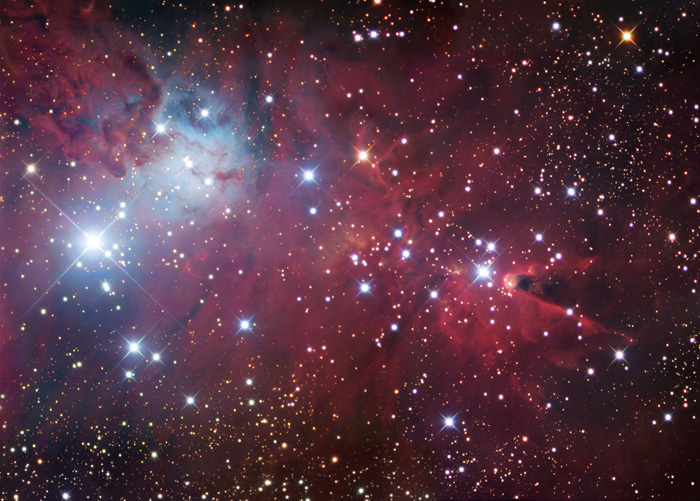 I found Robert Gendler's astrophotography web site through today's APOD, which is a very nice view of NGC 1055 and M77 by him. His web site has an amazing collection of photos and mosaics of nebulae (Cone Nebula mosaic shown here), galaxies, and other astronomical subjects, as well as some great photos of terrestrial subjects (especially his superb Grand Canyon Mosaics).
Thursday, December 14, 2006
Natural (Music) Selection (iPodolution)
I really like my iPod Nano (I know, everybody does). One thing I like about it is the rating system, which I'm using to figure out what music I really like. I started with around 980 songs, chosen fairly quickly from the 8000 or so on my home PC. So this was my "optimization starting point," hardly random to begin with, but subject to further "selection pressure" from the 5-star rating system. I rate the songs and remove the "weak" ones each week to make room for new music.
Starting from the bottom, I use one star to mean "delete" (next time I'm in iTunes). Two stars is a song that's OK and I might like to hear occasionally, though I might delete it if I need the space. Three is a good song that I'm happy to hear occasionally. Four stars is a really good song that I'm ready to hear any time, and five is basically the same, but also "undeniable" (truly awesome, classic, or both - or one of my own songs, some of which are fives to me at least!). I usually apply these ratings while listening, basically the only "input" allowed while listening to a song on the iPod (I can edit general information or delete songs only when plugged into a PC with iTunes).
With this system, I've so far rated 411 of the 977 songs currently on the iPod, with 131 of those getting five stars (copy/paste into Excel helps with this vital analysis). Some of my five star artists are Aimee Mann, Badfinger, Bare Naked Ladies, the Beatles, Billy Joel, and Bright Eyes. Scrolling to the end of the fives, I see Simon & Garfunkel, Sir Neville Marriner (for a Mozart piece), Stevie Wonder, Sting, Trisha Yearwood, U2, and Van Morrison.
Just thought you'd want to know. OK, you didn't, but I did.
Starting from the bottom, I use one star to mean "delete" (next time I'm in iTunes). Two stars is a song that's OK and I might like to hear occasionally, though I might delete it if I need the space. Three is a good song that I'm happy to hear occasionally. Four stars is a really good song that I'm ready to hear any time, and five is basically the same, but also "undeniable" (truly awesome, classic, or both - or one of my own songs, some of which are fives to me at least!). I usually apply these ratings while listening, basically the only "input" allowed while listening to a song on the iPod (I can edit general information or delete songs only when plugged into a PC with iTunes).
With this system, I've so far rated 411 of the 977 songs currently on the iPod, with 131 of those getting five stars (copy/paste into Excel helps with this vital analysis). Some of my five star artists are Aimee Mann, Badfinger, Bare Naked Ladies, the Beatles, Billy Joel, and Bright Eyes. Scrolling to the end of the fives, I see Simon & Garfunkel, Sir Neville Marriner (for a Mozart piece), Stevie Wonder, Sting, Trisha Yearwood, U2, and Van Morrison.
Just thought you'd want to know. OK, you didn't, but I did.
Wednesday, December 13, 2006
Wide Open Spaces (on Mars)
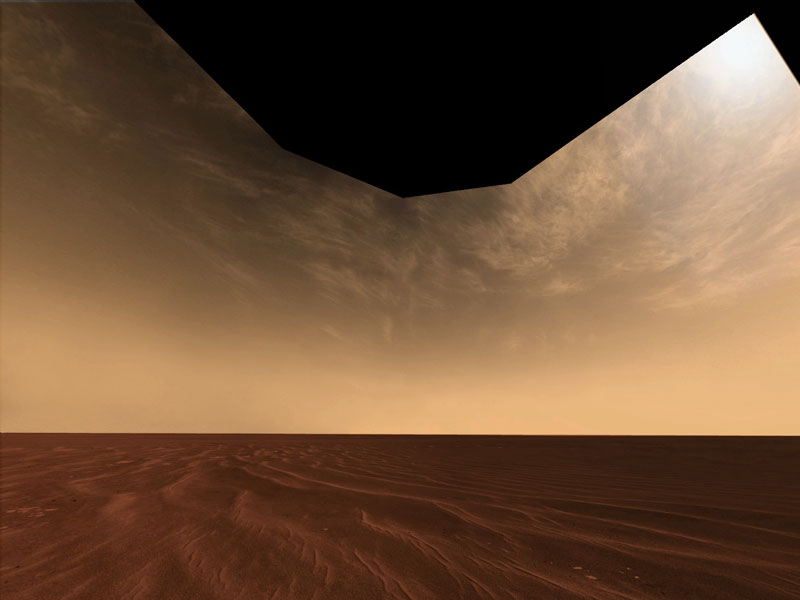 This picture is so cool. It was the Astronomy Picture of the Day for October 17, 2006 which I just happened to see on the way to something else. It was taken by the the Mars rover Opportunity, posted with the title "Clouds and Sand on the Horizon of Mars." Color is exaggerated in this image.
MiGMan in the Danger Zone
 My friend Peter "MiGMan" Inglis is a multitalented guy. In addition to being a professional classical guitarist (his Whole Guitarist web site is great) and author (Guitar Playing and How It Works), he's a flight simulation expert. For years he's been channeling his knowledge and enthusiasm for this subject into an amazing web site, MiGMan's Flight Simulation Museum. If you like airplanes, you will really enjoy exploring this site.
Recently MiGMan was invited to share his flight sim expertise with a much wider audience on the ABC Australia television show Good Game, where he talked about the joys of flight simming and gave a brief "master class" on the key points of takeoffs, aerial combat, and landing. Visit the museum to learn more and to view a nice streaming video (WMV) of his flight sim segment on Good Game. Excellent stuff!
Monday, December 11, 2006
Saturday Night (Space) Fever

 I had the pleasure of watching (via NASA TV) the dramatic Saturday night launch of Discovery with a group of other astronomy- and space-minded people, members of the Aldrich Astronomical Society, of which I am a new member. Before the launch, I met and talked with some other members of the club, showed off some simulated shuttle activities in Orbiter, and had a look at the Orion nebula through one of the club's telescopes. Aldrich has been supporting amateur astronomers and educational outreach in Central Massachusetts since 1932.
Discovery of course made it to orbit without a hitch, and I just watched the last few minutes of its docking with the International Space Station on NASA TV. Very smooth all the way.
Saturday, December 09, 2006
I WANNA GO!!!

 I've just had a look at two of Virgin Galactic's promotional videos for their planned commercial space flights. It may be "only" suborbital, but wow, it is going to be incredibly cool. The first video is accessed from the ""view the movie" link on the main VG web page. It is mostly Richard Branson talking about the program, with clips of SpaceShipOne's X-Prize-winning flights and interviews with the test pilots (and a lot of emphasis on safety). There's some other really great content on the VG web site - after all, they are trying to sell you on a $200,000 product! You can download a 38 page PDF brochure for offline viewing and printing.
The other video is a computer animated movie that shows the entire SpaceShipTwo flight sequence. This is really the coolest part of all - it's very well done and makes it seem incredibly real and exciting. Test flights are supposed to start in late 2007 with commercial flights starting about a year later if all goes well.
I really want to go.
Wednesday, December 06, 2006
Mars is Moist, Maybe
 This is a story that's showing up pretty big even in the mainstream media - signs of possible recent water flows on Mars. When talking about Mars, "recent" usually means "the last 300 or 400 million years" - but in this case, the changes are seen over the last seven years! Before NASA lost contact with Mars Global Surveyor (MGS), it was used to revisit hundreds of previously imaged high-slope gully areas in 2004 and 2005. Researchers then looked for changes between the old and new images and found some that are strongly suggestive of brief flows of liquid water (possibly from an underground geothermal source like a geyser). Coloration and other features suggest that these are liquid-based flows rather than shifting dust or debris. Pretty amazing stuff. The findings will appear in Friday's issue of the journal Science.
Does this increase the chances of finding life of some sort on Mars? That's what everybody thinks, hopes, wonders, or imagines. I suppose it makes it more plausible if not more likely. It would sure make Mars a more hospitable place for future human settlers. It's too bad that MGS went off line just before this big announcement, but the good news is that MRO is now in orbit and has just started its science phase, with even higher resolution instruments than the ones MGS used to make these observations.
USS Intrepid in NYC

I've been busy with work and preparing for an astronomy/space school event this Friday, so not much blogging time. There's lots of space news you can read about elsewhere of course - more details on NASA's Moon plans, Mars Reconnaissance Orbiter's imaging of the two Vikings and the Spirit rover, and the impending launch of STS-116. Cool stuff. No time.
But here's a quick flight related story - the USS Intrepid briefly takes to the water (towed to a New Jersey drydock for refurbishing). Intrepid is normally docked at Pier 86 in New York City, where it houses an excellent air and space museum. I love aircraft carriers, airplanes, and aviation history, and I visited the Intrepid museum several years ago. Then last April (2005) I had the good fortune to go along on a weekend outing with the Worcester Pilots Association, flying the Hudson River VFR Corridor at an altitude of 900 feet above the river. We flew down on the New Jersey side (passing the Statue of Liberty), turned around over the bay, then flew up the Manhattan side, passing close to the Intrepid. I interrupted looking for traffic and talking on the radio to take a few pictures, including the one shown here. I posted a couple of others on Flickr.
Saturday, December 02, 2006
Real "Music of the Spheres"
 I was looking through my space and astronomy books tonight, picking out some books to display at a middle school "star party" event I'm helping out with next week. I came across a book I hadn't looked at in a long time, Murmurs of Earth: The Voyager Interstellar Record, originally published in 1978. This book was written by Carl Sagan and several other people who were involved in the project to develop a "record of Earth" that could be attached to the two Voyager spacecraft that were launched in 1977 to visit Jupiter and Saturn (and ultimately Uranus and Neptune as well, in the case of Voyager 2).
The "golden record" that was attached to both spacecraft contained a variety of information encoded on a gold-plated audio-video disc, with visual instructions for playing back the disc in the unlikely event that the spacecraft is recovered by some distant civilization. Distant civilization? Was this even possible? Yes, in theory, because the Voyagers were planned to be the first human-made objects that would leave the solar system and enter interstellar space, with Voyager 1 now having just left the "heliosphere" in 2004. It will take thousands of years or more for either spacecraft to reach any star system, but if one were recovered by someone in the far future, the mission designers wanted to include some sort of message about who its makers were and where this odd artifact came from.
Of course the Voyager record is really more of a message to (and from) the people of Earth, so a lot of thought went into what should be included to represent as much of humanity's heritage as possible - samples of many languages, photos and diagrams, sounds and music. The book Murmurs of Earth is a detailed telling of what was included and how it was all decided and compiled. It's still a very cool book, and it includes all the images that were on the record.
Some later editions of the book also included a CD-ROM with the actual contents of the "golden disc," but my 1978 first edition hardcover did not have this. All versions of the book are now out of print, but many used copies are available through Amazon and other sources. Unfortunately none of them seems to include the CD-ROM, but as you might expect, much of the information that was on that disc is now on the Web. JPL has a web site devoted to the Voyagers, and a section of this site is devoted to the Golden Record itself. There you can find links to many of the images on the record, and most of the sound samples (though none of the music, probably due to performance copyright issues).
One of the sound samples is called "Music of the Spheres" (.wav file) and is a sound rendition of Johannes Kepler's Harmonica Mundi. Here's what the book says about this (page 154):
Kepler's concept was realized on a computer at Bell Telephone Laboratories by composer Laurie Spiegel in collaboration with Yale professors John Rogers and Willie Ruff. Each frequency represents a planet; the highest pitch represents the motion of Mercury around the Sun as seen from Earth; the lowest frequency represents Jupiter's orbital motion. Inner planets circle the Sun more swiftly than the outer planets. The particular segment that appears on the record corresponds to very roughly a century of planetary motion. Kepler was enamored of a literal "music of the spheres," and I think he would have loved their haunting representation here.
How appropriate for the sphere-trotting Voyagers and for this particular blog!
P.S. Although Pioneer 10 and Pioneer 11 were launched earlier and are also departing the solar system, Voyager 1 "caught up and passed" these spacecraft in terms of distance from the Sun and reached a distance of 100 AU (astronomical units, i.e., 100 times Earth's average orbital distance from the Sun) in August 2006, and is now in a region called the heliosheath, a zone where the sun's influence is very weak, though this is still not considered "interstellar space" (that will take about 10 more years).
Friday, December 01, 2006
Light Action!
 This seems to be the week for educational posts, and as they say on Monty Python, "now for something completely different" - a book about optics. I was just reminded of this by a caller who wanted to know about educational resources related to optics (triggered by my own Optics for Kids web site). I mentioned the book Light Action! (subtitled "Amazing Experiments with Optics," by Vicki Cobb and Josh Cobb, with illustrations by Theo Cobb). This book features a series of simple but enlightening experiments with light, using household materials such as flashlights, water, ice cubes, sunglasses, and TV remote controls. The experiments are easy to do and are followed by clear "here's what's happening" explanations of the optics involved.
This delightful 1993 science book for grades 6 and up went out of print some years ago, but I just checked Amazon and found that it's back in print, in a 2005 paperback edition from SPIE Press (SPIE is the optical engineering professional society).
Subscribe to:
Posts (Atom)