Thursday, September 13, 2012
Drambuie (a New Oldie)
Words and music by Bruce Irving and Rob Simbeck (c) 1978.
Yes, 1978! This is a new recording of an old song of mine, which I wrote with Rob Simbeck back when we were trying to develop a music career in Rochester, NY. We eventually wised up and moved to Los Angeles, and Rob later moved to Nashville, where he still lives. But I digress.
"Drambuie" was mostly Rob's lyric, based on the observation that some people like Drambuie, and others prefer beer. Or something like that. I wrote some semi-jazzy music on a classical guitar. I've always liked this song, but I never tried to make a serious recording of it. This week I was fooling around with a music arranging and songwriting program I have called Band-in-a-Box (2011), trying out some of their "RealTracks," which are prerecorded audio files of various riffs, chords, and drum parts played by professional musicians. I have quite a few of their RealTracks styles, and every few years I upgrade and buy more. In this simple, jazzy "classy ballad" style, the instruments are piano, acoustic bass, and drums with brushes. They sound pretty good to me considering I simply entered the chords for my song, chose the style, and BIAB did the rest, except for the singing (me) and the electric guitar, which was played by Roger Lavallee.
I exported the audio tracks from BIAB and imported them into Sonar X1 for further recording, effects, and mixing. This version is not quite final. I am not happy with the vocal, and the mix needs some work. Roger played some pretty nice guitar lines around the keyboard riffs played by someone years ago, probably in PG Music's studio in Victoria, BC.


Where It All Began

I meant to post this when it was actually 50 years to the day, but now it's after midnight. Oh well, it's still cool. Fifty years ago yesterday, September 12, 1962, President John F. Kennedy gave a speech at Rice University in Texas in which he stated the goal of landing a man on the moon by the end of decade. The famous part of the speech is this:
We choose to go to the moon. We choose to go to the moon in this decade and do the other things, not because they are easy, but because they are hard, because that goal will serve to organize and measure the best of our energies and skills, because that challenge is one that we are willing to accept, one we are unwilling to postpone, and one which we intend to win, and the others, too.Guess what? Apollo 11 landed on the moon on July 20, 1969, fulfilling JFK's pledge. There's a lot more to the story of course. But it's still a pretty good story. 1962 was right around when I started to get crazy about space and all the associated technology. It's pretty amazing that when he made this speech, only four Mercury astronauts had flown in space, two very quick suborbital flights (Shepard and Grissom) and two brief orbital flights (Glenn and Carpenter), three orbits each. Wally Schirra would fly six orbits a few weeks after this speech. It's a long way from three orbits to the moon.
There's a video here. The text of the speech and other links can be found here.
Thursday, August 23, 2012
Mars "Beach" Photos
Lest I get too Earth-centric in this blog, I want to mention the progress of MSL (Curiosity to her friends) on Mars. While the JPL team is still taking things slow to make sure everything is carefully checked out, there has been some cool progress, including at least one laser shot and a very short drive away from the landing site. The pictures are amazing, and I think one of the pluses here is that Curiosity's mast cameras are roughly at human eye level, so the perspective is like you would see if you were standing on Mars.

While the color photos are great, I'm really digging the sharp B&W shots we've been seeing recently. Our own robotic Ansel Adams on Mars. They somehow remind me of beach photos from when I was a kid and my parents took me to Cape Cod. I know, I know. No mountains in Cape Cod. No ocean on Mars. But the look of the B&W just does that for me. Takes me back to 5 years old, playing in the sand with my geological drill and laser spectrometer.
There are great official images here. My favorite spot for MSL news is Emily Lakdawalla's blog at the Planetary Society. She really digs up the latest Mars dirt (so to speak). Today she showed a wonderful full color panorama including the mountain. MSL's first tire tracks at the Ray Bradbury Memorial Landing Site on Mars are seen in this August 22 panorama:

Flying the NYC Hudson
I started to follow the Collings Foundation on Facebook, mainly because they post some of the coolest in-flight photos as they fly their B-24, B-17, and P-51 war birds on their "Freedom Tour" around the USA. Today they posted the wonderful shot below, taken from the cockpit of the P-51 as it flew south along the Hudson River corridor, with Manhattan off the left wing, and a B-24 off the nose (Collings Foundation photo).

Although there are special rules, you don't need to be flying a commercial or historic aircraft to fly along the Hudson like this. I was lucky enough to fly it once, back in 2005 when I was still somewhat active in flying and a member of the Worcester Area Pilot's Association. One of our weekend events was to fly a group of airplanes from Worcester to the Hudson River in New York state, where we joined the low-altitude traffic pattern for the corridor (south along the Jersey shore, north along Manhattan's west side). I flew as co-pilot in another member's Grumman Tiger. I handled the radio while we both looked for traffic (it is a pretty busy area). New altitude rules were introduced in 2009 after a collision, but the basic idea for small private craft is to stay low, below all the airline traffic for the three nearby major NYC airports. I believe we flew at 900 feet above ground (or river) level in 2005. It was really cool. Here are some pictures I took. The first one needs no introduction (flying south - I was in the right seat):


Although there are special rules, you don't need to be flying a commercial or historic aircraft to fly along the Hudson like this. I was lucky enough to fly it once, back in 2005 when I was still somewhat active in flying and a member of the Worcester Area Pilot's Association. One of our weekend events was to fly a group of airplanes from Worcester to the Hudson River in New York state, where we joined the low-altitude traffic pattern for the corridor (south along the Jersey shore, north along Manhattan's west side). I flew as co-pilot in another member's Grumman Tiger. I handled the radio while we both looked for traffic (it is a pretty busy area). New altitude rules were introduced in 2009 after a collision, but the basic idea for small private craft is to stay low, below all the airline traffic for the three nearby major NYC airports. I believe we flew at 900 feet above ground (or river) level in 2005. It was really cool. Here are some pictures I took. The first one needs no introduction (flying south - I was in the right seat):

This was flying north after turning around over the bay. This is the Verrazano Narrows Bridge, looking over Brooklyn towards Manhattan:

This one shows how close we were to Manhattan itself, flying north along the west side of the island (Empire State Building):

Finally one of my favorites, a close shot of the aircraft carrier USS Intrepid, which is a very cool air museum that is docked at Pier 86 (there's also a sub you can tour). Today you would see a large white structure on the aft deck which is the new home of the space shuttle Enterprise:

Sunday, August 19, 2012
AT-6 Texan Flight!
Last September, I took a flight in the Collings Foundation's B-24 "Witchcraft" when their "Wings of Freedom" tour came to Worcester Airport. Today I visited the Foundation's headquarters for one of their public events, "The Race of the Century." This is a living history of transportation progress in the form of brief races between different vehicles (and sometimes horses and a guy running). The Collings Foundation owns many vintage vehicles and aircraft, from horse-drawn wagons to Stanley Steamers to various aircraft, including a 1909 Bleriot monoplane (this was the type of aircraft that first flew the English Channel).
 The races and static displays at the Foundation's museum were great, but I paid (quite) a bit extra and took a flight in the foundation's AT-6 Texan. This is the most powerful single-engine aircraft I have ever flown, and I was really only expecting a ride. I was pleasantly surprised to learn that it was technically an instructional flight, and that the aircraft is fully aerobatic, if I was interested in that sort of thing.

Well I certainly was! Rob Collings was the pilot (he is the chief pilot and also directs the foundation), and of course he handled the takeoff, aerobatics, and landing, but I got to do some basic flying and some steep turns which were fun. We climbed to 3,500 feet and headed back to the field for some really fun stuff. First a loop, which was amazing. I have only done a few of these in my life and it's always a blast to see the ground coming up from "above" (visibility forward and aft was pretty poor from the back seat, but it was great through the top of the canopy). I love to feel the G-forces too (maybe 2G). We also did a couple of aileron rolls and a barrel roll. Whoopee!
I wanted to concentrate on the flying and on enjoying the aerobatics, so I didn't take many photos. The self-portrait above was not taken during a loop (I stowed the camera for that stuff). And I was having more fun than it may appear.
More pictures and a couple of videos (Stearman PT-17 takeoff and landing) my Flickr pages.
Saturday, August 11, 2012
The Dog Stars
How will the world end? Or at least humanity's part of it? War? Resource depletion? Pandemic? Asteroid? Of course I don't know. I hope we can learn to take better care of this world, and of one another, so we can carry on here for a very long time. I also hope we can develop space settlements similar to what is described in the novel 2312 that I read recently. It would be nice to have an off-site backup for humanity. SpaceX and Curiosity* notwithstanding, that's probably going to take a while.
 Meanwhile a lot of authors are thinking and writing about the end of the world in one form or another. I have read a fair amount of post-apocalyptic fiction in my time. Not sure why. I like a good story, and I'm curious about how things might turn out if things go bad for a lot more of us than is the case now. In the last two days, I read what may the best post-apocalyptic novel ever (for me anyway). The Dog Stars takes place in an unspecified but very near future, about 9 years after an especially vicious flu pandemic has wiped out over 99% of the human population. It seems totally plausible.
The narrator, Hig, lives at a small airport in Colorado. His only neighbor is a heavily armed survivalist, and together they manage to survive the occasional attacks by bands of desperate survivors looking for food and whatever else they can find. They are armed and prepared and they do not negotiate with these people. Hig flies patrols of their "perimeter" in his 1956 Cessna to spot trouble early, while Bangley handles the "ground war." Hig's best friend is his dog Jasper, and with his wife and everyone else he knew dead in the pandemic, his bond with Jasper is an important part of why he is still around. There are some other survivors who live a few miles away, a small group of Mennonites who are infected with "the blood," a wasting disease that is thought to be highly contagious (it somehow became common among survivors of the flu pandemic). Hig lands his plane on their farm sometimes and helps them out in various ways, without direct contact for fear of infection. He is a kind and caring person who is also an excellent hunter, able to take down a deer or a marauding human when the need arises.
That sets up the story, and I won't give away any more of the plot details, because it's a great story with vivid characters and a lot of interesting twists (no zombies, no monsters, no space or sciencey stuff, though there is a hint at one point that the virus that wiped us out was engineered in a lab - in California - but no one knows for sure). There's also a fair amount of "flying lore" built into the story which appealed to my pilot side. But the real appeal is Peter Heller's use of language. Heller is a poet who has written a lot of non-fiction. This is his first novel. The writing style simulates to some extent Hig's stream of consciousness, and at first you may be bothered by the lack of quotation marks and other "navigation aids." And also the incomplete sentences and even fragments. But. It seemed natural to me after a dozen or so pages.
The real beauty is in how he observes and connects things. He loves the woods, the mountains, the birds, the streams, the sky, everything in nature. And his dog. And his airplane. And his late wife. And poetry. And fishing. Somehow all of these things connect to create a personality that seems vividly real. Hig builds an inner world out of these parts, and you can see why it is worth fighting to go on as one of the few people left alive on earth. But what if one more thing is taken away?
I will say that this is the most uplifting post-apocalyptic novel I have ever read. Not a feel-good story exactly. But a tribute to the resilience of the human spirit and to the beauty of the world, in spite of almost anything. Post-apocalyptic fiction for people who don't like post-apocalyptic fiction. Maybe.
* This week the Mars Society sent members an email talking about the relatively low cosmic radiation levels that Curiosity has measured in its first first few days on the surface of Mars, saying that this level (about the same as astronauts experience in low Earth orbit) bodes well for human exploration of the Red Planet.
Monday, August 06, 2012
6 More Wheels on Mars!
I decided to go to bed rather than wait for Curiosity's planned 1:30 a.m. landing, but without setting any alarm, my wife and I both woke up at about 1:20, and we used the iPad to watch a video feed from the Planetary Society's Planetfest in Pasadena. We tuned in just after cruise stage separation, and both the Planetfest crowd and the JPL control room teams were already going wild. It was very exciting and emotional, and it all went perfectly, including the almost immediate display of a couple of low-res "hazcam" photos showing that Curiosity was indeed safe and sound. Awesome. I was glad I had watched the Eyes on the Solar System EDL simulation earlier in the evening so I could really picture each event as it was called out. We watched for about 20 minutes then went back to sleep.

This morning I checked the Planetary Society Blog where Emily Lakdawalla reported that there appeared to be a "puff" of something on the horizon in the very first hazcam image that was not there in a later shot after the transparent lens cover was opened. Her thought was that this might have been a dust cloud from the impact of the descent stage, which was programmed to fly off, run out its fuel, and crash far from the landing site. If so, that would be really cool. Imagery from the Mars Reconnaissance Orbiter will probably confirm that and also show us exactly where Curiosity landed.

This morning I checked the Planetary Society Blog where Emily Lakdawalla reported that there appeared to be a "puff" of something on the horizon in the very first hazcam image that was not there in a later shot after the transparent lens cover was opened. Her thought was that this might have been a dust cloud from the impact of the descent stage, which was programmed to fly off, run out its fuel, and crash far from the landing site. If so, that would be really cool. Imagery from the Mars Reconnaissance Orbiter will probably confirm that and also show us exactly where Curiosity landed.
Sunday, August 05, 2012
Eyes on Curiosity
I've been a very bad Solar System Ambassador the last couple of years. Other parts of life (job, family, music) have intervened, and I just haven't been keeping up with space developments and doing outreach events. My bad. I haven't even fired up Orbiter in probably 9 months. But I'm still really interested in this whole business of exploring the solar system (see my recent review of Kim Stanley Robinson's new book 2312 - he really makes the solar system come alive, 300 years in the future).
But of course the solar system is alive now. Mostly here on earth of course, but our latest robotic emissary to a neighboring planet is going to land there in less than four hours from now. That is of course NASA's Mars Science Laboratory (MSL), otherwise known as Curiosity. Today I have been reviewing the mission and the all important EDL (entry, descent, landing) phase, the famous "7 minutes of terror" that will start in just about three and half hours for us (Curiosity will experience it about 14 minutes before we hear about it, the time that light-speed radio signals from Mars will take to get here).
I have been watching the progress using JPL's very cool "Eyes on the Solar System" 3D visualization web application which includes a detailed simulation of the EDL phase. You can watch this as a preview (including controls to speed up, slow down, reverse, and pause the events) or you can watch it live. Right now the live view shows the cruise stage slowly spinning with its solar cells pointed to the sun:

But if you run the preview mode (or wait for the landing), you can watch all the more terror-laden steps like aero-shield heating, descent stage separation, and the grand finale, the special-forces-like "sky crane" landing (there is also a very cool JPL video about the EDL phase here):

I wish the landing weren't happening at 1:30 am in my time zone, but I plan to try to stay up even though it's a "school night." I was lucky enough to see Curiosity when it was still a bunch of parts in the JPL clean room back in May 2009, and I feel a special attachment the the not-so-little six-wheeled fella (gal?) - here's a picture I took of the descent stage at JPL that day:

Tuesday, July 24, 2012
KSR's 2312 is Very Cool

There are a lot of powerful technologies assumed to exist, starting with fusion power, space elevators, self-reproducing assemblers, and quantum computers (personal versions are called qubes). But there is no magic here. While it's not inevitable that these technologies will become practical or widespread, they are physically possible. As usual (from having read Red Mars and Green Mars), KSR is at least as interested in social possibilities as he is in technical ones. And there are some weird ones in 2312. There's also a mystery and a love story or two buried in this book.

It's also interesting what a writer like Robinson can do with a very specialized piece of science - such as the braided or perhaps kinked F-ring system of Saturn (pictured above). Doesn't that look sort of wave-like? And where there are waves, surely you will have surfers, right? Some residents of the cities on Saturn's moons like to fly to one of the "shepherd moons" that give the F-ring its gravity-sculpted structure, and from there, they have figured out how to surf these narrow waves made of ice blocks! Yes, they wear spacesuits with thruster rockets, and they surf the F-ring. He even makes it sound sort of plausible. This is shown in one incidental scene between two of the main characters, Swan and Wahrom.
A funny thing about Swan: She is from Mercury, and she is an impulsive risk taker who has tried all sorts of bizarre things in her young 110 year life (most "spacers" live to around 200, with periodic DNA repair and other longevity treatments). She is really a wild character, an artist whose whole life seems to be a sort of over-the-top performance art. Just when I started reading about Swan, I happened to start listening to the new Fiona Apple album, and I watched her bizarre video for "Every Single Night." From this coincidence, Swan and Fiona have fused in my mind. So I picture Fiona when I read about Swan's latest odd adventure.
Although some reviewers are bothered by certain devices that KSR uses in this book, such as lists and excerpts of supposedly technical or historical documents (from the future), I think these brief inter-chapter devices allow KSR to fill in the back story and set the many scenes in a relatively compact way so he can cover the whole solar system and multiple characters and story lines without drowning the reader in too much detail (it's about 570 printed pages, though I am reading it on Kindle myself). Highly recommended if you like imaginative hard SF. There's a cool interview with Robinson from June 2012 here.
Languages As Toys
I was thinking about the fact that I spent quite a few hours reviewing my very rusty (30+ years old) university Russian language skills before my recent trip to St. Petersburg. I have even continued to spend a little time on it since I got back. Why? I probably won't spend much time in Russia in the near future, and even if I do, I could probably get by just fine with English, as most tourists do. There's very little chance of achieving fluency or even minimal competence at this point in my life, though I'm confident that I could do it if by some bizarre circumstances I ended up living in Russia for a while (I feel the same way about French and Japanese). Was it worth the effort for just a few brief interactions in Russian?
 Oddly enough, yes, and I figured out the reason. For me, languages are toys or puzzles, fun to play around with in themselves.Consider if the first person on the Moon had been Russian, and he or she had said the same thing that Neil Armstrong had said with his first step, but in Russian. According to Google Translate, that would have been это один маленький шаг для человека, но гигантский скачок для всего человечества. Now anyone can do that with Google, but since I can still read Russian and understand a bit about the grammar, I can see that this is a plausible translation. I can also speculate that the well-known confusion about Neil's statement (did he say one small step for man, or for a man?) would likely not have happened in Russian, since для человека "dlya chelovyeka" (for person) and человечества "chelovechestva" (mankind) are quite distinct, while "man" (with no a) and "mankind" are roughly synonyms. Russian also doesn't have articles (a vs. the), but the forms (cases) of nouns usually make the meaning clear.
I consider that sort of thing entertaining enough to buy books on subjects that interest me in other languages, as a stimulus to learn more of these odd bits. I don't buy as many as I used to do in French and Japanese, and I tend to buy children's books, since I am not very advanced. I found one cool one in St. Petersburg, a children's book called simply космос ("kosmos," space). I was disappointed that I couldn't find such a book with more focus on Russian spaceflight (it's a translation of a British book). But this turned out to be useful, since I was able to buy a cheap used copy of the English version on Amazon, greatly helping my study efforts.


Once a nerd, always a nerd? Yup.
Saturday, July 21, 2012
SpaceX Dragon to ISS: Highlights
Cool video from SpaceX with highlights of the recent successful flight of their Dragon spacecraft (unmanned cargo version) to the International Space Station. This happened in late May when I was in Europe, so I didn't follow the mission at the time, but it's a great milestone for private space.
New Fiona Apple - Wow
Fiona Apple's new album has an odd name (The Idler Wheel Is Wiser Than the Driver of the Screw and Whipping Cords Will Serve You More Than Ropes Will Ever Do, a.k.a. "Idler Wheel"). The music and lyrics are even odder. And the video for "Every Single Night" is perhaps oddest of all. Definitely hallucinatory stuff (see above).
But I can't stop listening to it. It has really grabbed me like very little of her previous work. It is powerful, strange, raw, intimate, and somehow very real feeling. Wow. Her songwriting blows me away. She writes some amazing and disturbing lyrics, with incredible imagery, and her piano playing and use of percussion can be almost hypnotic.
The Act of Creation
The feeling is, you know, it is really exhilarating, it's like some kind of serotonin rush in your brain, you know, and you really feel great, and you want to go on and do it again, and again, and again. Later on you'll probably change your mind about it, about how well you succeeded. But at the moment that you finish and you're satisfied or you're more than satisfied, that's an extraordinary feeling, and that feeling is so powerful, that it makes you willing to go through the process and the frustration of trying to write again, write anew each time, just to get to that feeling, because there's a lot of frustration before you get there. But the feeling is good, and the act of creation is very pleasurable on a physical level.Paul Simon (2007)
Excerpt from "The Songwriting Process," an interview segment included with the album "iTunes Originals - Paul Simon."

This struck me as a really cool explanation for why I do a lot of things. It's pleasurable to solve problems. It's pleasurable to experience new things. It's pleasurable to read a book and find out how it ends. It's pleasurable to read a book or watch a movie that you really enjoyed the first time again, even though you know how it ends. There are lots of pleasurable things (or maybe not, if this is true, which I think it is - as Fiona Apple replied to a guy in her song "Paper Bag" who said "It's all in your head" -- "so's everything!"). Even finishing a blog post gives some kind of serotonin rush, albeit a very tiny one (judging from my recent low rate of repeating this behavior).
Tuesday, July 17, 2012
My Delayed Love Affair With Russia

I have long been fascinated with Russia. I even took four semesters of Russian in college (back in the mid-seventies - almost all forgotten except for reading and writing the Cyrillic alphabet). But I never made a trip to Russia until earlier this month, when I attended an optics conference in St. Petersburg. I naturally added a few days to the trip for some sightseeing. St. Petersburg really is a fantastic city, and I was fortunate enough to have excellent (hot) weather and "white nights" for the whole week I was there. Everything was great. Here are a few highlights.

Helicopter tour - The space museum was inside Peter and Paul Fortress on the small island where Peter the Great established the city. I didn't know there were helicopter tours, but when I saw and heard the low-flying MiL Mi-8's, I figured it out. It cost 3,000 rubles (about $90) for a 14 minute flight on the 16 passenger Soviet-era helicopter, but it was awesome. Check out my YouTube video here and here (YouTube smoothed the vibration-induced shakiness, but this caused my captions to get all jittery - oh well).

Boat Tour - There are many boat tours on the Neva River and through the many canals of St. Petersburg, "the Venice of the North." The hour tour took 20 minutes more due to tourist boat traffic jams. Although the river portion was great, the canal part of my tour was not the best in terms of passing close to major sights. Check the route before you book one.

The Hermitage - I spent about five hours walking the many rooms of the immense Hermitage, perhaps the best art museum in the world. Simply awe-inspiring. I used a wonderful and free iPhone guide app on my iPod Touch to navigate. I later bought inexpensive virtual tour upgrades to this app. It's really great (especially on the iPad, even though it's only an iPhone app). I took a lot of pictures too (you can pay extra to allow this). A tiny piece of the Hermitage can be seen on the left in the photo above and in one of the many rooms below.

There was much more. Interesting people. Great borscht. The Swan Lake ballet. Lots of Russian signs to practice reading. Beautiful parks, gardens, and churches. I really want to go back.
Wednesday, June 27, 2012
Deep, Light, and He Can't Help It

Nope. It sure seems that way sometimes, but I think this is an illusion. A very convincing illusion, but an illusion nonetheless. My friend Craig Collins explains this heavy concept with his usual light touch in this excellent blog post. Not that he had any choice in the matter.
Sunday, June 17, 2012
Cool Sounds (John & Lisa)

In addition to the "movie music" mentioned in my post about driving Europe, I've written a few other songs in the last few weeks, but nothing is quite ready to post. I need to get into my basement studio and finish some of these songs! It's too easy to start new songs and do partial demos on the iPad with GarageBand and all the various cool synths and other music apps now available. I shouldn't complain about too much inspiration, but the problem is not enough time and discipline to finish things. The good news is that thanks to these tools on the iPod Touch and iPad, I can write and record even when I travel, which was never very practical before.
I've also enjoyed music from other people, most notably the new John Mayer album "Born and Raised," which is great. Last week I saw cool concert in Boston, featuring Lisa Hannigan, an Irish singer-songwriter I've admired since I first heard her singing with Damien Rice some years back. Lisa was co-billed with an American singer-songwriter, Joe Henry. I was not familiar with his work and really didn't enjoy his part of the performance. But Lisa was wonderful. She performed most of her recent second album, "Passenger." I took a few videos, three of which are posted on YouTube: "Knots," "Little Bird," and "Passenger." The picture above is from Lisa's performance on NPR's Tiny Desk Concerts (pictured with her guitarist John Smith, who was also quite impressive at the Boston concert). We were in the fourth row at the Paradise, pretty nice seats but not quite as intimate as NPR's library.
Driving Europe

We took a lot of pictures and video clips, and on the flight home from Frankfurt, I used GarageBand on the iPad to create some instrumental soundtrack music for three short "slide show" videos that I later edited with iMovie on the iPad. You can see these videos on YouTube (note: choose HD or 720p in the YouTube settings to view these with full resolution):
Driving video - the whole trip in 2 minutes 20 seconds with fast music.
Europe sights - a bit longer and more relaxed with pseudo-classical music.
Jungfrau "Top of Europe" train ride - a pseudo-Romantic adagio. I was going for majestic to try to match the Alps. Almost 3 minutes.
Sunday, April 29, 2012
New Song: Blue (Monkey Butt)
It's weird what sorts of things pop up when I play around with the many sounds and options in GarageBand on the iPod Touch or iPad. Often an instrument sound, automatic pattern, and rhythm will lead to a new song. This new one sounded bluesy (not surprising since the progression is like Em Bm C F#dim), so I started using the word "blue," and before long I had a demo. Although most of the things I mention are not actually blue, monkey butts sometimes are. So there. Like much of life, this song is something of a joke, but not completely.
Tuesday, April 10, 2012
Music in Space

I really like Cady Coleman. She is one of the few astronauts I've had a chance to meet. She visited my space flight simulator demo booth at a Space Expo at the New England Air Museum a few years ago, and we spoke for a few minutes about educational outreach. She struck me as incredibly down-to-Earth (when she's not in space). I didn't realize at the time that she is also a musician.
Friday, April 06, 2012
iPad Rationalization

Well after I spent a week or so setting up that iPad 2, I could feel my anti-iPad rationalizations cracking under the strain of a nearly life-size HUD on my simulated space shuttle and the large instrument and control interfaces in GarageBand (yes, I was testing out a few apps my mother-in-law wouldn't need). I tried out a few magazines like WIRED, Newsweek, National Geographic, and Discover Magazine, and they were definitely much more enjoyable than on the pathetically tiny screen of the iPod Touch. Mainstream apps like web browsing, email, YouTube, and the like are easier to use too. FaceTime and Skype are wonderful on a face-size screen. My willpower was crumbling...
Apple delivered the final blow with the "new iPad" ("3G") announcement - super-high-res screen, faster graphics processors, and a better camera for the same price points as the iPad 2 (though they did drop the price of some iPad 2 models). I was sold. So I gave in and ordered one (wifi only) - telling my wife that this would be a family iPad, not my iPad. I can share (sometimes). I promised I would still use the iPod Touch for travel. And so far I have not taken the iPad on a trip (so far haven't taken a trip...).

The new iPad is really great. Many apps have already issued updates to take advantage of the 2048x1536 retina display, including F-SIM Shuttle (above). Gorgeous rendering of my still less-than-perfect landings. Music creation apps are wonderful on the larger screen. Apple's free movie trailer app was upgraded and the HD previews are amazing. One surprising fave is the NPR Music app (also free). With more room for interface controls and graphics, and plenty of video, it makes it a pleasure to explore new music. I really appreciate that many of the apps I had bought for the iPod Touch are "universal" apps that also work great on the iPad. I've only bought a couple of "HD" apps specialized for the iPad.
Who knew that apple flavored kool-aid could be so tasty?
Too Cool: Driven to Fly!
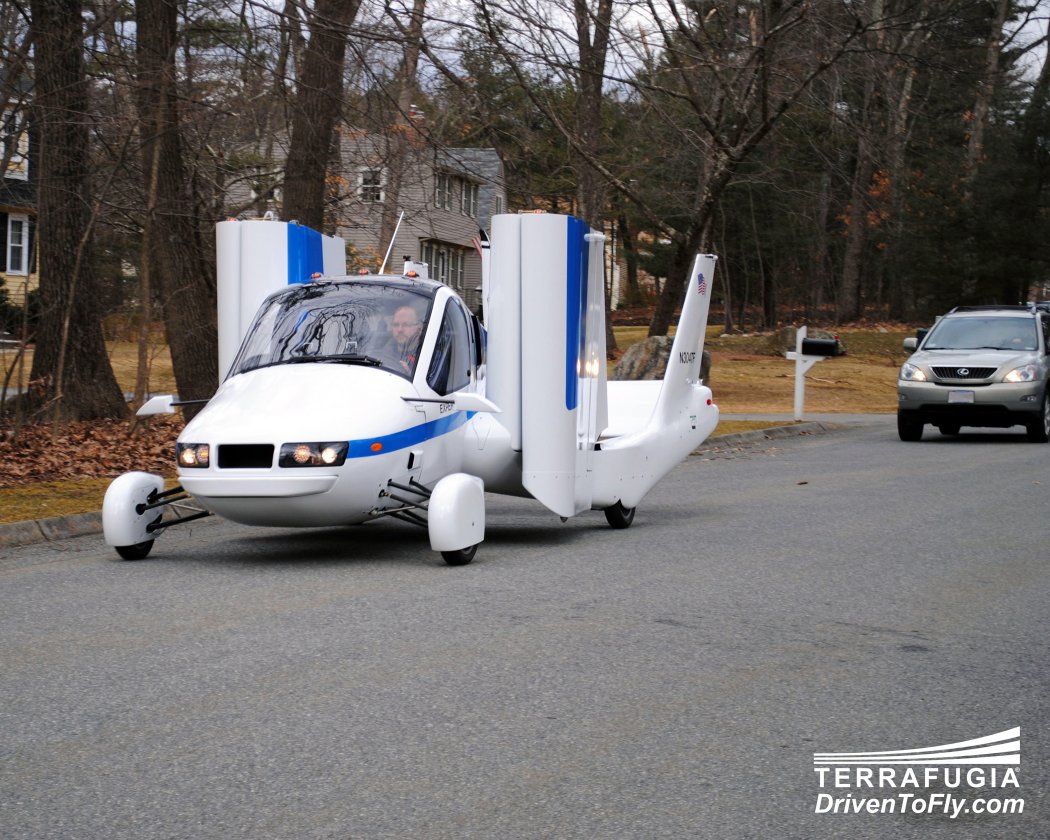
Terrafugia's FAQ has some useful info including this comment:
The Transition also reduces the cost of ownership of an airplane by burning automotive gasoline, parking in your garage at home instead of renting a hangar, and nearly eliminating ground transportation costs.Good points! So OK, I have a private pilot's license and a two-car garage that's within a 25 minute drive of at least three airports. I would love to have one. But aside from gasoline, hangar charges, and various insurance issues, a key factor in "cost of ownership" is the price - $279,000. Maybe not this year.
Monday, March 19, 2012
Elon Musk on 60 Minutes

In the history of space flight - only four entities have launched a space capsule into orbit and successfully brought it back to the Earth: the United States, Russia, China and Elon Musk.It's impressive and inspiring to me. I wish I were a 30-something engineer again. I would move back to Los Angeles and get a job with SpaceX!
The text version of the interview is here. The video of the whole show (including commercial breaks) is here (there was also a fascinating story on the neurological condition of face blindness). This appears to be just the SpaceX video segment. I don't know how long CBS keeps these 60 Minutes videos on-line.
Tuesday, March 13, 2012
Music Animation Machine


Monday, March 12, 2012
Matt Bors Wins Cartooning Award

Thursday, March 08, 2012
Unexpected Facts

One that especially caught my eye was, "Of all the people in the world who have ever lived to be 65, two-thirds are alive today." I guess that makes sense given that during most of human evolution, life was "solitary, poor, nasty, brutish, and short" (at least according to Thomas Hobbes). Here are a few others I like, found in this article:
- 0.3% of Saharan solar energy could power Europe.
- Only 4% of US films are made by women, compared to 25% in Iran.
- Right now, there are over half a million people traveling the world by air.
- Over 138 million people work outside their country of birth.
- There are five times more people learning English in China than there are people in England.
- The U.S. has more Spanish language newspaper readers than Latin America.
- Recycling one tin can saves enough energy to power a TV for three hours.
Wednesday, March 07, 2012
Love/Hate With Apple
I've got this love/hate thing with Apple (I'll admit it's mostly love).
The hate part: today's new iPad announcement that has finally made me really want one. It's hard to explain why. Better screen, faster processor, better camera? I don't exactly know. But it seems like it's ready and would be really great to have for recording and other things.

The love part? A new GarageBand update (v1.2 for iOS) that addresses my two biggest complaints. There's a "piano roll" note editor for MIDI parts (now if they would only add MIDI export!). And they added "smart strings" that sound really good based on my limited playing with them. There's also a multi-device "jam" feature that works over Wifi that might be cool. Best of all, immediate gratification: I downloaded the free update this evening. It seems to work well on my iPod Touch, but it also contributes to the hate part: now that I've really figured out how to use GarageBand efficiently, I want to use it more for songwriting and making demos, even when I'm home. If only that iPod screen were just a little bit bigger... wait...
Sunday, March 04, 2012
Brand New Tune: "Maybe Not"
I just got back from a business trip in China. Nothing much to report besides a very busy schedule, but since I had some 40 hours of time on airplanes, I managed to work on some songwriting, thanks to music apps on my iPod Touch. The one I'm using most these days is Apple's GarageBand (GB). I wrote about this app last month, but since then, I have really figured out how to use it effectively. The interface design is absolutely brilliant (OK, it's Apple, I know). It really is the ideal interactive sketchpad for creating new music (at least music that is based mainly on keyboards, guitars, drums, and vocals, though you can also record any acoustic or electric instrument you like - unless you're on an airplane). The "smart" instruments are able to generate various instrumental riffs and patterns based on the chords you play. You can also play manually though the tiny keyboard and guitar simulations are tough to use on the iPod Touch's small screen (still resisting buying an iPad). Semi-automatic is also possible (e.g., a palette of chords is presented with buttons that are easier to play than the conventional keyboard but still offer some expression and inversion features).
On the way home yesterday (13 hour flight from Shanghai to Toronto), I wrote a new song and made a rough demo, pretty much complete except for vocals which I did today. This song is called "Maybe Not," and the lyrics are pretty strange. But I mostly like it, and even though the demo has some quite rough edges, I uploaded a version to SoundCloud just now, for comparison with the studio version (TBD later this week I hope). A work in progress and a sample of my songwriting process and what is possible on a mobile device these days (with a powerful app like GarageBand).

Cool Optical Technology

Subscribe to:
Posts (Atom)