Friday, April 19, 2013

Exoplanets Rising


Several new Earth-like exoplanets were recently announced, based on continuing observations from NASA's Kepler satellite (the above graphic is from NASA's Kepler page). This brings the number of confirmed exoplanets to 882, according to one of my favorite iPad apps, the aptly named Exoplanet (also for iPhone). Kepler-62 is a five-planet system with planets of 1.4 and 1.6 Earth radii orbiting in the habitable zone, according to the discovery paper (abstract). Could these planets actually have liquid water? And life? Too soon to tell, but we will sure have plenty of candidates to look at once we have some tools with sharp enough vision and sensors, like the upcoming JWST (James Webb Space Telescope). Of course at 1200 light-years from Earth, no one is going to be visiting the Kepler-62 system anytime soon (barring great advances in wormhole transportation systems).
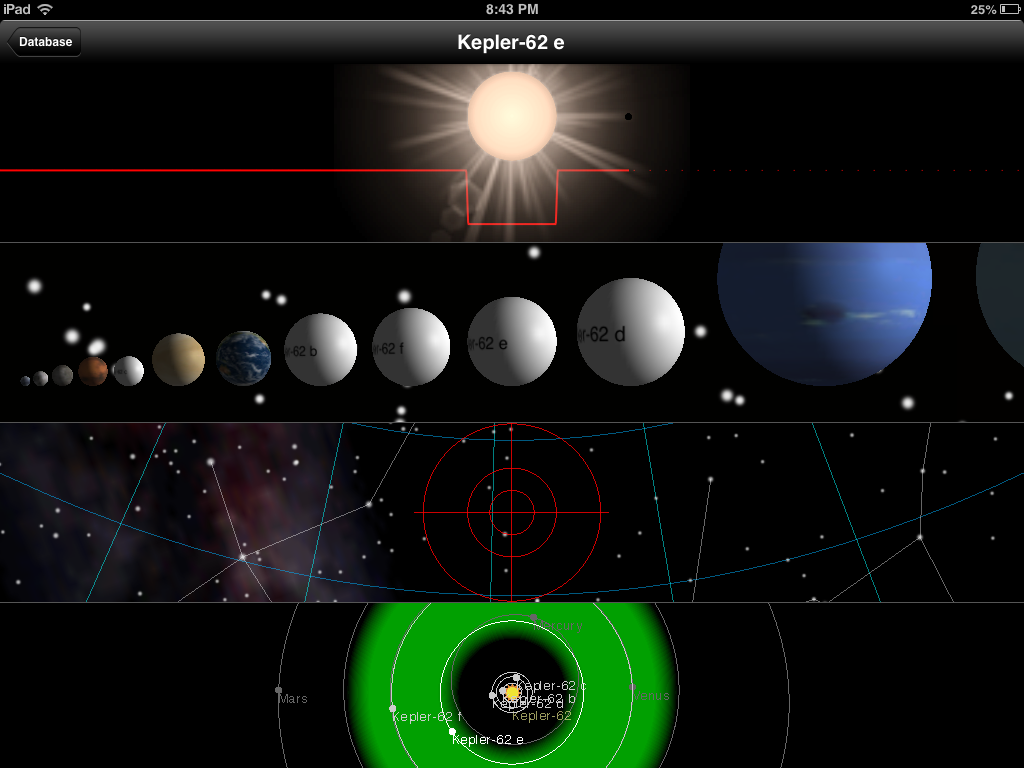

Of course you can find such information directly from Google, NASA, and other sources, but the Exoplanet app is pretty much one-stop shopping for keeping up with newly discovered planets and how they compare with one another, through a variety of cool graphics and comparison tools. For example, the page for Kepler-62e above includes the relative sizes (with Earth just to the left of Kepler-62b) and the location within the star's habitable zone (shown in green), along with other information (you can touch each band for a full-screen version). You can also view lovely, zoomable graphics of the Milky Way Galaxy, showing its structure along with the location of any selected exoplanet, plus our own Solar System, for reference (example below).


The screen below shows the latest discoveries at the top of a detailed database table. There is also some great background information that explains what exoplanets are, how they are discovered, and how they vary. The basic app is free, but there are various low-cost in-app purchases to add more features and to remove ads. Updates for newly discovered planets are small and frequent free downloads within the app (when you have an internet connection). A cool tool.


Monday, April 08, 2013

F-Sim Space Shuttle - Video!


F-Sim Space Shuttle (iTunes, also available for Android devices) is the only gaming app that stays on my iPad and iPhone for very long. I don't play it all the time, but every once in a while it's nice to shoot a few space shuttle approaches just for the fun of it. The latest update (v2.8) just came out, and developer Sascha Ledinsky has added a really cool feature: the ability to export videos of your flights!

He added external views and in-app replay features long ago, but with video export, you can share your accomplishments with the world - in HD! So of course I had to try it. This YouTube video features a "safe" landing (not bad except for landing left of the runway center line), with a musical soundtrack added in iMovie (2 minutes of the song "Down & Out" from my recent album "Look at You," available on iTunes, not to mention Amazon.com).

UPDATE: A small tip has helped my landings immensely - pinch-zooming to enlarge the HUD display so the FPM (flight path marker) and "guidance diamond" are easier to view and position. I finally made a "perfect" final approach landing for 900,832 points, recorded in this video. Next stop: a perfect full-HAC approach and landing, and a million point landing. Then I will retire just like the real shuttle pilots. Unless I decide to pursue shuttle aerobatics, like this amazing barrel roll on short final, followed by a good landing (flown by Sascha, the developer of F-Sim Space Shuttle). Slick!

"The Martian" - Great SF Book

This was a great find and practically a steal at 99 cents for a full-length SF Kindle e-book. Andy Weir's The Martian was recommended to me, probably because I had recently bought another Kindle SF title, Wool by Hugh Howie (also a great read from an "indie writer"). 

I tend to prefer so-called "hard" science fiction, stories that have at least some plausible claim to feasibility based on physics and technology, even if it's some pretty far-out physics and technology (I mostly don't like stories based on magic and fantasy, with occasional exceptions).  The Martian is definitely hard SF, but it's also a riveting story line. I read it in a couple of days. 

The story takes place on a NASA manned Mars mission (you immediately see the fiction here!), perhaps 30-40 years in the future. An ion-engine-powered (VASIMR actually) Mars transfer vehicle (the Hermes) has been built and used on two previous manned missions. These are short-term missions (about a month on the surface), using fairly extensive infrastructure delivered to the surface by multiple unmanned supply ships. Although not defined in detail, the mission architecture seems to borrow from Mars Direct and various NASA Mars Reference Missions, with in situ rocket fuel production, a fairly large "hab" to house the astronauts, large pressurized Mars rovers, and a separate MAV (Mars Ascent Vehicle) used to return the astronauts to the Mars-orbiting Hermes. These facilities all feature importantly in the story.

The six astronauts of Ares 3 run into trouble a few days after landing - an extra-powerful dust storm with winds that could damage the MAV, necessitating as hasty abort. As the crew of six makes its way to the MAV for emergency departure, Mark Watney is injured by flying debris. Telemetry indicates that he has died due to a large breach in his spacesuit. With the MAV about to topple in the wind, the rest of the crew barely escapes, leaving Mark's body behind.

Of course, Mark doesn't actually die (his suit was breached and he was injured, but some lucky circumstances allowed the suit to seal off the breach). The hab is still intact and stocked with food for six for a month-long mission, but all antennas have been lost, so Mark is unable to communicate with his crew mates or with Earth. Due to orbital mechanics and complex logistics, a rescue is unlikely even if he can reach someone, and even with rationing, the food supply will only give him a few months. But Mark figures he might as well try to survive, and as a clever and stubborn guy, as well as a botanist and mechanical engineer (every crew member is chosen for multiple skills), he manages to solve a steady stream of problems that Mars and his situation throw at him (none of them are aliens or demons as in some other Mars mission books and movies). 

I won't tell you more than that, except to say that with logbook entries as the format, I was skeptical that this could really hold my interest. But Mark (or should I say Andy) is quite funny, and his descriptions of his problem solving are extremely interesting (and detailed). This book made me think that humans on Mars will have a tough time, but that we will ultimately prevail in spite of the hostile environment. It also gave me a "real" use for the Mars Globe app that I have had on my iPod Touch and iPad for quite some time. I won't explain that any further - read it yourself! 


Wednesday, April 03, 2013

Tyson is My Hero


Neil DeGrasse Tyson is my hero. Astrophysicist, science educator, eloquent proponent for space exploration, writer, PBS television host. His book Space Chronicles: Facing the Final Frontier is one of about ten Kindle books I am actively reading on my iPad (it's a collection of previously published articles and essays on various space exploration topics). I've read interviews with him and watched a number of his videos, always impressed with his ability to communicate clearly and in a (yes) down-to-earth way on the issues of science, including space exploration and the role that it could play in building a better future for all of us, starting with the inspiration it could provide to the next generation of scientists and engineers.

Tyson is not the first to talk about the fact that Apollo was fundamentally a Cold War program, a technologically sophisticated battle with the Sputnik-launching, human-orbiting Soviets, which I have understood for years. NASA didn't receive as much as 4.4% of the federal budget in the 1960's [vs. around 0.5% now] with the goal of cracking the secrets of the universe or inspiring kids to study science and technology, but inspire it did. I'm one of those kids, even though I ended up an optical engineer rather than an astronaut or aeronautical engineer as I originally hoped I would be. Space has been and can continue to be a huge technology and education multiplier, and I hope that our leaders can come to see this in the next few years, even as private space begins to take over more of the routine aspects of spaceflight in low Earth orbit. Private space may get us to Mars someday, but NASA and other space agencies around the world really should be deeply involved with the vision and the parts that require big long-term investments.

If you want to learn more about the value of space exploration, you could read his Space Chronicles, or just search for Neil DeGrasse Tyson on YouTube or Google. He's a very engaging speaker and writer. This video, "Message to the Future" (apparently a speech from fall 2012) is a good place to start. He tells the story a lot better than I do.

Notes on a Shinkansen


This is a set of more or less random notes I wrote last November, the last time I was in Japan. I had planned to write a blog post about this but I forgot. I just discovered the notes on my iPod Touch and decided to post them even though it was a few months ago. I really like Japan and I wish I would get there more often and that I would really spend some time reviewing Japanese so I could converse better when I'm there. But it's pretty much once a year now, and I pretty much speak English. C'est la vie. Or should I say shikata ga nai?

Friday evening November 9. Night before flying home from Tokyo after one week business trip. Taking the Shinkansen alone from Osaka to Tokyo because my colleagues had other plans in Osaka. I've eaten my "ekiben" dinner (train station lunchbox) along with a couple of beers and I'm listening to music on my iPod. Feeling pretty relaxed.
  1. Crosby, Stills, and Nash's "Helplessly Hoping on headphones, first time in ages. Beautifully simple three-part with Stills in middle, Crosby on left, Nash on right. Just lovely. Parts are tight but very distinct. 
  2. Ekiben is usually good. Foods I wouldn't normally think to eat cold that somehow work. Tonight tonkatsu, breaded fried pork filet with sweet BBQ-like sauce. Side of sticky rice balls plus a piece of baked grilled salmon, a fried potato wedge, one piece each of broccoli and carrot. Plus a piece of sushi tamago which is really a slice of a cold, dense, sweet rolled up egg omelet. All cold. But good with a tall can of Suntory "The Premium Malts" beer. Works for me.
  3. Dorayaki (どら焼) was an early fave Japanese food for me when I started coming here in the early 1980's. A sandwich of small round pancakes with sweet bean paste inside. A sweet dessert my daughters thought was disgusting. Sweet bean paste is a bit odd. I just had one, first in years, from a 7-11 store. Pretty good. 
  4. No photo ops on night train back to Tokyo but yesterday coming down, Mt. Fuji was very clear and I wished I had a camera with me. Actually I have two, one in BlackBerry, one in iPod Touch, both suck. A friend on the trip took a nice iPhone picture in Mishima [see above] where we visited a customer. I finally will get an iPhone myself next month to replace Blackberry -- iPhone 5 should be cool even though I have lots of apps on iPod Touch. But having a nice camera, everywhere Internet, and GPS should be nice. Oh yeah, and it's a phone. [Update: the iPhone 5 is really cool]
  5. So many smartphones In Japan now, especially iPhone though I probably just notice those more. Many fewer paper manga and newspapers on trains. Everyone riding head down with their devices. 
  6. A small coincidence in shuffled songs on iPod. Two very random songs in a row happened to mention Japan. Julie Andrews "In My Own Little Corner" from "Cinderella" has the line "I'm an heiress who has always had her silk made, by her own flock of silkworms in Japan" (this is Rogers & Hammerstein so of course this is to rhyme with milkmaid). Then the Local Natives' song "Airplanes" which has the line "I keep those chopsticks you had from when you taught abroad in Japan."  Say what? I sure do have a weird collection of songs on my iPod. 

Thursday, March 21, 2013

Audiobus Shakes Up iOS Recording


I've been writing and recording songs using iOS apps on my iPod Touch for a couple of years. In the last year, I've also done a lot of writing and recording on the iPad, whose larger screen makes it much easier to use with simulated synth keyboards and recording consoles. I've gotten good results with apps such as Thumbjam, Chordbot, and especially Apple's own Garageband app. Most of these apps support some sort of data export or audio copy/paste, which allows combining sounds from different apps, although this is usually an awkward trial-and-error process.

Sometime last year, an app called Audiobus was released, described as the missing link or "cable"  between other iOS music-making apps. For apps supported by Audiobus, this allows nearly effortless real-time combination of different music apps. The makers of Audiobus and the various music app developers have been steadily adding to the library of iOS apps that work with Audiobus. I bought it a few weeks ago and have been experimenting with various combinations. But the other day was the breakthrough for me - Apple released version 1.4 of Garageband, with Audiobus support! Now I can work in my most comfortable iPad recording environment and easily incorporate the sounds of the many synths and other music making apps I have.

This takes the iPad almost into the realm of "grownup" recording applications on other platforms, such as Sonar X2, which I use on a Windows 7 laptop. It certainly competes in the variety of available "soft synths" and exceeds the Windows/Mac world in touch-specialized interfaces, best exemplified by Thumbjam. Of course there is always more to want: with all the instruments I can now use in Garageband, how can I get by with only eight tracks? Yes, I know the Beatles made Sgt. Pepper with only four track tape recorders (and like producer George Martin, you can bounce sub-mixes down to stereo to free up some tracks for more parts - just add genius, and you're the Beatles!).

Of course I still have Sonar to use for projects requiring dozens of tracks, so there is no reason to complain, especially when the iPad travels so well. One problem that I have in both environments: dozens of wonderful tools with enormous depth and breadth of features that I have barely started to discover. Do I spend time getting better with the tools? Or do I spend time creating new music? I try to do both at the same time!

Wednesday, March 20, 2013

Beautiful Earth Views from ISS!

Some space advocates decry the fact that humans are currently "stuck in low Earth orbit." While I too would love to see humans branch out to the Moon, Mars, the asteroids, and perhaps further, I have to say that low Earth orbit is still a pretty cool place to be. Case in point: I recently learned that the current ISS commander, Canadian astronaut Col. Chris Hadfield, frequently posts pictures from the ISS on Twitter and Facebook. So I "liked" Col. Hadfield on Facebook, and I now receive daily reports and photos from the ISS. Pretty amazing stuff (you can also see his pictures on Tumblr).
I also found a wonderful video compiled from ISS photography, including time-lapse views of auroras and other beautiful images of Earth. Christoph Malin's "Making the invisible visible" is a 15 minute video that is described as "a tribute to the International Space Station Program as well as Dr. Don Pettit, NASA Astronaut and ISS Astrophotographer." The screen shot below is from the video, looking north over New England (notice the hook of Cape Cod in the lower center). Also note the green aurora along the limb of the Earth. You should watch this video, preferably in HD.  


Sunday, March 10, 2013

What's on My Nightstand?


Here's a snapshot of my reading dilemma - the Kindle books on my iPad, something like my current reading list. A few of these are books I have already read but like to dip into once in a while. A couple are sort of referencey (e.g., Revolution in the Head, a song-by-song history of the Beatles).  It's a lot of books, but at least they aren't heavy. I've had The Making of the Atomic Bomb (in hardcover and paperback) since probably 1987 and I'm finally reading it thanks to Kindle. I somehow never wanted to take that 886 page book on an international business trip which is when I do most of my long-form reading.

Saturday, March 02, 2013

The Orchestra App on iPad


The Orchestra is one of the coolest music, education, and entertainment applications I have ever seen. It is what multimedia was meant to be - an intimate exploration of 8 pieces of classical music, conducted and explained by Esa Pekka-Salonen, with the Philharmonia Orchestra. It is made specifically for the iPad and makes great use of the touch interface and the large screen.

Basically, there are 8 short pieces of classical music (most are excerpts), from Haydn to modern, played by the orchestra while the score scrolls and videos are shown of Salonen conducting and of sections of the orchestra. There is also a diagram of the orchestra where each active instrument "lights up." All of this is perfectly synchronized with the music, and is adjustable in various ways (e.g., piano roll display instead of music notation for the score).There is also optional commentary by the conductor and select orchestra players.

There are also brief video interviews with the conductor on special aspects of each piece, text information about the history of each piece, and a fantastic tour of all the orchestra instruments, with a brief video comment and demonstration of each one.

I enjoy a lot of classical music, but as a largely self-trained musician, I have often felt that I am missing a lot of what is going on. So i have sought out books and software to help me with this over the years. When CD-ROM arrived in the early 90's (pre-Internet), some of the first multimedia programs were musical explorations similar to this. I remember having one by Microsoft on Mozart's "Dissonance Quartet." That was good, but not nearly as interactive and instructive as this new app.

So far I've explored two of the pieces (Debussy and Haydn) and some of the orchestra and background features. There is much to see, do, and learn here.

Two small complaints. It's expensive by app standards at $13.99, but compared to a music CD or DVD, it is a fantastic bargain. There is so much artistry and work in this product. And with the exception of Debussy's brief but complete "Faun" prelude, all the pieces are excerpts. This is because as a self-contained app, all content must fit in 2 GB, the iOS app size limit (the app is 1.8 GB). They apparently made a choice to showcase multiple works from the 18th century to now, rather than choosing one complete work to analyze. I think that was the right choice. If you explore these excerpts, I think it will greatly increase your appreciation and understanding of the complete works, and of other music as well. I have already learned things I never knew about conducting and orchestral instruments.

First World Problems & Rationalizations

I just saw a Facebook post complaining that the iPhone doesn't offer a shortcut to immediately scroll to the bottom of a page (there is a top scroll shortcut). Someone commented that this is a "first world problem." This made me think about some of my own first world problems (in addition to suffering with this one).
  • Too many books and magazines I want to read, hundreds of which now follow me everywhere in the Kindle app on my iPhone and iPad. And yet I buy more. 
  • Too much music I want to listen to. Amazon Cloud has almost all of my music, 27,465 songs, roughly 97 days of music (that's 24 hour days). This too follows me everywhere, and yes, still I buy more.
  • Too many ways to write and record songs, making it hard to decide which of these dozens of tools (many of them apps on the iPad and iPhone) I should choose when I want to create some music. This is so challenging that sometimes I give up and watch a movie instead. And yes, I buy more music apps. There are so many cool ones!
  • I have to fly economy class when I take business trips to Europe and Asia. Lest this start to sound too much like whining, I have to say that I don't really mind this. For one thing, the fact that I travel on business to Europe and Asia at all means that I get a nice break from the daily routine, that I get to see various international friends and colleagues, and that I can sometimes practice my French or Japanese. And oh yes, that I have a job. 
  • Too much food I want to eat, leading me to weigh too much. I'm working on this one using the Weight Watchers online program (mostly on the iPhone, making it convenient to track everything I eat). I started January 12 and have so far lost about 18 pounds. I spend 25-40 minutes a day on the treadmill fast-walking to gain "activity points" to help the process along. The game-like aspect of tracking points (and weight loss) seems to help me, though of course the trick is to keep it up over long periods. 

There's a rationalization connected with the Weight Watchers (WW) thing (I'm always rationalizing things). While the WW point system and app are well-designed and have helped me to lose weight, I wonder if this is really worth the roughly $18 a month it costs to subscribe. There are probably cheaper ways to track food and activity that would also work. But here's the rationalization: before I started this, I would buy an afternoon snack from the vending machine at work almost every day. Now that I'm tracking those points, I don't do that anymore (I carry fruit and carrots to work since those are "free" on the WW point system). Now I can say that I'm spending that roughly $20 a month on WW instead! 

I guess this is all just a strange way to say that I have a lot to appreciate with these various first world "problems."

Thursday, February 28, 2013

Inside the B-24

This web page is super cool if you like airplanes. It starts with a nice 3D cutaway view of the Collings Foundation's B-24 "Witchcraft," in the classic style of aviation fan magazines and books that focus on particular airplane models (yes, I have a few of those):


But hover your mouse over it, and labels appear to identify the different parts of the plane:


But wait, there's more. Click on one of the pictures (cockpit below), and a separate window will open with a photographic 3D virtual reality view you can control with the mouse to look around and zoom into details:


I was lucky enough to fly in Witchcraft a couple of years ago (photos here), and I walked and crawled through most of these stations (you could look over the pilots' shoulders but no room to enter the actual cockpit). This web site and Java-based app is the closest thing to being back there! And much less noisy.

Sunday, February 24, 2013

Sound Obsession: Alt J

I mentioned the band Alt J the other day in a blog post about music I've bought recently. I can't stop listening to their album "An Awesome Wave" (whose cover graphic, above, is actually an Envisat image of the Ganges delta). BTW, the MP3 album is still just $2.99 on Amazon.

I'm trying to figure out what I like about this music. The vocals and lyrics are strange to say the least - hard to say what the songs are about, but there are a lot of vaguely sexual and violent references in them. I watched videos for three songs, Tessellate, Breezeblocks, and Fitzpleasure, and they too are strange and semi-violent. The songs don't sound especially complex musically . So what's the deal?

I think it's mostly about texture and space. The sounds of the guitars, vocals, percussion, and synthesizers are varied and colorful, and there are usually not a huge number of sounds at once, so these varying textures "stick out" in the mix, giving a minimalist yet rich feeling. There is also "space" in the songs where everything stops except the vocals, guitar, or percussion, and things get very quiet, and then loud. There also seems to be variation in tempo. I guess that all adds up to the element of surprise - even after multiple listenings, there are new things to notice. It just seems so fresh and bursting with little variations at every turn. It works for me - and for a lot of other people, it seems. I noticed that they are playing in Boston next weekend, but of course the two shows are sold out already. You snooze, you lose, but in fairness, I did just discover this band on February 15!


Friday, February 22, 2013

Birth of the Blooze


Here's a little musical doodle I threw together tonight. I got a new music app called Scape for the iPad. It was developed by Brian Eno and Peter Chilvers as a kind of ambient music play set. You create musical "soundscapes" by choosing and positioning various backgrounds and graphical shapes. The picture above shows one I made tonight, the cleverly titled "Scape 5" (I haven't figured out how to rename these things). I recorded that into Sonar X2 on my PC and started fooling around with different synth sounds. I finally chose two, an ominous-sounding percussive voice, and a sampled string orchestra. I improvised some melodies and chords with the strings, added a bunch of reverb, and this is what I got. SF movie music. Or something.


Wednesday, February 20, 2013

An Awesome Wave of New Music

Music is my addiction. Fortunately it's not especially expensive or harmful. I enjoy "growing my own," but mostly I buy it, most frequently these days as Amazon MP3's, and quite often on sale. On my Amazon Cloud I have 27,333 songs, 10,022 of them purchased (from Amazon). A goodly number of those are classical collections of 99 or more pieces, many bought for a dollar or two. So the average is probably much less than the typical $0.99 or $1.29 per song, but even if it's 25 cents a song,   that's around $2,500 spent on musical bits. Most of the rest of the 27,000 songs were ripped from my own CD's (and some vinyl rips). A few hundred were probably bought on iTunes before I started to buy MP3's almost exclusively from Amazon.

So what have I bought recently? I'm glad I asked. Looking at the Amazon Cloud "Recently Added" folder for the last few items added, we find (oldest to newest):
  1. Big Mozart Box - A Bach Guild collection of 131 Mozart pieces, this was probably unnecessary since I have a zillion Mozart recordings already, but for 99 cents? I just leave these giant collections on the Amazon Cloud and stream them when I feel like some classical immersion. This one is still 99 cents.
  2. Local Natives, "Hummingbird" - Second album by an indie band I really like. Good, but I still prefer the first one.
  3. Blue Sky Riders, "Finally Home" - If this occasionally sounds like a fresh burst of 1970's, it could be the presence of Kenny Loggins. Three great writers, wonderful harmonies, somewhere between country and old-school acoustic pop.
  4. Girl Named T, "Hey Liebe" and "Wait by the Rabbit Hole" - I wrote about T briefly in my recent California trip post. I really love her writing, singing, and background vocals. Fresh alternative pop-rock. I actually bought these CD's at her concert in Berkeley (for $5 each, great deal).
  5. Muse, "The 2nd Law" - This was well-reviewed and cheap ($2.99), and I liked the samples, but now I'm not so sure. It has its moments but it's a bit over-dramatic or something. 
  6. Buffalo Springfield, "Retrospective (Best of)" - I watched a documentary that talked about these guys and others from the late-60's Hollywood/Laurel Canyon scene. I realized that I only had this on vinyl (now gone) and only had a couple of songs as MP3. A remedial classic.
  7. Alt-J, "An Awesome Wave" - I freaking LOVE this album. It is so weird. It's almost hypnotic. Strange vocals. Synthy instruments. It is so different and so good. Some of the lyrics and singing make me smile or even laugh out loud, even on the sixth listening. Another $2.99 special. Such a deal. 
  8. Corin Ashley, "New Lion Terraces" - I just bought this new release today when Roger Lavallee (friend, producer, musical mentor) praised it on Facebook. While Corin doesn't imitate the Beatles, there is something very Beatlish (and McCartneyish) about some of these songs, and I really like the album. Some of the chord progressions and key changes are strange, but they manage to work well with the vocals and harmonies. 

That's what I've bought on Amazon since January 29. Lots of music for three weeks - not that I buy this much every three weeks. It varies a lot.


Sunday, February 17, 2013

What I Write (and Why?)

I used to blog a lot more than I do these days. I started "Music of the Spheres" in October 2005 (about 88 months ago), mainly to write about the Orbiter spaceflight simulator that was a heavy obsession at that time (I wrote a tutorial book about Orbiter that year). I wrote over 200 posts a year from 2006 to 2009 (366 was my peak in 2008 when I pushed for one a day for some reason). But I wrote only 55 posts 2011 and 2012, closer to one a week. Nobody seems to especially care how much I blog, including me. But I've written 1,447 posts since I started this thing - an average of 16 a month. That's a lot of words!

I'm not into blogging as much as I once was, but occasionally I will still take a look at the stats. Google started tracking my blog stats in May 2008 (maybe that's when I decided to turn tracking on). Since then I have had 243,800 page views. I had about 11,000 last month, running around 300-400 a day. I sometimes wonder who all these page viewers are, and what they are viewing. Google has some information about this (e.g., "Carnival of Space #12," July 19, 2007, 913 page views), but it still blows my mind. I could probably find out a lot more detail, but I don't want to spend the time right now. Oddly enough my page views jumped to around 1,300 yesterday, and I have no idea why. I recently wrote about Mars-One and Elon Musk; maybe someone with a lot of readers or an interest in Mars colonization linked to that article.

This post was triggered when I looked at the list of keyword topics on the right side of the my blog. These are keywords that I chose myself and use to categorize my posts. I was surprised at how much I have written on some topics, and how little on some others that I find quite interesting. I grabbed everything down to 20 posts and put them into Excel (note that I usually apply multiple keywords to each post). Here's the graph (total posts to date, 1,447):

Orbiter was the original impetus for the blog, and I have written 250 posts about it (heavy overlap with "add-on" and "tutorial" topics), my #3 topic. Astronomy is #1 (308 posts), NASA is #2 (290). Books (216) and education (194) are pretty strong, as are blogs (219), space history (174), and people (170). I would have expected more on music (162), but these things come and go. When I do blog now, it is often about music, but my big years (2006-2009) were heavy with space stuff, totaling 1143 posts. Very little on optics (42), considering this is my profession. Not much on humor or religion.

Judging from this and from the hundreds of small notebooks that I still have from my pre-blog days when I would keep paper journals on various subjects of interest (flight simulators, Japanese, flight lessons, songwriting, travel, etc.), I like to write stuff, no matter who is reading it. For most of my life, I was the only one reading my stuff (unless that stuff was email). That's still mostly true, but there now seems to be dozens to hundreds of people a day who are also reading some of my stuff, for whatever reason. To all of you I say, thanks for your interest! Feel free to drop me a line (or a blog comment) if you think of it. Unless you are one of my many comment spammers (if so, you probably aren't actually reading this, nor are you actually a person, and I don't need to encourage you to comment!).

And WHY do I write all this stuff? Ah yes. Not for money. I have not taken any steps to "monetize" my blog, which was probably a mistake, though probably not a big one. As near as I can tell, I just like the sound of my own fingers.

"Look at You" on Noisetrade.com

My powerful music promotion machine is revving up for the new album - it's about to cross the all-important threshold from nanowatts to microwatts. Orders of magnitude! Yes, that powerful.

Today I made three MP3's from the new album available for free download on my Noisetrade.com artist page. This site is free to me, and free to you too, unless you choose to make an optional donation when you download something. I also uploaded some songs from my first two CD's (here and here). Here is the Noisetrade widget for the new album:


I also made a PDF of the lyrics for all the songs on the album and added this to the free downloads page of my website. I thought I also made this PDF available as an optional download on the Noisetrade page for "Look at You" but I don't see it there (maybe it shows up when you download the mp3's - yup, that's it - I did a test download).

You may no longer be able to get anything you want at Alice's restaurant, but you can on the internet!

Tuesday, February 12, 2013

Mars in 2023?

Mars Direct at Vallis Dao

Considering that this started out as something of a "space blog," it's odd that I haven't actually written about space in quite a while. Of course my tag line gives me a pretty wide charter: "Space flight, simulators, astronomy, books, flying, music, science, education: whatever the obsession of the moment might happen to be." And for the last couple of years, I've been occupied with other things, such as music and travel (not to mention work). So it goes.

But I really am still quite interested in space, even if I'm not writing books about space flight simulators (simulated Mars Direct mission in Orbiter shown in picture above) and attending space conferences as I did a couple of times back in 2006 and 2007. Two weeks ago, I made a special effort to go see the space shuttle Endeavour at its new museum home in Los Angeles. And I continue to follow developments in private space with great interest, including the accomplishments of SpaceX and its founder, Elon Musk, whom I heard speak at the Mars Society conference in Washington in 2006:

Elon Musk at MSC 2006

Today I was reading the tenth anniversary edition of The Space Review, a weekly roundup of space related articles published by Jeff Foust (congratulations Jeff!). One of the articles is "Can Elon Musk retire on Mars in 2023?" This is something I had heard about back in 2010 but mostly had forgotten. Musk told a newspaper interview that he planned to retire to Mars (not for a while I suppose, as he is only 41). Really? Could that be possible? I mean, I know Elon has had long-term goals for Mars and for human expansion into the solar system. But how soon could there be something on Mars that one might retire to? 

Maybe sooner than we might think if Mars-One has its way. I had not heard too much about this Netherlands-based private organization, but they've got some big plans, including the start of Mars colonist selection in 2013. Whoa, that is now! It's pretty wild and I don't know whether their "Mars colonization as a global reality TV show" could really work for funding. But they are thinking big by thinking small, as in, don't assume any major technological breakthroughs. Plan to use what we know how to make and do now, including rocket boosters from SpaceX, and various technology developed and used for the International Space Station. They claim it is indeed possible.


If they stay on schedule, they will launch a Mars communication satellite and a first pre-supply mission in 2016 (above), and land the first four colonists on Mars in 2023 (one major simplification of their humans-on-Mars program is that all trips are one-way, not round trip - if you go, you plan to stay). Four more colonists will land every two years in the initial plan, though other short-term colonization proponents believe that a viable colony will need to (and could) grow faster than this. By the time Elon reaches a still youngish retirement age of say 60 (in 2031), perhaps there could be a few dozen to a few hundred colonists he could join in a small Martian town.

I certainly believe that it's a good idea to expand humanity into the solar system, in part to provide a genetic backup of sorts in case of some unexpected disaster on Earth. And I would really be excited to see a private humans-on-Mars program starting as early as 2023 - just ten years away! I may be getting ready for retirement around then myself - but unlike Elon, I don't plan to join a Martian retirement village. I will enjoy watching from afar (I hope there's a virtual reality feed I can subscribe to), but I'm rather attached to Earth and many of the people who share it with me. I think I will just stay here and re-read some of Kim Stanley Robinson's novels like Red Mars and 2312. 

Saturday, February 09, 2013

Cool California Trip

I was in California on business from January 26 to February 6. It was a pretty interesting trip which included a couple of weekends. I flew into Los Angeles where I rented a van for the annual international distributors' meeting (IDM) that I always help to host (and serve as a driver for the various events). Before driving to San Diego for the IDM kickoff events, I spent a few hours at the California Science Center in Los Angeles. This museum is now the home of the retired space shuttle Endeavour, which I last saw in person in 2007, when I visited Kennedy Space Center for the launch of STS-118. At that time I got to see a little bit of Endeavour on the pad during a pre-launch KSC tour (it was wrapped in the service structure so you couldn't see much). Then I got to see the launch, which of course was thrilling.

This time I got a lot closer to Endeavour, which is displayed horizontally in its temporary hangar (the plan is to construct a new display building where the shuttle will be displayed vertically in simulated launch position). Of course it is huge, airliner size, and it was really cool to see the thousands of re-entry worn tiles that protected its belly, as well as the enormous main engines, thrusters, etc. I completely understand that the shuttle program had to end - with its 40+ year old technology, it was a costly and risky way to launch cargo to orbit, but it was much more than that. It was also the only true space plane people have flown or likely will fly for a long time to come (not that capsules can't do the basic job of transporting people to orbit).  So it was bittersweet to see Endeavour on display as a museum piece. I've got some more Endeavour pictures and video clips on Flickr, along with a couple of shots of the Apollo-Soyuz command module, Gemini 11 capsule, and the A-12 Blackbird "spy plane" that is displayed near the parking garage outdoors.


After the distributor meeting (which involves a lot of people, PowerPoint slides, and food), I flew up to San Francisco for the Photonics West conference. On the weekend, I got to spend some time with my wife's daughter, including a wonderful concert in Berkeley. It was a British Invasion tribute concert with a focus on Buddy Holly and his influence on the British bands of the 60's. Four local bands did cover versions of songs by such classic bands as the Yardbirds, along with Buddy Holly tunes, and a few originals. All four bands were great, but I especially liked Girl Named T, who performed with two different band line-ups. Their playing and harmonies were first-rate, and the few originals were intriguing, so I bought T's two CD's which were on sale at the merch table. An incredible find! Really great stuff! Check out her stuff at CD Baby or Amazon. I have also posted a 92 second YouTube clip of T and company doing a lovely version of John Lennon's "Because" - great harmonies! Check this out before YouTube's listening robot figures out it's a Beatles song and makes me take it down.

Sunday, January 27, 2013

"Look at You" - New Album


Well it needed a little bit of 2013, but my 2012 album project is finally done and has "shipped" - digitally on iTunes, Amazon, CDBaby.com, Google Play, and a few other download and streaming sites, with CD's available from CD Baby. I wrote the first new song for this album in a Korea hotel room in September 2011 ("Open Up Your Eyes"), and I started recording with Roger Lavallee in December 2011, shortly after discovering the Black Keys and writing a couple of rock songs inspired by them. Roger produced, engineered, and played most of the instruments on all but two of the eleven tracks on this album. We must have done around 15 sessions through the year, maybe more. The last few songs were done mostly on my PC-based Sonar X1 recording software at home. Roger normally uses ProTools on a Mac but he quickly figured out the new software and continued to come up with great sounds and ideas.

When I learned in early 2012 that our first grandchild would be arriving in the fall, this inspired me to write the lullaby-like song "Look at You" that became the title track. This song includes the lyrics, "Hubble pictures, wonders of the Universe, biggest little wonder lying here, it's true - look at you!" So I decided the cover should feature baby Stella and some sort of Hubble image. I was working with my wife on a design that I thought was pretty good, but when her daughter Rebecca came to visit us in December, she offered to "tweak" our design, which really meant a complete and much better re-design by a talented artist! I'm very happy with the way the art AND the music came out in this project. Here are some brief notes on the songs:
  1. Look at You (Stella's Song) - this is mostly acoustic and has a lot of harmony parts. 
  2. Spring (Rolling Over Me) - this started as a sort of haiku about spring, and the music started from a African-sounding loop that came with GarageBand. Roger expanded it with cool guitar and percussion parts.
  3. Maybe Not -this started with a "smart bass" part played in GarageBand. It's hard to tell whether this bass part is 3/4 or 4/4 which adds some ambiguous tension. I added some spacey synth parts using the Animoog app on the iPad, and Roger played a cool backwards guitar solo because I asked, and because he's the kind of guy who knows how every sound on every record was made. 
  4. Down & Out - the guitar riffs for this came out of an iPhone app called iShred (electric guitar simulator). Roger rocked it.
  5. Drambuie - this is the one old song on the album, a jazzy number I wrote to one of Rob Simbeck's lyrics back in 1978 when we were trying to get a music career started. 
  6. Lady Heartache - one of several Black Keys-inspired rock tunes from December 2011 (that year's company shutdown was very musically productive for me).
  7. Obliviosity - I thought I invented this word, but Google says others have used it, and why would Google lie? Obliviosity is a man thing - you've probably noticed it if you're a woman. The song totally came from my belated discovery of the Gmaj13 chord. 
  8. Open Up Your Eyes - this was the first song started and the last one finished because I didn't like the simple acoustic guitar intro. At the last minute, Roger came up with a cool percussion and electric piano intro, as well as some sweet guitar parts, and now I really like it.
  9. Losing Control (Drowned Cities) - this was a GarageBand instrumental experiment with lyrics inspired by a science fiction novel called "The Drowned Cities." Scary future stuff from rising sea levels.
  10. The Play's the Same - another one of the December 2011 rock songs, in which I argue that writing and recording music is worth doing even if no one else cares or listens to it. Written on acoustic guitar.
  11. My Baby Won't Say So - a straight Texas rock-blues number recorded with "RealTracks" from the Band-in-a-Box software. Real players, just not playing specifically for me. Roger and I didn't play any instruments on this track, but Roger cleaned up the guitar solo parts to make them sound more like a guitar player who knows that there is also a vocal.