Wednesday, November 30, 2005

But who will actually do it?

I read an article in the November 14 Economist called "Israel: Punching Above Its Weight," which discussed the fact that Israeli high tech businesses are successful in the world far out of proportion to Israel's size. Part of this is attributed to a high percentage of engineers in the work force. Out of 10,000 employees, Israel has 135 engineers, compared to 70 for the US, 65 for Japan, and 28 for Britain.

I also found this article on a national panel which in October called for "an urgent and wide-ranging effort to strengthen scientific competitiveness" in the US. Some interesting numbers from that article:
  • American 12th graders performed below the international average for 21 countries on general knowledge in math and science
  • Engineers graduated in 2004: China 600,000 - India 350,000 - USA 70,000
  • Cost of employing one chemist or engineer in the US is equal to five chemists in China or 11 engineers in India
We need more, and more inspiring, science and math teachers in the US. We need ways to help students get excited about science and math and to want to do these things as careers. Space is important, as are energy, environment, biotechnology, and many other technical fields. I'm not saying the sky is falling, but I am concerned not only for space development but for other things that require science and math - who will actually do this stuff? I am all for international efforts, and if the next human to walk on the Moon is Chinese, that in itself is OK with me (although there may be wider implications to this, I know). But the US has always been a leader, and I like to think a force for good (at least sometimes), and I wonder if we can continue to be if these trends continue.

Tuesday, November 29, 2005

The Party Line, Well Spoken

If you are reading this, and feel discouraged by an inability to communicate to others your own feelings about the importance of an active space development effort, comfort yourself with this thought. If you want to be on the leading edge of anything, you have by definition to be a couple of standard deviations away from most people. That makes you an odd-ball. The trick is to learn to accept it, then to like it--and keep on making lots of noise for what you believe in.
-Charles Sheffield, Keynote Address
AAS Annual Meeting, 1978

I wanted to chime in on Sam Dinkin's Space Review essay "The High Road" and add my voice to the sentiment that space is too important for advocates to be divided over petty differences. I also wanted to second a motion by Anthony Kendall that we speak out to people about the importance of space, even to those who may be most indifferent and our harshest critics (yes, our families and friends - just kidding - sort of). I went looking for a quote to support this sentiment, figuring I'd use something by Carl Sagan or Arthur C. Clarke, and I found a whole page of great space quotes by these and others. The "party line" is certainly presented eloquently by those collected there.

But I finally selected the quote above - perhaps less famous than some others on that page, but more relevant to the issues of fighting the good fight, cooperating with those who share your goals but maybe not your agenda, and making a contribution, however small, to something important. So here's to fellow space advocates and odd-balls, to future Mars colonists, and to all mankind.

Preview: The Rocket Company

Lots of real work and a new book have diverted me temporarily from Orbiter and blogging.

The book is The Rocket Company by Patrick Stiennon and David Hoerr, and it's really amazing. It's a fictional case study of a private venture to create and market a fully-reusable two stage launch vehicle. While there are characters and fictional situations, the technical and business material is detailed and realistic - the research behind this book is impressive, but it is also highly readable. I'm only half way through it, and I'm learning a lot about space vehicle engineering and the challenges of private space ventures. One interesting point: both stages of the rocket are piloted, and both return to the launch site, which is key to fast and low-cost reusability. More to come...

N.B. Two chapters (1 and 4) from the book are still available on line at HobbySpace.com, where work-in-progress portions of the book had originally been posted.

Sunday, November 27, 2005

ISS in Constant Sunshine

ISS Light - Earth Dark 11-24-05

Extended Map MFD ISS 11-24-05
Orbiter users quite often post really cool stuff in the forums, news of new add-ons, rumors of new releases, and sometimes a connection with real-world spaceflight. Recently "David413" posted a new add-on model of the ISS (International Space Station) in its current form (the default ISS in Orbiter is the future completed version). He included in this zip file three scenarios with up-to-date ISS orbital elements for November 24, 25, and 26 (the last few days) when the ISS was in one of its periodic "constant sunshine" states (when the positions of the ISS, the Earth, and the Sun result in the Sun being visible from the ISS at all times for several days, even when it is above areas of the Earth that are in darkness).

I installed the "new" ISS and ran the sunshine scenarios, and I also installed Radu Poenaru's "extended Map MFD" for the occasion (available at www.avsim.com, file mapmfd.zip). This add-on MFD shows multiple orbits as well as the sunlit areas of the Earth on an enhanced color map. In the pictures shown, you can see that at 1835 UT on November 24, the ISS was over the south Indian Ocean and was fully illuminated by the Sun. The MFD shows that the Indian Ocean region itself was in darkness. Pretty cool - orbital mechanics works!

Note that getting accurate ISS positions like this requires creating a scenario with updated orbital elements available from NASA. Harmsway explains how to do this here. The ISS elements are not automatically updated by Orbiter (which means that the position of the ISS in Orbiter does not closely match the real ISS by default).

Why Space?

Thanks to Anthony Kendall, who referred me to to Technorati.com, I registered my blog there and thereby found at least one other blogger who shares my interest in Orbiter. Citing my recent Orbiter review and this blog, Spaceflight Sandbox wrote about some Orbiter experiences on November 15. Exploring further, I found an October 9 post titled "Why Space?" which offers some good ideas for how to answer (and how not to answer) this question when it is asked by someone from outside the Space Faithful.

Saturday, November 26, 2005

Man Will Never Fly

There have been many famous and subsequently embarrassing impossibility statements in the past, including Lord Kelvin’s 1895 statement that “heavier-than-air flying machines are impossible” (he also predicted in 1897 that “radio has no future”), and the New York Times’ famous 1920 criticism of Robert Goddard and his rocketry experiments, which claimed as obvious that rockets could never operate outside the atmosphere as Goddard proposed, since the vacuum of space would give them nothing to push against! The Times published a “retraction” in 1969, the day after Apollo 11 landed on the Moon.

People who are aware of statements like this (and there are plenty more, this page collects many of them) tend to be wary of making technological impossibility statements, or at least to put them in more qualified terms, based on what is possible today, or at a reasonable cost, or within the known laws of physics, “possible but highly unlikely,” etc. Some examples of such “qualified impossibility” statements (related to human colonization of Mars) can be found in a recent opinion piece on SpaceDaily.com. Anthony Kendall made some really good points about this in his blog. Space advocates may sometimes need to be reminded of important realities, but we should try to not assassinate the messengers or their dreams in the process. I think space is too important to exclude anyone who is supportive of the goals, even if they are not rocket scientists.

Orbiter Web: Going into Harmsway

Shuttle Climbs Over KSC
Among the many Orbiter support and "fan" web sites, the Orbiter section of Harmsway's eHarm.net web site is probably the winner for the one Orbiter support site you would take to a desert island (OK, a ridiculous analogy, desert islands usually have broadband anyway). But Gene Harm really has put togther an extensive array of Orbiter support materials, with an FAQ, a number of tutorials, missions/adventures, screen shots, and more. His "Space Shuttle Guide" is a brief but up-to-date introduction to installing and flying the latest Space Shuttle add-ons for Orbiter. There's also a very useful overview of the Apollo/NASSP add-ons. This site has really helped me to explore and understand Orbiter, and I highly recommend it.

Friday, November 25, 2005

Venus & Mars

Venus and Sun

Just after sunset today, the sky was clear, and Venus was incredibly bright - I thought I was seeing landing lights for a business jet climbing out of Worcester Airport. Mars was already quite bright too.

I've read and thought a lot about colonizing Mars, but until I saw a reference to this NASA paper by Geoffrey A. Landis in a post on the Orbiter "real space" forum, I would have thought that colonizing Venus would be impossible without massive terraforming to modify its atmosphere (Carl Sagan suggested seeding the clouds of Venus with genetically modified algae to remove CO2 and eventually reduce the severe greenhouse effect). In Landis' paper, the idea is to avoid the brutal surface temperature and pressure by setting up floating cities in the clouds, about 50 km above the surface, where the atmospheric pressure and temperature are about Earth standard, and gravity is about 0.9 G. This is not something we could do next week, but the paper suggests that it would be physically possible and would offer some interesting advantages.

The picture is an Orbiter shot of Venus just after sunrise.

Wednesday, November 23, 2005

Orbiter: CEV/LSAM at Taurus-Littrow

CEV-LSAM at Taurus Littrow

CEV-LSAM Over Taurus-Littrow

I'm getting back to my CEV "Back to the Moon" practice mission, setting some things up to simulate NASA's planned mission profile. As I understand it, a heavy-lift launcher places the unmanned LSAM (lunar surface access module) along with a "departure stage" for TLI (trans-lunar injection, pretty much using the old Apollo terms) in a parking Earth orbit. The manned CEV is launched separately, and it soon docks with the LSAM in Earth orbit. At the right time, the CEV/LSAM/departure stage stack makes the burn for the Moon. There's more, but from here on, it pretty much follows the old Apollo Moon landing plan. I'm using Francis Drake's "old" CEV add-on, which doesn't have the very latest projected CEV shape but is quite cool.

Good things: I docked the CEV with the LSAM in LEO (don't we love our TLA's! OK, one FLA). I installed a Taurus-Littrow 3D terrain "base" (by jtiberius) to have an interesting place to land (but didn't actually land there yet). I edited scenario files to put the LSAM at this base and practiced taking off for lunar orbit (the LSAM either floats about half a meter above or sinks a little into the 3D mesh for this terrain - not sure if this is fixable).

Not-as-good: I couldn't run the edited scenario to dock the LSAM with the CEV-upper stage stack (not sure why). LSAM has the up-is-forward confusion of many tail-sitter spacecraft, so docking is tricky (both view and controls). Landing would be tricky too except for the Land MFD. No docking port frequencies so docking is all visual (no MFD help). Actually should have the LSAM on a different booster. A few minor problems but it pretty much works.

This is all preparation for a full-up CEV/LSAM Earth-Moon mission soon. More things to figure out, but it's going OK. More pix on Flickr.

Optics and Space

When I was a space-obsessed kid, I figured that if I couldn't someday be a military pilot and an astronaut, that I would at least end up being an astronautical engineer. But instead I majored in physics and later became an optical engineer, working mainly with optical design software. It's a long story, but the good news is twofold. First, optics has provided a diverse and enjoyable career. And second, there's a lot of optics in space. I've had some connection to many space related optics projects, through my company and through our customers, including many NASA and aerospace company engineers I have supported and trained over the years. Some examples of optics in space:
  • The Hubble Space Telescope is perhaps the most famous space-based optical system, and several of my colleagues actually worked on the design and other aspects of the repair optics (the company even won a NASA award for this and other space-related work).
  • In addition to the obvious imaging applications (e.g. amazing Cassini and Spitzer IR images), optics are also involved in science instruments such as spectrometers and polarimeters that provide scientific data on the atmospheres and surfaces of planets, moons, and stars.
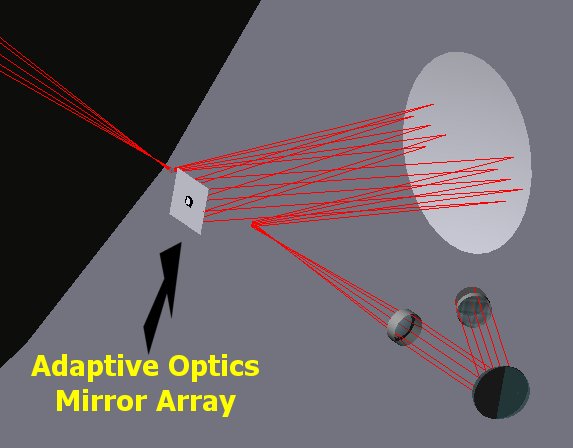
  • Adaptive optics are widely used in astronomy, laser communication, and other applications where the distortions of the atmosphere must by dynamically compensated. A future application could be the laser power beaming systems for the space elevator.

And even carbon nanotubes have an optical side - a recent report indicates that under some conditions, single-walled carbon nanotubes can emit very bright and tunable (1-2 micrometer wavelengths) infrared light.

Tuesday, November 22, 2005

h2g2

After mentioning the Hitchhiker's Guide to the Galaxy in my last post and linking it to Wikipedia as I often do, I happened upon a link to another "wiki" which is called h2g2 (one of the several extant abbreviations of Douglas Adams' best-known title). This one is hosted by the BBC and purports to be "the unconventional Guide to Life, the Universe and Everything," with user posts on a variety of subjects. The difference from the rawther serious Wikipedia is what seems to be a certain humorous or sarcastic spin to many of the entries (based on quick visits to a few pages). See for example cockpit, flight simulators, and Obstacles to Manned Space Exploration: Part I - Propulsion (including the sub-section "solutions to getting it up"), and Exactly 100 things to do with a towel.

Even better duct tape?

I really like Wired magazine, and in the December 2005 issue, there's an essay by Bruce Sterling on the Dawn of the Carbon Age. I've been reading and writing a lot about space elevators, whose now-more-likely feasibility is based on the remarkable strength and light weight of carbon nanotubes (CNT). Sterling does mention space elevators in his essay, but suggests (gasp!) that a material strong and light enough to create carbon beanstalks into space might have a few other uses down here. Of course that's true, and the fact that there will be huge demand for CNT-based materials will help to make them cheaper, which will be a good thing when you need to buy a 100,000 km ribbon of the stuff for the elevator. Thus begins the Age of Carbon. Future readers of the Hitchhiker's Guide to the Galaxy will no doubt be advised to carry a roll of CNT duct tape in addition to the indispensible towel.

Monday, November 21, 2005

SpaceDev - Chasing the Dream

Although it looks a bit like a cartoon spaceship, SpaceDev's lifting-body Dream Chaser is an intriguing alternative to capsule-style CEV spacecraft for "safe and affordable crew access to the International Space Station" and other missions. It also looks rather like the proposed (never built) European Hermes spaceplane. Note that the picture here is linked from the SpaceDev site - Dream Chaser is not in Orbiter quite yet (there is an Orbiter add-on version of the Hermes somewhere, but I can't find it online at the moment - OK, here is a lunar mission version!).

Now just a few days later, SpaceDev also announces the results of a study that "Finds Lunar Missions Can Be Completed for Less Than $10 Billion." In the proposed SpaceDev architecture, each mission would position a habitat module in lunar orbit or on the surface, allowing the buildup of some reusable infrastructure for later use. There is also a wild looking lunar-landing rocket chair that looks like a souped-up ejection seat (I guess it more or less is!).

An interesting week - SpaceX plans to launch their first Falcon 1 rocket this Friday. There's a lot going on in commercial space development. Will it all get funded? Will it all work? Probably not. But some of it will. Space is turning into a business with multiple paths and players. It's very dream-worthy in any case. Orbiter add-on builders, start your 3D modelers!

Orbiter Movie: "Stargazer

There's a really cool 5-minute video by "Tinfish" that showcases some aspects of Orbiter in a rather artful way. "Stargazer"(26 MB wmv) uses scenes of the Moon, Earth, Jupiter, and some spacecraft, and has a soundtrack with some interesting audio clips. I have seen a few other Orbiter-based videos, but this one really highlights the visual beauty that greatly adds to Orbiter's appeal as a space flight simulator. Tinfish has previously made movies based on Microsoft Flight Simulator (more info here). This is his first using Orbiter, and I hope he makes more.

Sunday, November 20, 2005

A quote from "Green Mars"

And because we are alive, the universe must be said to be alive. We are its consciousness as well as our own. We rise out of the cosmos and we see its mesh of patterns, and it strikes us as beautiful. And that feeling is the most important thing in all the universe - its culmination, like the color of the flower at first bloom on a wet morning. It's a holy feeling, and our task in this world is to do everything we can to foster it. And one way to do that is to spread life everywhere. To aid it into existence where it was not before, as here on Mars.
From Green Mars by Kim Stanley Robinson, spoken by the character Hiroko, page 9 of the US paperback edition.

Orbiter Web: John Dunn's Apollo Tutorial

Apollo 10 LM-CSM Docked

I've decided to start writing brief overviews of some of the many Orbiter-related web sites that are out there. Orbiter is freeware and has no official support, but between the forums, the add-on sites, and the web sites of many individual Orbiter users, the total available support is really quite extensive.

John Dunn's Orbiter site is a case in point. It focuses with incredible detail on flying Apollo missions using the NASSP add-on. It includes historical background on the real activities of each of the 17 phases of a full Apollo mission, followed by detailed instructions for the Orbiter procedures, including many screen shots and at least one video (lunar descent, stream or download). Although I have not yet done a complete Apollo mission myself (only selected parts), I have read through John's tutorial and used it as a reference to understand the "why" as well as the "how" of the many Apollo mission steps. It's quite an impressive document.

The tutorial dates from 2003 and thus is based on earlier versions of Orbiter and NASSP (Orbiter 030303 and NASSP4, while current versions are 050216 and NASSP 6.4.2), so there may be some changes in some details of how these missions are flown. For example, the tutorial refers to the Lunar Landing MFD (LM autopilot), and I have only used the more recent Land MFD when I have done practice Moon landings, so I'm not sure if the earlier MFD is still supplied or still works with the latest NASSP. But I have not found a more detailed tutorial on flying Apollo in Orbiter, and I believe it's worth reading if only to gain an appreciation of the scope and detail of these missions.

Speaking of impressive documents, John's site also includes a page with downloads of many official publications from the Apollo era, including the 56 MB PDF "NASA Apollo Command Module News Reference" from 1968.

The picture is my own shot from a recent Apollo 10 flight - just some lunar orbit docking practice. But someday I will fly a complete Apollo mission, and John's tutorial is already in a three-ring binder ready to guide me through the zillion steps to the Moon and back.

Saturday, November 19, 2005

World of 2001 for Orbiter!!!

Moon Bus and TMA

2001 v3 Orion Station V

Amazing new add-on just announced in the Orbiter Add-on Forum, World of 2001 (3.0) by Sputnik, Nautilus, and 80mileshigh. A complete rework for Orbiter 2005 with lots of new stuff. Amazing work! Dozens of scenarios, spacecraft, and bases from the classic movie "2001: A Space Odyssey." This was already my favorite family of SF-based add-ons, but the various parts had been built for earlier versions of Orbiter and sometimes caused problems. There is even an animated retracting dome at Clavius base. More pictures on Flickr.

ESPACE Magazine - Formidable!

I'm glad I've retained a moderate level of French language skills for all the many years since high school. In France, it's good for a laugh and sometimes even for conversation. And my reading level is still quite good, so I can generally read anything that interests me.

Case in point: brand-new issue of ESPACE Magazine that I picked up at the airport just before leaving Paris. This (#17) is a special edition with the theme "space exploration, the future in pictures." And the pictures are great - it's a large format glossy magazine with excellent full-color printing. There are many paintings and photos, starting with Chesley Bonestell's wonderful space paintings of the 1950's (discussed in my October 25 post on the "World of Colliers" add-on for Orbiter), many NASA concept paintings (including examples by and an interview with artist Pat Rawlings), and much more. There are also interviews with American and French astronauts and space researchers.

It's really cool. If you are a space enthusiast in France, you probably know this magazine. But why don't we have something like this in English? I haven't seen any in the US anyway - Britain?

Friday, November 18, 2005

Blogger's block?

I don't know how real teachers do it. After a few full days of teaching a software seminar here in Paris, my brain is fried, and I barely have the energy to deal with email let alone blog. Could jet lag and Beaujolais contribute to this effect? Perhaps a little.

In the meantime, the roll of space bloggers that I added to my site continues to grow, with many interesting entries (automatically generated, no energy required from me). With RSS feeds and Foxfire's "live bookmarks" it's easy to keep an eye on what's new. I really enjoy the enthusiastic posts of Sector 4 Command, the humor of some recent posts at Bad Astronomy Blog, and several others that help me keep up with space news. And although it's too eclectic to call a space blog, Anthonares is always thought-provoking and a good read. A continuing favorite.

For Orbiter fans looking for something new and fun to do, I'd suggest a look around Virtual Spaceflight. There are some really good scenarios and tutorials over at Andy's site.

Tuesday, November 15, 2005

Moon & Mars & Montmartre

Moon Over Montmartre
From my eighth floor seminar classroom in Paris, November 14, looking east, 1700 UTC, the Moon in light haze above Montmartre. But what is that reddish blur to the left and below the Moon? Could it be Mars? It's usually over my neighbor's house...
Moon and Mars from Earth 11-14-05 1700 UTC JPL SSS
JPL's Solar System Simulator page is the quick way to check. Enter the date and time, "Mars seen from Earth," 20 degree field of view, et voila. Yes that was Mars, 72.668 million kilometers away (Sacré Cœur was about 3 km). Click the pictures for bigger versions available on Flickr.