Saturday, May 06, 2006

Go Play In Space, Second Edition

Go Play In Space (2d Ed.)
Just a note to say that the revised and expanded version of Go Play In Space was released on May 4 when Orbiter 2006 was released. As I've mentioned in other recent posts, I've been working on this for a while, with help from new co-author Andy McSorley who provided a great tutorial chapter on using IMFD to go from Earth to Mars. I also added a new chapter on rendezvous and docking, updated the chapter on add-ons, added an appendix on how to use the new Scenario Editor, and upgraded everything for the 2006 version, including new screen shots. It was a lot of work but I was happy to fix up some things that bothered me about the first edition, and to add some new material.

This free ebook is suitable for ages 12 and up, though most emails I have gotten about the first edition were from much older "space kids" - so maybe I should say for kids of all ages. If you have an interest in space flight but don't know much about it, this book will lead you through the basics fairly painlessly (though I can't deny that there's a lot of detail to follow and learn). Even if you know quite a bit about space flight and Orbiter, you may find something of interest in the hands-on tutorial chapters or in the various background chapters. The new edition is 181 pages - lest this scare you away, note that the flight tutorial chapters are 14-22 pages each, and there is a 1-2 page checklist summary at the end of each flight chapter for quick reference while flying (the exception is Andy's Mars chapter, which is more of a checklist style anyway and doesn't have the summary checklist at the end).

One thing that's great with Orbiter 2006 is that I was able to provide annotated tutorial flight recordings for some of the chapters (chapter 2 intro mission, chapter 4 Moon flight, and chapter 5 rendezvous/dock). These are included with Orbiter and can show you visually how it's done. Like seeing the movie before reading the book (sort of).

Thursday, May 04, 2006

New Orbiter!

I haven’t written too much about Orbiter the last few weeks, partly because I’ve been busy, but mostly because I’ve been on the beta testing team for the new Orbiter 2006 version. This was so I could get a head start on revising Go Play In Space for the new version (that’s one of the things I’ve been busy with). There was a lot of interesting stuff going on, but I couldn’t write about the in-work beta versions.

But today I can, because Orbiter 2006 has been released. The second edition of Go Play In Space is also done and is available on new co-author Andy McSorley’s Virtual Space Flight web site, and also in the Orbiter wing of MiGMan’s Flight Sim Museum. MiGMan is also hosting most of the new Orbiter files as one of several mirror sites (thanks, Pete - if new files are not there for download, they will be soon).

Orbiter 2006 has some great new features, including support for high resolution level-10 planetary surface textures, improved physics modeling, “visual helpers” that dynamically show the forces acting on your spacecraft, and enhanced lighting effects (spacecraft can now enter a planet's shadow). But my favorite new features are in the usability department. The no-panel “glass cockpit” view now has buttons for all the basic controls, so you can fly no-panel add-on ships without remembering dozens of key commands. The Scenario Editor is amazing – you can change virtually anything about a scenario as it’s running, visually and interactively. You can even add new ships, position and orient them as desired, then click the Save button and you’ve got a new scenario. Set up specific orbital elements, formations, docked ships, etc.

Another great feature is the flight recorder – it records the states of all your ships so you can play back the flight and see it from any viewpoint. It even records time compression to allow long flights to be saved without generating huge recording files. Recorded flight files can be edited to add text that plays back with the scenario, providing explanatory commentary or training notes – great for tutorials. The new release includes several of these annotated tutorial playbacks (a couple by me). Playbacks are not “videos” – they are actually running in Orbiter, so just open the playback control, press the STOP button – and you are flying the spacecraft.

I will be adding some more pictures from the 2006 version to my Flickr site in the days to come, and also writing about some cool things you can do in the new version. It’s a big improvement on an already excellent space flight simulator. And still free.

N.B. One good thing is that with few exceptions, add-ons that worked well with Orbiter 2005 will still work well in the 2006 version, including DanSteph’s essential Orbiter Sound 3.0.

Sunday, April 30, 2006

Revisioning the Vision

CEV-LSAM Approach on Moon
I’ve been busy with work and with doing space stuff in Orbiter. On the Orbiter side, I’ve been finishing the second edition of Go Play In Space (and beta testing the upcoming 2006 release of Orbiter in connection with this), and working with a team on an Orbiter simulation of the MarsDrive Consortium’s Mars for Less reference mission. Mars for Less has been developed by Grant Bonin as a modular variation of Dr. Robert Zubrin’s well-known Mars Direct approach, and Grant will be presenting a paper on the mission design this coming week at ISDC 2006 in Los Angeles.

Wrapped up in real work and virtual space, I missed a big story on the real side of space, and I’m grateful to Grant for pointing this out. On March 15, Dr. John Marburger, Director of the White House Office of Science and Technology Policy (OSTP) gave a major speech at the 44th Robert H. Goddard Memorial Symposium in Greenbelt, Maryland. In it, he revisited President Bush’s 2004 Vision for Space Exploration (VSE), and spelled out more clearly that a major question answered by VSE is “whether we want to incorporate the Solar System in our economic sphere, or not.”

The VSE’s answer is “yes,” and Dr. Marburger goes on to justify the focus on the Moon as a crucial step, because it and its resources are fairly close at hand, and more importantly, lie far from the bottom of Earth’s deep gravity well. And “resources” are key, because he also talks about how our space program must be made to serve the goals of scientific, security, and economic interests. It is not only about science, although that is part of it, it’s about making space serve the interests of the people of the US, and mankind in general. It’s a long-run view that is really quite progressive, even (dare I say) visionary. It does put Mars on a distant back burner, which is disappointing but also unfortunately realistic from the perspective of an economic return – I’m all for someone going to Mars as soon as they can, but Mars is quite far away and getting there will require solving many more problems than getting back to the Moon (maybe someone will solve those problems before NASA gets to them).

The speech also puts into perspective the reductions in NASA’s budget for science programs – for one thing, I was surprised to learn that due to unexpected successes in the lifetimes of many spacecraft (e.g., the Mars Rovers), that the US currently has 55 viable spacecraft requiring operations support. There are also relative increases for certain non-space science areas important to US competitiveness (DOE, NSF, NIST). These factors (in addition to continued support for the ISS and Shuttle, and development of next generation manned spacecraft) certainly put pressure on NASA’s budget, and a 3% increase just can’t cover everything. Should NASA have gotten more? In part this is a ROI question – would the American people get a good return by investing more in NASA? I don’t know, but the 3% and this speech certainly show the Administration’s opinion.

There is more to it – it’s a good speech. Such a speech from the OSTP director could be seen simply as one of the President’s men defending the President’s policies, and at one level, it is. But at another level, it makes the case that the VSE really is visionary, setting the stage for making the Solar System part of our practical world. Whether NASA will be able to pull it off, and whether future administrations will support its goals, I don’t know. But it goes far beyond footprints and flags and is extremely space-positive. I rarely give him credit for much, but I do have to give the President credit for pointing us in a spacefaring direction.

There was also an interesting analysis of this speech by Dennis Wingo on Saturday in SpaceRef.com.

Saturday, April 29, 2006

Remedial Astronomy

I've got something really cool in my back yard... THE UNIVERSE! Despite all the time I spend "playing in space" with Orbiter on my computer, I sometimes forget that real, actual space is just a few hundred kilometers on up to several billion light years, right above my back deck! Pretty amazing, huh?

I know a a fair amount about physics, planetary motion, the properties of stars and galaxies. All of that book and software astronomy and space flight stuff. But I must confess that when it comes to actually knowing my way around the sky, I'm pretty dim. I know the most common markers - Orion and the Big Dipper (an asterism rather than a constellation, BTW), and I can recognize the planets when I know (from the web) when and where to look. But beyond that, I really know very little observational astronomy.

So when I stumbled on The Backyard Stargazer by Pat Price, I bought it, even though I already have a few amateur astronomy books. This 167 page book is really basic, and sad to say, I need that! It's full of good explanations, diagrams, rules of thumb (2.5°) that I sort of knew, and even a table of pronunciations so I finally know how to say Boötes (bo-OH-teez). It has sections on binoculars and telescopes but focuses more on naked-eye astronomy, which is what I really need to improve. On clear nights this spring and summer, I plan to spend some time in the back yard, getting to know my universe better with the help of this book.

Monday, April 24, 2006

Pioneers Get No Respect

Ira and George Gershwin wrote a great song called They All Laughed which starts out
They all laughed at Christopher Columbus
When he said the world was round
They all laughed when Edison recorded sound
They all laughed at Wilbur and his brother
When they said that man could fly...
The New York Times also laughed at Robert Goddard in 1920 for his crazy belief that rockets could work in the vacuum of space. And of course they're still laughing at space pioneers today, as discussed by Bob Clarebrough in a great essay called "That Kitty Hawk moment" at The Space Review. Pioneers get no respect.

And they probably won't get any respect until tourists are complaining about how slow the robot room service is in their hotel room on Mars (actually no one will think about space pioneers then, any more than most people think about the Wrights while eating a tiny bag of pretzels in a coach seat en route to Newark). But as Clarebrough suggests, let's at least cut the pioneers a little slack.

Sunday, April 23, 2006

Deepstar Interplanetary Ship 2071

Deepstar 2071 at Io Deepstar Lander Io 2071
I've been looking at Orbiter interplanetary add-on ships that carry landing craft. There are a few of them around, and I want to recommend one for a follow-up activity for the Earth-Mars chapter in the new edition of Go Play In Space. In that chapter, the standard Delta Glider is used, which makes things easy because it's a futuristic (though still physically realistic) spaceplane that has the range and power to get to Mars, as well as hover engines to make it (relatively) easy to land. It doesn't really matter in a simulator, but the fact that the Delta Glider has about the same interior space as a minivan hurts the realism just a bit for a six month flight.

Near-future Mars spacecraft such as Mars Direct and Mars for Less are in the pipeline for Orbiter, but for now, I thought I'd look a few more years ahead, to the late part of the century. There are some add-on ships around that implement exotic but possible propulsion systems, provide large crew spaces (often rotated for artificial G), and can carry one or more smaller craft (such as the Delta Glider) for surface operations.

I had been planning to recommend the Vespucci D (Nectioch, John McCain, and "Oz") which is a large spacecraft with rather exotic propulsion. This is a cool ship that can carry up to four Delta Gliders, but there is a bit of a procedural learning curve for using its power and propulsion systems. So I kept looking.

Today I tried out Deepstar 1.0, a rather nice recent add-on by Alain Hosking (80mileshigh), and this could be the answer. It's also a rather large ship with rotating hab compartments, and it carries two lunar module-like landing craft. These have hover engines, so the LandMFD autopilot can land them, at least on moons with minimal atmosphere such as Io (shown above). It seems to work quite well in local tests, and I see no reason it won't work well with IMFD (Alain supplies a large number of scenarios with tips for using TransX, perhaps the most commonly used interplanetary flight planning tool).

The only downside to the Deepstar (cool name) is that I'm not sure the LM-like landers are really suitable for Mars entry. They may work anyway (Orbiter doesn't really keep track of aero-heating, so you won't burn up), or maybe I can try substituting Delta Gliders for the standard landers. This could cause rotational stability problems though.

The quest continues... more pix on Flickr.

Thursday, April 20, 2006

Fast Food and Pornography

This summary is not available. Please click here to view the post.

Orbiter Add-on Riches

2001: Work Pod Betty with Discovery 2001: Aries at Clavius
I'm in the final few days of updating Go Play In Space for the expanded second edition - between work and that, I've had little time for blogging or anything else. The docking and Mars flight chapters have come out well. Thanks to Andy McSorley for all the Mars work, and to Terry Gibson and Mark Paton for testing preliminary versions of the two new chapters and making a lot of useful suggestions.

I'm now updating the add-ons chapter, and I'm realizing again what a wealth of amazing add-ons we have available for Orbiter. I've spent hundreds of hours on this ebook, but add-on developers must have spent thousands of hours developing the many available add-ons (some 1200 listed at www.orbithangar.com now - thanks also to Jeff aka x292 for his great work in creating and maintaining the primary library of Orbiter add-ons). Some add-ons are especially deep (and big!) such as World of 2001 (by Sputnik, 80mileshigh, and Nautilus) and David Bartles' 2001-2010 vehicles, both available at Orbit Hangar, with sample pix above. But there are a lot of great ones out there. Thanks to all the hard-working Orbiter add-on developers. More pix on Flickr.

Saturday, April 15, 2006

Wonderful Mars-Moon Web Site

Mars Approach 2033
I've been getting into another Mars phase recently. One reason for this is the new Earth-Mars chapter written by Andy McSorley for the new edition of Go Play In Space. I've been testing his Orbiter scenarios and instructions, and I'm finally starting to get a feel for what's involved in getting to Mars. It's relatively straightforward if you have a good planning tool like IMFD, a futuristic vehicle with huge (but still limited) delta-V capability, and extreme time acceleration for the long cruise phases. Real-life Mars missions are a little trickier.

The other thing is the Mars for Less (video clips now available there) mission approach developed by Grant Bonin for the MarsDrive Consortium (I've written about it previously). This is basically a variation on Mars Direct, restructured for use of multiple payloads launched with existing (or slightly modified) medium-lift launch vehicles, and with some specific ideas related to on-orbit assembly of the complete Mars vehicles. I'm working with Andy McSorley and Mark Paton to develop an add-on to simulate this mission in Orbiter.

I've therefore been looking for Mars references to support these two little projects. There is certainly no shortage of information on the web, from NASA, ESA, the Mars Society, and many other sources. A veritable confusion of data! But I recently found a "meta-site" that is really wonderful. It summarizes the issues and organizes the technical information in a series of clear and detailed PDF files on many issues of getting people to Mars (and back to the Moon). These papers are directly useful but also point to the various NASA studies and technical papers, making it easier to find the most useful and important original sources.

The simply named Mars and Moon Website is the personal site of Dr. Donald Rapp, an engineer and scientist who has worked for or with JPL for many years. This man knows a lot about planning Mars missions, trade-offs, ISRU, and much more. Dr. Rapp also has a number of "editorial" articles on his site, in which he gives his own views on various space issues. We're not talking about blog posts here - his opinions are backed by experience and technical data. His depressingly-titled February 2006 editorial "Why NASA is not going to be able to send humans to Mars this side of 2040 and probably 2080" (813 kb PDF) is 39 pages! We better look at some other options (this is MDC's goal).

Thanks to Dr. Rapp for making this resource available on the web.

Friday, April 14, 2006

Mars Sample Return Design Contest

MarsDrive Consortium (MDC, of which I am a member) has announced a Mars sample return mission design contest. The contest requires the design of an unmanned mission that would (1) place a scientific payload on the surface of Mars, (2) collect geological and astrobiological samples, and (3) use local Martian resources to produce propellent (methane, LOX) sufficient to allow the collected samples to leave the surface and return to Earth orbit.

Abstract submission is summer 2006, with design submission in fall 2006, and announcement of winners in winter 2007. A distinguished panel of experts will be involved in evaluating and selecting from the submissions, including Dr. Chris McKay (Planetary Scientist, NASA Ames Research Center), Dr. Robert Zubrin (President, The Mars Society), and Louis Friedman (Executive Director, The Planetary Society). Prizes will include cash and an expense-paid trip to the ISDC 2007 conference.

I think this is a great way to promote interest in a Mars sample return mission and to raise awareness and promote research on in-situ resource utilization (ISRU) for the production of sample-return fuel and oxidizer. ISRU is a key component in learning to "live off the land" as will be required in future manned missions to Mars.

Monday, April 10, 2006

The Truth Machine?

I year or so ago I read a couple of SF books by James Halperin. One was called The First Immortal, which is about radical life extension, and I liked it a lot. The other was The Truth Machine, and while it had a lot of intriguing ideas, it was not as well written as it could have been, and I never really bought its premise. It was about a near future world in which no one can lie, because a reliable technology for lie detection has been developed and widely deployed. It mostly explores the social changes that such a technology might lead to (think how this would transform politics!).

My problem with the premise is that lying seems to be a matter of degree. While most people know when they are lying, some don't, and then there is the matter of white lies. Is an insincere compliment a lie or is it something else? Does the context or motivation matter? There are many other issues, of course, and I just couldn't see how truth-telling could really be quantified.

But today I happened to read an article in the January 2006 issue of Wired magazine, "Don't Even Think About Lying." This concerns research and two imminent products based on fMRI brain scans. It seems that lying and truth-telling will "light up" different regions of the brain in distinctive ways, and that these patterns can now be detected. Of course the subject has to be in an expensive, noisy, coffin-like MRI machine, so it isn't exactly an unobtrusive technology. But it apparently works, raising a host of new social, ethical, and legal questions, even before the likely future development into a more "user friendly" interface (wearable or even wireless brain scans?).

Very much like Halperin's The Truth Machine! I think I may have to revisit that book sometime. Truth is stranger than fiction. Lying too.

Sunday, April 09, 2006

20 Trips to Mars

Mars approach with IMFD Screens

The good news is that thanks to the miracle of time acceleration, I took twenty trips to Mars this weekend. The bad news is that thanks to the anti-miracle of "slow learning curve," I had to take those twenty trips to Mars. For example, I spent about 4 hours discovering that 100 meters does not equal 100 kilometers. It took me this long (and an email to Andy) to figure out that the reason I kept colliding with Mars was that I had defined my orbital insertion periapsis to be 100 meters, omitting a crucial "k" in my input. The "bug" seemed familiar -- because I had done the same thing last fall when I was first learning IMFD. Mars is so unforgiving - and computers are too.

These are virtual trips in Orbiter, of course, working with Andy McSorley on the final chapter of Go Play In Space (Second Edition), for which he has been handling the Mars beat. I chimed in to try to find a better arrival date and time in October 2033 that will give us some daylight and a small orbital inclination that the Land MFD autopilot can land from (it doesn't like polar orbit approaches). I didn't do much better than what Andy started with, but at least I tested his procedures (a lot). I can see now why JPL has more than one or two people doing this stuff.

Interplanetary MFD (IMFD) is a wonderful "FMC" (flight management computer in aviation parlance) that handles general flight planning and can perform programmed engine burns automatically. The Land MFD (zip file) is an auto-lander intended mainly for bodies with no atmosphere (such as the Moon), but it works OK on Mars too, as long as you give it a decent orbit to start from.

Monday, April 03, 2006

Swift, Voltaire, and Saxifrage Russell

Green Mars Deimos Approach 2
Swift and Voltaire are the two largest craters on Deimos, the potato-shaped outer moon of Mars (its mean diameter is only about 13 km). Saxifrage Russell is one of the "first hundred" settlers on Mars in Kim Stanley Robinson's Mars Trilogy. More about the connection after a little background...

After starting it and getting interrupted some months ago, I just finished reading the second book in the trilogy, Green Mars, on my long flights to and from Taiwan. It's a powerful epic of terraforming, politics, social science, war & peace, geology, engineering, life extension, culture, psychology, biology, and just about anything else involving human beings. It's simply amazing that Robinson could have created a future world that is so richly imagined, so tangible and so detailed. Wonderful stuff.

Without giving away too much of the plot, I can say that in the period of this book (from the late twenty-first century until around the 2120's), Mars has been extensively terraformed, and it already supports a large human population. There is conflict set against the backdrop of powerful "metanational" companies who control much of crisis-gripped Earth, and who wish to hold on to Mars as well. Meanwhile a variety of factions on Mars struggle with this and with many other problems, and a movement for Mars independence grows.

Sax Russell is an amazingly brilliant and versatile scientist, the head of the initial terraforming actions in Red Mars (starting in 2026), and a dominant character with several roles in Green Mars. Late in the book, he is working hard to prepare defenses against the metanationals in the likely event of armed conflict. One thing he decides to do is to eliminate Deimos as a potential space weapons platform (a role served by Phobos in the first book, to disastrous end). In part 8 of Green Mars, Sax and his people land on Deimos in a number of space planes. They install robotic equipment that will construct the infrastructure needed to relocate Deimos to a safe distance. A pretty wild plan (read the book for more).

The picture above is from a scenario I set up in Orbiter to illustrate this scene from the book. I reinstalled the Green Mars planetary textures (by "Schimz," available at avsim.com) and placed a few Delta Glider space planes on close approach to Deimos. In the scene in the book, Sax lands near Swift Crater, and the experience of walking on the surface under extremely light gravity (about 0.04% of Earth G) is described. This is a tiny but fascinating episode in the epic of Green Mars.

N.B. KSR points out that the craters are called Swift and Voltaire because both men predicted that Mars would have moons, a century before any were observed. Swift even predicted that there would be two Martian moons, apparently based on a supposed sequence. Venus has no moons, Earth has one, and Jupiter four (as known at the time). The sequence 0, 1, 2, 4 has a certain appeal, so Mars was assumed to have two moons.

Friday, March 31, 2006

Jupiter Blues

Io Close-Up with New L8 Jupiter

Wow, this Taiwan trip was some time slip! A very busy week of business in Taipei, Hsinchu, Taichung, and a couple of universities. It went by fast. No time for blogging until now as I procrastinate on packing and going to bed before heading home in a few hours. Another 24 hour trip which takes place in the same calendar day but doesn't quite buy back the time I lost at the International Date Line last weekend. A la recherche du temps perdu. Oh well.

I did take a look at Orbit Hangar for the latest Orbiter add-ons and found an excellent new high-res texture for Jupiter (level 8, 13 MB zip file) by "Schimz," based on Cassini imagery. I really like the the detail and the blue regions. The picture shows Io in the foreground. Looks like a JPL image, but it's a screen shot from Orbiter.

Sunday, March 26, 2006

Taiwan Time Slip

In Kim Stanley Robinson's Red Mars, there is the idea of the Martian time slip, a 39.5 minute period between midnight and 12:01 that "stops the clock" each night to allow practical use of an Earth-like 24 hour clock despite Mars' slightly longer rotational period. After a 32-hour door-to-door journey from Boston to Taipei (including ground transport and layovers in San Francisco and Nagoya), I feel like I have experienced such a time gap. On the 11+ hour flight leg from SFO to NGO, I slept for several long blocks, waking up for short periods to check the flight map and read for a while, never quite sure what time it was, since there were four time zones in play (EST, PST, Japan, and Taiwan). Usually I try to follow a jet lag regimen in which I mentally switch to destination time, and sleep or rest only when it's night time at my destination. But this time I just let the time flow and slept when I was tired. I still slept a full melatonin-assisted first night in Taiwan, so I guess it's working out. I'll know by tonight I suppose.

One thing I miss on these long Pacific flights is Orbiter's time acceleration feature. Press the T key and speed up the clock by ten times. Doesn't work in the real world, alas, so I wonder if I'm really cut out for a Mars journey. Not that this is an imminent possibility, probably not at all unless the life extension thing kicks in pretty hard and soon. Andy McSorley has been working on the Earth-Mars chapter for the new edition of Go Play In Space (he thought he was done until I suggested looking into some promising future launch window dates in 2014 and 2033 - sorry Andy!). Depending on the dates and the delta-V you're willing to spend, a Mars flight can take from three to seven months. I hope I can get a business class upgrade for that flight!

The picture is only vaguely related, a new Orbiter add-on called Mars Hourglass Crater Base by "peaceman." This is a futuristic Mars base with some great 3D terrain based on NASA MOLA and ESA Mars Express data. The hills look especially realistic. I downloaded but no time to try it so far (real work to do here in Taiwan). Mars is getting to be a cool destination - in Orbiter at least!

Thursday, March 23, 2006

And America Will Have a Lot of Faith

Yesterday I was in the waiting room of dentist’s office, waiting for my daughter. A young man was standing in the office area nearby, having a discussion with the receptionist regarding the origin and age of the universe (which I couldn’t help but overhear). I later learned that the young man was the dentist’s son, a college student home on spring break, and a math-physics major. The woman was pretty clearly a Christian who believes in the literal truth of the Bible as far as the creation and age of the Earth and the universe.

The physics student was making some pretty good points about observation, evidence, the scientific method, and so on, but the woman was not buying any of it. She said that there were obviously “various theories – like the Big Bang, evolution, and so on, but there really is no proof,” and for her, the explanations of the Bible (seven days of creation, direct creation of humans by God, 6000 year old Earth, etc.) were perfectly convincing. She admitted that she didn’t know much about the “various scientific theories” but this didn’t bother her since these were just a few of many possibilities anyway. When asked what proof there was for the Bible’s version of events, she said, well the Bible of course, and pointed to her heart to add, “but all the evidence I need is right here.”

This was none of my business, of course, and I didn’t say anything, though I really wanted to tell the physics student to save his breath, as it was clearly a physics vs. faith discussion, and faith wasn’t going to budge. They would have to agree to disagree at best. But it made me wonder about a couple of things, and especially why these sorts of discussions seem to always focus on the origin and age of the universe and on the origin of humans. Of course this is because these are pretty much the fundamental questions, but since no one was around to directly observe the key events, and because the scientific view is based on a chain of observation-based reasoning, these basic questions are difficult or impossible to resolve in such discussions or debates. The basic assumptions are just too different.

You could even argue that the scientific view itself contains elements of faith – faith in the importance and validity of the scientific method, belief that observations that can be independently corroborated by different observers are better than results obtained by assertion and literary analysis, and so forth. I suppose it is also faith to believe that physical phenomena must have physical explanations, and that physics is a better description of what we see around us than magic. I see these more as “working assumptions” than as elements of faith, and these working assumptions have served us well in terms of understanding (science) and controlling (technology) many aspects of nature. But faith also has its fans.

So what to do? Give up? That would probably have been the best thing in this case. But in general, I would like to see such a discussion steered to a more immediate level. True, no one was around to see the Big Bang, and we infer that it happened through a lot of rather technical steps. Many people have reproduced these steps, and scientifically educated people agree that they make sense, but it is still an indirect argument. The same with evolution – true, “we have the fossils,” but Biblical “young Earth” advocates and creationists have alternate explanations (e.g., Matt Bors’ revised science textbooks for Christians), however far-fetched these may seem to the scientifically minded. Again it is difficult to reach common ground when the basic assumptions are just so different.

I would ask instead, do you believe your TV works? The satellite TV receiver on your roof? Your cell phone? The cells in your body? Do you believe that airplanes fly? Do you believe that bacteria become resistant to antibiotics? Physics and the sciences that derive from physics – chemistry, biology, and all the rest – can explain these things, and you can observe the results. Engineering, biotechnology, medicine, agriculture, and much more, all depend on the results of science, and on the scientific method, and we rely on these technologies for our very survival in the modern world.

You could go into detailed explanations of these things, but I won’t do that here. The point is that science works, and that we accept and rely upon many things that result from our understanding and application of science. If you want to believe that science only works here on Earth (and not in distant stars and galaxies), and only now (not thousands or millions or billions of years ago), then you can believe that God is pulling the wool over our eyes to make it look like galaxies are billions of light years away and moving as if expanding from the Big Bang, and to appear that fossils are tens of thousands or millions of years old. I can’t see why he would bother to fool us in this way, but if you want to believe that, OK. The good news is that you don’t have to believe in or understand science to enjoy its benefits. The bad news is that people who don’t understand and accept science are more likely to have children who don’t understand and accept science. That’s OK too as long as you don’t mind the likelihood that most of our future scientists and engineers will be in China, India, Korea, and other Asian countries. And America will have a lot of faith.

Wednesday, March 22, 2006

Getting to Mars with PDF Propellent

What's the ISP of PDF? Unfortunately, PDF isn't actually a propellent, it's a publication format. Too bad, because there is a lot of it floating around the web. This bizarre thought was triggered by yet another "humans to Mars" study that I hadn't seen before, this one by the European Space Agency (thanks for the link, Andy). It's quite an interesting study. Here's a link to it, and a few more you might find interesting. Of course a Google search will turn up even more, and if you want to keep your search within NASA sites, you can always add the qualifier site:nasa.gov to your Google search string. All links below are PDF files.

Sunday, March 19, 2006

Mind Bogglingly Funny

When I noticed I had used the phrase "space is big" in my last post, I decided to link that phrase to the famous Douglas Adams quote about how big space really is. So I did. But then I had a look at the other 22 Douglas Adams quotes on that same site, and they are really, really funny. So I decided to point this out. And now I have. I'm sure there are dozens of others on other quotation sites, not to mention his books. Adams was quite the amusing guy.

The Thrill of the (Orbital) Chase

Dock DG ISS HUD boxes VC
I'm working on an expanded second edition of my free tutorial book for Orbiter, Go Play In Space. This time I've signed up Andy McSorley as a co-author, and he has written a nice new chapter to guide our readers through a journey to Mars (with the help of Jarmo Nikkanen's Interplanetary MFD add-on). Meanwhile I'm working on another new chapter called "Dancing in the Dark" - a chapter title borrowed from Wayne Lee's book To Rise From Earth. The subject is rendezvous (which is called orbit synchronization in the Orbiter documention) and docking, one of the most satisfying tasks you can do in Orbiter. It can also be one of the most frustrating tasks for new users to learn, so I'm trying to do a good job of explaining how it works in this new chapter, including several diagrams inspired by Wayne Lee's book.

Like much of space flight, rendezvous and docking is largely a matter of timing, of literally being in the right place at the right time. Space is big and finding your way to the relatively tiny International Space Station in all that darkness can be tricky, even though Orbiter provides several excellent tools to guide your way there. Two important tips are precision and patience. Small residuals can add up to big miss errors over several orbits, and trying to rush your approach often leaves you hopelessly misaligned. Unlike the real shuttle astronauts who will spend several days and dozens of orbits to reach the ISS with minimal fuel use, Orbiter's futuristic "Delta Glider" lets you make relatively large and frequent "burns" as needed, and time acceleration lets you speed over the "boring" parts at 10-1000 times real time. More pix on Flickr.

Wednesday, March 15, 2006

The Case for Space Exploration

I just downloaded a new publication, The Case for Space Exploration (2 MB PDF) from the Space Foundation. Subtitled "Failure is not an option," it's a collection of essays and research findings by a number of authors on the importance of space exploration. It covers technological, educational, and economic factors and even includes a supportive essay by Neil Armstrong. I haven't read it yet, but it looks like an excellent and well produced resource. Here is a quote from the March 1 press release announcing the publication:
The Space Foundation produced The Case for Space Exploration because it strongly believes that a robust program of space exploration has been and will continue to be vital in sustaining the United States’ economic and national security, driving innovation, and motivating pursuit of and excellence in science, technology, engineering, and math (STEM).
I certainly agree with that statement! I'm looking forward to reading this document and to exploring other educational resources on the Space Foundation's web site.

Tuesday, March 14, 2006

California Dreamin'

I'm in Pasadena, California on a business trip, including a two day class at the Caltech Industrial Relations Center on doing business with India, an important subject for my international distribution manager responsibilities. Caltech has a great campus, and I really enjoy the fact that when eating lunch at the Athenaeum (Caltech Faculty Club), that I am dining in a room where Millikan, Michelson, and Einstein, and of course Richard Feynman, had also dined.

Caltech also operates nearby JPL for NASA, so space geek that I am, I wandered over to the Caltech bookstore in hopes of finding... some sort of space geek stuff, I guess. Lots of books, nothing really special that I don't already have (yikes). So I check out the apparel. Caltech T's and sweats... nah. NASA T's and sweats with a giant NASA logo on the back... nah. JPL T's and sweats, not really rocking my world. Then I saw it - in the total geek section of shirts with Maxwell's equations and DNA diagrams - a Caltech t-shirt that says "Actually, I am a rocket scientist." I was walking to the cash register when I realized the scorn I would have to endure from my daughter if I ever actually wore this shirt. I put it back. Now it can be told: I'm a wimp and a geek.

P.S. As I was grabbing JPL's web link, I noticed a new item (March 13) there, a still frame from a simulated fly through video of Valles Marineris, assembled from hundreds of images from NASA's Mars Odyssey orbiter. It's really amazing! The picture above is a frame from the video that shows the Los Angeles Basin area inserted into Valles Marineris with room to spare.

Rocket Company DH-1: Still Rising

DH-1 Final Rising DH-1 Final Landed2
Mark Paton has released his "final" version of the DH-1 add-on for Orbiter, having added a virtual cockpit (using Vinka's latest spacecraft3.dll), more scenarios, more documentation (a nice PDF with operational details by Mark and a bit of background contributed by me), and more. It's really cool and it makes me wonder: why isn't someone doing something like this in real life? The landed pix with the astronaut give a good idea of the scale. This is not a tiny vehicle, and both stages are piloted and fully reusable.

Is this really the final story on the DH-1 for Orbiter? Rumors from the UK suggest that a programmer may be working on a custom DLL that could perhaps simplify the operation somewhat. Stay tuned...

Sunday, March 12, 2006

There's Your Trouble

In an excellent opinion piece in today's New York Times ("Defenders of the Faith"), Slavoj Zizek comments on the famous warning of Dostoyevsky (and many others) "that if God doesn't exist, then everything is permitted." He writes in response
This argument couldn't have been more wrong: the lesson of today's terrorism is that if God exists, then everything, including blowing up thousands of innocent bystanders, is permitted — at least to those who claim to act directly on behalf of God, since, clearly, a direct link to God justifies the violation of any merely human constraints and considerations. In short, fundamentalists have become no different than the "godless" Stalinist Communists, to whom everything was permitted since they perceived themselves as direct instruments of their divinity, the Historical Necessity of Progress Toward Communism.
In my opinion, this summarizes the basic problem with any religion that claims to have an exclusive line on what constitutes "God's will" or even what is supposed to be fundamentally right. You don't need any god's permission or approval or some promise of salvation to be good. You can perform a good deed, help your neighbor or a stranger, and live a moral life in general simply because it is the right thing to do. It's not rocket science.

By the way, the "defenders of the faith" to whom Zizek refers are atheists.

Friday, March 10, 2006

MRO - Final Approach to Mars

MRO Mars Approach at 7 am EST
The Mars Reconnaissance Orbiter (MRO) spacecraft is in its final approach to Mars today, and late this afternoon (4:24 pm Eastern time), it will perform an orbital insertion burn to enter an initial high-ecentricity orbit. Over the next 6-7 months, a series of some 500 aerobraking maneuvers will use drag from Mars' thin atmosphere to circularize the orbit to its operational state. You can learn more about MRO and its arrival and follow the JPL mission timeline here.

Thanks to Orbiter add-on developer Brian Jones and Orbiter Forum member "Peter3210," you can simulate the arrival of MRO yourself. Brian's MRO add-on is available at avsim.com (search for mro.zip), and Peter has posted a set of instructions and a starting scenario for simulating the mission from 7 am EST to the insertion burn.

I heard a pretty good report about MRO on NPR this morning (a rare and wondrous thing to hear a space story on the radio, though more likely on NPR than anywhere else). MRO has some amazing instruments on board, and if all goes well, it could return 10 times as much information about Mars over the next few years than all past Mars missions combined.

P.S. at 5:46 pm EST - I parked NASA TV on my tool bar for the last 90 minutes so I could half-watch the JPL control room as the spacecraft's signal was lost and reacquired, both right on time. Early telemetry shows that MRO is in its initial Mars orbit and is healthy. Very cool!

Tuesday, March 07, 2006

Space Plane Speculation

X-15 Delta XB-70 Launch
Aviation Week has an article about a supposed secret military "space plane" called Blackstar that may or may not be related to the supposed hypersonic Aurora reconaissance aircraft, and may or may not have been a manned military orbital test (or operational) vehicle in the 1980's and 1990's. It might have been launched from a supersonic carrier plane resembling the experimental Mach 3 XB-70 bomber of the 1960's. And as a colleague said, the author of this piece may or may not be vacationing in Guantanomo Bay and unreachable for comment. It might also have something to do with pulsed propulsion systems and strange strings of high-altitude clouds as discussed here.

Or not. I don't know. But I do know that the non-classified Orbiter add-on developer team of Greg Burch and Scott Conklin have developed something really cool that has nothing to do with this but looks an awful lot like the AWST artist conceptions (except it rides on top instead of underneath). Their "alternate history" X-15 Delta (developed from their earlier realistic X-15) is a very cool add-on for Orbiter, and it includes not only three versions of the delta-winged X-15 variant, but a new launch aircraft: the XB-70! I have only played briefly with this add-on, but it is another work of art in 3D and flight modeling as well as documentation. Download, install, fly, and take as many pictures as you want.

Monday, March 06, 2006

NASA Mission Reports (Starring John Young)

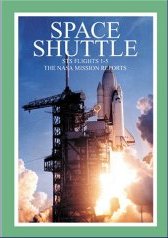
Apogee Books publishes the NASA Mission Reports, a series of books that collect various original mission documents from Apollo and other NASA programs. With all the NASA material available for free on the web, why would you buy these books? Well aside from the fact that I would never think to use the words "why buy books" in the same sentence, the answer is, books are still the best thing we have for casual browsing. But it was only very cheap sale table serendipity that led me to that conclusion the other day. Now I'm afraid my completeness obsession might start to kick in... MUST... NOT... CLICK.... AMAZON... TOOLBAR.... BUTTON....

Wow, that was close. I still have just the two books shown, and I can now easily read hundreds of pages of mission debrief interviews with John Young, from his Moon landing flight on Apollo 16 in April 1972, and his flight as commander of the first orbital mission of the space shuttle Columbia (STS-1) in April 1981 (they were the only two books in the series on the sale table, so the double dose of John Young was just by chance, and the Space Shuttle book actually covers the first five missions plus landing tests with the non-orbiting Enterprise, though STS-1 gets the most coverage). There are also mission timelines, press kits, photographs, diagrams, etc. There's a CD included with each book, with hundreds of pictures and movies. Really really cool stuff. Space geek heaven.

John Young had an amazing space career, by the way. He flew in all the NASA manned space programs except Mercury and Skylab - Gemini 3 (the first manned Gemini), Gemini 10, Apollo 10, Apollo 16 (that's right, two Moon missions, one orbital, one landing), as well as shuttle missions STS-1 and STS-9. What a job! Now I have to find the Descartes lunar scenery so I can fly Apollo 16 in Orbiter one of these days.

Sunday, March 05, 2006

Orbiter Web: Why Vinka Rules

Octopus Module using Spacecraft3.dll
Vinka's web site is deceptively simple, just a single page with a few download links. But it's arguably the engine that drives most of the large fleet of virtual spacecraft add-ons that are available for Orbiter. Vinka is the author of the spacecraft.dll and multistage.dll series of code modules for non-programming add-on builders. Using them, you can create spacecraft models that access many of the vehicle programming "hooks" that Martin Schweiger has made available in the Orbiter SDK (software developer kit). This is done by defining parameters in .ini files using a text editor - not always simple to get right, but no programming required.

Vinka's DLL's have long supported the basic behavior of spacecraft and aircraft, engines and thrusters (complete with customizable particle streams), and even animation of vehicle features such as landing gear and control surfaces. The latest version (spacecraft3.dll, compatible with spacecraft2.dll) has just been released, and it adds some really cool new features, including expanded aerodynamic parameters (with basic models based on the Delta Glider, Space Shuttle, and a "capsule" vehicle). It also extends animation to allow modeling of spacecraft with a user-controllable robot arm, as well as providing support for a basic virtual cockpit with slots for working MFD's and HUD!

The add-on builder is still required to create the 3D meshes and textures for everything and to define the needed parameters in the .ini files to tell the DLL what to do where and when. This remains an art in itself, but at least it removes the added requirement to be a C++ programmer. Amazing things can be built with this approach (e.g., X-15, DH-1, many more), and some have already been released that make use of the latest features such as the unusual OCTOPUS space station module by Papyref - it supports two robot arms!

In short: in the Orbiter add-on world, Vinka rules.

Friday, March 03, 2006

Cecil Is My Hero

I have loved the newspaper and web column The Straight Dope for many years. Cecil Adams (and his dedicated staff) tell it like it is on almost any sort of question, often with just the right sarcastic tone when questioners ask for it (I think some people write in hopes of being insulted by Cecil - or maybe they really are that dumb).

Today's Straight Dope email revisits a physics problem that circulates on the web as a trick question. It's the case of an airplane taking off on a conveyer belt runway. Very nice discussion of this here, now including the case of the continuously accelerating conveyer belt runway (very few of these in use up to now). As usual, Newton wins, with an assist from Cecil Adams.

Wednesday, March 01, 2006

Mars For Less

Over at MarsDrive Consortium is a fascinating document entitled MarsDrive Reference Mission: "Mars for Less" (1.9 MB PDF). It is a nicely explained and illustrated description of how a Mars Direct type manned Mars mission could be accomplished through the use of multiple launches with medium lift launch vehicles sooner and more cost-effectively than with heavy-lift launch vehicles.

While HLLV's are certainly desirable, their development time and costs are very high, meaning that they will probably not be available for many years, assuming their development survives the budget hurdles of multiple administrations and crises. There certainly are also challenges in assembling large Mars-bound systems in Earth orbit, but this paper explains that these are not insurmountable, and in some respects, on-orbit assembly represents the most well-tested aspect of manned Mars missions. And there are already MLLV's that can do the job, with more in development, so development delays and other problems with one launch vehicle do not necessarily lie in the critical path of the entire mission.

This paper was written by Grant Bonin based in part on earlier articles he published in the Journal of the British Interplanetary Society, Vol. 58, 2005, and The Space Review, January 2006.

Tuesday, February 28, 2006

Rocket (Company) Man

DH-1 in Orbit with EMU1
Mark Paton is continuing to develop the DH-1 add-on for Orbiter, and it's really cool. Based on the book The Rocket Company (discussed several times in this blog), Mark's third version can now simulate almost every aspect of the complex flight profile described in the book. He says that with enough fingers and attention to detail, you can launch the piloted DH-1 spacecraft to orbit and hover-land the piloted first stage back at KSC in the same session. You can later re-enter the orbital stage (if you were careful to save a little fuel) and land at KSC with the parasail. I've done most of the parts, but not all in one mission yet - working on it!

Mark still has a few things he wants to add, so expect a new release in a couple of weeks with some PDF documentation that I will be helping out with. I was the one who first got interested in a Rocket Company add-on for Orbiter (after author Patrick J. G. Stiennon saw my Space Review article on Orbiter and emailed me!), but lacking the skills to build it myself, I enlisted first Andy McSorley (prototype) and then Mark to help. Both have done amazing work.

The picture above is a little hack made by editing scenario files. Mark added a hatch to the orbital stage (a basic seat and joystick too), but it only opens in the landed configuration, so I had to trick it into opening in orbit. Then to show the scale, I added a couple of astronauts based on a new 3D mesh by "c3po" (one poor astronaut has drifted away in this shot). More pix on Flickr.

Monday, February 27, 2006

Orbiter/Firefly Fiction

Firefly Drive with Yellow Exhaust
This is something new (for me anyway): Orbiter-inspired fiction! Fired up by the amazing new Firefly "Jumbo" add-on about which I posted just the other day, "Staiduk" has written part one of an action-packed SF adventure story called In Darkness, the Rose - in the Simviation forum! It is heavily illustrated with cool screen shots of the Firefly in action in Orbiter (the one above is mine). Although it uses the Firefly freighter and its rather exaggerated performance to good effect, the story isn't really based on the Firefly TV series or the Serenity movie or their characters (maybe it's based in the same time frame and universe, I'm not really sure).

It's an action-story, and although the characters and dialog are just a bit over the top, it's a pretty entertaining start. Today's entry ends with "to be continued" and Staiduk says he's writing more tonight. Check it out.

100 Years and a Few Miles Away

I'm reading the 2003 book Rocket Man by David A. Clary, subtitled "Robert H. Goddard and the Birth of the Space Age." It's interesting on two levels for me. One is the obvious one, that Goddard was a true pioneer in the early development of liquid rockets, as well as in his ideas about the possibilities of space flight. The other point is that I live quite near Worcester, Massachusetts, which is where Goddard was born and spent most of his life. He went to school at South High and Worcester Polytechnic Institute, then got his Ph.D. and became a professor at Clark University, all within a perhaps 10 km of where I sit. So he was a local boy, which is kinda cool. I also wrote a little about him in an earlier post when I was playing in Orbiter with Mark Paton's cool Early Rockets add-on.

Early in the book, Goddard was a student at WPI, still living at home. Every evening he spent hours writing in his journals, often about the possibilities of space flight, about which he was optimistic, sometimes wildly so. But he also got discouraged at times. In March 1906, a hundred years and a few miles from here, he wrote that he had "decided today that space navigation is a physical impossibility." Fortunately he continued to study and work on the problems, and by 1909 had decided that rockets could do the job. Of course he spent most of the rest of his life developing them. I know you can't hear me Bob, but just for the record, it has worked out pretty damn well. We're still not where you thought we would be by this time, but we're working on it!

Friday, February 24, 2006

NASA For Teachers

I'm on an email list for announcements of new NASA educational resources, and I got one today. I took a look at at the educational materials pages and was again reminded of what an amazing range of resources are available from NASA, mainly for classroom use, but also for general space education and interest.

I downloaded a few educator guides that caught my eye, each a 3-8 MB PDF file with many pages of classroom activity sheets and supporting material, all identified by teaching standards references and grade levels. Titles include "Rockets" (132 pages, K-12), "Suited for Spacewalking" (100 pages, 5-12), "Planetary Geology" (223 pages, 5-college), and one for my own professional field, "Optics" (98 pages, K-12). There are also a variety of posters, lithographs (like the Saturn sample here), and even bookmarks. Cool stuff.

Wednesday, February 22, 2006

God is Grand

Steve Grand, that is. Steve Grand is the inventor of the artificial life computer game Creatures, and he describes his job as “digital god.” In 2000 he wrote a book called Creation: Life and How to Make It, relating his experiences and views on artificial life and many other things, and describing the work that went into the first Creatures game. With chapter titles such as “the importance of being emergent,” “God’s Lego set,” and “I am Ron’s brain,” you can perhaps see one of the things I really appreciate in Steve as god: his sense of humor. This is not to say that your more conventional supernatural gods such as Zeus don’t have a sense of humor as well – of course they do, and examples abound (e.g., Pat Robertson). But I find Steve’s self-effacing, witty, zany, and British brand of humor rather more amusing. He’s also much more transparent than your average god – he tells you what he’s trying to do, and why, and how. He works in interesting but not mysterious ways, thank god.

I found Creation on a bookstore bargain table and was really impressed by what Steve has accomplished and how he describes it. He’s rather down on the essentially failed traditional AI top-down approach of building isolated, specialized, and fragile programs to do things like play chess. His approach is bottom-up. Here’s a good summary from the book (chapter 8, page 119):
This is the way organisms work. There is no architect, and no master controller telling the system what to do. There are just vast numbers of small independent entities that respond to signals as and when it suits them, and emit new signals whose destination they do not know. Top-down control leads to complexity explosions, because something somewhere has to be in charge of the whole system, and how much this master controller needs to know increases exponentially with the number of components in the system. Living systems are bottom-up: no part knows or cares what its role is in the whole, but the whole still emerges from the cacophony of these zillions of mindless loops of cause and effect.
Steve does more than talk about this approach – the creatures in the Creatures game live by this approach and sport neural network brains that learn from their environment, immune systems, and their own genetic code. I just bought Creatures Exodus (essentially a repackaged Creatures 3), and though I doubt I will have time to explore it in much depth, I felt compelled to have a first-hand look at what can be done with this bottom-up approach. Because as Steve says in the book (page 8):
…if you’ll forgive the staggering lack of modesty this implies, Creatures was probably the closest thing there has been to a new form of life on this planet in four billion years.
I also bought his 2003 book, Growing Up With Lucy, which describes his attempt to build a robot that simulates a baby orangutan. This project seems to be on hold now for lack of funding (lots of great stuff on his web site on this and other subjects – click the buttons for Projects and Backgrounders). I guess I’m a Steve Grand fan now (in company with Richard Dawkins among many others), and although I don’t plan to build a shrine and worship him, he’s definitely got my vote in the next god elections.

Monday, February 20, 2006

Reach Out

I tend to write a lot about Orbiter and about various space topics that catch my eye, but if I had to briefly summarize what this blog is really about, I would say “science and technology education and outreach.” Orbiter is fun, and “space stuff” is cool, but my big concern is that the average citizen is not very aware of what is going on in science and technology, and that the average student in school is not very interested in becoming a scientist, an engineer, or even a citizen who is concerned with scientific and technological issues. They may admit that these issues are important, and they may be eager consumers of technology with their iPod Nano’s and PlayStations, but they are happy to let someone else worry about the details and make the decisions.

This is not a good situation, because like it or not, our civilization is dependent on science and technology and our very survival may hinge on decisions we make in these areas. Choosing to be uninformed and uninvolved is not a good plan.

How does a blog help this? In truth, not very much, at least not directly. I hope to be one voice among many that is trying to change this situation, and my strategy is to use space as a tool to help build interest in science and technology (space related or otherwise). Orbiter has the potential to be one of the “sharp ends” of this tool, because while it is game-like in some respects, it’s truly about physics and astronomy, and it’s a hands-on, first-person experience that can be extremely involving. Whether it’s enough to lead some kids into a career in science or engineering, I don’t know. But I figure it’s worth a shot.

Since I’m improvising in this whole outreach thing, I was happy to read a great post over at Centauri Dreams on Pitching Physics to the Public. It first makes the point that it’s important for scientists to be able to explain their ideas to non-specialists, and this made me think of what a good job some bloggers are now doing in this area (e.g., scienceblogs.com and anthonares.net). Paul then goes on to point out a wonderful free resource, the complete (17 MB PDF) proceedings of a 2005 conference in Europe, “Communicating Astronomy with the Public.” Astronomy has an advantage over many of the sciences in that everyone has seen the night sky, and so many of the images of astronomical objects from Hubble and various other space probes are simply beautiful. But there is still the need to build on this appreciation, converting some of it to understanding, and perhaps rubbing off a little of it onto the other sciences. I’m hoping to rub a little of it off on my outreach work.

Saturday, February 18, 2006

Firefly "Jumbo" for Orbiter

Firefly Shuttle Cockpit View Firefly Drive
Inspired by the cargo ship "Serenity" as seen in the TV series "Firefly" and in the movie "Serenity," this is a greatly expanded and improved version of an earlier add-on. Jon Marcure and Shawn Beard have been developing this for several months, posting screen shots and progress reports in the Orbiter forum. So this would certainly qualify as a hotly anticipated add-on, and it is finally available on Orbit Hangar. The 3D modeling and special effects are really cool. It includes two deployable shuttle craft that are flyable add-on ships themselves, as well as a number of animated features such as the cargo bay, rotating engine pods, and the spectacular Firefly drive (startup phase of animation shown above). Both the Firefly and the shuttles include virtual cockpits (view from the shuttle is shown above), a pretty rare feature in Orbiter add-on ships. Nice work Jon and Shawn!

Tuesday, February 14, 2006

Rocket Company DH-1: Massive Overhaul!

When I said on Friday that there was "some interest" in further work on Andy's basic prototype of the Rocket Company DH-1 model for Orbiter, I didn't realize what an understatement that was! Mark Paton said he would would start work on it over the weekend, and he did much more than start. Building on Andy's work, Mark created a textured and animated version of the DH-1 with deployable drogue chute, landing skids, and parasail. He even provides autopilot scripts for launches. Amazing work! And literally all done this past weekend.

Mark says there are a few additional things he'd like to add once he's seen some feedback from users. It also needs some flight testing to adjust various system parameters, so I hope some Orbiter test pilots will take it for a spin or two and make suggestions. Thanks to Andy McSorley and Mark Paton for bringing the ideas of The Rocket Company to (simulated) life in Orbiter.

I will put some pictures on Flickr as soon as I can - upload isn't working from this rather erratic hotel broadband connection at the moment.

Saturday, February 11, 2006

Rolling Stone on Mars: A Bust

Although it has changed a lot over the years and has become more mainstream and commercial, Rolling Stone magazine still projects an irreverent, liberal, sarcastic, and sometimes smart-ass, hipper-than-thou image in much of its writing. I don’t subscribe any more, but I still read it occasionally, mostly for interviews with interesting people (e.g., Bono, Neil Young) and for articles on off-beat subjects.

So when I noticed a long feature article on NASA’s Mars plans in the current Rolling Stone, I bought it, not knowing quite what to expect. Space isn’t the usual beat for RS, but if they were to get a decent freelance writer, it could be an opportunity for some good mainstream media coverage of future Mars exploration possibilities. No such luck.

You can get an idea from the title and subtitle blurb for the article: “Mars or Bust: It will take fifty years, cost $500 billion and may ultimately prove impossible. But convinced that life on Earth is doomed, NASA is launching the most ambitious mission ever conceived: permanent colonies on the Red Planet.” Except for the fact that it doesn’t mention alien abductions, this could easily be the start of a Weekly World News piece.

The article by Benjamin Wallace-Wells is long and covers a lot of topics, though not in a very well organized way. In addition to bashing NASA as an agency that has lost its focus, it talks about the Vision for Space Exploration, the Crew Exploration Vehicle, recycling urine for drinking water, making rocket fuel from rocks on Mars, “flat-out weirdos” in the Mars underground movement, the likelihood of disaster (psychological and/or technological) on a 2.5 year Mars mission, problems with zero-G, and the fact that some key technologies needed for manned Mars missions don’t exist yet. NASA may have indeed lost its focus (or more accurately was given too many missions with no coherent direction), and I'm not suggesting that sending humans to Mars is a trivial problem, but many of the key facts are wrong in content and/or context.

The final section of the article is called “the obsession” and focuses mainly on “Mars obsessives” (especially Robert Zubrin and his “wacky text” The Case for Mars), and the ironic twist that with Mars as an official NASA goal, Zubrin has consulted with NASA and “the agency’s engineers take his calculations seriously.” It even mentions the Mars Society’s arctic research center (conceived in “Zubrin’s fevered imagination”), but as with most topics in the article, it presents it in a mocking tone, as if to say “are these people wacked, or what?”

One amusing point is in the description of how run-down and retro the astronaut training facilities are at Johnson Space Center. “And when the astronauts practice weightlessness, they do it, wearing space suits, in what is basically a twenty-foot deep swimming pool,” the author writes. That certainly is retro, but doesn't he realize this is only because Congress has consistently voted down construction of our giant zero-G anti-gravity chamber? (Um, that's a joke.)

I guess I was expecting too much of RS, but the cover does have a fabulous picture of Mariah Carey.

Friday, February 10, 2006

Rocket Company DH-1 Prototype in Orbiter

Rocket Company DH-1 Launch2
A while ago, I wrote a brief note on a book called The Rocket Company, a fictional but technically accurate account of the development of a fully reusable two-stage launch vehicle. I really wanted to see this novel launch vehicle concept flying in Orbiter, so I enlisted the help of my friend Andy McSorley to do a proof-of-concept prototype for Orbiter. Our thought was to spread the word on the idea and then try to get some other add-on builders interested in doing a more complete implementation.

Today Andy posted the DH-1 prototype as a work in progress at Orbit Hangar, and he announced it on the Orbiter forum, inviting others to download the working prototype, graphical meshes, and the developer's notes (my main contribution other than cheerleading and test flights). Andy did a nice job, and the concept works - you can launch straight up and fly the second stage to orbit, while the first stage returns to the launch site (more or less by falling now, eventually to a piloted hover landing).

There seems to be some interest already, so we hope to see a more complete model of the DH-1 in the weeks to come.

Tuesday, February 07, 2006

Steal This Book!

Actually you don't have to steal it, it's free (OK, weird, random title for this post - it was the rather odd title of a 1970 book by sixties political activist Abbie Hoffman). Anthony Kendall has just posted the full journal of his experience as a member of the Mars Society's FMARS-10 crew in the summer of 2005. FMARS is the Flashline Mars Arctic Research Station, part of the Mars Society's research activities in simulating Mars surface missions on Earth. FMARS is located on Devon Island in northern Canada, 1400 km from the North Pole.

Rather than tell you more of what goes on there, I'll suggest that you read Anthony's book, as I will be doing tonight. Book? Isn't it a blog post? Yes, but it's the biggest blog post I've ever seen, a full 74 pages when printed from Firefox. So it's the blog post that's also a free book!

I know it now sounds like this is Anthony Kendall appreciation day, but I've been looking forward to reading more about his FMARS experience ever since he mentioned it in his Space Review article on human space exploration last October.

Blogging Breather

Deadline-driven work is taking a lot of extra time this week, and although I hate to disappoint my loyal readership (me and both of you), I guess blogging every day is not strictly required.

So it looks like I’m taking a breather until work and some other projects slow down a bit. There’s lots of interesting stuff to read, of course, although I have to say that even ScienceBlogs.com is getting to be too much of a good thing – 37 posts on February 6 alone (at least there are a few lines from each post on the entry page to help you decide what to read). For balance, diversity, and a keen eye for the interesting and important, I still recommend a daily dose of Anthonares. His recent post on censorship is great, and I especially liked his article on Resource Scarcity and Asteroid Mining (read the comments too – maybe I should have chosen Mandarin as my Asian language instead of Japanese, zannen desu ne). Anthony is now also a regular contributor to the already diverse and damn interesting Damn Interesting blog, with a good article yesterday on unexpectedly diverse termites.

Saturday, February 04, 2006

Orbiter Soundtrack Expansion

Sometimes I spend time in ways I don't plan or expect. Today I got the new Paste Magazine, with its sampler CD of new music. In addition, it contained a card for 50 free MP3 downloads at emusic.com/paste (I guess anyone can get this). So I figure, what the heck, and two hours and 50 songs later, here I am. It's a pretty cool site and I had meant to check it out sometime.

I first downloaded one of my own songs when I found I was on there (I suppose I'll get 60 cents or something from this free download, whoa). CD Baby is pretty good about getting your CD songs on dozens of download sites. Then I downloaded a whole bunch of pretty random stuff, just browsing and listening. Lots of cool new pop tunes, some old stuff, some Indian music, just extremely various.

One thing I found was a compilation of science fiction movie music. I would never buy the 4-CD set, but I like instrumentals for background music in Orbiter, so I downloaded a few tracks. These include themes from Contact and Aliens, plus the very brief theme from The Day the Earth Stood Still, perhaps the most stereotypical piece of "space music" you could imagine (but I like it). I also downloaded a couple of Kronos Quartet pieces that sound like they will go well in Orbiter. Sometimes it's fun to be random.

Friday, February 03, 2006

Wheels (and Beers) on Mars

It's a busy work period with not much time for blogging and Orbiter and such. I'm still in a pretty Mars-obsessed mood, finishing the Roving Mars book and following up on the Mars Rovers through various web sites. It's a little odd to have just read about how sick the Spirit Rover was just a couple of weeks after landing in January 2004 - the MER team was seriously worried that they had lost the little guy - and then to read this recent update on results and plans for some major new travels for both Spirit and Opportunity, both going quite strong two years later.

I found and ordered what appears to be an interesting 98 minute DVD on the project, Wheels on Mars - there's a good trailer for it here. And I also saw a commercial that shows a different approach to the search for life on Mars, using a seriously pimped-out rover derivative. Thanks to Alternate Reality for a couple of these tips.

Thursday, February 02, 2006

Fly Guy

I don't know why, but I love this little Flash thing, Fly Guy. It's a very relaxing sort of flying game. You can get to space, but the physics isn't quite as accurate as Orbiter.

Wednesday, February 01, 2006

Apollo History at NASA

As I've noted before, NASA has tons of great stuff on the web, but I just saw something mentioned on the Orbiter forum that was new to me. It's an interactive Flash animation of the Apollo Earth/Moon mission profile (above), as well as a clickable diagram of the Saturn V and the Apollo spacecraft. Access these from the graphic link in the middle of this Apollo History entry page. This page will also take you to short summaries of all the Apollo missions, and those pages have links to other more detailed Apollo sites.