Friday, June 07, 2013

Laura Mvula: Beyond Amazing

I discovered and bought Laura Mvula's debut album Sing to the Moon on April 19, and it immediately blew me away. It is still in heavy rotation in iTunes at home and in my car, and it still sounds surprising and fresh every time I hear it. What is it about her music? Part of it is her voice, which is smoky yet clear, an extremely expressive instrument, which she indeed uses as an instrument, with all sorts of tonal colors (the vocal harmonies are unusual and seductive as well). Part of it is the songs, which have structures and melodies that are just somehow different yet catchy and somehow familiar. She is not at all like Joni Mitchell, but her songs and sounds remind me of Joni's work from Blue through Hissing of Summer Lawns. Maybe a little of Paul Simon's Graceland too - again nothing like that work, except that it stands out as truly different, yet as delicious as any comfort food. Songs that are more than songs -- fully formed musical works that sound familiar yet somehow alien. Songs that have melodies, chords, and harmonies not that different from other popular music, yet totally unique. Mvula's work is like that - hard to describe, but just so pleasing to the ears, even after many listens.

Another part of it is orchestration. I read that Mvula is or was a composition student at a music school in Birmingham, England. Her songs are not the least bit "classical," but her use of woodwinds and strings is totally organic to the songs, not simply studio "sweetening." These songs are composed, but still loose and natural. Like Ravel or Rimsky-Korsakov, she turns combinations of orchestral and vocal sounds into beautiful colors. It is not really pop, soul, jazz, R&B, world, or classical. It is Laura Mvula's music!

Yes, I'm in love. I almost wrote something about her back in April, but so much new music becomes just OK after an initial burst of excitement. But Mvula's music is like Willy Wonka's everlasting gobstopper, it just keeps going and going and going...

P.S. Check out her videos: Green Garden, That's Alright, and She. Wonderful.

iPad Astronomy

I love my iPad Mini. It follows me everywhere and is the most wonderful little tool for reading books and magazines, creating music, studying Japanese, and exploring the Universe, to name only a few frequent uses I have for it. I have around 13 astronomy and space related apps on my iPad right now, including my favorite "game," F-Sim Space Shuttle (I probably have bought a dozen more astronomy/space apps not currently installed - 32 gigabytes is not as big as it sounds). Back in April, I wrote about one of my favorite apps, Exoplanet. Recently I've found a few other astronomy apps that are really awesome. Here's some info on two of them.


Luminos is currently my favorite general astronomy or "planetarium" app. It is beautiful and packed with features, more than I have really managed to learn so far, although I can't say the interface is poor - it's just that there's a lot of stuff to see and do. It is comparable to Stellarium, the (free) planetarium program I have used the most on Windows, but of course more portable and with a touch-based UI. I like that in addition to the usual planets, stars, and deep-space objects, it also includes small bodies (comets and asteroids) and satellites. Everything is easily configurable for how much information to collect, update, and display.


Cosmographia is one of two really beautiful astronomy apps from Fifth Star Labs LLC (the other one is Sky Guide, which is based on real astrophotography and has the interesting feature of assigning musical tones to different types of sky objects when you touch them). Cosmographia is focused on the solar system, and it reminds me in some ways of my favorite (free) space flight simulator for Windows, Orbiter, though it doesn't include the user-controlled space flight aspects of Orbiter. It is wonderful for tooling around the solar system, exploring the planets and their moons, as well as various minor objects and spacecraft including including Cassini (Saturn), ISS (Earth), Galileo (Jupiter), the two Voyagers (now leaving the solar system), and several others. Each of these typically includes one or more "highlights" which are scripts you can select to run a simulation of an event such as a close fly-by of Enceladus by Cassini (select the spacecraft, then the circled i for info, then scroll down to the mission highlight links at the bottom).


This is the part that most reminds me of a replay in Orbiter (though in Orbiter you have the ability to define or change spacecraft encounters by flying the spacecraft yourself, assuming you have learned the operations and orbital mechanics needed to do this, as explained in my free e-book Go Play In Space). The planetary and spacecraft graphics are beautiful, and there is also extensive information on each of the objects. You have full control over time, so you can also use this app to see the positions of the planets at any given time and date, as well as control time acceleration to speed things up and observe the motions. The app is very configurable. You can see and control orbit trails, stars, asteroids, labels, etc. You can even watch Curiosity (MSL) approach Mars and enter its atmosphere - in theory anyway. If you choose one of these highlights, it works for a while, but when it gets close to Mars - poof! MSL just disappears, showing up as a labeled dot on the surface that you can't zoom into.  Aside from that small defect, this app looks and works great, and I highly recommend it to fans of the solar system and space exploration.

Monday, June 03, 2013

Thursday, May 30, 2013

Why Would Aliens Care About Us?

I somehow came across this blog post the other day, "Why we'll never meet aliens." I'm familiar with the Fermi Paradox (if there are smart aliens, where are they?). There are a lot of assumptions built into that question, and a lot of possible explanations. But as imaginative as humans are (or imagine themselves to be), it's hard to get around the sample size problem. Everything we know about how intelligent creatures can be expected to behave is based on observing ourselves. If you expand that to other Earth life forms that are intelligent (other apes, whales, crows, etc.) or even just "interesting," you can certainly expand the range of possible adaptations (hive behavior, long lifetimes, different types of senses, metamorphosis, etc.). But all of these life forms evolved on this planet, and only one of them is known to possess the means to communicate or travel across space, or even to be curious about worlds other than this one. That is us. Are us. Sample size, N=1 for my purposes here.

One of the functions of science fiction is to go beyond that limited view, to imagine very different forms of life, intelligence, culture, and technology. There are zillions of examples of this, from the abysmal to the sublime. In "popular" SF (I'm thinking of most SF movies), writers tend to stay pretty close to human forms or at least motivations. This makes it easier to understand the story in terms of good guys and bad guys. Sometimes the bad guys (mysterious aliens) do pretty dumb things, like coming to Earth to take our water, because they need hydrogen (dudes, hang a right at Mars and check out Jupiter). That's one of the arguments of the "never meet aliens" blog post I found. They don't need us! They've got faster than light travel and they know where to find hydrogen (and anti-hydrogen) if they need some. They've been scooting through wormholes for millions of years, and they've seen all the possible forms of life. Humans? Yawn.

I mostly buy that. By the principle of mediocrity, our star and planet are nothing special (we've recently identified hundreds of planets orbiting other stars). We don't know how easily life starts (N=1 again), but we probably aren't very special in that regard either (although life had to emerge first SOMEWHERE in the universe, and it could be that we are that special - there's no way to know right now - just like someone wins the lottery, just never you). So I agree, it doesn't appear that we have much to offer an advanced alien life form.

Or do we? What is likely to be interesting or valuable to really old, advanced, intelligent entities? Maybe information. We have a lot of that here. Not so much in our computers and networks (though it's getting there), but rather in all the genetic material for all the millions of lifeforms on this planet. Although there may be similar beings elsewhere (filling similar ecological niches, much the way wolf-like creatures evolved independently in Australia - they happen to be marsupial and extinct, but OK), there is likely to be no life form elsewhere with exactly the same genetic signature as any particular species here on Earth. Evolution is a very big, parallel processing computer program that has been running for millions of years and generating millions of locally optimized solutions to the problem of living in some part of this world. The solutions (and programs) are recorded on tiny "reels of tape" called DNA.

That's the basic idea of a great SF trilogy I read in the last few days, Lilith's Brood (which collects all three original books) by Octavia Butler, although it's a lot more interesting than I've made it sound so far!  Written in the late 1980's, it starts with a nuclear war on Earth that very nearly wipes out humanity. But it turns out that a race of life-craving and life-preserving aliens have been studying us for some time from gigantic spaceships lurking in our stellar neighborhood, and they come in and rescue and heal a large number of surviving humans. Why? For a captive breeding program, basically. Wait, no, it's not what you think! Mars Needs Women, right? Vonnegut's zoo on Tralfamadore? No, it's not like that, but in a way it is, and that's what makes these books so confusing and engaging.

This blog post is already longer than I intended, so I won't attempt to summarize or review the books in detail. Some consider them to be an allegory on colonialism and slavery. I can see that, but I thought they were more about what it means to be alive, to be "a people," and what it is that is valuable about life, any life.  And why anything would "want" to live. While there is plenty of incidental technology (most of it could be considered extreme genetic engineering), that is not the main point. The Oankali have starships (organically grown!) but there is no discussion of their propulsion or the nature of space-time. Almost all of the book is about interpersonal relationships.

The Oankali are natural genetic engineers who can sense and manipulate genetic material as easy as you and I use a fork and knife. They crave new life forms, and they engage in genetic "trade" - integrating novel genetic "programs" into their own bodies to drive their own evolution (human cancer was a real find, like a fancy power tool if you learn how to harness its power, as they quickly do). They don't intentionally destroy life - unless you consider hijacking your reproductive system for the purpose of creating hybrid or "construct" children to be "destroying life." They certainly destroy "life as we know it," but humans would have become extinct if the Oankali had not come along. The Oankali value, preserve, and extend life, but they do not value any particular form of life. Their people have "traded genes" with many planets' species, and in so doing have changed their physical nature completely. While they will incorporate human DNA and adopt some human characteristics in the process, it is not in their "charter" to preserve the the culture or other defining characteristics of humans and human society. This is where the colonial and slave trade parallels really come to the fore - although the Oankali don't label the humans as "primitive" as Europeans once labeled native people they conquered (all genetic information is potentially useful!), neither do they honor or preserve most of the things humans consider important.

It sounds weird, I know, but the writing and characters are really wonderful. I still don't really know what I think about all of it. But I do believe that if there is any reason for other intelligent beings to be interested in us, it could be in the immense complexity and diversity of DNA that is within the genes of every plant and animal on Earth, including us. They can fill their hydrogen tanks at the nearest gas giant before they drop by here.

Saturday, May 25, 2013

Carnival of Space #303

It's been a long time since I participated in the Carnival of Space. I've been doing other things like work and music, and I haven't been reading and writing as much about "space stuff" as I once did. I used to post frequently in the Carnival of Space and I even hosted a few, starting with #6 in June 2007.

So now that I'm paying more attention to space stuff again, I expect I'll be following CoS more closely and occasionally even contributing, as I did this week. Carnival of Space #303 (303!) is hosted by Pam Hoffman's Everyday Spacer blog. At my recent blogging rate of maybe 5 posts a month, I can't promise to be an everyday spacer myself, but I will try harder.

Wednesday, May 22, 2013

Phlogiston, Ether, Dark Matter, and Starships


I've been reading about and playing with space stuff again recently. There are so many great astronomy and space apps on the iPad (more later maybe), and so much interesting SF and non-fiction space stuff to read. Going Interstellar, edited by Jack McDevitt,  is a mix of SF stories and non-fiction articles related to interstellar flight, all written with the constraint that only “known physics” could be assumed. This means no warp drives or space-time worm holes, but fusion and anti-matter based propulsion and advanced AI are OK, even though a huge amount of “it’s just engineering” remains before such systems could possibly be built. And for anti-matter propulsion, even if you can build the reactors and starships, the energy costs and logistics of generating, collecting, and containing large amounts of anti-matter are non-trivial to say the least!

This limitation means that the starships in the fictional stories are limited to something like 0.2c (20% of the speed of light). While this is fast, a journey to Gliese 581 (20.1 light years) is going to take 100 or so years, so we are talking “generation ships,” or possibly some sort of hibernation technique to allow humans to survive the long journey (unless the travelers are technologically enhanced or even non-biological, advanced AI’s or hybrids of some sort). “Known physics” still allows a lot of room for imagination. The best story in the book is Michael Bishop’s Twenty Lights to “The Land of Snow,” in which a group of 990 Tibetan Buddhists sets off with the Dalai Lama to found a new homeland on a planet in the Gliese 581 system.

I also recently re-read Ender’s Game, where starships are still sub-light-speed, but there exists an advanced communication system captured from the enemy aliens. The “ansible”  somehow (quantum entanglement? It is never explained) allows instantaneous communication across interstellar distances. This supports the key plot point of a fleet of starships sent toward the enemy’s home world years before anyone knew who would command them. When Ender Wiggin finally arrives at the Earth orbiting Battle School to learn how to save the day, there needs to be a way for his commands to reach Earth’s faraway fleet with no light-speed delay.

All of this got me thinking about dark matter and the question of “known physics.” Of course SF authors have always felt free to assume that new and convenient features of the universe will eventually be discovered so that faster-than-light travel  and other amazing feats can be accomplished. The convenience of writing away the problem you need to solve is one of the luxuries of fiction. Quite possibly boring old Einstein is right and c is the ultimate speed limit. But once upon a time, there was phlogiston theory, which explained combustion in terms of a special essence contained within materials that burn. Chemistry and oxygen eventually provided a better explanation. And what about the ether? In the nineteenth century, physicists quite logically assumed that light waves would require a medium, much as do sound and water waves. Michelson, Einstein  and others showed that no such medium existed nor was needed.


“Dark matter” really sounds like phlogiston or the ether to me. A placeholder until some new Einstein comes up with a better explanation. Will that explanation allow matter or energy to travel faster than the speed of light? Not necessarily. Einstein was a pretty sharp dude and plenty of experiments have shown that going faster than c is pretty damn hard if not impossible.  I’m just saying that it’s quite likely that the physics we have now is nowhere near the final word on how the universe really works. It’s a very good approximation, as was Newton’s mechanics for most of the problems anyone could think to ask until around 1900, and still good enough for most purposes. Einstein’s special and general relativity theories are minor corrections for most mechanics problems even today (even for most orbital mechanics, but not quantum mechanics). Any “bigger and better” physics that may arrive in coming years will still have to reduce down to what we have now for most circumstances. But with any kind of luck, someone will figure out how to build some special circumstances into the back ends of starships, and when the new physics kicks in, we’ll be able to get to Gliese 581 in time for dinner.

Thursday, May 16, 2013

Chris Hadfield's "Space Oddity"

Col. Chris Hadfield has returned to Earth from his five months on the International Space Station. His photos, videos, and tweets were amazing. He shared the space experience with the public better than any astronaut had ever done. But he had one more surprise in store before coming home - this music video, a lyrically revised version of David Bowie's "Space Oddity," with vocals and guitar recorded in space! So cool. Great job, Chris! I hope they decide to give you another gig in space real soon (though I heard somewhere that Canada isn't eligible to send another astronaut to the ISS for three years).


Floating in a most peculiar way indeed! Though they should have had him "upside down" for at least part of this shot.

Friday, May 03, 2013

Ender's Game Teaser

Orson Scott Card's Ender's Game is one of my favorite SF books. I know I'm not the only one, and for years there have been rumors of a film version. I haven't followed this too closely, but apparently it's finally happening (release date November 1, 2013). So far there is only a brief teaser trailer, introduced by stars Harrison Ford and Asa Butterfield (who plays Ender Wiggin). The full trailer is due May 7. The zero-G "Battle Room" plays a central role in the book, and the teaser shows a couple of brief shots of this, captured below. It looks really cool. I hope the movie is good. I just ordered the Kindle version so I can re-read it again (too lazy to go find the paperback!).


UPDATE (5/16/13): Ah yes, Ender Wiggin, not Wiggins. I saw the full trailer and didn't like it as much as I hoped. I suppose there are practical reasons for making Ender and the other Battle School kids older than they are in the book (Ender is six when he starts International Fleet Battle School, which he attends for only about three years before advancing to other things). And in his brief trailer scenes, Asa Butterfield doesn't quite look and act as I imagined Ender would look and act after re-reading the book last week. But there's a lot of potential there and I will keep an open mind and just wait for the film.

Wednesday, May 01, 2013

JPL's Basics of Space Flight

Serendipity works in mysterious ways. While updating the Kindle app on my iPad, the installation got hung up somehow. I tried various things and finally deleted the app and all its data, i.e., all my local e-books. No worries for the purchased Kindle books as Amazon keeps backups for you on its cloud server. But I also had a bunch of PDF files. I wasn't sure exactly which ones, so I searched my laptop's external drive for larger PDF files. I found several PDF books I had lost or forgotten about, including a wonderful book called The Ascent of Science, and a JPL work called "The Basics of Space Flight."

I wrote about JPL's "Basics" back in 2007. It's a really great educational web site developed by JPL spaceflight engineer Dave Doody. The web site has a number of interactive features (including quizzes) and is maintained and updated by JPL. There have been PDF versions available too, but they have carried a disclaimer that they are not maintained, and past versions were not very nicely formatted (essentially PDF captures of the web pages). When I found a PDF dated 2001, I decided to check JPL for a newer version. Sure enough, I found a 2011 version that Doody had reformatted specifically for e-book and print purposes. It's really great.

The home page for the JPL Basics of Space Flight website is here, and this is definitely the most complete and up-to-date version if you wish to explore interactively. If you want a nicely formatted, albeit slightly older and non-interactive PDF version, click here (it's about 17 megabytes). There is also a paperback version available from Amazon.

In reading the introduction to the PDF, I learned about a more technical book that Dave Doody published in 2009, Deep Space Craft: An Overview of Interplanetary Flight. I read a few pages through Amazon's "Look Inside" feature, and it's definitely a piece of space-geek heaven. But it's a $92 textbook and I wasn't going to buy it (no Kindle version, and I very rarely buy paper books these days). But just now I saw a "like new" copy from a third party seller for $32 so I decided to go for it. What can I say about an addiction?

Monday, April 29, 2013

The ISS Song, "live" from the ISS


I know I said that Neil DeGrasse Tyson is my hero, but can I have more than one? Because now Canadian astronaut Chris Hadfield is also my hero. In addition to the great photos and videos sent down daily from the ISS by Col. Hadfield, he also wrote and recorded a song with Ed Robertson of the Barenaked Ladies. Cool enough, but how cool would it be to sing and play the song in space while Ed and friends join in from Earth? You can see for yourself in this video -- the song is called "I.S.S. (Is Somebody Singing)." Chris is also helping to promote Canada's Music Monday on May 6.

It is the International Space Station, so the fact that a Canadian astronaut is bringing so much attention to the ISS should not be a surprise. I just hope that NASA, ESA, and the other ISS partners continue the public outreach that Chris Hadfield is leading so effectively now.  He's really given it a human face and voice. Chris won't be the ISS commander forever (in fact, he's scheduled to come down on May 13).

SpaceShipTwo Supersonic!


SpaceShipTwo is Virgin Galactic's suborbital passenger vehicle, currently in testing for commercial joy rides starting in the near future. Today SS2 achieved powered and supersonic flight (Mach 1.22) for the first time, with just a 16 second burn of its scary-awesome rocket engine.

I wanna go! Unfortunately Virgin won't accept my United award miles.

Photo credit: Virgin Galactic

Saturday, April 27, 2013

WIRED is 20!


WIRED is my favorite magazine. If my career and quirky hobbies (space flight simulators, studying Japanese, books, aviation, SF, recording music, etc.) didn't provide enough evidence of my full-blown geekiness, my affection for WIRED would probably make the case. Amazingly enough, 2013 is the twentieth anniversary of this forward looking magazine. I still like it.

I remember finding and buying the very first issue of WIRED in 1993. I was already living in Massachusetts, but in those pre-video-conferencing days, I traveled to my company's home office in Pasadena 5 or 6 times a year. On that trip, I was at UCLA for some reason, schmoozing in the bookstore (I've always loved college campuses and bookstores). That's where I spotted WIRED 1.01, probably attracted by the Japanese katakana ("otaku") and the headline "Digital Sex." I think I subscribed almost immediately, and I still receive the paper magazine, though I mostly read it on the iPad now and will probably stop the paper version soon.

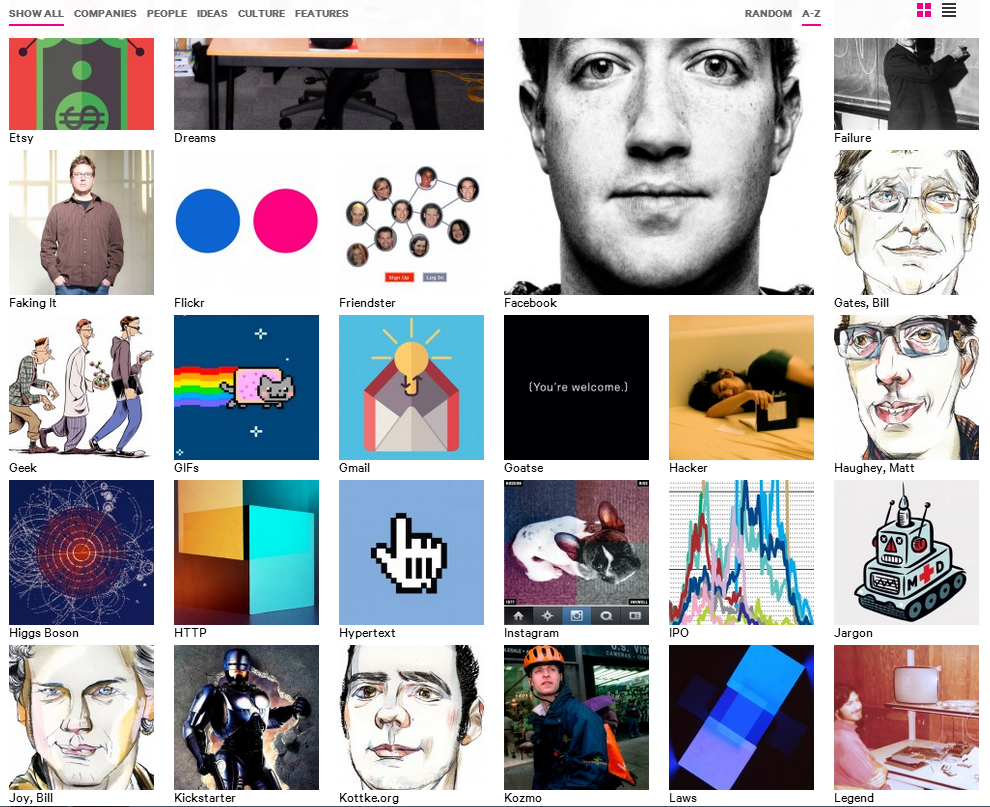
For the twentieth anniversary, the current issue of WIRED has a huge alphabetical list of topics that have been covered over the last 20 years (you can click on these topics on wired.com). From Angry Birds to Geek to Memes to Silicon Valley to xkcd and Mark Zuckerberg, I found many of these things interesting, though for some of them now, I wonder why. Which is actually a good question: why? Why has WIRED been my favorite magazine? I think it has to do with novelty and the future. I'm really interested in new and coming things, though not in all new things. For example, I have almost no interest in fashion, celebrities, or sports, although these areas are full of novelty (or simulated novelty). I tilt more toward the scientific and technological when it comes to novelty, and WIRED has always delivered.

If you click on the topic Geek, there's an explanation of the word, with credit to SF author William Gibson for introducing the modern usage of the word in the mid-80's. He described himself as "a geek who couldn't play baseball" (moi aussi). After some additional background, the item concludes with:
Be it a geek or a geck, both were misfits. And so was Gibson: Inept at sports, he took up science fiction. Foolishness in mainstream pursuits signified talent for their intellectual opposite. Geekiness became a synonym for countercultural braininess. And the rest is history.
While I don't consider myself entirely countercultural or entirely brainy, if there's anything I identify with, it would be countercultural braininess.I may no longer fly my freak flag, but I still roll under the geek banner.

UPDATE: I just noticed that I wrote a fond note about WIRED back in 2008, on the occasion of its 15th anniversary, with the title "Optimism as Strategy." I included a quote from an article in that issue that I think is still relevant to the magazine, the future, and more importantly, to living:
The challenge is obvious, the dangers present, the need great. But be optimistic. I would say that, wouldn't I, since we were often accused during my time at Wired of being overly optimistic. But optimism is not false hope, it's a strategy for living. If you are optimistic about the future, you will step up and take responsibility and attempt to make it better for yourselves and your own children.

Monday, April 22, 2013

Happy Earth Day!

Before it slips away and becomes belated as so many occasions seem to do, here's wishing everyone a very happy Earth Day!


The picture above is a screen shot from the Orbiter space flight simulator, which I keep wanting to return to playing with, but never seem to have time. This is a nice, big-picture graphic, but as a celebration of the Earth, it pales in comparison to the daily stream of fascinating Earth images beamed down from the International Space Station by its commander, Col. Chris Hadfield. Just amazing stuff. Follow him on Twitter or Facebook (or on Tumblr) if you really want to get to know the face of this wonderful planet! He also does great science demonstrations (thanks to Astropixie for this tip).

Friday, April 19, 2013

Exoplanets Rising


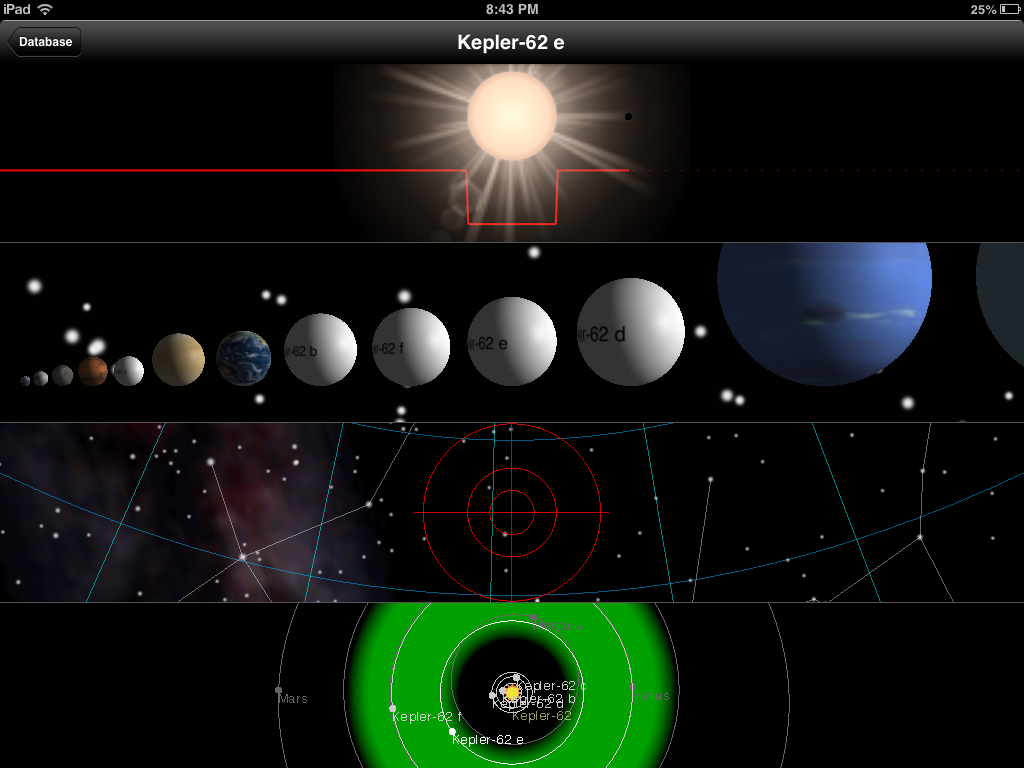
Several new Earth-like exoplanets were recently announced, based on continuing observations from NASA's Kepler satellite (the above graphic is from NASA's Kepler page). This brings the number of confirmed exoplanets to 882, according to one of my favorite iPad apps, the aptly named Exoplanet (also for iPhone). Kepler-62 is a five-planet system with planets of 1.4 and 1.6 Earth radii orbiting in the habitable zone, according to the discovery paper (abstract). Could these planets actually have liquid water? And life? Too soon to tell, but we will sure have plenty of candidates to look at once we have some tools with sharp enough vision and sensors, like the upcoming JWST (James Webb Space Telescope). Of course at 1200 light-years from Earth, no one is going to be visiting the Kepler-62 system anytime soon (barring great advances in wormhole transportation systems).


Of course you can find such information directly from Google, NASA, and other sources, but the Exoplanet app is pretty much one-stop shopping for keeping up with newly discovered planets and how they compare with one another, through a variety of cool graphics and comparison tools. For example, the page for Kepler-62e above includes the relative sizes (with Earth just to the left of Kepler-62b) and the location within the star's habitable zone (shown in green), along with other information (you can touch each band for a full-screen version). You can also view lovely, zoomable graphics of the Milky Way Galaxy, showing its structure along with the location of any selected exoplanet, plus our own Solar System, for reference (example below).


The screen below shows the latest discoveries at the top of a detailed database table. There is also some great background information that explains what exoplanets are, how they are discovered, and how they vary. The basic app is free, but there are various low-cost in-app purchases to add more features and to remove ads. Updates for newly discovered planets are small and frequent free downloads within the app (when you have an internet connection). A cool tool.


Monday, April 08, 2013

F-Sim Space Shuttle - Video!


F-Sim Space Shuttle (iTunes, also available for Android devices) is the only gaming app that stays on my iPad and iPhone for very long. I don't play it all the time, but every once in a while it's nice to shoot a few space shuttle approaches just for the fun of it. The latest update (v2.8) just came out, and developer Sascha Ledinsky has added a really cool feature: the ability to export videos of your flights!

He added external views and in-app replay features long ago, but with video export, you can share your accomplishments with the world - in HD! So of course I had to try it. This YouTube video features a "safe" landing (not bad except for landing left of the runway center line), with a musical soundtrack added in iMovie (2 minutes of the song "Down & Out" from my recent album "Look at You," available on iTunes, not to mention Amazon.com).

UPDATE: A small tip has helped my landings immensely - pinch-zooming to enlarge the HUD display so the FPM (flight path marker) and "guidance diamond" are easier to view and position. I finally made a "perfect" final approach landing for 900,832 points, recorded in this video. Next stop: a perfect full-HAC approach and landing, and a million point landing. Then I will retire just like the real shuttle pilots. Unless I decide to pursue shuttle aerobatics, like this amazing barrel roll on short final, followed by a good landing (flown by Sascha, the developer of F-Sim Space Shuttle). Slick!

"The Martian" - Great SF Book

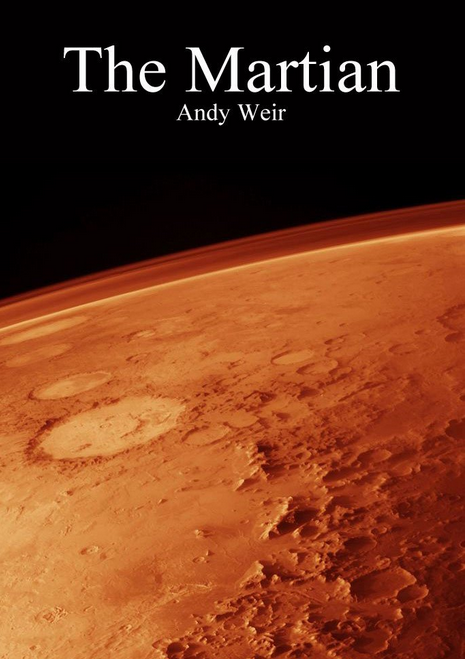
This was a great find and practically a steal at 99 cents for a full-length SF Kindle e-book. Andy Weir's The Martian was recommended to me, probably because I had recently bought another Kindle SF title, Wool by Hugh Howie (also a great read from an "indie writer"). 

I tend to prefer so-called "hard" science fiction, stories that have at least some plausible claim to feasibility based on physics and technology, even if it's some pretty far-out physics and technology (I mostly don't like stories based on magic and fantasy, with occasional exceptions).  The Martian is definitely hard SF, but it's also a riveting story line. I read it in a couple of days. 

The story takes place on a NASA manned Mars mission (you immediately see the fiction here!), perhaps 30-40 years in the future. An ion-engine-powered (VASIMR actually) Mars transfer vehicle (the Hermes) has been built and used on two previous manned missions. These are short-term missions (about a month on the surface), using fairly extensive infrastructure delivered to the surface by multiple unmanned supply ships. Although not defined in detail, the mission architecture seems to borrow from Mars Direct and various NASA Mars Reference Missions, with in situ rocket fuel production, a fairly large "hab" to house the astronauts, large pressurized Mars rovers, and a separate MAV (Mars Ascent Vehicle) used to return the astronauts to the Mars-orbiting Hermes. These facilities all feature importantly in the story.

The six astronauts of Ares 3 run into trouble a few days after landing - an extra-powerful dust storm with winds that could damage the MAV, necessitating as hasty abort. As the crew of six makes its way to the MAV for emergency departure, Mark Watney is injured by flying debris. Telemetry indicates that he has died due to a large breach in his spacesuit. With the MAV about to topple in the wind, the rest of the crew barely escapes, leaving Mark's body behind.

Of course, Mark doesn't actually die (his suit was breached and he was injured, but some lucky circumstances allowed the suit to seal off the breach). The hab is still intact and stocked with food for six for a month-long mission, but all antennas have been lost, so Mark is unable to communicate with his crew mates or with Earth. Due to orbital mechanics and complex logistics, a rescue is unlikely even if he can reach someone, and even with rationing, the food supply will only give him a few months. But Mark figures he might as well try to survive, and as a clever and stubborn guy, as well as a botanist and mechanical engineer (every crew member is chosen for multiple skills), he manages to solve a steady stream of problems that Mars and his situation throw at him (none of them are aliens or demons as in some other Mars mission books and movies). 

I won't tell you more than that, except to say that with logbook entries as the format, I was skeptical that this could really hold my interest. But Mark (or should I say Andy) is quite funny, and his descriptions of his problem solving are extremely interesting (and detailed). This book made me think that humans on Mars will have a tough time, but that we will ultimately prevail in spite of the hostile environment. It also gave me a "real" use for the Mars Globe app that I have had on my iPod Touch and iPad for quite some time. I won't explain that any further - read it yourself! 


Wednesday, April 03, 2013

Tyson is My Hero


Neil DeGrasse Tyson is my hero. Astrophysicist, science educator, eloquent proponent for space exploration, writer, PBS television host. His book Space Chronicles: Facing the Final Frontier is one of about ten Kindle books I am actively reading on my iPad (it's a collection of previously published articles and essays on various space exploration topics). I've read interviews with him and watched a number of his videos, always impressed with his ability to communicate clearly and in a (yes) down-to-earth way on the issues of science, including space exploration and the role that it could play in building a better future for all of us, starting with the inspiration it could provide to the next generation of scientists and engineers.

Tyson is not the first to talk about the fact that Apollo was fundamentally a Cold War program, a technologically sophisticated battle with the Sputnik-launching, human-orbiting Soviets, which I have understood for years. NASA didn't receive as much as 4.4% of the federal budget in the 1960's [vs. around 0.5% now] with the goal of cracking the secrets of the universe or inspiring kids to study science and technology, but inspire it did. I'm one of those kids, even though I ended up an optical engineer rather than an astronaut or aeronautical engineer as I originally hoped I would be. Space has been and can continue to be a huge technology and education multiplier, and I hope that our leaders can come to see this in the next few years, even as private space begins to take over more of the routine aspects of spaceflight in low Earth orbit. Private space may get us to Mars someday, but NASA and other space agencies around the world really should be deeply involved with the vision and the parts that require big long-term investments.

If you want to learn more about the value of space exploration, you could read his Space Chronicles, or just search for Neil DeGrasse Tyson on YouTube or Google. He's a very engaging speaker and writer. This video, "Message to the Future" (apparently a speech from fall 2012) is a good place to start. He tells the story a lot better than I do.

Notes on a Shinkansen


This is a set of more or less random notes I wrote last November, the last time I was in Japan. I had planned to write a blog post about this but I forgot. I just discovered the notes on my iPod Touch and decided to post them even though it was a few months ago. I really like Japan and I wish I would get there more often and that I would really spend some time reviewing Japanese so I could converse better when I'm there. But it's pretty much once a year now, and I pretty much speak English. C'est la vie. Or should I say shikata ga nai?

Friday evening November 9. Night before flying home from Tokyo after one week business trip. Taking the Shinkansen alone from Osaka to Tokyo because my colleagues had other plans in Osaka. I've eaten my "ekiben" dinner (train station lunchbox) along with a couple of beers and I'm listening to music on my iPod. Feeling pretty relaxed.
  1. Crosby, Stills, and Nash's "Helplessly Hoping on headphones, first time in ages. Beautifully simple three-part with Stills in middle, Crosby on left, Nash on right. Just lovely. Parts are tight but very distinct. 
  2. Ekiben is usually good. Foods I wouldn't normally think to eat cold that somehow work. Tonight tonkatsu, breaded fried pork filet with sweet BBQ-like sauce. Side of sticky rice balls plus a piece of baked grilled salmon, a fried potato wedge, one piece each of broccoli and carrot. Plus a piece of sushi tamago which is really a slice of a cold, dense, sweet rolled up egg omelet. All cold. But good with a tall can of Suntory "The Premium Malts" beer. Works for me.
  3. Dorayaki (どら焼) was an early fave Japanese food for me when I started coming here in the early 1980's. A sandwich of small round pancakes with sweet bean paste inside. A sweet dessert my daughters thought was disgusting. Sweet bean paste is a bit odd. I just had one, first in years, from a 7-11 store. Pretty good. 
  4. No photo ops on night train back to Tokyo but yesterday coming down, Mt. Fuji was very clear and I wished I had a camera with me. Actually I have two, one in BlackBerry, one in iPod Touch, both suck. A friend on the trip took a nice iPhone picture in Mishima [see above] where we visited a customer. I finally will get an iPhone myself next month to replace Blackberry -- iPhone 5 should be cool even though I have lots of apps on iPod Touch. But having a nice camera, everywhere Internet, and GPS should be nice. Oh yeah, and it's a phone. [Update: the iPhone 5 is really cool]
  5. So many smartphones In Japan now, especially iPhone though I probably just notice those more. Many fewer paper manga and newspapers on trains. Everyone riding head down with their devices. 
  6. A small coincidence in shuffled songs on iPod. Two very random songs in a row happened to mention Japan. Julie Andrews "In My Own Little Corner" from "Cinderella" has the line "I'm an heiress who has always had her silk made, by her own flock of silkworms in Japan" (this is Rogers & Hammerstein so of course this is to rhyme with milkmaid). Then the Local Natives' song "Airplanes" which has the line "I keep those chopsticks you had from when you taught abroad in Japan."  Say what? I sure do have a weird collection of songs on my iPod. 

Thursday, March 21, 2013

Audiobus Shakes Up iOS Recording


I've been writing and recording songs using iOS apps on my iPod Touch for a couple of years. In the last year, I've also done a lot of writing and recording on the iPad, whose larger screen makes it much easier to use with simulated synth keyboards and recording consoles. I've gotten good results with apps such as Thumbjam, Chordbot, and especially Apple's own Garageband app. Most of these apps support some sort of data export or audio copy/paste, which allows combining sounds from different apps, although this is usually an awkward trial-and-error process.

Sometime last year, an app called Audiobus was released, described as the missing link or "cable"  between other iOS music-making apps. For apps supported by Audiobus, this allows nearly effortless real-time combination of different music apps. The makers of Audiobus and the various music app developers have been steadily adding to the library of iOS apps that work with Audiobus. I bought it a few weeks ago and have been experimenting with various combinations. But the other day was the breakthrough for me - Apple released version 1.4 of Garageband, with Audiobus support! Now I can work in my most comfortable iPad recording environment and easily incorporate the sounds of the many synths and other music making apps I have.

This takes the iPad almost into the realm of "grownup" recording applications on other platforms, such as Sonar X2, which I use on a Windows 7 laptop. It certainly competes in the variety of available "soft synths" and exceeds the Windows/Mac world in touch-specialized interfaces, best exemplified by Thumbjam. Of course there is always more to want: with all the instruments I can now use in Garageband, how can I get by with only eight tracks? Yes, I know the Beatles made Sgt. Pepper with only four track tape recorders (and like producer George Martin, you can bounce sub-mixes down to stereo to free up some tracks for more parts - just add genius, and you're the Beatles!).

Of course I still have Sonar to use for projects requiring dozens of tracks, so there is no reason to complain, especially when the iPad travels so well. One problem that I have in both environments: dozens of wonderful tools with enormous depth and breadth of features that I have barely started to discover. Do I spend time getting better with the tools? Or do I spend time creating new music? I try to do both at the same time!

Wednesday, March 20, 2013

Beautiful Earth Views from ISS!

Some space advocates decry the fact that humans are currently "stuck in low Earth orbit." While I too would love to see humans branch out to the Moon, Mars, the asteroids, and perhaps further, I have to say that low Earth orbit is still a pretty cool place to be. Case in point: I recently learned that the current ISS commander, Canadian astronaut Col. Chris Hadfield, frequently posts pictures from the ISS on Twitter and Facebook. So I "liked" Col. Hadfield on Facebook, and I now receive daily reports and photos from the ISS. Pretty amazing stuff (you can also see his pictures on Tumblr).
I also found a wonderful video compiled from ISS photography, including time-lapse views of auroras and other beautiful images of Earth. Christoph Malin's "Making the invisible visible" is a 15 minute video that is described as "a tribute to the International Space Station Program as well as Dr. Don Pettit, NASA Astronaut and ISS Astrophotographer." The screen shot below is from the video, looking north over New England (notice the hook of Cape Cod in the lower center). Also note the green aurora along the limb of the Earth. You should watch this video, preferably in HD.  


Sunday, March 10, 2013

What's on My Nightstand?


Here's a snapshot of my reading dilemma - the Kindle books on my iPad, something like my current reading list. A few of these are books I have already read but like to dip into once in a while. A couple are sort of referencey (e.g., Revolution in the Head, a song-by-song history of the Beatles).  It's a lot of books, but at least they aren't heavy. I've had The Making of the Atomic Bomb (in hardcover and paperback) since probably 1987 and I'm finally reading it thanks to Kindle. I somehow never wanted to take that 886 page book on an international business trip which is when I do most of my long-form reading.

Saturday, March 02, 2013

The Orchestra App on iPad


The Orchestra is one of the coolest music, education, and entertainment applications I have ever seen. It is what multimedia was meant to be - an intimate exploration of 8 pieces of classical music, conducted and explained by Esa Pekka-Salonen, with the Philharmonia Orchestra. It is made specifically for the iPad and makes great use of the touch interface and the large screen.

Basically, there are 8 short pieces of classical music (most are excerpts), from Haydn to modern, played by the orchestra while the score scrolls and videos are shown of Salonen conducting and of sections of the orchestra. There is also a diagram of the orchestra where each active instrument "lights up." All of this is perfectly synchronized with the music, and is adjustable in various ways (e.g., piano roll display instead of music notation for the score).There is also optional commentary by the conductor and select orchestra players.

There are also brief video interviews with the conductor on special aspects of each piece, text information about the history of each piece, and a fantastic tour of all the orchestra instruments, with a brief video comment and demonstration of each one.

I enjoy a lot of classical music, but as a largely self-trained musician, I have often felt that I am missing a lot of what is going on. So i have sought out books and software to help me with this over the years. When CD-ROM arrived in the early 90's (pre-Internet), some of the first multimedia programs were musical explorations similar to this. I remember having one by Microsoft on Mozart's "Dissonance Quartet." That was good, but not nearly as interactive and instructive as this new app.

So far I've explored two of the pieces (Debussy and Haydn) and some of the orchestra and background features. There is much to see, do, and learn here.

Two small complaints. It's expensive by app standards at $13.99, but compared to a music CD or DVD, it is a fantastic bargain. There is so much artistry and work in this product. And with the exception of Debussy's brief but complete "Faun" prelude, all the pieces are excerpts. This is because as a self-contained app, all content must fit in 2 GB, the iOS app size limit (the app is 1.8 GB). They apparently made a choice to showcase multiple works from the 18th century to now, rather than choosing one complete work to analyze. I think that was the right choice. If you explore these excerpts, I think it will greatly increase your appreciation and understanding of the complete works, and of other music as well. I have already learned things I never knew about conducting and orchestral instruments.

First World Problems & Rationalizations

I just saw a Facebook post complaining that the iPhone doesn't offer a shortcut to immediately scroll to the bottom of a page (there is a top scroll shortcut). Someone commented that this is a "first world problem." This made me think about some of my own first world problems (in addition to suffering with this one).
  • Too many books and magazines I want to read, hundreds of which now follow me everywhere in the Kindle app on my iPhone and iPad. And yet I buy more. 
  • Too much music I want to listen to. Amazon Cloud has almost all of my music, 27,465 songs, roughly 97 days of music (that's 24 hour days). This too follows me everywhere, and yes, still I buy more.
  • Too many ways to write and record songs, making it hard to decide which of these dozens of tools (many of them apps on the iPad and iPhone) I should choose when I want to create some music. This is so challenging that sometimes I give up and watch a movie instead. And yes, I buy more music apps. There are so many cool ones!
  • I have to fly economy class when I take business trips to Europe and Asia. Lest this start to sound too much like whining, I have to say that I don't really mind this. For one thing, the fact that I travel on business to Europe and Asia at all means that I get a nice break from the daily routine, that I get to see various international friends and colleagues, and that I can sometimes practice my French or Japanese. And oh yes, that I have a job. 
  • Too much food I want to eat, leading me to weigh too much. I'm working on this one using the Weight Watchers online program (mostly on the iPhone, making it convenient to track everything I eat). I started January 12 and have so far lost about 18 pounds. I spend 25-40 minutes a day on the treadmill fast-walking to gain "activity points" to help the process along. The game-like aspect of tracking points (and weight loss) seems to help me, though of course the trick is to keep it up over long periods. 

There's a rationalization connected with the Weight Watchers (WW) thing (I'm always rationalizing things). While the WW point system and app are well-designed and have helped me to lose weight, I wonder if this is really worth the roughly $18 a month it costs to subscribe. There are probably cheaper ways to track food and activity that would also work. But here's the rationalization: before I started this, I would buy an afternoon snack from the vending machine at work almost every day. Now that I'm tracking those points, I don't do that anymore (I carry fruit and carrots to work since those are "free" on the WW point system). Now I can say that I'm spending that roughly $20 a month on WW instead! 

I guess this is all just a strange way to say that I have a lot to appreciate with these various first world "problems."

Thursday, February 28, 2013

Inside the B-24

This web page is super cool if you like airplanes. It starts with a nice 3D cutaway view of the Collings Foundation's B-24 "Witchcraft," in the classic style of aviation fan magazines and books that focus on particular airplane models (yes, I have a few of those):


But hover your mouse over it, and labels appear to identify the different parts of the plane:


But wait, there's more. Click on one of the pictures (cockpit below), and a separate window will open with a photographic 3D virtual reality view you can control with the mouse to look around and zoom into details:


I was lucky enough to fly in Witchcraft a couple of years ago (photos here), and I walked and crawled through most of these stations (you could look over the pilots' shoulders but no room to enter the actual cockpit). This web site and Java-based app is the closest thing to being back there! And much less noisy.

Sunday, February 24, 2013

Sound Obsession: Alt J

I mentioned the band Alt J the other day in a blog post about music I've bought recently. I can't stop listening to their album "An Awesome Wave" (whose cover graphic, above, is actually an Envisat image of the Ganges delta). BTW, the MP3 album is still just $2.99 on Amazon.

I'm trying to figure out what I like about this music. The vocals and lyrics are strange to say the least - hard to say what the songs are about, but there are a lot of vaguely sexual and violent references in them. I watched videos for three songs, Tessellate, Breezeblocks, and Fitzpleasure, and they too are strange and semi-violent. The songs don't sound especially complex musically . So what's the deal?

I think it's mostly about texture and space. The sounds of the guitars, vocals, percussion, and synthesizers are varied and colorful, and there are usually not a huge number of sounds at once, so these varying textures "stick out" in the mix, giving a minimalist yet rich feeling. There is also "space" in the songs where everything stops except the vocals, guitar, or percussion, and things get very quiet, and then loud. There also seems to be variation in tempo. I guess that all adds up to the element of surprise - even after multiple listenings, there are new things to notice. It just seems so fresh and bursting with little variations at every turn. It works for me - and for a lot of other people, it seems. I noticed that they are playing in Boston next weekend, but of course the two shows are sold out already. You snooze, you lose, but in fairness, I did just discover this band on February 15!


Friday, February 22, 2013

Birth of the Blooze


Here's a little musical doodle I threw together tonight. I got a new music app called Scape for the iPad. It was developed by Brian Eno and Peter Chilvers as a kind of ambient music play set. You create musical "soundscapes" by choosing and positioning various backgrounds and graphical shapes. The picture above shows one I made tonight, the cleverly titled "Scape 5" (I haven't figured out how to rename these things). I recorded that into Sonar X2 on my PC and started fooling around with different synth sounds. I finally chose two, an ominous-sounding percussive voice, and a sampled string orchestra. I improvised some melodies and chords with the strings, added a bunch of reverb, and this is what I got. SF movie music. Or something.


Wednesday, February 20, 2013

An Awesome Wave of New Music

Music is my addiction. Fortunately it's not especially expensive or harmful. I enjoy "growing my own," but mostly I buy it, most frequently these days as Amazon MP3's, and quite often on sale. On my Amazon Cloud I have 27,333 songs, 10,022 of them purchased (from Amazon). A goodly number of those are classical collections of 99 or more pieces, many bought for a dollar or two. So the average is probably much less than the typical $0.99 or $1.29 per song, but even if it's 25 cents a song,   that's around $2,500 spent on musical bits. Most of the rest of the 27,000 songs were ripped from my own CD's (and some vinyl rips). A few hundred were probably bought on iTunes before I started to buy MP3's almost exclusively from Amazon.

So what have I bought recently? I'm glad I asked. Looking at the Amazon Cloud "Recently Added" folder for the last few items added, we find (oldest to newest):
  1. Big Mozart Box - A Bach Guild collection of 131 Mozart pieces, this was probably unnecessary since I have a zillion Mozart recordings already, but for 99 cents? I just leave these giant collections on the Amazon Cloud and stream them when I feel like some classical immersion. This one is still 99 cents.
  2. Local Natives, "Hummingbird" - Second album by an indie band I really like. Good, but I still prefer the first one.
  3. Blue Sky Riders, "Finally Home" - If this occasionally sounds like a fresh burst of 1970's, it could be the presence of Kenny Loggins. Three great writers, wonderful harmonies, somewhere between country and old-school acoustic pop.
  4. Girl Named T, "Hey Liebe" and "Wait by the Rabbit Hole" - I wrote about T briefly in my recent California trip post. I really love her writing, singing, and background vocals. Fresh alternative pop-rock. I actually bought these CD's at her concert in Berkeley (for $5 each, great deal).
  5. Muse, "The 2nd Law" - This was well-reviewed and cheap ($2.99), and I liked the samples, but now I'm not so sure. It has its moments but it's a bit over-dramatic or something. 
  6. Buffalo Springfield, "Retrospective (Best of)" - I watched a documentary that talked about these guys and others from the late-60's Hollywood/Laurel Canyon scene. I realized that I only had this on vinyl (now gone) and only had a couple of songs as MP3. A remedial classic.
  7. Alt-J, "An Awesome Wave" - I freaking LOVE this album. It is so weird. It's almost hypnotic. Strange vocals. Synthy instruments. It is so different and so good. Some of the lyrics and singing make me smile or even laugh out loud, even on the sixth listening. Another $2.99 special. Such a deal. 
  8. Corin Ashley, "New Lion Terraces" - I just bought this new release today when Roger Lavallee (friend, producer, musical mentor) praised it on Facebook. While Corin doesn't imitate the Beatles, there is something very Beatlish (and McCartneyish) about some of these songs, and I really like the album. Some of the chord progressions and key changes are strange, but they manage to work well with the vocals and harmonies. 

That's what I've bought on Amazon since January 29. Lots of music for three weeks - not that I buy this much every three weeks. It varies a lot.


Sunday, February 17, 2013

What I Write (and Why?)

I used to blog a lot more than I do these days. I started "Music of the Spheres" in October 2005 (about 88 months ago), mainly to write about the Orbiter spaceflight simulator that was a heavy obsession at that time (I wrote a tutorial book about Orbiter that year). I wrote over 200 posts a year from 2006 to 2009 (366 was my peak in 2008 when I pushed for one a day for some reason). But I wrote only 55 posts 2011 and 2012, closer to one a week. Nobody seems to especially care how much I blog, including me. But I've written 1,447 posts since I started this thing - an average of 16 a month. That's a lot of words!

I'm not into blogging as much as I once was, but occasionally I will still take a look at the stats. Google started tracking my blog stats in May 2008 (maybe that's when I decided to turn tracking on). Since then I have had 243,800 page views. I had about 11,000 last month, running around 300-400 a day. I sometimes wonder who all these page viewers are, and what they are viewing. Google has some information about this (e.g., "Carnival of Space #12," July 19, 2007, 913 page views), but it still blows my mind. I could probably find out a lot more detail, but I don't want to spend the time right now. Oddly enough my page views jumped to around 1,300 yesterday, and I have no idea why. I recently wrote about Mars-One and Elon Musk; maybe someone with a lot of readers or an interest in Mars colonization linked to that article.

This post was triggered when I looked at the list of keyword topics on the right side of the my blog. These are keywords that I chose myself and use to categorize my posts. I was surprised at how much I have written on some topics, and how little on some others that I find quite interesting. I grabbed everything down to 20 posts and put them into Excel (note that I usually apply multiple keywords to each post). Here's the graph (total posts to date, 1,447):

Orbiter was the original impetus for the blog, and I have written 250 posts about it (heavy overlap with "add-on" and "tutorial" topics), my #3 topic. Astronomy is #1 (308 posts), NASA is #2 (290). Books (216) and education (194) are pretty strong, as are blogs (219), space history (174), and people (170). I would have expected more on music (162), but these things come and go. When I do blog now, it is often about music, but my big years (2006-2009) were heavy with space stuff, totaling 1143 posts. Very little on optics (42), considering this is my profession. Not much on humor or religion.

Judging from this and from the hundreds of small notebooks that I still have from my pre-blog days when I would keep paper journals on various subjects of interest (flight simulators, Japanese, flight lessons, songwriting, travel, etc.), I like to write stuff, no matter who is reading it. For most of my life, I was the only one reading my stuff (unless that stuff was email). That's still mostly true, but there now seems to be dozens to hundreds of people a day who are also reading some of my stuff, for whatever reason. To all of you I say, thanks for your interest! Feel free to drop me a line (or a blog comment) if you think of it. Unless you are one of my many comment spammers (if so, you probably aren't actually reading this, nor are you actually a person, and I don't need to encourage you to comment!).

And WHY do I write all this stuff? Ah yes. Not for money. I have not taken any steps to "monetize" my blog, which was probably a mistake, though probably not a big one. As near as I can tell, I just like the sound of my own fingers.

"Look at You" on Noisetrade.com

My powerful music promotion machine is revving up for the new album - it's about to cross the all-important threshold from nanowatts to microwatts. Orders of magnitude! Yes, that powerful.

Today I made three MP3's from the new album available for free download on my Noisetrade.com artist page. This site is free to me, and free to you too, unless you choose to make an optional donation when you download something. I also uploaded some songs from my first two CD's (here and here). Here is the Noisetrade widget for the new album:


I also made a PDF of the lyrics for all the songs on the album and added this to the free downloads page of my website. I thought I also made this PDF available as an optional download on the Noisetrade page for "Look at You" but I don't see it there (maybe it shows up when you download the mp3's - yup, that's it - I did a test download).

You may no longer be able to get anything you want at Alice's restaurant, but you can on the internet!