Tuesday, August 08, 2006

Mars Society - Final Thoughts

I wrote about the first three days of the Mars Society Conference and then fizzled out. So here are a few final thoughts and things I forgot to mention before.

I did mention seeing The Mars Underground on Thursday night, but since then the Space Review has carried an excellent review and discussion of the film by Dwayne A. Day, including some interesting observations on the conference and on the role of Dr. Robert Zubrin in promoting the case for humans on Mars.

The Saturday night banquet was pretty enjoyable for a dry event, though the entertainment and awards were full of insider jokes and references that a first-timer like me wouldn't really get. That's OK - Mars fans are an interesting extended family to watch (and start to join) just the same.

I went to a few track papers on various subjects and was struck on the one hand by the big picture optimism regarding humans on Mars ("we have the technology - all we need is the decision and the money"), and on the other hand by the difficulty of the details. Several papers pointed out the need for more extensive and realistic simulations of missions (by this I mean analog simulations, where people practice aspects of Mars missions in ground-based simulations of spacecraft, in the desert or in the Arctic). While these partial simulations are interesting and useful, more realistic simulations will be needed before we send 4-6 people on the way to Mars with only themselves to keep everything working (and everyone breathing).

We talk about "pseudo G" from tether-rotated spacecraft, and while the physics of this is clear, no one has actually done this with living things on an extended basis, let alone humans. Can a nearly closed life support system be made to work in space (and on Mars) for some four years? Can all the mechanical systems of the spacecraft work well for the time needed? The ISS is not a fair test since it is close to Earth and is resupplied and repaired on a regular basis. Even the issue of aerobraking into Mars orbit is a problem - it's never been done with a 40 tonne spacecraft. People are thinking about and working on this stuff. But if "Mars by 2020" really has a chance, we need to solve the big picture and sweat all these "small" details. I think it's possible, but 14 years doesn't sound like a huge amount of time to do it all, even with Uncle Sam's and Elon Musk's checkbooks.

Saturday, August 05, 2006

Mars Society, Day 3

Not much time to blog this since I have to run to the Mars Society Conference banquet in just a few minutes. Day three was good, starting with a somewhat rambling but pretty inspiring speech from Dr. Robert Zubrin on how far we've come, what's left to do (a lot), why we need to support NASA's Vision for Space Exploration (it's finally destination driven!), and why it has to be Mars as the real prize (it's a tough place but it has everything necessary to build a new branch of human civilization).

I was setting up a slide show for the MarsDrive exhibit and unfortunately missed most of Australian astronaut Andy Thomas's talk (STS-114 and five other flights) - too bad, because judging from the few Q&A responses I heard, he was very open and an excellent speaker. Dr. Chris McKay, one of the founders of the "Mars Underground," the predecessor of the Mars Society, spoke next. He's now with NASA Ames and is concerned with astrobiology, but his talk focused on using the Moon (no life expected there) as preparation for Mars exploration. He argued that the Moon will probably not have colonies as Mars ultimately will, but will remain a research site, more like Antarctica, a place where Ph.D. students do thesis research. But this is still a good thing. Once again HobbySpace has excellent summaries of the three morning speeches here.

In the afternoon I caught a couple of good talks by Reagan Walker, American Director for MarsDrive. One was on software/web based communication support for Mars analog research labs, and the other was an overview of MarsDrive and its aims. There was also a good talk on Mars Direct and Orbiter by Cyrus Phillips and Seth Hollingsead, which included live demos of Orbiter that really seemed to impress the audience. Cyrus, Seth, and Rich Wall also had an Orbiter table in the exhibit area and did a lot of "Orbiter evangelism" for all sorts of attendees, including astronaut Andy Thomas. I missed him there too! Seth told me that Andy asked, "where can I get a copy of this thing?" They gave him one. The picture above was posted by Cyrus in the Orbiter forum (Andy is standing in the blue suit).

My presentation went well also (Orbiter simulation of Mars for Less) - I showed 26 PowerPoint slides and 5 minutes of video clips in 30 minutes, and it seemed to be coherent and well received. People tend to be surprised at the technical and visual quality of Orbiter. The slides (PDF of the handout) are available at Andy's site here. To be continued...

Friday, August 04, 2006

Mars Immersion plus Air & Space

NASM #3: Apollo LM
Day 2 of the Mars Society Conference in Washington was also quite good, but I only caught one plenary speaker (Dr. Scott Horowitz, former astronaut and now NASA Associate Administrator for Exploration) before taking the rest of the morning off to go visit the National Air & Space Museum, just four blocks away. I've been to NASM maybe six times over the years but I still love it. The most obvious new thing in the main gallery was SpaceShip One. I didn't have much time, so I focused on the space side of things, Apollo, X-15, Skylab, etc. I also visited a gallery devoted to the Wright Brothers which was new to me -- it must have been added for the hundredth anniversary of flight in 2003. More pix on Flickr.

I devoted 45 minutes to seeing Tom Hanks' IMAX 3D film about the Apollo Moon missions, "Magnificent Desolation," which I had been meaning to see for a long time. It was fantastic - with the huge screen and 3D, I felt as if I were really viewing the dramatic terrain at Apollo 15's Hadley Rille. The script was also funny and extremely moving. Tom Hanks is a space freak for sure, and this movie is a loving tribute to the finest days of human spaceflight (so far) and to the people who made it happen.

Keeping with the apparent theme of this side trip from the Mars conference, I saw a book I had been curious about, Return to the Moon by Apollo 17 astronaut/geologist Harrison Schmitt. Since it looked pretty good and was autographed by the author, I decided to buy it.

This afternoon I sat in on five or six presentations at the Mars conference, a couple of them quite good, several others rather poorly prepared and presented. Grant Bonin did a very nice job on his updated overview of the Mars for Less mission design. Chris Carberry (political coordinator for the Mars Society) presented "Operation President," an enthusiastic talk about how we can build on past successes in reaching presidential and congressional candidates to be sure that the" Vision for Space Exploration" and Mars in particular will be on the agenda for both Democratic and Republican candidates in the 2008 presidential race.

Thursday, August 03, 2006

Mars Immersion, Day 1

Mike Griffin at MSC 2006
Day one of the Mars Society Conference was really great. It started with a so-so 20 minute speech (PDF) by NASA Administrator Mike Griffin (pictured) followed by 40 minutes of excellent and funny questions and answers on all sorts of NASA, space, and Mars issues. HobbySpace.com has a great summary report including the Q&A. Griffin said he was the "warmup act for Elon Musk," and he sort of was! Musk gave a great talk, showing many slides with diagrams of the in-work Falcon-9 launch vehicle and Dragon manned spacecraft (see HobbySpace again for good summary of Musk's talk).

NASA Associate Administrator for Legislative Affairs Brian Chase gave a talk on political and funding issues, a good warmup for the afternoon "Mars Blitz 2006" where about 100 Mars Society members visited the offices of various Senators and Representatives on Capitol Hill (meeting with staff members in almost all cases). Despite the 100 degree (F) heat and humidity and the fact that we only met with technology/science staff aids, it was an interesting and fun experience wandering the offices, halls, and tunnels of the Hill office buildings. Our Massachusetts group visited Senators Kerry, Kennedy, and Sununu (NH) as well as Rep. Michael Capuano. Although all claimed to strongly support NASA's Vision for Space Exploration which aims for the Moon and (eventually) Mars, we tried to press the case for more Mars focus and a faster schedule.

The evening started with a reception with some good food and OK wine, followed by a pint of Guinness and a screening of an excellent new documentary on the drive for Mars, "The Mars Underground," profiling efforts since 1978 to promote manned exploration of Mars. This film featured a lot of interviews with Mars Society President Robert Zubrin and some excellent computer-generated video of his Mars Direct mission plans. The DVD of this film was said to have distribution in most overseas markets (couldn't find it on Amazon UK) but not yet in the US - but this is expected by December. The soundtrack is really beautiful.

Wednesday, August 02, 2006

Must Be Washingon

I've always loved Washington, ever since I first visited here with my high school senior class, quite a few years ago, when youthful energy and a dare prompted me to climb the steps of the Washington Monument (pictured here, from my hotel window). I don't know what it is - the history? I guess I'm impressed by all the monuments that were built to impress people. I even like the cheesy stuff in the hotel gift shop - the Air Force One t-shirts, FBI baseball caps, and CIA golf balls (?!?) - but don't worry, I didn't buy any of that crap! I'm saving my money for the Air and Space Museum, or maybe the merch tables at the Mars Society Conference itself.

So tomorrow morning, a quick breakfast in my room, register for the meeting at 8, then go hear NASA Administrator Mike Griffin give the keynote address at 9 am. Is this space geek heaven, or what?

Tuesday, August 01, 2006

Mars Cliff Dweller View

Mars Cliff Dweller View
I don't think there are any Martian cliff dwellers yet, though I seem to recall there were some fictional ancient cliff dwellers in Ben Bova's novel Mars - a pretty good book, though not the best of the Mars SF I have read. But I still like the cliff-perspective view in this Orbiter screen shot. It's an outtake from the final "photo session" to capture pictures for the Mars/Orbiter paper I've been working on and will finally present on Saturday in Washington, DC at the Mars Society Conference.

MSC should be a cool event - the keynote speaker Thursday morning will be NASA Administrator Mike Griffin, and Thursday afternoon I will join many other Mars enthusiasts in making the "case for Mars" with my representatives on Capitol Hill. Meanwhile I'm just happy that the presentation and the technical paper are both finally done. Thanks again to my co-authors Andy McSorley, Mark Paton, and Grant Bonin for all the great ideas, hundreds of emails, and zillions of hours of work on this project.

Sunday, July 30, 2006

Magazines to Read and Hear

Despite the plethora of reading materials on the web, I still like books and magazines, though I don't subscribe to as many as I did in pre-web days (mainly Newsweek, National Geographic, Wired, Paste, and SEED - there are also a few guitar and songwriting magazines that come and go, plus The Atlantic, which I decided I didn't have time to read but now miss).

Paste has been around a couple of years and is the main way that I keep my ears refreshed with new and often amazing music, mostly by newcomers and relative unknowns. Each issue includes a CD with about 21 songs (and sometimes a DVD too, with short independent films and music videos, which I rarely have time look at). I've discovered artists like Bright Eyes, Teitur, Anna Nalick, Patty Griffin, and many more through Paste CD's. It's an eclectic mix that rarely includes rap or metal but does include almost anything else. Highly recommended, but this month there's good news and bad news: Paste has gone monthly (from bimonthly) and I just don't think I have the bandwidth for twice as much new music!

Seed (subtitled "Science is culture") is new and rather different, aiming to unite "the two cultures" (aren't there more than two now?). I find I'm drawn to only about half of what they publish, but this often includes some amazing gems, such as an article in the latest (September, just arrived) called "How We Know" by Jonah Lehrer. This article discusses research and experience with effective learning methods, focusing on the fact that to the brain, doing and learning are effectively one and the same - which means that what you learn by doing something generally stays with you, while what you learn by conventional classroom approaches often does not. This may not seem like shocking news, but with the recent focus on "teaching to the test" to prepare students for government-mandated standard examinations, the effectiveness of active learning methods in getting students involved and really learning is largely ignored.

Lehrer also reveals the secret of Mozart and Tiger Woods: 10,000 hours of practice. Mozart seems to have achieved this by the age of eight (thanks to a demanding father), and Tiger was already learning golf as a toddler. Experts like these achieve a fluency in their skills that makes it look easy and natural, and there certainly is a seed of genius in many such cases, but the real secret is the combination of effective practice (creative and realistic so that learning IS doing), and lots of time devoted to it. I better get busy!

Friday, July 28, 2006

Mars for Less for Orbiter: PPT Done!

MTSV Modules Assembling with CEV
The PowerPoint I will present next Saturday at the Mars Society Conference is finally done! It's 26 slides including six short video clips that total about five minutes (I know, too much material for a 30 minute presentation). I think it's good but in some ways it seems like a relatively small result for all the work that co-authors Andy McSorley, Mark Paton, Grant Bonin, and I put into it over the last 3 or 4 months. But of course it's not the whole story. I still have to finish the technical paper itself, for which Mark has contributed some 10 pages on his Orbiter-based design and testing for Mars EDL (entry/descent/landing - I've got a nice video of the entry and landing). And the spacecraft, launch vehicles, accessories, and dozens of scenarios will be assembled and released as a new Orbiter add-on as soon as we get a chance to clean up all the loose ends.

The picture above is from one of the slides - it shows the two sections of the MTSV about to be assembled in LEO with the help of NASA's CEV and two EVA astronauts. More pix on Flickr.

Tuesday, July 25, 2006

The One Minute Astronomer

Jack Horkheimer: Star Gazer has been a weekly public service "short subject" for some twenty years, though I just discovered it myself on the web. This tiny show specializes in naked eye astronomy, focusing each week on some notable sky event, such as Jupiter being visible just above the Moon in the southwest an hour after sunset on August 1 (the video shows easy to follow diagrams and instructions on what to look for and where). Some TV stations play the five minute version just before they go off the air at night (not a very convenient time for most of us), but now you can view the last 12 month's worth of videos (both one minute and five minute versions) on the web here, using RealPlayer. There's also a video podcast version - take the lesson right to the back yard on your iPod!

Jack also has a some astronomy cartoons on line! Astronomy cartoons? How cool is that? (My daughter now has even more proof that I am a goober.) The picture above links to one from March 2006, "the rival of Mars and how the scorpion lost its claws." The web site has a useful FAQ that tells other ways to get access to the show, especially for teachers. Note that since Jack is based in Florida, he talks about northern hemisphere constellations and events - sorry southern hemispherians.

Lake Rocket Fuel

Recent radar images of Titan from NASA's Saturn-orbiting Cassini spacecraft show dark patches that are being interpreted as "hydrocarbon lakes." At the temperature and pressure conditions of Titan, water would not be a liquid, but methane or ethane would be. Giant lakes of rocket fuel! Just touch down and fill the tanks! OK, maybe it's not that easy, and you still have to get your oxidizer somewhere unless you're flying a nuclear-thermal rocket or something. But it's still a pretty amazing image and idea.

Monday, July 24, 2006

Read This Interview!

I happened to notice this link to a video feature page in my daily New York Times news email. It's a wonderful interview with Neil deGrasse Tyson, an astrophysicist, author, and director of the Hayden Planetarium in New York. I've seen Tyson on TV and read some of his work, and I know him as an articulate and passionate proponent of space exploration, astronomy, and science education. But in this 30 minute interview (in 7 short "chapters"), he gets right to the heart of what matters to him and why it matters to all of us. Great stuff. It may require registration with the Times web site to view these videos (low and high bandwidth versions available).

Unrelated except that it's also in the New York Times today is this opinion piece on the psychology of retribution and retaliation, "He Who Cast the First Stone Probably Didn’t." It seems that escalation is built into our fundamental psychology. Bummer. But my brother always did hit me first -- except for that one time...

Saturday, July 22, 2006

Musical Interlude

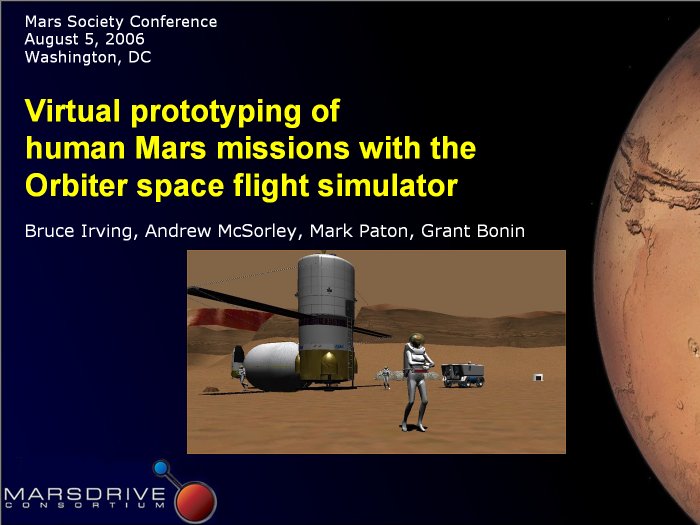
No blogging time the last few days - a long-time friend and musical partner from Nashville has been visiting and we've been writing and recording some new songs, something I haven't really done much of since I entered my current "space cadet" phase in spring of 2005 (when I discovered Orbiter). I'm also working on the final screen shots, video clips, and PowerPoint slides for the Mars for Less paper I will present at the Mars Society Conference on August 5, two weeks from today. Title slide shown above.

Monday, July 17, 2006

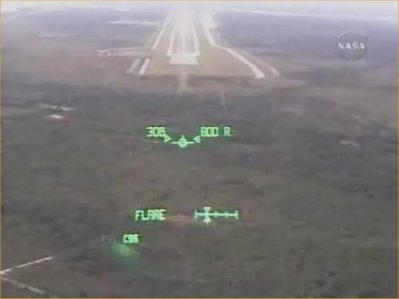
STS-121 Landing Live!


Of course this isn't actually live HERE since it happened at 9:14 am EDT, but I watched NASA TV on my computer for the last 30 minutes of Discovery's entry, approach, and landing. I've watched Shuttle landings before, but this is the first time I recall seeing live HUD video from the pilot's perspective and it was really great! Congratulations to the Discovery crew and to NASA on a great mission.

Sunday, July 16, 2006

Making Vallis Dao a Little Lived In

ERV with Greenhouses etc
I spent several hours this weekend furnishing the virtual Mars for Less base at Vallis Dao with a few props, most courtesy of Greg Burch (from his Heinlein Moon Base). Of course Orbiter isn't The Sims, but I wanted to make the virtual base a little lived in, even if all we'll do is land and take off from there.

I added six "inflatable" greenhouses (to the left of the ERV above) as well as a protective enclosure for the small nuclear reactor that Mark Paton built, a tall antenna with a red beacon, and some cargo containers (from a cargo drop?), the latter three not shown. This adds to the four astronauts already borrowed from Greg (2M, 2F), Andy's Mars Rover, Mark's ERV and MTSV, and an inflatable "lab" added on to the MTSV (this is from the ESA space station inflatable add-on by "No matter" and intended for zero-G, not surface use - but no matter). I couldn't find a suitable vehicle to stand in for the robot tractor that would remove the nuclear reactor from the ERV and install it to get the methane/LOX fuel production going for the ERV's return flight. But at least this gives some idea of what the first Mars base might be like - pretty spartan, but home just the same.

At Mark Paton's suggestion, we have dubbed this first base "Mandya Arti" (which means Mandya's blood), a name that comes from an Australian Aboriginal Dreamtime legend called "How the hills came to be." More pix at Flickr.

Saturday, July 15, 2006

Back to the Future (and the past)

Orbiter and its add-on developers continue to amaze me. The creators of two must-have add-on packages for Orbiter 2005 have just announced updates (in one case, an interim patch) for Orbiter 2006.

I've written before about both Project X-15 and World of 2001. Greg Burch and Scott Conklin have updated their X-15 packages (there are three, X-15, Edwards AFB, and X-15 Delta) for Orbiter 2006, taking advantage of the advanced features of Vinka's spacecraft3.dll to improve aerodynamics as well as usability and immersiveness. I've just downloaded the packages and haven't tried them myself yet, but the original add-ons were great and the early reviews on the forum are strong.

World of 2001 (Wo2001) by Erik Anderson (Sputnik), Alain Hosking (80mileshigh), and Wolfgang Schwarz (Nautilus), is another work of art for Orbiter. They have just released a patch with fixes required for everything to work in 2006, and their web site says a full 2006 rework is planned for later in the year. In the meantime, get the original and the patch, and watch this cool video (15 MB wmv). The picture above is a Phobos base from Wo2001, which implements bases and spacecraft described only in Arthur C. Clarke's books in addition to the well-known ones from the Stanley Kubrick movie.

Thursday, July 13, 2006

Coming Soon to a Mars Near You

ERV MTSV Landing
MTSV Chute Over ERV Site
I'm getting ready to capture video clips of the key Mars for Less mission steps to use in the PowerPoint I will present in a few weeks at the Mars Society Conference. I'm testing my camera positions and views with static screen shots, using a wide-screen format which I think is pretty cool. Mark Paton's autopilot-assisted entry sequence for precision landing at "Mandya Arti" (the name we've chosen for the base, not a real Mars feature) works very well, though I still have to manually detach chutes and the aeroshield, and the timing of these events affects where the MTSV actually lands, sometimes a few meters from the waiting ERV, sometimes inside the valley wall! More pix on Flickr.

Wednesday, July 12, 2006

Bigelow's Genesis

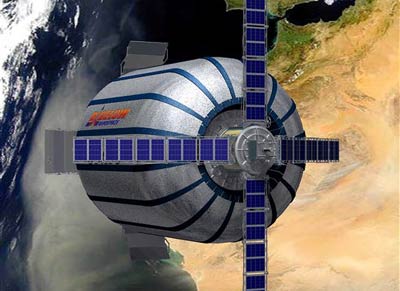
Private space company Bigelow Aerospace achieved a real milestone today with the succesful orbital launch of its research satellite Genesis I. It was launched in Russia on a converted ballistic missile. The Genesis is a scaled-down research prototype of an inflatable "hab" structure for use in a future commercial space station. Bigelow hopes to launch such a space station by 2015, but a lot of research on inflatables needs to be done first.

This was originally a NASA concept that Bigelow took over. If "inflatable" suggests floating around inside a thin mylar balloon, think again. It would really be a thick multi-layer structure that would inflate by a factor of roughly two, giving a very roomy space in space. There are some good pictures here and and a report on a visit to Bigelow here (not much on the Bigelow site, oddly enough). There's also a good article (from 2004) at the Space Review on "inflatable POOF's" (privately owned orbital facilities!) that discusses the origins of the idea and Bigelow's plans. I want to go!

Tuesday, July 11, 2006

STS-121 and Orbiter

I feel a little bad. Here I am a space freak, and I haven't blogged a word about the current shuttle mission to the ISS, STS-121 - a mission that seems to be going fantastically well, I'm happy to say. I was in Australia when Discovery launched, with limited web and TV access, so I missed the lead-up and the early details. There's no shortage of mission information at NASA and other sources, of course.

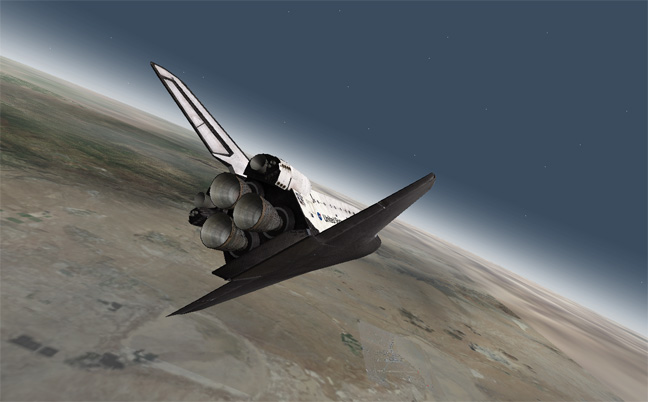
As usual, the Orbiter community has been following along, with a great effort by "David413" and friends to update the Shuttle Fleet add-on (e.g., Discovery 3.9.1) and to provide a huge STS-121 expansion pack to allow faithful simulation of the actual mission (check for updates to this). David has also provided a new add-on of the ISS in its current configuration (11A, the standard Orbiter ISS is the future, complete version).

Finally a reminder that Gene Harm has some of the best advice for flying the shuttle in Orbiter on his web site (including the pic above).

Monday, July 10, 2006

Making Flat Earthers Look Smart

As you may have gathered, I’m a space advocate, and in fact, I believe strongly with Tsiolkovsky that “Earth is the cradle of mankind, but one cannot remain in the cradle forever.” People should and will eventually also live in places other than Earth, and for a variety of reasons, I believe this is an important idea. I realize this is currently a minority viewpoint and that most people assume that human life begins and ends here on Earth. So it goes.

But what I didn’t realize until today is that there’s a big hidden assumption in the above beliefs: that it’s a good thing for human life to continue to exist at all. While I’ve heard of all sorts of beliefs, including those of people who demand the destruction of other people who don’t share their faith, and those of the occasional cult whose disturbed leader calls for mass suicide, I was not prepared for the bizarre beliefs of VHEMT, the Voluntary Human Extinction Movement. I learned about it today in an article in the Space Review (“Destroy all humans!”). Why there? I guess because this view represents the polar opposite of the typical space advocate’s view of “expand into space to spread and preserve humanity” – it’s “keep human life on Earth and let it become extinct.” VHEMT doesn’t advocate suicide or war, merely that we all stop having children and let the human race quietly go extinct.

I’m not sure why this weird movement bothers me more than, say, the Flat Earth Society, but it does. If you read the article and look further at the VHEMT web site (which claims to be serious), it’s clear that they represent an extreme form of Earth-first environmentalism (“Phasing out the human race by voluntarily ceasing to breed will allow Earth’s biosphere to return to good health.”) I’m all for preserving the environment and living in balance with our fellow creatures. But this idea that “nature” is the only thing that matters, and that humans are a kind of toxin whose main effect is to destroy nature– that’s just insane. We’re part of nature too!

Humans are animals that have evolved to be especially versatile in adapting to environments. Evolution gave us large, adaptable brains, and we have used them to extend our capacities beyond biology. We make use of culture and technology to adapt better than biology alone would allow. While we have been wildly successful at this, we have not always been kind to our fellow creatures (including fellow humans) and to our Earthly home. Through our numbers and our technology, we have “fouled the nest,” as they say. But we are also smart enough to finally realize this and to begin to take measures to overcome it. We have made mistakes in managing this planet, but our brains, culture, and technology can also give us the tools we need to fix the problems. Will we be successful? I think so, though it may take a while. Obviously not everyone is on the same page on this, and there are many competing problems and threats. We need to try a lot of things, including fixing up our environment, cleaner energy sources, reasonable population controls, and expansion into space – a backup plan, as it were.

Just as obviously, the VHEMT freaks don’t represent any sort of mainstream view, so I feel a little funny ranting about them like this. They aren’t going to convince many people to “cease to breed,” and since they aren’t advocating active measures to reduce the population (such as mass murder), they don’t seem to be much of a threat. But the fact that a group of people can seriously advocate the extinction of all human life as some sort of a desirable goal shows that humans can believe anything. And that’s scary! Unfortunately it’s not the scariest irrational belief that’s floating around the planet these days.

Eagle Eye View (Literally)

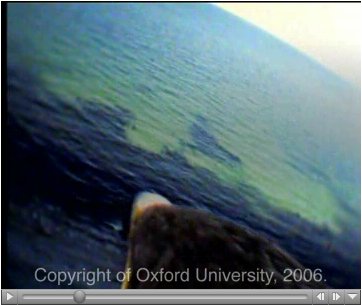
This is too cool! In the June/July issue of Europhotonics there is a brief article on research into the mechanisms of bird flight. Graham K. Taylor and Adrian Thomas of the Zoology Department of Oxford University (UK) are using miniature CMOS cameras and a motion measurement device mounted on the back of a trained steppe eagle to study the bird's movements and behavior in free flight! The cameras have built-in 2.4 GHz transmitters to send the video to a ground station. There is a news release that tells more as well as a brief Quicktime video clip (still frame above) that shows this literally eagle's-eye view as "Cossack" turns his head and then banks for the point where he is looking. Fascinating!

Saturday, July 08, 2006

Mars for Less: End to end!

I was relatively Orbiter-free during my two weeks in Australia, but Andy McSorley and Mark Paton have continued to work on the Mars for Less project for Orbiter and now have nearly completed all the esssential 3D and space flight modeling. They've done an amazing job on this project (we will release this as a free add-on for Orbiter in the next couple of months).

Mark has done extensive EDL (entry-descent-landing) testing, including aerocapture into Mars orbit, all the way to entry and landing, using two parachutes to limit entry loading to 3g (using only one chute allowed 5g, probably too much for astronauts who have been in artificial Mars gravity for six months - the tether-based rotational pseudo-G can be simulated in Orbiter too). Andy has worked out the Earth return part of the mission, launching the ERV from Mars to a parking orbit, trans-Earth injection (TEI), precision guidance back to Earth for aerocapture into low Earth orbit. Andy has put together a mission "storyboard" page of Orbiter screen shots on his web site (sample pic above, ERV departing from Vallis Dao).

This is all good fun if you're an Orbiter and Mars fan, of course, but the impressive thing to me is that Orbiter can model such a mission in sufficient detail to simulate aerocapture/EDL and even measure G loads and other flight data. This is why we are calling it "virtual prototyping of human Mars missions" for a paper we will present in a few weeks at the Mars Society Conference in Washington, DC. The MSC agenda is now on line (PDF). In addition to the Orbiter MFL virtual prototyping paper (Irving-McSorley-Paton-Bonin, Saturday, August 5 at 4 pm), one other MarsDrive related paper is scheduled, Regan Walker on the Drive to Mars (Saturday at 5 pm).

Friday, July 07, 2006

Down Under: The Book

Looking for something more to read on the long flight home from Sydney, I picked up Bill Bryson's Down Under (2001, apparently published in the US under the title In A Sunburned Country). Good choice. The only Bill Bryson book I had read before this was A Short History of Nearly Everything, which is a good overview of the history of science and technology. While that book had some humorous moments, I wasn't prepared for the laugh-out-loud flavor of Bryson's travel writing.

Bryson has seen a lot more of Australia than I could in just two short weeks, and he artfully mixes history, descriptions of nature and geology, a bit of politics, and encounters with everyday Australians in every corner of this huge, sparsely populated, and amazingly good natured and scenic country. While I would love to go back to Australia and see more of it, Bryson's book is a good way to extend the vacation right now. I'll have to check out some of his other travel writing too.

Thursday, June 29, 2006

Orbiter in Education: Amazing Site

I just have a few minutes here at a United lounge in Melbourne, but I have to comment on the Orbiter educational site Orbiter School by Falcoleprof who is an elementary school teacher in Quebec. He is using Orbiter in his classroom and has built a "cockpit" for this purpose (see this forum thread), which he demonstrates in a new video. Fantastique! I will write more about this when I have a chance. Have to catch a flight now.

Sunday, June 25, 2006

Do you blog from the Land Down Under?

It's a tribute to the meme-like power of pop music that one of my strongest associations with Australia is the 1982 song "Land Down Under" by Men at Work. Now that I'm finally here for a couple of weeks, I'm hoping to explore a bit and to form some stronger associations, but not necessarily to try a vegemite sandwich.

One thing I usually do on vacation trips is read a lot, and the current book is the excellent Mapping Mars by Oliver Morton (subtitled "Science, imagination, and the birth of a world"). I really like the way he connects the historical, scientific, and literary Mars, including a chapter on Mars in science fiction, mostly focused on Kim Stanley Robinson's Mars Trilogy. Robinson was heavily inspired by the 1984 book The Surface of Mars, by Michael Carr (who also gets a chapter, "Mike Carr's Mars"). Based on Viking imagery and data from the late 1970's, Morton says it is "...still unrivaled as a single-author survey of the subject." The coherence and completeness of this work apparently helped Robinson to imagine and portray Mars as a believable place. Morton's book adds greatly to this sense of Mars as a real place and connects the many threads of astronomy, geology, space science, technnology, and imagination that allow us to think of Mars as a world and not simply a planet.

Thursday, June 22, 2006

Mars Art

I just happened to notice this very cool painting which I had downloaded as wallpaper a while ago. "Chasm" (large version here) is an imagined Mars scene by an artist named `Alyn who has quite an impressive array of space-related and other imaginative work in his gallery at DeviantART - which is a very interesting site in general.

I may be posting occasionally from the Southern Blogosphere the next two weeks, or maybe not - it all depends on how our vacation goes. I'm looking forward to finally meeting some internet friends and to seeing some views of the stars down under.

Tuesday, June 20, 2006

Flash! The End of the World!

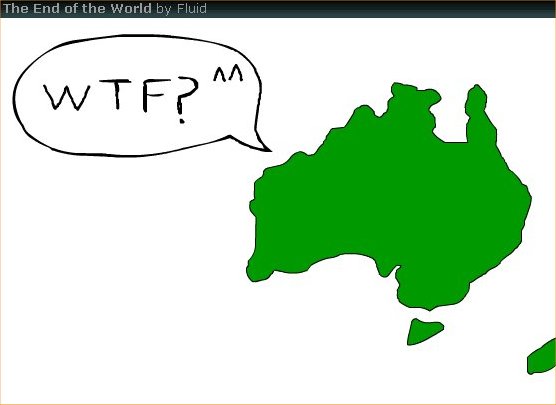
No worries, it's not really ending just yet. That's Macromedia Flash, and The End of the World is just one of my favorite Flash movies. OK, it's about the end of the world, it's got a few naughty words, and it's really funny. WTF, mate?

Monday, June 19, 2006

Orbiter web: Le Monde d'Orbiter

Orbiter users are wildly international, and the French-speaking community is especially active, with a number of talented add-on builders and a strong presence on the web. I can still read French fairly well, but thanks to tools such as Google Translate or Babel Fish, there is no reason to miss out on a useful web site just because you don't read French. Here are a few pointers.

  • DanSteph is the author of the essential add-on Orbiter Sound 3.0 (bilingual site).
  • Mustard has just announced a new home, "the web site of Francophone addons" (mostly English) with a lot of great stuff. The picture above is from the extensive simulation of the Kourou launch site by Papyref and Mustard.
  • Orbiter News is a kind of blog or Orbiter news site with a lot of information about add-ons, including pictures and links to tutorials and missions. I just found this and it's really good (not exactly sure who the author is).
I know there are other Francophone Orbiter sites - you can find links to them on the above sites. To all the French-speaking Orbiter community: merci beaucoup!

Saturday, June 17, 2006

Pesky Peroxides & Pingo Hills

The Martian Race is a 1999 book by Gregory Benford (paperback published in 2001). Benford is a physicist and an excellent writer of science-based "hard SF," and this book is no exception. Its subject is a near-future race for Mars in pursuit of a $30 billion "Mars Prize," and it is heavily based on Robert Zubrin's "Mars Direct" plan (although a second party in the race uses a somewhat different approach). I read the book last summer, but it came up recently in a discussion over at MarsDrive. This led me to dig it out, and with my recent interest in the Mars for Less add-on in development for Orbiter (and Mars in general), I've decided to read it again, probably next weekend on a long flight to Australia (where one of the Mars astronauts in this book happens to be from).

Skimming through the book just now, I was reminded of how rich and (literally) gritty this book is -- not only in the science, but in the details of early Mars exploration done on a (relatively) shoestring budget with hardware that is basically what we can do today. It's not easy. The gritty and corrosive "pesky peroxides" of the fine Martian dust get into everything. Hardware breaks down. People are injured. But the pingo hills finally yield water (pingos are buried mounds of ice as found in Earth's arctic regions). There are real surprises, and even the seemingly less probable surprises are handled in a plausible way. This is a really good book that I'm looking forward to reading again.

Note: The picture is the cover of the 1999 hardcover, but I like it better than the cover of the paperback edition I have.

Friday, June 16, 2006

Carbon Based Life

I talked about "future creep" back in November 2005, and since I subscribe to the KurzweilAI.net newsletter, Wired Magazine, and MIT Technology Review's Emerging Technology weekly update, it's not surprising that I see a steady flow of innovations in my inbox. Carbon nanotubes (CNT) seem to figure in many developments these days, and not only those about space elevators (a personal favorite future application) and CNT computers.

Case in point from a recent MIT report: the use of arrays of carbon nanotubes to form a membrane that can be used to efficiently filter and desalinate water. The fresh water supply is a huge and growing problem in many places in the world, and while desalination is basically a simple process, it requires a lot of energy. This CNT membrane method could reduce the cost by 75% compared to current reverse osmosis methods. Carbon is amazing stuff.

Thursday, June 15, 2006

Valuable Public Service

My daughter loves South Park (I think it's pretty outrageously funny too). She introduced me to a web page that lets you generate your own South Park characters. I thought it would be a valuable public service to post this link (Flash required) in my blog. The character with Mars on a black t-shirt was just a test. It looks nothing like me. Mars was added by hand. Yes, that's Phobos passing over Mars.

Tuesday, June 13, 2006

Hawking: What if the Sky DOES Fall?

Vespucci-D at Mars with Delta Glider
I just saw this AP news item, reporting some comments made by famous British astrophysicist Steven Hawking at a news conference in Hong Kong. Hawking believes that we face grave risks from a number of directions, and says, "It is important for the human race to spread out into space for the survival of the species."

This is not the first time Hawking has made such comments - he was criticized for making similar "apocalyptic" remarks in 2001, shortly after the 9/11 attacks. But basically, he's right. We really need to have a backup plan in case the current "one planet solution" doesn't work out and world-wide disaster strikes, destroying civilization or much of it. Whether such disaster might occur through relatively slow environmental effects, or through deliberate or accidental destruction by means of engineered viruses, nuclear weapons, or other as yet unknown means (even an asteroid strike), I believe it could happen. It's not certain to happen, but it could, and if it does, colonies in space (Moon, Mars, and perhaps engineered asteroids or artificial colonies built from lunar materials) would allow some people to survive to rebuild civilization.

Does this sound crazy? I would have thought so a few years ago. I'm basically an optimistic and solution-oriented person, not a hand-wringer or a Chicken Little. I was somewhat concerned in the 1980's when the US and then USSR held each other (and the world) hostage with thousands of nuclear weapons. Ronald Reagan played chicken with the Soviets and won, spending them into bankruptcy, and in retrospect, while there was danger, the two main parties truly did consider "mutual assured destruction" to be MADness.
But not everybody feels this way. There are many in this world who believe that this is just a rest stop on the way to paradise (for some) and to hell (for the rest of us). Some of these people would not hesitate to pull any available trigger, even if it meant that they too would be destroyed (see my post from the other day). Just because science fiction writers have written the most about such terrible futures doesn't mean that such a terrible future is science fiction (my favorite books in this vein are the Meme Wars series by John Barnes).

This is one of the reasons I'm a space advocate - call it rational escapism. But I have some fear that Hawkins' estimate of a permanent Moon base in 20 years and a Mars colony in 40 may be optimistic unless we get really, really scared (think Manhattan Project). I've read and seen in recent days with our Mars for Less project for Orbiter how hard it is simply to enter and land a 30+ metric tonne crewed spacecraft on Mars under realistic (simulated) conditions. That Mars atmosphere is mighty thin stuff! But I remain hopeful.

N.B. (June 14) Greg Burch has an interesting post today on Hawking's remarks.

Monday, June 12, 2006

Mars Needs Women!

Vallis Dao Astronaut Test #1
Mars Needs Women is the title of a 1967 B-movie starring Tommy Kirk, but this post has nothing to do with that movie (which I have never seen). What I really mean is that Mars for Less for Orbiter needs virtual crew members for our Mars base (which is at Vallis Dao, mainly because there is a nice 3D terrain add-on for this region of Mars).

Greg Burch has created a whole series of Orbiter add-ons representing late-century space technology, and he has modeled some astronauts and other crew members to use with his spacecraft and space stations. This is pretty unusual among Orbiter add-ons - although Orbiter supplies a "NASA MMU" astronaut to simulate EVA's, most Orbiter add-ons are ghost ships, without a crew member in sight. Of course Orbiter is more concerned with ship performance and orbital mechanics than with simulated crews, but I like to see some people if only to provide a sense of scale. Greg has graciously allowed us to borrow the four futuristically-garbed astronauts (2 female, 2 male - Mars needs men too) from his EVA Pack add-on. Thanks Greg!

Sunday, June 11, 2006

The Danger of Certainty

As long as it is acceptable for a person to believe that he knows how God wants everyone on Earth to live, we will continue to murder one another on account of our myths.
-The End of Faith (page 134)
The End of Faith by Sam Harris (2004) is a disturbing and important book. It's a basic tenet of nearly every religion that "ours" is certainly the true faith, while "theirs" is at best wrong, and at worst a threat to people of the "right" religion. What action one may take on the basis of this certainty varies considerably over time and between religions. Many religions coexist peacefully with others, while some label non-believers as "enemies of God" who are worthy of discrimination, abuse, and even torture and death. Examples abound, from the Inquisition to the Salem Witch Trials to the 9/11 attacks and daily suicide bombings in Iraq.

Harris argues that with the modern availability of "user friendly" weapons of local and even mass destruction, faith itself has become a danger. This does not apply only to Islam (the obvious modern example of the dangers of certainty). Religious based "reasoning" and influence on government leaders threatens scientific education and potentially life-saving medical research even in the U.S., where religious freedom allows one to follow the religion of one's choice (or more likely one's parents' choice), but where it is politically unwise to question the importance of some sort of religious faith, or to suggest that religious faith itself is dangerous.

Terrorism by Islamic "extremists" is the most dangerous example of faith run amok. The strange thing is, the extremists are not all that extreme. They are pretty much going by the book, truly doing what they believe to be best for their people, their God, and themselves (as martyrs, immediately bound for paradise). As Harris says,
The men who committed the atrocities of September 11 were certainly not "cowards," as they were repeatedly described in the Western media, nor were they lunatics in any ordinary sense. They were men of faith - perfect faith, as it turns out - and this, it must finally be acknowledged, is a terrible thing to be.
Amen. Please read this book.

Saturday, June 10, 2006

More "Mars for Less"

Ariane-5 Launch Kourou
Andy McSorley and Mark Paton have been working steadily on the Orbiter models for our Mars for Less (MFL) virtual prototype. Most of the major components are complete and have been tested independently. On the Flickr pages, I've shown a number of shots of Andy's work with the Ariane-5 launch vehicle and his "Proteus" modular boosters, plus some of my tests with using tethers and small "droid" spacecraft to assist in (simulated) remote-control orbital assembly of these modules.

I've also shown a few examples in this blog of Mark's prototype MFL spacecraft, with which he has been doing Mars aerocapture and entry tests as well as modeling. We decided to "fatten up" the crew vehicles by assuming a larger launch fairing for the Ariane-5 (or other MLLV that might be used to launch these components). Mark is completing work on this now, so we will soon be able to perform "integration testing" and start capturing data, pictures, and video clips for the paper we will present at the Mars Society Conference in Washington, DC in August (Andy's picture above is a preview of the all-up Mars spacecraft with Francis Drake's CEV docked to deliver the crew). Once the paper is out of the way, we will clean up and document the whole lot and release it as an add-on for Orbiter users to play with. Note that we are making use of various other add-ons as part of these efforts - these will be referenced and credited in our paper and in the eventual release documentation.

The process of turning Grant Bonin's MarsDrive Mars for Less reference mission into a virtual prototype has been an iterative exercise through which Andy, Mark, Grant, and myself have learned a lot about spacecraft, launch vehicles, and Mars mission design. It has identified various design issues that we have been able to visualize and solve using Orbiter (it helps that both Andy and Mark are able and quick when it comes to 3D model building for Orbiter). This is really the point of our paper - that Orbiter is a fantastic, easy to use, and quite accurate tool for such virtual prototyping. It's also educational and fun (and it's free).

Sunday, June 04, 2006

The Force Is Strong In This One

Tethered Modules with Thrust Display
One more thing with the tethers and I'll let it go for a while. A pair of tethered modules coupled and interacting in various ways in LEO is a perfect chance to try out visible force and torque vectors, a new "visual helper" (Control-F9) feature in Orbiter 2006. In the picture above, the gray vectors are total force (F, mainly gravitational for the background module, pointing toward the Earth's center), and the blue vector on the foreground module is thrust (T, from a 360 kilo-Newton pulse of main engines, which is adding to the other forces to shift the resultant force toward the other module). Lift and drag vectors are not relevant above the atmosphere (these are cool to see on the Delta Glider flying around in the atmosphere). The magenta torque vectors are also not visible here - magnitude too small at this particular moment (see Flickr for another example showing torque).

Forces and motion made visible on your PC screen. Orbiter is a physics lab in a fancy 3D space suit!

Saturday, June 03, 2006

Thinking Physics

One of the secrets of doing physics is to keep in mind what you don't know. The trick is to get from what you know, to what you want to know, without going through what you don't know.
-Thinking Physics (page 300)

I don't know why I never bought this book before - I've looked at it a dozen times over the years. This time I had a 30% coupon at Borders, saw it again in the science section, and here it is.

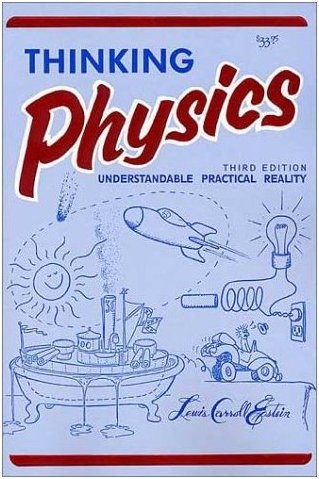
Thinking Physics by Lewis Carrol Epstein is a wonderful book, full of (seemingly) simple and occasionally complex physics problem, most inspired by everyday objects and situations. You're supposed to think about the problem and try to solve it before looking at the answer. In many cases, the "obvious" answer is wrong, and Epstein's explanations show you why, and also show you how the right answer is really intuitive if you think about it the right way. There is very little math here - problems are solved by physical reasoning, analogy, symmetry, and various heuristics, supported by simple sketches.

This is the Bathroom Reader for science nerds, but you don't have to be a science nerd to enjoy and learn from it. I'm an optical engineer, but I find that I'm learning or re-learning things about light that I thought I understood (or perhaps understood in an equation sense). This book helps you to see even familiar things like shadows and mirrors in new and fascinating ways.

Thursday, June 01, 2006

Pull Yourself Together

Tether Droid #2
We have two possible uses for tethers in our Mars for Less project for Orbiter. One is to generate artificial gravity for the crew by spinning their spacecraft on a long (~1.5 km) tether connected to the spent final stage. The other possible use is in connecting the modules of the Mars-bound spacecraft in low Earth orbit. My idea here is that even if all the modules have thrusters (and some may not), using thrusters for final maneuvering could be tricky and possibly risky, especially if it is being done semi-autonomously (with remote control assistance from ground controllers). Tethers with electric spoolers could be used to slowly pull the modules together once they are roughly aligned and within (say) 100 meters. The Tether MFD add-on for Orbiter (by Matthew W) does an amazingly good job of simulating the tethers and the coupled behavior of the connected spacecraft (the motion can easily get away from you, and stopping it is not simply a matter of pressing the "kill rotation" button). I actually docked two nearly-aligned propulsion modules using only the tether force, no thrusters.

If there are no astronauts on the scene (though there might be for critical assemblies), how would the ends of the tethers be connected? One idea would be to use small, short-range, remote-controlled satellite "droids" to grab, extract, and connect the tethers to their attachment points once the spacecraft are close together. Several of these small robots could be used to provide multiple viewpoints (with on-board cameras and laser rangefinders) for the ground controllers doing the assembly. I used Chris Johnston's Aercam/Sprint add-on to simulate this in the picture above. More pix on Flickr.

N.B. I just noticed a new NASA article about tiny "droid" satellites to be tested on the ISS - it even mentions the idea of orbital assembly, but not tethers. One of three of the small test "droids" is already aboard the ISS (the red one - blue and yellow will come aboard with STS-121 whenever that flies).

Monday, May 29, 2006

Stellarium: More Stellar Freeware

Stellarium Constellation Art
Stellarium is a wonderful freeware program that I learned about from Gene Harm's astronomy and Orbiter web site. I played with it for a few days last year but quickly went back to Orbiting. But this weekend, with the help of a couple of books and relatively clear late spring skies, I started my remedial astronomy program, then rediscovered and reinstalled Stellarium.

Stikky Night Skies performed as promised for both my wife and myself - we quickly learned to spot and use as guides the Big Dipper, Orion, Cassiopeia, and Taurus, as well as a few key stars (Polaris, Betelgeuse, Sirius, Vega). Although some of these objects were already pretty familiar, we had never really used them as guides to finding other things in the sky. Some of the paper exercises were tricky "Where's Waldo" adventures with hundreds of simulated stars in various orientations. When it was time to test our new skills, the skies cooperated and we were able to spot the expected constellations and stars in our back yard (Orion and Sirius remained out of sight due to the season). Jupiter was also quite bright in the southern sky. But what were some of those other stars? A "Star Finder" wheel helped us to identify Arcturus, but there were others that we still weren't quite sure about.

Enter Stellarium. It shows an accurate and easily controlled and configured view of the sky for any desired location, date, and time. It also allows you to speed up time, configure labels, and much more (the picture shows the optional constellation art overlay - more screens at Flickr). Very cool. The sky is starting to make a lot more sense.

Saturday, May 27, 2006

Stikky Remedial Astronomy

I found another great book for remedial astronomy. Stikky Night Skies, published by Laurence Holt Books (no author listed, apparently a team effort). The subtitle is "Learn 6 constellations, 4 stars, a planet, a galaxy, and how to navigate at night - in one hour, guaranteed." That's a tall order, but it comes through with an innovative visual approach to presenting and reinforcing the information. There are two other books in this Stikky series (trees and stock charts, oddly enough), and it looks like there are more on the way.

I like this approach - taking a small chunk of knowledge and presenting it in a sequential, visually oriented, and easy to follow way. The nice thing about the sky version is that in addition to some easy to attain goals, it gives you a framework for exploring and learning more of the sky. By combining this with The Backyard Stargazer, I think this can be the summer that my daughter and I finally learn our way around the sky. We tried a couple of summers ago with a few nights of meteor shower watching and an ill-advised telescope purchase. This naked-eye approach looks much more promising.

Thursday, May 25, 2006

Orbinauts Who Blog and Flickr

Soyuz by DarthVader
While it's obvious that there are vast numbers of "space blogs," it turns out that there are also a few others that are focused on Orbiter, so I decided to finally bring this to the attention of my readers (both of you).

The original idea for this blog came from DarthVader's Fly Me To The Moon. Darth's original goal was to learn about Orbiter and space history by going through all the Apollo missions in chronological order. I think he got as far as Apollo 7 before he was drawn to the Dark Side and became an Orbiter add-on developer focused on Soviet era rockets and spacecraft (that's not really especially "dark," but come on, Darth Vader?). He's got some amazing works in progress as shown in the Soyuz picture above, with more examples on his Flickr site.

VLA/CXV by Kodiak
Another blog I just discovered actually pre-dates mine, Kodiak's Space Contraptions. Kodiak has done a number of cool add-ons for Orbiter, but his latest one (soon to be released) looks amazing. It's the air-dropped booster and crew transfer vehicle (CXV) from t/Space. More pix on Kodiak's Flickr site.

There are two other notable Orbiter-related Flickr sites that I know of, Simcosmos (with add-on development and source pix as well as Orbiter shots) and Sir Mildred Pierce (some 30 very cool Orbiter screen shots).

Wednesday, May 24, 2006

Bay Mir Bistu Sheyn

NASA STS071-744-30Mir Orbiter Blue Test #1
The Yiddish title above is that of a song that was a big hit for the Andrews Sisters in 1938. It means "to me, you're beautiful." I'm not sure that the late Russian Mir space station was exactly beautiful, but it must have been a striking sight at the very least.

I saw the photo above (left) in a book of photographs by NASA astronauts, and I tracked it down on the web. It was taken from the Atlantis on STS-71 in July 1995. I decided to see how well I could match it in Orbiter, using EndeavorCmdr's very cool atmospheric enhancement (basically a new horizon texture and adjustments to some atmospheric color parameters in the Earth.cfg file). While the clouds and Mir's orientation aren't quite right, the overall look is pretty close. You can see larger versions of the photos at Flickr (the NASA photo is only available at 640x480 as far as I can tell, and I have cropped it).

Tuesday, May 23, 2006

Mars for Less: The Blue Period

Ariane SRB Sep
I've been working with Andy McSorley, Mark Paton, and Grant Bonin on an Orbiter add-on to simulate the MarsDrive Consortium Mars for Less (MFL) mission (work in progress, more info here). Andy just sent over his latest mods to the Ariane-5 booster (I like the logos) and his "Proteus" modular booster stage. Four of these 25 tonne modules will be assembled (possibly by remote control) in LEO and mated to one of two Mars bound spacecraft, the initially uncrewed ERV (Earth return vehicle) or the crewed MTSV (Mars transfer and surface vehicle). The spacecraft are Mark's area, still in progress (I've shown some sneak previews in earlier posts). For the complete MFL story, see the MarsDrive web site.

I installed EndeavorCmdr's recent "atmospheric realism" enhancement, and while it does have a few small artifacts I'm not sure about (e.g., the visible steps in the horizon gradient), those deeper blues do make the screen shots a lot more reminiscent of astronaut photos of the Earth (especially from the Gemini era). More pix on Flickr.

Sunday, May 21, 2006

Essential New Controls for Orbiter 2006

Weighing in at a mere 8.1 KB, Artlav's new InterMod autopilots module packs a lot of punch. Just updated for Orbiter 2006, this add-on is simply a small DLL that gets activated in the Modules tab of the Orbiter launchpad. It doesn't require an MFD and doesn't have any on-screen display (other than a switchable debug readout in the lower left corner of the screen).

What it adds is several new autopilot command keys analogous to Orbiter's built in ones such as kill rotation, horizontal-level, and auto hover. One is "kill translation" (numpad-7) which is an analog to kill rotation (numpad-5) and which zeroes out translation components relative to the nearest vessel. Other keys include V for vertical auto-hover (used to hold a "tailsitter" spacecraft which lacks hover engines in an automatic hover using the main engines) and C which holds vertical orientation (i.e., nose pointing at zenith, typically used with V). There are also finer resolution controls for hover engines and a few other features. Simple but elegant.

Mars Flights, Radiation, and Discover Magazine

I like Discover magazine, but I have to accept it for what it is - "science lite," more or less. Because it tends to be detailed and technical, science can be a tough sell for the general reading public. Discover's approach is to focus on the human interest side of science stories, without a lot of technical detail. And for me, that's OK for most subjects. I know it's not the final word, but I learn about a lot of things in more depth than I usually get from the web or Newsweek.

But sometimes Discover's approach can be overly dramatic. The cover story (subscription required) of the June 2006 issue features the headline "Are we trapped on Earth? Why cosmic rays could prevent us from leaving" (i.e., leaving for long-term flights to Mars and beyond). The story (which features some great Mars surface photos) refers to new research on galactic cosmic rays and suggests that these heavy, energetic particles might contribute not only to long-term cancer risk, but also cause short term and potentially debilitating damage to human organs, most alarmingly to the brain.

The key term here is might - the article mentions some of this recent research but mostly summarizes issues and concludes that there are a lot of factors that aren't known very well, some of which might interact with other factors, and some of which could be pretty scary if they happened.

In The Case for Mars, Robert Zubrin talks about "killing dragons" that seem to bar the way to human flights to Mars, radiation being one of them. Zubrin estimates that the average radiation dose people will experience over a 2.5 year Mars mission (from cosmic rays and solar flares) is on the order of 50 rem, a non-trivial amount that could significantly increase the risk of various cancers, but comparable to other risks that many people take on voluntarily. He estimates that long-distance airline crews might receive half of this dose over a 25 year flying career (around 1 rem per year, 2 rem/year is a recommended limit mentioned here). This 2005 paper (PDF) suggests a similar figure, but notes that there are many factors (e.g., solar maximum vs. minimum years, time of exposure, etc.), though it also points out that cosmic-ray intensity has varied considerably over time, and that data collected since the space era are not necessarily typical (e.g., estimated shielded dose levels in 1954 would have been ~62 rem). This 2004 NASA article ("Can people go to Mars?") gives some other perspectives. Note that a large proportion of the exposure (~75%) would occur in transit, since the atmosphere of Mars and simple shielding measures on the surface would provide substantial protection (even though Mars lacks Earth's protective magnetic field). Also see Health Physics Society FAQ on space and radiation here.

My point is not that radiation exposure on Mars missions is a trivial matter, or even that it is completely understood. More research is clearly needed, and many experts believe the risks can be moderated by various technical measures. Even if they remain fairly high (as are many aspects of space flight), there will still be people willing to accept these risks as part of the price of exploration of the Solar System.

Note added on May 25: Excellent discussion of this topic at Hobbyspace here.

Monday, May 15, 2006

Orbiter web: 2006 Manual in Russian

I took four semesters of Russian in college, a bunch of years ago. I really liked it and did well, but unfortunately never got to use it for travel (unlike Japanese and French), so I forgot all but a few phrases. One of them is "gde moy brat," but unless one of my siblings is kidnapped in Russia, "where is my brother?" is not a very useful phrase.

So even though it's not very practical for me, I think it's really cool that a Russian translation of the Orbiter 2006 manual is already available, thanks to Yuri "Kulch" Kulchitsky. Kulch is an amazing Orbiter add-on developer who really likes to "push the envelope" of what it's possible to do in Orbiter. In addition to "conventional" boosters such Energia, he has developed exotic systems such as mass drivers, winged boosters, and even a space elevator. Most of his add-ons are available at Orbit Hangar, but his web site has more information on works in progress as well as a screen shot gallery. Spasiba, Kulch!

Sunday, May 14, 2006

Orbiter Web: Simcosmos

Simcosmos (António Maia) is an Orbiter add-on developer who also maintains the most complete collection of links to the many Orbiter-related resources on the web. From his base in Portugal, he develops and launches Orbiter models of NASA's planned CLV (crew launch vehicles) and many other experiments.

Recently he added a Flickr site where you can easily browse pictures and descriptions of his various projects (sample above). Thanks to Simcosmos for his many contributions to the international Orbiter community!Publish

Friday, May 12, 2006

Mars Labels and Clouds (Orbiter 2006)

Mars North Pole with Labels
Feast or famine - three posts in one day? Maybe if I type fast (almost midnight).

Mars gets some really nice treatment in Orbiter 2006. Thanks to Seth Hollingsead (Iceversaka), the hi-res distribution offers amazing (but gigantic) level 10 Mars textures, as well as a standard level 8 with a level 10 area around Olympus Mons (I think he now has a level 9 as well, check his web site). Even the level 8 is quite nice, and with the addition of a large set of configurable surface feature labels (Control-F9), you can get to know Mars as you fly around in Orbiter.

There are no clouds by default, but VF2_Rolf has some great cloud textures (especially #5) that work with Orbiter 2006 with just a small configuration file fix (available on his site). They make subtle but noticeable difference in the realism of Mars. Thanks to Seth and VF2_Rolf for making Mars a nicer place to visit in Orbiter 2006!

North pole shown with labels - more new Mars pix on Flickr.

Now is a good time to explore

The headline comes from an impeccable source: a fortune cookie. Fortune cookies are an excellent source of random phrases that mean pretty much whatever you think they mean. But this one is right. Here’s another one.
One day, I don't know when, but one day, there will be more humans living off the Earth than on it.

That’s not a fortune cookie, that’s NASA Administrator Mike Griffin quoted in Rolling Stone (February 23, 2006). That article was pretty much mocking the whole humans in space endeavor, but I think he’s right too. And how about this:
It’s really incumbent on us as life’s agents to extend life to another planet. I think that being a multi-planet species will significantly increase the richness and scope of the human experience.
That sounds like Kim Stanley Robinson’s character Hiroko in Green Mars (though too wordy and not quite mystical enough for her). But it’s actually Elon Musk, founder and president of SpaceX (in an interview in the summer 2006 issue of Ad Astra). It’s tough work building completely new launch vehicles and spacecraft that will eventually lower the cost of access to space, but Elon and his team are working on it.

And I’m working on it too, in a much smaller way. Writing Go Play In Space to help people learn to use Orbiter was a start – Orbiter is an immersive simulation of many aspects of spaceflight, allowing a “hands on” approach otherwise unavailable to anyone outside NASA or ESA. I think Orbiter can really help to build interest in spaceflight. This week I was pleased to accept the position of Educational Outreach Director for the MarsDrive Consortium (MDC). I had been working with Grant Bonin, who previously held this position along with “Missions Planning Director,” a bit too much for one person.

The basic educational outreach task is “education of the public on the merits of unmanned and manned space exploration with an emphasis on Mars,” and this needs to be focused and turned into actions and materials, which I will be working on over the next few months. If you have an interest in scientific and technical education with an emphasis on space, please consider joining MDC and contributing your efforts to this or to one of MDC’s other task forces. There’s more than one way to get to Mars, and now is a good time to explore.

Evolution - Because It Works

I've been busy with a lot of things and I have a backlog of "space stuff" to blog about but just haven't had time. Perhaps this weekend, but in the meantime, I really like this essay on evolution. It's interesting that few seem to object to the theories of gravitation or relativity (or at least their applications) that allow such marvels as GPS to work (though I'm sure there is an alternate theory somewhere, perhaps navigation angels to keep the GPS satellites in orbit?). Proponents of so-called intelligent design even accept (or will at least take if they are sick) antibiotics and other drugs which are designed based on detailed understanding of bacterial genetics and practical application of the theory evolution (evolution is how bacteria develop resistance to antibiotics among other things). But they reject the idea that evolution also applies to humans, even though we share our genetic code with all the other living things on this planet.

I really don't get this selective approach to scientific theories. Scientific theories are judged on their predictive, practical value, and evolution is applied practically in drug development and many other areas of medicine, biology, animal and plant breeding, etc. every day. But supposedly humans are exempt. At least in Kansas.