 I watched NASA TV for a couple of hours this evening, culminating in the beautiful night launch of the shuttle Endeavour on STS-126. I would sure like to see a night launch in person, but I'm not sure I'll be able to work that out before they retire the shuttles in 2010 (or maybe later if they decide to fund some additional missions, as President-elect Obama had discussed during the campaign - before the current economic crisis). At least I got to see one shuttle launch, which was also Endeavour (on STS-118 back in the summer of 2007). An awesome experience.
Friday, November 14, 2008
Night Launch
I watched NASA TV for a couple of hours this evening, culminating in the beautiful night launch of the shuttle Endeavour on STS-126. I would sure like to see a night launch in person, but I'm not sure I'll be able to work that out before they retire the shuttles in 2010 (or maybe later if they decide to fund some additional missions, as President-elect Obama had discussed during the campaign - before the current economic crisis). At least I got to see one shuttle launch, which was also Endeavour (on STS-118 back in the summer of 2007). An awesome experience.


Planets!
 If you pay attention to space and astronomy news, you've certainly heard about this already - it was even a top five popular news items on Yahoo earlier today. But I have to chime in to say that direct imagery of planets orbiting stars other than the sun is simply an amazing accomplishment, one that I didn't expect we would see for a few more years. But thanks to the ever amazing Hubble Space Telescope and the wonders of adaptive optics coupled with large ground based telescopes, we've now seen exoplanets "with our own eyes"- four planets orbiting two different stars!
"With our own eyes" is not literally true, of course, but compared to inferences made from photometry curves (when a planet passes in front of the star, the star's light dims) or gravitational "wobble" (tracking small deviations in the star's position caused by orbiting planets), this is truly the realm of "seeing is believing." It opens the door to spectral analysis of the light reflected from these faraway planets, and although we can only see quite large planets now (several times the mass of Jupiter), it may not be too long before we can detect a "pale blue dot" like the one seen by the Voyager spacecraft when they looked back toward home en route to the outer planets of our solar system.
I grabbed today's Astronomy Picture of the Day for the nice labeling of the planet Fomalhaut b and its accompanying dust ring. Talk about a needle in a haystack! This is a planet that is 25 light-years from Earth, pretty much a next door neighbor in the the cosmic scheme of things.
Thursday, November 13, 2008
Beyond the Moon
 The Planetary Society has released a "Roadmap to Space," a free 20 page PDF document on the future of human spaceflight that proposes an approach somewhat different from the Vision for Space Exploration. Under the Vision, NASA seems to have become fixated on returning to the moon, with Mars and anything else in the solar system as mere afterthoughts. This "roadmap" (actual title "Beyond the Moon") still supports NASA building the Ares launch vehicles and the Orion spacecraft, but bypasses the moon as a primary target or even a necessary intermediate stage.
Instead they propose that Orion be modified to support flights "beyond the moon," most likely to visit near-Earth asteroids (NEA's, as discussed here) as a way of showing that we can move beyond duplicating what we did 40 years ago with Apollo. They claim we could save money by deferring the building of lunar bases and the new lunar lander. Mars would be the explicit ultimate goal, with moon landings to be done in the interim only as needed to prove out landing systems and the like. Deep space missions to NEA's might better prepare us for the long flights needed for Mars, though I would want something a bit more roomy than Orion for any multi-month mission.
Many people think the moon is interesting in its own right, as a possible source of materials and as a large and stable platform in near-Earth space. But there is a certain allure in doing something totally new... boldly going where no man (or woman) has gone before. The Planetary Society's pitch is clearly aimed at the new president, in hopes that he will refocus the Vision on something really new, and in the process get more people interested in the space program (and fund it, too). I'm not sure if we can sneak past the moon or not, but trying for something farther out would certainly result in more robust and flexible systems for long-duration spaceflight (some of which could be tested on the ISS). Whether the public imagination can truly be engaged with long space voyages to small objects depends a lot on how it's done, and on how much involvement the public can have. Maybe NASA can learn some lessons from the Obama campaign in building a base of support through the internet.
Wednesday, November 12, 2008
Landing with Lasers
 One of the things that's nice about spaceflight in the simulated solar system of Orbiter is that you always know exactly where you are and how fast you are moving in 3D. It's easy since this is the information that the program is numerically predicting with every tick of the simulator clock. It can simply use coordinate transforms to express your position and speed relative to the body you are orbiting or trying to land on. Piece of cake.
In real life, knowing your position and velocity is not quite so easy. On or near the Earth, you've got GPS, and ground based Doppler radars can measure position and speed with quite good accuracy even as far away as the moon. Going the other way, ground based receivers can determine a lot of information from the radio signals transmitted by even very distant spacecraft. JPL obviously has this down, since they routinely maneuver the Saturn-orbiting Cassini spacecraft to pass within a few kilometers of Titan and the other moons of Saturn.
But what about landing on the moon or on Mars? The Apollo lunar module used radar to provide ground reference data down to a few tens of meters altitude when the commander would take over to manually avoid boulders and craters and land safely. Future lunar landers will need to land accurately even without a pilot on board (there will be unmanned cargo flights). So they will need very precise position and velocity information.
 Fortunately we have optics. Laser radar (LIDAR) can use pulsed lasers to measure distances very accurately, but for a new lunar landing laser system, NASA will use three continuous-beam lasers and is applying the Doppler technique to get continuous and more accurate velocity information as well. In an optical context, the Doppler shift shows up as a very small "red shift" or "blue shift" in the wavelength of the light that bounces off the surface and is collected by the receiver lenses. And this is only part of the story - you will still need other systems to image and evaluate rough terrain and obstacles. The Technology Review article doesn't go into too many details on the method, but it gives a good general idea of how a laser system like this will guide future astronauts to precise and safe landings on the moon and eventually on Mars.
Tuesday, November 11, 2008
Farewell Phoenix
 The Mars Phoenix mission is over. It was planned for three months and lasted for five, but as a fixed robotic lander in the north polar region of Mars, there came a point where its solar panels simply could not produce enough power from the low sun to keep it going, even with special power management techniques like selectively shutting down parts of the spacecraft to save power for other systems. So this really isn't a surprise and Phoenix accomplished a lot of good science in its time, doing experiments 149 out of 152 days. The picture above is from Orbiter (the excellent Phoenix add-on by Brian Jones).
If all goes well (including funding), NASA will launch another Mars visitor in fall of 2009, the highly mobile Mars Science Laboratory, a Mars-ready "SUV" with the heart (and brains and instruments) of a planetary scientist. MSL won't be dependent on the sun to keep its wheels rolling, its instruments warm and measuring, and its radios transmitting.
P.S. The Astronomy Picture of the Day for November 12 has a brief summary of the Phoenix mission including some good links.
Amie Miriello
 Serendipity strikes again. Amie Miriello is a young singer-songwriter from Connecticut. I saw an ad for her album in the new Paste Magazine (OK, the smile in that picture might have caught my eye). I quickly went to the iTunes store on my iPod and previewed a few songs. They sounded good. So I ended up downloading her album I Came Around (for $7.99 from Amazon.com, as it turns out, to get DRM-free MP3's). She's great!
Sunday, November 09, 2008
Optimism About Optimism
 While the economy is still in trouble, the election of Barack Obama has generated a tremendous amount of optimism in the US and indeed around the world. Certainly it's foolish to think that President Obama will be able to quickly solve every problem we face, but he will probably be given the chance to try quite a few things and maybe even make some mistakes before most people withdraw their support and abandon their optimism. If he keeps us informed as he has promised to do, I think the good will can last for a long time, even if some problems take longer than we would like to work out.
I was glad to read that Obama does not intend to delay starting work on the core programs of energy, health care, education, and middle class tax cuts because of the economic crisis. Starting work on these areas (or at least laying the ground work) will demonstrate the resolve to build long term economic solutions, in parallel with necessary crisis management. I think we need to give Mr. Obama some breathing room and a chance to build up his team (and to actually become the president on January 20). There's already a lot of second-guessing on his early staff choices, but I guess that's what pundits do. With the election over, I'm trying to get out of the part-time pundit business and back to space, science, education, and other related topics. But of course, sometimes the politics will be related to those things. So I make no promises.
I read an article today in Newsweek about the need for a "Green New Deal" - not only to create long term solutions for climate change and energy, but to support expansion of an energy technology industry that can create new jobs in the short run, jobs that are based on producing real products (and energy), not on manipulating flows of paper. This is essentially what Obama has proposed in his campaign, to invest $150 billion over the next 10 years to create those green technologies and green jobs. Falling oil prices could make it much harder for private industry to invest in new energy R&D, but government should still invest strongly in this essential next generation infrastructure.
I've also read a number of blogs and forum posts on the subject of Obama and space, with people speculating on what he will do about NASA's administrator, extending shuttle flights beyond 2010, and developing the Constellation program, among other things. I don't know how this will all play out, but I was somewhat encouraged by the fact that in his acceptance speech late Tuesday night, Obama briefly mentioned space and science, albeit in the context of "things they said could never be":
A man touched down on the moon; a wall came down in Berlin; a world was connected by our own science and imagination.
He also mentioned at various times during the campaign how his grandfather had taken him to see some returning Apollo astronauts at a Hawaii Air Force base (that would have to have been Apollo 13 which splashed down in the Pacific on April 17, 1970 when Obama was 9). He mentioned this in the context of past NASA missions offering a source of inspiration, something he believes NASA no longer does as well as it did in the past. This doesn't mean that Obama is a major space fan, but he certainly understands the need for inspiration in education and in the development of science and technology.
I'm hoping that he will strongly support the development of private space along with continued support of NASA's human and robotic space flight missions. In the long run, this could certainly tie in with energy production (solar power satellites) in addition to the many benefits that space already provides. This is something that may take a little longer to work out, though the decision on whether to extend shuttle operations past 2010 will require a fast decision since the work force and supporting infrastructure are already being redeployed in some cases. But I'm optimistic that President-elect Obama will be looking to the future even in the face of many current problems.
When We Left Earth
 On the long plane ride home from Salzburg yesterday, I had time to watch a few videos I had loaded on my iPod, including two episodes of the Discovery Channel documentary miniseries "When We Left Earth - The NASA Missions." I missed this when it was broadcast on the Discovery Channel earlier this year, so I was pleased to find the six episodes for sale on iTunes for only $1.99 per episode (about 50 minutes each).
The two episodes I watched were on Project Gemini and the early Apollo missions (up to Apollo 11's first moon landing). The series includes some previously unreleased NASA footage, and all the footage was digitally restored and enhanced - it looks really great. The Gemini episode was focused on the rapid pace and on the many key capabilities that had to be demonstrated in preparation for the Apollo moon missions. These included EVA (space walks), rendezvous and docking, and long duration flight (up to two weeks on Gemini 7, in a two-man capsule with a volume similar to the front seat of a very small car - Frank Borman and Jim Lovell said the cabin environment was especially nasty on the last three days of the mission). Gemini 6 was launched while 7 was still in orbit in order to rendezvous with it, and the close up film of this meeting in space is especially dramatic. I had forgotten that two Gemini missions were launched on my birthday, June 3 (Gemini IV in 1965, Gemini IX in 1966).
The Apollo 11 episode is good too, although cramming Apollo 1 (the fire), 7, 8, 9, 10, and 11 into one hour doesn't really do justice to the accomplishments of the pre-landing missions. It is really cool that Neil Armstrong agreed to appear in the interview segments (I wish he had also agreed to appear in last year's In The Shadow of the Moon).
Friday, November 07, 2008
Making Mozart Real
 I haven't quite gotten my "space groove" back, though I have enjoyed reading this week's post-election email traffic from members of the Space Policy Advisory Group which I joined a while back through the Obama campaign website (no calls yet from Barack on how he should handle space, but I'm standing by). More on that in a few days as I emerge from election obsession and a busy week of teaching.
Tomorrow morning I will leave Salzburg where I have enjoyed revisiting my old obsession with Mozart, listening to his music (live and on iPod) and visiting two residences that are now museums. In one of those I saw the Mozart family portrait from which the above detail is taken. Mozart's sister Nannerl said that this was the best likeness of Wolfgang as a young man.
I've also been rereading a wonderful biography, Mozart by Marcia Davenport. I have read several other biographies of Mozart and also have a couple of recent ones in hardcover that I have not yet read (too heavy for this trip). But Davenport's 1932 book brings Mozart and his world to life in most lively and readable style. It may be too informal for some, but it's the ideal companion for a trip to Salzburg. It seems to be out of print but many used copies are available through Amazon and other sources.
Wednesday, November 05, 2008
714 Front Pages
 I'm still stunned and I can't believe I'm up this late after so little sleep last night. But I still can't stop myself from reading about Barack Obama's amazing win (and watching CNN Europe at the same time). Now I have to stop and get some sleep, and we will all soon have to go back to "real life" (whatever that is). In the meantime check out 714 front pages from today's newspapers in 66 countries. This is what history looks like. And feels like I guess.
Tuesday, November 04, 2008
Mr. President
 I turned on CNN just as they were projecting that Barack Obama will be the next president of the United States. I didn't sleep as well as I'd hoped and I had started looking at web sites on my iPod in the dark around 3 am (9 pm EST) when a big win was already looking pretty likely with Pennsylvania and Ohio in the bag.
This is amazing and I am so proud of my country and especially proud of all the people who got involved and worked for the Obama campaign and helped to make this historic moment a reality.
Waiting for Christmas Morning
My plan to get to bed early here in Salzburg is being helped along by some nice pasta, a good bit of Italian wine, and a complimentary kirschwasser, but I have a few quick things to post before setting my alarm for 4:30 am (10:30 pm EST Tuesday) and hitting the sack...
I've got CNN on with the sound off. The sound is mostly annoying anyway since there's really nothing to report yet (2:55 pm EST as I write this). Video clips of long lines at various polling places around the USA brought a tear to my eye. Then John McCain was there blabbing to his base, with wife Cindy and Joe Lieberman standing in the background. Joe, you suck.
Friends sent me a last minute must-watch (the funny and inspiring video above, even if it is one day late) and a must-read, this powerful and moving essay on how co-presidents Bush and Cheney have gutted this great country, by conservative Obama supporter Andrew Sullivan.
I'm hoping I can really sleep from soon until 4:30 am local time and that when I wake up, it will be Christmas morning in Salzburg, and like that real Christmas morning around 1965 when Santa brought me that amazing electric road-race set, I'll get just what I wanted.
P.S. This is such an emotional election - I just about lost it when I saw another blog post that said "Will Toot's vote count?" (Yup.) Here's a news item on that (the blog post won't load).
Monday, November 03, 2008
American Memories in Austria
It's election eve, early evening back home, almost bedtime here in Salzburg. I had a good first day teaching and enjoyed a wonderful meal this evening with some friends and colleagues in the old part of the city. Since returning to the hotel, I've been reading news articles and blogs on the election, wishing I could stop myself. The polls look good for Obama, but every article includes the required "yes, but..." that reminds me unnecessarily not to get my hopes up no matter how many points up he may be in the polls, or how unlikely a McCain comeback may be. And now I've just learned that Obama's grandmother has passed away in Hawaii, just a day before the election. Not unexpected, but really sad.
Like so many millions of Obama's volunteers and contributors, I feel I have a stake in this election, beyond the normal but important role of voter. Whatever happens tomorrow, I love that so many people have cared about this election, cared about what it means to this country and its future, and that they have stepped up to do whatever they can to make a difference. I met quite a few of these people at Obama offices and campaign events in New Hampshire. Good people, working together on a good cause. People with all sorts of backgrounds, most of them doing this for the first time (me too, except for a few weeks way back in 1972). All so focused and positive. Barack Obama has truly brought out something good in this country. I feel privileged to have done my small part, and while I wish I could have been there in these critical final few days, I know that those who are there are doing a great job getting out the vote. Thanks for all your help (you know who you are!).
Now I just have to get some sleep, teach my second day tomorrow, force myself to go to bed early Tuesday evening (hours before any polls close), then get up at maybe 4:30 am on Wednesday (10:30 pm EST Tuesday), and see where we stand.
Sunday, November 02, 2008
Salzburg Scenes


 If I had to be stuck where I couldn't possibly help get out the vote for Obama in these nerve-wracking final days, I could have done worse than Salzburg. What a gorgeous city, and what amazing weather for an early November weekend (clear, sunny, warm). Here are a few pictures I took while wandering around today. Note that there is a small science connection here: a block away from a house where Mozart lived for many years, I noticed a plaque indicating the birthplace of physicist Christian Doppler (1803-1853), discoverer of you guessed it, the Doppler Effect of red-shift and other fame. And there are two Sound of Music connections in the pictures above. The cow is obvious (promoting the bus tour that I didn't take...this time), but do you know the other one?
Für immer Mozart
 This is a beautiful weekend in Salzburg, and I took advantage of yesterday's nice weather to walk around the old city and to make a little Mozart pilgrimage, visiting the small museum in the Mozart Geburtshaus (birthplace) at 9 Getreidegasse. Then last night I heard a concert of chamber music by Mozart, Haydn, Schubert, and Dvorak up in the Fortress Hohensalzburg (shown above). It included Mozart's Oboe Quartet in F (K.370), one of my favorites, and of course also Eine Kleine Nachtmusic (K.525). My seat was about three meters from the first violin. It was great.
Today I have to do some final preparation for my seminar this week, but since it's another clear day, I'm thinking I may return to the Fortress to check out the daylight views of the city from up there.
Note: The gold ball with a man on top in the foreground of the photo is a sculpture in the square next to the Salzburg cathedral.
Friday, October 31, 2008
Halloween Sky Show
 I got a NASAgram about a nice collection of sky objects that will be visible in the southwest at sunset tonight. The moon will be a very thin crescent and only visible very close to the horizon just before it sets, Venus will be nearby and very bright, and Jupiter will be high and bright a bit to the east. This picture is from Stellarium. The NASA page has sky diagrams for tonight and for several other sky shows in the next few weeks.
I won't see this since I'll be on a plane over the Atlantic at that time, en route to Frankfurt and finally Salzburg. With regular work stuff, preparations for the trip, making phone calls to New Hampshire for Obama, and other campaign distractions, I haven't paid much attention to space and astronomy developments, let alone written about them. After this trip and the election, I'm hoping to get back into the swing of things.
Tuesday, October 28, 2008
Advice to the Next President
 Although he hasn't been elected yet, plenty of experts are already dispensing advice to our next president. The new Newsweek has a cover story about all the problems facing the new president, "Nightmare on Pennsylvania Avenue." It includes NY Mayor Michael Bloomberg's advice on the economy, among other things.
MIT Technology Review also has a "Dear Mr. President" article with expert advice on the topics of energy and electronic information systems for health care, and an especially important memo on research from Charles M. Vest, President of the National Academy of Engineering. He says we need to invest in education, research, and innovation, and he gives some specific steps we need to take to accomplish this.
None of these articles speculates on who we will elect next Tuesday. I really hope it's Barack Obama, and even though the polls are looking good and the Democrats are taking many precautions against election fraud, I'm sure the GOP is still working on ways to steal this election as they stole the 2000 election. Like many Obama supporters, I'm a bit stressed about this! There's not much I can do about it, though I am continuing to make phone calls every evening to voters in New Hampshire. This helps to refine the Obama databases in preparation for the final get out the vote effort starting this weekend. I wish I could volunteer in New Hampshire for the final four days, but instead I will be in Europe on business. So I am signing up a few loved ones to go to NH instead of me. I hope Obama's victory doesn't hang on those four electoral votes, but I want them to be there if he does need them!
Monday, October 27, 2008
Getting Back to Mozart
 On Friday I'm heading to Salzburg, Austria where I will teach a seminar next week. I've been to Salzburg two or three times before, the first time in the late 1980's during my "heavy Mozart" phase. The 1984 movie Amadeus sparked my initial interest in Mozart (I first saw it in Japan in 1985), and Mozart's music was nearly an obsession for a while. I was lucky to be able to feed that obsession by visiting the Mozart Gerburtshaus (birthplace) in Salzburg and even attending a chamber music concert in the concert hall of the Residenz (the archbishop's palace, where young Mozart had performed many times). I also collected many Mozart CD's (but not quite the complete works).
So now I'm doing a little Mozart re-immersion in preparation for the trip, ripping a few more of my Mozart CD's so I can listen to my own Mozart soundtrack on my iPod as I wander the city next weekend. While doing this, I rediscovered my special affinity for Mozart pieces in the key of G minor. He didn't often compose in that key, and when he did, the music tended to be energetic and defiant more than sad or moody as many minor key musical works can seem. I especially like Symphony No. 25 (K.183, the "little" G minor, whose first movement is used in the opening scene of Amadeus), the Piano Quartet in G minor (K.478), the String Quintet in G minor (K.516), and Symphony No. 40 (K.550), the second of his final three symphonies, all amazingly composed in 1788.
Friday, October 24, 2008
Desktop Sky Viewing
 There's nothing to compare with seeing the night sky with your own eyes (given a clear night, suitable optics to help you see things better, and a human or other guide to help you understand what you're seeing). But thanks to the internet, there are other options that let you explore the night sky through your computer screen. Some amateurs such as Rob Gendler make magnificent use of digital night sky images captured with remote controlled telescopes. There are "pay per view" sites with elaborate interfaces, multiple large telescopes in good viewing locations, guided tours, and more (Slooh is probably the best known).
I found a free service that is not so elaborate but is an interesting place to start. It's the Micro Observatory Online Telescopes offered by the Harvard-Smithsonian Center for Astrophysics. Although this is an educational project aimed at teachers who will use the telescopes to enrich science education for grade 6-12 students, there is also an all-access "guest observer portal." The telescopes aren't very large, but they let you do some interesting things, though somewhat indirectly.
 I tried this out the other day and received my first few images today. Basically this is telescope "batch processing" with a limited number of pre-defined observations that you can request, and a few "decisions" you have to make about the observations. For the Andromeda Galaxy shown above, I had to choose the exposure time (but it tells you if you choose the wrong one). For Jupiter and its moons (recreating Galileo's first telescope observations from January 1610), I just had to request a number of observations (up to 5 to be taken at different times, so you can see the moons' positions change). I made my requests, gave an email address, and two days later I received my images by email, with links to more detailed information online.
I was lucky and skies were clear last night. The images come back as GIF files but you can also download your images in FITS format (an astronomical image format that preserves more image data). To work with FITS, you can also download a free astronomical image processing application (written in Java). For the image above, I used this program to play around with the contrast, exported the result as GIF, opened in PaintShop Pro, increased the color depth (to allow more image manipulation), and played further with the contrast to bring out the arms of the Andromeda Galaxy. For some reason, I didn't receive all the Jupiter moon images I requested, so I didn't try out the option of making a stacked image and saving it as an animated GIF. I'll have to try again.
There's much more to explore here. While there are relatively few objects to grab, there's good background material to help you understand what you're seeing, and there are hands-on possibilities for learning to manipulate astronomical images. Rob Gendler, watch your back!
Oui, On Peut!
It's hard to beat this video for a feel-good message of diversity and hope - it's an Obama zydeco music video from the Cajun country of Louisiana. "Oui, on peut" of course means "yes we can."
I also want to point out another very moving video, featuring Maya Soetoro-Ng, Barack Obama's half sister, talking briefly about their mother. She says that their story is "a quintessentially American story." The video is under three minutes but I think it says a lot about the roots of who Obama is.
Thursday, October 23, 2008
The High Road vs. The Vile Road
This video clip is the final 5 minutes or so of a speech that Barack Obama gave the other day at a rally in Richmond, Virginia. He talks about what a serious time this is and about how the huge problems we now face require a united America, not the divisions that McCain and Palin are encouraging in these final days of the campaign. He echoes some of the things he said in his famous 2004 DNC speech about that fact that there is no Red America and Blue America, there's a United States of America. We're all real Americans, and we're all "pro-America." Just because people oppose the policies of Bush and the very similar policies proposed by McCain doesn't make them any less American or patriotic than those who support those policies.
At the other end of the spectrum, the McCain campaign has resorted to its own brand of terrorism, attempting to scare voters into ignoring our real problems and to focus instead on fear, fear that Barack Obama is "not who you think he is." I spent yesterday at an Obama office in New Hampshire calling voters, some of whom told me that they have already been receiving nasty "robocalls" from the McCain campaign. McCain also has a new mailer - the cover says "Terrorists don't care who they hurt," opening up to a large photo of Obama with the words "Not who you think he is." It's as insane as it is disgusting.
John McCain is said to be "absolutely" proud of this line of attack. So much for his promise to run a respectful campaign, and for his memories of the hurtful robo-call attacks on him and his family in the 2000 campaign. In the past, I thought of John McCain as someone I could live with as president, someone I might disagree with on issues, but who was at least an honorable man. Clearly those days are gone. As one writer put it, McCain placed his principles in a blind trust at the start of his campaign against Obama. He also seems to have lost track of his judgment, as he showed in his choice of Sarah Palin and in his various responses to the financial crisis.
Of course such vile attacks are business as usual for the GOP. They worked for George Bush, and they will probably sway some voters this time. That's why I and many other volunteers for Obama are continuing to reach out to swing state voters to tell the truth about what Obama represents - true concern for our middle class and poor people, and policies that will rebuild this country starting with jobs, new energy and education policies, and strong but non-belligerent foreign policy (among other things).
Wednesday, October 22, 2008
Extreme Planets!
 I picked up a couple of books for my space/astronomy outreach collection today. One is a nice Q&A format picture book for ages 5-9, Extreme Planets! (2008, part of a new Smithsonian "extreme" series including dinosaurs, aircraft, and even "Extreme White House!"). There are 20 questions on planets and other solar system objects, and the answers are brief but reasonably detailed, with a web link to more in-depth material on each answer page. It's up to date on Pluto and other dwarf planets and the illustrations (mostly NASA photos) are great. It includes a glossary, index, references, and a "meet the astronomer" interview with Christine Pulliam, public affairs specialist at the Harvard-Smithsonian Center for Astrophysics (though she is not credited as the author). This is a good introduction to the solar system for curious young readers.
Tuesday, October 21, 2008
Misery Loves Republicans
Here's an interesting opinion piece in the Christian Science Monitor by Larry M. Bartels of Princeton University. Ignoring for the moment that he's an east coast Ivy League university professor and almost certainly one of those elitists you hear about, there's some fascinating data in his article about unemployment and real income growth under Republican and Democratic presidents, and how this relates to the economic plans of McCain and Obama.
You might remember that things were pretty good economically under President Clinton - 22 million jobs were created, unemployment and inflation were low, and there were federal budget surpluses. Clinton presided over the longest economic boom in U.S. history. Looking further back, since the late 1940's, unemployment has averaged 4.8% under Democratic presidents, and 6.3% under Republicans. Whether these economic results are the direct or primary result of each president's actions is hard to say - it's a complicated thing - but the fact is that by and large, most Americans have done better economically under Democrats. Bartels notes that the economic plans of Obama and McCain are in most respects typical of their respective parties, though as you know, "past performance does not guarantee future results." Recent GOP performance has not exactly inspired confidence, and McCain basically offers more of the same, with policies weighted toward high income earners and big business.
The web site miseryindex.us offers another way to look at the history (the site offers a number of ways to look at historical unemployment and inflation). The misery index is the sum of the unemployment rate and inflation rate (smaller is better). Here's the average misery index history by president since Truman:
16.27 Jimmy Carter ( 1977 - 1980)
15.93 Gerald Ford (1974 - 1976)
12.19 Ronald Reagan (1981 - 1988)
10.68 George H.W. Bush (1989 - 1992)
9.98 Richard Nixon (1969 - 1973)
7.89 George W. Bush (2001 - 2007)
7.87 Harry Truman (1948 - 1952)
7.80 William J. Clinton (1993 - 2000)
7.27 John F. Kennedy (1961 - 1962)
6.78 Lyndon Johnson (1963 - 1968)
6.26 Dwight Eisenhower (1953 - 1960)
Although Eisenhower and Carter are exceptions, it looks like misery loves Republicans, but it's hard to tell because of the different numbers of years served. So I put this into an Excel spreadsheet and calculated a weighted average misery for Dem vs. GOP, the sum of (misery)*(years in office) for each, divided by the number of total Dem years (25) or GOP years (35). The average Democratic misery index is 8.9, while the average GOP index is 9.8.
REALLY Planning Ahead
 Here's an article (courtesy of New Scientist Space) that looks well beyond November 4 - about a billion years beyond. Starting in about 5 billion years, the sun will evolve into a red giant star and its outer gas shell will eventually engulf the Earth's orbit. But long before that, in 1.1 billion years, the sun will grow 11% brighter, raising average Earth temperatures to around 50 degrees C (120 degrees F). This extreme "global warming" will make life on Earth nearly impossible, although SPF 1000 sun screen will help.
The article mentions mass evacuation of the Earth - billions of rocket launches. Not very practical, but I assume if we survive that long, we will have long since developed space elevators or other more efficient space transportation methods. We would also need to have terraformed Mars or made other living arrangements in the outer solar system (space settlements of some sort). The article concludes that a better plan might be to move the Earth itself to a more distant orbit, maybe out around Mars (the hotter sun will make up for the increased distance). Sound challenging? It is, but there are at least two conceptual ways of doing it, though either method would take a very long time, as well as technical capabilities that don't nearly exist. So it's a good thing we're planning ahead! Of course bad stuff could happen well before then, so we better keep working on space technology.
Monday, October 20, 2008
Where's the Space?
If I still have any regular (or irregular) readers who are interested in space, Orbiter, astronomy, books, and education, you may be wondering: where is that stuff? Has this turned into just another political blog?
The short answer: temporarily, yes. As I write this on October 20, we're just over two weeks from a very important election that has been absorbing a lot of my time, attention, and energy in support of Barack Obama. The result of this election will affect many things, including science and technology policy, education, energy, and more.
So I'll be continuing to write frequently on political stuff (and occasionally on other stuff) until the election. After that, I expect politics to fade back to its normal, truly occasional level.
In the meantime, if you're interested in Orbiter (202 articles), astronomy (182), NASA (175), books (152), Mars (119), space history (92), or many other topics listed on the side bar, I hope you'll browse my archives which date back to October 2005.
Powell's Moving Endorsement
 Yesterday I read about General Colin Powell's endorsement of Barack Obama, but I didn't see the video until this morning. His explanation of his decision and his description of Obama as a "transformational figure" were great. Powell is a Republican "soldier/statesman" who has served three Republican presidents, and in spite of his role in promoting the disastrous Iraq War when he was George Bush's Secretary of State (which he regrets), he is known and respected by many Americans of all parties.
But the most surprising and moving part of his statement concerned the unofficial campaign that is underway by supporters of McCain to convince people that Obama is secretly a Muslim. It's a bit long, but I'm just going to quote that part of his remarks here:
I'm also troubled by, not what Senator McCain says, but what members of the party say. And it is permitted to be said such things as, "Well, you know that Mr. Obama is a Muslim." Well, the correct answer is, he is not a Muslim, he's a Christian. He's always been a Christian. But the really right answer is, what if he is? Is there something wrong with being a Muslim in this country? The answer's no, that's not America. Is there something wrong with some seven-year-old Muslim-American kid believing that he or she could be president? Yet, I have heard senior members of my own party drop the suggestion, "He's a Muslim and he might be associated with terrorists." This is not the way we should be doing it in America.
I feel strongly about this particular point because of a picture I saw in a magazine. It was a photo essay about troops who are serving in Iraq and Afghanistan. And one picture at the tail end of this photo essay was of a mother in Arlington Cemetery, and she had her head on the headstone of her son's grave. And as the picture focused in, you could see the writing on the headstone. And it gave his awards--Purple Heart, Bronze Star--showed that he died in Iraq, gave his date of birth, date of death. He was 20 years old. And then, at the very top of the headstone, it didn't have a Christian cross, it didn't have the Star of David, it had crescent and a star of the Islamic faith. And his name was Kareem Rashad Sultan Khan, and he was an American. He was born in New Jersey. He was 14 years old at the time of 9/11, and he waited until he can go serve his country, and he gave his life. Now, we have got to stop polarizing ourself in this way. And John McCain is as nondiscriminatory as anyone I know. But I'm troubled about the fact that, within the party, we have these kinds of expressions.
Like so many others, I was greatly moved by this, and grateful that Gen. Powell used his national position to make this important point (the photo he refers to is here). Obama is not a Muslim. He's an American who happens to be a Christian. And while it's sad that you even have to make a point of this, Muslim-Americans are Americans too.
Sunday, October 19, 2008
Free Presidential Bios
 I was looking around iTunes U for free educational videos to put on my iPod to support my space/astronomy outreach work. I found some great space stuff, but I also noticed some other (temporarily) free stuff. The PBS program The American Experience has been running a series of in-depth biographical films on U.S. presidents called, logically enough, The Presidents. They have made six of the complete films available as free downloads on iTunes U through Inauguration Day.
The six available subjects are FDR, Truman, LBJ, Nixon, Carter, and Reagan. I downloaded all of them to my portable hard drive for eventual viewing on my PC and/or iPod. I've been watching part 1 of the FDR show and it's excellent. You can also watch the full programs online at program's web site (including one on George H.W. Bush that is not available at iTunes U).
Carnival of Space #75
Lounge of the Lab Lemming is hosting the seventy-fifth outing of the Carnival of Space. Check it out.
Friday, October 17, 2008
Bloggin' the Bloomin' Solar System
 Last weekend I finished an interesting SF book, Bloom by Wil McCarthy. Published in 1999, it's essentially a "nanotechnology run amok" story, taking place in the 2100's. The people in this story are the survivors of a catastrophe that took place some 20 years earlier, when self-replicating nanotechnology systems somehow gave rise to "technogenic life" which then proceeded to devour virtually everything in the inner solar system. These "mycora" (so named because the early versions apparently resembled some type of fungus and reproduce by sending out "spores") do not seem to be intelligent, but their "blooms" are persistent and fast growing.
Thanks to well-developed space and nuclear energy technology (see, we do need it), a few humans manage to escape the Earth and have retreated to settlements on the moons of Jupiter (deep underground) and in hollowed-out asteroids. The mycora don't do well in extreme cold, so the outer solar system is relatively safe, though spores somehow still manage to get to the human bases, which are protected by nanotechnical "immune systems" (the part of humanity living in the Jupiter system is called "the Immunity").
There is great fear that the mycora will evolve ways to deal with the cold and to overcome the Immunity's defenses. So a space mission to the dangerous inner solar system (or "Mycosystem") is launched to set up an early warning system, and most of the story takes place on board the Louis Pasteur during this perilous journey. The strange thing is, the narrator is essentially a blogger. There were no bloggers per se in 1998 when this was written, but in the computer-immersed culture of the Immunity (people routinely wear immersive VR glasses called zee-specs), John Strasheim is more or less a video blogger. He has a day job as a shoemaker (!), but he is noted as a sort of freelance journalist, and is drafted to join the crew to document the mission for the folks back home on Ganymede. It's a pretty good device because excerpts of his reports fill in details of the problems and technology of the time so you can understand what's going on. As a space-obsessed blogger myself, I liked the idea of this guy being plucked from obscurity and sent on a space mission (I'm ready, NASA!), even though the mission was hardly a picnic.
 The book works better than it might sound from my description - the characters are pretty good, the technology is well described and quasi-plausible, and there are some real surprises in the plot. An interesting sideline in the story is the resemblance of the mycora to cellular automata, and specifically to Conway's Game of Life, which becomes a sort of obsession for Strasheim (I'm guessing it was a major inspiration for the book). I've played with Life a bit in the past, and there are many versions of it if you are interested, including a Java version that requires no installation (screen shot shown here, button at upper left of that page).
Autumn Daylight Moon

It's a gorgeous New England autumn day today, and after walking the dog this morning, I went back out for a couple of shots of the colorful leaves and the clearly visible waning gibbous moon.
Democracy and Humor in Action
John McCain and Barack Obama appeared together last night at the 63rd annual Alfred E. Smith Memorial Foundation Dinner in New York, a charitable fund raising event with a tradition of humorous speeches. In their speeches, McCain and Obama each poked fun at his opponent as well as at himself, and I have to say that while Obama's speech was very funny, McCain was the winner of this event. The debates might have been more favorable to John McCain if he had appeared as relaxed and natural as he did in this speech. Each of them spoke for about 15 minutes. The video above is part 1 of McCain's speech (part 2 is here). Obama followed McCain (part 1 and part 2).
You can see that both McCain and Obama do indeed have a sense of humor, and it's great to see it on display here, in spite of the tough campaign and the current economic crisis. It's also a great thing about our system that whatever their differences, even in the midst of a hard-fought presidential battle, that they can appear together like this and even praise one another in their speeches - and that it sounds sincere. Politics can be a dirty business, but it's clear that each of these men cares deeply about this country.
Wednesday, October 15, 2008
Nobel Scientists for Obama
I've been continuing to make phone calls to New Hampshire for the Obama campaign, and I'll be going up there to canvass again this weekend. While I've been dismayed by the negative campaign that McCain and Palin have been running, I've decided to follow Obama's lead, by trying to stay positive and just doing my small part to help. The American people can see that the McCain campaign is avoiding the issues with its ugly personal attacks on Obama, and I guess McCain's people can see that too, since McCain and Palin seem to have reduced the intensity of their attacks in the last few days (though the ads and surrogates continue full force with the lies and smears). But the polls show that the attacks are not helping them - it's the economy, stupid.
I was also pleased to learn that the three most recent Nobel Prize winners in the sciences are endorsing Obama, specifically for his positions and plans for the sciences and education, which have really taken a beating under the anti-science Bush administration. They have joined 62 other American Nobel science winners in adding their signatures to an open letter (PDF) to the American people that was issued on September 25, 2008. The video here is by Dr. Martin Chalfie of Columbia University, one of the new winners in chemistry. Although the video quality is poor, his explanation of why he supports Obama is excellent.
Here is the opening text from the letter:
This year's presidential election is among the most significant in our nation's history. The country urgently needs a visionary leader who can ensure the future of our traditional strengths in science and technology and who can harness those strengths to address many of our greatest problems: energy, disease, climate change, security, and economic competitiveness. We are convinced that Senator Barack Obama is such a leader, and we urge you to join us in supporting him.
Tuesday, October 14, 2008
Soyuz Quick Tour
 The picture above is from a New York Times interactive feature showing the main features of Russia's venerable (but still active) Soyuz spacecraft. The Soyuz is in the news because the latest private "space flight participant," Richard Garriott, finally got his $30 million chance to ride one to space on Sunday, along with American astronaut Michael Fincke and Russian cosmonaut Yury Lonchakov (they docked with the ISS today). Garriott's web site has full information on his flight and activities for his 10 day mission. Air & Space Magazine did an interview with Garriott in March.
The interactive feature is a sidebar to an excellent article on the Russian space center "Star City." Star City is a home away from home for American astronauts (and the occasional space tourist) training to fly with the Russians to the ISS. And assuming the shuttle is retired in 2010 as planned, it will be the one and only gateway to the ISS until (perhaps) 2015 when NASA's Orion spacecraft is expected to become operational. If things continue to go well for SpaceX, astronauts may be able to fly to the ISS on their privately developed Dragon spacecraft before 2015, though there is still a lot of development ahead. There will certainly be some ISS flights of the cargo version of the Dragon first, maybe as soon as 2012.
P.S. For more in-depth information on the Soyuz, check out the Soyuz section of Kosmonavtka, Suzy McHale's excellent site on Russian space flight.
Sunday, October 12, 2008
NASA's Greatest Hits
 In recognition of NASA's 50th anniversary, the November 2008 issue of Air & Space Magazine has a feature on NASA's 50 best photos of all time. Number 1 is shown here - the famous "blue marble" Earth photographed in December 1972 by Apollo 17. The photo gallery (starting with #2) is available online here.
Friday, October 10, 2008
The Walrus Explained!

I Am The Walrus is one of John Lennon's odder songs, and certainly a Beatles classic. But what does it mean? Perhaps a little set theory can help us decipher it. I found this chart on GraphJam.com, a site that uses business and mathematical charting tools for subversive and sometimes hilarious purposes. You can even make and submit your own charts.
Thursday, October 09, 2008
Adventures in Rocket Science
 I just got one of my occasional email announcements from NASA on new or revised educational materials. This one included a link to an updated educational guide called Adventures in Rocket Science. It's a 178 page PDF that starts with some background and history on rockets (including a section on NASA's next generation Ares rockets). It then goes on to present instructions for 25 rocket-related science experiments of varying difficulty and complexity, from a balloon thrust experiment to parachutes to rocket altitude tracking (with templates for making an altitude tracking scope). Looks like fun stuff (educational too).
They also announced three additional teacher guides from 2005-2006, Space Math I and II (grades 7-9) and Space Math III (9-12). These guides present math problems based on space radiation, solar storms, star count estimates, Doppler shift, and much more - complete with answers.
Tuesday, October 07, 2008
Answers from the ISS
 A couple of months back I wrote a post about how you could submit questions to be answered by astronaut Greg Chamitoff, a member of the Expedition 17 crew on board the International Space Station (Greg is on the left in this crew photo). I happened to check back just now and noticed that Greg had answered two weeks worth of questions, apparently back in August (since one of the questions referred to the Beijing Olympics "going on now").
He didn't answer my question (it was about time sense or "jet lag" type effects), but he answered some interesting ones. Topics ranged from the orbital mechanics of docking, to hallucinations (none), haircuts (possible), space vs. underwater habitats (he has spent some time in one), to the behavior of flames in zero-G. And that was just week one. His answers are quite detailed yet down to Earth (figuratively speaking).
What is not mentioned in the Q&A is that Chamitoff is the first crew member to have taken bagels to the ISS. Eighteen sesame seed bagels, my personal favorite. Wikipedia never fails to inform!
Hubble's Final Service Mission
 Here's a brief but very good article from OSA's Optics & Photonics News (OPN) on the final servicing mission for the Hubble Space Telescope and what it's expected to accomplish in terms of HST's astronomical capabilities. STS-125 was scheduled to launch next week but was recently pushed back to February 2009 or later because of the recent failure of an important piece of HST's data communication equipment. Since this is the final mission, they decided to delay it so that a replacement part could be prepared, and so the astronauts can practice to add this additional task to their already full mission schedule.
I've written before about STS-125 and have even done some simulations of it with Orbiter (picture above). It's an important mission and worth waiting a little longer to make sure that HST will be ready to give us another five or more years of scientific results and beautiful images of our universe.
The Real McCain
 The real John McCain is apparently quite different from the image he and his backers try to portray - "outsider," "country first," "maverick," and all that. A new investigative article in Rolling Stone is based on discussions with people who have been close to McCain, from Annapolis classmates to fellow Vietnam POW's to fellow senators. There are many examples that illustrate McCain's poor judgment, hotheadedness, and willingness to compromise anything as long as it benefits John McCain. The picture that emerges is clearly "McCain first," not "country first." There's also a short piece on how McCain's positions have changed on many issues.
P.S. As you can see from my electoral-vote.com widget, the Votemaster's latest poll-based projection gives Obama 349 electoral votes. Cool! But even cooler is this week's projection on the Republican-leaning electionprojection.com site: Obama 364, McCain 174! The Votemaster's site has a lot of interesting background information too. Check out this article on the correlation between "experience" and "great presidents" (as rated by historians). Basically there isn't any correlation.
Saturday, October 04, 2008
Electoral Vote Projections
 I've added a new temporary widget to the top of my side bar. It shows projected Electoral College results for Obama and McCain. It comes from electoral-vote.com, a web site that projects electoral college results (as well as Senate and House results) based on analysis of a wide range of polls. He has Obama as substantially ahead in projected electoral votes as of today (338 with 270 needed to win). The "Votemaster" claims to be unbiased in his statistical analysis, but if you doubt this, he suggests that you can look at a similar site run by a "rabid Republican," electionprojection.com (this site also has Obama in the lead, but with only 273 electoral votes as of today).
Of course the only poll that counts is on election day, but it's still interesting to see how the race is shaping up in this crazy electoral college system of ours!
Cliff Notes from 300 MYA
 On a brief driving vacation to New Brunswick and Nova Scotia, we got to make a side trip to a 300 million year old tropical forest. Of course it’s a fossilized forest, but we were able to closely examine part of a large cross section of sedimentary rock that is literally teeming with fossilized remains of plants and animals. This is from the Carboniferous Era (359 to 299 MYA, million years ago) when most of the world’s coal was produced. The site is the Joggins Fossil Cliffs, and it was recently declared a UNESCO World Heritage Site. The exposed layers at Joggins represent a period between 310 and 300 MYA.
 Joggins, Nova Scotia is a small village near the head of the Bay of Fundy, which is famous for its very high and very fast-moving tides. The tidal action wears away layers of the seaside cliffs, continuously exposing and releasing new fossils. It first came to wide scientific attention in the mid-nineteenth century. The famous English geologist Sir Charles Lyell (a friend and colleague of Darwin) and Canadian geologist Sir William Dawson visited the site and discovered fossils of amphibians and of the some of the earliest reptiles here in 1851 (the Carboniferous Period was of course many years before the dinosaurs which lived 220 to 65 MYA).
 We didn’t see anything as dramatic as a reptile skeleton on the cliffs or on the beach, but we did see sections of preserved tree trunks and roots as well as some mollusk shells, fern leaves, a very large fish scale, and some coprolites (fossilized poop!). We might not have known this except for a helpful staff member from the brand-new Joggins Fossil Centre who was collecting samples on the beach. We learned more from visiting the Centre where many of the best fossils collected over the years are on display along with excellent interpretive displays.
It was pretty lucky the way the small land creatures were fossilized. Joggins had a lot of tree-like plants whose large trunks contained a spongy core. When the area was flooded and the settling sediment surrounded them, the cores would rot away, while the tougher “bark” would endure, eventually becoming coal. The tree shells were left in a standing position, and small animals would get trapped inside these hollow cylinders, allowing sediment to fall on them, which would sometimes preserve their bones as fossils. We are also lucky that the glaciers only left a 6-7 meter layer of debris on top of the present cliffs and did not completely scramble the 300 million year old layers below.
I visited another World Heritage site today, Old Town Lunenburg. This charming village on the south coast of Nova Scotia used to be a fishing center and a ship-building town, though now it is mostly known for tourism and art galleries.
Thursday, October 02, 2008
Carnival of Space #73

Alice's Astro Info has sent a 50th birthday greeting to NASA this week. Actually it's the Carnival of Space #73 with a not-so-hidden message. Check it out.
Wednesday, October 01, 2008
How high is high?
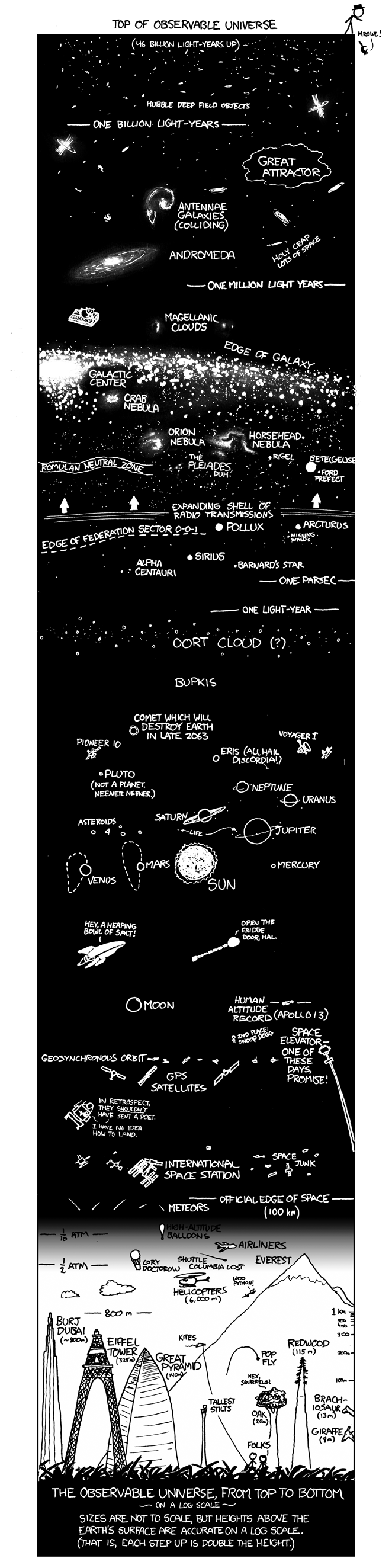 I love this graphic from the scientifically oriented comic strip xkcd. Using a log scale (something you don't see every day in a comic strip), it compares the "height" of everything from "folks" to the Andromeda Galaxy and beyond. There are also a lot of funny little annotations if you zoom in close. Thanks to Orbiting Frog for the tip!
NASA is 50!
Happy birthday NASA! The space agency began operations on October 1, 1958. Watching this 50th anniversary video with commentary from so many notable figures in the history of the space age (even Neil Armstrong!), I am reminded again of how much my life and career were influenced by the US space program, especially the parts I witnessed on TV and in LIFE magazine as a kid in the sixties. I can trace my interest in science, math, flying, and computers to those exciting missions.
I first started paying close attention on John Glenn's 1962 orbital Mercury flight, and by the time Gemini was flying in 1964-1966, I was devouring "NASA Facts" and everything else I could find, and I considered myself an expert (at the age of 12) on space and aviation. I was sure I would have a space-related career, though I ended up working with computer software and optics instead. Now I'm a 50-something "space kid" who plays with space flight simulators and gives educational talks on space and astronomy as a volunteer JPL Solar System Ambassador. I never really lost the space bug.
NASA has truly been an inspiration to me as it has been to so many others. Congratulations on 50 amazing years in space!
Subscribe to:
Posts (Atom)